Introduction:
Plasma Proteomics Services are specialized analytical services used to identify and quantify proteins in blood plasma using advanced proteomic technologies. These services are essential for biomarker discovery, disease mechanism studies, drug development, and translational research.
Blood plasma contains thousands of proteins originating from tissues, organs, immune responses, and disease processes. Because plasma circulates throughout the body, it serves as a highly informative biological matrix for understanding health and disease conditions. Researchers and pharmaceutical companies increasingly rely on plasma proteomics to accelerate precision medicine initiatives and identify clinically relevant biomarkers.
Modern plasma proteomics combines high-resolution mass spectrometry, chromatography, protein enrichment strategies, and sophisticated bioinformatics tools to generate meaningful biological insights from highly complex plasma samples.
Summary:
- Plasma Proteomics Services help researchers identify, quantify, and analyze proteins present in plasma for biomarker discovery, disease research, and therapeutic development.
- Plasma is one of the most valuable biological samples because it reflects physiological and pathological changes occurring throughout the body.
- Advanced technologies such as LC-MS/MS, high-resolution mass spectrometry, bioinformatics, and quantitative proteomics enable deep plasma protein profiling.
- Plasma proteomics supports applications in oncology, neurology, immunology, cardiovascular diseases, metabolic disorders, and personalized medicine.
- High-quality sample preparation, analytical validation, and robust data interpretation are essential for reliable results.
- ResolveMass Laboratories Inc. provides comprehensive analytical support for plasma proteomics workflows with a focus on accuracy, reproducibility, and regulatory-quality data.
1: What Are Plasma Proteomics Services?
Plasma proteomics services involve the comprehensive analysis of proteins present in blood plasma to understand biological processes, disease progression, and therapeutic responses. These services help researchers identify changes in protein expression, protein structure, molecular interactions, and post-translational modifications associated with various diseases and drug treatments.
Using advanced technologies such as liquid chromatography-tandem mass spectrometry (LC-MS/MS), plasma proteomics enables the detection and quantification of thousands of proteins within highly complex biological samples. This information is essential for biomarker discovery, precision medicine, translational research, and pharmaceutical development.
Core Components of Plasma Proteomics Services
| Service Component | Purpose |
|---|---|
| Sample Preparation | Protein extraction, depletion of abundant proteins, and enzymatic digestion |
| Protein Identification | Detection and characterization of proteins using LC-MS/MS |
| Quantitative Proteomics | Comparative analysis of protein abundance across multiple samples |
| Biomarker Discovery | Identification of disease-associated or therapy-responsive proteins |
| Bioinformatics Analysis | Data processing, pathway mapping, and biological interpretation |
| Data Validation | Verification of reproducibility, accuracy, and analytical reliability |
One of the major challenges in plasma proteomics is the extremely wide dynamic range of plasma proteins. Highly abundant proteins such as albumin and immunoglobulins can mask low-abundance biomarkers that may be clinically significant. To address this, specialized sample preparation methods, high-sensitivity instrumentation, and advanced bioinformatics workflows are used to improve detection accuracy and analytical depth.
2: Why Is Plasma Important in Proteomics Research?
Plasma is one of the most valuable biological samples used in proteomics research because it provides a minimally invasive, information-rich, and clinically relevant source of biomarkers. Since plasma circulates throughout the body, it carries proteins released from various tissues, organs, and cellular processes, making it highly useful for studying disease mechanisms and therapeutic responses.
Researchers use plasma proteomics to investigate physiological and pathological changes associated with conditions such as cancer, cardiovascular disorders, neurological diseases, metabolic syndromes, and immune-related conditions. Its accessibility and clinical relevance make plasma an ideal sample type for both discovery-based and translational research studies.
Key Advantages of Plasma in Proteomics Research:
- Easily accessible through routine blood collection
Plasma samples can be collected through standard blood draws, making the process minimally invasive and practical for both clinical and research settings. - Reflects systemic physiological changes
Plasma contains circulating proteins originating from multiple organs and biological pathways, allowing researchers to monitor overall physiological and pathological conditions. - Suitable for longitudinal patient monitoring
Repeated plasma sampling enables researchers to track disease progression, treatment response, and biomarker changes over time without invasive procedures. - Contains biomarkers from multiple organs and tissues
Proteins released into plasma from tissues such as the liver, brain, heart, and immune system provide insights into organ-specific and systemic diseases. - Supports translational and clinical research applications
Plasma proteomics bridges basic research and clinical implementation by enabling biomarker discovery, patient stratification, and precision medicine development.
One of the most significant advantages of plasma proteomics is its ability to identify early-stage disease biomarkers before clinical symptoms become visible. Early biomarker detection can improve diagnostic accuracy, accelerate therapeutic intervention, and support personalized treatment strategies in modern healthcare and pharmaceutical research.
3: How Do Plasma Proteomics Services Work?
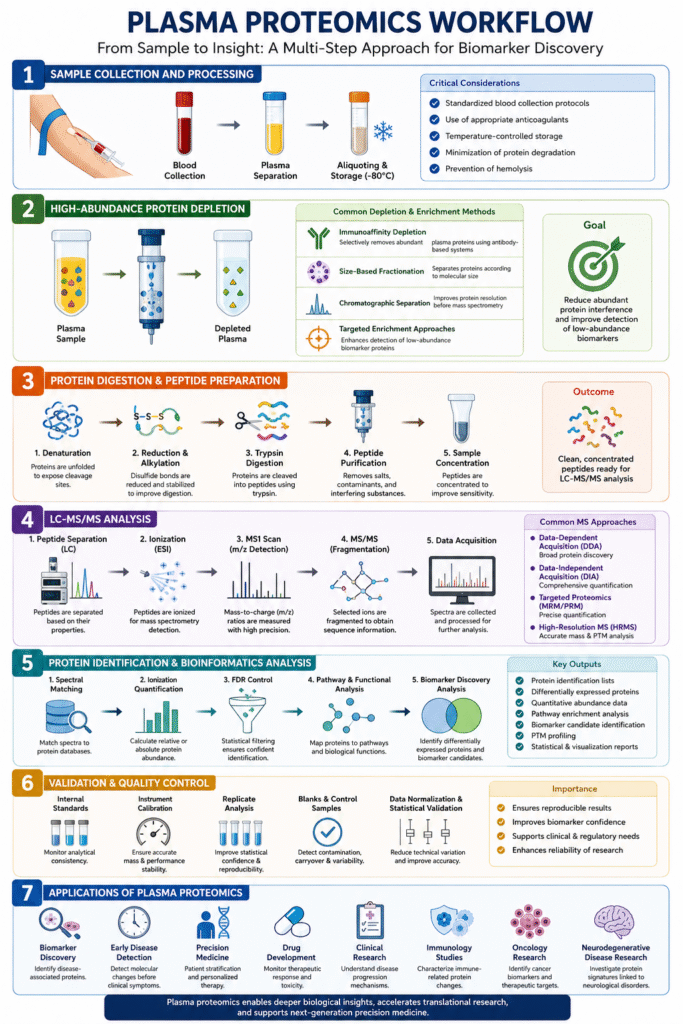
Plasma proteomics services follow a highly controlled and multi-step analytical workflow designed to identify and quantify proteins present in plasma samples with high sensitivity and accuracy. Each stage of the process is optimized to maximize protein coverage, improve reproducibility, and generate biologically meaningful data for biomarker discovery and disease research.
Because plasma is an extremely complex biological matrix containing proteins across a very wide concentration range, advanced preparation and analytical techniques are essential for reliable proteomic analysis.
1. Sample Collection and Processing
The success of any plasma proteomics study begins with proper sample collection and handling. Poor sample preparation can introduce variability, protein degradation, or contamination that may compromise downstream analysis.
Critical Considerations During Sample Handling
- Standardized blood collection protocols
Consistent collection procedures reduce experimental variability and improve reproducibility across studies. - Use of anticoagulants
Appropriate anticoagulants help prevent clotting while preserving plasma protein integrity. - Temperature-controlled storage
Plasma samples are typically stored at low temperatures to minimize protein degradation and maintain sample stability. - Minimization of protein degradation
Rapid sample processing and controlled handling conditions help preserve sensitive proteins and peptides. - Prevention of hemolysis
Hemolysis can release intracellular proteins into plasma, interfering with proteomic analysis and biomarker interpretation.
Even small inconsistencies in sample handling can significantly impact analytical outcomes, making standardized workflows essential for high-quality plasma proteomics data.
2. High-Abundance Protein Depletion
One of the major analytical challenges in plasma proteomics is the dominance of highly abundant proteins such as albumin, immunoglobulins, transferrin, and fibrinogen. These proteins can mask the detection of low-abundance biomarkers that may be biologically or clinically important.
To improve analytical sensitivity, specialized depletion and enrichment strategies are used to reduce dominant protein interference.
Common High-Abundance Protein Depletion Methods
| Depletion Method | Purpose |
|---|---|
| Immunoaffinity Depletion | Selectively removes abundant plasma proteins using antibody-based systems |
| Size-Based Fractionation | Separates proteins according to molecular size |
| Chromatographic Separation | Improves protein resolution before mass spectrometry |
| Targeted Enrichment Approaches | Enhances detection of low-abundance biomarker proteins |
These approaches increase the likelihood of detecting rare proteins associated with disease progression, therapeutic response, or early-stage pathology.
3. Protein Digestion and Peptide Preparation
Before mass spectrometric analysis, plasma proteins are enzymatically digested into smaller peptide fragments that can be efficiently separated and analyzed.
Typical Protein Preparation Workflow
- Protein denaturation
Proteins are unfolded to expose cleavage sites for enzymatic digestion. - Reduction and alkylation
Disulfide bonds are reduced and stabilized to improve digestion efficiency and peptide consistency. - Trypsin digestion
Proteins are cleaved into peptides using proteolytic enzymes such as trypsin. - Peptide purification
Cleanup procedures remove salts, contaminants, and interfering substances prior to analysis. - Sample concentration
Peptide samples are concentrated to improve analytical sensitivity during LC-MS analysis.
Proper peptide preparation is critical for achieving efficient chromatographic separation, optimal ionization, and accurate protein identification during liquid chromatography-tandem mass spectrometry (LC-MS/MS) workflows.
4: Role of Mass Spectrometry in Plasma Proteomics Services
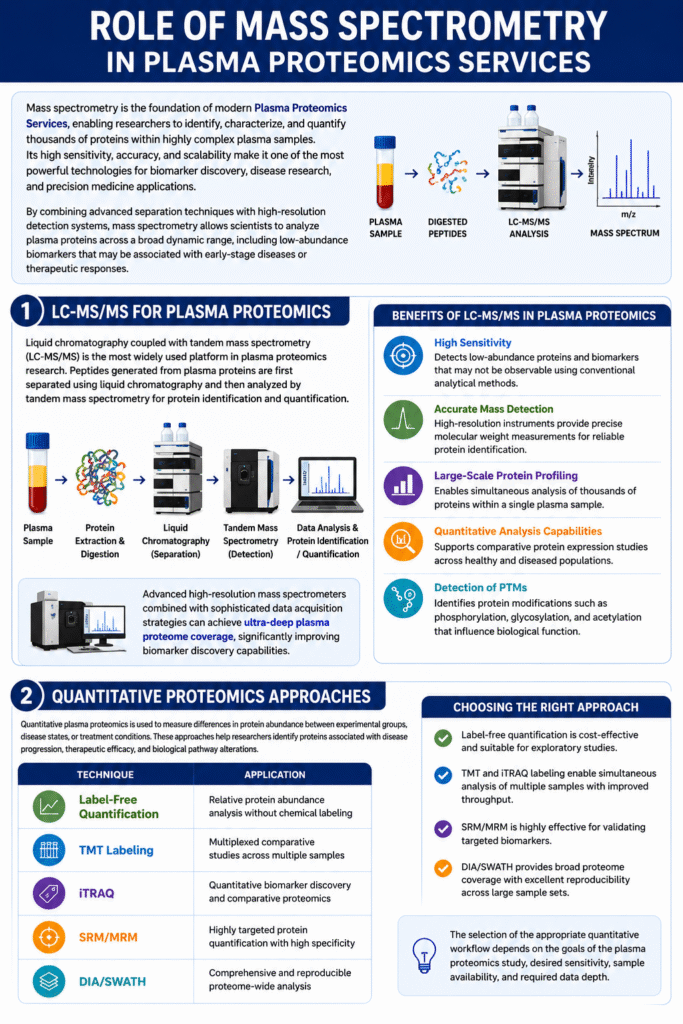
Mass spectrometry is the foundation of modern Plasma Proteomics Services, enabling researchers to identify, characterize, and quantify thousands of proteins within highly complex plasma samples. Its high sensitivity, accuracy, and scalability make it one of the most powerful analytical technologies for biomarker discovery, disease research, and precision medicine applications.
By combining advanced separation techniques with high-resolution detection systems, mass spectrometry allows scientists to analyze plasma proteins across a broad dynamic range, including low-abundance biomarkers that may be associated with early-stage diseases or therapeutic responses.
1. LC-MS/MS for Plasma Proteomics
Liquid chromatography coupled with tandem mass spectrometry (LC-MS/MS) is the most widely used platform in plasma proteomics research. In this workflow, peptides generated from plasma proteins are first separated using liquid chromatography and then analyzed by tandem mass spectrometry for protein identification and quantification.
LC-MS/MS provides comprehensive proteomic profiling with exceptional analytical depth and reproducibility, making it essential for both discovery-based and targeted proteomics studies.
Benefits of LC-MS/MS in Plasma Proteomics
- High sensitivity
Detects low-abundance proteins and biomarkers that may not be observable using conventional analytical methods. - Accurate mass detection
High-resolution instruments provide precise molecular weight measurements for reliable protein identification. - Large-scale protein profiling
Enables simultaneous analysis of thousands of proteins within a single plasma sample. - Quantitative analysis capabilities
Supports comparative protein expression studies across healthy and diseased populations. - Detection of post-translational modifications (PTMs)
Identifies protein modifications such as phosphorylation, glycosylation, and acetylation that influence biological function.
Modern high-resolution mass spectrometers combined with advanced data acquisition strategies can achieve ultra-deep plasma proteome coverage, significantly improving biomarker discovery capabilities.
2. Quantitative Proteomics Approaches
Quantitative plasma proteomics is used to measure differences in protein abundance between experimental groups, disease states, or treatment conditions. These approaches help researchers identify proteins associated with disease progression, therapeutic efficacy, and biological pathway alterations.
Common Quantitative Proteomics Techniques
| Technique | Application |
|---|---|
| Label-Free Quantification | Relative protein abundance analysis without chemical labeling |
| TMT Labeling | Multiplexed comparative studies across multiple samples |
| iTRAQ | Quantitative biomarker discovery and comparative proteomics |
| SRM/MRM | Highly targeted protein quantification with high specificity |
| DIA/SWATH | Comprehensive and reproducible proteome-wide analysis |
Each quantitative strategy offers specific advantages depending on study design, sample complexity, throughput requirements, and analytical objectives.
For example:
- Label-free quantification is cost-effective and suitable for exploratory studies.
- TMT and iTRAQ labeling enable simultaneous analysis of multiple samples with improved throughput.
- SRM/MRM is highly effective for validating targeted biomarkers.
- DIA/SWATH provides broad proteome coverage with excellent reproducibility across large sample sets.
The selection of the appropriate quantitative workflow depends on the goals of the plasma proteomics study, desired sensitivity, sample availability, and required data depth.
5: Applications of Plasma Proteomics Services
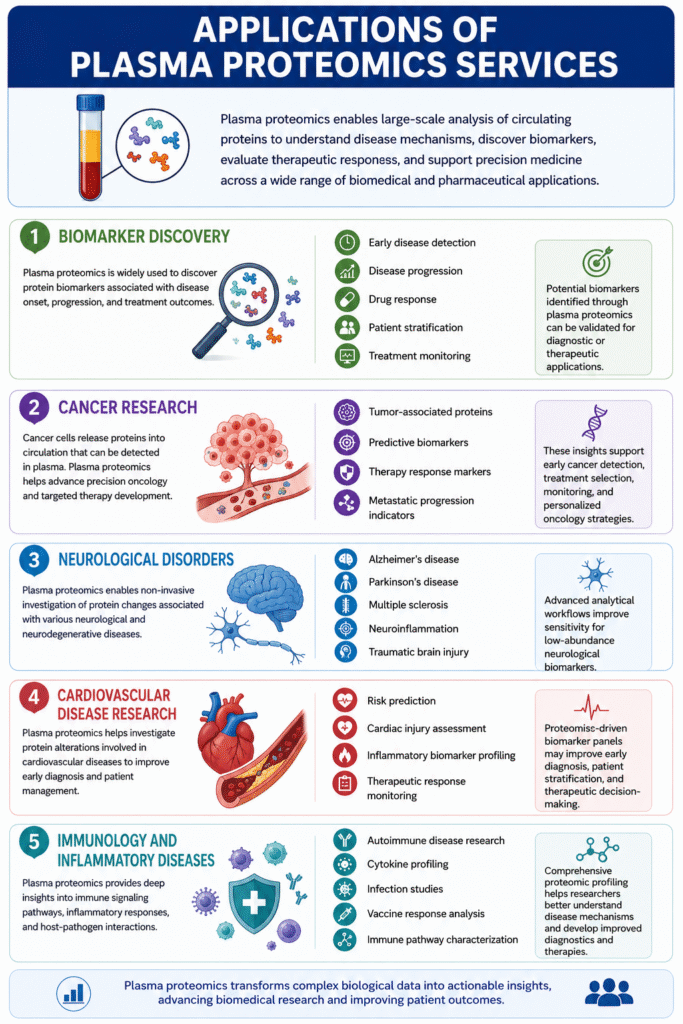
Plasma proteomics supports a wide range of biomedical and pharmaceutical applications.
1. Biomarker Discovery
Biomarker discovery is one of the primary uses of plasma proteomics services.
Researchers use plasma protein profiling to identify biomarkers associated with:
- Early disease detection
- Disease progression
- Drug response
- Patient stratification
- Treatment monitoring
Potential biomarkers identified through plasma proteomics can later be validated for diagnostic or therapeutic applications.
2. Cancer Research
Cancer cells release proteins into circulation that can be detected in plasma.
Plasma proteomics helps identify:
- Tumor-associated proteins
- Predictive biomarkers
- Therapy response markers
- Metastatic progression indicators
These insights support precision oncology and targeted therapeutic development.
3. Neurological Disorders
Neurological diseases often lack accessible biomarkers. Plasma proteomics enables non-invasive investigation of protein changes associated with:
- Alzheimer’s disease
- Parkinson’s disease
- Multiple sclerosis
- Neuroinflammation
- Traumatic brain injury
Advanced analytical workflows improve sensitivity for low-abundance neurological biomarkers.
4. Cardiovascular Disease Research
Cardiovascular disorders involve complex inflammatory and metabolic pathways that influence plasma protein expression.
Applications include:
- Risk prediction
- Cardiac injury assessment
- Inflammatory biomarker profiling
- Therapeutic response monitoring
Proteomics-driven biomarker panels may improve early diagnosis and patient management.
5. Immunology and Inflammatory Diseases
Plasma proteomics provides insights into immune signaling pathways and inflammatory responses.
Key applications include:
- Autoimmune disease research
- Cytokine profiling
- Infection studies
- Vaccine response analysis
- Immune pathway characterization
Comprehensive proteomic profiling helps researchers better understand disease mechanisms.
6: Challenges in Plasma Proteomics
Although plasma proteomics offers immense potential, it also presents several analytical challenges.
Wide Dynamic Range of Plasma Proteins
Plasma proteins span a concentration range of more than ten orders of magnitude, making low-abundance biomarker detection difficult.
This challenge requires:
- Advanced depletion methods
- Highly sensitive instrumentation
- Optimized sample preparation
- Sophisticated data analysis
Biological Variability
Patient-to-patient variability can complicate biomarker interpretation.
Factors influencing variability include:
- Age
- Diet
- Medication
- Disease state
- Genetics
- Sample collection conditions
Careful study design and statistical analysis are essential for reliable conclusions.
Data Complexity
Proteomics datasets are extremely large and require advanced computational tools for interpretation.
Bioinformatics plays a critical role in:
- Protein identification
- Pathway analysis
- Statistical validation
- Functional annotation
- Multi-omics integration
Reliable data analysis ensures biologically meaningful outcomes.
7: Importance of Bioinformatics in Plasma Proteomics Services
Bioinformatics transforms raw proteomics data into actionable biological insights.
Advanced analytical pipelines help researchers:
- Identify differential protein expression
- Map signaling pathways
- Perform network analysis
- Predict biomarker candidates
- Validate biological relevance
Integrated bioinformatics workflows improve confidence in biomarker discovery studies and accelerate translational research.
8: How Plasma Proteomics Supports Precision Medicine
Precision medicine depends on identifying molecular differences between patients. Plasma proteomics contributes by enabling individualized protein profiling.
Benefits include:
- Personalized treatment selection
- Early therapeutic monitoring
- Identification of responder populations
- Real-time disease monitoring
- Improved clinical decision-making
As precision medicine expands, plasma proteomics services are becoming increasingly important in clinical research and pharmaceutical development.
9: Choosing the Right Plasma Proteomics Service Provider
Selecting an experienced analytical partner is critical for successful plasma proteomics studies.
Important considerations include:
| Selection Criteria | Why It Matters |
|---|---|
| Advanced Instrumentation | Ensures high sensitivity and accuracy |
| Scientific Expertise | Supports complex study design |
| Bioinformatics Capability | Enables meaningful data interpretation |
| Quality Systems | Improves reproducibility and compliance |
| Custom Workflow Development | Supports unique research objectives |
| Regulatory Understanding | Essential for translational studies |
A reliable partner should provide end-to-end support from experimental planning through data interpretation.
10: Why ResolveMass Laboratories Inc. for Plasma Proteomics Services?
ResolveMass Laboratories Inc. offers comprehensive analytical expertise in advanced proteomics and bioanalytical characterization.
Key strengths include:
- High-resolution LC-MS/MS capabilities
- Advanced biomarker discovery workflows
- Customized proteomics method development
- Robust quantitative proteomics support
- Comprehensive bioinformatics analysis
- High-quality analytical reporting
- Strong scientific and regulatory understanding
The team supports pharmaceutical, biotechnology, and academic researchers with reliable analytical solutions tailored to complex biological studies.
11: Future of Plasma Proteomics Services
The future of plasma proteomics is being shaped by advancements in instrumentation, artificial intelligence, automation, and multi-omics integration.
Emerging trends include:
- Ultra-deep plasma proteome profiling
- AI-driven biomarker discovery
- Single-molecule proteomics
- Clinical proteomics integration
- Multi-omics data fusion
- High-throughput automation
These innovations are expected to improve biomarker sensitivity, accelerate drug development, and enhance personalized medicine strategies.
Conclusion:
Plasma Proteomics Services play a critical role in modern biomedical research, biomarker discovery, and precision medicine. By enabling comprehensive analysis of plasma proteins, these services provide valuable insights into disease mechanisms, therapeutic responses, and patient-specific biological changes.
With advancements in mass spectrometry, quantitative proteomics, and bioinformatics, plasma proteomics continues to transform translational research and pharmaceutical development. High-quality analytical support remains essential for generating accurate, reproducible, and clinically meaningful data.
ResolveMass Laboratories Inc. provides advanced plasma proteomics capabilities designed to support complex research programs with scientific rigor, analytical precision, and dependable data quality.
Frequently Asked Questions:
Plasma is considered one of the most informative biological samples because it contains proteins released from multiple tissues and organs throughout the body. It can be collected through minimally invasive blood sampling, making it highly practical for clinical studies. Plasma reflects physiological and pathological changes associated with diseases and treatments. Researchers use plasma proteomics to monitor disease progression and identify early biomarkers. It also supports translational and precision medicine research applications.
LC-MS/MS stands for liquid chromatography coupled with tandem mass spectrometry. It is a highly sensitive analytical technique used to separate, identify, and quantify plasma proteins and peptides. In plasma proteomics, proteins are first digested into peptides, separated by liquid chromatography, and analyzed by mass spectrometry. This workflow enables high-throughput and accurate protein profiling. LC-MS/MS is essential for biomarker discovery and quantitative proteomics studies.
Cancer cells release proteins and signaling molecules into circulation that can be detected in plasma samples. Plasma proteomics helps identify tumor-associated proteins, predictive biomarkers, and therapy response indicators. Researchers use these insights to improve early cancer detection and personalized treatment strategies. It also assists in studying metastatic progression and resistance mechanisms. Advanced proteomics workflows support precision oncology and targeted therapeutic development.
Yes, plasma proteomics is increasingly used to study neurological and neurodegenerative diseases such as Alzheimer’s disease, Parkinson’s disease, and multiple sclerosis. Because direct brain sampling is invasive, plasma provides a minimally invasive alternative for biomarker research. Advanced analytical methods improve detection of low-abundance neurological proteins in circulation. Researchers use these biomarkers to study disease progression and therapeutic response. Plasma proteomics may contribute to earlier diagnosis and improved neurological care.
Quantitative proteomics techniques are used to measure differences in protein abundance between biological samples or patient groups. Common methods include Label-Free Quantification, TMT labeling, iTRAQ, SRM/MRM, and DIA/SWATH workflows. These techniques help researchers identify proteins associated with diseases and therapeutic responses. Some approaches are better suited for exploratory studies, while others are designed for targeted biomarker validation. The choice of technique depends on study goals and sample complexity.
Bioinformatics is essential for processing and interpreting the large and complex datasets generated during proteomics studies. It helps identify proteins, analyze biological pathways, and perform statistical validation. Advanced computational tools allow researchers to discover disease-associated biomarkers and understand molecular mechanisms. Bioinformatics also supports data visualization and integration with other omics datasets. Accurate data interpretation is critical for generating meaningful biological conclusions.
Reference
- Issaq HJ, Xiao Z, Veenstra TD. Serum and plasma proteomics. Chemical reviews. 2007 Aug 8;107(8):3601-20.https://pubs.acs.org/doi/full/10.1021/cr068287r
- Deutsch EW, Omenn GS, Sun Z, Maes M, Pernemalm M, Palaniappan KK, Letunica N, Vandenbrouck Y, Brun V, Tao SC, Yu X. Advances and utility of the human plasma proteome. Journal of proteome research. 2021 Oct 21;20(12):5241-63.https://pubs.acs.org/doi/abs/10.1021/acs.jproteome.1c00657
- He B, Huang Z, Huang C, Nice EC. Clinical applications of plasma proteomics and peptidomics: Towards precision medicine. PROTEOMICS–Clinical Applications. 2022 Nov;16(6):2100097.https://onlinelibrary.wiley.com/doi/abs/10.1002/prca.202100097
- Soni RK. Frontiers in plasma proteome profiling platforms: innovations and applications. Clinical Proteomics. 2024 Dec;21(1):43.https://link.springer.com/article/10.1186/s12014-024-09497-2