


Summary:
- PLGA quality for injectable use goes far beyond basic polymer specs — purchasers must request a comprehensive analytical data package to ensure safety, efficacy, and regulatory compliance.
- Key data categories include molecular weight and distribution, end-group chemistry, residual solvent levels, water content, microparticle morphology, sterility/endotoxin data, and encapsulation performance.
- Regulatory frameworks (ICH Q6A, USP <467>, FDA guidance on parenteral excipients) define minimum thresholds for several of these parameters.
- Supplier COAs alone are insufficient — independent analytical verification by a qualified CRO is often essential before GMP manufacturing.
- ResolveMass Laboratories Inc. provides full-scope PLGA characterization for injectable formulations, supporting both development-stage and GMP-ready programmes.
Introduction: Why PLGA Analytical Data for Injectable Use Demands a Higher Standard
When procuring poly(lactic-co-glycolic acid) for parenteral formulations, the PLGA analytical data for injectable use you request from a supplier can make the difference between a successful IND-enabling study and a catastrophic late-stage failure. Unlike PLGA used in topical or oral systems, injectable-grade material is introduced directly into biological tissue or the bloodstream — demanding exacting control over every physicochemical attribute.
PLGA has become one of the most widely used biodegradable polymers in controlled-release injectable formulations, including microspheres, nanospheres, implants, and in situ gels. Its appeal lies in its well-characterized degradation profile and established regulatory history. As discussed in our guide to PLGA (Polylactic-co-Glycolic Acid) for Parenteral Use, the polymer has become a cornerstone of modern injectable drug delivery systems. Its growing adoption in Long-Acting Injectable Drug Delivery Technologies has increased the need for robust analytical characterization and supplier qualification.
This guide outlines the essential analytical data categories that pharmaceutical developers, formulation scientists, and procurement teams should demand before accepting any PLGA lot for injectable use — and explains how each parameter impacts product performance and patient safety.
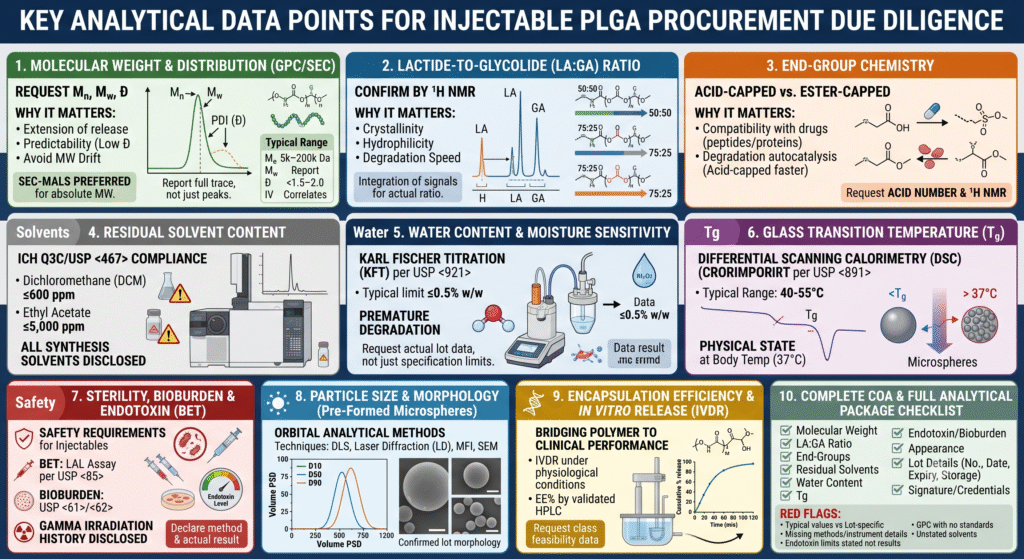
1. Molecular Weight and Molecular Weight Distribution
Molecular weight characterization is one of the most critical aspects of PLGA Characterization Methods because it directly impacts degradation behavior and release kinetics. This information is particularly important for sponsors pursuing PLGA Polymer Characterization for Generics and demonstrating PLGA Polymer Sameness for ANDA submissions.
Why it matters for injectables:
- Higher MW PLGA degrades more slowly, extending drug release over weeks to months.
- Low Đ (narrow distribution, ideally <1.5–2.0) indicates tighter polymer chain length consistency, which translates to more predictable in vitro and in vivo release profiles.
- Batch-to-batch MW drift — even within a supplier’s stated specification — can cause clinically meaningful shifts in Tmax and Cmax for encapsulated drugs.
Required analytical method:
- Gel Permeation Chromatography (GPC) / Size Exclusion Chromatography (SEC) with a calibrated refractive index (RI) or multi-angle light scattering (MALS) detector.
- Report should include a full GPC trace, not just peak MW values.
- Calibration standards (polystyrene or PMMA) and column conditions must be declared; absolute MW via SEC-MALS is preferred for regulatory filings.
| Parameter | Typical Range | Analytical Method | Regulatory Relevance |
|---|---|---|---|
| Number-average MW (Mn) | 5,000 – 200,000 Da | GPC/SEC-RI or SEC-MALS | ICH Q6A, FDA Excipient Guidance |
| Weight-average MW (Mw) | Report alongside Mn | GPC/SEC-RI or SEC-MALS | ICH Q6A |
| Dispersity Index (Đ) | < 1.5 – 2.0 preferred | Calculated from Mw/Mn | ICH Q6A |
| Inherent Viscosity | Correlates with MW | Ubbelohde viscometer | USP <911> |
2. Lactide-to-Glycolide Ratio (LA:GA Ratio)
The LA:GA molar ratio directly governs crystallinity, hydrophilicity, and degradation speed, and must be confirmed by the supplier using spectroscopic methods — not assumed from the product label. A 50:50 PLGA degrades in 1–2 months; a 75:25 blend can persist for 4–6 months.
The LA:GA ratio not only influences degradation rate but also determines the polymer’s erosion mechanism. Understanding Bulk Erosion vs Surface Erosion in PLGA can help formulation scientists predict long-term release behavior and select the most suitable polymer grade for their application.
Request the following:
- ¹H NMR spectrum (in deuterated DMSO or CDCl₃) confirming actual LA:GA integration ratios — not just the nominal grade.
- FTIR spectrum as a supplementary fingerprint, particularly useful for lot-to-lot comparison.
- Deviations of even ±5% from the stated ratio can meaningfully alter microsphere degradation and drug release in vivo.
3. End-Group Chemistry: Acid-Capped vs. Ester-Capped
End-group chemistry is a frequently overlooked but critical variable that significantly affects drug-polymer compatibility, degradation autocatalysis, and encapsulation of basic drugs. Acid-capped (free carboxylic acid) PLGA degrades faster due to autocatalytic acid generation; ester-capped variants degrade more slowly and are preferred for acid-sensitive payloads.
End-group chemistry becomes particularly important in PLGA Peptide Delivery systems because acidic microenvironments generated during polymer degradation may affect peptide stability, potency, and shelf life.
Data to request:
- Acid number (mg KOH/g) determined by titration — confirms whether the polymer is truly acid-capped or ester-capped.
- ¹H NMR end-group analysis to quantify terminal group identity.
- Especially important when encapsulating peptides, proteins, or oligonucleotides that are susceptible to acid hydrolysis within the microsphere core.
4. Residual Solvent Content
For PLGA intended for injectable use, residual solvents from synthesis or processing must comply with ICH Q3C guidelines and USP <467>. Dichloromethane (DCM), ethyl acetate, acetone, and acetonitrile are common solvents in PLGA synthesis and microsphere manufacturing — all Class 2 or Class 3 solvents with defined limits.
Essential data points:
- Residual solvent content by headspace GC-MS for all process solvents used in synthesis.
- DCM limit: ≤600 ppm (ICH Q3C Class 2); ethyl acetate: ≤5,000 ppm (Class 3).
- Supplier must disclose all solvents used in synthesis, even if below limits, to allow the formulation team to assess cumulative patient exposure.
- For drug product microspheres, additional residual solvent testing of the formulation itself may be required under ICH Q3C.
5. Water Content and Moisture Sensitivity
Residual moisture in PLGA is a primary driver of premature hydrolytic degradation during storage, and even small amounts can compromise lot stability and encapsulation yield. Water content should be verified by Karl Fischer Titration (KFT) per USP <921>.
Moisture control is a major determinant of polymer stability. Manufacturers should consider factors affecting the Shelf Life of PLGA, PLA, and PCL and understand how storage conditions influence long-term polymer integrity.
- Acceptable water content: typically ≤0.5% w/w for injectable-grade PLGA, though supplier specifications vary.
- High moisture lots can produce microspheres with compromised morphology, premature burst release, and reduced encapsulation efficiency.
- Request moisture data from the lot itself, not just specification limits — a COA showing only the upper limit is insufficient.
- Storage conditions (nitrogen-flushed, desiccated, ≤−20°C) and packaging integrity must be verified alongside moisture data.
6. Glass Transition Temperature (Tg)
Tg determines the polymer’s physical state at body temperature (37°C) and directly affects microsphere morphology integrity, drug diffusion rate, and in vivo performance. PLGA with Tg close to 37°C may soften unpredictably in vivo, altering intended release profiles.
The relationship between molecular weight, copolymer composition, and PLGA Glass Transition Temperature is critical for predicting both manufacturing behavior and in vivo performance. Understanding Tg helps developers select polymers that maintain structural integrity throughout the intended release period.
- Measurement: Differential Scanning Calorimetry (DSC) per USP <891>.
- Typical Tg for injectable PLGA: 40–55°C, though this varies by MW and LA:GA ratio.
- Confirm Tg is sufficiently above physiological temperature to ensure mechanical integrity post-injection.
- Request the full DSC thermogram, not just the reported Tg value, to assess purity and the absence of anomalous thermal events.
7. Sterility, Bioburden, and Endotoxin / Bacterial Endotoxin Testing (BET)
For injectable-grade PLGA, endotoxin and bioburden data are non-negotiable safety requirements and must appear on every lot COA. Endotoxins (lipopolysaccharides from Gram-negative bacteria) can trigger severe pyrogenic responses even at sub-microgram levels.
Minimum required data:
- Bacterial Endotoxin Testing (BET): Limulus Amebocyte Lysate (LAL) assay per USP <85> / EP 2.6.14.
- Endotoxin limit: Supplier should declare the method and result; formulation teams must calculate final product endotoxin levels using dose and route of administration.
- Bioburden: Total viable aerobic count per USP <61>/<62>.
- If the PLGA lot will be sterile-processed downstream, request a Certificate of Analysis with bioburden data to inform terminal sterilization strategy.
- Gamma irradiation for terminal sterilization can accelerate PLGA chain scission — any irradiation history must be disclosed and its effect on MW documented.
8. Particle Size Distribution and Morphology (for Pre-Formed Microsphere Lots)
If purchasing pre-formed PLGA microspheres rather than bulk polymer, particle size distribution and surface morphology are critical quality attributes (CQAs) that govern injectability, dose uniformity, and in vivo release. These must be characterized using orthogonal analytical methods.
Particle characteristics play a major role in PLGA Microsphere Formulation Development. Depending on therapeutic objectives, developers may also evaluate the advantages and limitations of PLGA Nanoparticles vs Microspheres when designing controlled-release injectable systems.
| Technique | Parameter Measured | Regulatory Reference |
|---|---|---|
| Dynamic Light Scattering (DLS) | Hydrodynamic diameter, PDI | FDA Guidance for Nanomaterials |
| Laser Diffraction (LD) | Volume-weighted PSD (D10, D50, D90) | USP <429> |
| Micro-Flow Imaging (MFI) | Subvisible particle count and morphology | USP <787>/<788> |
| Scanning Electron Microscopy (SEM) | Surface texture, porosity, shape | ICH Q6A |
- For syringeability, the D90 particle diameter should generally be below 125 µm for 21–23 gauge needle delivery; confirm with your formulation team.
- SEM images from the supplied lot (not reference images) should be requested to confirm batch-specific morphology.
9. Drug Encapsulation Efficiency and In Vitro Release Performance (If Applicable)
When purchasing PLGA for a specific drug product programme, requesting encapsulation feasibility data or reference release profiles for your drug class adds a layer of formulation intelligence that generic COA data cannot provide. Encapsulation efficiency (EE%) and in vitro drug release (IVDR) profiles are essential for bridging polymer characterization to clinical performance.
Drug release behavior is highly dependent on polymer quality and formulation design. One of the most common development challenges is Burst Release in PLGA Formulations, where excessive initial drug release can compromise safety, efficacy, and overall product performance.
- Request in vitro drug release data under physiologically relevant conditions (pH 7.4 PBS, 37°C, sink conditions) — at minimum over the intended duration of action.
- Encapsulation efficiency should be determined by a validated HPLC or LC-MS/MS method appropriate for the payload.
- For complex depot injectables, IVIVC (in vitro–in vivo correlation) data or relevant precedent literature strengthens the development case.
10. Complete Certificate of Analysis (COA) and Full Analytical Package Checklist
Beyond analytical data, sponsors should evaluate supplier reliability and regulatory readiness. Understanding the Benefits of Selecting the Right PLGA Supplier and current GMP PLGA Requirements can significantly reduce development and regulatory risks.
A legitimate injectable-grade PLGA COA should be a multi-page document — not a single-page summary. Below is the minimum acceptable checklist for procurement due diligence:
- Molecular weight (Mn, Mw, Đ) by GPC/SEC-MALS
- LA:GA ratio by ¹H NMR
- End-group identity and acid number
- Residual solvents by headspace GC-MS (all synthesis solvents declared)
- Water content by Karl Fischer Titration
- Glass transition temperature by DSC
- Endotoxin level by LAL assay (USP <85>)
- Bioburden / sterility (if applicable)
- Appearance and physical description
- Lot number, synthesis date, expiry date, and storage conditions
- Name and qualifications of the QC analyst and QA signatory
- Manufacturing site address and regulatory registration status
Red flags to watch for in supplier documentation:
- COA referencing “typical values” rather than lot-specific tested values
- Absence of analytical method references or instrument details
- GPC data presented without calibration standard disclosure
- Endotoxin limits stated but not actual test results
- No disclosure of residual solvents used in synthesis
How ResolveMass Laboratories Supports PLGA Analytical Data for Injectable Use
ResolveMass Laboratories Inc. is a USFDA-registered Canadian contract research and development organization (CRO/CDMO) specializing in bioanalytical characterization, peptide drug development, and complex injectable formulation sciences. Our analytical capabilities directly address the full spectrum of PLGA characterization requirements for injectable-grade material.
Our PLGA analytical services include:
- Molecular weight characterization by SEC-MALS and GPC-RI
- LA:GA ratio confirmation by ¹H NMR and FTIR
- Residual solvent quantification by headspace GC-MS (ICH Q3C compliant)
- Karl Fischer Titration for water content
- DSC thermal analysis for Tg and purity assessment
- Endotoxin testing by LAL assay (USP <85>)
- Particle size analysis by DLS, laser diffraction, and MFI
- SEM imaging for microsphere morphology
- Encapsulation efficiency and in vitro drug release testing
- Full analytical package compilation for IND, IMPD, and regulatory dossier support
Our expertise extends beyond routine characterization and includes support for complex depot formulations, reverse engineering projects, and generic development programs. We have extensive experience with PLGA Characterization of Lupron Depot, addressing Leuprolide Depot Formulation Challenges, and performing PLGA Reverse Engineering for ANDA submissions. As a specialized PLGA Reverse Engineering CRO, we also support projects involving Reverse Engineering of PLGA Polymer in Lupron Depot and Reverse Engineering Risperidone PLGA Microspheres.
Our scientists have also contributed to advanced characterization projects including Dexamethasone Implant PLGA Characterization, Goserelin PLGA Implant Characterization, Buprenorphine Depot PLGA Characterization, and the Exenatide PLGA Microsphere Characterization Case Study.
Additionally, our team supports formulation strategies involving Highly Potent APIs Using PLGA Microspheres and advanced Characterization of Long-Acting Biologics.
Our scientists work closely with pharmaceutical sponsors at all stages — from early-stage polymer screening to GMP lot release — ensuring that the analytical foundation of your injectable formulation is robust, well-documented, and defensible to regulatory agencies.
Conclusion:
Procuring PLGA for parenteral formulations without a comprehensive analytical data package is a regulatory and scientific risk that no development programme can afford. The PLGA analytical data for injectable use outlined in this guide — spanning molecular weight, LA:GA ratio, end-group chemistry, residual solvents, moisture, thermal properties, sterility indicators, and particle characteristics — collectively define whether a polymer lot is fit for purpose.
The stakes are highest for injectable formulations. A polymer lot that passes a basic appearance test but fails on endotoxin, residual solvent, or MW distribution can derail a clinical programme and generate significant remediation costs. Proactive, independent analytical verification is not an optional quality step — it is the scientific foundation of a defensible injectable product development strategy.
Advanced analytical characterization is especially important for specialized applications such as PLGA for Oncology Implants, PLGA-Based Ocular Drug Delivery, and PLGA in CNS Drug Delivery Across the Blood-Brain Barrier, where polymer performance directly influences therapeutic outcomes.
Developers should also understand The Role of PLGA Polymer Grade in Long-Acting Release Formulations, compare PLGA, PLA, and PCL Degradation Rates, and evaluate the latest information on PLGA Biocompatibility, Safety, Toxicology, and Regulatory Considerations before selecting a polymer for injectable use.
ResolveMass Laboratories Inc. brings deep expertise in both PLGA characterization and injectable formulation sciences, providing pharmaceutical sponsors with the analytical confidence they need to move from polymer procurement to clinical-grade product development with regulatory certainty.
Frequently Asked Questions:
No, a supplier Certificate of Analysis (CoA) alone is generally not sufficient to fully qualify PLGA for GMP manufacturing. While the CoA provides important information about the polymer’s quality attributes, manufacturers often require additional verification through incoming material testing, supplier qualification programs, and risk assessments. Critical parameters such as molecular weight, residual solvents, and impurity levels may need independent confirmation. This additional scrutiny helps ensure regulatory compliance and consistent product performance throughout commercial manufacturing.
The most common cause of injectable PLGA lot failure is variability in critical quality attributes. Differences in molecular weight, polydispersity, moisture content, residual solvent levels, or copolymer composition can significantly affect degradation behavior and drug release profiles. Such variations may lead to inconsistent formulation performance and manufacturing challenges. Thorough analytical characterization and batch-to-batch consistency testing are essential to minimize the risk of lot failures.
The lactic acid:glycolic acid (LA:GA) ratio is one of the most important factors influencing PLGA degradation and drug release kinetics. PLGA with a 50:50 ratio typically degrades the fastest, making it suitable for shorter-duration therapies. Polymers with higher lactic acid content, such as 75:25 or 85:15, degrade more slowly and are often selected for extended-release formulations. Choosing the appropriate ratio helps ensure that the drug is released at the desired rate throughout the treatment period.
Although endotoxin testing is mandatory for the final injectable drug product, obtaining endotoxin data for the PLGA polymer can provide valuable risk-management information. Monitoring endotoxin levels in raw materials helps identify potential contamination sources early in development and manufacturing. This is particularly important for parenteral products, where endotoxin contamination can have serious patient safety implications. Evaluating both the polymer and the finished product supports a more robust quality control strategy.
Residual solvent testing is essential because trace amounts of solvents used during PLGA synthesis and purification may remain in the final material. These solvents can impact patient safety, polymer stability, and regulatory compliance if present above acceptable limits. Common residual solvents include dichloromethane, acetone, and ethyl acetate. Testing ensures compliance with ICH Q3C guidelines and confirms that the polymer is suitable for use in injectable pharmaceutical products.
End-group chemistry plays a significant role in determining PLGA degradation behavior and drug release characteristics. Acid-terminated PLGA is generally more hydrophilic and degrades faster, often resulting in accelerated drug release. In contrast, ester-terminated PLGA tends to absorb less water and degrades more slowly, making it suitable for longer-duration controlled-release applications. Selecting the appropriate end-group chemistry is critical for achieving the intended therapeutic performance of the injectable formulation.
A Certificate of Analysis (CoA) is an official quality document issued by the supplier that summarizes the analytical results for a specific PLGA batch. It typically includes information such as molecular weight, lactic:glycolic acid ratio, moisture content, residual solvent levels, and other specification-related parameters. The CoA demonstrates that the material meets predefined quality standards and serves as an important component of supplier qualification and regulatory documentation. However, additional testing may be required depending on the intended application and regulatory requirements.
Reference
- Wang Y, Qin B, Xia G, Choi SH. FDA’s Poly (Lactic-Co-Glycolic Acid) Research Program and Regulatory Outcomes: FDA’s PLGA Research Program. The AAPS journal. 2021 Jun 29;23(4):92.https://link.springer.com/article/10.1208/s12248-021-00611-y
- Muddineti OS, Omri A. Current trends in PLGA based long-acting injectable products: The industry perspective. Expert opinion on drug delivery. 2022 May 4;19(5):559-76.https://www.tandfonline.com/doi/abs/10.1080/17425247.2022.2075845
- Park K, Skidmore S, Hadar J, Garner J, Park H, Otte A, Soh BK, Yoon G, Yu D, Yun Y, Lee BK. Injectable, long-acting PLGA formulations: Analyzing PLGA and understanding microparticle formation. Journal of Controlled Release. 2019 Jun 28;304:125-34.https://www.sciencedirect.com/science/article/pii/S0168365919302512
- Costello MA, Liu J, Kuehster L, Wang Y, Qin B, Xu X, Li Q, Smith WC, Lynd NA, Zhang F. Role of PLGA variability in controlled drug release from dexamethasone intravitreal implants. Molecular Pharmaceutics. 2023 Nov 13;20(12):6330-44.https://pubs.acs.org/doi/abs/10.1021/acs.molpharmaceut.3c00742
- Hinds KD, Campbell KM, Holland KM, Lewis DH, Piché CA, Schmidt PG. PEGylated insulin in PLGA microparticles. In vivo and in vitro analysis. Journal of controlled release. 2005 Jun 2;104(3):447-60.https://www.sciencedirect.com/science/article/pii/S0168365905000982
- Kumari L, Ehsan I, Mondal A, Al Hoque A, Mukherjee B, Choudhury P, Sengupta A, Sen R, Ghosh P. Cetuximab-conjugated PLGA nanoparticles as a prospective targeting therapeutics for non-small cell lung cancer. Journal of Drug Targeting. 2023 May 28;31(5):521-36.https://www.tandfonline.com/doi/abs/10.1080/1061186X.2023.2199350
About the Author


