

Introduction
Poly(lactic-co-glycolic acid) characterization provides the essential analytical data required to control degradation rates, optimize drug entrapment, and ensure batch-to-batch reproducibility in long-acting parenteral formulations. Contracting specialized PLGA Characterization and Testing Services enables drug developers to evaluate critical quality attributes (CQAs), including particle size distribution, encapsulation efficiency, polymer molecular weight, and multi-phase in vitro release profiles. Poly(lactic-co-glycolic acid) (PLGA) is a biodegradable, biocompatible copolymer approved by global regulatory bodies for sustained drug delivery. Its ester backbone undergoes hydrolytic cleavage into non-toxic monomeric units of lactic acid and glycolic acid, which are cleared through normal metabolic pathways. However, small variations in copolymer composition, lactide-to-glycolide (L:G) ratio, molecular weight distribution, and end-group functionalization can drastically alter matrix degradation kinetics, burst dynamics, and overall bioavailability. Consequently, robust analytical characterization is mandatory for translating PLGA micro- and nanoparticle drug delivery platforms from early formulation feasibility through clinical development and commercial regulatory approval.
Explore how polymer selection impacts performance with our detailed breakdown on PLA vs PLGA vs PCL.
Developing parenteral depot formulations, such as extended-release microspheres, sub-micron colloidal nanocarriers, and in situ forming implants, demands an integrated analytical testing framework. Subtle modifications to emulsification parameters, solvent extraction rates, or surfactant concentrations can alter internal matrix porosity, particle morphology, and drug spatial distribution. These structural changes frequently cause unintended performance failures, including excessive initial burst release, incomplete drug liberation, or batch failure during scale-up. Modern characterization strategies combine dynamic and static light scattering, high-resolution size-exclusion chromatography, mass spectrometry, thermal analysis, and flow-through dissolution systems to demonstrate qualitative (Q1), quantitative (Q2), and structural (Q3) sameness for complex innovator and generic drug products.
Learn more about navigating complex manufacturing hurdles in our guide to challenges in PLGA microsphere development.
Share via:
Article Summary:
- PLGA characterization and testing are essential for controlling polymer degradation, drug encapsulation, release behavior, and batch-to-batch consistency in long-acting injectable formulations.
- Particle size distribution is a critical quality attribute because it influences surface area, degradation rate, syringeability, drug release, and potential administration-related risks. Techniques such as DLS, laser diffraction, light obscuration, and SEM provide complementary particle data.
- Encapsulation efficiency and drug loading determine how effectively the PLGA matrix retains the active pharmaceutical ingredient. Polymer concentration, molecular weight, end-group chemistry, emulsification method, drug-to-polymer ratio, and solvent evaporation rate can significantly affect drug entrapment.
- In vitro release profiling helps characterize how the drug is liberated from the PLGA matrix over time. The release process commonly involves an initial burst, a slower diffusion-dominated phase, and a later erosion-driven phase.
- Polymer physicochemical characterization evaluates important attributes such as molecular weight, molecular weight distribution, lactide-to-glycolide ratio, glass transition temperature, end-group chemistry, residual solvents, and potential extractables and leachables.
- Analytical techniques including GPC/SEC, ¹H-NMR, mDSC, GC-MS, HPLC, LC-MS/MS, light scattering, and flow-through dissolution testing provide the data needed to connect polymer properties with formulation performance.
- A comprehensive PLGA analytical program supports Q1, Q2, and Q3 sameness assessments, strengthens quality control, enables regulatory submissions, and helps developers advance long-acting injectable products from early formulation development toward commercial approval.
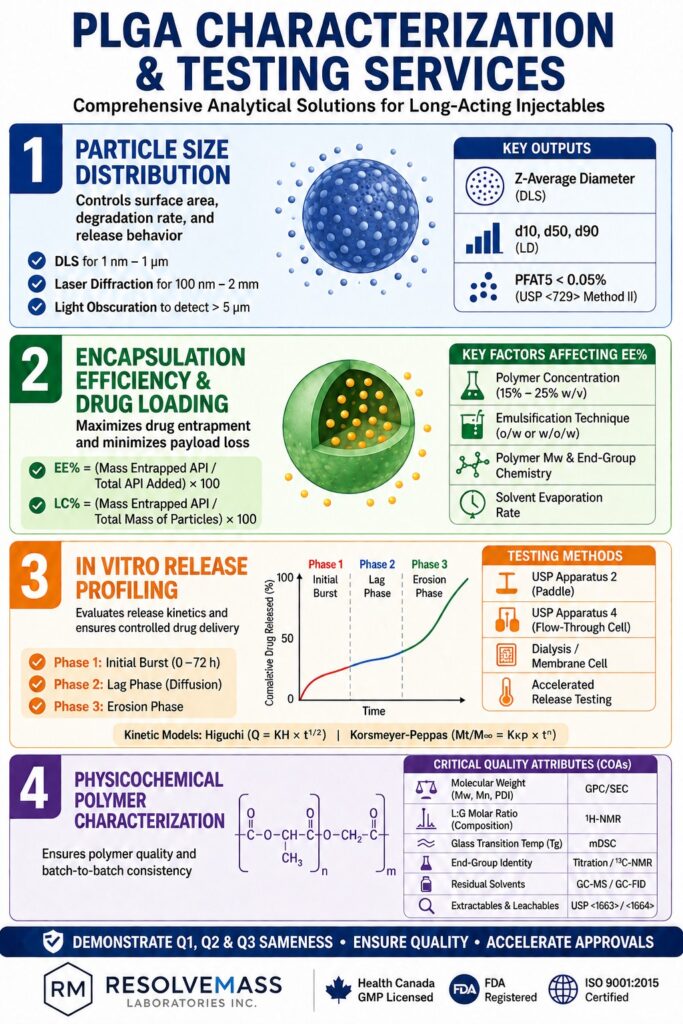
Particle Size Distribution Analysis in PLGA Characterization and Testing Services
Particle size distribution directly dictates the specific surface area, degradation velocity, syringeability, and initial burst kinetics of PLGA microparticles and nanoparticles. Utilizing targeted PLGA Characterization and Testing Services for particle size determination ensures physical stability, prevents vascular embolization during administration, and maintains consistent drug entrapment across production lots.
Sub-Micron Nanoparticle Characterization via Dynamic Light Scattering
Dynamic Light Scattering (DLS) measures the hydrodynamic diameter (Z-average) and Polydispersity Index (PDI) of sub-micron PLGA nanocarriers (1 nm – 1 µm) by detecting intensity fluctuations caused by Brownian motion. DLS operates by illuminating colloidal suspensions with a monochromatic laser source, where backscattered light intensity (173° optics) is processed through autocorrelation functions to derive the translational diffusion coefficient.
The Z-average represents the intensity-weighted harmonic mean size, while the PDI reflects the breadth of the particle size distribution. A narrow distribution (PDI ≤ 0.1 – 0.2) confirms a monodisperse system, helping prevent Ostwald ripening and ensuring uniform systemic clearance profiles.
Understand the regulatory impact of polydispersity through our analysis on PLGA PDI in pharmaceutical applications.
Microparticle Sizing via Laser Diffraction and Light Obscuration
Laser Diffraction (LD) serves as the primary technique for measuring the volumetric particle size distribution of microparticle depot formulations (1 – 100 µm). Laser diffraction measures the angular dependence of scattered light as particles pass through a laser beam, applying Mie scattering theory to calculate volumetric metrics, including d10, d50 (median diameter), and d90.
To quantify the uniformity of the microparticle population, the Span index is calculated using the following equation:
Span = (d90 – d10) / d50
A low Span value (Span < 1.0) reflects a narrow, unimodal size distribution, which is required to achieve predictable inter-injection pharmacokinetics and consistent syringeability through fine-gauge needles (e.g., 21G–25G).
Discover specialized applications for localized delivery in our overview of PLGA-based ocular drug delivery.
Alignment with United States Pharmacopeia Guidelines
Testing protocols follow United States Pharmacopeia guidelines, specifically USP <729> (“Globule Size Distribution in Lipid Injectable Emulsions”), which establishes dual-method criteria applicable to polymeric colloidal systems:
Method I (Light Scattering Method): Utilizes DLS or classical laser diffraction to verify that the intensity-weighted mean droplet or particle diameter remains within defined nanometer thresholds (< 500 nm).
Method II (Light Obscuration / Single Particle Optical Sizing – SPOS): Employs light extinction counters, such as AccuSizer systems, to quantify large-diameter tails above 5 µm (PFAT5). Standard compliance requires the volume-weighted fraction of particles exceeding 5 µm to remain below 0.05%, helping prevent microvascular occlusion during intravenous or intramuscular injection.
| Analytical Technique | Applicable Size Range | Primary Measured Parameters | Regulatory & Quality Standards |
|---|---|---|---|
| Dynamic Light Scattering (DLS) | 1 nm – 1 µm | Z-Average Diameter, Polydispersity Index (PDI) | USP <729> Method I, ISO 22412 |
| Laser Diffraction (LD) | 100 nm – 2 mm | Volumetric Diameters (d10, d50, d90), Span | USP <729>, ISO 13320 |
| Light Obscuration / SPOS | 0.5 µm – 400 µm | Absolute Particle Counts, PFAT5 (> 5 µm) | USP <729> Method II, USP <787> |
| Scanning Electron Microscopy (SEM) | 1 nm – 1 mm | Surface Topography, Internal Porosity, Shape | Internal CQAs, Process Validation |
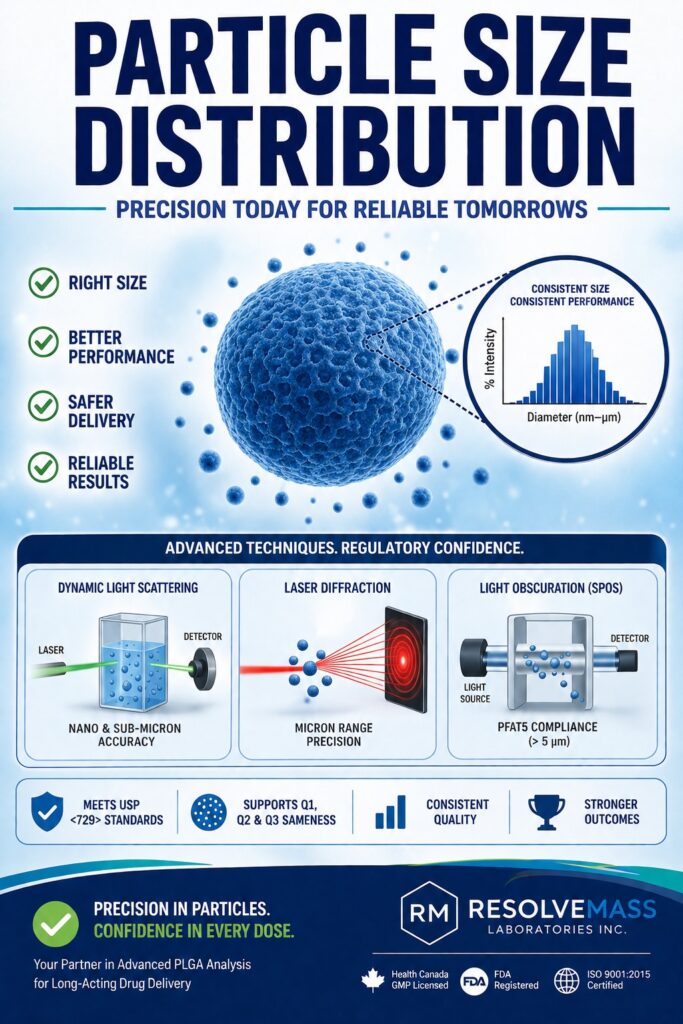
Encapsulation Efficiency and Drug Loading Optimization in PLGA Formulations
Encapsulation Efficiency (EE%) and Loading Capacity (LC%) quantify the mass of active pharmaceutical ingredient (API) successfully entrapped within the polymer matrix relative to the initial input and total formulation mass. Comprehensive PLGA Characterization and Testing Services establish validated extraction and chromatographic protocols to optimize drug entrapping efficiency, reduce payload loss, and prevent surface leaching.
Mathematical Definitions
Encapsulation Efficiency and Loading Capacity are defined by the following mathematical equations:
EE% = (Mass of Entrapped API / Total Mass of API Added Initially) × 100
LC% = (Mass of Entrapped API / Total Mass of Dry Microparticles/Nanoparticles) × 100
Formulation and Process Variables Governing Encapsulation
Optimizing payload entrapment requires balancing drug-polymer solubility parameters, phase volumes, and solvent extraction rates:
Emulsification Technique: Single emulsion (Oil-in-Water, o/w) systems suit lipophilic small molecules, such as letrozole and itraconazole, yielding drug loading efficiencies between 60% – 85%. Double emulsion (Water-in-Oil-in-Water, w/o/w) systems are essential for hydrophilic biologics, peptides, and proteins, forming primary water-in-oil droplets that protect water-soluble compounds from partitioning into the aqueous continuous phase.
Polymer Concentration and Viscosity: Higher PLGA concentrations (15% – 25% w/v) in organic solvents, such as dichloromethane or ethyl acetate, increase organic phase viscosity. This restricts drug diffusion toward the external aqueous phase during primary emulsion hardening, driving encapsulation efficiency above 80%.
PLGA End-Group Functionality: Acid-terminated (uncapped) PLGA grades feature free carboxylic acid end-groups that form electrostatic interactions with basic or positively charged peptide residues, significantly enhancing peptide entrapment compared to ester-capped grades.
Solvent Evaporation Dynamics: Fast extraction solvents, such as dichloromethane, accelerate polymer precipitation at the droplet interface, forming a dense outer polymer shell that encapsulates the drug. Conversely, slow-evaporating solvents can produce porous matrices that are susceptible to API loss.
Read our complete technical guide on encapsulating hydrophilic vs hydrophobic APIs in PLGA.
Quantitative Extraction and HPLC Assays
Quantifying drug content requires complete dissolution of the polymer matrix. PLGA microparticles are dissolved in polar organic solvents, such as dimethyl sulfoxide (DMSO), tetrahydrofuran (THF), or acetonitrile, followed by polymer precipitation with an anti-solvent, such as methanol or water. The resulting supernatant is filtered through a 0.22 µm membrane and analyzed using validated Reverse-Phase High-Performance Liquid Chromatography (RP-HPLC) or LC-MS/MS with UV or mass detection. The total drug mass is then determined by comparison with linear calibration standards.
Examine process optimization strategies in our study on surfactants and emulsifiers in PLGA microsphere fabrication.
| Parameter Variable | Parameter Change | Impact on Encapsulation Efficiency (EE%) | Impact on Release Kinetics & Initial Burst |
|---|---|---|---|
| Polymer Molecular Weight (Mw) | Increase (> 50 kDa) | Increases EE% because of higher solution viscosity | Retards overall drug release and lowers the initial burst |
| Polymer Concentration | Increase (15% – 25% w/v) | Significantly increases EE% | Dense polymer matrix slows hydrolytic diffusion |
| Drug-to-Polymer Ratio | Increase (Excess Drug) | Decreases EE% once the matrix saturation limit is exceeded | Increases excess surface drug and elevates burst release |
| Homogenization Speed | Increase (> 15,000 rpm) | Decreases particle size and may slightly reduce EE% | Increases specific surface area, thereby elevating burst release |
| End-Group Chemistry | Uncapped (Carboxylic Acid) | Enhances EE% for basic peptides | Accelerates water uptake and hydrolytic erosion |
In Vitro Release Profiling and Kinetics of PLGA Systems
In vitro drug release profiling measures the time-dependent liberation of the active drug from the PLGA matrix under simulated physiological conditions, generating essential data for establishing In Vitro-In Vivo Correlations (IVIVC). Standardized release profiling supports the assessment of long-term therapeutic efficacy while confirming the absence of hazardous initial dose dumping.
The Tri-Phasic Release Mechanism
PLGA delivery systems exhibit a tri-phasic drug release profile governed by the combined effects of diffusion and bulk degradation pathways:
Phase 1 (Initial Burst Phase): This phase occurs within the first 24 to 72 hours and is driven by the rapid dissolution of drug molecules adsorbed onto the particle surface or localized within open pores near the surface. Uncontrolled burst release (> 30%) can result in systemic toxicity and premature depletion of the therapeutic dose.
Phase 2 (Lag Phase): This phase is characterized by slow, diffusion-driven drug release through tortuous water channels within the dense polymer core, while hydrolytic degradation begins to progress.
Phase 3 (Erosion Phase): This phase is driven by autocatalytic bulk hydrolysis of ester bonds within the PLGA backbone. As polymer chain length decreases below critical molecular weight thresholds, structural erosion begins, producing a second wave of drug release that continues until the matrix undergoes complete degradation.
Compare matrix degradation behavior in our guide to bulk erosion vs surface erosion in PLGA.
Dissolution Testing Methodologies
Selecting the appropriate dissolution testing equipment is critical for maintaining sink conditions, in which the volume of the release medium is at least three to five times greater than the saturation limit of the API:
USP Apparatus 2 (Paddle Method): This method is commonly used for extended-release dosage forms and typically operates at 37 ± 0.5°C in phosphate-buffered saline (PBS, pH 7.4). However, microparticles may aggregate at the bottom of the vessel, which can alter their effective surface area and influence the observed release profile.
USP Apparatus 4 (Flow-Through Cell): This is the preferred system for long-acting injectable microparticles and implants. Dissolution media is pumped through a cell packed with glass beads at controlled flow rates of 4 – 16 mL/min. This configuration helps prevent particle aggregation and maintains controlled laminar flow conditions.
Membrane Diffusion / Dialysis Techniques: In this approach, microparticles are suspended within semi-permeable dialysis sacs with a molecular weight cutoff (MWCO) of 12 – 100 kDa and submerged in an agitated receptor medium. This method separates particulates from the analytical sampling phase, making it suitable for evaluating sub-micron nanoparticles.
Learn more about designing sustained parenteral systems in our guide to PLGA depot formulations.
Mathematical Kinetic Modeling
Release data are fitted to kinetic models to identify the underlying transport mechanisms. The Higuchi model describes Fickian diffusion from insoluble or slowly eroding spherical matrices:
Q = KH × t¹ᐟ²
Where Q represents the cumulative percentage of drug released at time t, and KH is the Higuchi release constant.
When diffusion and polymer erosion occur simultaneously, the Korsmeyer-Peppas model is applied:
Mt / M∞ = KKP × tn
Where Mt / M∞ represents the fractional drug release, KKP is the structural velocity factor, and n is the release exponent. For spherical particles, n ≤ 0.43 indicates pure Fickian diffusion, 0.43 < n < 0.85 indicates anomalous (non-Fickian) transport involving both diffusion and degradation, and n ≥ 0.85 reflects case-II transport governed primarily by polymer matrix erosion.
| Release Testing Apparatus | Operational Parameters | Primary Advantages | Best-Fit Applications |
|---|---|---|---|
| USP Apparatus 2 (Paddle) | 50 – 100 rpm; 500 – 1000 mL PBS, pH 7.4 | Simple setup and standard quality control validation | Robust microparticles with high density |
| USP Apparatus 4 (Flow-Through Cell) | Flow rate of 4, 8, or 16 mL/min; packed bead cell | Prevents aggregation and maintains continuous sink conditions | Gold standard for LAI microparticles and hydrophobic APIs |
| Dialysis / Membrane Cell | Dialysis membrane with tailored MWCO; agitated bath | Separates nanoparticles from the release medium | Polymeric nanoparticles (< 1 µm) and micelles |
| Accelerated Release Testing | Elevated temperature (45 – 55°C) or modified pH | Reduces testing time from months to days | QC release testing and real-time release profile correlation |
Physicochemical Polymer Characterization for Quality Attributes
Physicochemical characterization of raw and formulated PLGA polymers evaluates intrinsic polymer parameters that directly influence hydrolytic degradation rates, mechanical stability, and bioerodibility. Validation of these polymer quality attributes is essential for ensuring consistent performance across manufacturing lots.
Molecular Weight Determination via Gel Permeation Chromatography
Gel Permeation Chromatography / Size Exclusion Chromatography (GPC/SEC) measures molecular weight distributions. When equipped with Refractive Index (RI) or Multi-Angle Light Scattering (MALS) detectors and operated with THF or chloroform mobile phases, GPC provides critical molecular weight metrics:
Number-Average Molecular Weight (Mn): Reflects the average molecular weight based on the total number of polymer chains.
Weight-Average Molecular Weight (Mw): Represents the average molecular weight weighted according to polymer mass and influences solution viscosity and matrix strength.
Polydispersity Index (PDI = Mw / Mn): Measures the breadth of the molecular weight distribution. A low PDI (1.3 – 1.8) is required to support uniform degradation behavior.
Molar Composition via Proton Nuclear Magnetic Resonance
Proton Nuclear Magnetic Resonance (¹H-NMR) spectroscopy verifies the exact molar ratio of Lactic Acid (LA) to Glycolic Acid (GA). By dissolving the polymer in deuterated chloroform (CDCl₃), integration of the lactide CH-methyl multiplet (approximately 1.55 ppm) relative to the glycolide CH₂-methylene singlet (approximately 4.8 ppm) confirms the polymer composition. A higher glycolic acid content increases hydrophilicity and accelerates hydrolytic degradation.
Read our technical overview on using NMR spectroscopy for accurate monomer ratio testing.
Thermal Analysis via Modulated Differential Scanning Calorimetry
Modulated Differential Scanning Calorimetry (mDSC) measures the glass transition temperature (Tg) of the polymer. Raw PLGA typically exhibits a Tg between 40°C and 55°C, which is well above physiological body temperature (37°C). A decrease in Tg below 37°C indicates matrix plasticization caused by residual organic solvents or moisture uptake, which can trigger structural collapse and uncontrolled drug leakage.
End-Group Analysis, Residual Solvents, and E&L Profiling
Acid value titration with methanolic potassium hydroxide (KOH) determines end-group chemistry, distinguishing between hydrophobic ester-capped grades and hydrophilic carboxyl-terminated grades. Trace organic solvents, such as dichloromethane and ethyl acetate, are quantified using Headspace Gas Chromatography-Mass Spectrometry (GC-MS) in accordance with ICH Q3C guidelines. Additionally, Extractables and Leachables (E&L) screening following USP <1663> and USP <1664> standards ensures that no toxic compounds leach from container closures or manufacturing equipment into the final formulation.
| CQA Parameter | Analytical Method | Acceptance Specification | Direct Product Impact |
|---|---|---|---|
| Molecular Weight (Mw, Mn) | GPC/SEC with RI/MALS Detection | Target Mw ± 10%; PDI ≤ 1.5 – 1.8 | Governs hydrolytic degradation kinetics and matrix erosion |
| L:G Molar Ratio | ¹H-NMR Spectroscopy | Molar ratio ± 2% (e.g., 50:50, 75:25) | Dictates polymer hydrophobicity and water uptake rate |
| Glass Transition Temp (Tg) | Modulated DSC (mDSC) | 45°C – 55°C (dry state) | Maintains physical matrix rigidity during storage |
| End-Group Identity | Acid Value Titration / ¹³C-NMR | Ester-capped vs. Carboxyl-terminated | Controls initial hydration rate and burst release |
| Residual Solvents | Headspace GC-FID / GC-MS | DCM < 600 ppm; Ethyl Acetate < 5000 ppm | Ensures clinical safety and prevents plasticization |
Regulatory Sameness and Quality Control Standards
Demonstrating regulatory sameness for PLGA-based generic formulations requires proving qualitative (Q1), quantitative (Q2), and microstructural (Q3) equivalence compared with reference listed drugs (RLDs). Demonstrating bioequivalence for complex formulations demands comprehensive analytical documentation:
Q1 Sameness: Confirms that the test product contains identical active and inactive ingredients to those used in the reference listed drug.
Q2 Sameness: Verifies that inactive excipient concentrations match those of the reference formulation within tight regulatory limits (± 5%).
Q3 Sameness: Demonstrates equivalence in microstructural arrangement, particle morphology, spatial drug distribution, polymer branching, and porosity.
Regulatory submissions rely on FDA Type IV Drug Master Files (DMFs) for excipients, supported by analytical method validation following ICH Q2(R1) guidelines. Method validation evaluates specificity, linearity, precision, accuracy, limit of detection (LOD), limit of quantitation (LOQ), and robustness across all analytical platforms.
Learn more about navigating abbreviated new drug approvals in our guide to PLGA polymer sameness for ANDA.
Strategic Execution of PLGA Analytical Programs
Integrating polymer chemistry, mass spectrometry, and formulation analytics within a single cGMP quality system streamlines drug product development and accelerates regulatory clearance.
Operating from Health Canada GMP-licensed, FDA-registered, and ISO 9001:2015-certified facilities in Laval, Québec, ResolveMass Laboratories Inc. offers comprehensive analytical testing for PLGA drug delivery systems. Cross-disciplinary technical teams manage all stages of testing, from custom polymer synthesis and monomer composition verification to sub-micron particle sizing, E&L studies, and multi-month USP Apparatus 4 dissolution profiling, delivering regulatory-ready data packages for global IND, NDA, and ANDA filings.
See how our generic bioequivalence workflows function in our breakdown on Q1/Q2 polymer equivalence assessment.
Conclusion
Comprehensive PLGA Characterization and Testing Services provide the structural, physical, and kinetic data required to successfully translate long-acting injectables from preclinical development to commercial registration. Rigorous analytical characterization programs combine light scattering, high-resolution chromatography, mass spectrometry, thermal analysis, and flow-through dissolution techniques to demonstrate Q1, Q2, and Q3 equivalence for global regulatory filings.
Partnering with an experienced CRO/CDMO ensures robust method validation, stringent batch-to-batch quality control, and complete compliance with global FDA, EMA, and ICH regulatory standards. To discuss specialized testing programs or request analytical support for extended-release formulations, visit the ResolveMass Laboratories Contact Page to connect directly with an analytical scientist.
Frequently Asked Questions
Encapsulation Efficiency (EE%) indicates how much of the API initially added during manufacturing is successfully incorporated into the PLGA matrix. Loading Capacity (LC%), in contrast, expresses the proportion of the final dry microparticle or nanoparticle mass that consists of the entrapped drug. A high EE% reflects efficient utilization of the starting drug material and minimizes manufacturing losses. A high LC% allows the required therapeutic dose to be delivered using a smaller quantity of the polymeric carrier.
USP Apparatus 4 (Flow-Through Cell) is advantageous for PLGA depots because the continuous movement of dissolution media helps maintain particle dispersion throughout the test. In USP Apparatus 2 (Paddle), microparticles may settle and form aggregates at the base of the vessel, potentially changing the exposed surface area and affecting drug release. The flow-through configuration also supports efficient media replacement and helps maintain sink conditions. These characteristics make it particularly suitable for long-acting injectable microparticles and poorly soluble APIs.
The Lactide-to-Glycolide (L) ratio strongly influences the hydrophobicity and water sensitivity of PLGA. The methyl group present in lactic acid provides greater hydrophobic character, whereas glycolic acid lacks this substituent and allows comparatively greater water penetration. Consequently, PLGA compositions with higher glycolide content, such as 50:50 L, generally undergo faster hydrolytic degradation and drug release. Lactide-rich compositions, such as 85:15 L, are typically more hydrophobic and can support longer release durations.
Initial burst release commonly occurs when drug molecules remain near the particle surface, occupy interconnected pores, or become unevenly distributed during particle formation. Rapid solvent extraction and insufficient polymer coverage can further increase the amount of readily accessible API. Control strategies include optimizing homogenization conditions, selecting an appropriate PLGA end-group chemistry, maintaining a suitable drug-to-polymer ratio (10% – 25% w/v), and removing unentrapped surface-associated drug through appropriate washing procedures. These measures can reduce uncontrolled early drug release.
Gel Permeation Chromatography / Size Exclusion Chromatography (GPC/SEC) is the principal analytical approach for evaluating the molecular weight distribution of PLGA copolymers. When combined with Refractive Index (RI) or Multi-Angle Light Scattering (MALS) detection, the technique can provide molecular weight information, including weight-average molecular weight (Mw) and number-average molecular weight (Mn). The Polydispersity Index (PDI) is calculated from the relationship between these molecular weight values. Together, these measurements help assess polymer consistency and degradation behavior.
Carboxyl-terminated (uncapped) PLGA contains free carboxylic acid groups that increase the polymer’s hydrophilic character. This can promote greater water uptake and accelerate hydrolytic degradation, potentially resulting in faster drug release. Ester-capped PLGA contains terminal ester groups that increase hydrophobicity and generally reduce water penetration into the polymer matrix. As a result, ester-capped grades may provide slower degradation and more prolonged release profiles, depending on the overall polymer composition and formulation design.
The glass transition temperature (Tg) represents the temperature at which PLGA changes from a rigid, glassy state to a more flexible, rubbery state. Standard PLGA commonly has a Tg between 40°C and 55°C, supporting structural rigidity under appropriate storage conditions. Residual solvents or absorbed moisture can act as plasticizers and reduce the Tg. If the Tg falls below relevant storage or physiological temperatures, including 37°C, the polymer matrix may soften or collapse, potentially causing drug leakage and compromising formulation stability.
Residual solvent analysis in PLGA drug delivery systems is primarily governed by ICH Q3C guidelines and applicable USP standards. Solvents commonly used during PLGA processing must be controlled according to their toxicological classification and permitted concentration limits. For example, Dichloromethane, a Class 2 solvent, is generally controlled below 600 ppm, while Ethyl Acetate, classified as a Class 3 solvent, is limited to 5000 ppm. Headspace Gas Chromatography using GC-FID or GC-MS is commonly used to identify and quantify residual solvent levels.
Hydrophilic biomolecules, including peptides and proteins, can readily migrate into the external aqueous phase during conventional single-emulsion processing, which can significantly reduce encapsulation efficiency. The double-emulsion (w/o/w) method first dissolves the hydrophilic payload in an internal aqueous phase and disperses it within an organic PLGA solution to create a primary water-in-oil (w/o) emulsion. This primary emulsion is subsequently dispersed into a second aqueous phase, producing a water-in-oil-in-water system. The resulting internal aqueous compartments help retain the hydrophilic biomolecule within the polymer matrix during particle formation.
Reference:
- He, Z., Wang, Z., Song, Y., Liu, Y., Kang, L., Fang, X., Wang, T., Fan, X., Li, Z., Wang, S., & Bai, Y. (2023). The reliability and quality of short videos as a source of dietary guidance for inflammatory bowel disease: Cross-sectional study. Journal of Medical Internet Research, 25, e41518. https://doi.org/10.2196/41518
- Lagreca, E., Onesto, V., Di Natale, C., La Manna, S., Netti, P. A., & Vecchione, R. (2020). Recent advances in the formulation of PLGA microparticles for controlled drug delivery. Progress in Biomaterials, 9, 153–174. https://doi.org/10.1007/s40204-020-00139-y
- Park, K., Skidmore, S., Hadar, J., Garner, J., Park, H., Otte, A., Soh, B. K., Yoon, G., Yu, D., Yun, Y., Lee, B. K., Jiang, X., & Wang, Y. (2019). Injectable, long-acting PLGA formulations: Analyzing PLGA and understanding microparticle formation. Journal of Controlled Release, 304, 125–134. https://doi.org/10.1016/j.jconrel.2019.05.003
- Eshaghi, M., Dehghani, M., Abedi, A., Moosazadeh Moghaddam, M., & Taheri, R. A. (2025). Poly(lactic-co-glycolic acid) nanoparticles and microparticles for peptide delivery: Release mechanisms and controlling factors. ADMET & DMPK, 14, 3091. https://doi.org/10.5599/admet.3091
- U.S. Food and Drug Administration. (2025, February 20). Compilation of FDA guidance and resources for in vitro dissolution testing of immediate release solid oral dosage forms. FDA guidance page
- United States Pharmacopeial Convention. (2011, February 25). <711> Dissolution [Stage 6 harmonized monograph]. USP monograph PDF
- United States Pharmacopeial Convention. (2006). <724> Drug release [Pharmacopeial Forum, 32(2)]. USP document
Get In Touch With Us
About The Author


