


Introduction:
PLGA Inhalable Microparticle Development combines polymer science, particle engineering, analytical characterization, and inhalation-product performance testing to create a formulation capable of delivering a drug to the respiratory tract. PLGA, or poly(lactic-co-glycolic acid), is a biodegradable polymer that can be engineered to provide controlled drug release and protect an encapsulated active pharmaceutical ingredient — a property already well established for PLGA use in parenteral formulations.
For pulmonary drug delivery, however, simply producing PLGA microparticles is not sufficient. The formulation must generate particles with appropriate aerodynamic behavior, acceptable dispersibility, adequate drug loading, reproducible dose delivery, and suitable release characteristics. This case study describes an illustrative pharmaceutical development program in which a PLGA microparticle formulation was optimized for pulmonary delivery. The numerical results are representative development data intended to demonstrate the analytical decision-making process rather than results from a specific client project.
Summary:
- PLGA Inhalable Microparticle Development can provide a platform for localized pulmonary delivery, controlled drug release, and reduced dosing frequency, but it requires simultaneous control of polymer attributes, particle size, morphology, aerodynamic performance, drug loading, solid-state properties, and release kinetics.
- This case study covers an illustrative pulmonary respiratory program in which formulation optimization improved the aerodynamic and physicochemical performance of a PLGA microparticle formulation.
- Spray drying was selected as the primary particle-engineering approach because it can produce inhalable particles while offering control over particle morphology and formulation composition.
- Key analytical assessments included GPC/SEC, NMR, DSC, SEM, particle-size analysis, residual-solvent testing, assay/impurity profiling, and cascade-impactor testing.
- The development strategy followed a science- and risk-based framework consistent with ICH Q8, Q9, and Q10, with aerodynamic performance and delivered-dose uniformity evaluated in line with USP <601> expectations for inhalation products.
- ResolveMass Laboratories supported the program with polymer characterization, particle characterization, cascade impaction testing, in vitro release method development, and full stability-indicating analytical support.
1. What Was the Development Objective?
The primary objective was to develop PLGA microparticles capable of providing reproducible pulmonary delivery with controlled drug release while maintaining acceptable formulation stability.
| Parameter | Initial Development Target |
|---|---|
| Dosage form | Inhalable dry-powder PLGA microparticles |
| Route | Pulmonary |
| Polymer | PLGA |
| Manufacturing approach | Spray drying |
| Particle morphology | Spherical/free-flowing particles |
| Aerodynamic performance | Suitable respirable fraction |
| Drug loading | High and reproducible |
| Encapsulation efficiency | High |
| Drug release | Controlled/sustained |
| Residual solvents | Within predefined limits |
| Polymer integrity | Maintained during processing |
| Stability | Suitable for further development |
The development strategy was designed around the principle that the final formulation must satisfy the intended patient and product performance requirements rather than optimizing one laboratory parameter in isolation. This approach is consistent with ICH Q8, which describes pharmaceutical development as a process focused on understanding the relationship between material attributes, process parameters, and product performance.
2. Why Was PLGA Selected for Pulmonary Delivery?
PLGA was selected because its composition, molecular weight, and end-group chemistry can be adjusted to influence degradation and drug-release behavior, in the same way PLGA polymer grade governs long-acting release formulation performance in injectable depot systems.
PLGA undergoes hydrolytic degradation, ultimately generating lactic- and glycolic-acid-derived degradation products. Its biodegradability and established use in drug-delivery systems make it an attractive polymer platform for controlled-release applications — a mechanism explored further in the comparison of bulk erosion versus surface erosion in PLGA. Important polymer variables include:
- Lactide ratio
- Molecular weight and molecular-weight distribution
- End-group chemistry
- Glass-transition temperature
- Polymer purity
- Residual monomers and solvents
ResolveMass Laboratories’ PLGA characterization workflow emphasizes techniques such as NMR, GPC, DSC, and residual-monomer analysis to understand polymer identity, molecular weight, thermal properties, and purity. These characteristics ultimately influence a chain of outcomes: PLGA molecular structure → particle properties → drug release → pulmonary performance. Therefore, polymer characterization was incorporated early rather than being treated only as a final quality-control exercise.
3. What Made the Initial Formulation Challenging?
The initial formulation produced acceptable drug encapsulation but showed insufficient aerodynamic performance and excessive variability in powder dispersion. During early screening, several PLGA grades and formulation compositions were evaluated, and the development team observed that improving one property could adversely affect another:
- Increasing polymer concentration improved particle integrity but increased particle size
- Changes in feed composition affected particle morphology
- Higher drug loading influenced particle density and release behavior
- Drying conditions affected residual solvent content and particle structure
- Changes in polymer molecular weight influenced drug-release kinetics
This is a common challenge across inhalable particle development: geometric particle size alone does not adequately describe pulmonary deposition. A particle can have a relatively large geometric diameter but still demonstrate useful aerodynamic behavior if its density and morphology are appropriately engineered — a principle that mirrors the formulation trade-offs seen in PLGA-based ocular drug delivery and oncology implant applications, where geometry, density, and release must similarly be balanced against the delivery route’s physical constraints.
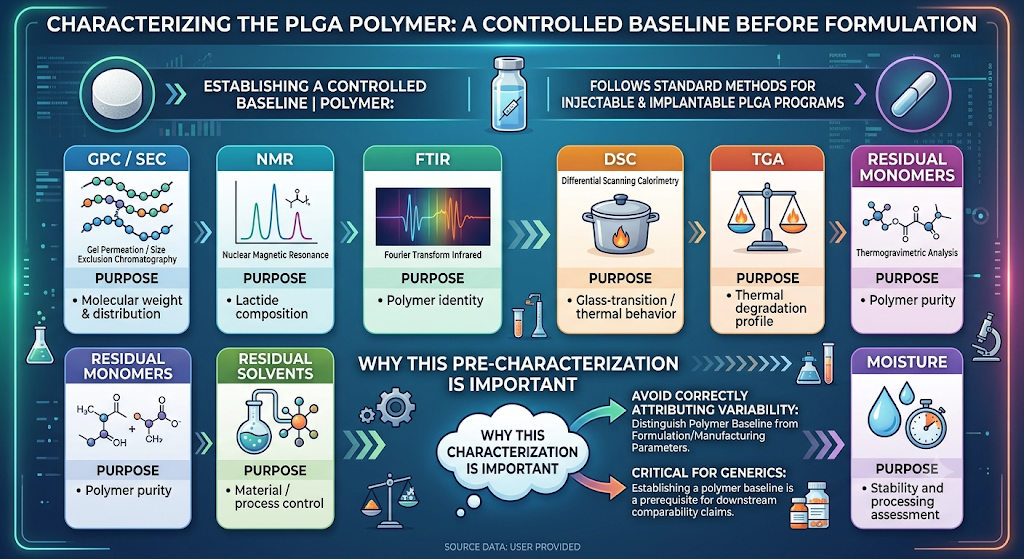
4. How Was the PLGA Polymer Characterized Before Formulation?
The PLGA starting material was characterized before formulation to establish a controlled polymer baseline, following the same PLGA characterization methods applied across injectable and implantable PLGA programs.
| Test | Purpose |
|---|---|
| GPC/SEC | Molecular weight and distribution |
| NMR | Lactide composition |
| FTIR | Polymer identity |
| DSC | Glass-transition/thermal behavior |
| TGA | Thermal degradation profile |
| Residual monomers | Polymer purity |
| Residual solvents | Material/process control |
| Moisture | Stability and processing assessment |
This step was important because variability in polymer molecular weight or composition could otherwise be incorrectly attributed to formulation or manufacturing parameters — the same rationale behind PLGA polymer characterization for generics, where establishing a polymer baseline is a prerequisite for downstream comparability claims.
5. How Were the Particles Engineered?
Spray drying was selected as the primary particle-engineering strategy because it provides a practical route to producing dry particles while allowing formulation and process parameters to be adjusted, consistent with established PLGA microsphere formulation development practices.
The formulation development investigated variables such as:
- PLGA concentration and drug-to-polymer ratio
- Solvent system, feed concentration, and feed rate
- Drying temperature and atomization conditions
- Gas flow and solid content
- Stabilizer/excipient concentration
The objective was not simply to minimize particle size. Instead, the team sought to balance particle size, morphology, density, dispersibility, drug loading, and release together. Spray drying is widely studied for pulmonary formulations because it can generate particles in a desirable size range, although maintaining the appropriate solid state and particle properties can be challenging.
6. How Was Particle Size and Morphology Optimized?
The optimized formulation demonstrated a more favorable particle morphology and particle-size distribution than the initial formulation, evaluated through laser diffraction, SEM imaging, particle-size distribution, surface morphology, bulk/tapped density, flow properties, and moisture content.
SEM was particularly useful for identifying:
- Spherical versus irregular particles
- Surface roughness
- Collapsed particles, pores, or cracks
- Agglomeration
The optimized particles showed a more consistent morphology and reduced visible aggregation. Importantly, geometric particle size was interpreted together with aerodynamic data rather than used as a standalone acceptance criterion — the same principle that distinguishes PLGA nanoparticles from microspheres when selecting a particle platform for a given delivery route.
7. What Did Aerodynamic Performance Testing Show?
Aerodynamic performance was the key decision point, because inhaled particles must reach the intended region of the respiratory tract rather than simply possess a small geometric diameter. The formulation was evaluated using a cascade-impactor-based approach, with measurements including emitted dose, fine particle fraction (FPF), fine particle dose, mass median aerodynamic diameter (MMAD), geometric standard deviation (GSD), device retention, and stage-by-stage deposition.
USP <601> recognizes aerodynamic or optical particle-size measurements, depending on the dosage form, together with delivered-dose uniformity, as important performance assessments for inhalation products.
| Parameter | Initial Formulation | Optimized Formulation |
|---|---|---|
| Drug loading | 18.5% | 21.7% |
| Encapsulation efficiency | 78.2% | 91.4% |
| FPF | 18.6% | 31.8% |
| MMAD | 7.8 µm | 4.9 µm |
| GSD | 2.42 | 1.91 |
| Visible aggregation | Moderate | Low |
| Drug release control | Inconsistent | More reproducible |
Illustrative development data; not a client-specific study.
These results demonstrate an important principle: successful PLGA Inhalable Microparticle Development requires optimization of aerodynamic performance rather than relying solely on conventional particle-size measurements.
8. How Were Drug Loading and Encapsulation Efficiency Optimized?
Drug loading and encapsulation efficiency were optimized to maximize the amount of drug delivered without compromising particle formation or release behavior — a balance that becomes especially demanding when formulating highly potent APIs using PLGA microspheres or peptide actives, as seen in PLGA-based peptide delivery programs.
Low encapsulation efficiency can create significant development problems, including poor dose efficiency, increased manufacturing waste, greater batch variability, difficulties maintaining dose uniformity, and increased formulation cost. At the same time, simply maximizing drug loading is not necessarily optimal: excessive drug loading can alter particle morphology, polymer matrix integrity, release kinetics, powder flow, and aerodynamic performance. This mirrors the peptide-polymer interaction challenges documented in the exenatide PLGA microsphere characterization case study, where drug loading had to be balanced against polymer compatibility. The optimized formulation in this program was therefore selected based on the overall balance between loading, aerodynamic performance, morphology, and release.
9. What Did In Vitro Release and Polymer Degradation Testing Reveal?
In vitro release testing was used to determine whether the optimized formulation could provide the intended controlled-release profile. Samples were collected at predefined time points and analyzed using a validated chromatographic method, monitoring percentage drug released, initial burst release, release rate, cumulative release, drug degradation, and polymer molecular-weight change.
A representative profile demonstrated lower initial burst release and a more controlled release phase after optimization. PLGA molecular weight, composition, and end-group chemistry can influence degradation and release behavior, making polymer characterization particularly important for controlled-release formulations — a dynamic also documented in the dexamethasone implant PLGA characterization case study, and in the erosion-and-release behavior seen in leuprolide depot formulation challenges.
The polymer was also evaluated by GPC at selected release time points to determine whether molecular-weight reduction correlated with drug release. This type of correlation can provide a stronger scientific understanding than evaluating dissolution/release results alone.
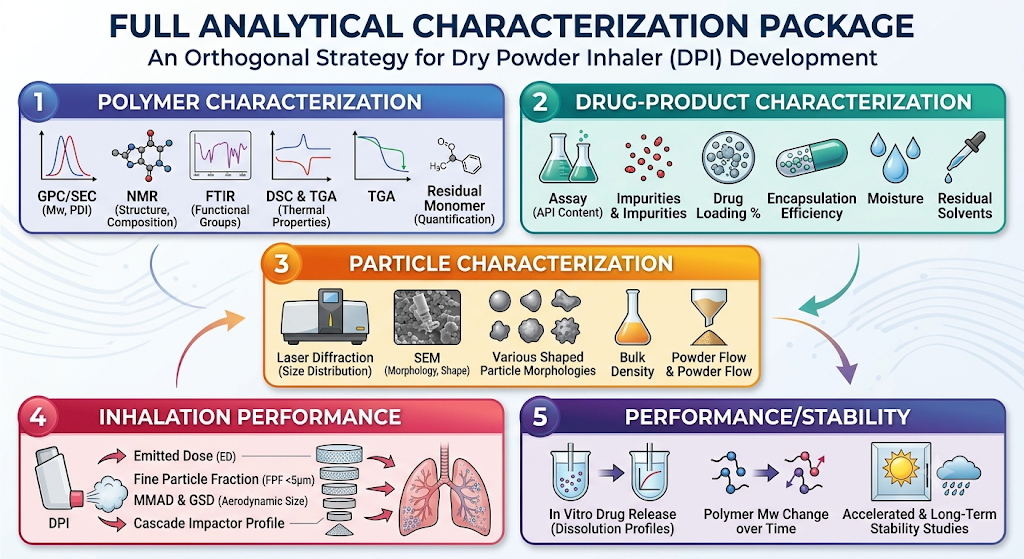
10. What Made Up the Full Analytical Characterization Package?
A comprehensive analytical package was required to demonstrate that formulation optimization had improved the product without introducing new quality risks:
- Polymer characterization — GPC/SEC, NMR, FTIR, DSC, TGA, residual monomer analysis
- Drug-product characterization — assay, related substances/impurities, drug loading, encapsulation efficiency, moisture, residual solvents
- Particle characterization — laser diffraction, SEM, particle morphology, bulk density, powder flow
- Inhalation performance — emitted dose, fine particle fraction, MMAD, GSD, cascade-impactor deposition profile
- Performance/stability — in vitro drug release, polymer molecular-weight change, accelerated and long-term stability
This orthogonal strategy reduces the risk of making development decisions from a single analytical measurement.
11. How Was Quality-by-Design and Risk-Based Development Applied?
The development program was structured around material attributes and process parameters that could have a meaningful impact on critical quality attributes.
| Risk Factor | Potential Impact | Control Strategy |
|---|---|---|
| PLGA molecular weight | Release rate | GPC specification |
| Lactide:glycolide ratio | Degradation | NMR characterization |
| Feed concentration | Particle size | Process optimization |
| Drying conditions | Morphology/residual solvent | DOE and monitoring |
| Drug loading | Dose/release | Formulation optimization |
| Moisture | Stability | Moisture control |
| Particle morphology | Aerodynamic behavior | SEM |
| Aerodynamic size | Lung deposition | Cascade impactor |
| Polymer degradation | Release/stability | Time-point GPC |
| Residual solvent | Safety/quality | GC-based testing |
This approach aligns with the Q8/Q9/Q10 framework, where pharmaceutical development, quality risk management, and the pharmaceutical quality system work together to support product and process understanding, and reflects the same GMP requirements for PLGA products applied across ResolveMass’s PLGA testing programs.
12. What Regulatory Considerations Apply to Pulmonary PLGA Products?
Regulatory development should demonstrate control of the drug substance, excipients/polymer, manufacturing process, finished-product quality, and inhalation performance. For DPI and MDI products, FDA’s quality guidance addresses development and manufacturing considerations for inhalation aerosols and powders.
For a PLGA-based pulmonary program, the CMC package may need to establish polymer identity and characterization, polymer specifications, drug substance characterization, formulation composition, manufacturing-process description, critical process parameters and quality attributes, particle-size distribution, aerodynamic performance, dose uniformity, assay and impurities, residual solvents, moisture, stability, and container-closure/device considerations.
These regulatory expectations closely parallel generic-pathway PLGA programs, where PLGA reverse engineering for ANDA submissions and demonstrating PLGA polymer sameness for ANDA require comparable polymer and particle characterization rigor. ResolveMass has documented this reverse-engineering approach in case studies including reverse engineering of PLGA polymer in Lupron Depot, PLGA characterization for Lupron Depot, and reverse engineering of risperidone PLGA microspheres, all of which rely on a dedicated PLGA reverse-engineering CRO workflow. The precise regulatory package depends on the dosage form, route, indication, development stage, and regulatory pathway.
13. How Does ResolveMass Laboratories Support PLGA Inhalable Microparticle Development?
ResolveMass Laboratories Inc. can support PLGA programs through polymer characterization, analytical development, formulation-related characterization, and advanced analytical testing, backed by the benefits of working with an established PLGA supplier and analytical partner across the long-acting injectable drug delivery technologies landscape.
For a pulmonary PLGA program, an integrated analytical strategy can include:
- PLGA molecular-weight characterization, lactide ratio determination, and end-group characterization
- Thermal analysis and residual monomer/solvent testing
- Drug assay and impurity profiling
- Particle characterization and morphological assessment
- Stability studies and method development
- Comparative polymer evaluation and data interpretation supporting formulation decisions
The advantage of this approach is that analytical results can be interpreted in the context of formulation performance, rather than treating every test as an isolated laboratory measurement. ResolveMass has also published analytical workflows for PLGA microspheres and complex PLGA drug-delivery systems, including orthogonal characterization using GPC/SEC, NMR, DSC, XRD, and other techniques.
14. What Are the Key Development Lessons?
The central lesson from PLGA Inhalable Microparticle Development is that successful pulmonary formulations require simultaneous optimization of polymer, particle, aerodynamic, and drug-release properties.
- Characterize PLGA before formulation. Polymer molecular weight and composition can strongly influence downstream performance.
- Do not optimize geometric particle size alone. Aerodynamic performance is more directly relevant to pulmonary deposition.
- Use orthogonal analytical methods. GPC, NMR, DSC, SEM, chromatography, and aerodynamic testing provide complementary information.
- Control the manufacturing process. Spray-drying parameters can substantially affect particle morphology and performance.
- Correlate polymer degradation with drug release. Time-point polymer characterization can improve understanding of controlled-release behavior.
- Use risk-based development. Identifying critical material attributes and process parameters early can reduce formulation-development risk.
- Build regulatory considerations into development. Analytical methods and specifications should evolve with the intended regulatory pathway.
Conclusion
PLGA Inhalable Microparticle Development requires an integrated understanding of polymer chemistry, particle engineering, aerodynamic performance, drug release, and analytical characterization. A formulation that looks acceptable based on conventional particle-size measurements may still fail to deliver an appropriate respirable dose. In this illustrative case study, optimization of polymer and process variables improved particle morphology, encapsulation efficiency, aerodynamic performance, and release consistency — demonstrating why successful pulmonary delivery depends on connecting material attributes, manufacturing parameters, particle characteristics, aerodynamic behavior, and drug release into a single development strategy.
For pharmaceutical developers, early investment in comprehensive PLGA characterization can help identify formulation risks before they become manufacturing or regulatory problems. A science- and risk-based strategy consistent with ICH Q8/Q9/Q10 principles can further strengthen product and process understanding in any PLGA Inhalable Microparticle Development program.
Frequently Asked Questions:
PLGA is a biodegradable and biocompatible polymer widely investigated for controlled drug delivery.
Its degradation rate can be influenced by molecular weight and lactide:glycolide ratio.
This allows developers to modify the drug-release profile of the formulation.
PLGA can also be engineered into microparticles suitable for inhalation applications.
Its versatility makes it an attractive polymer for sustained pulmonary drug delivery.
Particle size is an important factor because it influences where particles deposit within the respiratory tract.
For inhalation products, aerodynamic particle size is generally more important than geometric size alone.
Particles in the respirable range are typically targeted for delivery to the lower respiratory tract.
The optimal range depends on the formulation, device, and intended deposition site.
Therefore, particle size should be evaluated together with aerodynamic performance.
PLGA molecular weight is commonly determined using gel permeation chromatography (GPC).
GPC, also known as size-exclusion chromatography (SEC), separates polymer molecules according to their hydrodynamic size.
The analysis provides information about average molecular weight and molecular-weight distribution.
These properties can influence polymer degradation and drug-release behavior.
Therefore, GPC is an important analytical tool during PLGA formulation development.
Spray drying converts a drug-polymer solution or suspension into dry particles through controlled atomization and solvent evaporation.
It provides flexibility to adjust particle size, morphology, density, and formulation composition.
Parameters such as feed concentration, drying temperature, feed rate, and atomization conditions can be optimized.
The process can produce particles suitable for further inhalation testing.
However, spray-drying conditions must be carefully controlled to maintain drug and polymer integrity.
Inhalable PLGA microparticles require both physicochemical and aerodynamic characterization.
Common tests include particle-size distribution, SEM morphology, assay, drug loading, and encapsulation efficiency.
Aerodynamic testing may include MMAD, GSD, fine particle fraction, and emitted dose.
Residual solvents, moisture, impurities, and in-vitro drug release may also be evaluated.
Stability studies are performed to determine whether these properties remain consistent during storage.
MMAD stands for Mass Median Aerodynamic Diameter and describes the aerodynamic size distribution of inhaled particles.
It considers particle behavior in an air stream rather than only its physical dimensions.
MMAD is therefore useful for assessing the likely deposition behavior of inhaled particles.
It is commonly determined using cascade-impactor testing.
Together with GSD and fine particle fraction, MMAD helps characterize inhalation performance.
Fine particle fraction represents the proportion of an emitted inhaled dose within a defined respirable particle-size range.
It is an important indicator of the fraction of powder potentially capable of reaching the lower respiratory tract.
FPF is commonly determined using an appropriate cascade-impactor method.
A higher FPF can indicate improved respirable performance, although it should not be interpreted alone.
It should be evaluated alongside emitted dose, MMAD, GSD, and other performance parameters.
Scanning electron microscopy (SEM) provides detailed images of particle shape and surface morphology.
It can identify characteristics such as spherical particles, cracks, pores, aggregation, and surface roughness.
Morphology can influence powder flow, dispersion, and aerodynamic performance.
SEM can therefore help explain differences observed between formulation batches.
It is commonly used alongside particle-size and aerodynamic measurements for comprehensive characterization.
Reference
- Yang Y, Bajaj N, Xu P, Ohn K, Tsifansky MD, Yeo Y. Development of highly porous large PLGA microparticles for pulmonary drug delivery. Biomaterials. 2009 Apr 1;30(10):1947-53.https://www.sciencedirect.com/science/article/pii/S0142961208010181
- Parumasivam T, Leung SS, Quan DH, Triccas JA, Britton WJ, Chan HK. Rifapentine-loaded PLGA microparticles for tuberculosis inhaled therapy: Preparation and in vitro aerosol characterization. European Journal of Pharmaceutical Sciences. 2016 Jun 10;88:1-1.https://www.sciencedirect.com/science/article/pii/S0928098716301002
- Rongala DS, Patil SM, Kunda NK. Design of experiment (DoE) approach for developing inhalable PLGA microparticles loaded with clofazimine for tuberculosis treatment. Pharmaceuticals. 2024 Jun 7;17(6):754.https://www.mdpi.com/1424-8247/17/6/754
- O’hara P, Hickey AJ. Respirable PLGA microspheres containing rifampicin for the treatment of tuberculosis: manufacture and characterization. Pharmaceutical research. 2000 Aug;17(8):955-61.https://link.springer.com/article/10.1023/A:1007527204887
- Hamishehkar H, Emami J, Najafabadi AR, Gilani K, Minaiyan M, Mahdavi H, Nokhodchi A. Effect of carrier morphology and surface characteristics on the development of respirable PLGA microcapsules for sustained-release pulmonary delivery of insulin. International journal of pharmaceutics. 2010 Apr 15;389(1-2):74-85.https://www.sciencedirect.com/science/article/pii/S0378517310000542
- Tavares M, Cabral RP, Costa C, Martins P, Fernandes AR, Casimiro T, Aguiar-Ricardo A. Development of PLGA dry powder microparticles by supercritical CO2-assisted spray-drying for potential vaccine delivery to the lungs. The Journal of Supercritical Fluids. 2017 Oct 1;128:235-43.https://www.sciencedirect.com/science/article/pii/S0896844617301675
About the Author


