

Introduction
Professional PLGA Microsphere Scale-Up Services provide the essential engineering, analytical, and manufacturing infrastructure needed to successfully transition complex poly(lactic-co-glycolic acid) (PLGA) depot formulations from laboratory-scale development to pilot-scale operations and commercial GMP manufacturing. Scaling up a microencapsulation process is far more complex than simply increasing batch size based on laboratory parameters. As reactor volumes expand, significant thermodynamic, kinetic, and hydrodynamic changes occur, all of which can substantially influence product quality. At the laboratory level, producing a few grams of consistently sized microspheres depends on high shear forces and rapid solvent evaporation, both of which are relatively straightforward to control. However, when the same formulation is transferred into processing vessels with capacities of 20 liters or 100 liters, the behavior of fluid flow, heat transfer, and solvent diffusion changes dramatically. Without a carefully designed engineering strategy, these process variations can result in batch-to-batch inconsistency, broader particle size distributions, unpredictable pharmacokinetic release characteristics, and considerable loss of the active pharmaceutical ingredient (API).
Explore the complex technical hurdles encountered during development by reviewing the guide on challenges in PLGA microsphere development.
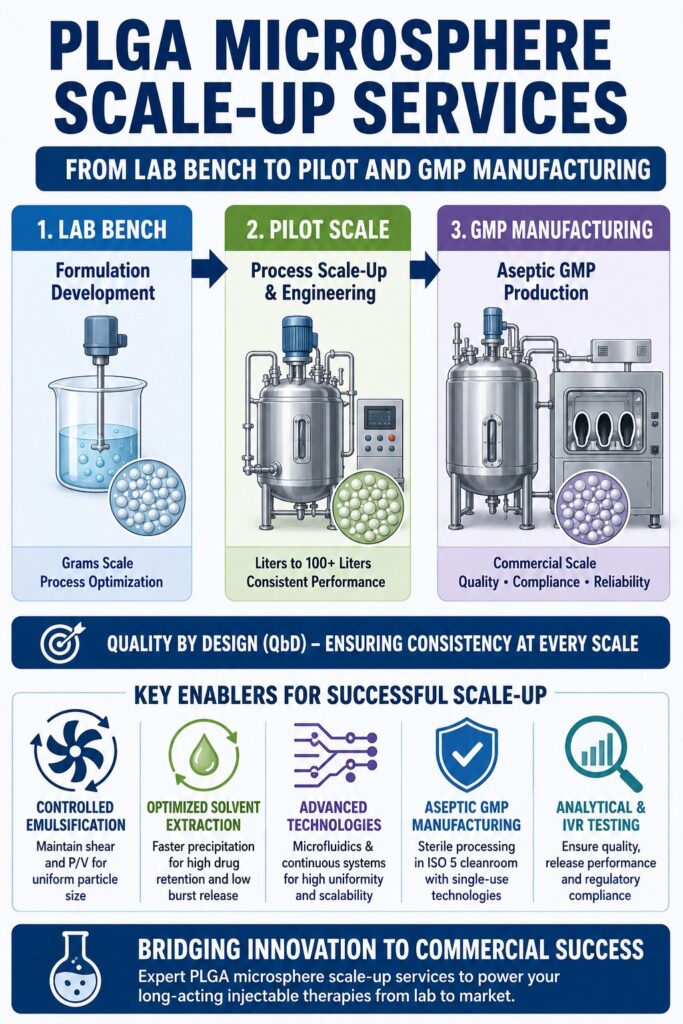
To address these scale-up challenges, pharmaceutical manufacturers must implement a Quality by Design (QbD) strategy that combines computational fluid dynamics (CFD), adaptive impeller control, and continuous process analytical technology (PAT). Together, these technologies help maintain process consistency and product quality throughout manufacturing. This report outlines the key technical approaches and regulatory considerations required to successfully scale up and manufacture PLGA-based long-acting injectable formulations under aseptic GMP conditions.
Read about the broader engineering landscape for developing a successful commercial PLGA long-acting injectable formulation.
Share via:
Article Summary:
- PLGA microsphere scale-up involves much more than increasing batch size. Changes in fluid flow, heat transfer, solvent removal, and mixing at larger volumes can significantly affect particle size, drug loading, and release performance.
- Successful scale-up starts with proper polymer selection. Choosing the right PLGA molecular weight, lactide:glycolide ratio, end-group chemistry, and solvent system helps achieve the desired drug release profile while reducing development risks.
- Process engineering is essential for consistent manufacturing. Maintaining uniform emulsification energy, optimizing impeller design, applying Computational Fluid Dynamics (CFD), and controlling power-per-unit-volume (P/V) help ensure reproducible microsphere quality across production scales.
- Efficient solvent extraction and advanced manufacturing technologies improve encapsulation efficiency and particle uniformity. Techniques such as vacuum-assisted solvent removal, continuous processing, and microfluidics minimize burst release and enhance batch consistency.
- Manufacturing PLGA formulations containing highly potent APIs requires closed containment systems, specialized encapsulation methods, and strict occupational safety controls to protect both product quality and manufacturing personnel.
- Aseptic GMP production and comprehensive analytical testing are critical because PLGA microspheres cannot tolerate conventional terminal sterilization. Sterile processing, along with characterization using GPC, DSC, GC, SEM, HPLC, and in vitro release studies, verifies product quality and regulatory compliance.
- A Quality by Design (QbD) approach integrates engineering, process monitoring, and analytical controls to support reliable scale-up from laboratory development to commercial manufacturing, enabling consistent production of long-acting injectable PLGA drug products.
Pre-Formulation and Polymer Selection in PLGA Microsphere Scale-Up Services
Selecting the most appropriate PLGA polymer grade and gaining a thorough understanding of its degradation behavior form the foundation of a scalable and reproducible microsphere formulation. The performance of a PLGA matrix, including its glass transition temperature (Tg), hydrophobicity, and hydrolytic degradation characteristics, is determined by several critical factors, including molecular weight, the lactide-to-glycolide monomer ratio, and the chemistry of the polymer’s terminal end groups.
Since PLGA undergoes degradation through the hydrolysis of its ester linkages, increasing the proportion of hydrophilic glycolic acid enhances water penetration into the polymer matrix and accelerates polymer erosion. In contrast, the methyl side chain present in lactic acid increases hydrophobicity, thereby slowing the degradation process. During scale-up, aligning the target product profile (TPP) with the appropriate PLGA chemistry at the earliest stage minimizes development risks and helps avoid expensive formulation modifications during later phases of clinical development.
Understand how different biomaterials behave by reading the PLGA, PLA, and PCL degradation rates comparison.
| PLGA Monomer Ratio (LA:GA) | Typical Molecular Weight (Mw) | End-Capping Chemistry | Technical Impact and Release Duration |
|---|---|---|---|
| 50:50 | 10–30 kDa (Low) | Acid / Uncapped | Highly hydrophilic and undergoes rapid hydrolysis. Well suited for short-acting depot formulations with a release duration of approximately 1 to 2 months. |
| 75:25 | 70–80 kDa (Medium) | Acid / Uncapped | Offers balanced hydrophobicity and strong structural integrity, enabling sustained drug release over approximately 3 to 6 months. |
| 85:15 | >100 kDa (High) | Ester / Capped | Highly hydrophobic with minimal water absorption. Commonly selected for long-term implantable formulations and slow-release products extending beyond 6 months. |
In addition to the inherent properties of the polymer, selecting an appropriate organic solvent plays an equally important role in formulation development. Dichloromethane (DCM) remains the preferred solvent across the pharmaceutical industry because of its high volatility and excellent ability to dissolve PLGA, allowing rapid solidification of emulsion droplets. Nevertheless, ethyl acetate (EA) has become increasingly attractive for large-scale manufacturing due to its lower toxicity and improved compliance with ICH Q3C residual solvent guidelines, although its comparatively slower evaporation rate requires extended solvent removal times.
Discover the fundamental mechanisms governing matrix degradation in our guide on bulk erosion vs. surface erosion in PLGA.
Core Engineering Challenges in PLGA Microencapsulation
The primary engineering challenge associated with scaling up microencapsulation is preserving the same physicochemical conditions responsible for droplet formation and polymer solidification as manufacturing volumes increase substantially. Process variables such as shear stress, temperature, and solvent concentration may have only minor effects in a 100 mL laboratory batch, yet these same variations become major sources of process failure in reactors with capacities of 50 liters or more. Such deviations frequently promote droplet coalescence, alter microsphere porosity, and compromise overall product uniformity.
Emulsification Energy, Impeller Dynamics, and Fluid Mixing
The emulsification process determines the initial droplet size within the dispersed phase, making it one of the most influential factors controlling the final microsphere diameter and subsequent drug release characteristics. Laboratory-scale homogenizers generate highly concentrated mechanical energy, producing uniform shear fields that effectively break larger droplets into consistently sized particles. As manufacturing volume increases, however, distributing identical kinetic energy uniformly throughout the reactor becomes hydrodynamically challenging using conventional geometric scale-up principles. Consequently, regions with insufficient shear, commonly referred to as “dead zones,” develop within pilot-scale reactors. These low-energy regions permit droplets to merge and coalesce, significantly increasing particle size variability and broadening the polydispersity index.
To learn more about controlling particle size metrics, read our detailed overview on managing the PLGA polydispersity index (PDI) in pharmaceutical manufacturing.
To overcome these limitations, advanced PLGA scale-up strategies utilize both kinematic and dynamic similarity principles. Process engineers preserve consistent shear conditions by maintaining a constant power-per-unit-volume (P/V) across different manufacturing scales using the following relationship:
P/V = k × (rpm)³ × D⁵
where k represents the impeller constant and D denotes the impeller diameter.
Maintaining a consistent P/V ratio ensures that the polymer-drug dispersion experiences equivalent disruptive forces during commercial production as it did during laboratory-scale development. Furthermore, Computational Fluid Dynamics (CFD) simulations are extensively employed to predict fluid velocity profiles, mixing efficiency, and shear distribution before manufacturing begins. These predictive models allow engineers to optimize reactor design using stainless-steel jacketed vessels equipped with combined axial-radial impellers and real-time viscosity feedback systems. As a result, scale-up variability can be reduced to less than 5%, significantly improving manufacturing consistency.
Solvent Extraction and Evaporation Kinetics
The kinetics of solvent extraction determine the rate at which the dissolved PLGA polymer precipitates from solution, directly influencing microsphere porosity, encapsulation efficiency, and the magnitude of the initial burst release. During small-scale production, the high surface-area-to-volume ratio allows highly volatile solvents such as DCM to evaporate rapidly, enabling the polymer matrix to solidify quickly and effectively entrap the active pharmaceutical ingredient (API). In contrast, solvent evaporation proceeds much more slowly in large-scale reactors.
When polymer droplets remain in a liquid or semi-solid state for prolonged periods, the API has additional time to diffuse from the organic phase into the surrounding aqueous phase. This unwanted drug migration significantly decreases encapsulation efficiency while depositing unencapsulated drug on the surface of the hardened microspheres. As a consequence, the formulation may exhibit an excessive burst release immediately after administration, creating the risk of dose dumping. To minimize these issues, commercial-scale manufacturing facilities employ advanced vacuum-assisted solvent exchange systems, continuous solvent-nonsolvent precipitation technologies, and tightly controlled extraction temperatures. These integrated process controls accelerate polymer precipitation, rapidly seal microsphere pores, and substantially improve drug retention within the polymer matrix.
Explore advanced techniques for maintaining purity by reading about residual solvent control in PLGA microsphere manufacturing.
Advanced Manufacturing Technologies for PLGA Microparticles
Although the emulsion-solvent evaporation technique continues to be the most commonly employed manufacturing method for PLGA microspheres, the growing need for highly uniform particle populations and increased drug loading has accelerated the adoption of advanced continuous manufacturing technologies. Techniques such as microfluidics and precisely controlled spray drying provide highly effective alternatives for scaling complex formulations that cannot be manufactured reliably through conventional batch homogenization methods.
Batch vs. Continuous Microfluidic PLGA Encapsulation
Continuous microfluidic encapsulation transforms the traditional batch manufacturing process by generating PLGA microspheres individually within carefully engineered microchannels, resulting in exceptional particle uniformity and remarkably high encapsulation efficiency. Unlike conventional batch reactors, where shear forces vary throughout the processing vessel, microfluidic devices expose every droplet to identical flow conditions, fluidic pressures, and residence times. This highly controlled environment effectively eliminates many of the challenges associated with conventional scale-up. Rather than increasing reactor size, manufacturing capacity is expanded through a “scale-out” strategy, in which hundreds or even thousands of identical microfluidic channels operate simultaneously.
Microfluidic systems based on flow-focusing or step-emulsification technologies consistently manufacture PLGA microspheres with a coefficient of variation (CV) below 5%, producing particle sizes ranging from 1 µm to 100 µm. This exceptional level of monodispersity minimizes the variability in polymer degradation that commonly occurs in highly polydisperse batches. As a result, these systems support highly predictable zero-order drug release profiles, making them particularly advantageous for formulations containing drugs with narrow therapeutic indices.
Formulating Highly Potent APIs (HPAPIs)
Encapsulating Highly Potent Active Pharmaceutical Ingredients (HPAPIs), including oncology therapeutics and immunomodulatory peptides, requires specialized microencapsulation strategies that maximize encapsulation efficiency while maintaining stringent containment and operator safety standards. HPAPIs represent both a significant economic investment and a substantial occupational safety concern due to their high biological activity and toxicity. PLGA microspheres provide an ideal delivery platform for these compounds by minimizing systemic exposure while enabling sustained, localized drug release over extended periods.
Scaling up HPAPI-containing PLGA microspheres requires the use of fully enclosed manufacturing systems. Production is typically carried out within negative-pressure Restricted Access Barrier Systems (RABS) or isolators equipped with comprehensive solvent vapor containment systems to comply with strict Occupational Exposure Limit (OEL) requirements. For hydrophilic peptides, formulators commonly employ Water-in-Oil-in-Water (W/O/W) double emulsion processes. Careful optimization of the internal aqueous phase volume together with the polymer-to-drug ratio routinely increases encapsulation efficiency to levels exceeding 85%.
Learn how to optimize encapsulation metrics based on drug properties in our guide on encapsulating hydrophilic vs. hydrophobic APIs in PLGA.
Aseptic Processing and GMP Manufacturing Requirements
Because PLGA microspheres are administered as long-acting injectable products through the parenteral route, absolute sterility is essential. However, conventional terminal sterilization methods irreversibly damage the polymer structure, making aseptic manufacturing the only practical approach for achieving GMP compliance.
Exposure of PLGA microspheres to terminal heat sterilization through autoclaving subjects the polymer to temperatures significantly higher than its glass transition temperature (Tg approximately 40–60°C). Under these conditions, the polymer softens, microspheres lose their spherical structure, and adjacent particles fuse together, rendering the product unsuitable for clinical use. Gamma irradiation, despite being a non-thermal sterilization method, causes extensive chain scission within the PLGA backbone. Cleavage of these covalent polymer chains substantially reduces molecular weight, weakens the structural integrity of the depot system, and accelerates drug release in an unpredictable manner. Ethylene oxide sterilization is likewise generally avoided because toxic residual gas can become trapped within the porous polymer matrix, creating additional safety concerns.
For these reasons, GMP manufacturing depends entirely on rigorously controlled aseptic processing procedures. Both the organic polymer-drug solution and the continuous aqueous phase are sterilized by passage through 0.22 µm sterile filtration systems before emulsification begins. All downstream manufacturing operations, including homogenization, solvent extraction, washing, and lyophilization, must be performed within carefully controlled ISO 5 (Class 100) cleanroom environments. The increasing adoption of fully enclosed processing systems, pre-sterilized single-use manufacturing technologies, and automated aseptic filling equipment further minimizes the possibility of microbial contamination during commercial-scale production.
Analytical Characterization and In Vitro Release (IVR) Testing
Extensive analytical characterization is essential for confirming that scaled-up PLGA microspheres maintain the same physicochemical characteristics, structural integrity, and drug release behavior as the original laboratory-scale formulation. GMP quality control programs rely on a comprehensive collection of advanced spectroscopic, chromatographic, and microscopic analytical techniques to ensure product consistency throughout commercial manufacturing.
Ensure compliance and structural validation by studying the processes involved in PLGA characterization for reference listed drugs (RLDs).
| Analytical Attribute | Primary Testing Methodology | Purpose in PLGA Characterization |
|---|---|---|
| Molecular Weight & PDI | Gel Permeation Chromatography (GPC) / Size Exclusion Chromatography (SEC) | Confirms that polymer degradation or excessive shear during scale-up has not caused polymer chain scission. |
| Thermal Properties (Tg) | Differential Scanning Calorimetry (DSC) | Evaluates physical aging, structural stability, and verifies the absence of undesirable drug crystallization within the polymer matrix. |
| Residual Solvents | Gas Chromatography (GC-FID / GC-MS) | Verifies that residual solvents such as DCM and EA remain well below ICH Q3C safety limits, typically less than 0.05%. |
| Internal Morphology | Scanning Electron Microscopy (SEM) | Examines surface morphology and internal pore architecture, both of which influence water penetration and polymer erosion. |
| Drug Encapsulation | High-Performance Liquid Chromatography (HPLC) | Precisely measures the quantity of API encapsulated within the polymer matrix and differentiates it from surface-associated drug. |
Learn how to demonstrate equivalence for generic submissions by evaluating PLGA polymer sameness for ANDA applications.
In Vitro Release (IVR) Testing Methodologies
In Vitro Release (IVR) testing provides the essential foundation for establishing a reliable in vitro-in vivo correlation (IVIVC), allowing researchers to predict how PLGA microspheres will degrade and release their therapeutic payload following administration. Because PLGA degradation involves multiple interconnected processes, including water uptake, ester bond hydrolysis, localized autocatalytic acidification, polymer erosion, and eventual mass loss, developing standardized IVR methods remains technically demanding.
The pharmaceutical industry primarily relies on two established testing approaches. The Sample and Separate (SS) method remains the most widely used technique. In this procedure, microspheres are suspended in an appropriate release medium, typically phosphate-buffered saline (PBS) maintained at pH 7.4 and 37°C, inside sealed vials or flasks placed on an orbital shaker. At predetermined sampling intervals, portions of the release medium are collected while microspheres are separated through centrifugation or filtration. The amount of released drug is subsequently quantified using High-Performance Liquid Chromatography (HPLC). Although this method is flexible, economical, and broadly applicable, it can be affected by microparticle aggregation and unavoidable particle losses during repeated sampling procedures.
An alternative approach is the Flow-Through Cell Method (USP Apparatus 4), which provides a highly controlled dynamic testing environment that more closely resembles the physiological conditions found within subcutaneous and intramuscular tissues. In this system, microspheres are placed inside specially designed flow cells containing glass beads that minimize particle aggregation. Release medium is continuously circulated through the system in a closed-loop configuration. Continuous flow prevents the accumulation of acidic polymer degradation products, thereby reducing artificial autocatalytic degradation while improving reproducibility, particularly for highly porous or rapidly degrading PLGA formulations.
Review strategic considerations for designing sustainable delivery matrices in our analysis of PLGA depot formulations.
Managing Residual Solvents via Lyophilization
Removing the final traces of organic solvent trapped within the dense interior of PLGA microspheres remains one of the most technically challenging aspects of manufacturing, yet regulatory agencies require strict compliance with residual solvent specifications. Conventional vacuum drying at ambient temperature is frequently inadequate because the absence of moisture limits polymer plasticization, preventing efficient diffusion of trapped solvent molecules from the rigid polymer network. To address this challenge, advanced scale-up facilities employ specialized wet extraction methods using alcoholic solvent systems, including ethanol or methanol-based mixtures, to temporarily plasticize the PLGA polymer chains. This controlled plasticization lowers the Tg, allowing residual dichloromethane to diffuse from the polymer matrix more efficiently. The process is subsequently completed through carefully optimized lyophilization (freeze-drying), which removes remaining moisture and residual solvent while preserving the microsphere’s internal pore structure and preventing structural collapse.
Examine the factors determining long-term stability in our publication on the shelf life of PLGA, PLA, and PCL matrices.
Conclusion
The successful commercialization of long-acting injectable therapies depends heavily on professional PLGA Microsphere Scale-Up Services that effectively bridge the transition from laboratory research to clinical and commercial manufacturing. As production volumes increase, the fundamental behavior of shear distribution, heat transfer, fluid dynamics, and solvent evaporation changes significantly, posing considerable risks to polymer structure, encapsulation efficiency, and drug release performance. By implementing a comprehensive Quality by Design (QbD) framework that incorporates predictive computational modeling, maintains precise kinematic scaling relationships, and integrates continuous Process Analytical Technology (PAT), manufacturers can proactively control these process variables and minimize scale-up risks. In addition, strict adherence to aseptic manufacturing practices ensures that sensitive biological products and highly potent therapeutic compounds remain sterile and stable without exposing the polymer matrix to the damaging effects associated with terminal sterilization.
ResolveMass Laboratories Inc. specializes in addressing these complex scale-up challenges by providing comprehensive CDMO services that encompass custom polymer synthesis, advanced formulation development, and fully validated GMP manufacturing scale-up. Organizations seeking to overcome formulation obstacles and accelerate the development of long-acting injectable therapies are encouraged to contact the ResolveMass Laboratories Inc. team through the Contact Us page to discuss project-specific requirements and explore advanced engineering solutions.
Frequently Asked Questions (FAQs) About PLGA Microsphere Scale-Up
During large-scale processing, PLGA polymers are exposed to different mechanical and environmental conditions compared to laboratory production. Prolonged mixing, increased shear stress, and longer solvent exposure may influence molecular weight, polymer stability, and glass transition temperature (Tg). These changes can alter degradation behavior and ultimately impact the controlled release profile of the encapsulated drug. Careful monitoring helps preserve the intended formulation characteristics.
Commercial GMP production relies on advanced processing equipment specifically designed for sterile and reproducible manufacturing. Typical systems include stainless-steel jacketed reactors, high-shear homogenizers, precision impeller assemblies, solvent recovery units, sterile filtration systems, and aseptic filling equipment. Many facilities also utilize closed manufacturing systems and ISO 5 cleanroom environments to minimize contamination risks while maintaining product quality.
Efficient solvent removal is essential to meet regulatory standards and preserve microsphere integrity. Large-scale manufacturing commonly employs vacuum-assisted solvent extraction, continuous solvent exchange systems, or specialized wet extraction techniques using suitable alcoholic media. These approaches promote complete removal of residual organic solvents while protecting the polymer structure and preventing pore collapse or excessive moisture retention.
Terminal sterilization is generally not suitable for PLGA microspheres because it can significantly damage the polymer matrix. High-temperature sterilization may soften or deform the particles, while gamma irradiation can reduce polymer molecular weight through chain scission. To preserve product quality and drug release performance, PLGA microspheres are typically manufactured using validated aseptic processing methods combined with sterile filtration.
Consistent product quality is achieved by implementing a Quality by Design (QbD) strategy throughout the manufacturing process. Critical parameters such as mixing intensity, power per unit volume (P/V), solvent removal, and emulsification conditions are carefully controlled across all production scales. Advanced tools including Computational Fluid Dynamics (CFD) and Process Analytical Technology (PAT) provide continuous monitoring to minimize variability between manufacturing batches.
Continuous manufacturing provides greater process control than conventional batch production by maintaining stable operating conditions throughout manufacturing. Technologies such as microfluidic encapsulation generate highly uniform droplets under identical flow conditions, resulting in excellent particle size consistency. Production capacity can be increased by operating multiple parallel systems, allowing manufacturers to expand output without compromising product quality.
Computational Fluid Dynamics (CFD) enables engineers to simulate fluid flow, mixing behavior, heat transfer, and shear distribution before manufacturing begins. These virtual models help identify inefficient mixing regions and optimize reactor geometry, impeller configuration, and operating conditions. Using CFD during process development significantly reduces scale-up uncertainty and improves manufacturing efficiency by minimizing the likelihood of process failures.
Several Critical Process Parameters (CPPs) directly influence the quality of PLGA microspheres throughout manufacturing. Important variables include homogenization speed, polymer concentration, emulsifier concentration, solvent extraction rate, mixing conditions, and the polymer-to-drug ratio. Careful control of these parameters ensures consistent particle morphology, high encapsulation efficiency, and reproducible drug release behavior in the final product.
Reference:
- Park, J., Kim, M., Wang, Y., Schwendeman, A., & Schwendeman, S. P. (2022). Transitioning from a lab-scale PLGA microparticle formulation to pilot-scale manufacturing. Journal of Controlled Release, 348, 841–848. https://doi.org/10.1016/j.jconrel.2022.06.036
- Zolnik, B. S., Burgess, D. J., & Chen, Y. (2016). A reproducible accelerated in vitro release testing method for PLGA microspheres. International Journal of Pharmaceutics, 498(1–2), 274–282. https://doi.org/10.1016/j.ijpharm.2015.12.031
- Kias, F., & Bodmeier, R. (2024). Acceleration of final residual solvent extraction from poly(lactide-co-glycolide) microparticles. Pharmaceutical Research, 41(9), 1869–1879. https://doi.org/10.1007/s11095-024-03744-9
Get In Touch With Us
About The Author


