

Introduction:
Biologics, including monoclonal antibodies (mAbs), recombinant proteins, enzymes, fusion proteins, and biosimilars, are structurally complex medicines whose quality depends on more than their amino acid sequence. Post-translational modifications (PTMs) and glycosylation influence protein folding, biological activity, immunogenicity, stability, and batch-to-batch consistency. PTM and Glycosylation Analysis Services help pharmaceutical and biotechnology companies identify, characterize, and monitor these modifications throughout development and manufacturing.
Unlike many small-molecule drugs, therapeutic proteins can undergo multiple modifications during cell culture, purification, formulation, storage, and administration. Some are necessary for function, while others indicate degradation, process variability, or changes that call for further investigation.
For example, variations in antibody Fc-region glycosylation may affect interactions with Fc receptors, while oxidation of susceptible residues can influence stability or activity. Deamidation may alter charge heterogeneity and, depending on its location and extent, affect biological function.
A comprehensive analytical strategy combines complementary techniques to establish the identity, location, relative abundance, and potential significance of each modification. ResolveMass Laboratories Inc. provides analytical testing and characterization capabilities to support teams investigating complex molecules and biologic products, including biosimilar characterization using mass spectrometry.
Summary:
- PTM and Glycosylation Analysis Services characterize the modifications (glycosylation, oxidation, deamidation, and others) that determine a biologic’s structural integrity, biological activity, stability, and quality.
- Post-translational modifications (PTMs), including oxidation, deamidation, phosphorylation, glycation, and disulfide bond changes, can influence a biologic’s safety, efficacy, and shelf life.
- Glycosylation analysis evaluates glycan composition, site occupancy, glycan distribution, and critical attributes such as high-mannose, afucosylated, and sialylated glycans.
- LC-MS/MS, high-resolution mass spectrometry (HRMS), peptide mapping, intact mass analysis, and glycan profiling work best when combined, because each answers a different question.
- These services support biologics development, biosimilar comparability, process optimization, stability studies, and regulatory submissions.
- A fit-for-purpose strategy helps teams identify critical quality attributes (CQAs), investigate product variability, and generate reliable characterization data.
- ResolveMass Laboratories Inc., a Canadian analytical CRO/CDMO, supports characterization programs built to help developers understand protein modifications and assess product quality.
1: What Are PTM and Glycosylation Analysis Services?
PTM and Glycosylation Analysis Services are specialized analytical studies that identify, characterize, and quantify the chemical and enzymatic modifications that occur in proteins after translation. They show which residues are modified, how much of each modification is present, and whether those levels remain consistent across batches, process changes, or against a reference product.
In biologics produced in mammalian systems such as CHO cells, many PTMs are unavoidable and some are essential. Because they vary with cell culture conditions, purification, formulation, and storage, they must be monitored with robust, orthogonal methods.
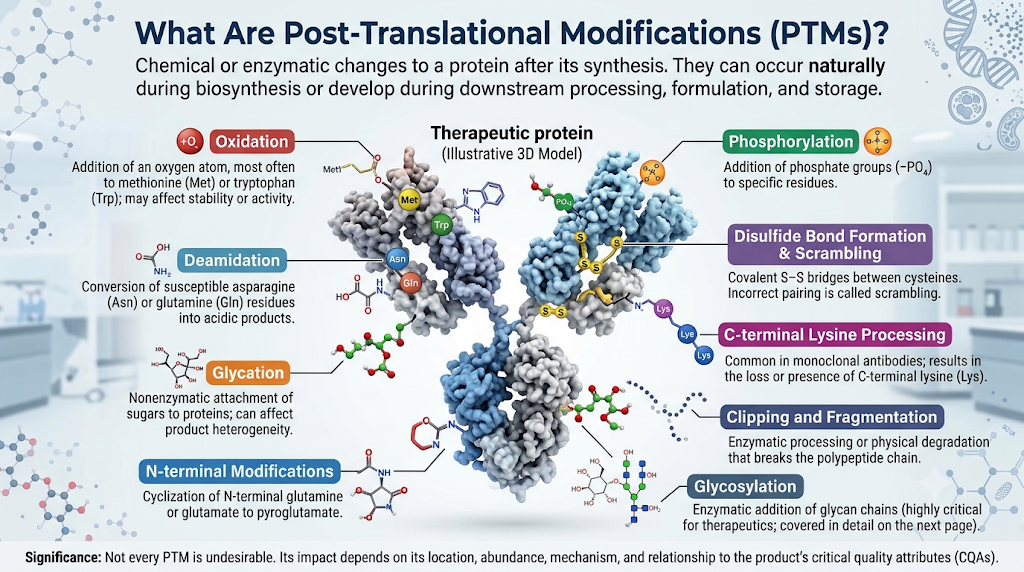
What Are Post-Translational Modifications (PTMs)?
PTMs are chemical or enzymatic changes to a protein after its synthesis. They can occur naturally during biosynthesis or develop during downstream processing, formulation, and storage.
Common PTMs in therapeutic proteins include:
- Oxidation: often affects methionine and tryptophan residues and may influence structure, stability, or activity.
- Deamidation: converts susceptible asparagine or glutamine residues into acidic products, potentially changing charge properties and stability.
- Glycation: the nonenzymatic attachment of sugars to proteins; can affect product heterogeneity.
- Phosphorylation: adds phosphate groups to specific residues and may matter for certain protein therapeutics.
- Disulfide bond formation and scrambling: can affect folding, structural integrity, and biological activity.
- C-terminal lysine processing: common in monoclonal antibodies and associated with charge heterogeneity.
- N-terminal modifications: may include cyclization of N-terminal glutamine or glutamate residues.
- Clipping and fragmentation: may arise from enzymatic processing or degradation and can affect molecular integrity.
Not every PTM is undesirable. Its significance depends on its location, abundance, mechanism, and relationship to the product’s critical quality attributes.
What Is Glycosylation Analysis?
Glycosylation analysis examines the carbohydrate structures attached to proteins, including the glycan types present, their attachment sites, relative abundance, and distribution. It is especially important for monoclonal antibodies, Fc-fusion proteins, and many recombinant therapeutics because glycans influence folding, clearance, receptor interactions, and immune effector functions.
Major glycosylation characteristics include:
- N-linked glycosylation: glycans attached to asparagine residues, commonly at an N-X-S/T sequon where X is not proline.
- O-linked glycosylation: glycans attached primarily to serine or threonine residues.
- High-mannose glycans: may influence clearance and other biologically relevant properties.
- Afucosylated glycans: lack core fucose and can enhance certain antibody-dependent cellular cytotoxicity (ADCC) responses.
- Galactosylated glycans: may influence complement-related effector functions in some antibody systems.
- Sialylated glycans: contain sialic acid, which can influence protein interactions and clearance depending on the molecule and glycan context.
A detailed profile helps establish product consistency and identify differences linked to cell culture conditions, manufacturing processes, or storage. For a deeper look at this area, see our guide to glycosylation profiling for biosimilar characterization.
2: Why Are PTM and Glycosylation Analysis Services Important for Biologics?
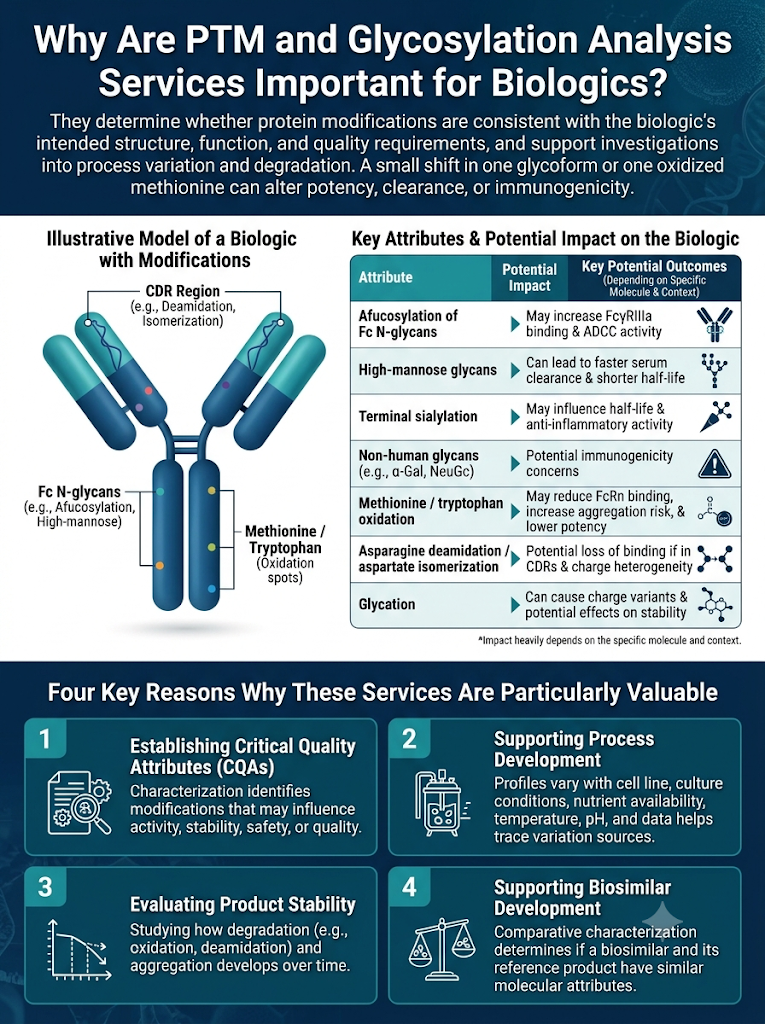
They determine whether protein modifications are consistent with the biologic’s intended structure, function, and quality requirements, and they support investigations into process variation and degradation. A small shift in one glycoform or one oxidized methionine can alter potency, clearance, or immunogenicity.
| Attribute | Potential impact on the biologic |
|---|---|
| Afucosylation of Fc N-glycans | Increased FcγRIIIa binding and ADCC activity |
| High-mannose glycans | Faster serum clearance, shorter half-life |
| Terminal sialylation | Influences half-life and anti-inflammatory activity |
| Non-human glycans (e.g., α-Gal, NeuGc) | Potential immunogenicity concerns |
| Methionine / tryptophan oxidation | Reduced FcRn binding, aggregation risk, lower potency |
| Asparagine deamidation / aspartate isomerization | Loss of binding if in CDRs, charge heterogeneity |
| Glycation | Charge variants, possible effects on stability |
These services are particularly valuable for four reasons:
- Establishing critical quality attributes: characterization identifies modifications that may influence activity, stability, safety, or other quality characteristics.
- Supporting process development: profiles can vary with cell line, culture conditions, nutrient availability, temperature, pH, purification, and storage, and analytical data help teams trace the sources of variation.
- Evaluating product stability: forced-degradation and stability studies can reveal oxidation, deamidation, fragmentation, aggregation-associated changes, or glycan-related differences that develop over time.
- Supporting biosimilar development: comparative characterization determines whether a proposed biosimilar and its reference product have similar molecular attributes. Observed differences must be assessed for potential impact rather than judged solely by their presence.
3: What Is Included in a PTM and Glycosylation Analysis Service Package?
A complete package covers modification identification, site localization, relative quantitation, and comparability reporting, tailored to the molecule (mAb, fusion protein, bispecific, enzyme, or other modality) and development stage.
Typical deliverables include:
- Peptide mapping with LC-MS/MS for sequence coverage and PTM site localization, including peptide biosimilar characterization using LC-MS
- Intact and subunit (reduced, IdeS-digested, middle-down) mass analysis for a global view of glycoforms and modifications
- Released N-glycan profiling (fluorescent labeling with HILIC-UHPLC and MS confirmation)
- Site-specific glycopeptide analysis, including glycan occupancy and microheterogeneity
- Disulfide bond mapping to confirm connectivity and investigate scrambling
- Monosaccharide and sialic acid analysis for composition and terminal sialic acid species
- Forced degradation and stability-linked PTM monitoring
- Comparability or biosimilarity reports with side-by-side data against a reference product
4: Which Analytical Techniques Are Used in PTM and Glycosylation Analysis?
Reliable characterization typically requires several complementary techniques, because no single method can fully describe every modification. The right choice depends on the molecule, expected modification, sensitivity requirements, and intended use of the data.
| Analytical technique | Primary purpose | Typical application |
|---|---|---|
| LC-MS/MS peptide mapping | Identifies peptides and localizes modifications | Oxidation, deamidation, sequence confirmation, modification mapping |
| High-resolution mass spectrometry (HRMS) | Measures accurate mass and resolves molecular species | Intact mass, subunit analysis, modification assessment |
| Intact mass analysis | Assesses overall molecular mass | Detecting mass shifts and broad heterogeneity |
| Glycopeptide LC-MS/MS | Identifies glycosylated peptides and associated glycans | Site-specific glycosylation characterization |
| Released glycan profiling | Characterizes glycans separated from proteins | Glycan distribution, relative abundance, structural profiling |
| Disulfide bond mapping | Determines disulfide connectivity | Structural integrity, scrambling investigation |
| SEC and complementary size-based methods | Characterizes size variants | Aggregates and fragments, with suitable detection |
| Charge-variant analysis | Separates acidic, main, and basic variants | Deamidation, terminal processing, other charge changes |
| Orthogonal structural or functional assays | Assesses higher-order structure or biological performance | Correlating modifications with product attributes |
LC-MS/MS Peptide Mapping for PTM Characterization
LC-MS/MS peptide mapping is a widely used approach for confirming sequence coverage and localizing protein modifications. The protein is digested with a suitable enzyme, commonly trypsin, and the resulting peptides are separated by liquid chromatography before mass spectrometric analysis.
The workflow identifies modifications such as oxidation, deamidation, glycation, and other mass-shifting events. Interpretation may include peptide identification, modification localization, relative abundance estimation, and sample comparison.
Method development must account for analytical artifacts. Deamidation can occur during sample preparation, and oxidation can be introduced by handling or exposure to air (oxidation adds roughly 16 Da, deamidation roughly 1 Da, so mass accuracy matters). Controlled digestion conditions (pH, temperature, time), appropriate controls, and careful data review separate true product-related modifications from method-induced ones.
Good-practice points we apply:
- Orthogonal fragmentation (CID/HCD, and ETD/EThcD where appropriate) to confirm modification sites
- Spiked or stressed reference materials to confirm detection and quantitation
- Multiple-enzyme digestion strategies to improve sequence coverage
- Clear reporting of relative abundance with defined variability
High-Resolution Mass Spectrometry for Intact and Subunit Analysis
High-resolution mass spectrometry provides accurate mass measurements that support identity confirmation and the assessment of protein heterogeneity. Intact mass analysis can reveal broad mass differences linked to glycosylation, terminal processing, or other modifications.
For complex mAbs, subunit analysis offers an intermediate level of detail between intact-protein analysis and peptide mapping. Enzymatic digestion or selective reduction simplifies the profile and improves interpretation. Learn more in our article on intact mass analysis and middle-up characterization of biosimilar mAbs.
Intact mass data alone generally cannot establish the exact location or identity of every modification, so detailed characterization often adds peptide mapping, glycopeptide analysis, or other orthogonal methods.
Glycan Profiling and Site-Specific Glycosylation Analysis
Glycan profiling evaluates the distribution of carbohydrate structures on a therapeutic protein, either after release from the protein or while attached to their peptides. Released-glycan analysis gives a broad view of composition and relative abundance. Site-specific glycopeptide analysis links particular glycans to their attachment sites, adding information on occupancy and site-level heterogeneity.
A complete strategy may combine LC-MS-based profiling with chromatographic or fluorescence-based methods. Using orthogonal methods strengthens the package: if released-glycan and glycopeptide results agree, the conclusion is far more defensible in regulatory review.
5: How Does Glycosylation Analysis Support Biosimilar Development?
It provides structural evidence that a proposed biosimilar’s glycosylation profile is highly similar to the reference product, which is a core part of analytical similarity assessment. Glycan differences are among the most common sources of regulatory questions, so early, high-quality data reduces risk.
In a biosimilar program, this data typically supports:
- Reference product characterization: mapping the range of glycoforms across multiple reference lots (see our approach to biosimilar reference standard characterization)
- Clone and process selection: choosing cell lines and conditions that best match the reference
- Process change comparability: showing that scale-up or site transfer did not shift CQAs
- Regulatory submissions: presenting clear, traceable data aligned with expectations from agencies such as Health Canada, the FDA, and the EMA
Glycan and PTM data are most persuasive when linked to other evidence. A physicochemical assessment for biosimilar characterization places modifications in the context of size, charge, and structural attributes, while functional assays for biosimilar characterization show whether differences in glycosylation or PTMs actually affect biological activity. Smaller peptide-based biologics follow the same logic, as in insulin biosimilar characterization.
6: How Are PTMs Such as Oxidation and Deamidation Distinguished from Artifacts?
Chemical PTMs are confirmed by peptide mapping with high-resolution LC-MS/MS, combined with controls that show whether a modification is present in the product or introduced during sample handling. Poorly controlled digestion can create artifactual deamidation or oxidation, leading to overestimated levels.
Well-designed workflows use optimized digestion, orthogonal fragmentation, and stressed controls so reported levels reflect the product rather than the method.
7: What Regulatory Guidelines Apply to PTM and Glycosylation Characterization?
The main reference points are ICH Q6B (specifications for biotechnological products), ICH Q5E (comparability after manufacturing changes), and agency biosimilar guidance. These expect thorough structural characterization, including glycosylation and other PTMs, supported by suitable, qualified methods.
Practical implications:
- Characterize glycosylation and key PTMs with orthogonal, appropriately qualified methods
- Justify which modifications are CQAs through a risk-based assessment (impact on activity, PK, safety, immunogenicity)
- Maintain data integrity and traceability from raw files to final report
- Plan for method validation as the program moves toward commercial release
Confirm current requirements with the relevant agency and your regulatory team, since expectations evolve.
8: What Does a Typical PTM and Glycosylation Analysis Workflow Include?
A structured workflow connects the analytical question to the appropriate sample preparation, measurement, data interpretation, and reporting.
- Project assessment: define the biologic type, development stage, target modifications, sample availability, and intended use of the results.
- Analytical strategy selection: select methods based on the required depth and relevant quality attributes.
- Sample preparation: prepare samples under controlled conditions that minimize degradation and preparation-related artifacts.
- Instrumental analysis: perform LC-MS/MS, HRMS, glycan profiling, or complementary analyses as appropriate.
- Data processing: identify peptides, modifications, glycan structures, and molecular variants using suitable procedures.
- Relative abundance assessment: estimate modification levels or glycan distributions where the method supports reliable quantification.
- Interpretation and comparison: evaluate results against reference samples, historical data, predefined criteria, or stability trends.
- Reporting: document methods, findings, limitations, and relevant observations to support technical decision-making.
The final scope should be defined before testing begins. Not every project needs every technique, and a targeted study may be more appropriate than a broad discovery-style investigation.
9: How Do You Choose a PTM and Glycosylation Analysis Partner?
Choose a partner on scientific depth, data transparency, and regulatory awareness, not on turnaround time alone. A fast report that cannot withstand a deficiency letter costs more in the end.
- Relevant experience with your molecule class and with biosimilar or comparability studies
- Modern high-resolution mass spectrometry and orthogonal separation capability
- Site-specific data, not just a global glycan profile
- Scientists who interpret results and explain what they mean for your CQAs
- Clear, auditable reporting with documented methods and available raw data
- Confidentiality and quality systems appropriate for regulated development
- Direct communication with the scientists running your study
ResolveMass Laboratories Inc. is built around these principles. As a Canadian analytical CRO/CDMO with focus areas that include biosimilar characterization, mass spectrometry, PLGA-based drug delivery, and nitrosamine testing, our teams are accustomed to regulated, high-scrutiny environments and to communicating results in a way both scientists and regulators can follow.
Conclusion:
High-quality PTM and Glycosylation Analysis Services turn complex modification data into decisions you can defend, from clone selection to comparability to regulatory submission. Glycosylation and chemical PTMs influence efficacy, safety, and stability, so characterizing them with orthogonal, well-controlled methods is a necessity rather than a formality.
Frequently Asked Questions:
Common post-translational modifications include oxidation, deamidation, glycation, phosphorylation, disulfide bond changes, N-terminal modifications, C-terminal lysine processing, and proteolytic clipping. Their significance depends on the modification’s location, abundance, and effect on product quality.
PTM analysis covers a broad range of chemical and enzymatic protein modifications, whereas glycosylation analysis specifically examines carbohydrate structures attached to proteins. Glycosylation is therefore one important category of post-translational modification.
Glycosylation can influence monoclonal antibody stability, clearance, and interactions with Fc receptors. For example, reduced core fucosylation can enhance certain antibody-dependent cellular cytotoxicity (ADCC) responses, while other glycan features may affect additional effector functions.
N-linked glycosylation involves glycans attached to the nitrogen atom of an asparagine side chain, commonly within an N-X-S/T sequence motif. O-linked glycosylation generally involves glycans attached to the oxygen atom of serine or threonine residues, although specific structures and pathways vary by protein and expression system.
PTM analysis helps compare a proposed biosimilar with its reference biologic by evaluating attributes such as oxidation, deamidation, glycosylation, disulfide bonds, and terminal processing. The findings contribute to a broader analytical similarity assessment alongside structural and functional testing.
Yes. These analyses can detect certain degradation-related changes, including oxidation, deamidation, fragmentation, and changes in glycan profiles. Additional techniques, such as size-exclusion chromatography and appropriate functional assays, may be needed to assess aggregation or determine the impact on biological activity.
Site-specific glycosylation analysis identifies the glycan structures attached to individual protein glycosylation sites. It provides more detailed information than a total released-glycan profile because it links glycan heterogeneity to specific locations on the protein.
Reference
- Dotz V, Haselberg R, Shubhakar A, Kozak RP, Falck D, Rombouts Y, Reusch D, Somsen GW, Fernandes DL, Wuhrer M. Mass spectrometry for glycosylation analysis of biopharmaceuticals. TrAC trends in analytical chemistry. 2015 Nov 1;73:1-9.https://www.sciencedirect.com/science/article/pii/S0165993615001995
- Rathore D, Faustino A, Schiel J, Pang E, Boyne M, Rogstad S. The role of mass spectrometry in the characterization of biologic protein products. Expert review of proteomics. 2018 May 4;15(5):431-49.https://www.tandfonline.com/doi/abs/10.1080/14789450.2018.1469982
- Borza B, Hajba L, Guttman A. N-glycan analysis in molecular medicine: Innovator and biosimilar protein therapeutics. Current Molecular Medicine. 2020 Dec 1;20(10):828-39.https://www.benthamdirect.com/content/journals/cmm/10.2174/1566524020999201203212352
- Ohyama Y, Nakajima K, Renfrow MB, Novak J, Takahashi K. Mass spectrometry for the identification and analysis of highly complex glycosylation of therapeutic or pathogenic proteins. Expert review of proteomics. 2020 Apr 2;17(4):275-96.https://www.tandfonline.com/doi/abs/10.1080/14789450.2020.1769479
- Kaur H. Characterization of glycosylation in monoclonal antibodies and its importance in therapeutic antibody development. Critical Reviews in Biotechnology. 2021 Feb 17;41(2):300-15.https://www.tandfonline.com/doi/abs/10.1080/07388551.2020.1869684
About the Author