

Introduction
The optimization of Purification Techniques for Peptide-Oligonucleotide Conjugates depends on the strategic application of orthogonal chromatographic methodologies capable of resolving the pronounced physicochemical differences that characterize these hybrid biomolecules. Peptide-oligonucleotide conjugates (POCs) represent an emerging and rapidly evolving therapeutic class in which highly polar, polyanionic nucleic acids, such as siRNA or antisense oligonucleotides, are covalently linked to peptides that are often hydrophobic, cationic, and susceptible to secondary structure formation. This inherent structural complexity makes conventional single-platform purification strategies inadequate for achieving the stringent purity requirements of ≥95% necessary for clinical development and commercial manufacturing.
Because the peptide and oligonucleotide components display dramatically different chromatographic retention characteristics, downstream purification workflows must be carefully designed to control sequence-specific degradation, linker instability, oxidative modifications, and charge heterogeneity. The manufacturing process inevitably produces a highly complex impurity profile that includes truncated sequences, unconjugated free peptides, residual oligonucleotides, and conjugated aggregates, all of which must be effectively separated and removed. To address these challenges, advanced analytical infrastructures, including the methodologies implemented at ResolveMass Laboratories Inc., utilize a multi-stage purification framework integrating Ion-Pair Reversed-Phase High-Performance Liquid Chromatography (IP-RP-HPLC), Strong Anion-Exchange Chromatography (SAX), and Size-Exclusion Chromatography (SEC). This detailed report examines the underlying separation mechanisms, optimized operating conditions, and continuous processing advancements required for the purification and characterization of these sophisticated therapeutics while maintaining compliance with international regulatory expectations.
Want to learn more about how these complex hybrid molecules function in therapeutic settings? Explore our guide on peptide-oligonucleotide conjugates mechanism of action.
Share via:
Article Summary:
- Peptide-oligonucleotide conjugates (POCs) require advanced purification because they combine hydrophobic peptides with highly charged oligonucleotides, creating complex impurity profiles that cannot be resolved by a single chromatographic method.
- Ion-Pair Reversed-Phase HPLC (IP-RP-HPLC) serves as the primary purification technique by separating molecules based on hydrophobicity, effectively removing truncated sequences, free peptides, and chemically modified impurities while improving product purity.
- Strong Anion Exchange Chromatography (SAX-HPLC) separates POCs according to charge differences, enabling the removal of deletion variants, unconjugated oligonucleotides, and charge-related impurities while supporting compliance with ICH Q6B quality requirements.
- Size Exclusion Chromatography (SEC) acts as the final polishing step by eliminating high-molecular-weight aggregates and low-molecular-weight contaminants, improving product stability, safety, and long-term therapeutic performance.
- Hydrophilic Interaction Liquid Chromatography (HILIC) provides an orthogonal purification approach for highly polar impurities, including linker fragments and degradation products that may not be efficiently separated using reversed-phase chromatography.
- Continuous purification technologies such as Multi-Column Solvent Gradient Purification (MCSGP) enhance manufacturing efficiency by increasing product recovery, reducing solvent consumption, and supporting cost-effective large-scale commercial production.
- Comprehensive quality control, including HRMS, peptide mapping, aggregate analysis, and orthogonal chromatographic techniques, ensures that purified peptide-oligonucleotide conjugates achieve the high purity, structural integrity, and regulatory compliance required for clinical and commercial applications.
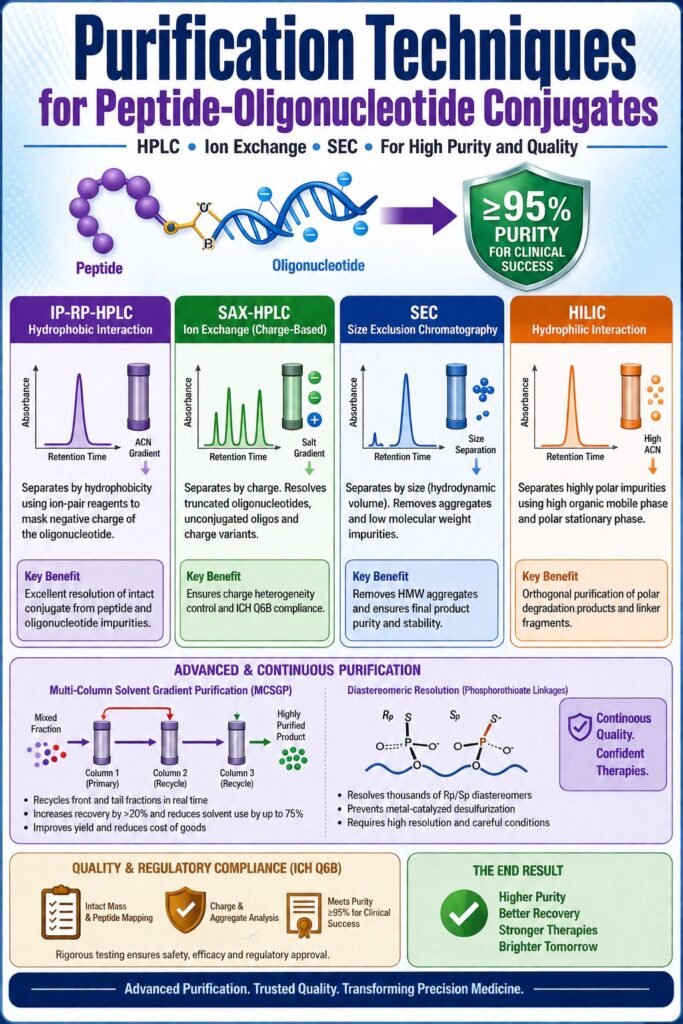
High-Performance Liquid Chromatography (HPLC) in Purification Techniques for Peptide-Oligonucleotide Conjugates
High-Performance Liquid Chromatography (HPLC) purifies peptide-oligonucleotide conjugates by exploiting subtle differences in hydrophobicity and polarity through the use of specialized stationary phases, elevated operating temperatures, and carefully optimized ion-pairing reagents. One of the principal challenges in HPLC-based separation of POCs arises from the complex electrostatic interactions within the conjugate itself. Cationic cell-penetrating peptides (CPPs), including nona-arginine sequences, often interact unpredictably with the negatively charged phosphodiester or phosphorothioate backbone of the oligonucleotide. These interactions can promote self-association and aggregation, resulting in poor chromatographic resolution and inconsistent peak shapes.
Looking to streamline your production pipeline? Discover advanced peptide-oligonucleotide conjugate synthesis methods.
Ion-Pair Reversed-Phase HPLC (IP-RP-HPLC)
Ion-Pair Reversed-Phase HPLC (IP-RP-HPLC) separates peptide-oligonucleotide conjugates according to hydrophobicity by employing mobile-phase additives that transiently mask the polyanionic charge of the oligonucleotide backbone. This temporary neutralization enables the intact conjugate to interact more consistently with the reversed-phase stationary phase. Successful separation at both analytical and preparative scales generally requires the use of wide-pore C18 columns, typically with pore sizes around 300Å, to accommodate the substantial hydrodynamic dimensions of these hybrid biopolymers. Such column configurations reduce steric limitations and improve mass transfer during chromatographic partitioning.
Among all method development variables, the choice of ion-pairing reagent is often the most influential factor affecting chromatographic performance. Although triethylammonium acetate (TEAA) has long served as a standard reagent for unconjugated oligonucleotide analysis, purification of POCs typically demands more specialized ion-pairing systems capable of compensating for the influence of the peptide moiety. Extensive analytical evaluations have demonstrated that different ion-pairing reagents can significantly affect recovery, retention behaviour, peak symmetry, and overall resolution.
Triethylamine and Hexafluoroisopropanol (TEA/HFIP)
The TEA/HFIP system is highly volatile and maintains a pH range compatible with column stability. It is particularly advantageous for downstream Liquid Chromatography–Mass Spectrometry (LC-MS) applications because it minimizes alkali metal adduct formation and reduces ionization suppression effects. Nevertheless, in preparative-scale chromatography, TEA/HFIP may occasionally produce inconsistent peak areas when analysing highly basic peptide-oligonucleotide conjugates.
Triethylammonium Acetate (TEAA)
TEAA, commonly employed at concentrations of approximately 100 mM and pH 7.0, generates highly reproducible chromatograms. However, its use frequently results in broader chromatographic peaks, which can reduce the ability to resolve closely related structural variants and low-level impurities.
Diethylammonium Acetate (DEAA)
Under standard operating conditions, DEAA has generally demonstrated unstable retention characteristics and reduced chromatographic resolution, particularly when applied to conjugates containing arginine-rich peptide sequences.
Butylammonium Acetate (BAA)
For highly complex peptide-oligonucleotide conjugates, BAA at a concentration of 100 mM and pH 7.0 consistently provides superior peak shape, recovery, and chromatographic resolution. The increased hydrophobic character imparted by the butyl group enhances retention of the polyanionic oligonucleotide backbone, strengthening interactions with the C18 stationary phase and producing sharper peaks that facilitate the separation of trace-level impurities.
Temperature regulation is another critical parameter in IP-RP-HPLC method optimization. Peptide-oligonucleotide conjugates possess a strong tendency to form intermolecular assemblies, which frequently appear chromatographically as broad, unresolved peak clusters. Raising the column temperature to between 60°C and 80°C supplies sufficient thermal energy to disrupt secondary structures and reduce electrostatic aggregation. Operating near 80°C often produces significantly sharper and more quantifiable chromatographic peaks, enabling precise identification and separation of minor synthetic by-products, including conjugates lacking specific terminal alkyne functionalities.
Navigating complex manufacturing bottlenecks? Learn how to overcome key challenges in peptide-oligonucleotide conjugates.
| Chromatographic Parameter | Optimized Condition | Technical Rationale |
|---|---|---|
| Column Type | Wide-pore C18 (e.g., 300Å) | Accommodates large hybrid biopolymers and minimizes steric restrictions. |
| Column Temperature | 60°C to 80°C | Disrupts secondary structures and reduces electrostatic aggregation. |
| Mobile Phase A | 100 mM Butylammonium Acetate (BAA) (pH 7.0) | Ion-pairing mechanism neutralizes backbone charge, improving retention and peak symmetry. |
| Mobile Phase B | Acetonitrile (ACN) or Methanol | Supports efficient elution of hydrophobic peptide segments. |
| Gradient Elution | Shallow gradients (e.g., 7% to 17% ACN over 10 min) | Maximizes separation between the intact conjugate and closely eluting truncated variants. |
Hydrophilic Interaction Liquid Chromatography (HILIC)
Hydrophilic Interaction Liquid Chromatography (HILIC) separates peptide-oligonucleotide conjugates based on polarity and partitioning behaviour, providing an orthogonal purification strategy for highly polar impurities that may co-elute under conventional reversed-phase conditions. Through the use of aqueous-organic mobile phases containing high proportions of acetonitrile and polar stationary phases such as silica or amide-functionalized materials, HILIC effectively retains and separates the highly polar oligonucleotide component of the conjugate.
This chromatographic technique is particularly valuable in industrial purification workflows because it efficiently isolates impurity classes that are not adequately retained on conventional hydrophobic stationary phases. During solid-phase synthesis and subsequent conjugation processes, numerous highly polar degradation products can be generated, including cleaved hydrophilic linker fragments, deprotected nucleobase derivatives, and unconjugated polyanionic oligonucleotides. These contaminants can complicate preparative RP-HPLC operations and reduce purification efficiency. HILIC provides an additional purification dimension that effectively removes such polar species, thereby improving the overall purity of the final active pharmaceutical ingredient (API).
Ion Exchange Chromatography (IEX) for Charge-Based Separation
Ion Exchange Chromatography (IEX) purifies peptide-oligonucleotide conjugates by separating molecules according to their net electrostatic charge. This approach is highly effective for distinguishing the desired conjugate from truncated nucleotide sequences, deletion variants, and unconjugated oligonucleotide impurities. Because both peptide and oligonucleotide synthesis involve repetitive stepwise coupling reactions on solid supports, cumulative efficiency losses inevitably lead to the formation of failure sequences. Even when coupling efficiencies exceed 99% at each synthetic step, the production of a 40-mer conjugate can still generate measurable populations of n-1, n-2, and other truncated species.
Ensure robust bioconjugation design. Read about peptide-oligonucleotide conjugate linker chemistry best practices.
Strong Anion Exchange (SAX-HPLC) in Purification Techniques for Peptide-Oligonucleotide Conjugates
Strong Anion Exchange HPLC (SAX-HPLC) is a critical component of Purification Techniques for Peptide-Oligonucleotide Conjugates, enabling the resolution of structurally related impurities through differences in negative charge density associated with oligonucleotide chain length. The negatively charged nucleic acid backbone binds strongly to the positively charged quaternary ammonium groups present on the SAX stationary phase. Because an n-1 deletion variant contains one fewer negative charge than the full-length conjugate, it exhibits slightly weaker interaction with the stationary phase and consequently elutes earlier during a controlled salt-gradient separation.
Within comprehensive downstream processing workflows, SAX-HPLC is generally employed after IP-RP-HPLC purification. Whereas reversed-phase methods primarily separate species according to peptide hydrophobicity and linker integrity, SAX-HPLC provides a rigorous assessment of oligonucleotide sequence integrity. To achieve optimal separation performance, SAX-HPLC methods commonly utilize gradients of sodium perchlorate, sodium chloride, or sodium bromide at elevated pH values, often greater than 8.0. These conditions help suppress non-specific hydrophobic interactions while enabling controlled elution of strongly retained biopolymeric species.
The primary impurity classes targeted by SAX-HPLC include:
Truncated Oligonucleotides
Deletion variants such as n-1 and n-2 sequences arise from incomplete phosphoramidite coupling reactions during solid-phase oligonucleotide synthesis. These impurities exhibit reduced charge density and can be effectively separated from the full-length product using SAX-HPLC.
Unconjugated Oligonucleotides
These impurities consist of full-length oligonucleotide sequences that failed to conjugate with the peptide component during the ligation or coupling stage. Their charge characteristics differ sufficiently from the desired conjugate to permit chromatographic separation.
Deamidated Peptide Variants
Peptide deamidation reactions, such as the conversion of asparagine residues to aspartic acid, introduce subtle changes in the overall net charge of the conjugate. SAX-HPLC can detect and resolve these charge-modified variants from the desired product population.
In addition to its purification role, IEX serves an important regulatory function by supporting compliance with ICH Q6B requirements. Regulatory authorities require comprehensive characterization and quantification of charge heterogeneity in biopharmaceutical products. SAX-HPLC offers a validated and highly reproducible analytical platform for profiling charge variants, demonstrating manufacturing consistency across production batches and confirming that charge-related impurities remain within acceptable limits without adversely affecting the therapeutic performance of the product.
Size Exclusion Chromatography (SEC) and Aggregate Removal
Size Exclusion Chromatography (SEC) eliminates high-molecular-weight aggregates and low-molecular-weight reaction by-products by passing the sample through a porous stationary phase where separation is governed exclusively by hydrodynamic volume. Unlike interaction-based chromatographic techniques such as RP-HPLC or Ion Exchange Chromatography (IEX), SEC operates through a physical sieving mechanism. Smaller molecules penetrate the pores of the stationary phase and travel through a longer and more complex path, resulting in delayed elution. In contrast, larger molecular assemblies are unable to enter the pores and therefore pass through the column more rapidly, eluting within the void volume.
Managing Aggregation and Linker Stability
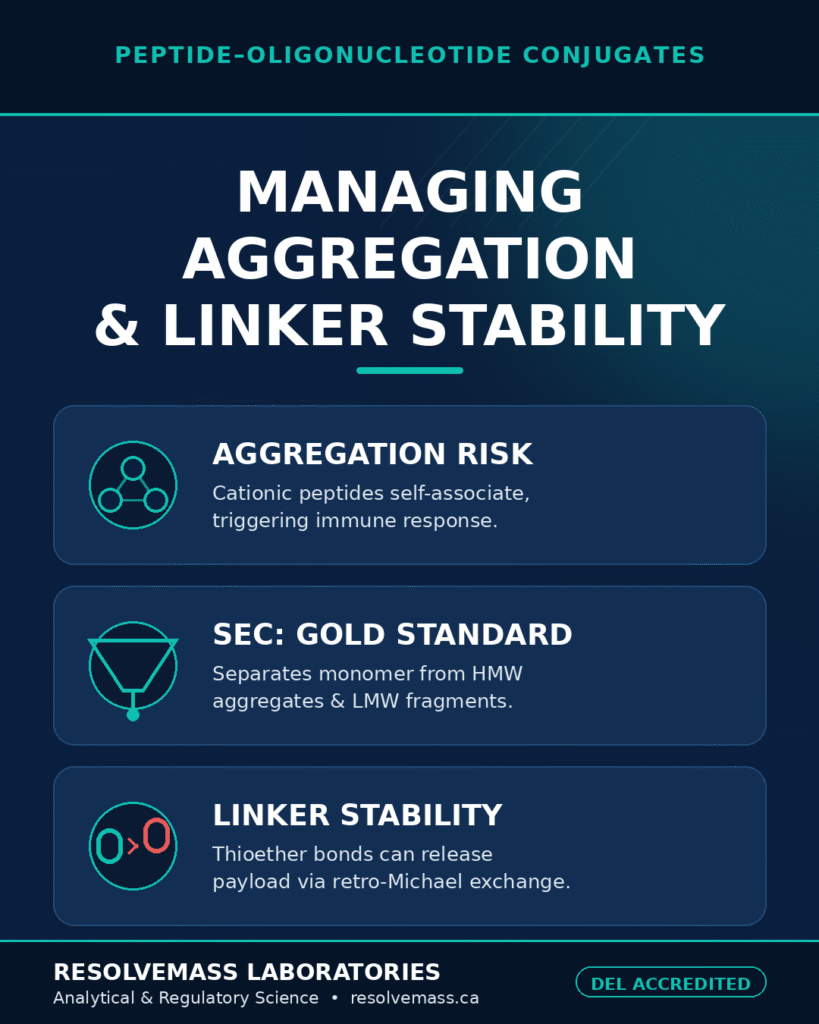
Aggregation represents one of the most critical safety and performance concerns in the development and formulation of peptide-oligonucleotide therapeutics. Amphipathic and highly hydrophobic cell-penetrating peptides frequently promote intermolecular self-association, leading to the formation of nanoscale coiled-coil assemblies and fibrillar structures. These aggregates can induce unwanted immunogenic responses and significantly alter the biodistribution, pharmacokinetics, and therapeutic performance of the drug product. SEC remains the gold-standard, regulatory-accepted technique for separating the active monomeric peptide-oligonucleotide conjugate from these high-molecular-weight (HMW) aggregate species. In addition, SEC effectively removes low-molecular-weight (LMW) contaminants, including residual free peptides, cleaved linker fragments, and excess conjugation reagents such as copper catalysts and unreacted maleimide linkers.
Beyond its role in initial purification, SEC is extensively employed during long-term stability assessments and forced degradation studies. Peptide-oligonucleotide conjugates constructed through thiol-maleimide conjugation chemistries contain thioether linkages that may be susceptible to degradation under specific conditions. In the presence of physiological thiols such as glutathione, or during prolonged storage in aqueous formulations, the thioether bond can undergo retro-Michael exchange reactions, resulting in premature release of the oligonucleotide payload. SEC enables analytical scientists to directly monitor the appearance of free oligonucleotides over time, thereby providing critical information regarding conjugate stability. This approach also allows confirmation of whether advanced stabilization techniques, including controlled hydrolysis of the thiosuccinimide ring to lock the conjugate into a more stable configuration, have been successfully implemented.
The emergence of Native SEC coupled with Mass Spectrometry (SEC-MS) has further enhanced the characterization of hybrid biotherapeutics. Since peptide conjugation significantly alters the molecular weight of the oligonucleotide component, SEC-MS provides effective baseline separation between the conjugated product and its unconjugated precursors. This capability enables real-time confirmation of conjugation stoichiometry, such as verification of a 1:1 peptide-to-oligonucleotide ratio, while simultaneously supporting purity assessment. Unlike RP-HPLC methods that often require ion-pairing reagents capable of suppressing ionization efficiency, SEC-MS allows direct mass analysis with substantially reduced signal interference.
Maximize product shelf-life and monitor degradation pathways. Explore comprehensive data on peptide-oligonucleotide conjugate stability.
| Chromatography Mode | Separation Principle | Primary Targeted Impurities | Industrial Application |
|---|---|---|---|
| IP-RP-HPLC | Hydrophobic interaction | Chemically modified fragments, unreacted peptides | Primary preparative separation; essential for sequence-specific resolution. |
| SAX-HPLC | Electrostatic charge | n-1 deletions, unconjugated free oligonucleotides | Charge heterogeneity profiling and ICH Q6B compliance. |
| SEC | Hydrodynamic radius | HMW aggregates, LMW linker fragments | Final polishing step, aggregate removal, and stability monitoring. |
| HILIC | Partitioning / Polarity | Highly polar linkers and degradation products | Orthogonal purification of hydrophilic contaminants. |
Advanced and Continuous Purification Methodologies
Advanced purification technologies, including Multi-Column Solvent Gradient Purification (MCSGP) and stereospecific resolution approaches, significantly improve both manufacturing yield and regulatory compliance in peptide-oligonucleotide conjugate production. As POCs progress from early-stage clinical development toward commercial manufacturing, economic and operational challenges become increasingly significant. Conventional batch chromatography often requires large volumes of costly solvents, specialized stationary phases, and extended processing times. To overcome these limitations, modern biomanufacturing facilities are increasingly adopting continuous processing technologies that improve efficiency, enhance recovery, and reduce manufacturing costs.
Multi-Column Solvent Gradient Purification (MCSGP)
Multi-Column Solvent Gradient Purification (MCSGP) continuously recycles partially purified chromatographic fractions that would otherwise be discarded, thereby maximizing recovery of the target conjugate while maintaining stringent purity specifications. During traditional single-column batch purification, the leading and trailing portions of the main product peak frequently overlap with closely eluting impurities, including n-1 truncation products, deamidated variants, and other structurally related contaminants. To maintain purity levels of ≥95%, these overlapping fractions are typically discarded, resulting in substantial product losses.
MCSGP addresses this inefficiency through the use of a synchronized multi-column architecture. As the front and tail fractions emerge from the primary column, the system automatically redirects these mixed fractions onto secondary columns for additional separation in real time. Meanwhile, the highly purified centre fraction is collected as the final product. This continuous recycling process dramatically improves recovery while preserving product quality.
Industrial implementation of MCSGP has demonstrated remarkable benefits for peptide-oligonucleotide conjugate scale-up. Published manufacturing data indicate that continuous chromatography can increase overall product recovery by more than 20% while reducing solvent consumption by as much as 75%.
This substantial reduction in solvent usage, particularly for high-purity acetonitrile and specialized ion-pairing reagents such as Butylammonium Acetate, contributes significantly to lowering the overall cost of goods (CoGs). When integrated with orthogonal purification techniques such as IP-RP-HPLC and SAX-HPLC, MCSGP ensures that commercial-scale manufacturing can achieve high yields without compromising the stringent impurity limits required by international regulatory authorities.
Diastereomeric Resolution of Phosphorothioate Linkages
One of the most technically demanding challenges in peptide-oligonucleotide conjugate purification arises from the stereochemical complexity associated with phosphorothioate (PS) backbones. To protect oligonucleotide therapeutics from rapid nuclease-mediated degradation in biological systems, non-bridging oxygen atoms within phosphodiester linkages are frequently replaced with sulfur atoms. While this modification substantially enhances biological stability, it simultaneously introduces a chiral centre at each modified phosphorus atom, generating thousands of potential diastereomeric forms consisting of Rp and Sp configurations within a single manufacturing batch.
These diastereomers possess subtle yet meaningful differences in hydrophobicity and three-dimensional structure. Consequently, they often elute as broad and overlapping multiplets rather than as a single, well-defined chromatographic peak during IP-RP-HPLC analysis. Effective management of this stereochemical heterogeneity requires exceptionally high-resolution chromatographic methods, shallow gradient profiles, and carefully controlled column temperatures that may reach 80°C to minimize peak broadening and maximize resolution.
Furthermore, special precautions must be implemented during purification of phosphorothioate-modified conjugates to prevent metal-catalysed desulfurization. When conjugates are synthesized using copper-catalysed azide-alkyne cycloaddition (CuAAC) click chemistry, residual copper ions may interact with sulfur atoms within the phosphorothioate backbone. This interaction can remove sulfur atoms and convert phosphorothioate linkages back to conventional phosphodiester bonds. Such desulfurization events are commonly detected during post-purification High-Resolution Mass Spectrometry (HRMS) analysis, where the conjugate exhibits a mass decrease of 16 Da for each affected linkage. Therefore, complete removal of residual metal catalysts before final polishing and formulation is essential to preserve the intended pharmacokinetic stability and therapeutic performance of the product.
Gain deep insights into molecular conformation. Read about structural characterization of peptide-oligonucleotide conjugates.
Quality Control and ICH Q6B Regulatory Compliance
Regulatory compliance under ICH Q6B requires purification processes for peptide-oligonucleotide conjugates to be validated using rigorous orthogonal analytical methodologies, including intact mass spectrometry, peptide mapping, and aggregate quantification. The International Council for Harmonisation (ICH) Q6B guideline establishes the specifications and critical quality attributes (CQAs) that biopharmaceutical products must satisfy to support successful regulatory submissions such as New Drug Applications (NDAs) and Biologics License Applications (BLAs).
Because peptide-oligonucleotide conjugates are hybrid molecules that combine characteristics of both peptides and nucleic acids, comprehensive structural characterization requires analytical techniques adapted from both fields. Following purification, exact molecular weight confirmation must be performed using High-Resolution Mass Spectrometry (HRMS), often in conjunction with volatile ion-pairing systems such as HFIP/TEA to minimize signal suppression and improve mass accuracy.
In addition, peptide mapping studies are required to verify the primary amino acid sequence of the peptide component and confirm the precise site of conjugation. By employing complementary proteolytic digestion strategies, such as dual enzyme digestion using Glu-C and Chymotrypsin followed by UPLC-HRMS analysis, analytical scientists can generate detailed peptide maps that provide extensive structural confirmation. These maps demonstrate that the peptide component has not undergone unintended post-translational modifications, cleavage events, or sequence deletions during solid-phase synthesis, conjugation, purification, or downstream processing.
Only through the successful integration of advanced purification technologies, continuous manufacturing strategies, and comprehensive structural characterization can peptide-oligonucleotide conjugates satisfy the rigorous safety, efficacy, and quality expectations required for modern precision medicine applications.
Prepare your documentation with confidence. Learn about peptide-oligonucleotide conjugates in IND submissions.
Conclusion
The successful purification and commercialization of next-generation hybrid biotherapeutics depend on the precise implementation of advanced Purification Techniques for Peptide-Oligonucleotide Conjugates. Because these complex molecules combine the distinct chemical properties of hydrophobic amino acid sequences and highly polyanionic nucleotide structures, conventional downstream purification approaches are fundamentally insufficient. Achieving the stringent purity requirement of ≥95% necessary for clinical performance demands a comprehensive orthogonal purification strategy that integrates Ion-Pair Reversed-Phase HPLC for hydrophobicity-based separation, Strong Anion Exchange Chromatography for charge-based sequence evaluation, and Size Exclusion Chromatography for critical aggregate removal and final product polishing.
In addition, the incorporation of continuous manufacturing technologies such as MCSGP enables these demanding quality specifications to be achieved efficiently at commercial scale while significantly reducing solvent consumption and improving overall product recovery. Successfully navigating the physicochemical complexity of peptide-oligonucleotide conjugates, preserving linker integrity against retro-Michael degradation, and fulfilling ICH Q6B regulatory expectations require highly specialized expertise and analytical infrastructure.
Accelerate your development timeline. Discover our expert peptide-oligonucleotide conjugates preclinical services.
ResolveMass Laboratories Inc. remains at the forefront of this rapidly evolving field, developing customized purification and structural characterization workflows that transform crude, heterogeneous reaction mixtures into highly purified, stereochemically defined, clinical-grade therapeutics.
To collaborate with experts in conjugate characterization and scalable biomanufacturing, please contact us here: Contact page
Frequently Asked Questions (FAQs)
Peptide-oligonucleotide conjugates possess both hydrophobic peptide regions and highly charged oligonucleotide segments, making them difficult to separate using conventional reversed-phase chromatography alone. IP-RP-HPLC employs ion-pairing reagents that temporarily reduce the effective negative charge of the oligonucleotide backbone, improving retention on hydrophobic stationary phases. This approach enhances resolution and enables effective separation of the desired conjugate from structurally similar impurities and synthesis by-products.
Ion-exchange chromatography differentiates molecules according to their overall charge characteristics. In peptide-oligonucleotide conjugates, truncated sequences such as n-1 or n-2 variants contain fewer nucleotides and therefore possess a different charge profile than the full-length product. Strong Anion Exchange (SAX) chromatography exploits these subtle charge differences, allowing efficient separation and purification of the desired conjugate from deletion-related impurities generated during synthesis.
Column temperature and mobile-phase pH have a significant influence on chromatographic performance during peptide-oligonucleotide conjugate purification. Elevated temperatures help disrupt secondary structures and reduce intermolecular interactions that can cause peak broadening or poor resolution. At the same time, carefully controlled pH conditions help maintain linker integrity, improve chromatographic reproducibility, and ensure consistent retention behaviour throughout the purification process.
Butylammonium Acetate (BAA) often provides superior chromatographic performance for complex peptide-oligonucleotide conjugates because its hydrophobic butyl group enhances interactions with reversed-phase stationary phases. This increased retention can improve peak shape, resolution, and recovery, particularly for conjugates containing highly basic peptide sequences. In many cases, BAA enables more effective separation of closely related impurities than traditional ion-pairing reagents such as Triethylammonium Acetate (TEAA).
MCSGP increases manufacturing efficiency by continuously recycling partially purified fractions that would normally be discarded in traditional batch chromatography. Instead of sacrificing product yield to maintain purity, the system redirects overlapping fractions for additional separation and recovery. This continuous processing approach can substantially improve overall product recovery while simultaneously reducing solvent consumption and lowering manufacturing costs.
Crude peptide-oligonucleotide conjugate preparations often contain a diverse range of impurities generated during synthesis and conjugation. Common examples include unreacted peptides, unconjugated oligonucleotides, truncated sequences, degraded linker fragments, and aggregated species. Additional impurities may arise from side reactions, oxidation, deamidation, or incomplete coupling events, making comprehensive purification essential for obtaining a high-quality final product.
Phosphorothioate modifications introduce stereochemical complexity because each modified phosphorus atom can exist in multiple configurations. As a result, a single conjugate preparation may contain numerous closely related diastereomeric forms. High-resolution chromatographic methods, carefully optimized gradients, and controlled operating temperatures are commonly employed to improve separation and ensure consistent product quality, purity, and performance across manufacturing batches.
The purification and characterization of peptide-oligonucleotide conjugates are generally performed in accordance with regulatory expectations outlined in ICH Q6B and other relevant quality guidelines. These requirements emphasize comprehensive assessment of critical quality attributes, including purity, identity, aggregation, charge heterogeneity, and structural integrity. Analytical techniques such as High-Resolution Mass Spectrometry (HRMS), peptide mapping, and orthogonal chromatographic methods are commonly used to demonstrate product quality and support regulatory submissions.
Reference:
- McGinnis, A. C., Grubb, E. C., & Bartlett, M. G. (2013). Systematic optimization of ion-pairing agents and hexafluoroisopropanol for enhanced electrospray ionization mass spectrometry of oligonucleotides. Rapid Communications in Mass Spectrometry, 27(23), 2655–2664. https://doi.org/10.1002/rcm.6733
- Ajinomoto Co., Inc. (2020). Method for producing modified oligonucleotide including complementary sequence (WO Patent No. WO2020171092A1). World Intellectual Property Organization (WIPO). https://patents.google.com/patent/WO2020171092A1/en
- Dyne Therapeutics, Inc. (2025). Muscle targeting complexes and formulations for treating myotonic dystrophy (U.S. Patent No. US12440574B2). U.S. Patent and Trademark Office. Google Patents Record
- Lahnsteiner, M., Kastner, A., Mayr, J., Roller, A., Keppler, B. K., & Kowol, C. R. (2020). Improving the stability of maleimide–thiol conjugation for drug targeting. Chemistry – A European Journal, 26(68), 15867–15870. https://doi.org/10.1002/chem.202003951
- F. Hoffmann-La Roche AG. (2021). Conjugates comprising oligonucleotides and branched polypeptides (European Patent Application No. EP3774824A1). European Patent Office. https://patents.google.com/patent/EP3774824A1/en
- Takakura, Y., Hanayama, R., Akiyoshi, K., Futaki, S., Hida, K., Ichiki, T., Ishii-Watabe, A., Kuroda, M., Maki, K., Miura, Y., Okada, Y., Seo, N., Takeuchi, T., Yamaguchi, T., & Yoshioka, Y. (2024). Quality and safety considerations for therapeutic products based on extracellular vesicles. Pharmaceutical Research, 41(8), 1573–1594. https://doi.org/10.1007/s11095-024-03757-4
Get In Touch With Us
About The Author


