Introduction
Quantitative NMR (qNMR) for peptide reference standard characterization is an increasingly important analytical approach for establishing the quantitative content, purity, and identity of peptide reference materials. Unlike chromatographic methods that depend on detector response and external calibration curves, qNMR determines the amount of a compound from the integrated NMR response of selected nuclei relative to a known reference — giving sponsors an independent, orthogonal measurement that does not rely on a pre-qualified standard of the same peptide.
Peptide reference standards underpin identity testing, assay, impurity evaluation, system suitability, method development, and comparative analytical studies. Because every downstream release, stability, and comparability result traces back to how well the reference material itself was characterized, a rigorous, multi-technique value-assignment strategy matters as much for the reference standard as it does for the drug substance it supports. For synthetic and therapeutic peptides, however, qNMR should not be treated as a stand-alone solution for every quality attribute — peptides generate complex spectra, structurally related impurities can overlap with target signals, and factors such as counter-ions, water, residual solvents, and sample heterogeneity all affect the assigned value. A scientifically sound strategy combines qNMR with orthogonal analytical techniques as part of comprehensive peptide characterization services.
Summary:
- Quantitative NMR (qNMR) for peptide reference standard characterization provides a direct, orthogonal approach for assigning peptide purity or content based on NMR signal integration against a suitable calibrant.
- qNMR complements — not replaces — HPLC, LC-MS/MS, amino acid analysis, and mass spectrometry when building a well-characterized peptide reference standard.
- Peptide qNMR demands careful control of sample preparation, internal standard selection, signal specificity, relaxation delay, temperature, solvent, water content, and integration parameters.
- Spectral overlap from related peptide impurities is one of the biggest practical challenges in applying qNMR to complex peptide materials, including cyclic peptides.
- A defensible purity assignment considers mass balance — peptide content, counter-ions, water/solvent, residual impurities, and measurement uncertainty — rather than a single analytical result.
- Regulatory expectations (FDA Q6A, ICH Q6B) require that reference standards be appropriately characterized and quantitatively measured for their intended purpose.
- ResolveMass Laboratories Inc. integrates qNMR with complementary characterization techniques to build scientifically defensible data packages for peptide development, IND, NDA, and ANDA programs.
1: What Is qNMR for Peptide Reference Standards?
qNMR for peptide reference standards is the quantitative application of nuclear magnetic resonance spectroscopy to determine the amount or purity of a peptide by comparing selected NMR signal integrals against those of a calibrated reference compound.
In a typical ¹H-qNMR experiment, the area of a suitable peptide resonance is compared with the area of a signal from an internal or external standard of known concentration or certified purity. The relationship can be represented conceptually as:
Peptide content ∝ (Peptide signal integral ÷ Reference signal integral) × Reference concentration × Molecular-weight and stoichiometric corrections
The calculation must also account for the number of nuclei contributing to each integrated signal. The appeal of qNMR comes from the inherently quantitative nature of the NMR response — signal area is directly proportional to the number of contributing nuclei, independent of extinction coefficients or column chemistry. USP technical material has specifically discussed qNMR as an approach for peptide reference-material quantitation, while highlighting practical challenges such as overlapping peptide signals, internal-standard selection, and the general complexity of peptide spectra.
2: Why Peptide Reference Standards Need an Absolute Purity Method
A peptide reference standard’s purity value must reflect actual peptide content, not just chromatographic homogeneity, because dosing calculations, potency assignments, and specification limits all trace back to this single number.
qNMR can provide an important orthogonal measurement of peptide content that strengthens the overall body of evidence supporting reference-standard value assignment. For a peptide reference standard, the analytical objective is usually far broader than simply demonstrating the peptide is present. A laboratory may need to establish:
- Identity
- Quantitative peptide content
- Chemical purity
- Related peptide impurities
- Counter-ion content
- Water and residual solvent
- Degradation products
- Homogeneity
- Stability
- Lot-to-lot consistency
- Measurement uncertainty
Chromatographic purity (HPLC/UPLC area%) alone tells you how “clean” a peak looks relative to other peaks in the same run, but it says nothing about non-UV-active impurities, residual water or trifluoroacetate (TFA) counter-ions bound to the peptide, or the actual peptide mass fraction versus total vial content. A multi-technique approach incorporating NMR, mass spectrometry, HPLC, and other analytical procedures is what establishes a truly defensible reference-material value — the same integrated strategy applied in therapeutic peptide characterization for NDA and ANDA submissions.
3: How Is qNMR Used for Peptide Purity Assignment?
qNMR is used for peptide purity assignment by selecting quantitatively suitable, sufficiently resolved signals and comparing their integrated response against a traceable or appropriately characterized reference standard.
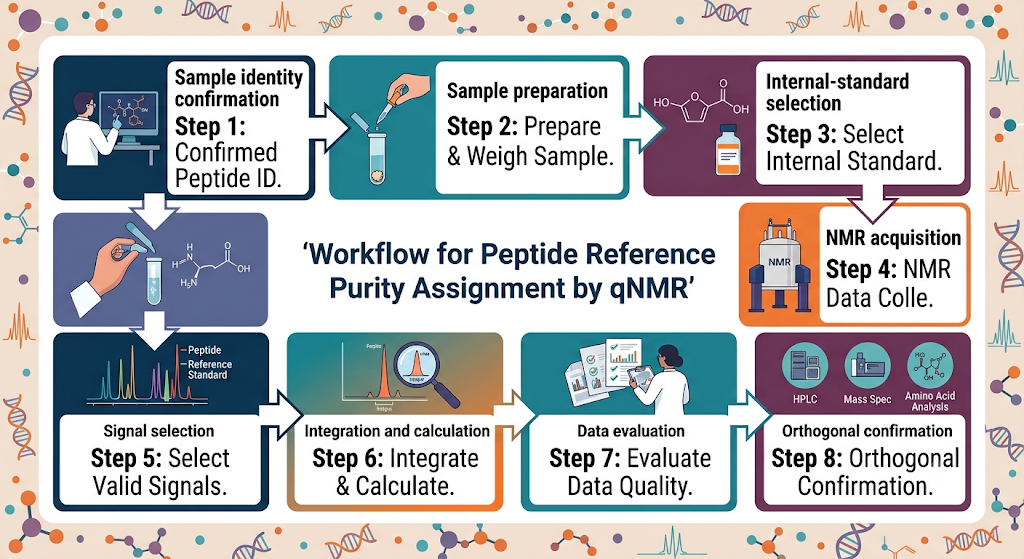
Typical qNMR workflow for a peptide reference standard:
- Sample identity confirmation – Confirm the peptide structure and expected molecular characteristics using appropriate orthogonal techniques before quantitation begins.
- Sample preparation – Accurately weigh the peptide and reference material, select an appropriate deuterated solvent (commonly D₂O or DMSO-d₆), and ensure complete dissolution and homogeneous sample preparation.
- Internal-standard selection – Choose a stable compound with suitable solubility and spectral separation (e.g., maleic acid, dimethyl sulfone, or 1,4-BTMSB) that does not react with or interact significantly with the peptide.
- NMR acquisition – Optimize pulse sequence, relaxation delay, number of scans, temperature, receiver gain, shimming, and other acquisition parameters for fully quantitative conditions.
- Signal selection – Identify peptide resonances that are sufficiently resolved from impurities, solvent signals, water, and reference-standard peaks.
- Integration and calculation – Integrate predefined regions and apply the appropriate proton-count and molecular-weight corrections.
- Data evaluation – Assess repeatability, spectral quality, signal-to-noise ratio, integration consistency, and potential spectral overlap.
- Orthogonal confirmation – Compare the qNMR result with complementary methods such as HPLC, LC-MS/MS, amino acid analysis, or mass-balance calculations.
4: Key Factors Affecting qNMR for Peptide Reference Standards
Several method-level factors can significantly influence the accuracy of a qNMR-derived purity value.
| Factor | Why It Matters |
|---|---|
| Internal standard | Its purity, stability, solubility, and signal separation directly influence quantitation |
| Signal selection | Overlapping signals can produce biased peptide content values |
| Relaxation delay | Insufficient relaxation can cause systematic integration errors |
| Sample weighing | Gravimetric uncertainty contributes directly to the final result |
| Solvent | Solubility, exchangeable protons, and spectral resolution depend strongly on solvent choice |
| Temperature | Temperature changes can affect chemical shifts, viscosity, and sample behavior |
| Concentration | Very high or low concentrations may negatively affect spectral quality |
| Water content | Peptides can be hygroscopic, making dry-basis calculations important |
| Counter-ions | Acetate, TFA, chloride, and other counter-ions can affect molecular-weight and content calculations |
| Residual solvents | These may contribute to total mass without representing true peptide content |
| Spectral overlap | Related peptides and degradation products can interfere with integration |
| Data processing | Phase, baseline correction, integration boundaries, and processing parameters can influence results |
5: What Makes Peptide qNMR More Challenging Than Small-Molecule qNMR?
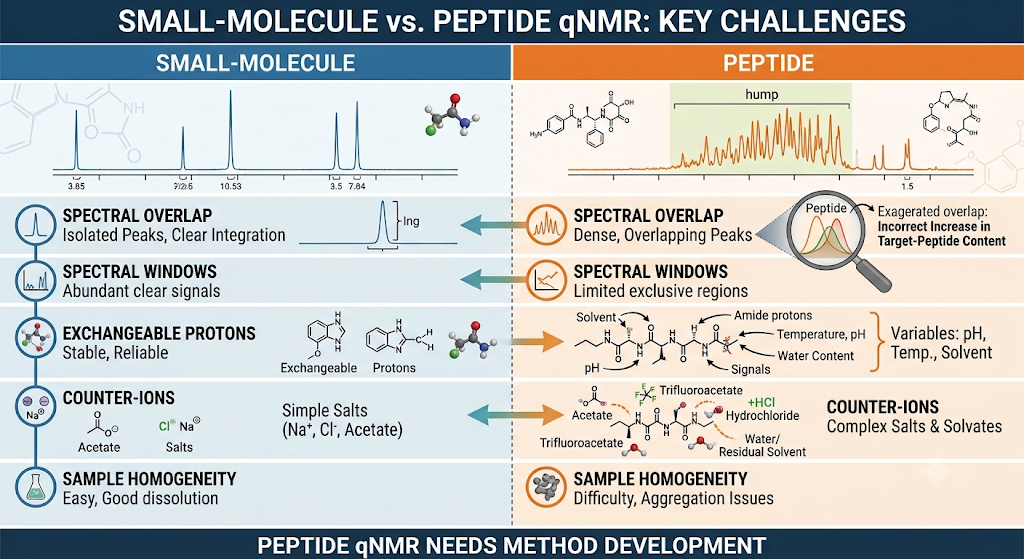
Peptide qNMR is more challenging than small-molecule qNMR because peptide spectra contain many closely spaced signals, creating a greater risk of overlap between the target peptide and structurally related impurities.
Small molecules often provide relatively simple spectra with isolated resonances that integrate cleanly. Peptides, in contrast, can contain numerous amino-acid-derived resonances spread throughout the spectrum. Important challenges include:
- Spectral overlap — Related peptide impurities can produce resonances in the same regions as the target peptide, causing an apparent increase in target-peptide content if the overlapping signal is incorrectly treated as pure target signal.
- Limited spectral windows — Finding a signal that belongs exclusively to the target peptide can be difficult; USP discussions of peptide qNMR have identified peptide spectral complexity and limited available regions for internal standards as important practical considerations.
- Exchangeable protons — Amide and other exchangeable protons are affected by solvent, temperature, concentration, pH, and water content, making them less reliable as quantitative signals.
- Counter-ions and solvates — The isolated peptide may exist as an acetate, trifluoroacetate, or hydrochloride salt, and water or residual solvent can substantially widen the gap between apparent mass-based purity and true peptide content.
- Sample homogeneity — Incomplete dissolution or aggregation can compromise quantitative reproducibility.
These challenges are especially pronounced for structurally complex or constrained sequences, which is why cyclic peptide characterization programs typically require additional method development around signal specificity and conformational behavior.
6: qNMR vs. HPLC vs. Amino Acid Analysis for Peptide Purity
qNMR and HPLC provide complementary rather than competing measurements. HPLC is highly effective for separating and profiling peptide-related impurities, while qNMR provides an independent quantitative measurement of peptide content when a suitable signal and method are available. Amino acid analysis adds a hydrolysis-based, absolute content check.
| Attribute | qNMR | HPLC | Amino Acid Analysis |
|---|---|---|---|
| Quantitative principle | NMR signal integration | Detector response | Hydrolysis-based content |
| Separation required | Not necessarily | Usually yes | No |
| Structural information | Strong | Limited without MS | Limited |
| Related impurity separation | Limited by spectral overlap | Generally strong | Limited |
| Detector response factors | Different approach entirely | May require consideration | Amino-acid-standard based |
| Peptide content | Useful | Useful | Useful |
| Impurity profiling | Limited for overlapping species | Strong | Not applicable |
| Requires reference standard of same peptide | No | Often yes (RRT-based) | No |
| Orthogonal value | High | High | High |
For a reference-standard program, using all three techniques together provides substantially stronger evidence than relying on any single method independently.
7: Role of LC-MS and Mass Spectrometry in Peptide Reference Standard Characterization
LC-MS and high-resolution mass spectrometry complement qNMR by confirming molecular mass and helping identify related peptide species that NMR integration alone may not distinguish. Mass spectrometry can help investigate:
- Molecular-ion confirmation
- Sequence-related impurities
- Truncated peptides
- Oxidation products
- Deamidation-related species
- Modification products
- Adducts
- Processing-related impurities
This orthogonal strategy is consistent with the broader multi-technique approach used for peptide reference standards, where NMR, mass spectrometry, and chromatography are combined to establish identity, purity, and assigned values. For structurally complex or higher-order peptide targets, this often extends to native mass spectrometry for therapeutic peptide characterization and to Multi-Attribute Method (MAM) for peptide characterization, which can monitor multiple quality attributes from a single high-resolution MS dataset alongside qNMR-derived content values.
8: qNMR and Mass-Balance Purity Assignment
qNMR can form one component of a mass-balance strategy in which peptide content is evaluated alongside chromatographic impurities, water, residual solvents, counter-ions, and inorganic components. A simplified mass-balance concept is:
Assigned purity/content = 100% − quantified impurities − water − residual solvents − other relevant components
The exact calculation depends on the reference material’s intended purpose, analytical design, and salt/counter-ion form. A two-step value-assignment strategy — in which bulk peptide material is quantitatively characterized before being used to assign values to vialed reference material — reflects why reference-standard characterization should be treated as a complete analytical program rather than a single purity test.
9: Regulatory Considerations for Peptide Reference Standards
Regulatory expectations favor appropriately characterized reference standards that are suitable for their intended analytical use and supported by scientifically justified analytical procedures.
- FDA Q6A states that a reference standard should have quality appropriate to its intended use, and that reference standards used for assay or purity testing should be appropriately characterized; for new drug-substance reference standards, purity should be measured using a quantitative procedure.
- ICH Q6B, for biological and biotechnology products, emphasizes characterization of physicochemical properties, purity, and impurities, and recommends appropriately characterized in-house reference materials where applicable.
- FDA analytical-procedure guidance provides further recommendations relevant to methods used to establish identity, strength, quality, purity, and potency of drugs and biologics.
qNMR should therefore be incorporated into a fit-for-purpose analytical strategy, with method performance, calculations, uncertainty, and complementary characterization considered according to the intended use of the reference material — whether that use is peptide characterization for ANDA submission, an IND filing, or internal method development.
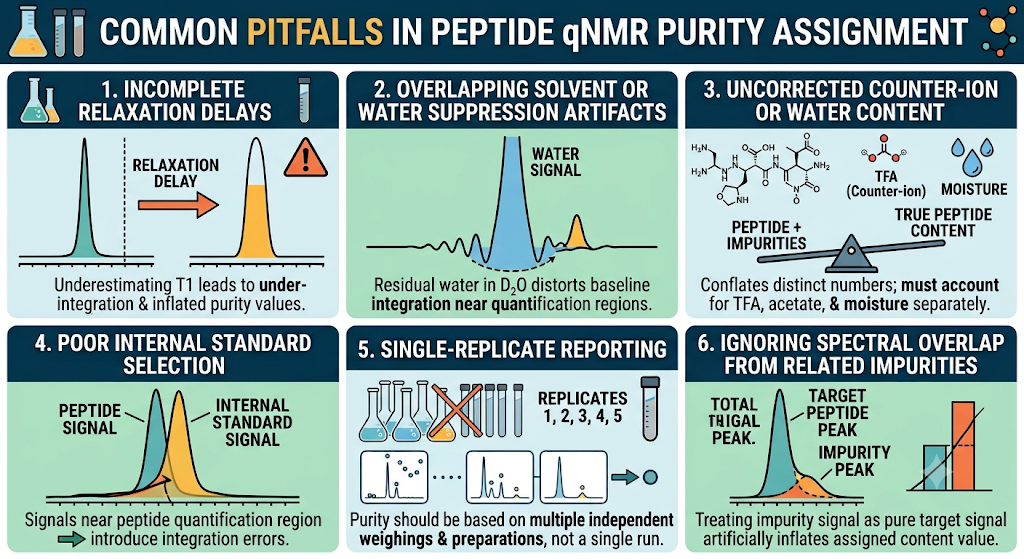
10: Common Pitfalls in Peptide qNMR Purity Assignment
Even a technically sound qNMR method can produce misleading purity values if a few well-known pitfalls are not controlled.
- Incomplete relaxation delays — underestimating T1 relaxation times leads to systematic under-integration and inflated purity values.
- Overlapping solvent or water suppression artifacts — residual water peaks in D₂O can distort baseline integration near quantification regions.
- Uncorrected counter-ion or water content — reporting “peptide purity” without separately accounting for TFA, acetate, or moisture content conflates two distinct numbers.
- Poor internal standard selection — a standard with signals near the peptide’s quantification region introduces integration error.
- Single-replicate reporting — purity assignment for a reference standard should be based on multiple independent weighings and preparations, not a single run.
- Ignoring spectral overlap from related impurities — treating an overlapping impurity signal as pure target signal artificially inflates the assigned content value.
12: What Should a qNMR Peptide Reference Standard Report Include?
A scientifically useful report documents enough information to allow the result to be evaluated and reproduced. Typical reporting elements include:
- Sample identification and batch number
- Peptide name and molecular information
- Sample preparation procedure, solvent, and concentration
- Reference-standard identity and purity
- NMR instrument, field strength, and probe information (where relevant)
- Temperature and acquisition parameters
- Number of scans and relaxation delay
- Selected quantitative signals and integration regions
- Calculation methodology
- Replicate results, precision/repeatability, and measurement uncertainty (where applicable)
- Observations concerning spectral overlap
- Complementary analytical results
- Final assigned value and basis for assignment
Good documentation is especially important when the material will later serve as a primary or secondary reference standard — the same level of documentation rigor covered in a peptide characterization CRO deliverables checklist. Sponsors evaluating outsourcing partners should also review specifications to provide when outsourcing peptide characterization to a CRO so that qNMR method scope, acceptance criteria, and reporting expectations are agreed upfront.
13: Benefits of qNMR for Peptide Reference Standards
- Orthogonal quantitation — provides a measurement independent of chromatographic detector response.
- Minimal dependence on analyte-specific calibration curves — quantitation is based on signal integration against an appropriate reference, not a compound-specific curve.
- Structural confirmation — NMR simultaneously provides valuable structural information alongside the purity value.
- Useful for value assignment — contributes directly to reference-material characterization packages.
- Complementary to LC-MS and HPLC — helps build a robust, multi-technique evidence package.
- Potentially non-destructive — the sample can remain chemically intact after analysis under appropriate conditions.
- Broad applicability — qNMR principles can be adapted to different peptide structures with appropriate method development.
14: How ResolveMass Approaches qNMR for Peptide Reference Standards
ResolveMass Laboratories Inc. approaches qNMR for peptide reference standards as part of an integrated analytical characterization strategy rather than treating qNMR as an isolated test. Depending on project requirements, a peptide reference-standard program may integrate:
- ¹H-NMR/qNMR characterization
- Peptide identity confirmation
- LC-MS/MS and high-resolution mass spectrometry
- RP-HPLC purity and impurity profiling
- Peptide mapping
- Residual solvent assessment
- Water determination
- Counter-ion evaluation
- Stability assessment
- Orthogonal analytical confirmation
- Reference-standard qualification and documentation
The appropriate combination depends on peptide structure, intended use, manufacturing process, formulation or salt form, expected impurities, and regulatory strategy. This integrated approach is especially valuable when a reference standard will support peptide characterization CRO services for IND submission, ANDA or NDA filings, method validation, release testing, stability programs, or comparability studies.
Conclusion:
Quantitative NMR (qNMR) for peptide reference standard characterization gives peptide developers an orthogonal, defensible purity value that chromatographic methods cannot provide on their own. Its value is greatest when qNMR is integrated with HPLC, LC-MS/MS, high-resolution mass spectrometry, water/solvent testing, counter-ion assessment, and other appropriate characterization techniques. Reliable value assignment requires more than a single NMR spectrum — signal specificity, internal-standard suitability, sample preparation, relaxation behavior, spectral overlap, counter-ions, water, impurities, measurement uncertainty, and orthogonal confirmation all need to be considered as part of a defensible peptide reference standard qualification package.
Frequently Asked Questions:
Mass-balance purity assignment evaluates the peptide together with relevant impurities and other components such as water, residual solvents, and counter-ions. A simplified concept is to subtract quantified non-target components from 100%. qNMR can contribute quantitative peptide-content information to such an approach. The exact calculation should be scientifically justified for the specific reference material.
A peptide qNMR report should typically include sample identification, sample preparation, solvent, concentration, NMR instrument information, temperature, acquisition parameters, relaxation delay, selected quantitative signals, integration regions, calculations, replicate results, precision, and measurement uncertainty where applicable. Any spectral overlap or analytical limitations should also be documented. The final assigned value should have a clearly described scientific basis.
qNMR can be applied to many synthetic and therapeutic peptides when the peptide is sufficiently soluble and provides suitable NMR signals for quantitative analysis. The method can be adapted based on peptide size, sequence, concentration, solvent, and structural characteristics. Method suitability should be assessed individually because complex peptide spectra can create signal-overlap challenges. Complementary techniques may be required for complete characterization.
Yes, 1H-qNMR can be suitable for peptide purity or content determination when appropriate quantitative signals can be identified. Proton NMR generally provides strong sensitivity and can offer several signals for evaluation. However, overlapping resonances and exchangeable protons can complicate quantitative analysis. Careful signal selection and validation are therefore important.
The solvent depends on the peptide’s solubility and chemical properties. Deuterated solvents such as D2O, DMSO-d6, CD3OD, or other suitable deuterated systems may be considered depending on the peptide. Solvent selection can influence chemical shifts, signal resolution, proton exchange, and sample stability. The selected solvent should therefore be justified based on the specific peptide.
Reference
- Josephs RD, Martos G, Li M, Wu L, Melanson JE, Quaglia M, Beltrão PJ, Prevoo-Franzsen D, Boeuf A, Delatour V, Öztug M. Establishment of measurement traceability for peptide and protein quantification through rigorous purity assessment—a review. Metrologia. 2019 Aug 1;56(4):044006.https://iopscience.iop.org/article/10.1088/1681-7575/ab27e5/meta
- Frank O, Kreissl JK, Daschner A, Hofmann T. Accurate determination of reference materials and natural isolates by means of quantitative 1H NMR spectroscopy. Journal of agricultural and food chemistry. 2014 Mar 26;62(12):2506-15.https://pubs.acs.org/doi/abs/10.1021/jf405529b
- Melanson JE, Thibeault MP, Stocks BB, Leek DM, McRae G, Meija J. Purity assignment for peptide certified reference materials by combining qNMR and LC-MS/MS amino acid analysis results: application to angiotensin II: Melanson JE et al. Analytical and bioanalytical chemistry. 2018 Oct;410(26):6719-31.https://link.springer.com/article/10.1007/s00216-018-1272-7
- Choi K, Myoung S, Seo Y, Ahn S. Quantitative NMR as a versatile tool for the reference material preparation. Magnetochemistry. 2021 Jan 18;7(1):15.https://www.mdpi.com/2312-7481/7/1/15
- McCarthy D, Han Y, Carrick K, Schmidt D, Workman W, Matejtschuk P, Duru C, Atouf F. Reference Standards to Support Quality of Synthetic Peptide Therapeutics: McCarthy et al. Pharmaceutical Research. 2023 Jun;40(6):1317-28.https://link.springer.com/article/10.1007/s11095-023-03493-1
About the Author