

Introduction
Radiolabeled Peptide Manufacturing involves a highly coordinated framework that combines automated solid-phase peptide synthesis, efficient chelator conjugation, and controlled radiometal complexation to produce high-purity diagnostic imaging agents. This case study outlines the essential technical considerations, analytical methodologies, and regulatory compliance practices required to advance peptide-based radiopharmaceuticals from research-stage development into scalable clinical manufacturing.
The commercial development of peptide-based radiotracers for Positron Emission Tomography (PET) and Single-Photon Emission Computed Tomography (SPECT) depends on stringent control of both precursor synthesis and radiochemical formulation processes. Diagnostic radiopeptides are designed to selectively bind cellular receptors such as somatostatin receptor subtype 2 (SSTR2), prostate-specific membrane antigen (PSMA), gastrin-releasing peptide receptors (GRPR), and integrins (αvβ3). Because of this receptor specificity, maintaining structural integrity and manufacturing consistency between production batches is essential. Variations in peptide sequence purity, chelator attachment efficiency, radiolabeling performance, or radiolytic stability can significantly influence clinical imaging outcomes, biodistribution behavior, and target-to-background image quality.
Explore our comprehensive solutions for peptide physicochemical characterization services to ensure complete structural integrity throughout development.
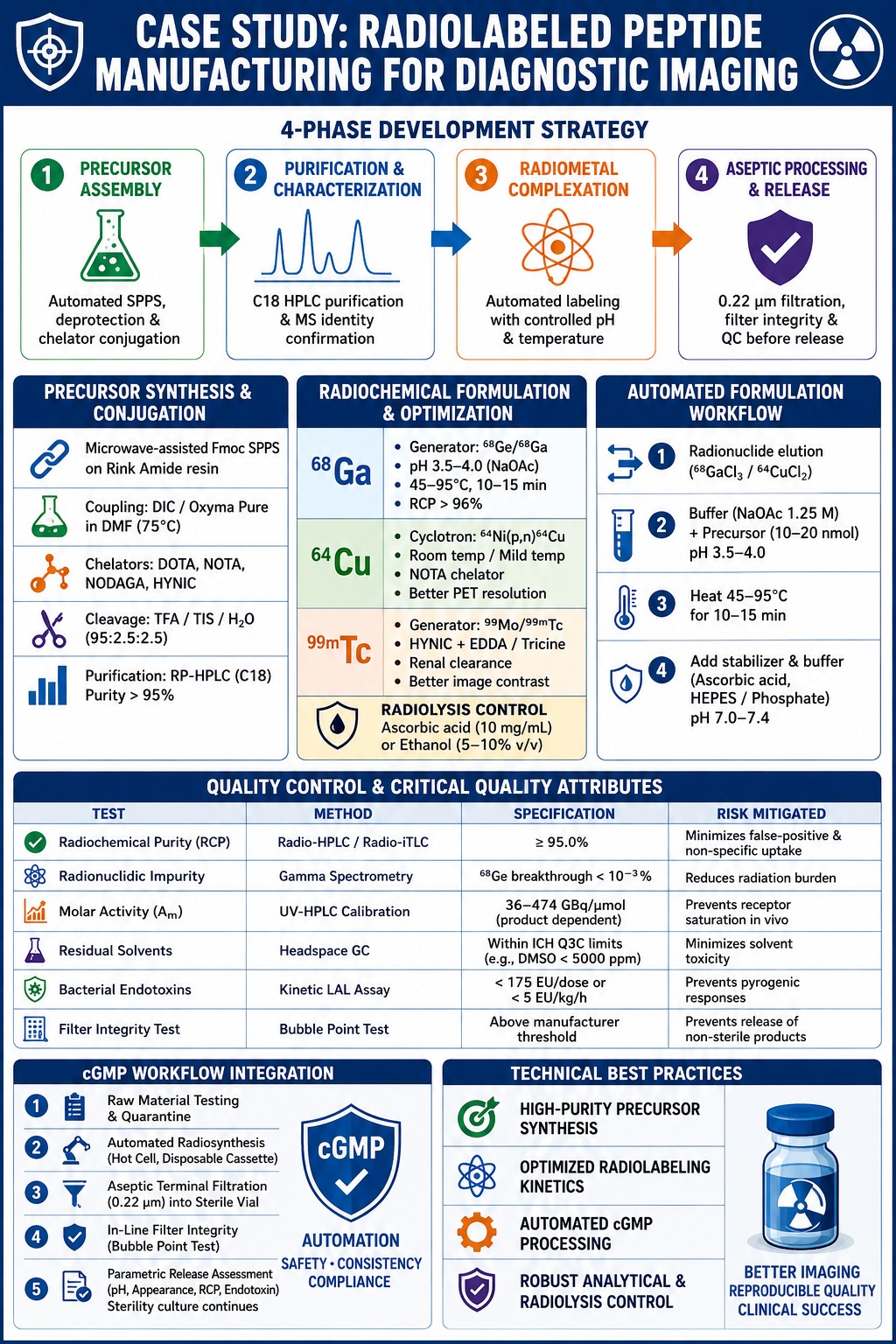
To successfully advance a radiopeptide candidate into clinical production, manufacturers generally implement a structured four-phase development strategy:
- Phase 1: Solid-Phase Precursor Assembly: Automated microwave-assisted synthesis of the peptide backbone on resin supports, followed by side-chain deprotection and site-directed or N-terminal chelator incorporation.
- Phase 2: Preparative Purification and Characterization: High-resolution C18 reverse-phase chromatography is used to isolate the desired precursor, while mass spectrometric characterization confirms molecular identity and removes truncated or deletion-related impurities.
- Phase 3: Automated Radiometal Complexation: Purified peptide precursors are incubated with generator- or cyclotron-produced radionuclides under carefully controlled pH and temperature conditions within shielded radiochemistry environments.
- Phase 4: Aseptic Processing and Release Testing: Sterile filtration through a 0.22 µm membrane, automated filter integrity verification, and rapid radiochemical quality assessments are performed before clinical release authorization.
Share via:
Article Summary:
- Radiolabeled peptide manufacturing combines peptide synthesis, chelator conjugation, radiometal complexation, and aseptic processing to produce diagnostic PET/SPECT imaging agents.
- A four-phase workflow includes precursor assembly, C18 HPLC purification and characterization, automated radiometal labeling, and sterile filtration with release testing.
- Precursor quality depends on optimized Fmoc-SPPS, careful chelator selection (DOTA, NOTA, NODAGA, HYNIC), controlled cleavage, and purification to achieve high chemical purity.
- Radiochemical formulation requires precise control of radionuclide, pH, temperature, reaction time, stoichiometry, and radiolysis protection. Key radionuclides include ⁶⁸Ga, ⁶⁴Cu, and ⁹⁹ᵐTc.
- Quality control evaluates radiochemical purity, radionuclidic identity, molar activity, residual solvents, endotoxins, and filter integrity using techniques such as radio-HPLC, radio-iTLC, gamma spectrometry, GC, and LAL testing.
- cGMP manufacturing integrates automated hot-cell radiosynthesis, aseptic 0.22 µm filtration, automated filter integrity testing, electronic process monitoring, and parametric release controls.
- Overall, high-purity precursors, optimized radiolabeling, radiolysis control, automation, and robust analytical testing are essential for reproducible manufacturing, regulatory compliance, and reliable diagnostic imaging performance.
Precursor Synthesis and Conjugation Strategies in Radiolabeled Peptide Manufacturing
The synthesis of radiopeptide precursors depends on optimized solid-phase peptide chemistry combined with precise bifunctional chelator conjugation strategies to consistently achieve chemical purities greater than 95%. Careful control of cleavage conditions, thermal exposure, and scavenger composition during synthesis minimizes undesirable side reactions, including oxidation events that can negatively affect subsequent radiolabeling efficiency.
Manufacturing begins with microwave-assisted Fmoc solid-phase peptide synthesis (SPPS) using a suitable solid support such as Rink amide resin. Amino acid coupling reactions employ orthogonal protection strategies and activation systems such as N,N’-diisopropylcarbodiimide (DIC) and Oxyma Pure in dimethylformamide (DMF), helping to reduce racemization while maintaining high coupling efficiency. After completion of sequence assembly, the peptide is released from the resin and globally deprotected using a trifluoroacetic acid (TFA)-based cleavage cocktail containing triisopropylsilane (TIS) and water as scavenging agents.
Site-selective attachment of bifunctional chelators—including 1,4,7,10-tetraazacyclododecane-1,4,7,10-tetraacetic acid (DOTA), 1,4,7-triazacyclononane-1,4,7-triacetic acid (NOTA), and hydrazinonicotinic acid (HYNIC)—can be performed either while the peptide remains resin-bound or after cleavage in solution. In solution-phase conjugation, DOTA activation commonly utilizes N-hydroxysuccinimide (NHS), 1-ethyl-3-(3-dimethylaminopropyl)carbodiimide (EDCI), and N,N-diisopropylethylamine (DIPEA) in anhydrous dimethyl sulfoxide (DMSO), enabling efficient modification of N-terminal amines or lysine side chains.
One of the major challenges encountered during precursor production is the susceptibility of certain amino acid residues to thermal and oxidative degradation. Methionine-containing peptides, for example, are particularly prone to oxidation into methionine sulfoxide during radiolabeling procedures performed at elevated temperatures ranging from 80°C to 95°C. The resulting oxidized species often exhibit reduced biological activity and lower radiochemical purity. To minimize these effects, manufacturers may introduce non-oxidizable amino acid analogs or engineer structural constraints such as β-hairpin motifs to improve thermal resilience and metabolic stability.
For complex cyclic or constrained architectures, discover our cyclic peptide characterization methodologies.
| Synthetic Parameter | Technical Specification | Functional Impact on Radiolabeling | Optimization Strategy |
|---|---|---|---|
| Peptide Resin Support | Rink Amide Resin (0.1 mmol scale) | Influences C-terminal amidation efficiency and overall cleavage recovery | Controlled resin swelling in DMF before microwave-assisted coupling |
| Coupling Reagents | DIC / Oxyma Pure in DMF | Reduces epimerization risk for sterically demanding amino acids | Optimization of microwave power settings and reaction temperatures (75°C) |
| Bifunctional Chelator | DOTA, NOTA, NODAGA, HYNIC | Determines coordination geometry and long-term radiometal stability | Pre-activation using NHS/EDCI chemistry in anhydrous DMSO |
| Resin Cleavage Cocktail | TFA / TIS / H₂O (95:2.5:2.5) | Minimizes carbocation-mediated side reactions on sensitive residues | Tailored scavenger composition based on peptide sequence characteristics |
| Preparative Purification | Reverse-Phase C18 HPLC (0.1% TFA/MeCN) | Eliminates deletion sequences and truncated impurities | Gradient optimization to achieve precursor purity greater than 95% |
Radiochemical Formulation and Process Optimization for Diagnostic Programs
Successful radiochemical formulation requires balancing complexation thermodynamics, precursor-to-radionuclide stoichiometry, and reaction-buffer composition to achieve radiochemical yields exceeding 95% without the need for additional purification steps. Maintaining appropriate pH, temperature, and radical-scavenger concentrations is essential for preventing radiolytic degradation and preserving tracer stability at elevated radioactivity concentrations.
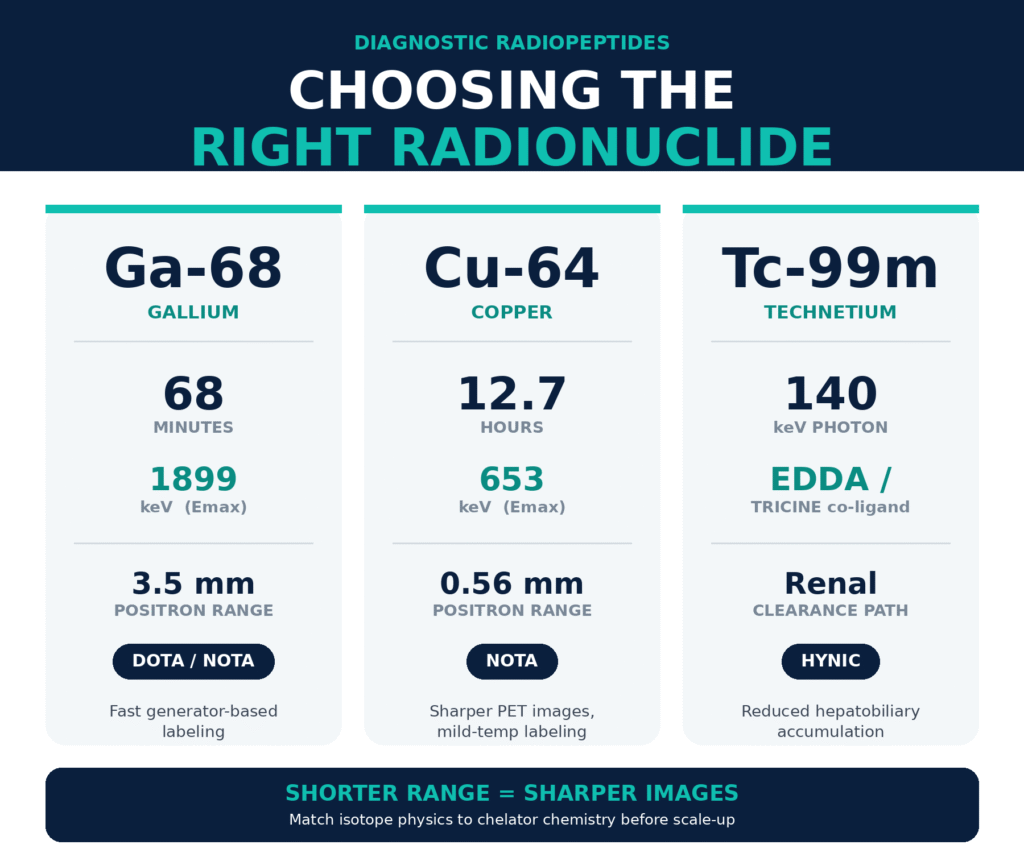
The choice of radionuclide directly influences reaction conditions, labeling efficiency, and imaging performance characteristics:
- Gallium-68 (⁶⁸Ga): Produced from a ⁶⁸Ge/⁶⁸Ga generator system and typically eluted using 0.1 M HCl. Effective radiolabeling requires tight pH control between 3.5 and 4.0 using 1.25 M sodium acetate buffer. Reaction temperatures ranging from 45°C to 95°C for approximately 10–15 minutes commonly achieve complexation efficiencies above 96% when DOTA or NOTA chelators are used.
- Copper-64 (⁶⁴Cu): Generated through the ⁶⁴Ni(p,n)⁶⁴Cu cyclotron reaction, Copper-64 possesses a 12.7-hour half-life and relatively low positron energy (Emax = 652.6 keV). This results in a shorter positron travel distance of approximately 0.56 mm and improved PET image resolution compared with Gallium-68, which exhibits an Emax of 1899 keV and an average range of approximately 3.5 mm. Mild-temperature or room-temperature labeling with NOTA-based chelators helps preserve thermally sensitive peptide structures.
- Technetium-99m (⁹⁹ᵐTc): Obtained as [⁹⁹ᵐTc]TcO₄⁻ from a ⁹⁹Mo/⁹⁹ᵐTc generator system. HYNIC-containing peptides typically require co-ligands such as ethylenediaminediacetic acid (EDDA) or tricine to complete the octahedral coordination environment. These hydrophilic co-ligands often promote renal clearance pathways and reduce hepatobiliary accumulation, thereby enhancing imaging contrast.
Radiolysis remains one of the most significant degradation mechanisms encountered during high-activity production. The emission of β⁺ or β⁻ particles generates hydroxyl radicals and hydrated electrons in aqueous solutions, which can attack peptide bonds and sensitive amino acid residues. To reduce radiolytic damage, stabilizing additives such as ascorbic acid (10 mg/mL) or ethanol (5–10% v/v) are introduced before or immediately after the heating phase.
To evaluate non-covalent higher-order associations and radiolytic oligomers, leverage native mass spectrometry for therapeutic peptide characterization.
Molar activity (Am), expressed in GBq/µmol, is another critical parameter requiring careful optimization. Excessive quantities of unlabeled precursor may compete with the radiolabeled compound for receptor binding sites, potentially reducing imaging sensitivity. Conversely, extremely high molar activities achieved using very low precursor concentrations can negatively affect chelation kinetics and lower radiochemical conversion efficiency.
A typical automated formulation process follows a controlled sequence:
- Radionuclide Elution and Transfer: Radiometal solutions such as ⁶⁸GaCl₃ or ⁶⁴CuCl₂ are transferred from the generator or target system directly into the automated synthesis vessel.
- Buffer Addition and Precursor Introduction: Concentrated sodium acetate buffer (1.25 M) is added to establish an optimal pH range of 3.5–4.0, followed by the addition of approximately 10–20 nmol of the chelator-conjugated peptide precursor.
- Thermal Complexation: The reaction mixture is heated under controlled conditions between 45°C and 95°C for approximately 10–15 minutes to facilitate efficient radiometal incorporation into the chelator cavity.
- Stabilization and Neutralization: Ascorbic acid and buffering agents such as HEPES or phosphate buffer are added to protect against radiolysis and adjust the final formulation to physiological pH values of 7.0–7.4.
Quality Control Analytics and Critical Quality Attributes
Critical Quality Attributes (CQAs) for diagnostic radiopeptides are established through comprehensive analytical evaluation using radio-HPLC, radio-iTLC, gamma spectrometry, and mass spectrometric techniques. These testing approaches confirm radiochemical purity, radionuclidic identity, molar activity, and overall product quality while ensuring safety and compliance before clinical administration.
Streamline multi-quality parameter screening with multi attribute monitoring MAM for peptide characterization.
Analytical assessment of the final radiopharmaceutical formulation must demonstrate both chemical and radiochemical integrity:
- Radiochemical Purity (RCP): High-Performance Liquid Chromatography (HPLC) equipped with radiometric detection separates intact radiopeptides from radiolytic degradation products, free radiometals such as ⁶⁸Ga³⁺ and ⁶⁴Cu²⁺, and oxidized peptide species. Instant Thin-Layer Chromatography (iTLC) serves as a rapid complementary method for quantifying colloidal impurities, including insoluble radiometal hydroxides.
- Radionuclidic Identity and Purity: Gamma spectrometry confirms radionuclide identity through characteristic energy emissions, including 511 keV for positron emitters and 140 keV for ⁹⁹ᵐTc. Long-lived parent radionuclide contamination, such as ⁶⁸Ge breakthrough in generator-derived ⁶⁸Ga preparations, must remain below 10⁻³% to minimize unnecessary radiation exposure.
- Chemical Identity and Residual Precursor Quantification: High-Resolution Electrospray Ionization Mass Spectrometry (HR-ESI-MS) and Ultra-Performance Liquid Chromatography (UPLC) verify molecular identity and quantify residual precursor content.
- Endotoxin and Sterility Assurance: Bacterial endotoxins are evaluated using kinetic chromogenic Limulus Amebocyte Lysate (LAL) assays. Sterility testing is subsequently performed on decayed samples using fluid thioglycollate and soybean-casein digest media.
Assess self-association risks in active radiopharmaceutical formulations using advanced peptide aggregation analysis.
| Quality Control Test | Analytical Method | Standard Release Criteria | Risk Mitigated |
| Radiochemical Purity (RCP) | Radio-HPLC / Radio-iTLC | ≥ 95.0% intact radiopeptide | Minimizes false-positive findings and non-specific uptake |
| Radionuclidic Impurity | Gamma Spectrometry / Decay Tracking | ⁶⁸Ge breakthrough < 10⁻³% | Reduces unnecessary radiation burden to patients |
| Molar Activity (Am) | UV-HPLC Calibration Curve | 36–474 GBq/µmol (product dependent) | Prevents target receptor saturation in vivo |
| Residual Solvents | Headspace Gas Chromatography (GC) | Within ICH Q3C limits (e.g., DMSO < 5000 ppm) | Minimizes systemic solvent-related toxicity |
| Bacterial Endotoxins | Kinetic LAL Assay | < 175 EU/dose or < 5 EU/kg/h | Prevents pyrogenic responses |
| Filter Integrity Test | Automated Bubble Point Test | Above membrane manufacturer acceptance threshold | Prevents release of non-sterile products |
Regulatory Compliance and cGMP Workflow Integration
Regulatory compliance for radiolabeled peptide manufacturing requires adherence to current Good Manufacturing Practice (cGMP) requirements, ICH Q11 principles, and regional radiopharmaceutical regulations, including FDA CDER expectations and EMA Annex 3 requirements. The incorporation of automated radiosynthesis systems within shielded hot-cell environments enhances process reproducibility, operator safety, and overall manufacturing reliability.
Review key submission frameworks in detail with our guide to regulatory requirements for GLP-1 peptide characterization.
Because diagnostic radionuclides often possess short physical half-lives, such as ⁶⁸Ga (67.7 minutes) and ¹⁸F (109.8 minutes), conventional release testing approaches must be adapted. Regulatory agencies, including the US Food and Drug Administration (FDA) and the European Medicines Agency (EMA), permit conditional product release before completion of lengthy sterility testing procedures, provided validated aseptic processing systems and robust parametric release controls are in place.
Automated synthesis modules located within lead-shielded hot cells, typically operating in Class C environments with Class A laminar airflow protection, conduct reagent transfer, heating, purification, and formulation operations without manual intervention. Automation reduces process variability, improves reproducibility, and captures real-time process parameters such as temperature, pressure, and radioactivity levels for electronic batch documentation.
Final product sterilization is achieved through inline filtration using a 0.22 µm sterile polyethersulfone (PES) or polyvinylidene fluoride (PVDF) membrane filter into depyrogenated and pre-sterilized final product vials. Automated bubble-point testing is performed immediately before or after dispensing to verify membrane integrity and maintain sterility assurance.
A typical cGMP-compliant manufacturing sequence includes:
- Raw Material Testing and Quarantine: Incoming peptide precursors, chelators, solvents, and reagents are tested against predefined acceptance specifications before use.
- Automated Radiosynthesis and Formulation: Production is conducted within validated hot-cell systems utilizing disposable fluidic cassettes to eliminate cross-contamination risks.
- Aseptic Terminal Filtration: The bulk formulation is passed through a sterile 0.22 µm membrane filter directly into a Grade A dispensing environment.
- In-Line Filter Integrity Verification: Automated bubble-point testing confirms filter performance and integrity after product dispensing.
- Parametric Release Assessment: Real-time review of critical quality parameters including pH, appearance, radiochemical purity, and endotoxin results supports clinical release while sterility cultures continue incubation.
Ensure audit readiness by downloading our peptide characterization CRO deliverables checklist.
Technical Best Practices in Radiolabeled Peptide Manufacturing
Successful Radiolabeled Peptide Manufacturing requires the integration of high-purity precursor synthesis, optimized radiochemical reaction kinetics, and automated cGMP-compliant processing systems. The implementation of robust analytical controls and radiolytic stabilization measures supports consistent batch performance and reliable diagnostic imaging quality throughout clinical development programs.
By minimizing oxidative degradation during peptide synthesis, selecting chelators that are appropriately matched to radionuclide coordination requirements, and utilizing automated radiosynthesis platforms, radiopharmaceutical developers can efficiently advance novel radiopeptides from preclinical research into multicenter clinical trials. Scalable cGMP manufacturing infrastructure enables reproducible product quality, reduced background signal, and improved diagnostic imaging performance.
For specialized consultation, process development support, or advanced analytical testing services, contact ResolveMass Laboratories Inc. through the Contact Page.
Frequently Asked Questions
Methionine is particularly vulnerable to oxidation because its sulfur-containing side chain readily reacts with reactive oxygen species generated during radiolabeling processes. Elevated reaction temperatures and radiation-induced free radicals can convert methionine into methionine sulfoxide or other oxidized forms. These chemical modifications may alter the peptide’s biological activity, stability, and receptor-binding characteristics, ultimately affecting product quality.
Copper-64 offers several practical benefits for PET imaging applications, including a significantly longer half-life than Gallium-68. This extended half-life supports centralized manufacturing, wider distribution networks, and imaging at delayed time points when needed. Additionally, Copper-64 emits lower-energy positrons, resulting in shorter positron travel distances in tissue and often producing higher-resolution PET images.
Radio-HPLC and radio-iTLC serve complementary roles in radiopharmaceutical quality assessment. Radio-HPLC provides detailed separation and characterization of intact radiopeptides, degradation products, oxidized species, and other impurities. Radio-iTLC is a rapid screening technique that quickly distinguishes free radiometals, colloidal impurities, and labeled compounds, making it particularly useful for routine release testing and process monitoring.
Controlling parent radionuclide breakthrough is essential to ensure patient safety and regulatory compliance. Purification strategies such as cation-exchange cartridges, solid-phase extraction systems, or specialized purification columns are commonly used to remove unwanted parent radionuclides before radiolabeling. Final product testing using gamma spectrometry confirms that breakthrough levels remain within established acceptance criteria before clinical use.
Co-ligands are critical components in Technetium-99m labeling systems that utilize HYNIC-based chelators. These molecules help stabilize the radiometal complex by completing the coordination environment around the technetium center. In addition to improving complex stability, co-ligands can influence the overall physicochemical properties of the radiopeptide, including its biodistribution profile and clearance pathway within the body.
Radical scavengers protect radiopeptide formulations by neutralizing highly reactive free radicals generated through the radiolysis of water and other formulation components. Compounds such as ascorbic acid, gentisic acid, and ethanol intercept these reactive species before they can damage the peptide structure. This protective effect helps maintain radiochemical purity, formulation stability, and product performance throughout the intended shelf life.
The quality of synthetic peptide precursors is governed by a combination of pharmaceutical development and manufacturing regulations. ICH Q11 provides guidance for drug substance development, while FDA and EMA cGMP requirements establish expectations for quality, consistency, and traceability. Comprehensive characterization, impurity profiling, residual solvent analysis, and identity confirmation are typically required to demonstrate suitability for clinical manufacturing.
PET radiopharmaceuticals often contain radionuclides with very short half-lives, making it impractical to wait for conventional sterility test completion before product administration. As a result, regulatory authorities allow conditional release based on validated aseptic manufacturing processes, environmental monitoring programs, and rapid quality control testing. Sterility testing continues after release to confirm the effectiveness of the manufacturing process.
Filter integrity testing is commonly performed using an automated bubble point or pressure-hold system integrated into the manufacturing process. After sterile filtration, controlled gas pressure is applied to the wetted membrane filter, and the system evaluates the pressure response against predefined specifications. Successful completion of the test confirms that the filter remained intact during processing and that sterility assurance was maintained.
Reference:
- Fathi Vavsari, V., & Balalaie, S. (2024). Technetium-99m-labeled peptides and their applications in radio imaging: Advancements in Latin American research. Exploration of Drug Science, 2, 814–835. https://doi.org/10.37349/eds.2024.00075
- Decristoforo, C. (2007). Challenges in the small-scale preparation of radiopharmaceuticals: A European perspective. FABAD Journal of Pharmaceutical Sciences, 32(3), 131–138. Retrieved from FABAD Journal PDF
- Goel, M., Mackeyev, Y., & Krishnan, S. (2023). Radiolabeled nanomaterial for cancer diagnostics and therapeutics: Principles and concepts. Cancer Nanotechnology, 14(1), 15. https://doi.org/10.1186/s12645-023-00165-y
- Velikyan, I. (2015). 68Ga-based radiopharmaceuticals: Production and application relationship. Molecules, 20(7), 12913–12943. https://doi.org/10.3390/molecules200712913
- von Hacht, J. L., Erdmann, S., Niederstadt, L., Prasad, S., Wagener, A., Exner, S., Beindorff, N., Brenner, W., & Grötzinger, C. (2019). Increasing molar activity by HPLC purification improves 68Ga-DOTA-NAPamide tumor accumulation in a B16/F1 melanoma xenograft model. PLoS ONE, 14(6), e0217883. https://doi.org/10.1371/journal.pone.0217883
Get In Touch With Us
About The Author


