


Introduction
Developing robust Reference Standards and Analytical Method Validation strategies for peptide-oligonucleotide conjugates (POCs) is critical for establishing biopharmaceutical identity, purity, potency, and structural integrity throughout the drug development lifecycle. These highly complex chimeric molecules require specialized multi-attribute analytical strategies under internationally recognized quality frameworks, including ICH Q2(R2) and ICH Q14, to address mass balance, charge distributions, and heterogeneous counterion profiles. As targeted delivery platforms, POCs integrate the high cell-permeability or receptor-targeting properties of peptides with the gene-silencing or splice-modulating therapeutic functions of oligonucleotides. However, the integration of these two chemically distinct molecular classes introduces substantial analytical complexity that cannot be adequately addressed using conventional single-entity assay platforms alone.
Developing appropriate control strategies for POCs requires extensive knowledge of separation science, high-resolution mass spectrometry (HRMS), quantitative nuclear magnetic resonance (qNMR), and ion chromatography. Synthetic peptides can introduce hydrophobic variants, deletion sequences, and trifluoroacetate counterions, while oligonucleotides contribute hydrophilic, polyanionic backbones, shortmers (n-1 species), depurination products, and inorganic sodium salts. Validation of analytical procedures for these bioconjugates in accordance with ICH Q2(R2) ensures that critical quality attributes (CQAs) can be measured reliably during release and stability testing. This supports consistent lot-to-lot quality and provides analytical evidence required for regulatory submissions.
Explore our Peptide-Oligonucleotide Conjugate Analysis services for specialized analytical strategies supporting POC characterization and development.
Share via:
Quick Summary:
- POC complexity: Peptide–oligonucleotide conjugates combine two chemically different domains, creating challenges in charge, counterions, retention, mass spectrometry, and impurity profiling.
- Reference standards: Qualified in-house primary standards require comprehensive mass balance, accounting for water, counterions, residual solvents, inorganic impurities, and related impurities.
- Orthogonal analytics: HRMS, qNMR, ion chromatography, UV-Vis, ICP-OES, HS-GC-MS, and amino acid analysis are combined to confirm identity, purity, structure, and net active content.
- Method validation: Under ICH Q2(R2) and Q14, methods should demonstrate specificity, linearity, accuracy, precision, range, sensitivity, and robustness using scientifically justified criteria.
- Forced degradation: Acid, base, oxidative, thermal, photolytic, and enzymatic stress studies establish stability-indicating capability and help distinguish degradation products from the intact POC.
- Advanced impurity profiling: IP-RP-UHPLC, HILIC, AEX, Native SEC-MS, and HRMS/MS provide complementary separation and structural information for truncations, charge variants, regioisomers, and aggregates.
- Mass balance & control: Counterion quantification and reconciliation should bring total components to approximately 100% ± 1.5%, supporting reliable dosing, consistent batch quality, stability testing, and regulatory submissions.
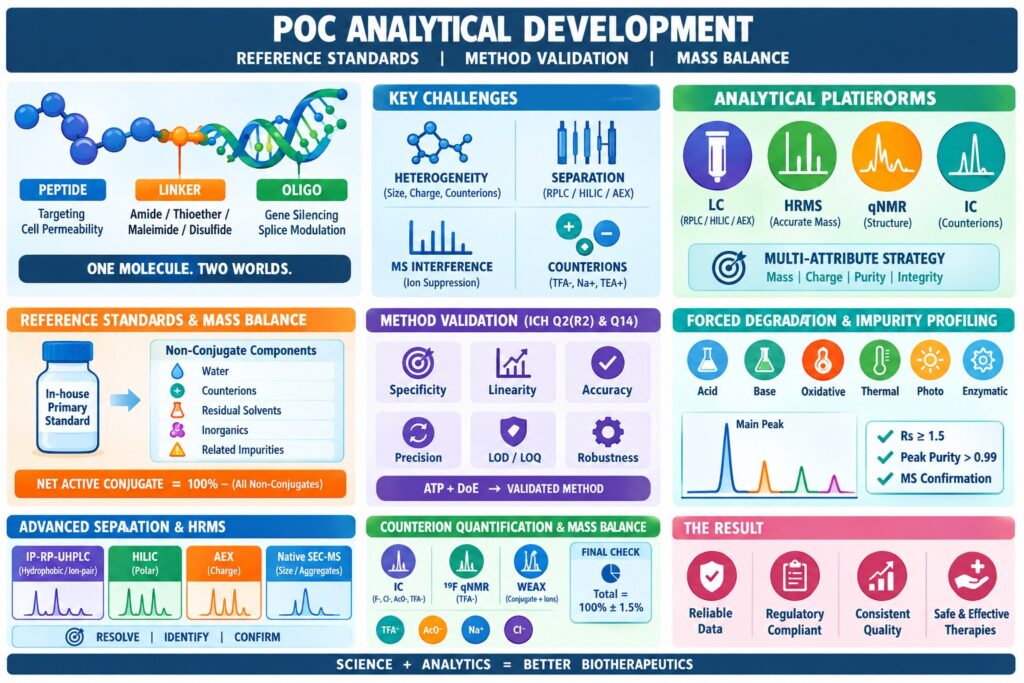
Physicochemical Complexity and Characterization Challenges of POCs
Peptide-oligonucleotide conjugates exhibit pronounced physicochemical heterogeneity because they combine polycationic or amphiphilic peptide chains with polyanionic, highly polar nucleic acid backbones. This structural combination generates complicated counterion equilibria, variable UV extinction coefficients, and substantially different chromatographic retention characteristics. Together, these properties can make baseline separation and quantitative recovery particularly challenging.
POC synthesis generally involves connecting a synthesized peptide domain with an oligonucleotide sequence through stable amide, thioether, or maleimide linkers, or through bio-cleavable disulfide bonds. The peptide component, which is commonly manufactured through Solid-Phase Peptide Synthesis (SPPS), contains basic amino acids such as Arginine, Lysine, and Histidine that can strongly associate with trifluoroacetate (TFA–) or acetate (AcO–) anions. The oligonucleotide component, generated through phosphoramidite chemistry, contains negatively charged phosphodiester or phosphorothioate linkages associated with sodium (Na+) or triethylammonium (TEA+) cations. As a result, the intact conjugate may demonstrate zwitterionic behavior in aqueous media, producing unpredictable secondary interactions with chromatographic stationary phases and substantial mass spectrometry ion suppression when counterions are not adequately controlled.
Learn more about peptide-oligonucleotide conjugate linker chemistry and the structural considerations that influence conjugate performance.
| Physicochemical Parameter | Peptide Domain | Oligonucleotide Domain | Conjugate (POC) Hybrid |
|---|---|---|---|
| Primary Charge State | Polycationic (basic residues: Arg, Lys, His) | Polyanionic (phosphodiester / phosphorothioate) | Zwitterionic / Amphiphilic depending on solution pH |
| Dominant Counterions | Trifluoroacetate (TFA–), Acetate (AcO–) | Sodium (Na+), Triethylammonium (TEA+) | Mixed counterion shell (TFA–, AcO–, Na+) |
| Spectroscopic Absorption (λmax) | 214 – 220 nm (peptide amide backbone) | 260 nm (purine and pyrimidine nucleobases) | Bimodal maxima at 220 nm and 260 nm |
| Primary Degradation Modes | Oxidation, deamidation, racemization, diketopiperazine | Depurination, n-1 truncation, backbone cleavage | Linker hydrolysis, peptide oxidation, depurination |
| Solvent Affinity | Aqueous / Organic (Acetonitrile, Methanol) | Polar aqueous / High-salt mobile phases | Mixed polar-organic / Ion-pairing aqueous buffers |
Characterization of these hybrid biotherapeutics requires orthogonal analytical platforms that can resolve degradation pathways associated with both molecular domains simultaneously. Traditional reversed-phase liquid chromatography (RPLC) approaches developed for pure peptides frequently provide inadequate retention or elution behavior for the polyanionic oligonucleotide component. Conversely, ion-exchange methods optimized for oligonucleotides may promote precipitation or irreversible adsorption of hydrophobic peptide domains. Resolving these limitations requires customized separation strategies combined with systematic mass balance accounting procedures.
Review our structural characterization services for peptide-oligonucleotide conjugates to understand how complementary analytical techniques can support complex POC characterization.
Reference Standards and Analytical Method Validation: Characterization and Mass Balance Framework
Developing qualified Reference Standards and Analytical Method Validation protocols for peptide-oligonucleotide conjugates requires an absolute mass balance strategy that determines the net active conjugate content while comprehensively accounting for non-conjugate components. Because internationally recognized primary standards are generally unavailable for custom bioconjugates, sponsors must characterize in-house primary standards using multiple orthogonal analytical techniques capable of accounting for counterions, residual moisture, volatile organic compounds, and inorganic impurities.
Characterization of a primary reference standard should establish the net active conjugate content rather than depending solely on chromatographic peak area normalization, which represents only UV-absorbing components. The actual net active conjugate content is obtained by deducting all non-conjugate mass contributions from the total weighed material:
Net Active Conjugate Content (% w/w) = 100% − (% Water + % Counterions + % Residual Solvents + % Inorganic Impurities + % Related Impurities)
Comprehensive mass accounting requires the integration of several specialized analytical procedures:
- Net Conjugate Mass and Sequence Confirmation: High-Resolution Mass Spectrometry (HRMS) is used to verify the exact monoisotopic molecular weight and sequence integrity, while quantitative amino acid analysis (AAA) or total nitrogen determination provides information on absolute molar ratios.
- Residual Moisture Quantification: Karl Fischer coulometric titration or Thermogravimetric Analysis (TGA) is employed to determine adsorbed and bound water present within the lyophilized material.
- Anionic and Cationic Counterion Profiling: Suppressed Ion Chromatography (IC) or quantitative Fluorine-19 Nuclear Magnetic Resonance (19F qNMR) is used to quantify TFA–, AcO–, and Cl–, whereas Inductively Coupled Plasma Optical Emission Spectroscopy (ICP-OES) determines the concentrations of Na+ and K+ cations.
- Residual Volatile Solvents: Headspace Gas Chromatography-Mass Spectrometry (HS-GC-MS) quantifies residual synthetic solvents, including acetonitrile, dimethylformamide, triethylamine, and piperidine, in accordance with ICH Q3C criteria.
- Molar Extinction Coefficient Determination: UV-Vis spectrophotometry determines the extinction coefficient (ε) at 260 nm and 220 nm using verified net active mass while accounting for hyperchromic shifts associated with secondary structural folding.
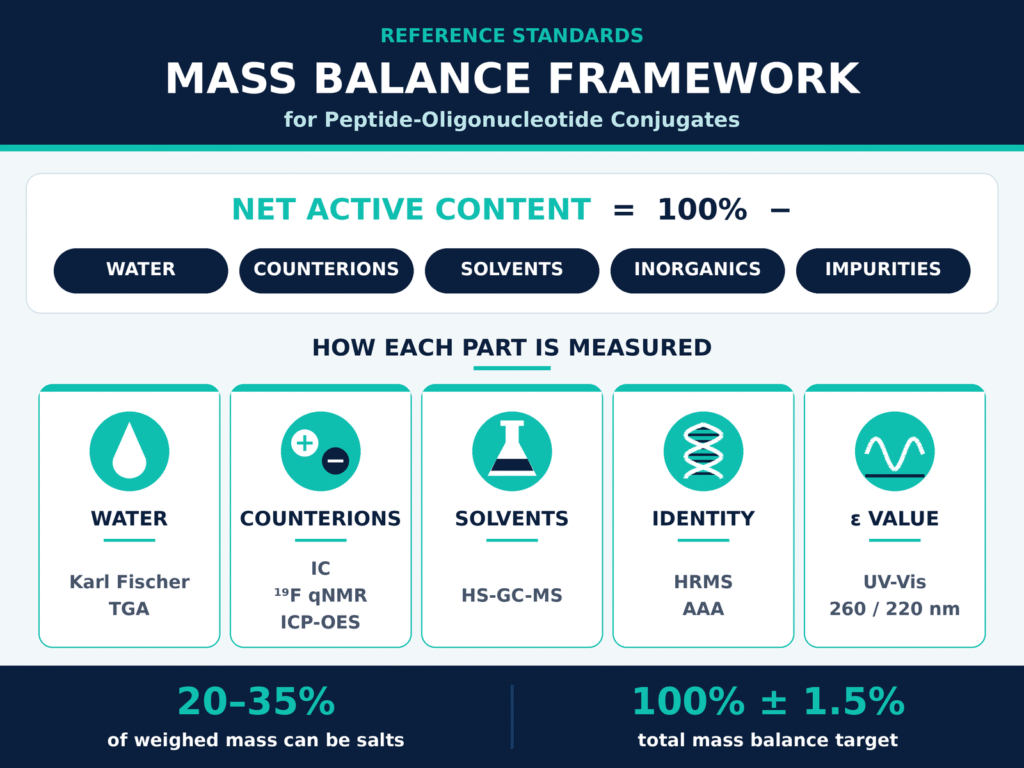
In-house primary reference standards are subsequently used to calibrate secondary working reference standards intended for routine batch release and stability testing. Defined re-qualification procedures, controlled storage conditions, typically -80°C under inert gas, and two-tiered stability monitoring programs help protect reference standard integrity throughout the product lifecycle.
Explore QC testing for peptide-oligonucleotide conjugates for analytical testing approaches that can support quality assessment throughout development and manufacturing.
Method Validation Parameters under ICH Q2(R2) and ICH Q14 Guidelines
Analytical method validation under the current ICH Q2(R2) and ICH Q14 frameworks provides documented scientific evidence demonstrating that analytical procedures developed for peptide-oligonucleotide conjugates are robust, specific, and suitable for their intended regulatory application. Validation requires assessment of critical performance characteristics, including specificity, linear response, accuracy, repeatability, intermediate precision, and reportable range, against predefined acceptance criteria.
ICH Q14 emphasizes scientifically structured analytical method development and encourages establishment of an Analytical Target Profile (ATP), together with systematic assessment of method operating parameters using Design of Experiments (DoE). Following method development, analytical procedures undergo formal validation in accordance with ICH Q2(R2) to demonstrate consistent performance during both release and stability testing.
Specificity and Forced Degradation Profiling for Reference Standards and Analytical Method Validation
Specificity in POC analysis requires clear demonstration that the intended conjugate can be distinguished from unreacted starting materials, isomeric impurities, and degradation products generated during stress conditions. Photodiode array spectral deconvolution, when combined with high-resolution mass spectrometry, can provide evidence that co-eluting components do not adversely affect quantitative measurements.
Forced degradation (stress testing) subjects the conjugate to deliberately challenging environmental conditions, including acidic (0.1 M HCl), basic (0.1 M NaOH), oxidative (3% H2O2), thermal (60°C), photolytic (ICH Q1B), and enzymatic (nuclease/protease) conditions. Stability-indicating capability is established when the principal conjugate peaks retain baseline separation (Rs ≥ 1.5) from generated degradation products and mass spectral deconvolution confirms spectral purity throughout the chromatographic peak profile.
Learn about peptide-oligonucleotide conjugate stability and analytical considerations for monitoring degradation and product integrity.
Response, Linearity, and Reportable Range Optimization
Linearity and reportable range should be assessed across both the peptide UV absorption region (214 – 220 nm) and the oligonucleotide absorption region (260 nm) to support accurate determination of response factors. Evaluation from 50% to 150% of the nominal target assay concentration can demonstrate whether the response follows an appropriate linear model, with correlation coefficients meeting R2 ≥ 0.998.
Assessing analytical response at a minimum of five concentration levels establishes whether the measured signal remains proportional to analyte concentration. Current ICH Q2(R2) principles also allow the use of non-linear calibration models, such as quadratic or sigmoidal models in immunoassay or bioassay applications, when the selected mathematical model is scientifically and statistically justified. The reportable range should cover the applicable upper and lower specification limits, extending from low-level impurities, including the 0.05% reporting threshold, through 120% of the target assay concentration.
Accuracy, Precision, and Sensitivity Thresholds
Accuracy and precision for POC analytical procedures are assessed through recovery studies involving known spiked quantities and repeatability studies involving multiple analysts across the established reportable range. Method sensitivity is established by determining limits of detection (LOD) and quantitation (LOQ), using either signal-to-noise relationships or statistical evaluation of response variability.
Accuracy is demonstrated by spiking known quantities of qualified reference standard into drug substance matrix blanks at 80%, 100%, and 120% of the nominal assay concentration. Typical target recovery ranges are 98.0% to 102.0% for active substance assays and 80.0% to 120.0% for low-level impurities. Precision assessment includes repeatability, such as six replicate injections at 100% target concentration, with peak area % RSD ≤ 1.0%, as well as intermediate precision evaluated across multiple days, analysts, and chromatographic systems, with % RSD ≤ 2.0%.
Sensitivity limits can be calculated using signal-to-noise (S/N) relationships or calibration slope statistics:
LOD = (3.3 × σ) / S
LOQ = (10 × σ) / S
where σ represents the standard deviation of the baseline response and S denotes the slope of the calibration curve. Baseline method requirements specify S/N ≥ 3:1 for LOD and S/N ≥ 10:1 for LOQ, while LOQ precision should demonstrate % RSD ≤ 10.0%.
| Performance Characteristic | Analytical Method Test Strategy | Acceptance Criteria (Assay / Content) | Acceptance Criteria (Impurity Profiling) |
|---|---|---|---|
| Specificity | Forced degradation; PDA peak purity index; ESI-HRMS mass deconvolution | No co-eluting interferences; Peak purity > 0.99; Rs ≥ 1.5 | Chromatographic resolution Rs ≥ 1.5 from adjacent impurities |
| Linearity / Response | 5-point calibration curve (50% – 150% target assay level) | R2 ≥ 0.998; Y-intercept < 2.0% of 100% target response | R2 ≥ 0.990 from LOQ to 120% reporting threshold |
| Accuracy (Recovery) | Triplicate spiking at 3 levels (80%, 100%, 120%) against reference standard | Mean recovery: 98.0% – 102.0% | Mean recovery: 80.0% – 120.0% at impurity levels |
| Repeatability Precision | 6 independent sample preparations at 100% target concentration | Peak Area % RSD ≤ 1.0%; Retention Time % RSD ≤ 0.5% | Peak Area % RSD ≤ 5.0% at LOQ level |
| Intermediate Precision | Multi-day, multi-analyst, multi-instrument evaluation | Overall % RSD ≤ 2.0% | Overall % RSD ≤ 10.0% for total impurities |
| Robustness | Small, deliberate shifts in mobile phase pH (± 0.2), column temperature (± 2°C), gradient slope (± 2%) | Recovery within 98.0% – 102.0%; System suitability met | Equivalent impurity quantification within ± 10% relative difference |
Advanced Separation Modes and HRMS for Impurity Profiling
Comprehensive impurity profiling of peptide-oligonucleotide conjugates requires multidimensional chromatographic separation strategies combined with electrospray ionization high-resolution mass spectrometry (ESI-HRMS). Employing orthogonal techniques such as Ion-Pair Reversed-Phase UHPLC (IP-RP-UHPLC), Hydrophilic Interaction Liquid Chromatography (HILIC), and Anion-Exchange Chromatography (AEX) provides complementary selectivity for resolving sequence truncations, regioisomers, and aggregation products.
Ion-Pair Reversed-Phase UHPLC (IP-RP-UHPLC) is commonly used as a primary separation approach for intact POC analysis. Volatile alkylammonium salts, including triethylammonium acetate (TEAA) or hexylamine (HA), are combined with hexafluoroisopropanol (HFIP) in aqueous mobile phases. The hydrophobic alkyl groups of the ion-pairing reagent interact with the C18 stationary phase, while positively charged ammonium groups reversibly associate with the negatively charged phosphorothioate or phosphodiester backbone of the oligonucleotide. Organic modifiers such as acetonitrile or methanol then promote elution according to the hydrophobic characteristics of the peptide domain, allowing separation of full-length conjugates, failure sequences, and truncated analogs.
See our peptide-oligonucleotide conjugate synthesis methods to learn how different synthetic approaches can influence product composition and analytical requirements.
Hydrophilic Interaction Liquid Chromatography (HILIC) provides complementary selectivity by separating compounds according to their polar partitioning characteristics. HILIC can retain hydrophilic unreacted oligonucleotides and shortmers while allowing more hydrophobic peptides and conjugates to elute earlier. Anion-Exchange Chromatography (AEX) provides charge-based separation and can distinguish full-length conjugates from n-1 oligonucleotide truncation products according to differences in net backbone charge.
High-resolution Orbitrap or Time-of-Flight (Q-ToF) mass spectrometry operated in negative electrospray mode can be coupled to these separation methods for accurate mass confirmation with an error of < 5 ppm. MS/MS peptide mapping workflows using selective enzymatic cleavage, such as trypsin or Lys-C, or targeted nuclease digestion enable detailed localization of conjugation sites and structural confirmation of linkers. Native Size Exclusion Chromatography coupled with HRMS (Native SEC-MS) provides a non-denaturing approach for evaluating higher-order non-covalent aggregates while minimizing disruption of sensitive structural interactions.
Explore our CMC services for peptide-oligonucleotide conjugates for integrated analytical characterization and broader CMC support.
| Chromatographic Separation Mode | Primary Interaction Mechanism | Target Analytes & Resolved Impurities | Mobile Phase Additives & Conditions |
|---|---|---|---|
| IP-RP-UHPLC | Hydrophobic / Ion-pairing partition | Full-length POC, hydrophobic peptide variants, regioisomers | TEAA or HA/HFIP in water/acetonitrile gradients |
| HILIC | Polar partition / Hydrophilic retention | Unreacted oligonucleotide starting material, n-1 shortmers | High-organic aqueous ammonium acetate / acetonitrile |
| AEX Chromatography | Electrostatic charge interaction | Net charge variants, backbone depurination, truncation products | Aqueous sodium chloride or perchlorate salt gradients |
| Native SEC-MS | Hydrodynamic size exclusion | Non-covalent soluble aggregates, high-molecular-weight species | Volatile ammonium acetate (100 – 200 mM) at neutral pH |
Counterion Quantification and Mass Balance Reconciliation
Accurate counterion quantification is essential for establishing the mass balance of synthetic peptide-oligonucleotide conjugates because non-conjugate salt components may account for 20% to 35% of the total weighed solid material. Suppressed Ion Chromatography (IC) and quantitative Fluorine-19 Nuclear Magnetic Resonance (19F qNMR) provide important analytical approaches for determining the concentrations of trifluoroacetate (TFA–), acetate (AcO–), sodium (Na+), and chloride (Cl–).
Synthetic peptides contain basic amino acid residues, including Arginine, Lysine, and Histidine, that can retain TFA– originating from SPPS cleavage reagents and preparative RP-HPLC mobile phases. Each basic residue can associate with an equivalent of trifluoroacetate, contributing approximately 113 mass units per site. Oligonucleotides contain sodium (Na+) or triethylammonium (TEA+) cations associated with the nucleic acid backbone. When these components are combined within a conjugate, the competing counterion populations generate complex salt matrices that can substantially influence the overall mass of the drug substance.
Residual TFA can present both biological and analytical concerns. TFA has been reported to exhibit cytotoxic effects in cell culture models at concentrations above 10 nM, potentially producing cell growth inhibition or unexpected proliferation artifacts that may influence bioassay outcomes. From an analytical perspective, TFA can cause significant mass spectrometry signal suppression and affect concentration calculations. Consequently, biopharmaceutical specifications may require counterion exchange from TFA to acetate or hydrochloride forms using strong anion-exchange chromatography or freeze-drying from dilute organic acids.
Analytical approaches used for counterion characterization include:
- Suppressed Ion Chromatography (IC): A quantitative technique for separating and determining fluoride, chloride, formate, acetate, and trifluoroacetate anions with high sensitivity and precision.
- Quantitative Fluorine-19 NMR (19F qNMR): A non-destructive and highly selective approach for quantifying residual TFA– by monitoring the singlet resonance at -75.7 ppm relative to a known fluorinated internal standard.
- Mixed-Mode Weak Anion-Exchange (WEAX): A chromatographic technique that can support simultaneous separation and quantification of net active conjugate mass and associated counterion species within a single analytical injection.
Final mass balance reconciliation requires confirmation that the combined quantities of net active conjugate, measured counterions, bound water, residual solvents, and inorganic salts total 100% ± 1.5%. This provides a basis for accurate dosing calculations and dependable analytical response factors.
Discover peptide-oligonucleotide conjugate manufacturing services to support analytical characterization, process development, and manufacturing requirements for complex POC programs.
Conclusion: Mastering Reference Standards and Analytical Method Validation for POCs
Successful implementation of Reference Standards and Analytical Method Validation for peptide-oligonucleotide conjugates depends on the integration of orthogonal separation science, high-resolution mass spectrometry, and comprehensive mass balance accounting. Applying ICH Q2(R2) and ICH Q14 lifecycle principles helps ensure that analytical procedures generate reproducible and regulatory-compliant data capable of supporting drug product quality, safety, and clinical efficacy.
Developing thoroughly characterized reference standards through detailed mass balance assessment helps minimize systematic concentration errors during analytical testing. Validation of analytical procedures for specificity, linearity, precision, accuracy, and counterion content provides biopharmaceutical developers with the analytical control strategies required to address global regulatory expectations. As targeted conjugate therapies progress through clinical development, maintaining scientifically robust analytical validation methodologies remains critical for demonstrating quality and ensuring consistent batch-to-batch performance.
For specialized analytical testing, reference standard characterization, or regulatory method validation consultation, visit the ResolveMass Contact Us Page.
Frequently Asked Questions
Trifluoroacetate (TFA) can associate with basic amino acid residues and contribute significantly to the measured mass of a POC reference standard. Measuring TFA is therefore important for accurately determining net active content and avoiding errors in standard preparation, assay calculations, and interpretation of biological testing results.
Specificity is established by showing that the analytical method can clearly distinguish the intact POC from starting materials, failure sequences, related impurities, and degradation products. Forced degradation studies, photodiode array peak purity analysis, and high-resolution mass spectrometry can provide complementary evidence of method selectivity.
IP-RP-MS methods commonly employ volatile ion-pairing systems such as triethylammonium acetate (TEAA) or hexylamine (HA) together with hexafluoroisopropanol (HFIP). These reagents help manage interactions with the negatively charged oligonucleotide backbone while maintaining suitable conditions for electrospray ionization mass spectrometry.
Peptide and oligonucleotide components have different UV absorption characteristics, with peptides typically showing stronger absorption around 214–220 nm and oligonucleotides near 260 nm. Analytical procedures can assess both wavelengths and experimentally determine extinction coefficients for the intact conjugate using well-characterized reference materials.
Gross powder weight represents the total mass of the isolated material, including the POC along with water, counterions, residual solvents, and inorganic impurities. Net active content refers specifically to the percentage of the total material that corresponds to the actual peptide-oligonucleotide conjugate.
Covalent attachment and stoichiometry can be evaluated using complementary techniques such as ESI-HRMS, native Size Exclusion Chromatography-MS (SEC-MS), and LC-MS/MS peptide mapping. Selective enzymatic cleavage can provide additional information about the conjugation site, structural integrity, and expected composition of the POC.
ICH Q14 provides a systematic framework for analytical procedure development using risk assessment, Quality by Design (QbD), and Design of Experiments (DoE). These approaches help establish the Analytical Target Profile (ATP) and define suitable operating ranges for parameters such as mobile phase pH, column temperature, and gradient conditions.
Quantitative 19F qNMR offers a direct and specific approach for measuring trifluoroacetate (TFA) because the fluorine-containing counterion produces a distinct NMR signal. Quantification against an appropriate internal fluorinated standard provides an orthogonal method that can complement ion chromatography for counterion analysis.
Stability-indicating validation should examine degradation mechanisms affecting both the peptide and oligonucleotide components of the conjugate. Relevant pathways can include linker hydrolysis, nucleobase depurination, phosphorothioate backbone cleavage, peptide oxidation, deamidation, racemization, and formation of soluble aggregates.
Reference:
- International Council for Harmonisation of Technical Requirements for Pharmaceuticals for Human Use. (2025). ICH Q2(R2): Validation of analytical procedures—Training Module 2: Fundamental principles of ICH Q2(R2). ICH Training Module PDF
- International Council for Harmonisation of Technical Requirements for Pharmaceuticals for Human Use. (2023). ICH Q2(R2): Validation of analytical procedures. ICH Q2(R2) Guideline PDF
- Jensen, O. N., Kulkarni, S., Aldrich, J. V., & Barofsky, D. F. (1996). Characterization of peptide-oligonucleotide heteroconjugates by mass spectrometry. Nucleic Acids Research, 24(19), 3866–3872. PMC article
- International Council for Harmonisation of Technical Requirements for Pharmaceuticals for Human Use. (2024). ICH Q2(R2) validation of analytical procedures—Step 5: Revision 2. European Medicines Agency. EMA guideline page
- International Council for Harmonisation of Technical Requirements for Pharmaceuticals for Human Use. (2025). ICH Q2(R2) and Q14 training materials: Module 7—Additional case studies and examples. ICH Training Module 7 PDF
- U.S. Food and Drug Administration. (2024). Q2(R2) validation of analytical procedures: Guidance for industry. U.S. Department of Health and Human Services. FDA guidance PDF
- International Council for Harmonisation of Technical Requirements for Pharmaceuticals for Human Use. (2022, March 24). Q14: Analytical procedure development and Q2(R2): Validation of analytical procedures—Step 2 document. ICH Q2/Q14 Step 2 Presentation PDF
Get In Touch With Us
About The Author


