


Introduction
Residual uncertainty in biosimilar development determines the scope of regulatory clinical trials by requiring each successive stage of testing to address only the specific scientific questions that remain unresolved after previous analytical and functional assessments. Under the evolving regulatory frameworks established by the Food and Drug Administration (FDA), European Medicines Agency (EMA), World Health Organization (WHO), and Health Canada, biosimilar candidates do not necessarily follow a predetermined clinical trial pathway. Instead, their development follows a dynamic, risk-based approach in which high-resolution structural and functional data progressively reduce residual uncertainty during the early stages of development. This approach may eliminate the need for redundant non-clinical studies and Phase III clinical efficacy trials when the available evidence sufficiently establishes biosimilarity.
Historically, biologic drug development depended heavily on extensive Phase III comparative clinical efficacy studies (CES) to establish safety and therapeutic efficacy in patient populations. However, advances in high-resolution analytical mass spectrometry, cell-based bioassays, and multi-attribute characterization techniques have significantly transformed regulatory science. Global regulatory authorities increasingly recognize that comparative analytical assessments (CAA) can detect subtle structural differences with greater sensitivity than clinical trials, which are frequently influenced by patient heterogeneity, underlying disease variability, and broad therapeutic windows. Consequently, the traditional hierarchy of regulatory evidence has evolved. Comprehensive structural and functional characterization now provides the foundation for demonstrating biosimilarity, while human studies, particularly comparative pharmacokinetics (PK), pharmacodynamics (PD), and immunogenicity assessments, are used to address the residual uncertainty that remains after analytical evaluation.
Assessing residual uncertainty involves determining the potential clinical consequences of minor structural differences between a proposed biosimilar and its reference product. When analytical characterization establishes that a biosimilar candidate is highly similar to the reference product, despite minor variations in components that do not affect clinical performance, the remaining uncertainty regarding its clinical behavior may be substantially reduced. In such circumstances, requiring extensive comparative efficacy trials may impose unnecessary burdens on clinical participants and expose them to additional study procedures without generating meaningful scientific information. Understanding how regulatory authorities assess residual uncertainty at each development stage enables biopharmaceutical developers to design efficient, scientifically robust development programs that support timely market authorization while maintaining stringent standards for drug safety, purity, and potency.
Explore our biosimilar characterization services to support analytical assessments and evidence-based biosimilar development.
Share via:
Quick Summary:
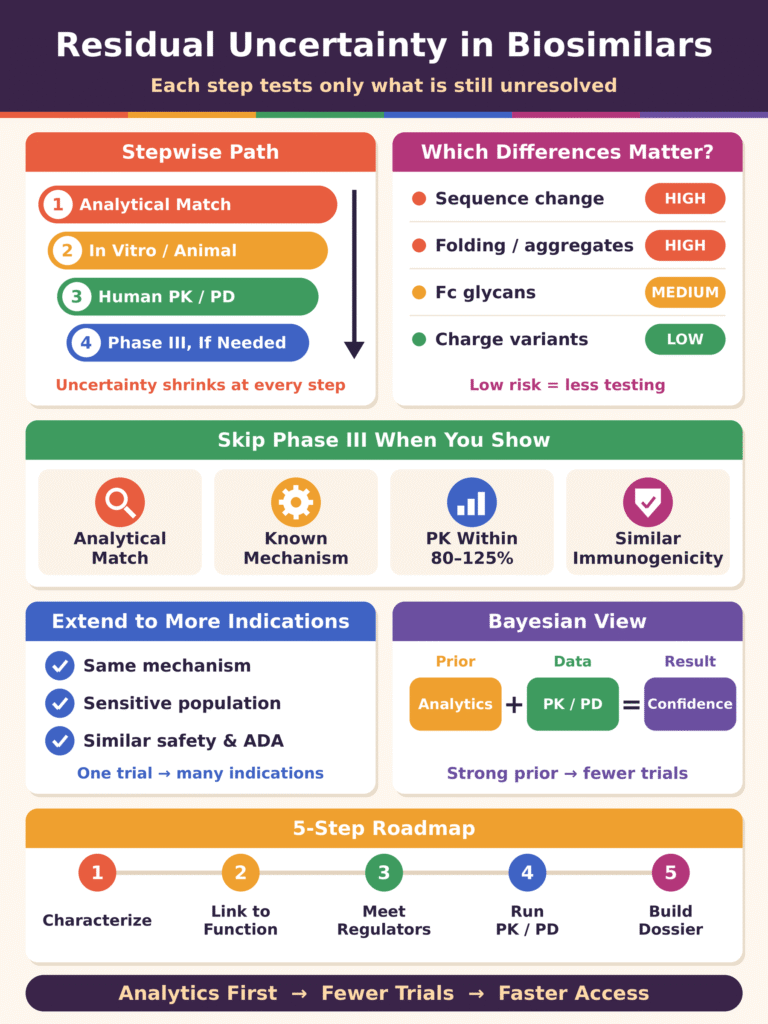
- Residual uncertainty drives the trial plan: Each stage of biosimilar development only addresses the scientific questions still unresolved after earlier analytical and functional testing, rather than following a fixed clinical pathway.
- Analytics now lead the evidence: High-resolution tools like LC-MS/MS, HDX-MS and cell-based bioassays can detect structural differences more sensitively than clinical trials, which are clouded by patient and disease variability.
- Not every difference matters equally: Changes in amino acid sequence or higher-order structure carry high risk, Fc glycosylation changes carry moderate risk, and charge variants like C-terminal lysine are usually low risk when properly justified.
- Development follows four steps: Comparative analytical assessment, then in vitro or animal studies (often not needed), then human PK/PD studies (typically 80–125% equivalence limits), and finally Phase III efficacy trials only if meaningful uncertainty remains.
- Phase III can be waived: This is possible when sponsors show strong analytical similarity, a well-understood mechanism of action, PK/PD equivalence, and a comparable immunogenicity profile.
- Extrapolation and Bayesian modeling cut trials further: Approval can extend to other indications when the mechanism, population sensitivity and safety profile support it. Bayesian methods combine analytical “prior” evidence with clinical data to judge whether more trials would add value.
- A five-step roadmap ties it together: Characterize early, link quality attributes to function, engage regulators early, run sensitive PK/PD studies, and build a totality-of-evidence dossier. This leads to faster timelines, lower costs and better patient access.
Structural and Functional Mechanics of Residual Uncertainty in Biosimilar Development
Structural and functional assessments examine how specific molecular differences, including post-translational modifications, higher-order structure variations, and charge heterogeneity, may influence biological activity and determine whether residual uncertainty remains. By linking critical quality attributes (CQAs) to mechanisms of action (MoA), sponsors can establish whether observed differences are unlikely to affect clinical outcomes or require additional, targeted in vitro or clinical investigations.
Biologics are complex macromolecules produced in living host cell systems. Because these systems naturally introduce molecular heterogeneity, achieving absolute structural identity with a reference product is generally not feasible. Accordingly, regulatory science emphasizes demonstrating high similarity by evaluating structural characteristics and determining their potential downstream biological consequences. Modern analytical characterization programs assess numerous physicochemical properties to identify and interpret differences before clinical studies begin:
- Primary and Higher-Order Structure (HOS): Complete amino acid sequence identity is generally expected for a biosimilar, with any sequence differences requiring a scientific and regulatory assessment. Higher-order folding, including secondary, tertiary, and quaternary structures, is evaluated using hydrogen-deuterium exchange mass spectrometry (HDX-MS), circular dichroism, nuclear magnetic resonance (NMR), and differential scanning calorimetry. Even subtle conformational changes may introduce structural uncertainty and influence target-binding affinity, protein stability, or systemic clearance.
- Post-Translational Modifications and Glycosylation: Glycoform distributions, including terminal galactosylation, core fucosylation, high-mannose structures, and sialylation, can substantially influence antibody effector functions. For example, afucosylation can enhance antibody-dependent cellular cytotoxicity (ADCC) by increasing binding affinity to FcγRIIIa receptors. Conversely, increased levels of certain high-mannose glycoforms may accelerate clearance through mannose receptors, potentially contributing to pharmacokinetic differences.
- Charge Heterogeneity and Aggregation Profiles: Acidic and basic charge variants, oxidation levels, and deamidation rates require careful characterization and control. Protein aggregation is also an important potential immunogenicity concern because high-molecular-weight aggregates may disrupt immune tolerance and contribute to anti-drug antibody (ADA) responses.
To manage these variables systematically, quality risk management frameworks classify structural attributes according to their potential effects on biological activity, clinical performance, and patient safety. The following table illustrates how different analytical findings may influence residual uncertainty and inform subsequent regulatory testing requirements.
| Quality Attribute Domain | Observed Analytical Difference | Biological / Clinical Consequence | Impact on Residual Uncertainty | Subsequent Regulatory Requirement |
|---|---|---|---|---|
| Primary Sequence | Amino acid substitution | Potentially altered epitope binding or target specificity | Critical / High | Generally incompatible with the conventional biosimilarity pathway unless scientifically and regulatorily justified; candidate redesign may be necessary. |
| Higher-Order Structure | Conformational unfolding or altered aggregation profile | Potential changes in half-life, stability, or immunogenic potential | High | Targeted non-clinical functional assays and, when justified, human PK/PD and immunogenicity studies. |
| Glycosylation (Fc-Region) | Change in core fucosylation level | Potentially altered FcγRIIIa binding affinity and ADCC activity | Moderate | Functional cell-based cytotoxicity assays and additional PK/PD evaluation when warranted. |
| Charge Heterogeneity | Increase in basic C-terminal lysine variants | C-terminal lysine residues may undergo in vivo enzymatic cleavage without a meaningful loss of biological function | Low / Negligible, if adequately justified | Additional clinical testing may not be necessary when supporting in vitro and analytical data establish the absence of a clinically meaningful impact. |
| Formulation / Excipients | Change in buffer system or surfactant type | Potential changes in stability, compatibility, or local injection-site tolerability | Low, depending on the change | Bridging stability and local tolerability data, with the need for additional clinical studies assessed scientifically. |
When analytical methods establish that observed differences fall within the natural variability of the reference product or involve attributes demonstrated to have no meaningful clinical impact, residual uncertainty may remain low. In contrast, differences involving receptor binding, target neutralization, or cell signaling require more detailed investigation. Developers must conduct targeted functional assays to determine whether these findings justify additional non-clinical or human studies.
Learn how critical quality attributes in biosimilars are identified and evaluated to understand their potential effects on biological activity and clinical performance.
The Stepwise Development Paradigm: Managing Residual Uncertainty in Biosimilar Development
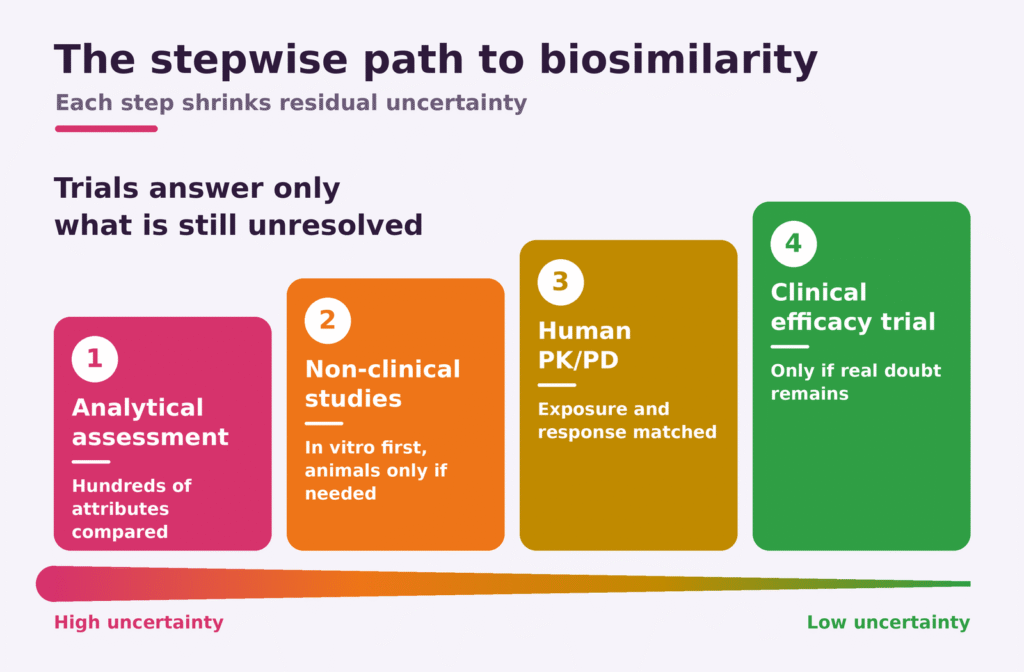
The stepwise development paradigm is a sequential, evidence-based strategy for evaluating residual uncertainty at each milestone in biosimilar development and determining the appropriate scope of subsequent non-clinical and clinical studies. This structured approach ensures that human clinical trials are designed to answer specific scientific questions that remain unresolved after comprehensive analytical characterization and functional testing.
Step 1: Comparative Analytical Assessment (CAA)
Comparative analytical assessment establishes the scientific foundation for demonstrating biosimilarity by quantitatively characterizing hundreds of quality attributes in the proposed biosimilar and comparing them with those of the reference product. Sponsors use complementary analytical technologies, combining separation techniques such as capillary electrophoresis and liquid chromatography with tandem mass spectrometry (LC-MS/MS), to evaluate the candidate against multiple reference product lots. Quantitative fingerprinting enables the assessment of structural and physicochemical similarity across numerous CQAs. When analytical characterization demonstrates a high degree of similarity and functional equivalence across relevant assays, residual uncertainty can be substantially reduced at the beginning of development.
Discover peptide mapping in biosimilars to understand how mass spectrometry supports detailed structural comparability assessments.
Step 2: Non-Clinical Animal and In Vitro Toxicity Evaluations
Non-clinical evaluations investigate potential toxicological concerns, although in vivo animal testing may be unnecessary when analytical similarity is convincingly established and appropriate in vitro functional assays adequately address the relevant scientific questions. Under contemporary guidance from the FDA, EMA, Health Canada, and WHO, animal toxicity studies are not universally required as a routine component of biosimilar development. Historically, animal studies were used to investigate potential off-target toxicity and identify unexpected safety signals. However, species-specific differences in biological reactivity can limit the ability of animal models to predict subtle biological effects in humans.
When comprehensive in vitro characterization, including receptor-binding assays, surface plasmon resonance (SPR), and cell-based biological assays, demonstrates comparable biological activity, the need for additional animal studies may be reduced. Nevertheless, the absence of analytical differences alone does not establish that every toxicological uncertainty has been eliminated. Regulatory authorities may discourage unnecessary animal testing while supporting further investigation when a novel expression system, a unique excipient, or another product-specific feature introduces a safety concern that cannot be adequately resolved through in vitro methods.
Step 3: Comparative Human Pharmacokinetics (PK) and Pharmacodynamics (PD)
Comparative human PK/PD studies assess systemic drug exposure and biological responses in appropriately selected populations to resolve remaining uncertainties before confirmatory clinical trials are considered. These studies are often designed as single-dose, randomized, double-blind crossover or parallel-group investigations involving sensitive and relatively homogeneous populations, such as healthy adult volunteers, when scientifically and ethically appropriate. They evaluate systemic exposure and, where relevant, measurable pharmacodynamic responses. PK similarity is generally assessed using the 90% confidence intervals for the geometric mean ratios of primary parameters, including Area Under the Curve (AUC0–∞ and AUC0–t) and Maximum Plasma Concentration (Cmax). For many products, the conventional bioequivalence acceptance interval is 80.00% to 125.00%, although the applicable criteria depend on the product, study design, regulatory guidance, and prespecified analysis.
When sensitive pharmacodynamic biomarkers are available, such as absolute neutrophil count for filgrastim or serum calcium levels for teriparatide, comparative PD assessments can provide important evidence regarding biological activity. However, PD equivalence supports the overall demonstration of biosimilarity rather than automatically replacing every clinical efficacy assessment. Establishing comparable PK/PD profiles in a sensitive human model can substantially reduce the remaining uncertainty regarding clinical bioactivity and help determine whether further clinical studies would provide meaningful additional evidence.
Step 4: Comparative Clinical Efficacy and Safety Trials (CES)
Comparative clinical efficacy trials are considered when meaningful uncertainty regarding clinical performance remains after analytical, functional, and PK/PD assessments. These studies may involve Phase III randomized controlled trials designed to demonstrate that the biosimilar candidate and reference product have sufficiently similar efficacy and safety outcomes within prospectively defined equivalence margins.
However, clinical efficacy endpoints, including overall response rate and changes in disease activity scores, may exhibit considerable variability and have limited sensitivity for detecting certain molecular differences. Factors such as patient characteristics, concomitant medications, disease progression, and background biological variability can obscure relatively small product-related effects. Consequently, a Phase III trial may not provide additional information when extensive analytical and functional testing has already established similarity and sensitive PK/PD studies have resolved the remaining relevant questions. Under an evidence-based regulatory approach, further clinical efficacy studies are considered when unexplained analytical differences, uncertain biological effects, or inconclusive PK/PD findings prevent a sufficiently robust demonstration of biosimilarity.
Regulatory Frameworks for Waiving Phase III Studies by Resolving Residual Uncertainty in Biosimilar Development
Modern regulatory frameworks allow Phase III comparative clinical efficacy studies to be waived in appropriate circumstances when comparative analytical assessments, functional studies, and PK/PD investigations provide sufficient evidence to establish biosimilarity. Global health authorities recognize that clinical efficacy trials may be less sensitive than detailed structural characterization and appropriately designed PK studies for identifying certain product-related differences.
The scientific rationale for waiving Phase III studies reflects the limitations of conventional clinical efficacy endpoints. In complex diseases, including oncology and autoimmune disorders, clinical outcomes may be influenced by patient comorbidities, concomitant immunosuppressive medications, receptor saturation dynamics, and subjective disease-scoring systems. These factors can make subtle molecular differences difficult to detect. By comparison, high-resolution physicochemical analytical techniques and single-dose human PK studies conducted in appropriately controlled populations may provide more sensitive evidence for identifying specific product differences.
To support a Phase III CES waiver, developers should address four principal scientific considerations that collectively demonstrate whether residual uncertainty has been adequately resolved:
- High-Resolution Analytical Comparability: Analytical similarity should be established across relevant primary, secondary, tertiary, and quaternary structural attributes using complementary, orthogonal assays. Any minor differences in individual attributes, such as charge variants or glycosylation patterns, should be supported by characterization data demonstrating their potential biological and clinical significance. Where appropriate, these data should establish that the differences do not meaningfully affect target-binding kinetics, receptor affinity, protein stability, or biological activity.
- Fully Characterized Mechanism of Action (MoA): The biological mechanisms responsible for therapeutic activity across the intended indications must be sufficiently understood. For a monoclonal antibody (mAb) that binds to a target cell-surface antigen and also triggers Fc-mediated immune functions, sponsors should demonstrate comparable activity for both Fab-mediated target binding or neutralization and Fc-mediated effector functions. Relevant assessments may include FcγR binding, C1q binding, ADCC, and complement-dependent cytotoxicity (CDC), as appropriate to the product’s mechanism of action.
- Demonstrated PK/PD Bioequivalence: Human PK studies should meet the applicable prespecified equivalence criteria for CmaxC_{\max} and AUC\text{AUC} in a suitably sensitive population. The conventional 80.00%–125.00% interval is frequently used for these parameters, although product-specific requirements may differ. When appropriate and validated PD biomarkers are available, comparative PD profiles should provide supportive evidence of similar biological responses and concentration-effect relationships.
- Tiered Immunogenicity Strategy: Comparative immunogenicity assessments should determine whether the biosimilar has a similar immunogenicity profile to the reference product. Validated, tiered assay strategies may include screening assays, confirmatory assays, neutralizing antibody (NAb) assays, and antibody titer determinations. The resulting evidence should be evaluated for differences in Anti-Drug Antibody (ADA) incidence, magnitude, persistence, and kinetics, where relevant.
When these considerations are adequately addressed and the totality of evidence demonstrates that no clinically meaningful differences remain unresolved, a Phase III comparative efficacy trial may not be scientifically necessary. The final decision depends on the product-specific evidence, the proposed indication, the applicable regulatory pathway, and the requirements of the relevant regulatory authority.
Read more about charge variant analysis in biosimilars and the mass spectrometry approaches used to investigate molecular heterogeneity.
Extrapolation of Indications and Resolution of Residual Uncertainty
Extrapolation allows a biosimilar demonstrated to be similar to its reference product in one appropriately selected indication to receive authorization for additional indications held by the reference product without conducting separate comparative efficacy trials for every condition. This approach is justified when the totality of analytical, functional, PK/PD, safety, and immunogenicity evidence supports similarity across the proposed indications. Its scientific basis involves demonstrating that relevant structural characteristics, receptor-binding properties, and biological mechanisms do not leave clinically meaningful uncertainty for the additional therapeutic uses.
Extrapolation is not an automatic administrative approval. It requires a scientifically supported justification based on analytical similarity, biological mechanisms, and the available clinical evidence. Biosimilar sponsors must systematically address three major considerations to evaluate residual uncertainty across multiple therapeutic indications:
- Mechanism of Action Mapping Across Pathology Types: When the reference product acts through the same biological pathway across multiple diseases, demonstrating comparable activity against the relevant target can support extrapolation. For example, a tumor necrosis factor-alpha (TNF-α) inhibitor may be used in rheumatoid arthritis, plaque psoriasis, and inflammatory bowel disease. Comparable binding to soluble and transmembrane TNF-α can support the assessment of similarity across these conditions. However, when a particular indication involves an additional or different mechanism of action, such as ADCC-mediated cell killing in one setting compared with ligand blockade in another, sponsors may need targeted in vitro functional assays to establish comparable activity for the relevant mechanisms.
- Target Population Sensitivity and Receptor Expression: Sponsors should select appropriate and sufficiently sensitive models for PK/PD and immunogenicity evaluations. Healthy volunteers may provide a relatively homogeneous population for identifying PK differences because they generally have fewer disease-related confounding factors and less variability in background treatment. However, when target-mediated drug disposition (TMDD) differs substantially between patient populations because of variations in receptor expression, supplementary PK analyses, mechanistic modeling, or other scientific assessments may be needed to determine whether exposure-response relationships remain comparable across the proposed indications.
- Comparative Safety and Immunogenicity Profiles: Extrapolation requires an assessment of whether differences between patient populations, including immune status, concomitant medications, and target tissue distribution, could influence the safety or immunogenicity profile. Evidence concerning structural similarity, aggregation, impurities, and relevant biological functions should be integrated with available clinical safety and immunogenicity data. These assessments help determine whether the proposed extrapolation is scientifically justified across the intended indications.
Under the regulatory frameworks of Health Canada, the FDA, and EMA, the need for indication-specific clinical efficacy data depends on the totality of evidence and the applicable requirements. A shared mechanism of action and a comparable active drug substance can provide important support for extrapolation, but they do not automatically eliminate the need to address indication-specific uncertainties. This approach reinforces the regulatory principle that comprehensive analytical and functional evidence can resolve many questions more effectively than separate clinical efficacy trials for every disease, provided that the scientific justification is adequate.
Explore post-translational modifications in biosimilars to learn how molecular modifications are evaluated during comparability assessments.
Bayesian Statistics and Quantitative Modeling of Residual Uncertainty in Biosimilar Development
Bayesian statistical frameworks provide a method for quantifying residual uncertainty by incorporating prior analytical and functional comparability evidence into statistical models and updating the resulting probability distributions with new PK/PD or clinical data. This approach can help developers evaluate the additional information provided by subsequent studies and determine whether a Phase III trial is likely to contribute meaningful evidence beyond that already obtained through analytical characterization.
In regulatory research and development, Bayesian models may represent comprehensive analytical similarity data through informative prior distributions. Rather than interpreting each subsequent PK/PD or clinical study in isolation, Bayesian inference combines prior information with incoming data to generate a posterior probability distribution concerning therapeutic equivalence or a relevant biosimilarity parameter. The mathematical relationship is expressed through Bayes’ Theorem, applied to a biosimilarity parameter θ, such as a clinical effect size or difference in drug exposure:
P(θ | DataClinical) = P(DataClinical | θ) × P(θ | DataAnalytical) P(DataClinical)
Where:
- P(θ | DataAnalytical) represents the prior distribution informed by analytical comparability assessments (CAA), structural characterization, and in vitro biological studies.
- P(DataClinical | θ) represents the likelihood function derived from clinical PK, PD, and immunogenicity data, as appropriate to the statistical model.
- P(θ | DataClinical) represents the posterior distribution, which describes the updated probability distribution for the biosimilarity parameter after incorporating the relevant evidence.
By applying Bayesian modeling approaches, sponsors can investigate how analytical and functional findings contribute to the reduction of uncertainty throughout development. When prior information is sufficiently reliable and the statistical model is appropriately specified, subsequent clinical evidence can refine the assessment without requiring every study to be evaluated independently. Strong analytical evidence may therefore support a more focused clinical development strategy when the combined evidence indicates that additional Phase III comparative efficacy trials would provide limited incremental information.
However, Bayesian methods do not automatically establish biosimilarity or justify the omission of clinical trials. Their suitability depends on the model assumptions, the quality and relevance of the prior information, the clinical evidence, and regulatory acceptance. When applied appropriately, quantitative modeling can strengthen the scientific rationale for development decisions, support transparent evidence integration, and help align regulatory assessments with advances in computational and analytical science.
Strategic Roadmap to Eliminate Residual Uncertainty in Biosimilar Development
Reducing residual uncertainty requires an integrated, analytical-first regulatory strategy that resolves molecular and functional questions early and uses the resulting evidence to determine the appropriate clinical trial requirements. Implementing a structured development roadmap can help biopharmaceutical sponsors prepare scientifically justified requests for Phase III waivers and support efficient market authorization.
To develop a streamlined biosimilar program that systematically addresses residual uncertainty at every stage, sponsors should follow a structured five-phase roadmap:
- Establish High-Density Analytical Characterization Platforms: Implement multi-attribute methods (MAM), LC-MS/MS, HDX-MS, and high-field NMR early in development. Use these technologies to characterize primary, secondary, and tertiary structures and other relevant quality attributes across multiple reference product lots, thereby establishing the natural variability of the reference product and providing a robust basis for comparison.
- Map Critical Quality Attributes to Biological Function: Conduct comprehensive receptor-binding kinetic studies using surface plasmon resonance (SPR) or biolayer interferometry (BLI), together with appropriate cell-based bioassays. These assessments should link observed analytical differences, including charge isoforms and glycoforms, to target neutralization, receptor interactions, and Fc-mediated biological functions, helping determine whether the differences have meaningful functional consequences.
- Engage Regulatory Agencies Early for Phase III Waiver Alignment: Arrange early scientific advice meetings, such as FDA Biosimilar Biological Product Development (BPD) meetings or EMA Scientific Advice consultations, to discuss analytical comparability findings, justify the proposed non-clinical strategy, and seek alignment on the need for comparative clinical efficacy studies. Early engagement can help identify unresolved scientific questions before human studies begin and clarify the evidence expected to support a potential Phase III CES waiver.
- Execute Single-Dose PK/PD Studies in Sensitive Populations: Design appropriately powered, randomized PK/PD crossover or parallel-group studies in suitable populations, including healthy adult volunteers when appropriate. Use validated, sensitive bioanalytical assays to assess systemic exposure and relevant pharmacodynamic responses against prospectively defined acceptance criteria. The conventional 80.00%–125.00% confidence interval is commonly applied to PK equivalence assessments, subject to product-specific and regulatory requirements.
- Build a Comprehensive Totality-of-Evidence Dossier: Integrate analytical, functional, PK/PD, safety, and immunogenicity findings into a coherent regulatory submission. The dossier should explain how the evidence addresses residual uncertainty, justify the proposed clinical development strategy, and support indication extrapolation when the relevant scientific criteria are met. Where the totality of evidence is sufficient, sponsors may seek authorization without conducting comparative Phase III efficacy trials.
Learn how forced degradation of biosimilars supports stability assessment and the investigation of potential molecular differences.
Conclusion: The Future of Residual Uncertainty in Biosimilar Development
The management of residual uncertainty in biosimilar development has increasingly shifted from a clinical-trial-intensive approach toward a strategy centered on advanced analytical characterization, functional evaluation, and appropriately targeted human PK/PD studies. As regulatory authorities continue to refine and harmonize their approaches to biosimilarity, developers that prioritize early analytical risk assessment can potentially shorten development timelines, reduce unnecessary expenditures, and improve patient access to high-quality biological therapies.
Planning a biosimilar regulatory submission? Explore our end-to-end biosimilar analytical package to support an integrated, evidence-driven characterization strategy.
By integrating advanced structural characterization techniques, cell-based bioassays, and appropriate statistical methods for evaluating the totality of evidence, sponsors can establish a robust foundation for demonstrating high similarity early in development. This evidence may support the omission of unnecessary animal toxicity studies and Phase III comparative clinical trials when the applicable scientific and regulatory requirements are satisfied. Developers seeking specialized analytical characterization, higher-order structure analysis, and tailored regulatory testing strategies to address residual uncertainty in biosimilar development can consult the technical experts at ResolveMass Laboratories Inc. through the Contact Us Page.
Frequently Asked Questions (FAQs)
The stepwise approach evaluates analytical similarity, biological activity, and potential safety concerns before determining whether animal studies are scientifically justified. When comprehensive in vitro assessments adequately address relevant toxicological questions, additional animal testing may offer limited value. However, unresolved safety risks, novel product characteristics, or limitations in available testing methods may warrant further non-clinical investigation.
A Phase III comparative efficacy study may be waived when the totality of evidence demonstrates high analytical similarity, comparable biological functions, and sufficiently similar PK profiles. Relevant PD and immunogenicity findings must also support the conclusion that no clinically meaningful differences remain unresolved. The decision depends on the product-specific evidence and the applicable requirements of the regulatory authority.
Comparative analytical assessments use advanced techniques, including mass spectrometry and NMR spectroscopy, to identify subtle differences in molecular structure, composition, and physicochemical properties. Clinical trials evaluate outcomes that may be influenced by disease severity, patient variability, concomitant medications, and other biological factors. Consequently, analytical methods can detect certain product-related differences that may be difficult to distinguish through clinical endpoints alone.
Pharmacodynamic biomarkers provide measurable evidence of how a drug influences a biological process associated with its therapeutic activity. Comparing PD responses between a biosimilar and its reference product can help establish whether their biological effects are sufficiently similar. When suitable, sensitive biomarkers are available, these findings can strengthen the evidence for biosimilarity and potentially reduce the need for additional comparative efficacy studies.
The significance of glycosylation differences depends on the affected glycan structure and its relationship to biological function. For example, changes in core fucosylation can influence FcγRIIIa binding and antibody-dependent cellular cytotoxicity (ADCC), making comparative functional testing important. If the observed variation does not meaningfully affect biological activity or product quality, the remaining uncertainty may be limited and may not justify additional clinical studies.
Indication extrapolation requires a comprehensive assessment of analytical similarity, relevant mechanisms of action (MoA), functional activity, safety, and immunogenicity. Sponsors must evaluate whether differences between disease conditions or patient populations could influence the biosimilar’s performance. When the available evidence adequately supports similarity across the proposed indications, separate comparative efficacy trials for every condition may not be necessary.
Bayesian statistical modeling combines existing evidence with newly generated data to update the estimated probability of a particular scientific conclusion. In biosimilar development, analytical and functional findings may inform prior distributions, while comparative PK, PD, and immunogenicity results contribute additional evidence. The resulting posterior distributions help quantify uncertainty, although the conclusions depend on the model assumptions, data quality, and suitability of the statistical approach.
Differences in anti-drug antibody (ADA) incidence, persistence, or neutralizing antibody (NAb) activity may indicate potential concerns regarding safety, efficacy, or drug clearance. When such differences are observed, sponsors must investigate their clinical significance and determine whether they are associated with product characteristics or other contributing factors. Depending on the findings, additional immunogenicity assessments, impurity investigations, or manufacturing process improvements may be necessary before development can proceed.
Regulatory developments increasingly emphasize comprehensive analytical characterization and scientifically justified clinical testing rather than requiring the same clinical development pathway for every biosimilar. Depending on the product and the applicable guidance, strong analytical and functional evidence, supported by appropriate comparative PK/PD data, may justify omitting a Phase III comparative efficacy study. The need for animal toxicity studies is also assessed according to the unresolved scientific questions, helping reduce unnecessary testing while preserving rigorous standards for biosimilar quality, safety, and efficacy.
Reference:
- U.S. Food and Drug Administration. (2015). FDA’s overview of the regulatory guidance for the development and approval of biosimilar products in the US. https://www.fda.gov/files/drugs/published/FDA%E2%80%99s-Overview-of-the-Regulatory-Guidance-for-the-Development-and-Approval-of-Biosimilar-Products-in-the-US.pdf
- U.S. Food and Drug Administration. (2015). Scientific considerations in demonstrating biosimilarity to a reference product: Guidance for industry. https://www.fda.gov/media/82647/download
- European Medicines Agency. (2026). Reflection paper on a tailored clinical approach in biosimilar development. https://www.ema.europa.eu/en/documents/other/reflection-paper-tailored-clinical-approach-biosimilar-development_en.pdf-0
- U.S. Food and Drug Administration. (2025). Considerations in demonstrating biosimilarity to a reference product: Guidance for industry. https://www.fda.gov/media/189366/download
Get In Touch With Us
About The Author