


Introduction
Sequence Confirmation Services for Synthetic Therapeutic Peptides provide definitive verification of the primary amino acid sequence, terminal modifications, and structural fidelity of peptide active pharmaceutical ingredients throughout all stages of drug development. Establishing the primary sequence of synthetic therapeutic peptides with high accuracy is critical for satisfying global regulatory requirements, minimizing the risk of off-target biological effects, and confirming product sameness across different manufacturing batches.
The biopharmaceutical market has experienced substantial growth in synthetic peptide therapeutics, including glucagon-like peptide-1 (GLP-1) receptor agonists, cyclic peptides, and peptidomimetics. Solid-phase peptide synthesis (SPPS) and liquid-phase peptide synthesis (LPPS) enable the incorporation of non-canonical amino acids, D-enantiomers, and targeted chemical modifications designed to improve half-life and potency. Nevertheless, chemical synthesis can introduce several structural risks, including amino acid deletions, insertions, racemization, incomplete deprotection, and side-chain modifications.
Implementing a robust analytical strategy during the early stages of development helps maintain structural integrity from initial research batches through Good Manufacturing Practice (GMP) lot release. Regulatory authorities such as the U.S. Food and Drug Administration (FDA) and the European Medicines Agency (EMA) impose stringent requirements described in International Council for Harmonisation (ICH) guidelines, particularly ICH Q6B and ICH Q3A/B/C/D, as well as United States Pharmacopeia (USP) monographs. Comprehensive analytical dossiers must establish high-resolution structural identity, quantitative purity, and batch-to-batch comparability to support clinical trial approvals (IND/IMPD) and marketing authorizations (NDA/ANDA). ResolveMass Laboratories Inc. provides regulatory-ready mass spectrometry and chromatographic characterization strategies specifically designed for complex synthetic peptide architectures.
Learn more about comprehensive regulatory support by exploring Regulatory Requirements for GLP-1 Peptide Characterization.
Share via:
Quick Summary:
- Sequence confirmation verifies the exact amino acid sequence, terminal modifications, and structural integrity of synthetic therapeutic peptides from research batches through GMP production.
- LC-HRMS/MS and peptide mapping provide high-resolution mass accuracy, sequence coverage, variant detection, and site-specific modification mapping.
- Edman degradation, amino acid analysis, and chiral RP-HPLC/Marfey’s provide orthogonal confirmation of N-terminal sequence, amino acid composition, and D/L stereochemical purity.
- Regulatory compliance relies on frameworks including ICH Q6B, ICH Q2, ICH Q3A/B/C/D, USP, FDA guidance, and 21 CFR Part 11 to establish identity, purity, and batch comparability.
- Phase-appropriate validation progresses from exploratory HRMS screening in research to qualified methods in clinical development and fully validated LC-MS/MS, GC-MS, and ICP-MS methods for commercial GMP lots.
- Advanced analytical strategies address challenging issues such as Leu/Ile isobaric residues, racemization, terminal modifications, disulfide connectivity, and cyclic peptide structures.
- GMP data integrity and quality management use validated methods and ALCOA+ principles to ensure reliable, traceable, audit-ready results and support regulatory submissions.
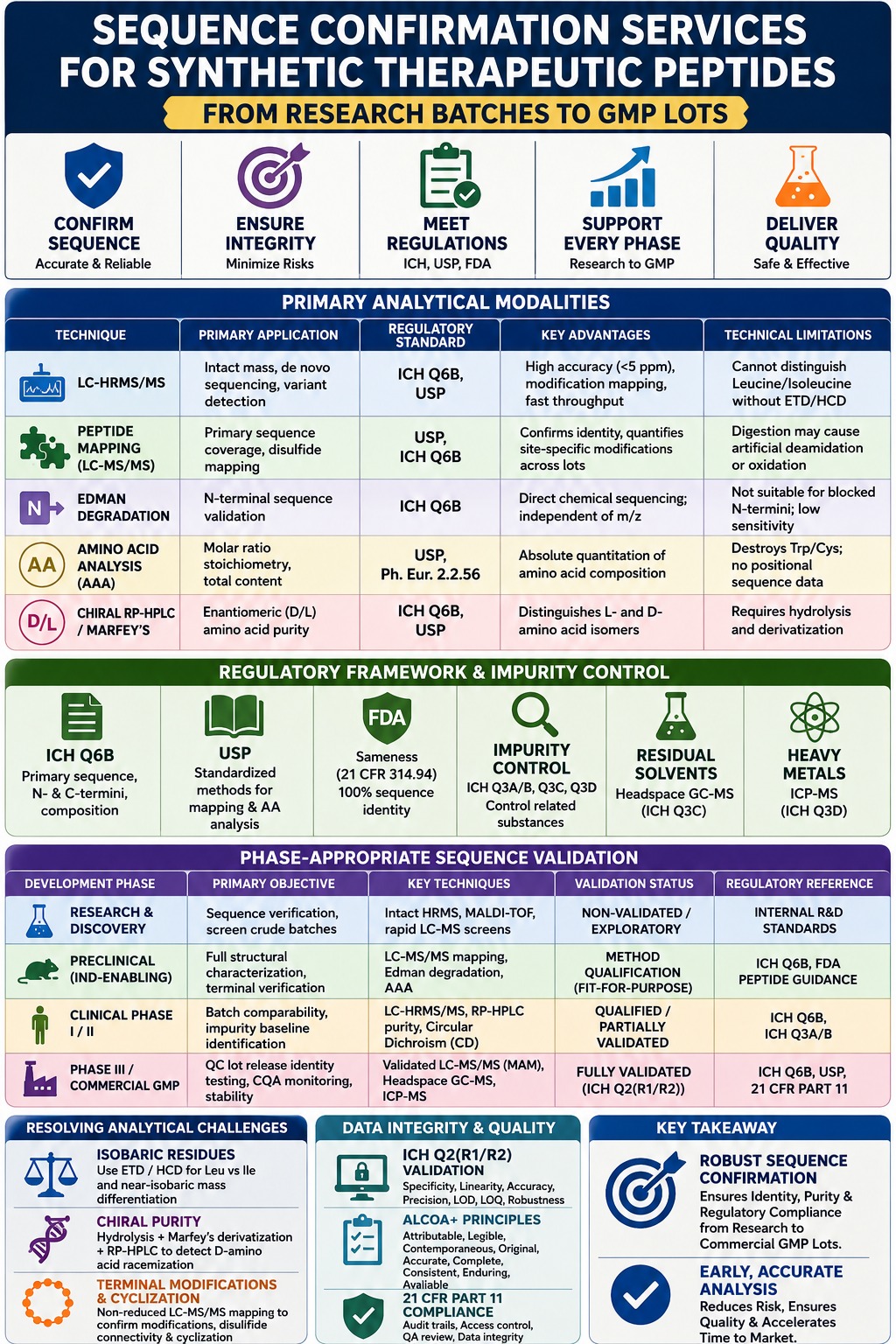
Primary Analytical Modalities for Sequence Confirmation Services for Synthetic Therapeutic Peptides
Primary analytical modalities used in Sequence Confirmation Services for Synthetic Therapeutic Peptides assess full-length primary amino acid sequences through high-resolution tandem mass spectrometry (LC-MS/MS), orthogonal Edman degradation, and quantitative amino acid analysis. These complementary analytical approaches provide comprehensive sequence coverage, confirm terminal modifications, and help resolve structural ambiguities associated with synthetic peptide formulations.
High-Resolution Tandem Mass Spectrometry (LC-MS/MS) and Peptide Mapping
High-resolution LC-MS/MS and peptide mapping form the foundation of contemporary sequence confirmation workflows because they provide high mass accuracy and detailed fragmentation spectra for confirming amino acid order and identifying post-translational modifications. Instruments based on Quadrupole Time-of-Flight (Q-TOF) or Orbitrap geometry can deliver mass measurements with mass accuracies below 2–5 parts per million (ppm).
For short-to-medium length synthetic peptides (up to ~30–40 amino acids), top-down LC-MS/MS analysis assesses intact molecular mass together with collision-induced dissociation (CID), higher-energy collisional dissociation (HCD), or electron-transfer dissociation (ETD) fragmentation spectra to establish sequence order without requiring enzymatic cleavage. For larger peptides or highly folded cyclic constructs, bottom-up peptide mapping approaches digest the analyte into defined fragments using site-specific endopeptidases, such as trypsin, chymotrypsin, and Lys-C, or targeted chemical cleavage before LC-MS/MS analysis. Interpretation of fragmentation spectra focuses on characteristic fragment ion series (b– and y-ions for CID/HCD; c– and z-ions for ETD) to verify individual amino acid positions and determine the locations of post-translational or synthetic modifications, including N-terminal pyroglutamination and C-terminal amidation.
To review complete analytical capabilities for sequence validation, visit Peptide Sequencing of GLP-1 Peptide Services.
Edman Degradation Gas-Phase Sequencing
Edman degradation provides chemical confirmation of the N-terminal sequence through sequential phenylisothiocyanate derivatization followed by chromatographic identification of individual amino acids. During this process, N-terminal amino acids are sequentially cleaved after phenylisothiocyanate (PITC) derivatization, and the resulting phenylthiohydantoin (PTH)-amino acids are identified using RP-HPLC. Although Edman degradation has limitations related to throughput and blocked N-termini, including acetylated or pyroglutamyl peptides, it provides direct and unambiguous stepwise chemical confirmation of accessible N-terminal regions when mass spectrometry-derived fragment ions produce uncertain sequence assignments.
Quantitative Amino Acid Analysis (AAA) for Sequence Confirmation Services
Quantitative amino acid analysis determines the absolute empirical molar ratios of constitutive amino acids in a synthetic peptide after acid hydrolysis, thereby supporting Sequence Confirmation Services for Synthetic Therapeutic Peptides. Performed in accordance with USP and European Pharmacopoeia (Ph. Eur.) 2.2.56, the procedure generally involves acid hydrolysis, typically using 6 N HCl at 110 °C for 24 hours, followed by chromatographic separation through RP-HPLC or Ion-Exchange Chromatography. Pre- or post-column derivatization, including ninhydrin, OPA, or FMOC, may be used before UV or fluorescence detection. AAA provides an orthogonal quantitative reference that complements mass spectrometry results by confirming that the measured empirical amino acid ratio corresponds with the expected theoretical stoichiometry.
For full contract research organization support in routine and complex peptide testing, explore GLP-1 Peptide Sequencing CRO Services.
| Analytical Technique | Primary Application | Regulatory Standard | Key Advantages | Technical Limitations |
|---|---|---|---|---|
| LC-HRMS/MS | Intact mass, de novo sequencing, variant detection | ICH Q6B, USP | High mass accuracy (<5 ppm), site-specific modification mapping, rapid throughput | Cannot easily distinguish isobaric Leucine/Isoleucine without specialized ETD/HCD |
| Peptide Mapping (LC-MS/MS) | Primary sequence coverage, disulfide mapping | USP, ICH Q6B | Confirms identity and quantifies site-specific modifications across lots | Digestion protocols can introduce artificial deamidation or oxidation if unoptimized |
| Edman Degradation | N-terminal sequence validation | ICH Q6B | Direct chemical sequencing; independent of mass-to-charge ratios | Ineffective on N-terminally modified or blocked peptides; low sensitivity |
| Amino Acid Analysis (AAA) | Molar ratio stoichiometry, total content | USP, Ph. Eur. 2.2.56 | Absolute quantitation of amino acid composition | Destroys tryptophan/cysteine during acid hydrolysis; lacks sequence positional data |
| Chiral RP-HPLC / Marfey’s | Enantiomeric (D/L) amino acid purity | ICH Q6B, USP Monograph | Distinguishes L- and D-amino acid optical isomers | Requires hydrolytic cleavage and derivatization prior to analysis |
Regulatory Frameworks Governing Synthetic Therapeutic Peptide Characterization
Regulatory frameworks governing synthetic therapeutic peptide characterization require rigorous adherence to ICH, USP, and FDA guidelines to establish identity, purity, and batch-to-batch structural comparability. Compliance with these requirements is essential for successful Investigational New Drug (IND), New Drug Application (NDA), and Abbreviated New Drug Application (ANDA) regulatory submissions.
International harmonized quality standards establish defined characterization expectations throughout the peptide drug development lifecycle:
- ICH Q6B Guidelines: Require comprehensive primary sequence confirmation, verification of amino acid composition, and characterization of both N- and C-terminal regions for peptide active pharmaceutical ingredients.
- Compendial Standards (USP and USP): Establish standardized approaches for peptide mapping, enzymatic digestion, chromatographic separation, and quantitative amino acid profiling.
- FDA Sameness Guidance (21 CFR 314.94): Requires generic synthetic peptide applicants to establish 100% primary sequence identity, equivalent higher-order structure using Circular Dichroism (CD) and FTIR, and comparative purity relative to the Reference Listed Drug (RLD).
- Impurity Profiling Standards (ICH Q3A/B, Q3C, Q3D): Require stringent control and quantitation of synthetic related substances, residual solvents through Headspace GC-MS, and trace heavy metal catalysts using ICP-MS.
Under ICH Q6B, identity testing must use analytical methodologies capable of distinguishing closely related structural variants and deletion sequences. For generic peptide development through ANDA regulatory pathways, the FDA’s active ingredient sameness guidance requires applicants to establish that synthetic peptides do not contain new synthetic impurities above 0.10% that exceed 0.5% of the total drug substance without formal clinical justification.
For a detailed breakdown of step-by-step methodologies used in peptide identity confirmation, read about the GLP-1 Analog Peptide Sequencing Workflow.
Process-related impurities arising from wash solvents, including DMF, DCM, and acetonitrile, must be controlled according to ICH Q3C limits using headspace gas chromatography-mass spectrometry (GC-MS). Likewise, heavy metal impurities introduced through coupling reagents or synthesis equipment are quantified using Inductively Coupled Plasma Mass Spectrometry (ICP-MS) in accordance with ICH Q3D requirements.
For a detailed breakdown of step-by-step methodologies used in peptide identity confirmation, read about the GLP-1 Analog Peptide Sequencing Workflow.
Phase-Appropriate Sequence Validation: From Research Batches to Commercial GMP Lots
Phase-appropriate sequence validation increases analytical rigor throughout drug development, progressing from rapid structural screening during early discovery to fully validated assays operating under 21 CFR Part 11 requirements for commercial GMP lot release.
During early research and candidate discovery, sequence verification primarily emphasizes high-throughput screening to confirm the intended molecular weight and identify synthesis-related failures. Intact high-resolution mass spectrometry (HRMS) and MALDI-TOF-MS can rapidly identify incomplete coupling steps, deletion peptides, and incompletely removed protecting groups, such as t-Bu, Pbf, and Trt, introduced during solid-phase synthesis.
As candidate peptides progress into preclinical evaluation and Phase I/II clinical trials (IND/IMPD filings), analytical procedures transition toward formal method qualification. At this stage, testing establishes comprehensive primary sequence coverage, confirms N- and C-terminal identity, verifies native disulfide bridge pairings, and develops preliminary impurity profiles. This analytical foundation allows manufacturers to demonstrate comparability as peptide synthesis progresses from benchtop batches to pilot manufacturing lots.
To learn more about analyzing higher-order structures across phases, see CD Spectroscopy for Peptide Secondary Structure Characterization.
For Phase III clinical trials and commercial GMP lot release associated with NDA/ANDA submissions, sequence confirmation procedures must operate under fully validated protocols consistent with ICH Q2(R1/R2) guidelines. Validated Multi-Attribute Methods (MAM) based on LC-MS/MS enable simultaneous monitoring of site-specific Critical Quality Attributes (CQAs) and automated non-targeted peak detection (NPD) to identify unexpected impurities. All analytical workflows must comply with 21 CFR Part 11 data integrity requirements to support commercial batch release and stability testing.
Discover solutions for complex geometries by visiting Cyclic Peptide Characterization Services.
| Development Phase | Primary Objective | Key Analytical Techniques | Method Validation Status | Regulatory Reference |
|---|---|---|---|---|
| Research & Discovery | Sequence verification, screening crude synthesis batches | Intact HRMS, MALDI-TOF, rapid LC-MS screens | Non-validated / Exploratory | Internal R&D standards |
| Preclinical (IND-Enabling) | Full structural characterization, terminal verification | LC-MS/MS mapping, Edman degradation, AAA | Method Qualification (fit-for-purpose) | ICH Q6B, FDA Peptide Guidance |
| Clinical Phase I / II | Batch comparability, impurity baseline identification | LC-HRMS/MS, RP-HPLC purity, Circular Dichroism | Qualified / Partially Validated | ICH Q6B, ICH Q3A/B |
| Phase III / Commercial GMP | QC Lot release identity testing, CQA monitoring, stability | Validated LC-MS/MS (MAM), Headspace GC-MS, ICP-MS | Fully Validated per ICH Q2(R1/R2) | ICH Q6B, USP, 21 CFR Part 11 |
Resolving Analytical Challenges in Synthetic Peptide Sequence Confirmation
Addressing analytical challenges in peptide sequencing requires specialized tandem mass spectrometry fragmentation and chiral separation approaches to differentiate isobaric residues, optical enantiomers, and structurally complex chemical modifications.
Isobaric Residues and Near-Isobaric Mass Differentiation
Distinguishing isobaric residues such as Leucine and Isoleucine requires electron-transfer dissociation (ETD) or higher-energy collisional dissociation (HCD) approaches capable of producing diagnostic side-chain fragment ions. Leucine and Isoleucine have the same elemental composition (C6H13NO2) and identical accurate mass (113.0840 Da), which makes them difficult to distinguish using conventional CID fragmentation because they produce identical backbone b– and y-ions.
Using ETD or EThcD fragmentation enables side-chain cleavage and produces characteristic w-ions w-ions (wIle vs. wLeu), supporting definitive positional assignment. Near-isobaric pairs, including Lysine (128.09496 Da) and Glutamine (128.05858 Da), have a mass difference of only 0.03638 Da. This difference can be resolved using high-resolution Orbitrap or Q-TOF mass spectrometers operating at resolving powers greater than 60,000.
To address high-order physical stability challenges alongside sequence confirmation, view Peptide Aggregation Analysis Guidelines.
Chiral Enantiomeric Purity and Racemization Analysis
Determining stereochemical purity and detecting racemization of L- and D-amino acids requires hydrolytic cleavage followed by chiral derivatization and reverse-phase HPLC separation. Synthetic therapeutic peptides often incorporate D-amino acids to reduce susceptibility to enzymatic cleavage by endogenous proteases. Because optical enantiomers have identical mass-to-charge ratios and similar mass spectral fragmentation characteristics, mass spectrometry alone cannot establish their stereochemical identity.
For chiral purity determination, peptides undergo complete acid hydrolysis followed by derivatization using chiral reagents such as Marfey’s reagent (1-fluoro-2,4-dinitrophenyl-5-L-alanine amide; FDAA). The resulting diastereomeric derivatives are separated by RP-HPLC and quantified against authentic reference standards, enabling detection of trace D-amino acid racemization at levels down to 0.1%.
For targeted optical purity testing parameters, read about Chiral Analysis of Therapeutic Peptide APIs.
Structural Characterization of Terminal Modifications and Cyclization
Characterization of terminal modifications and cyclic structures requires non-reduced LC-MS/MS peptide mapping to confirm amide backbones, disulfide connectivity, and lipophilic conjugations. Synthetic modifications such as N-terminal pyroglutamination, C-terminal amidation, and fatty acid acylation, including palmitoylation in long-acting GLP-1 analogs, produce predictable mass shifts that must be verified at their respective sequence positions.
For cyclic peptides containing intra-molecular disulfide bonds or head-to-tail backbone cyclizations, non-reduced LC-MS/MS mapping approaches maintain native linkages, allowing analysts to distinguish the intended connectivity from scrambled structural isomers.
Review analytical requirements using the Peptide Characterization CRO Deliverables Checklist.
Data Integrity, Validation, and Quality Management in GMP Sequence Confirmation
GMP sequence confirmation requires rigorous compliance with ICH Q2(R1/R2) validation parameters and ALCOA+ data integrity principles to ensure that analytical results can withstand regulatory inspections and audits.
Once sequence confirmation protocols are established for commercial lot release and stability testing, analytical methods undergo formal validation in accordance with ICH Q2(R1/R2) guidelines. Validation packages evaluate specificity to ensure that target peptide sequences can be distinguished from deletion variants and degradation products. Method linearity, range, accuracy, repeatability, intermediate precision, and robustness are documented together with rigorous Limit of Detection (LOD) and Limit of Quantitation (LOQ) determinations for process-related impurities.
Data governance frameworks must implement ALCOA+ principles (Attributable, Legible, Contemporaneous, Original, Accurate, Complete, Consistent, Enduring, and Available) throughout analytical testing environments. ResolveMass Laboratories Inc. operates 21 CFR Part 11-compliant data acquisition platforms featuring automated audit trails, role-based security access controls, and independent Quality Assurance (QA) data verification to maintain comprehensive audit readiness for global regulatory submissions.
To implement multi-attribute LC-MS workflows into your quality systems, explore Multi-Attribute Monitoring (MAM) for Peptide Characterization.
Conclusion
Implementing robust Sequence Confirmation Services for Synthetic Therapeutic Peptides supports structural identity, purity, and regulatory compliance throughout the pharmaceutical development lifecycle. Compliance with regulatory standards such as ICH Q6B, USP, USP, and FDA active ingredient sameness guidelines enables drug developers to establish compliant CMC dossiers that can withstand international regulatory review.
Integrating high-resolution mass spectrometry, targeted fragmentation modalities (CID/HCD/ETD), Edman degradation, and chiral amino acid analysis helps address complex structural challenges, including isobaric amino acid assignment, stereochemical purity assessment, and terminal modification mapping. Establishing phase-appropriate sequence validation at an early development stage safeguards product quality, minimizes regulatory risks, and can support more efficient commercial launch timelines.
For comprehensive regulatory submission support, examine the Full Characterization Data Package for GLP-1 Receptor Agonist ANDA Submissions.
For expert guidance on custom sequence confirmation protocols or regulatory-ready peptide characterization packages, contact the technical team at ResolveMass Laboratories Inc. through the ResolveMass Laboratories Inc. Contact Page.
Frequently Asked Questions (FAQs)
LC-MS/MS generally provides broader analytical capabilities, faster processing, and greater sensitivity than Edman degradation. It can evaluate modified peptides and structures with blocked N-termini while providing detailed fragmentation information across the peptide sequence. Edman degradation, in comparison, is primarily suited to sequential analysis of accessible, unmodified N-terminal residues.
ICH Q6B establishes characterization principles used to demonstrate the identity and structural attributes of peptide and biological products. Sequence confirmation may include assessment of the primary amino acid sequence, amino acid composition, and terminal structures. These analyses help establish consistent molecular identity and support comparability between manufacturing batches.
Conventional collision-induced dissociation (CID) does not readily differentiate Leucine from Isoleucine because both residues have the same elemental composition and mass of 113.0840 Da. Specialized tandem mass spectrometry approaches, including Electron-Transfer Dissociation (ETD) or Higher-Energy Collisional Dissociation (HCD), can generate diagnostic side-chain fragments. These characteristic w-ions can help establish whether the residue is Leucine or Isoleucine.
USP provides compendial guidance and analytical approaches relevant to peptide characterization and identity testing. These approaches can support peptide mapping, enzymatic digestion, chromatographic separation, and mass-based detection for structural evaluation. Such standardized analytical procedures can contribute to lot release, stability studies, and broader quality-control programs.
Terminal modifications are evaluated using high-resolution tandem mass spectrometry (LC-MS/MS) and peptide mapping techniques. Characteristic changes in molecular mass and diagnostic fragment ions can confirm modifications such as N-terminal pyroglutamation and C-terminal amidation. Fragmentation data also helps determine whether the modification occurs at the expected terminal position within the peptide structure.
Generic peptide sameness assessment requires comprehensive analytical characterization against the Reference Listed Drug (RLD). Testing can include high-resolution LC-MS/MS for primary sequence confirmation, Circular Dichroism (CD) or FTIR for higher-order structural comparison, and chromatographic methods for impurity profiling. The analytical package must demonstrate that the synthetic peptide meets applicable identity, purity, and impurity requirements.
Stereochemical purity is commonly assessed through chiral Amino Acid Analysis (Chiral AAA). The peptide is hydrolyzed to release its constituent amino acids, followed by derivatization with a chiral reagent such as Marfey’s reagent. The resulting derivatives are separated by RP-HPLC and compared with authentic L- and D-amino acid standards to determine the level of enantiomeric impurities.
Research-grade characterization is primarily intended for rapid structural screening, molecular mass confirmation, and identification of synthesis-related issues during early development. GMP lot release testing requires qualified or fully validated analytical procedures appropriate to the development stage and applicable regulatory requirements. These tests are performed within controlled data management systems, including 21 CFR Part 11-compliant environments, with appropriate Quality Assurance (QA) oversight.
Amino Acid Analysis (USP) provides an independent measurement of the peptide’s amino acid composition and molar ratios. LC-MS/MS primarily establishes sequence order, molecular mass, and fragmentation-based structural information, whereas AAA offers quantitative compositional confirmation. Using both techniques provides orthogonal evidence that the observed peptide composition is consistent with the expected molecular structure.
Reference:
- U.S. Food and Drug Administration. (2022). Sameness evaluations of active ingredients in ANDAs. https://www.fda.gov/regulatory-information/search-fda-guidance-documents/sameness-evaluations-anda-active-ingredients
- Elsayed, Y. Y., Kühl, T., & Imhof, D. (2025). Regulatory guidelines for the analysis of therapeutic peptides and proteins. Journal of Peptide Science, 31(3), e70001. https://doi.org/10.1002/psc.70001
- Yan, Y., Kusalik, A. J., & Wu, F.-X. (2016). De novo peptide sequencing using CID and HCD spectra pairs. Proteomics, 16(20), 2615–2624. https://doi.org/10.1002/pmic.201500251
- U.S. Food and Drug Administration. (1999, August). Q6B specifications: Test procedures and acceptance criteria for biotechnological/biological products. FDA (U.S. Food and Drug Administration)
- U.S. Food and Drug Administration. (2017). FYs 2013–2017 regulatory science report: Complex mixtures and peptides. U.S. Food and Drug Administration
Get In Touch With Us
About The Author


