

Introduction:
Silicone Lubricant Leachables are chemical substances that can migrate from silicone-lubricated components of a pharmaceutical container or drug-delivery system into the drug product during storage and use. For an auto-injector, this matters because the primary container, formulation, elastomeric components, lubricant, and device materials together form an interconnected drug-contact system — a change in any one of them can shift the leachable profile of the whole system.
Auto-injectors are increasingly used for self-administration of injectable medicines, including biologics and other sensitive formulations. Their design combines a primary container with mechanical components that must perform consistently over the full shelf life, which is exactly why silicone lubrication is applied in the first place — and exactly why it needs to be evaluated as a potential leachable source rather than treated as an inert manufacturing aid.
This case study walks through a practical, source-to-risk analytical strategy for investigating Silicone Lubricant Leachables in an auto-injector primary container: from the first stability signal, through component-level source attribution, chemical characterization, and toxicological risk assessment, to the corrective actions and regulatory framework that support container-closure suitability.
Summary:
- Silicone Lubricant Leachables are silicone-derived chemical species — cyclic and linear siloxanes, PDMS oligomers — that can migrate from lubricated components of an auto-injector primary container into the drug product, requiring a scientifically justified extractables and leachables (E&L) assessment.
- In this case study, an analytical investigation identifies and characterizes silicone-related signals detected during stability testing of a biologic auto-injector.
- A multi-platform approach — GC-MS, LC-MS, ICP-MS, and complementary techniques such as FTIR and headspace GC-MS — provides broad coverage of volatile, semi-volatile, non-volatile, and elemental species.
- Source attribution requires side-by-side comparison of the drug product, placebo, individual components, controlled extracts, and stability samples — detecting a peak is not the same as proving it came from silicone lubricant.
- Leachable risk is evaluated using exposure, toxicological relevance, and analytical uncertainty, not concentration alone, in line with USP <1663>, USP <1664>, and USP <1031>.
- Regulatory expectations are tightening: FDA published a draft ICH Q3E guideline on extractables and leachables in November 2025, and an updated FDA draft guidance on container closure systems followed in August 2026.
- A risk-based, root-cause-driven E&L program — not one-off end-product testing — is what supports container-closure suitability, patient safety, and a defensible regulatory submission.
1: What Are Silicone Lubricant Leachables?
Silicone Lubricant Leachables are lubricant-derived chemical species — primarily polydimethylsiloxane (PDMS) oligomers, cyclic siloxanes (D4, D5, D6), and linear siloxane fragments — that actually migrate into the drug product under real or simulated storage and use conditions. They may originate from silicone oil or silicone-based materials applied to plungers, seals, syringe barrels, or other drug-contact surfaces.
It is important to distinguish extractables from leachables, and from the silicone-related compounds an investigation is specifically looking for:
| Term | Meaning | Typical Investigation |
|---|---|---|
| Extractables | Compounds that can be released from a material under exaggerated laboratory extraction conditions | Controlled extraction studies |
| Leachables | Compounds that actually migrate into the drug product during intended storage/use | Drug-product stability studies |
| Silicone lubricant-related compounds | Silicone-derived species potentially originating from lubricant or silicone-containing components | GC-MS, LC-MS, and complementary techniques |
USP <1663> provides a framework for extractables assessment, while USP <1664> addresses assessment of drug-product leachables. Neither chapter prescribes one universal analytical method or acceptance limit for every packaging system — the assessment must be scientifically justified for the specific product and container-closure combination.
2: Why Are Silicone Lubricant Leachables a Concern for Auto-Injectors?
Silicone Lubricant Leachables matter because migrating substances can potentially affect drug-product quality, patient exposure, and regulatory acceptability, and the auto-injector format concentrates that risk through its mechanical firing system, fixed critical dimensions, and ambient-temperature shelf life.
Potential concerns include:
- Chemical interaction with the drug substance
- Changes in formulation quality
- Effects on sensitive biologics or peptides
- Particulate or visible-material findings
- Unexpected impurities appearing during long-term storage
- Increased patient exposure to packaging-derived substances
- Challenges during regulatory review
- Difficulty distinguishing lubricant-derived compounds from formulation impurities
The concern is not simply whether silicone is present — nearly every siliconized syringe will show some silicone-related signal. The real question is what chemical species are present, at what concentration, under what exposure conditions, and whether that combination poses a meaningful risk.
3: Case Background: The Stability Signal
The signal in this case first appeared as a slow, statistically consistent increase in silicone-related chromatographic signals and sub-visible particle counts (per USP <787>/<788>) during long-term and accelerated stability testing of a monoclonal antibody auto-injector.
The formulation passed all standard release specifications (potency, purity, pH, osmolality), which is exactly why the finding was easy to miss — the change was subtle and only became visible once multiple stability batches were compared side by side. The investigation needed to determine:
- Whether the detected compounds originate from the auto-injector system
- Whether silicone lubricant is the probable source
- Which chemical species are present
- Whether concentrations increase during storage
- Whether the detected compounds require toxicological evaluation
- Whether the container-closure and delivery system remains suitable for its intended use
4: Investigation Strategy: Source-to-Risk, Not Just End-Product Testing
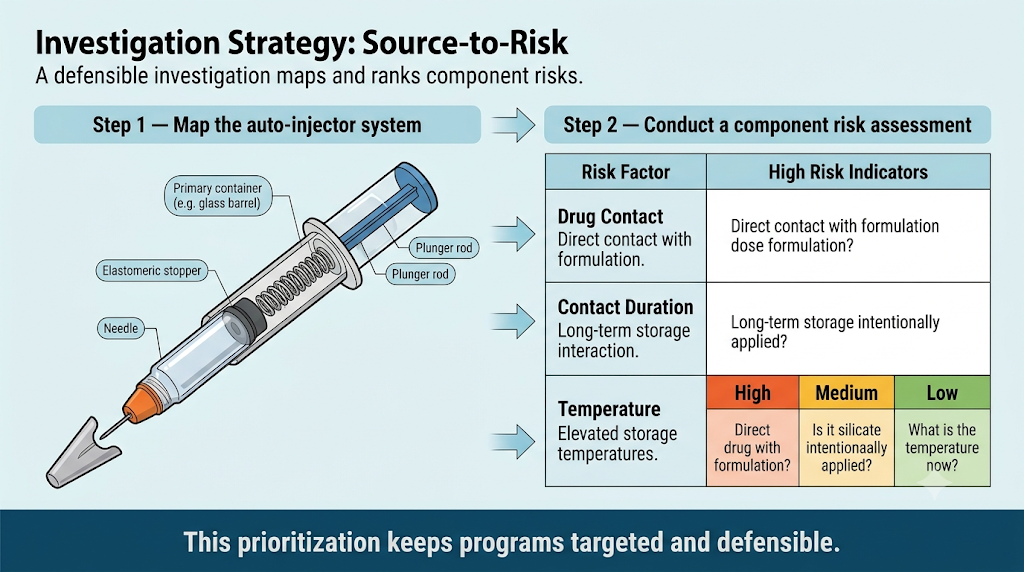
A defensible investigation begins by mapping the full auto-injector system and ranking each component’s contribution risk, rather than jumping straight to testing the final drug product in isolation.
Step 1 — Map the auto-injector system. Every material that can potentially contact the formulation or influence the drug-contact environment is documented: primary container, elastomeric stopper or plunger, syringe barrel, needle-related components, lubricated surfaces, polymer components, adhesives (if applicable), device-contact materials, protective caps or seals, and secondary packaging. Material composition, supplier information, lubricant type, manufacturing process, and surface treatment are all reviewed.
Step 2 — Conduct a component risk assessment. Each component is ranked against factors that determine how likely it is to contribute leachables:
| Risk Factor | Question |
|---|---|
| Drug contact | Does the component directly contact the formulation? |
| Proximity | Is it located close to the drug-contact surface? |
| Lubrication | Is silicone lubricant intentionally applied? |
| Contact duration | How long can the formulation interact with the material? |
| Temperature | What temperatures are encountered during storage? |
| Surface area | How much material is available for interaction? |
| Formulation chemistry | Could the formulation promote migration? |
| Patient exposure | What is the maximum expected dose/frequency? |
This prioritization step is what keeps an E&L program targeted and defensible instead of generating an unmanageable volume of low-value data.
5: Analytical Testing for Silicone Lubricant Leachables
A multi-platform analytical strategy is more effective than any single technique because silicone-related compounds span a wide range of volatility and molecular size.
GC-MS is useful for detecting volatile and semi-volatile silicone-related compounds, including cyclic siloxanes, and for comparing component extracts against drug-product samples to support source attribution.
LC-MS complements GC-MS by investigating less-volatile, higher-molecular-weight organic species such as non-volatile silicone-related compounds, lubricant-related additives, and other packaging-derived organics.
ICP-MS is added when elemental analysis is required — for trace metals, elemental impurities associated with materials, or potential catalyst/manufacturing-related residues.
Complementary techniques, selected according to the suspected chemistry, may include FTIR, Raman spectroscopy, GC-FID, high-resolution MS, headspace GC-MS, NMR, microscopy, and TOC analysis.
6: Silicone Lubricant Leachables: Source Attribution
Source attribution is the part of the investigation most often done poorly, because detecting a compound in the drug product does not by itself prove it came from silicone lubricant.
A scientifically defensible investigation compares multiple sample types side by side:
| Sample | Purpose |
|---|---|
| Drug product | Determines the actual leachable profile |
| Placebo | Helps distinguish formulation-derived signals |
| Unused primary container | Establishes a baseline |
| Individual components | Identifies potential sources |
| Silicone-lubricated component | Directly investigates the suspected source |
| Non-lubricated component | Provides comparative evidence |
| Extracts | Expands chemical characterization |
| Stability samples | Determines time-dependent migration |
When the same chemical signature appears in both the lubricated component extract and the drug product, while being absent or significantly lower in the relevant controls, the evidence for source attribution becomes much stronger.
7: Designing the Extractables and Leachables Study
The extractables study should challenge the materials with scientifically justified extraction conditions — chosen based on drug-contact materials, material chemistry, route of administration, solvent compatibility, temperature, extraction duration, surface-area-to-volume ratio, and intended shelf life — that generate useful, targeted information rather than an artificially large, low-context compound list.
The leachables study then evaluates the drug product (or an appropriate product-contact system) under conditions representative of intended storage and use: initial/zero-time samples, long-term stability samples, accelerated stability samples where justified, multiple storage intervals, appropriate controls, and quantitative or semi-quantitative monitoring of target compounds. The resulting concentration-versus-time profile shows whether a compound remains stable, increases progressively, plateaus, appears only under certain conditions, or is clearly associated with one particular component — information that is especially important for substances migrating slowly from silicone-lubricated surfaces.
This is the same underlying logic our team applies across E&L testing for generic injectable drugs, where container-closure and formulation variability between reference and generic products makes rigorous, comparative extractables and leachables data essential.
8: Case Study Findings and Interpretation
Analytical screening identifies a group of silicone-related signals in stability samples, and closely related signals are observed in extracts from the silicone-lubricated component. Comparing the chain — component extract → placebo → drug product → stability samples — shows a consistent chemical relationship between the lubricated component and the detected drug-product signals. Further characterization using orthogonal analytical techniques strengthens the identification.
| Parameter | In-Spec Syringe Lot | Out-of-Trend Syringe Lot |
|---|---|---|
| Silicone oil weight (µg/barrel) | 180–220 | 310–380 |
| Cyclic siloxane leachables (D4/D5/D6, ppm at 12 months) | <2 ppm | 6–9 ppm |
| Sub-visible particles ≥10 µm (per USP <788>) | Within limit | Trending toward limit |
| Break-loose/glide force | Within spec | Within spec (no functional failure) |
The investigation concludes that the auto-injector primary container system is a probable source of the detected silicone-related leachables, based on the overall weight of evidence rather than a single chromatographic peak — and notably, the leachable levels remained below the calculated Safety Concern Threshold, meaning this was a quality and control risk rather than an immediate safety finding.
9: Toxicological and Safety Assessment
Detection alone does not establish that a leachable represents an unacceptable safety risk; the identified compound and the patient’s actual exposure must be evaluated using an appropriate toxicological framework.
The assessment should consider:
- Chemical identity
- Concentration
- Maximum daily dose
- Route of administration
- Patient population
- Duration of treatment
- Frequency of administration
- Available toxicological information
- Genotoxicity concerns where applicable
- Exposure margins
- Analytical uncertainty
The emerging regulatory landscape supports this kind of systematic, risk-based evaluation. FDA’s November 2025 draft ICH Q3E guideline describes a holistic framework for the assessment and control of extractables and leachables, including safety-assessment principles — and because Q3E remains a draft guideline, it should be treated as current regulatory direction rather than a final binding requirement.
10: Regulatory Considerations for Auto-Injector E&L Testing
E&L testing for an auto-injector should evaluate the complete drug-contact and delivery system rather than individual materials in isolation, since FDA’s container-closure framework addresses the quality and suitability of the packaging system as a whole.
FDA also issued a new draft Container Closure Systems guidance in August 2026 that specifically addresses container-closure systems, including systems that may function as device constituent parts of combination products — directly relevant to auto-injectors. Relevant standards and resources include:
- USP <1663> — Extractables assessment
- USP <1664> — Drug-product leachables assessment
- USP <1031> — Biocompatibility of pharmaceutical packaging materials, which discusses the relationship between packaging-system biocompatibility and toxicological evaluation of E&L-identified chemicals
- FDA container-closure guidance (including the August 2026 draft update)
- Applicable ICH quality and impurity principles, including the draft ICH Q3E framework
- Applicable combination-product/device requirements
This same regulatory logic extends to other GMP-critical systems. For biologics and sterile manufacturing, similar risk-based principles apply to single-use systems and GMP extractables and leachables (E&L) testing and the broader extractables and leachables (E&L) requirements for single-use bioprocessing, where bags, tubing, and filters carry their own leachable risk profile.
11: How to Control Silicone Lubricant Leachables
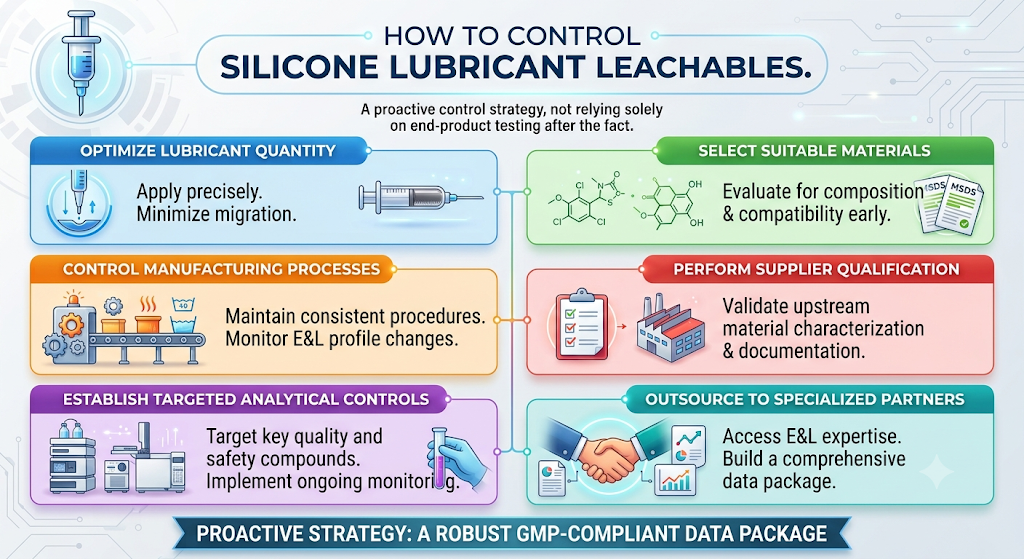
The preferred strategy is to control leachables through material selection, lubricant control, process optimization, and analytical monitoring — not to rely solely on end-product testing after the fact.
- Optimize lubricant quantity. Excess silicone increases the reservoir of substances available to migrate, so lubricant application should be controlled and reproducible.
- Select suitable materials. Evaluate materials for chemical composition, extractables profile, and compatibility with the formulation before they are locked into the design.
- Control manufacturing processes. Changes in lubrication procedure, component supplier, silicone grade, curing process, washing, sterilization, or component processing can all shift the extractables/leachables profile.
- Perform supplier qualification. Supplier documentation and material characterization provide critical input for understanding potential E&L sources upstream.
- Establish targeted analytical controls. Introduce ongoing monitoring for specific compounds once they are identified as relevant to product quality or patient safety.
A properly scoped, GMP-compliant extractables and leachables (E&L) study built around these controls — rather than broad, undirected screening — is what makes this strategy practical to execute and defend during regulatory review. For sponsors managing multiple programs or limited internal capacity, outsourcing extractables and leachables (E&L) testing to a specialized analytical partner is often the fastest way to build this data package without diverting internal resources from formulation and device development.
Key Lessons from the Case Study
- Silicone lubricant should be considered during early packaging risk assessment, not after a stability signal appears.
- A detected compound should never be attributed to silicone without source evidence — comparing components, placebo, and controls is essential.
- GC-MS and LC-MS provide complementary chemical coverage; neither alone tells the full story.
- Extractables studies help predict potential leachables before they show up on stability.
- Stability studies are essential for understanding migration over time, especially for slow-migrating silicone species.
- Component-by-component testing strengthens source attribution far more than testing the finished drug product alone.
- Toxicological assessment should be based on actual patient exposure and confirmed compound identity, not concentration in isolation.
- Any change to packaging or device components should trigger a documented impact assessment.
- The complete container-closure/delivery system should be evaluated together, not component by component in isolation.
- A risk-based strategy reduces unnecessary testing while maintaining scientific and regulatory confidence.
How ResolveMass Laboratories Supports Silicone Lubricant Leachables Investigations
A robust Silicone Lubricant Leachables investigation requires more than a single chromatogram — it requires analytical method selection, sample preparation, chemical characterization, source attribution, and scientifically defensible interpretation. At ResolveMass Laboratories Inc., our team runs this exact workflow: risk assessment → component screening → extractables testing → leachables testing → GC-MS/LC-MS analysis → compound identification → source attribution → quantitation → toxicological assessment support → technical reporting.
We support pharmaceutical and biotech teams across container-closure and delivery-device programs, including work aligned with our GMP-compliant extractables and leachables (E&L) study services, and this same source-to-risk methodology underpins our broader analytical and mass spectrometry offering.
Conclusion:
Silicone Lubricant Leachables in an auto-injector primary container require a systematic, risk-based investigation that connects material characterization, analytical testing, source attribution, and patient-exposure assessment — not interpretation from a single analytical result. For drug-device combination products, E&L assessment should begin early enough to influence material selection and device design, guided by the established frameworks in USP <1663> and <1664> and by the evolving regulatory landscape, including FDA’s draft ICH Q3E guideline and its August 2026 draft container-closure guidance.
A well-designed Silicone Lubricant Leachables program ultimately helps developers understand the interaction between the drug product and its delivery system, catch potential chemical risks early, and build stronger evidence for product quality and patient safety.
Frequently Asked Questions:
Source attribution typically involves comparing the chemical profiles of the drug product, placebo, individual packaging/device components, silicone-lubricated components, and controlled extracts. Finding matching chemical signatures across relevant samples can provide evidence supporting the suspected source.
Potential sources include the primary container, elastomeric stopper or plunger, syringe barrel, lubricated surfaces, polymers, adhesives, needle-related components, protective components, and other materials that contact or are located close to the drug product.
Important factors include:
-Silicone lubricant type and quantity
-Material composition
-Drug formulation chemistry
-Temperature
-Storage duration
-Contact area
-Contact time
-Surface treatment
-Manufacturing process
-Sterilization conditions
-Drug-device interaction
No. Each identified compound should be evaluated according to its chemical identity, concentration, patient exposure, toxicological profile, and relevance to the drug product. The risk associated with a compound cannot be determined from the analytical detection alone.
Reference
- Chern RT, Givand JC, Hwang R, Nikolai TJ. Devices and combination products for biopharmaceuticals. InQuality by Design for Biopharmaceutical Drug Product Development 2015 Apr 2 (pp. 403-435). New York, NY: Springer New York.https://link.springer.com/chapter/10.1007/978-1-4939-2316-8_18
- Sacha GA, Saffell-Clemmer W, Abram K, Akers MJ. Practical fundamentals of glass, rubber, and plastic sterile packaging systems. Pharmaceutical development and technology. 2010 Feb 1;15(1):6-34.https://www.tandfonline.com/doi/abs/10.3109/10837450903511178
- Ghosh I, Deodhar S, Gutka H, Sridharan S, Bindra D. Subcutaneous drug delivery of high concentration antibody products–part 2: formulation, device options, and clinical bridging strategies for patient-centric commercial presentations. InMabs 2026 Dec 31 (Vol. 18, No. 1, p. 2680773). Taylor & Francis.https://www.tandfonline.com/doi/abs/10.1080/19420862.2026.2680773
- Zhao X, Chen Y, Hamzaoui H, Wen X, Song J, Wang K, Hu G. Glass Silicone Oil Free Pre-filled Syringe as Primary Container in Autoinjector. Pharmaceutical Research. 2024 Dec;41(12):2319-29.https://link.springer.com/article/10.1007/s11095-024-03795-y
About the Author


