
Introduction:
Small molecule API process development CDMO services help drug developers convert a promising synthetic route into a robust, scalable and compliant manufacturing process. A route that works on a 5-gram bench scale often behaves very differently at kilogram scale, where heat removal, mixing, filtration and impurity formation can change the outcome. A specialized contract development and manufacturing organization (CDMO) closes that gap with process chemists, analytical scientists and quality systems working together.
At ResolveMass Laboratories Inc., a Canadian analytical CRO and CDMO, we approach process development as a science-first discipline. Our analytical foundation in mass spectrometry, impurity characterization and nitrosamine testing means every process decision is supported by data that regulators and partners can verify. This guide explains how small-molecule API development and scale-up work, what to expect from a CDMO partner, and how to evaluate one. For finished-dose programs, see our generic drug development CDMO overview.
Summary:
- What it is: Small molecule API process development at a CDMO turns a laboratory synthesis into a safe, reproducible, scalable and regulatory-ready manufacturing process.
- Why outsource: A CDMO adds process chemistry expertise, analytical capability, GMP infrastructure and scale-up experience without the sponsor building its own plant.
- Core stages: Route scouting, route optimization, Design of Experiments (DoE), impurity profiling, process validation readiness, tech transfer and scale-up.
- Biggest scale-up risks: Heat and mass transfer changes, mixing, crystallization and polymorph control, impurity growth, and safety hazards.
- Analytical strength matters: Mass spectrometry, impurity identification and nitrosamine risk assessment protect patient safety and speed regulatory review.
- How to choose: Look for transparent communication, documented quality systems, analytical depth, and a track record of clean tech transfer.
1: What Is Small-Molecule API Process Development at a CDMO?
Small molecule API process development at a CDMO is the systematic design, optimization and scale-up of the chemical synthesis that produces an active pharmaceutical ingredient (API), so it can be manufactured consistently, safely and to regulatory standards. It sits between early discovery chemistry and commercial GMP manufacturing.
A development team typically delivers:
- A defined, scalable synthetic route with justified starting materials
- Optimized reaction, work-up and isolation conditions
- A control strategy for critical process parameters and impurities
- Validated or fit-for-purpose analytical methods
- Technology transfer documentation and manufacturing batch records
The appropriate scope depends on whether the program involves a new chemical entity, an established API needing process improvement, a clinical-stage compound, or a commercial process transfer.
2: Why Is Process Development Critical Before API Scale-Up?
Process development reduces the technical and commercial risks of moving an API synthesis from laboratory experiments to larger manufacturing batches. A reaction that performs well at small scale may behave differently in larger equipment because heat transfer, mixing, reaction time and mass transfer conditions change. Without systematic development, manufacturers may face inconsistent yields, unexpected impurities, difficult filtration, poor crystallization or batches that miss specification.
Important benefits include:
- Improved process consistency: Reproducible operating conditions and suitable in-process controls
- Better impurity management: Understanding how impurities form, persist and can be removed
- Higher manufacturing efficiency: Fewer unnecessary steps and less solvent use, processing time and material loss
- Safer scale-up: Early identification of exotherms, gas evolution and pressure risks
- Greater regulatory readiness: Scientific evidence to support process descriptions and control strategies
- More predictable technology transfer: Documented procedures and process knowledge for manufacturing teams
This matters most for potent compounds, oxidation-sensitive intermediates, moisture-sensitive reagents, complex heterocycles, and APIs with challenging impurity or solid-state profiles.
3: Why Do Sponsors Outsource Small-Molecule API Process Development to a CDMO?
Sponsors outsource to a CDMO to gain specialized process chemistry, analytical depth and GMP capacity faster and at lower fixed cost than building these capabilities internally. This is especially valuable for emerging biotech and virtual companies that lack pilot-scale infrastructure.
| Sponsor Need | What a CDMO Provides |
|---|---|
| Speed to clinic | Dedicated teams and parallel workstreams |
| Technical depth | Process chemists, analytical scientists, engineers |
| Capital efficiency | Access to reactors and equipment without capex |
| Regulatory readiness | Quality systems aligned with GMP and ICH guidance |
| Risk reduction | Experience with scale-up failures and how to avoid them |
4: What Are the Stages of Small Molecule API Process Development at a CDMO?
The main stages are route scouting, route optimization, impurity profiling, scale-up and technology transfer, with analytical support running through all of them.
| Stage | Primary Goal | Typical Output |
|---|---|---|
| Route scouting | Identify feasible, scalable routes | Ranked route options with risk assessment |
| Route optimization | Improve yield, purity, safety and cost | Optimized conditions, DoE data |
| Impurity profiling | Identify and control impurities | Impurity fate and purge data |
| Kilo-lab / pilot scale-up | Confirm performance at larger scale | Engineering batches, scale-up learnings |
| Tech transfer / GMP batches | Reproduce the process under GMP | Batch records, release data |
| Process validation readiness | Demonstrate consistency | Control strategy, validation protocols |
5: How Is a Synthetic Route Selected and Optimized?
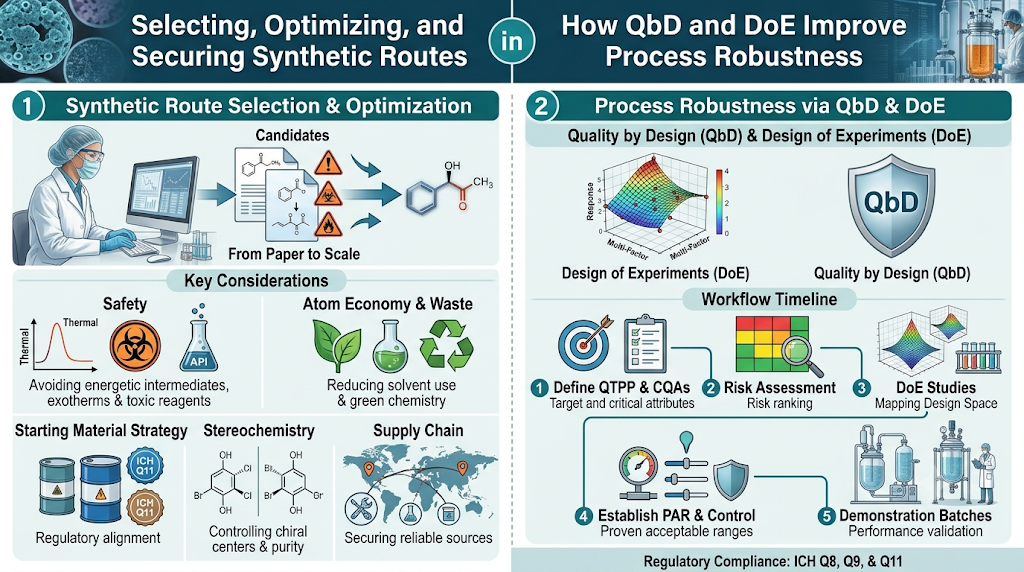
A synthetic route is selected by comparing candidates on safety, step count, yield, impurity risk, raw material availability, cost and scalability, then refined through experimentation. The route that looks shortest on paper is not always the most robust at scale.
Key considerations during small molecule API process development at a CDMO include:
- Safety: Avoiding or controlling energetic intermediates, exotherms and toxic reagents
- Atom economy and waste: Reducing solvent use and aligning with green chemistry principles
- Starting material strategy: Selecting commercially available, well-controlled materials in line with ICH Q11 principles
- Stereochemistry: Controlling chiral centers and enantiomeric purity
- Supply chain: Confirming reliable sources for reagents and catalysts
How Do Quality by Design and DoE Improve Process Robustness?
Quality by Design (QbD) and Design of Experiments (DoE) improve robustness by identifying which process parameters truly affect product quality, and defining the ranges in which the process reliably performs. Instead of changing one variable at a time, DoE tests multiple factors together and reveals interactions that otherwise cause batch failures.
A typical QbD-aligned workflow includes:
- Defining the quality target product profile and critical quality attributes (CQAs)
- Performing risk assessment to rank potentially critical process parameters
- Running DoE studies to map the design space
- Establishing proven acceptable ranges and a control strategy
- Confirming performance through demonstration batches
This approach follows the thinking set out in ICH Q8, Q9 and Q11, and it produces data packages that support regulatory filings.
6: How Does a CDMO Optimize API Yield, Purity and Process Efficiency?
A CDMO improves yield, purity and efficiency by systematically identifying the variables that influence reaction performance and downstream recovery. Optimization should consider the whole process, not reaction yield in isolation. A reaction with high conversion but hard-to-remove impurities may be less suitable than a slightly lower-yielding one that gives a cleaner intermediate and simpler purification.
| Development Area | Optimization Approach | Expected Benefit |
|---|---|---|
| Reaction chemistry | Evaluate solvent, temperature, stoichiometry, catalyst and reaction time | Improved conversion and selectivity |
| Impurity control | Identify impurity sources and evaluate purge in downstream steps | Better API purity and process understanding |
| Crystallization | Optimize solvent composition, cooling profile, seeding and supersaturation | More reproducible isolation and solid properties |
| Filtration and washing | Evaluate particle characteristics, wash solvent and cake resistance | Improved recovery and impurity removal |
| Drying | Establish temperature, pressure, time and endpoint criteria | Controlled residual solvents and moisture |
| Solvent use | Assess recovery, replacement and reduction | Lower cost and environmental burden |
| Process monitoring | Define meaningful in-process tests and operating ranges | Consistency and earlier detection of deviations |
A scientifically justified control strategy links process conditions to the quality attributes that matter for the API, and separates parameters that need tight control from those managed by routine monitoring.
7: What Challenges Arise When Scaling Up a Small-Molecule API Process?
The main scale-up challenges are heat transfer, mixing, mass transfer, crystallization control and impurity growth, because these behave differently in large reactors than in laboratory flasks. Anticipating them early prevents costly late-stage surprises.
| Challenge | Why It Happens at Scale | Mitigation Approach |
|---|---|---|
| Exotherm control | Lower surface-area-to-volume ratio limits heat removal | Calorimetry studies, controlled dosing |
| Mixing and mass transfer | Slower blending creates local concentration gradients | Mixing studies, agitator and geometry selection |
| Crystallization and polymorphism | Cooling rates and seeding differ | Seeded crystallization, polymorph screening |
| Impurity growth | Longer hold times and temperature gradients | Purge studies, hold-time testing |
| Filtration and drying | Cake behavior changes with particle size | Particle engineering, filtration trials |
| Safety | Hazards amplify with volume | Process hazard assessment before scale-up |
A disciplined scale-up plan uses small, well-characterized steps, such as laboratory to kilo-lab to pilot, rather than a single large jump. Solid-state and solubility behavior matter too, particularly in generic drug development for poorly soluble APIs, where particle properties and polymorph control influence downstream formulation.
Why Is Reaction Safety Important During Scale-Up?
Reaction safety is essential because larger reaction volumes can release heat or generate gas faster than equipment can safely manage. A scale-up assessment should identify exothermic behavior, pressure generation, reagent incompatibilities and potential failure scenarios before batch size increases.
Where the chemistry indicates, studies may include reaction calorimetry, thermal stability assessment, gas evolution evaluation and engineering review of cooling and pressure-relief provisions. Safety cannot be inferred from successful small-scale reactions alone; it needs appropriate data and qualified process safety expertise.
8: How Do Analytical Methods Support Small Molecule API Process Development at a CDMO?
Analytical methods support process development by measuring reaction progress, identifying impurities and proving that each batch meets specification. Without reliable analytics, process decisions are guesses.
Common analytical contributions include:
- In-process controls: HPLC and UPLC monitoring for reaction completion and impurity trends
- Impurity identification: High-resolution mass spectrometry and NMR to characterize unknown impurities
- Residual solvents and elemental impurities: Testing aligned with ICH Q3C and Q3D
- Solid-state characterization: XRPD, DSC and TGA for form and stability
- Method development and validation: Aligned with ICH Q2(R2) and Q14 principles
Because ResolveMass is built on analytical science, our process teams work side by side with analytical specialists, which shortens the loop between experiment and answer.
Which Analytical Techniques Are Used in API Process Development?
Common techniques include HPLC/UHPLC, LC-MS/MS, HRMS, GC-MS and NMR, selected according to the API’s structure, process and impurity risks. For complex APIs, orthogonal techniques are often needed because no single method characterizes every impurity or quality attribute.
| Technique | Typical Application |
|---|---|
| HPLC/UHPLC | Assay, related substances, purity and reaction monitoring |
| LC-MS/MS | Targeted impurity quantification and sensitive detection |
| HRMS | Accurate-mass measurement and impurity identification |
| GC-MS | Volatile compounds, residual solvents and volatile impurities |
| NMR spectroscopy | Structure confirmation and elucidation |
| ICP-MS | Elemental impurity assessment where applicable |
| FTIR | Functional-group assessment and identification support |
| DSC and XRPD | Thermal behavior and solid-form characterization |
| Karl Fischer titration | Water content |
| Particle-size analysis | Particle properties relevant to processing or performance |
Not every project requires every technique.
How Does Impurity Profiling Support Process Optimization?
Impurity profiling shows where unwanted compounds originate, how they change during processing and whether purification can control them. A structured investigation typically involves:
- Comparing chromatographic profiles of starting materials, reaction mixtures, intermediates and final API
- Using mass spectrometry and, where needed, NMR to support structural identification
- Linking reaction conditions to impurity formation
- Evaluating whether purification steps remove or reduce relevant impurities
- Establishing suitable analytical procedures and control strategies
The investigation should also consider mutagenic impurities, residual solvents, elemental impurities and other risks identified in the process risk assessment.
9: How Are Nitrosamine and Genotoxic Impurity Risks Managed During Process Development?
These risks are managed by assessing every step, reagent, solvent and potential cross-contamination source early, then confirming the risk with sensitive, validated testing. Nitrosamine impurities such as N-nitrosamines are classified as a cohort of concern, and regulators including Health Canada, the U.S. FDA and the EMA expect manufacturers to evaluate and control them.
A sound strategy includes:
- Reviewing the route for secondary or tertiary amines and nitrosating agents
- Evaluating solvents, reagents, water and recovered materials
- Applying ICH M7 principles for mutagenic impurities
- Using trace-level LC-MS/MS or GC-MS/MS methods for confirmation
- Setting limits based on acceptable intake and documenting the rationale
Designing out the risk during route development is almost always cheaper and faster than managing it after a regulatory query.
How Do Regulatory and Quality Expectations Shape API Process Development?
Regulatory and quality expectations shape the work by requiring that the process be documented, controlled and reproducible under GMP, using frameworks such as ICH Q7 for API manufacturing. Early alignment prevents rework when the program moves toward filing.
Key expectations include:
- ICH Q7: GMP for active pharmaceutical ingredients
- ICH Q8, Q9, Q10: Pharmaceutical development, risk management and quality systems
- ICH Q11: Development and manufacture of drug substances
- ICH Q3A and Q3B: Impurity thresholds and qualification
- Data integrity: Traceable, contemporaneous and attributable records
| Guideline | Relevance to API Development |
|---|---|
| ICH Q7 | Good manufacturing practice for active pharmaceutical ingredients |
| ICH Q11 | Development and manufacture of drug substances, process understanding and impurity control |
| ICH Q9(R1) | Quality risk management and risk-based decisions |
| ICH Q10 | Pharmaceutical quality systems and continual improvement |
| ICH Q3A(R2) | Impurities in new drug substances |
| ICH Q3C | Residual solvents |
| ICH Q3D | Elemental impurities |
| ICH Q2(R2) | Validation of analytical procedures |
| ICH Q14 | Analytical procedure development |
Referencing guidelines in a development report does not by itself achieve compliance. The process, analytical methods, documentation and quality system must meet the requirements for the actual activities performed, and regulatory strategy should be reviewed by qualified professionals for the target jurisdiction.
Sponsors should confirm that any CDMO can show current regulatory inspection history and quality documentation relevant to the intended market. For programs targeting Europe, see our guidance on EU generic drug dossier development and EMA submission.
How Do You Choose a CDMO for Small Molecule API Process Development?
Choose a CDMO by evaluating its technical depth, analytical capability, quality systems, communication practices and track record of successful technology transfer. The checklist below can guide due diligence. Sponsors of generic programs should also weigh CRO vs in-house ANDA development and the role of a generic drug development CRO for ANDA.
- Demonstrated experience with comparable chemistry and complexity
- In-house analytical capability, including mass spectrometry and impurity characterization
- Documented quality management system and audit readiness
- Clear scientific communication, with named technical contacts
- Transparent project management, timelines and change control
- Strong intellectual property protection and confidentiality practices
- Capacity to scale from lab to pilot to GMP manufacturing
How Does ResolveMass Laboratories Inc. Support Small-Molecule API Programs?
ResolveMass Laboratories Inc. supports small-molecule API programs by combining process development expertise with advanced analytical science, so decisions are backed by high-quality data. As a Canadian analytical CRO and CDMO, our work spans mass spectrometry, impurity profiling, nitrosamine testing, and complex characterization.
What sponsors can expect:
- Science-led project teams with clear technical accountability
- Analytical depth that accelerates impurity identification and method development
- Documentation designed to support regulatory submissions
- Collaborative communication from first scoping call through technology transfer
Value is greatest when results are interpreted in the context of the synthesis, process history and intended specifications. For example, an unexpected impurity after a scale-up batch may need analytical identification plus a review of reaction conditions, raw material quality and purification performance.
Scope note: ResolveMass’s analytical and development capabilities do not confirm that every process chemistry, pilot-scale, GMP manufacturing or commercial CDMO service is available for every project. Manufacturing scope, facility capabilities, regulatory status and deliverables should be confirmed directly with the company.
How Does API Process Development Connect to Generic Drug Development?
API process development is the foundation for finished generic drug products, because the quality, impurity profile and solid-state properties of the API shape formulation, bioequivalence and regulatory filings. Explore these related ResolveMass resources:
- Generic drug development CDMO: an overview of integrated development support for generic programs
- Generic drug development CRO for ANDA: how a CRO supports Abbreviated New Drug Application programs
- CRO vs in-house ANDA development: how to weigh outsourcing against internal capability
- Generic drug development for poorly soluble APIs: solubility and solid-state challenges
- Generic drug development for inhaled drug products: particle and performance considerations for inhalation
- CDMO services for generic topical and semisolid drug products: development of creams, gels and ointments
- EU generic drug dossier development and EMA submission: dossier planning for European filings
Conclusion:
Successful small molecule API process development CDMO partnerships rest on three things: sound chemistry, rigorous analytics and disciplined scale-up. By combining route optimization, QbD principles, impurity control and regulatory-aware documentation, a CDMO helps sponsors reach the clinic and the market with fewer surprises. ResolveMass Laboratories Inc. brings analytical expertise and a collaborative, science-first approach to every program.
Frequently ASked Questions:
Technology transfer is the documented transfer of process knowledge, analytical methods, manufacturing instructions, and control strategies from one development or manufacturing site to another. It helps the receiving site implement the process consistently.
A CDMO can improve yield by optimizing reaction conditions, reagent quantities, reaction time, solvent selection, and downstream recovery. Improvements must also be evaluated for impurity formation, process safety, reproducibility, and overall product quality.
The timeline depends on molecular complexity, the number of synthetic steps, impurity challenges, analytical requirements, and the target scale. Some optimization projects take weeks to months, while complex route development and scale-up programs may take longer.
Process optimization improves reaction yield, selectivity, impurity control, and recovery while potentially reducing production costs, solvent consumption, processing time, and waste. It also helps establish reproducible manufacturing conditions.
API process development establishes and optimizes the manufacturing process at laboratory or development scale. API scale-up evaluates how that process performs in larger equipment while maintaining product quality, process safety, reproducibility, and manufacturing efficiency.
Reference
- Daly AM, Hardiman S, Hogan D, Morris G, Moylan R, O’Donovan B, Power E, Phillips P, Robinson S, Roth PM, Smyth M. Insights into Flow and Continuous Systems in Pharmaceutical Manufacturing: Challenges and Opportunities. Organic Process Research & Development. 2026 Feb 23;30(3):578.https://pmc.ncbi.nlm.nih.gov/articles/PMC13010349/
- Noriega-Fernandes B, Ibrahim M, Cruz R, Kuehl PJ, Shepard KB. Navigating the development of dry powder for inhalation: a CDMO perspective. Pharmaceuticals. 2025 Mar 19;18(3):434.https://www.mdpi.com/1424-8247/18/3/434
- Krueger J, Dieskau AP, Hassfeld J, Gries J, Block O, Weinmann H, Kaufmann D, Hildbrand S, Kraft V, Moeckel R, Dehli JR. Chemical process development in the pharmaceutical industry in Europe—Insights and perspectives from industry scientists. Angewandte Chemie. 2025 May;137(19):e202420719.https://onlinelibrary.wiley.com/doi/abs/10.1002/ange.202420719
- Koleng J, Owens III DE, Hannon K. How The Right CDMO Partner Can Accelerate Biologics Development.https://www.bioprocessonline.com/doc/how-the-right-cdmo-partner-can-accelerate-biologics-development-0001
- Barry CS. The Role of Contract Manufacturing in Antibody–Drug Conjugate (ADC) Drug Substance Development–Strategies for Successful Engagement. AAPS PharmSciTech. 2026 Jul 9;27(5):255.https://link.springer.com/article/10.1208/s12249-026-03466-8
About the Author