

1. Introduction
Solid-state characterization and polymorph screening are essential components of pharmaceutical development because the physical form of an active pharmaceutical ingredient (API) can influence its stability, solubility, dissolution rate, bioavailability, manufacturability, and overall product quality. An API may exist in multiple crystalline forms, amorphous states, hydrates, or solvates. Although these forms can have the same chemical composition, differences in their molecular arrangements and solid-state properties may result in significantly different pharmaceutical performance.
Polymorphism refers to the ability of a compound to crystallize in more than one crystal structure. Each polymorph may exhibit distinct thermodynamic properties, melting behavior, solubility, and physical stability. A metastable polymorph may initially provide improved dissolution characteristics but can transform into a more stable form during storage or manufacturing. Such transformations can affect product consistency and may create regulatory and commercial risks.
For pharmaceutical companies evaluating external development partners, understanding the scope of pharmaceutical CDMO services in the United States and Canada can help clarify how analytical development, manufacturing support, and process scale-up may be coordinated throughout development.
Contract development and manufacturing organizations (CDMOs) support pharmaceutical companies by identifying relevant solid forms, evaluating their physical properties, and establishing reliable analytical methods. A structured solid-state characterization program combines complementary analytical techniques, systematic polymorph screening, and process-relevant studies to identify a suitable form and understand the conditions under which it remains stable.
Integrating these activities early in development helps reduce the risk of unexpected solid-form transformations during scale-up, formulation, process validation, and commercial manufacturing. A scientifically justified solid-form selection strategy also supports regulatory submissions and lifecycle management.
Share via:
Quick Summary:
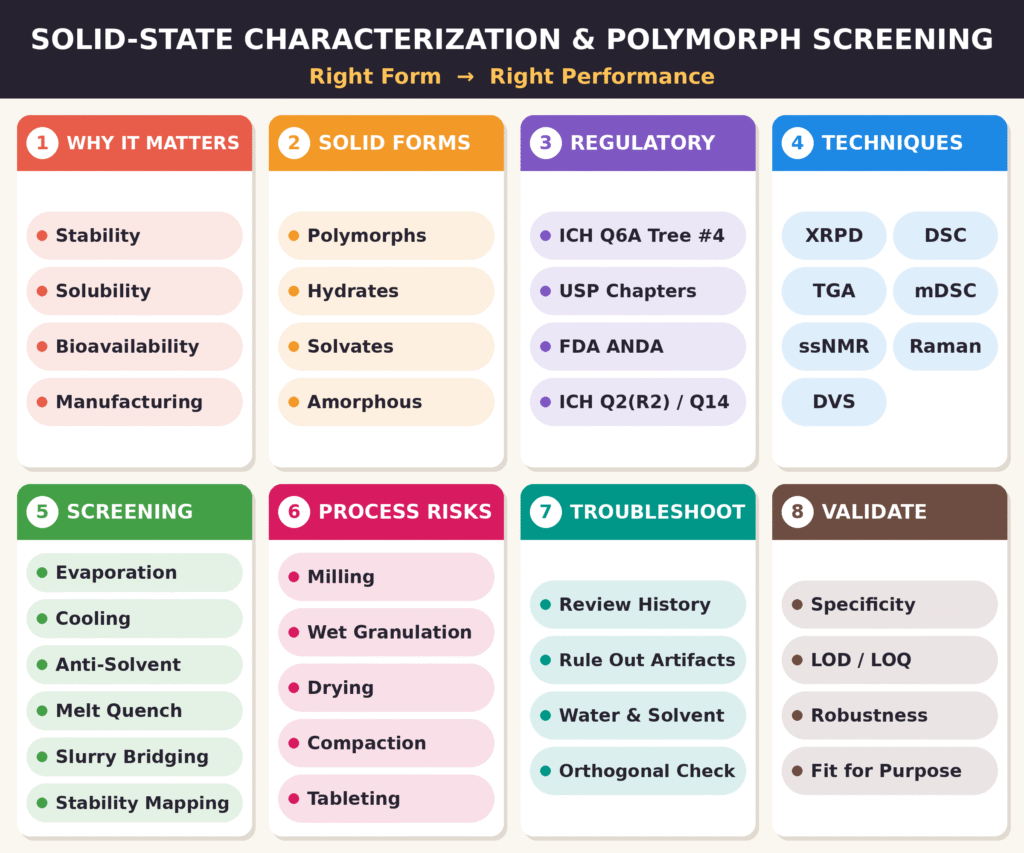
- Why solid form matters: An API can exist as different polymorphs, hydrates, solvates or amorphous forms. These forms share the same chemistry but can differ in stability, solubility, dissolution, bioavailability and manufacturability. A metastable form may convert to a more stable form during storage or processing.
- Regulatory expectations: ICH Q6A Decision Tree #4 sets out when polymorphism must be investigated and controlled. USP chapters, FDA guidance for ANDAs, and ICH Q2(R2)/Q14 add requirements for appropriate, fit-for-purpose analytical methods.
- Orthogonal analytical techniques: No single method is enough. XRPD identifies crystalline phases, while DSC, TGA and mDSC show thermal events and mass loss. ssNMR and Raman probe molecular environments, and DVS tracks moisture sorption. Each method has limits, such as preferred orientation in XRPD.
- Polymorph screening: High-throughput screening uses small amounts of API to explore many conditions. Methods include evaporative, cooling and anti-solvent crystallization and melt quenching. Every isolated solid needs proper characterization, because a different crystal habit alone does not prove a new polymorph.
- Stability mapping: Slurry bridging and thermodynamic studies show the relative stability of forms. They also show whether two forms are monotropic or enantiotropic, which guides form selection and storage controls.
- Process-induced transformations: Milling, wet granulation, drying, compaction and tableting can change the solid form through mechanical energy, heat, pressure or moisture. Materials should therefore be tested before and after each critical operation.
- Troubleshooting and validation: Unexpected results should be investigated step by step. Review the material’s history, rule out analytical artifacts, check water and residual solvent, and confirm findings with orthogonal methods. Methods should be validated for specificity, LOD/LOQ and robustness so that routine variability isn’t mistaken for a real form change.
2. Regulatory Guidelines for Solid-State Characterization and Polymorph Screening
Regulatory expectations for solid-state characterization depend on the nature of the API, the dosage form, the development stage, and the potential effect of solid-form variation on product quality. Pharmaceutical manufacturers must understand whether different solid forms are possible, determine whether they can affect the finished product, and establish appropriate controls where necessary.
ICH Q6A and Decision Tree #4
The International Council for Harmonisation (ICH) guideline Q6A, Specifications: Test Procedures and Acceptance Criteria for New Drug Substances and New Drug Products: Chemical Substances, provides a framework for determining appropriate specifications for drug substances and drug products.
Decision Tree #4 in ICH Q6A addresses polymorphism in drug substances. It helps determine whether polymorphism should be investigated and whether the identification or control of different solid forms is necessary. The decision depends on whether polymorphism is observed and whether differences between forms could influence the performance, quality, or stability of the drug product.
Solid-form investigations should therefore be scientifically justified and proportionate to the potential risk. When different forms may affect dissolution, bioavailability, stability, or manufacturing performance, the development program should establish suitable characterization methods and appropriate controls.
United States Pharmacopeia (USP)
Relevant United States Pharmacopeia (USP) chapters and general guidance provide information on analytical approaches used to characterize pharmaceutical materials and assess their physical properties. Depending on the material and the purpose of the investigation, methods such as X-ray powder diffraction (XRPD), thermal analysis, and spectroscopic techniques may support solid-form identification and evaluation.
Compendial methods should be applied in accordance with their intended purpose and scope. Where a method is developed or adapted for a specific API, its suitability should be demonstrated using appropriate validation or verification procedures.
FDA Guidance on ANDA Submissions and Polymorphism
The U.S. Food and Drug Administration (FDA) provides guidance relevant to polymorphism in drug substances used in abbreviated new drug applications (ANDAs). Solid-state properties can be important when assessing the quality and performance of a generic drug product relative to its reference product.
Applicants should evaluate whether polymorphic forms, hydrates, solvates, or amorphous material may influence critical product attributes. The analytical strategy should provide sufficient evidence to identify relevant forms, assess their potential impact, and establish appropriate controls when necessary.
For generic drug development programs, integrated analytical services for ANDA development can help coordinate testing requirements across development stages.
ICH Q2(R2) and ICH Q14
ICH Q2(R2), Validation of Analytical Procedures, and ICH Q14, Analytical Procedure Development, provide complementary frameworks for developing reliable analytical procedures. These guidelines support a science-based approach to demonstrating that analytical methods are suitable for their intended purpose.
For solid-state characterization, method development should consider the material being analyzed, the target attribute, expected variability, sample preparation, measurement conditions, and potential analytical interference. Validation characteristics should be selected according to the method’s intended use and the risks associated with an incorrect analytical result.
Robust analytical procedures are particularly important when solid-form identification or quantification supports release testing, stability studies, process investigations, or regulatory submissions.
Summary of Regulatory and Compendial Considerations
| Regulatory or Compendial Reference | Core Regulatory Objective | Technical Requirement | CDMO Operational Application |
|---|---|---|---|
| ICH Q6A Decision Tree #4 | Assess the relevance of polymorphism to drug-substance quality and product performance. | Determine whether polymorphism exists and whether solid-form differences require identification or control. | Develop a risk-based polymorph screening and characterization strategy. |
| United States Pharmacopeia (USP) | Support appropriate characterization and testing of pharmaceutical materials. | Apply relevant compendial methods and demonstrate suitability for the intended application. | Select appropriate analytical techniques and establish fit-for-purpose procedures. |
| USP solid-state characterization guidance | Support evaluation of physical properties relevant to pharmaceutical quality. | Use suitable analytical approaches to assess solid-state attributes where applicable. | Combine diffraction, thermal, spectroscopic, and other relevant methods as required. |
| FDA guidance on polymorphism in ANDA submissions | Evaluate the potential significance of solid-form differences in generic drug development. | Assess relevant polymorphic forms and their potential effects on product quality and performance. | Generate analytical evidence to support solid-form selection and control strategies. |
| ICH Q2(R2) and ICH Q14 | Support reliable analytical procedure development and validation. | Demonstrate that analytical methods are suitable for their intended purpose. | Develop, validate, and document robust solid-state analytical procedures. |
3. Orthogonal Analytical Architectures in Solid-State Characterization and Polymorph Screening
No single analytical technique can provide a complete understanding of an API’s solid-state properties. A reliable characterization strategy therefore uses orthogonal methods that examine different physical or chemical characteristics. Combining complementary techniques improves confidence in solid-form identification and helps distinguish genuine polymorphic differences from experimental artifacts.
For complex pharmaceutical materials, peptide analytical characterization services illustrate the importance of complementary analytical approaches in material assessment.
3.1 X-Ray Powder Diffraction (XRPD)
X-ray powder diffraction is a principal technique for identifying crystalline phases and distinguishing polymorphs. Crystalline materials produce characteristic diffraction patterns because their atoms or molecules occupy periodically ordered positions within a crystal lattice. Differences in lattice spacing and crystal structure produce differences in diffraction peak positions and intensities.
The relationship between the X-ray wavelength, interplanar spacing, and diffraction angle is described by Bragg’s law:
λ = 2d sin(θ)
In this equation, λ represents the X-ray wavelength, d represents the distance between crystal lattice planes, and θ is the Bragg angle. Diffraction data collected under controlled conditions can be used to identify crystalline phases, compare samples with reference patterns, and investigate phase changes during processing or storage.
XRPD can also support the evaluation of crystallinity and the detection of certain crystalline impurities. However, the sensitivity of the technique depends on factors such as the sample matrix, phase abundance, crystallite properties, instrument configuration, and data-processing approach.
3.2 X-Ray Source Selection
The selection of an appropriate X-ray source depends on the sample composition, the required resolution, and the analytical objective. Common laboratory instruments use characteristic radiation generated by metal anodes. Copper radiation is widely used for pharmaceutical materials, although alternative sources may be appropriate for samples containing elements that produce significant fluorescence or for specialized analytical applications.
Source selection should account for potential background interference, signal intensity, measurement time, and the ability to distinguish relevant diffraction features. Consistent instrument conditions are important when comparing patterns across samples, batches, or stability time points.
3.3 Diffraction Geometry and Preferred Orientation
Sample preparation and diffraction geometry can influence the observed XRPD pattern. Preferred orientation occurs when crystallites align in a non-random manner, causing certain diffraction peaks to appear stronger or weaker than expected. This effect may complicate comparisons between samples or lead to incorrect interpretations of phase composition.
Appropriate sample preparation, suitable holders, and consistent measurement procedures can help reduce these effects. Where necessary, the analyst should investigate whether unusual peak intensities reflect a genuine material difference or an artifact arising from sample preparation and measurement geometry.
3.4 Non-Ambient XRPD
Non-ambient XRPD enables diffraction measurements under controlled environmental conditions, including changes in temperature or humidity. This approach can help investigate temperature-dependent phase transitions, dehydration, hydrate formation, and transformations between crystalline forms.
Such studies are particularly useful when an API may undergo solid-state changes during drying, storage, transportation, or processing. Monitoring diffraction patterns as conditions change can provide evidence about the temperature or environmental range in which a form remains stable.
3.5 Thermal Analysis: DSC and TGA
Differential scanning calorimetry (DSC) measures heat flow associated with thermal events in a sample. It can help identify melting transitions, crystallization, glass transitions, desolvation, and other thermally induced changes. Differences in thermal behavior may support the distinction between polymorphs or provide evidence of a phase transformation.
Thermogravimetric analysis (TGA) measures changes in sample mass as a function of temperature or time under a defined atmosphere. It is useful for investigating moisture loss, solvent loss, decomposition, and other events associated with changes in sample mass.
DSC and TGA provide complementary information. For example, a thermal event observed by DSC alongside a corresponding mass loss in TGA may indicate dehydration or desolvation. A thermal event without a corresponding mass change may require further investigation to distinguish melting, crystallization, or a solid-solid transition.
3.6 Modulated Differential Scanning Calorimetry (mDSC)
Modulated differential scanning calorimetry applies a modulated temperature program to help separate reversing and non-reversing heat-flow components. This can assist with the interpretation of overlapping thermal events and the evaluation of glass transitions, relaxation phenomena, and other complex thermal behavior.
The relationship between the heat-flow components can be expressed as:
Total Heat Flow = Reversing Heat Flow + Non-Reversing Heat Flow
Interpretation should account for the experimental conditions, instrument settings, sample properties, and limitations of the measurement. mDSC is most useful when its results are considered alongside other analytical evidence rather than used as the sole basis for assigning a solid form.
3.7 Advanced Spectroscopic and Sorption Tools
Solid-State Nuclear Magnetic Resonance (ssNMR)
Solid-state nuclear magnetic resonance spectroscopy provides information about the local chemical environments of nuclei within a solid material. It can help distinguish forms that have similar diffraction patterns or investigate molecular environments, disorder, and interactions within the solid state.
ssNMR may be particularly useful when complementary techniques do not provide a definitive interpretation. Its application depends on the material, the nuclei being studied, experimental sensitivity, and the analytical question.
Raman Spectroscopy
Raman spectroscopy provides molecular vibrational information that can support the identification of solid forms and the investigation of chemical or structural differences. It can be used to compare reference materials, examine samples with different physical properties, and support process monitoring when an appropriate method and sampling configuration are available.
Raman measurements can sometimes be performed with limited sample preparation. Nevertheless, fluorescence, sample heterogeneity, laser-induced heating, and differences in measurement conditions should be considered during method development and data interpretation.
Dynamic Vapor Sorption (DVS)
Dynamic vapor sorption measures changes in sample mass as relative humidity or vapor pressure is varied under controlled conditions. It helps characterize moisture sorption and desorption behavior and can provide evidence of hydrate formation, dehydration, or humidity-dependent changes in the material.
DVS data can inform the selection of storage conditions, packaging strategies, and handling controls. When moisture uptake may alter the solid form, DVS results should be correlated with techniques such as XRPD, TGA, or spectroscopy to establish the nature of the change.
3.8 Comparison of Analytical Methods
| Analytical Method | Primary Properties Evaluated | Typical Sample Requirement | Sensitivity or Detection Considerations | Relevant Standards or Guidance |
|---|---|---|---|---|
| XRPD | Crystalline phase identity, polymorph differentiation, and crystallinity. | Generally milligram quantities; the amount depends on the instrument and sample holder. | Detection depends on phase abundance, peak overlap, sample preparation, and instrument configuration. | Applicable pharmacopeial procedures and fit-for-purpose validated methods. |
| DSC | Melting, crystallization, glass transitions, and thermal events. | Typically milligram quantities. | Depends on transition enthalpy, sample mass, heating conditions, and event overlap. | Applicable compendial guidance and validated analytical procedures where required. |
| TGA | Mass loss, moisture or solvent loss, and thermal decomposition. | Typically milligram quantities. | Depends on the magnitude of mass change, sample characteristics, and instrument performance. | Applicable compendial guidance and fit-for-purpose procedures. |
| ssNMR | Local molecular environment, solid-state structure, and molecular disorder. | Sample requirements vary with the instrument, rotor, and experimental sensitivity. | Depends on the nucleus, concentration, acquisition time, and experimental conditions. | Method-specific scientific and analytical validation principles. |
| Raman spectroscopy | Molecular vibrations and spectroscopic differences between solid forms. | Often small quantities; requirements depend on the sampling configuration. | Depends on signal strength, fluorescence, sample heterogeneity, and spectral overlap. | Fit-for-purpose method development and validation principles. |
| DVS | Moisture sorption, desorption, and humidity-dependent mass changes. | Typically milligram quantities, depending on the instrument and material. | Depends on balance performance, equilibration criteria, and the magnitude of mass change. | Appropriate method qualification and scientifically justified experimental procedures. |
Sample quantities and detection limits are method-dependent and should not be treated as universal specifications. The appropriate method and acceptance criteria should be established according to the analytical objective, the properties of the API, and the intended use of the data.
4. Workflow Strategies for Polymorph Screening and Solid-Form Selection
A well-designed polymorph screening program explores a range of crystallization and processing conditions to identify accessible solid forms and understand their relative stability. The strategy should be systematic, documented, and appropriate to the development stage. It should also consider the practical conditions that the material may encounter during manufacturing and storage.
4.1 High-Throughput Polymorph Screening
High-throughput screening can help evaluate multiple crystallization conditions using small quantities of API. The goal is to maximize the likelihood of identifying relevant crystalline forms while efficiently exploring different solvent systems and processing conditions.
Evaporative Crystallization
Evaporative crystallization involves removing solvent from a solution to increase supersaturation and promote nucleation and crystal growth. Screening different solvents, concentrations, evaporation rates, and environmental conditions can produce different solid forms or crystal habits.
Because the outcome can be influenced by solvent interactions and crystallization kinetics, each isolated solid should be characterized using suitable analytical methods. A crystal habit difference alone does not establish that two samples are different polymorphs.
Cooling and Anti-Solvent Crystallization
Cooling crystallization reduces solubility by lowering the solution temperature, while anti-solvent crystallization reduces solubility through the addition of a liquid in which the API is less soluble. Both approaches can generate supersaturation and promote nucleation.
Screening variables may include solvent composition, cooling rate, anti-solvent addition rate, agitation, concentration, and final temperature. These variables can influence nucleation, crystal growth, particle characteristics, and the solid form obtained.
Melt Quenching
Melt quenching involves heating a material to a molten state and cooling it rapidly to limit crystallization. This approach can be used to investigate the formation of amorphous material and evaluate whether the API can exist in a non-crystalline state under relevant conditions.
Not every API is suitable for melt quenching. Thermal degradation, melting behavior, and the stability of the resulting amorphous material should be considered before selecting this approach.
4.2 Slurry Bridging and Thermodynamic Free-Energy Mapping
Slurry experiments can help assess the relative stability of solid forms by suspending a material in a suitable solvent under controlled conditions. When sufficient time and appropriate conditions are provided, a less stable form may dissolve and a more stable form may crystallize. The outcome depends on solvent selection, temperature, equilibration, and the kinetics of solid-form conversion.
Slurry bridging can be used to compare forms and investigate potential transformations. However, the final form observed in a slurry experiment should be interpreted in the context of the experimental conditions and should not automatically be considered the universally most stable form under every environment.
Thermodynamic relationships between polymorphs may be classified as monotropic or enantiotropic. In a monotropic system, one form is thermodynamically more stable than the other over the relevant temperature range below the transition or melting conditions. In an enantiotropic system, the relative stability of two forms changes at a transition temperature.
Understanding these relationships helps guide solid-form selection and establish suitable temperature and storage controls. Thermal analysis, XRPD, and complementary techniques can provide evidence for evaluating possible phase transitions and the relative behavior of the forms.
4.3 Process-Induced Phase Transformation (PIPT)
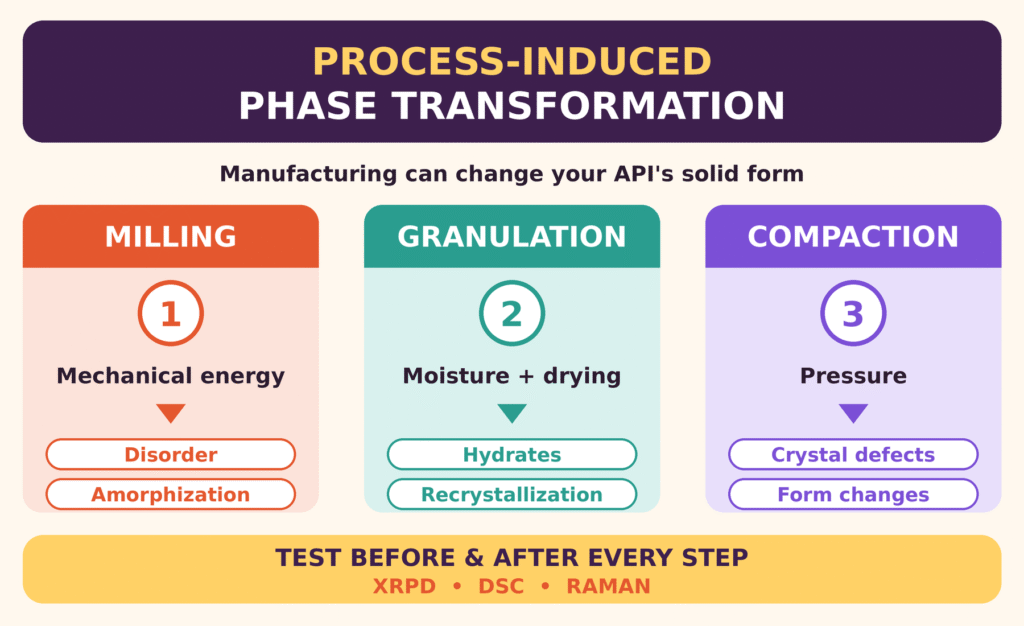
Process-induced phase transformation refers to a change in the solid form of an API caused by manufacturing operations or processing conditions. A form that is stable during laboratory storage may transform during milling, granulation, drying, compaction, or other operations involving mechanical energy, heat, pressure, or moisture.
A process-relevant characterization program should therefore investigate not only the initially selected form but also its behavior under the conditions expected during manufacturing.
For teams moving from laboratory experiments to larger production batches, peptide API scale-up strategies can provide useful context for planning process development and scale-up.
Milling and Micronization
Milling and micronization reduce particle size and can improve dissolution or support formulation requirements. However, mechanical energy can introduce defects, increase disorder, or cause partial amorphization and other solid-state changes in susceptible materials.
Samples collected before and after milling should be compared using appropriate techniques. XRPD may help identify changes in crystalline structure, while DSC and spectroscopy can provide complementary information about thermal behavior and molecular environments.
Wet Granulation and Drying
Wet granulation exposes materials to liquid and moisture, which can promote dissolution, recrystallization, hydrate formation, or transformation between solid forms. Subsequent drying may remove water or solvent and can lead to additional changes in the material.
Process development should evaluate the effects of liquid composition, granulation time, temperature, drying conditions, and residual moisture. The selected analytical methods should be capable of detecting solid-form changes that could affect product quality.
Roller Compaction and Tableting
Roller compaction and tableting expose powders to mechanical pressure and may alter particle properties or the physical state of susceptible materials. Depending on the API, these operations may influence crystallinity, induce defects, or affect the distribution of solid forms within a formulation.
Solid-state characterization before and after compression can help determine whether the process affects the API. Where transformations are observed, process parameters should be evaluated to establish whether they can be controlled without compromising other critical quality attributes.
For projects requiring manufacturing scale-up, peptide CDMO scale-up services explain how process development can support the transition toward larger-scale production.
5. Troubleshooting Manufacturing Failures and Validating Analytical Methods
Unexpected solid-state results during development or manufacturing require a structured investigation. Potential causes include genuine phase transformations, sample-preparation artifacts, moisture uptake, residual solvent, instrument-related variability, and analytical method limitations. An effective troubleshooting strategy should distinguish between these possibilities before changes are made to the manufacturing process or control strategy.
5.1 Review the Material and Process History
The investigation should begin with a review of the material’s history, including synthesis, crystallization, isolation, drying, milling, storage, transportation, and subsequent processing. Relevant process parameters may include temperature, humidity, solvent exposure, drying time, mechanical stress, and storage duration.
Comparing the material before and after the operation of interest can help identify the stage at which the unexpected result first appeared. Where possible, retain samples and appropriate reference materials should be analyzed under consistent conditions.
5.2 Distinguish Genuine Transformations from Analytical Artifacts
An unexpected XRPD peak, thermal event, or spectroscopic signal does not necessarily demonstrate a polymorphic transformation. Sample preparation, preferred orientation, instrument settings, background interference, and sample heterogeneity can affect analytical results.
Analysts should repeat measurements where appropriate, review instrument performance, assess sample preparation, and compare results with relevant reference materials. Orthogonal methods should be used when necessary to determine whether the observation reflects a genuine change in the material.
5.3 Investigate Water and Residual Solvent
Moisture and residual solvents can influence the physical state of an API. Water uptake may result in hydrate formation or other humidity-related changes, while solvent retention can indicate the presence of a solvate or affect the material’s thermal behavior.
Techniques such as TGA, DVS, and suitable solvent-analysis methods can help investigate mass loss, moisture sorption, and residual solvent behavior. XRPD and spectroscopy may then be used to assess whether these changes are associated with a different solid form.
The interpretation should consider the limitations of each method. For example, a mass-loss event alone may not establish the identity of the lost substance or conclusively identify a solid-form transformation.
5.4 Verify Findings Using Orthogonal Techniques
When the initial result remains ambiguous, complementary analytical techniques can help confirm the finding. XRPD may establish whether the crystalline phase has changed, while DSC and TGA can assess thermal events and mass changes. Raman spectroscopy or ssNMR may provide additional information about molecular environments and structural differences.
The methods selected should be capable of addressing the specific uncertainty under investigation. Combining independent lines of evidence improves confidence in the conclusion and helps avoid decisions based on a single inconclusive result.
5.5 Analytical Method Validation
Analytical procedures used for solid-state characterization should be suitable for their intended purpose. Method development and validation should consider the material, the target attribute, the expected range of results, and the consequences of an incorrect result.
Relevant validation characteristics may include specificity, accuracy, precision, detection capability, quantitation capability, linearity, range, and robustness, depending on the type of method and its intended application.
When evaluating a development partner, peptide CDMO services can help clarify the range of development and manufacturing support to consider alongside analytical needs.
Specificity
Specificity is the ability of an analytical procedure to assess the target attribute in the presence of other components or potential interferences. For polymorph analysis, the procedure should distinguish the relevant solid forms from one another and from other material components to the extent required for its intended use.
Limit of Detection and Limit of Quantitation
The limit of detection (LOD) relates to the lowest amount or concentration of an analyte or phase that can be detected under specified conditions. The limit of quantitation (LOQ) relates to the lowest level that can be quantified with suitable performance for the intended application.
LOD and LOQ should be established using a scientifically appropriate approach for the particular method. They should not be assumed to be interchangeable across different instruments, APIs, sample matrices, or analytical techniques.
Robustness
Robustness evaluates the ability of an analytical procedure to remain reliable when small, deliberate variations are introduced into relevant method parameters. Depending on the technique, these parameters may include sample preparation, measurement conditions, instrument settings, or data-processing choices.
Robust methods help reduce the risk that routine analytical variability will be misinterpreted as a genuine change in solid form. Method documentation should clearly define the operating conditions and the controls necessary to maintain reliable performance.
6. Conclusion
Solid-state characterization and polymorph screening are fundamental to the development of pharmaceutical products with consistent quality, stability, and performance. Because different solid forms can exhibit different physical properties, selecting an appropriate form requires a systematic assessment of crystalline structure, thermal behavior, moisture sensitivity, and process-related transformation risks.
A comprehensive strategy combines orthogonal analytical techniques such as XRPD, DSC, TGA, mDSC, ssNMR, Raman spectroscopy, and DVS according to the specific needs of the material and development program. High-throughput screening, slurry studies, and process-relevant investigations further help identify accessible forms and evaluate their behavior under manufacturing conditions.
Reliable analytical procedures and well-documented scientific reasoning support informed solid-form selection, effective process controls, and regulatory readiness. By integrating these activities throughout development, pharmaceutical teams can reduce the risk of unexpected transformations and improve the consistency of the finished product.
When assessing external partners, peptide CDMO selection criteria can help development teams evaluate relevant capabilities and plan their development strategy.
For support with solid-state characterization, polymorph screening, and pharmaceutical analytical testing, contact the ResolveMass Laboratories Inc. team to discuss your project requirements.
Frequently Asked Questions
X-ray powder diffraction (XRPD) evaluates solid-state similarity by comparing diffraction peak positions and relative intensities of a generic API with those of an appropriate reference material. Matching patterns can support the identification of the same crystalline phase, although differences in sample preparation and preferred orientation must also be considered. If excipients interfere with measurements in finished products, complementary techniques such as solid-state NMR or Raman spectroscopy may provide additional evidence.
Dynamic vapor sorption (DVS) measures changes in sample mass as relative humidity increases or decreases under controlled conditions. Surface moisture may produce gradual mass changes, whereas hydrate formation can cause a distinct step or change in the sorption profile. Because these patterns are not conclusive on their own, post-analysis using XRPD or another suitable technique can help confirm whether the crystal structure has changed.
High-throughput slurry bridging is useful when investigating the relative stability of different solid forms under defined solvent and temperature conditions. Solvent evaporation, by contrast, can help generate and isolate forms that develop during rapid supersaturation and crystallization. Combining both approaches can reveal a broader range of polymorphs and provide information about their stability, although the results depend on experimental conditions and transformation kinetics.
Differential scanning calorimetry (DSC) identifies thermal events by measuring changes in heat flow, but it does not independently determine the crystal structure formed during those events. Variable-temperature XRPD records diffraction patterns as a sample is heated or cooled, allowing structural changes to be monitored alongside temperature-dependent behavior. Together, these methods help distinguish polymorphic transitions from events such as dehydration, melting, and crystallization.
The detection limit for crystalline impurities in an amorphous solid dispersion depends on the API, the polymer matrix, the analytical instrument, and the degree of diffraction peak overlap. Conventional XRPD may detect some crystalline impurities at approximately 0.5–1.0% by weight, while optimized configurations or complementary techniques may achieve lower levels in suitable systems. These values are indicative rather than universal, so the LOD should be experimentally established for the specific formulation and analytical procedure.
Copper Kα radiation can produce fluorescence in samples containing certain elements, including iron, cobalt, and manganese, increasing background noise and reducing the clarity of diffraction peaks. Cobalt Kα radiation has lower photon energy than copper Kα radiation and can reduce fluorescence from iron-containing samples. The appropriate source depends on the sample composition and analytical objective, and its suitability should be confirmed during method development.
ICH Q6A Decision Tree #4 provides a framework for assessing whether polymorphism requires investigation and control based on its potential effect on drug-substance and drug-product quality. If different solid forms could influence solubility, dissolution, stability, or bioavailability, the development team should evaluate whether specific identification tests or acceptance criteria are needed. The final specification should be supported by product-specific scientific evidence rather than determined solely by a general solubility classification.
Solid-state nuclear magnetic resonance (ssNMR) provides information about the local chemical environments of nuclei within a material, offering a different perspective from XRPD. In finished products, it may help investigate API solid forms when excipient diffraction peaks overlap with important XRPD signals. Appropriate nuclei, acquisition conditions, and data-analysis methods must be selected to obtain meaningful results and distinguish API signals from those of the formulation.
Mitigating process-induced phase transformations begins by identifying the conditions responsible for the change, such as moisture exposure, temperature, mechanical stress, or solvent interactions. Depending on the findings, manufacturers may adjust liquid addition, granulation time, drying conditions, or mechanical processing parameters. Alternative approaches, including dry granulation or a suitable non-aqueous process, may be considered when they are compatible with the formulation and manufacturing requirements.
Monotropic polymorphs have a consistent thermodynamic stability order over the relevant temperature range below melting, whereas enantiotropic forms can exchange relative stability at a transition temperature. This distinction can be investigated using complementary thermal measurements, solubility data, and solid-state characterization. The heat of fusion rule may provide supporting evidence, but it should be applied cautiously alongside other data because experimental limitations and kinetic effects can complicate interpretation.
Reference:
- Brittain, H. G. (Ed.). (2009). Polymorphism in pharmaceutical solids (2nd ed.). Informa Healthcare. https://www.researchgate.net/publication/327304832_Polymorphism_in_Pharmaceutical_Solids_Second_edition
- U.S. Food and Drug Administration. (2007, July). ANDAs: Pharmaceutical solid polymorphism—Chemistry, manufacturing, and controls information: Guidance for industry. Center for Drug Evaluation and Research. https://www.fda.gov/media/71375/download
- International Council for Harmonisation of Technical Requirements for Pharmaceuticals for Human Use. (2000). Specifications: Test procedures and acceptance criteria for new drug substances and new drug products: Chemical substances (ICH Q6A). European Medicines Agency. https://www.ema.europa.eu/en/documents/scientific-guideline/ich-q-6-test-procedures-and-acceptance-criteria-new-drug-substances-and-new-drug-products-chemical-substances-step-5_en.pdf
- U.S. Food and Drug Administration. (2007, July). ANDAs: Pharmaceutical solid polymorphism—Chemistry, manufacturing, and controls information: Guidance for industry. https://www.fda.gov/regulatory-information/search-fda-guidance-documents/andaspharmaceutical-solid-polymorphism-chemistry-manufacturing-and-controls-information
- Raw, A. S., Furness, M. S., Gill, D. S., Adams, R. C., Holcombe, F. O., Jr., & Yu, L. X. (2004). Regulatory considerations of pharmaceutical solid polymorphism in Abbreviated New Drug Applications (ANDAs). Advanced Drug Delivery Reviews, 56(3), 397–414. https://doi.org/10.1016/j.addr.2003.10.011
- Lee, E. H. (2014). A practical guide to pharmaceutical polymorph screening & selection. Asian Journal of Pharmaceutical Sciences, 9(4), 163–175. https://doi.org/10.1016/j.ajps.2014.05.002
Get In Touch With Us
About The Author