

Introduction
Biopharmaceutical sponsors confronting geopolitical supply restrictions, significant global capacity constraints, and evolving cross-border trade regulations are increasingly choosing to source their peptides from a Canadian CDMO to strengthen the stability of their clinical and commercial pipelines. Following the enactment of the U.S. BIOSECURE Act in December 2025 and the growing demand for complex metabolic and conjugated peptides, North American drug developers are diversifying their supply chains away from single-region Asian dependencies and moving toward politically aligned, technically specialized manufacturing hubs. Canada offers a combination of Health Canada Good Manufacturing Practice (GMP) oversight, advanced analytical characterization capabilities, favorable U.S.-to-Canadian dollar exchange rates, and newly proposed federal R&D tax expansions for 2026.
However, relocating peptide sourcing to Canada involves navigating specific regulatory and trade requirements rather than relying solely on geographical proximity. Although clinical-trial supplies, R&D materials, and generic peptides imported from Canada enter the United States at a 0% duty rate under the 2026 Section 232 rules, commercial-stage patented peptide active pharmaceutical ingredients (APIs) are not covered by a blanket CUSMA exemption. Similarly, although Health Canada maintains GMP Mutual Recognition Agreements (MRAs) with Europe, the United Kingdom, Switzerland, and Australia, APIs remain temporarily excluded under the Canada–EU Comprehensive Economic and Trade Agreement (CETA) protocol. Organizing Canadian synthesis and analytical operations around these precise legal and technical requirements allows sponsors to benefit from North American cost and operational advantages while minimizing unexpected compliance challenges.
Share via:
Quick Summary:
- Why Canada: Sponsors are moving peptide sourcing to Canadian CDMOs to cut reliance on single-region Asian suppliers, get a politically aligned partner, and find capacity in a market strained by GLP-1 and complex peptide demand.
- BIOSECURE Act: Signed December 18, 2025 (Section 851 of the FY2026 NDAA), it bars U.S. federal procurement, grants and contractors from using designated “biotechnology companies of concern.” OMB’s first list is due by December 2026, and enforcement phases in after the FAR changes. That pushes sponsors toward allied, non-China CDMOs early.
- Capacity crunch: Building a new U.S. plant can cost billions and take years. Smaller biotechs therefore rely on specialized CDMOs with flexible mg-to-kg synthesis and in-house analytics to keep clinical timelines on track.
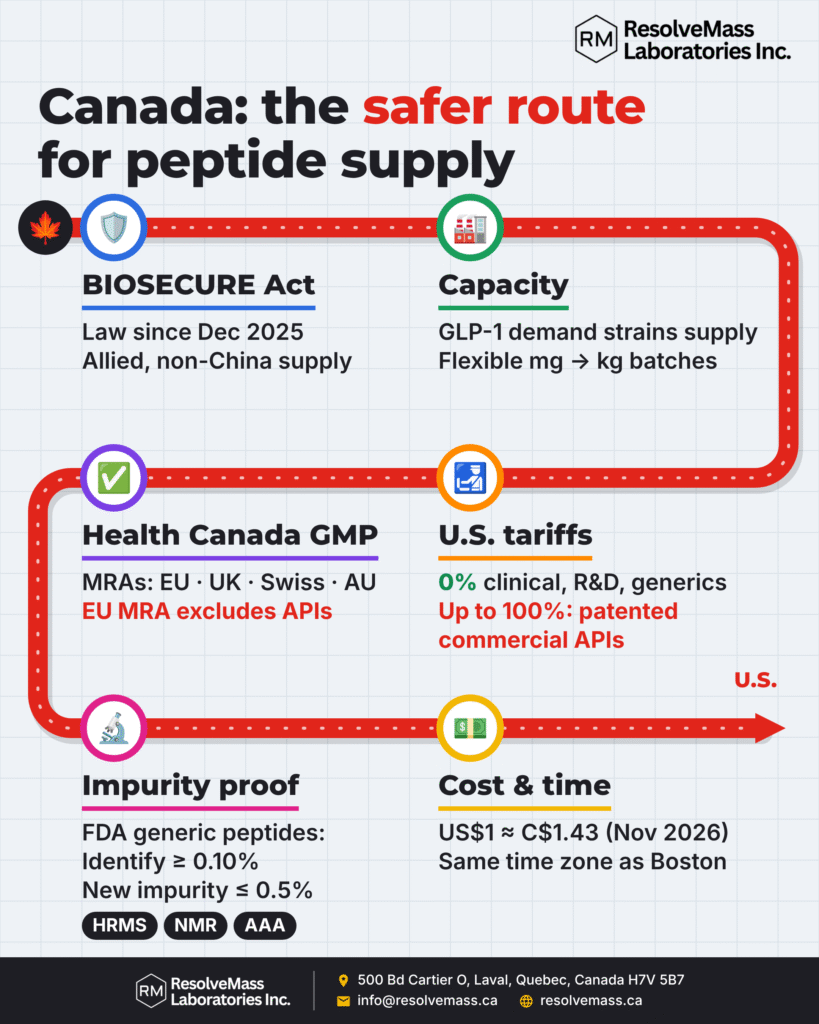
- U.S. Section 232 tariffs: Clinical-trial, R&D and generic peptides from Canada enter at 0% additional duty. Commercial patented peptide APIs can face up to 100%, and CUSMA/USMCA gives no exemption. Commercial programs need planning such as Foreign Trade Zones, duty drawback or onshoring partnerships.
- Regulatory fit: Health Canada GMP follows PIC/S and ICH standards. Canada has GMP mutual recognition agreements with the EU, UK, Switzerland, EEA-EFTA and Australia, plus inspection cooperation with the FDA. APIs, however, are excluded from the Canada–EU MRA.
- Analytical depth: FDA’s guidance for generic synthetic peptides expects every peptide-related impurity at or above 0.10% to be identified, and any new impurity to stay at or below 0.5%, justified for immunogenicity risk. Meeting that takes integrated HRMS, LC-MS/MS, NMR, amino acid analysis and stability testing.
- Cost and logistics: A strong U.S. dollar (about C$1.43 in mid-November 2026) stretches U.S. budgets. Canada’s proposed SR&ED expansion also supports its life-sciences ecosystem, and Eastern Time alignment plus short cold-chain routes make collaboration and delivery to U.S. sites easier.
Why Are Biopharma Sponsors Choosing to Source Your Peptides from a Canadian CDMO Amid Global Reshoring?
Biopharmaceutical sponsors are increasingly choosing to source their peptides from a Canadian CDMO to reduce federal contracting exposure under the U.S. BIOSECURE Act and obtain access to dedicated technical capabilities in a market experiencing significant capacity constraints. These limitations have intensified because of the growing demand for GLP-1 peptides and other complex therapeutic molecules. According to an industry analysis by Vision Life Sciences, establishing a new domestic pharmaceutical manufacturing facility in the United States can cost up to 2 billion USD and take approximately five to ten years to complete. Consequently, emerging biotechnology companies and mid-sized pharmaceutical manufacturers depend on established non-Chinese contract development and manufacturing organizations (CDMOs) to address immediate clinical and commercial supply requirements.
How Does the BIOSECURE Act Reshape North American Peptide Supply Chains?
The BIOSECURE Act requires U.S.-funded researchers, federal contractors, and downstream biopharmaceutical partners to discontinue relationships with designated “Biotechnology Companies of Concern” (BCCs). This requirement is accelerating the relocation of supply chains toward allied CDMOs in North America, Europe, and partner markets across the Asia-Pacific region. Enacted on December 18, 2025, as Section 851 of the FY2026 National Defense Authorization Act (NDAA), the legislation addresses national security concerns and risks involving multiomic data associated with entities connected to foreign adversary military or intelligence organizations.
Instead of permanently identifying specific companies within the statute, Section 851 establishes a dynamic designation mechanism administered by the Office of Management and Budget (OMB), with automatic connections to the U.S. Department of Defense Section 1260H list. For peptide manufacturers and sponsors, the legislation affects supply-chain decisions through four primary mechanisms:
Direct Procurement and Grant Bans: U.S. federal agencies are prohibited from procuring biotechnology equipment or services from BCCs. They are also restricted from using federal grant and loan funding, including National Institutes of Health (NIH) and Biomedical Advanced Research and Development Authority (BARDA) awards, to obtain these products and services.
Contractor Flow-Down Provisions: Federal agencies cannot enter into contracts with prime contractors that use equipment or services supplied by BCCs to fulfill federal contractual obligations. This requirement extends compliance assessments throughout subcontractor relationships and CDMO supply networks.
Multi-Year Implementation Schedule: Compliance timelines published by the CITI Program in January 2026 anticipated OMB guidance approximately 180 days after enactment, around June 2026. The projected schedule also included an initial public BCC list by December 18, 2026, Federal Acquisition Regulation (FAR) amendments by June 2027, and enforcement beginning in late 2027. However, analysts at Vision Life Sciences have indicated that complete enforcement could extend into late 2028.
Conditional Safe Harbors: Existing contracts involving newly designated BCCs are eligible for a five-year transition period after the relevant FAR updates become effective. However, this protection does not extend to companies already included on the DoD 1260H list as of December 18, 2025.
According to an industry report by Faxian Gongchang, China represented approximately 25–30% of the global CXO market, valued at more than 150 billion USD. Given this substantial market participation, even early-stage sponsors planning future U.S. licensing arrangements or federal grant applications are evaluating qualified non-Chinese peptide CDMOs in advance. This proactive approach helps prevent disruptive technology transfers, supplier replacement challenges, and potential compliance interruptions during ongoing development programs.
Compare the considerations involved in selecting a suitable U.S. peptide manufacturing partner and evaluating its regulatory and technical capabilities.
Read how to choose a peptide CDMO in the United States.
How Does Canadian Capacity Address the GLP-1 and Complex Peptide Bottleneck?
Canadian CDMOs are helping address significant North American synthesis and analytical capacity constraints resulting from the rapid expansion of metabolic, oncology, and peptide-conjugate development pipelines. According to an October 2026 market forecast distributed through GlobeNewswire, the global GLP-1 manufacturing and supply chain market reached approximately 45.0 billion USD in 2025. The market is projected to expand at a compound annual growth rate (CAGR) of 26.0%, reaching approximately 180.0 billion USD by 2031. The value associated with manufacturing capacity is increasing almost twice as quickly as end-market drug revenue because peptide synthesis complexity, rather than commercial demand alone, was a major limiting factor affecting patient access during 2023 and 2024.
Capital investment patterns further demonstrate this shift toward manufacturing diversification. Of the estimated 24.86 billion USD invested globally in GLP-1 CDMO capacity during 2025, approximately 18.48 billion USD, representing nearly three-quarters of the total investment, was directed toward U.S. and non-China facilities. Despite these investments, Vision Life Sciences projected in February 2026 that global CDMO rates would increase by approximately 5–10% annually as manufacturing capacity becomes increasingly constrained.
Large pharmaceutical companies may have the financial resources to establish manufacturing facilities costing billions of dollars, but smaller biotechnology companies generally cannot support the expense of developing and maintaining independent production infrastructure. Collaborating with specialized Canadian CDMOs that integrate flexible milligram-to-kilogram synthesis capabilities with in-house high-resolution analytical services allows sponsors to maintain preclinical and clinical development timelines without waiting behind large-volume commercial manufacturing campaigns.
Explore how specialized manufacturing partners support increasing production requirements and the transition from early development to larger peptide manufacturing batches.
Discover peptide CDMO scale-up services.
How Do U.S. Section 232 Tariffs Affect Canadian Peptide Sourcing and Trade Strategy?
U.S. Section 232 pharmaceutical tariffs maintain an additional duty rate of 0% for clinical-trial materials, R&D supplies, and generic peptides sourced from Canada. In contrast, commercial patented peptide APIs may face an ad valorem tariff of up to 100% unless they qualify for specific exemptions, an approved onshoring arrangement, or applicable customs-mitigation mechanisms.
Introduced under Presidential Proclamation 11020 on April 2, 2026, the Section 232 duties cover patented drugs identified in the FDA Orange Book or Purple Book, together with their APIs and key starting materials. The measures extend across more than 130 tariff lines within HTSUS Chapters 29 and 30. The tariffs became effective on July 31, 2026, for 17 major pharmaceutical manufacturers identified in Annex III and were extended to all other importers on September 29, 2026.
An important legal distinction confirmed by Canada’s Trade Commissioner Service is that CUSMA/USMCA compliance does not provide an exemption from Section 232 tariffs on patented pharmaceuticals and their associated ingredients. Additionally, Canada introduced reciprocal counter-tariffs of 15%, 25%, and 50% on selected U.S. imports, effective September 8, 2026.
Consequently, cross-border peptide procurement requires accurate HTSUS Chapter 99 classification and careful consideration of the development stage. The applicable categories include:
| Peptide Import Category (U.S. Entry) | Applicable Chapter 99 Heading | Section 232 Additional Duty Rate | Strategic Implication for Canadian Sourcing |
|---|---|---|---|
| Clinical trials, R&D, and non-commercial supplies | 9903.04.70 | 0% | Preclinical, IND-enabling, and clinical-trial peptides manufactured in Canada can enter the United States without additional Section 232 duties. |
| Generic peptides, biosimilars, and unpatented goods | 9903.04.67 / 9903.04.69 | 0% | Generic peptide APIs, including off-patent injectable products, and non-patented Chapter 29/30 chemicals are excluded. |
| Qualifying orphan drugs, ADCs, cell/gene, and specialty therapies | 9903.04.66 | 0% (conditional) | Zero-rated treatment applies when all approved indications qualify and the product addresses an urgent U.S. health requirement or originates from an eligible jurisdiction. |
| Qualifying U.S.-packaged dosage forms | 9903.04.68 | 0% | Applies to qualifying pharmaceutical products manufactured in the United States or packaged domestically under the required documented compliance conditions. |
| Commercial patented peptide API without an exemption or approved plan | 9903.04.60 | 100% | The full standard duty applies unless reduced through an approved U.S. onshoring plan (20% until April 2030), an MFN pricing agreement (0% until January 2029), Foreign Trade Zones, or duty drawback. |
For emerging biotechnology companies, described by industry group leaders as “the next 1,700 companies” that cannot independently finance manufacturing facilities, the clinical and R&D exclusion under heading 9903.04.70 preserves the opportunity to source peptides from Canada without additional Section 232 duties throughout Phase I–III development.
As development programs move closer to U.S. commercial launch, sponsors working with patented peptide sequences must evaluate potential landed costs well in advance. Applicable strategies may include Foreign Trade Zones, which defer duties until products enter U.S. commerce, duty drawback arrangements, temporary importation under bond, and licensing partnerships with organizations that maintain approved onshoring agreements.
Understand the differences between development-focused and manufacturing-focused peptide outsourcing arrangements.
Explore peptide CDMO versus CMO services.
What Regulatory and Quality Advantages Does Canadian Peptide Manufacturing Offer?
Sourcing peptides from Canada provides access to internationally harmonized GMP oversight under Health Canada, together with established regulatory cooperation and alignment involving the U.S. FDA, EMA, and Pharmaceutical Inspection Co-operation Scheme (PIC/S) inspectorates. Because regulatory reliance mechanisms facilitate the exchange of inspection findings across jurisdictions, working with a manufacturing facility designed around international data-integrity expectations can help reduce delays during multi-jurisdictional regulatory assessments.
How Do Health Canada GMP, FDA Registration, and Mutual Recognition Agreements Support Cross-Border Supply?
Health Canada’s GMP framework follows internationally recognized PIC/S and ICH standards and connects Canadian pharmaceutical manufacturing operations with mutual recognition arrangements involving Europe, the United Kingdom, Switzerland, and Australia. Canada also maintains an active inspection-sharing arrangement with the U.S. FDA. Nevertheless, sponsors must understand the scope limitations associated with individual agreements, particularly the exclusion of active pharmaceutical ingredients under the Canada–EU CETA protocol, when preparing international commercial filings.
Canadian pharmaceutical manufacturing and testing operations are regulated under Part C, Division 2 of the Food and Drug Regulations and Health Canada’s GUI-0001 guidance. This framework incorporates the principles of ICH Q10 Pharmaceutical Quality System and PIC/S Annex 1. Licensed facilities must maintain activity-specific Drug Establishment Licences (DELs) and use validated computerized systems, including Laboratory Information Management Systems (LIMS), Manufacturing Execution Systems (MES), and Enterprise Resource Planning (ERP) platforms.
These computerized systems must operate under appropriate data-integrity, documentation, and archival controls. Batch records must be retained for the longer of one year following the batch expiry date or three years from the date of batch release, as outlined in Canadian compliance documentation guidance.
At the international level, Health Canada’s Regulatory Operations and Enforcement Branch (ROEB) administers GMP MRAs with the European Union, incorporated under CETA in September 2017, with recognition of extra-jurisdictional inspections added in April 2021. These arrangements also extend to the United Kingdom, Switzerland, the European Economic Area–European Free Trade Association (EEA-EFTA) states, and Australia.
Since March 1, 2024, Australia’s Therapeutic Goods Administration (TGA) has also provided abbreviated GMP Clearance without compliance verification fees to sponsors submitting Health Canada third-country inspection evidence. This arrangement covers API manufacturers, contract testing laboratories, and contract sterilisers.
Although Canada and the United States do not maintain a bilateral MRA equivalent to the EU arrangement, the U.S. FDA and Health Canada operate an indefinite Agreement of Cooperation (FDA Agreement 225-75-2027). This agreement supports the exchange of pharmaceutical manufacturing inspection reports and facilitates joint foreign inspections.
Established Canadian CDMOs can operate across both regulatory environments. For instance, ResolveMass Laboratories Inc., located in Laval, Quebec, maintains an active Health Canada Drug Establishment Licence (3-002945-A), U.S. FDA registration (FEI 3042696771), and ISO 9001:2015 certification. These credentials support the progression of pharmaceutical programs from early-stage R&D characterization to GMP-compliant analytical testing and product release.
Review the capabilities and regulatory considerations associated with Canadian peptide manufacturing facilities.
Explore peptide CDMO services in Canada.
Why Analytical Depth Matters When You Source Your Peptides from a Canadian CDMO
Choosing a manufacturing partner with integrated high-resolution analytical capabilities is particularly important when you source your peptides from a Canadian CDMO. Synthetic peptides are specifically excluded from the standard small-molecule ICH Q3A and Q3B impurity guidelines. Under FDA guidance concerning highly purified synthetic peptides referencing recombinant listed drugs, and further reinforced by revised draft Product-Specific Guidances issued in July 2026 for semaglutide, tirzepatide, liraglutide, teriparatide, and other injectable peptides, regulators evaluate trace peptide-related impurities for their potential adaptive and innate immunogenicity risks.
Although the FDA’s May 2021 guidance specifically covers five recombinant DNA (rDNA)-referenced peptides, namely glucagon, liraglutide, nesiritide, teriparatide, and teduglutide, the agency recognizes that its underlying scientific principles may also apply to other synthetic peptides depending on their individual risk profiles.
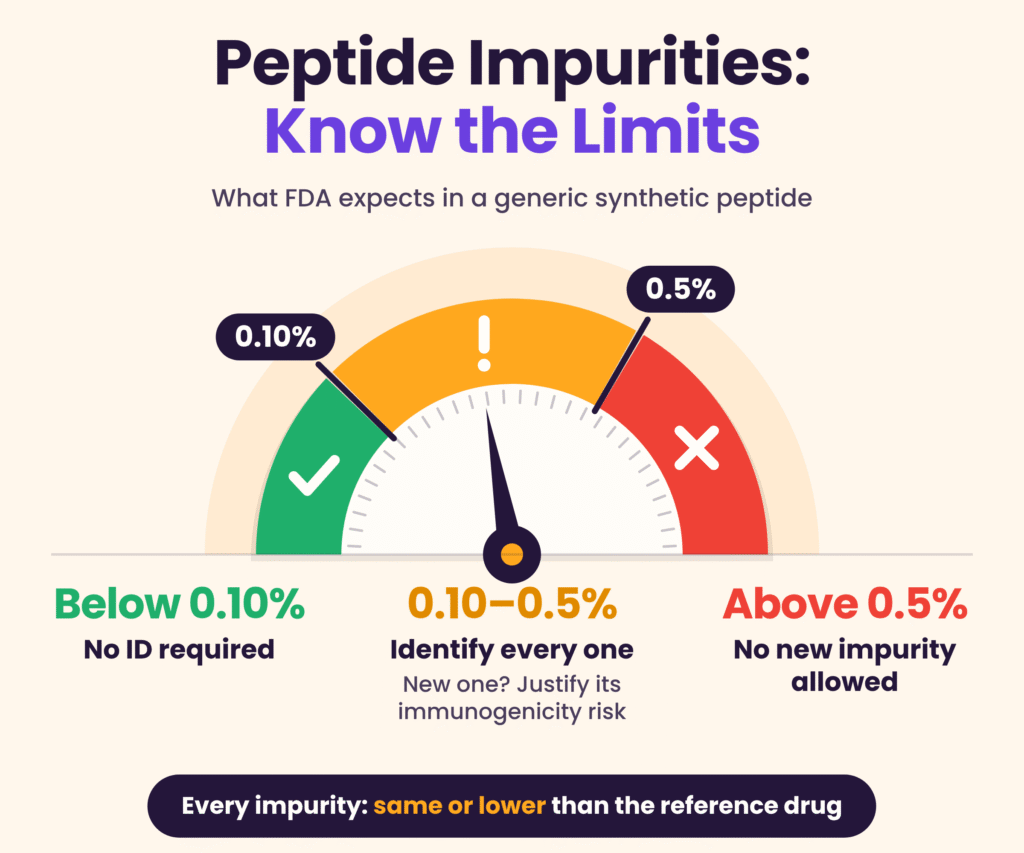
Under these expectations, applicants must identify every peptide-related impurity present at concentrations of 0.10% or higher, demonstrate that no new peptide-related impurity exceeds 0.5%, and provide scientific justification for any new or increased impurity detected between 0.10% and 0.5% through comparative immunogenicity assessments.
Achieving these analytical requirements involves access to complementary instrumentation and specialized expertise within an integrated laboratory environment rather than relying on fragmented testing services from multiple third-party providers.
High-Resolution Mass Spectrometry and Sequencing: UHPLC-HRMS, ESI-MS, MALDI-TOF, and LC-MS/MS are used to establish intact molecular mass, identify deletion and truncation sequences, detect oxidation and deamidation by-products, and confirm the primary amino acid sequence. These techniques provide essential information about peptide identity, structural integrity, and impurity profiles.
Learn how advanced analytical techniques support the identification and characterization of GLP-1 peptide impurities.
Explore GLP-1 peptide analytical characterization.
Nuclear Magnetic Resonance (NMR) and Stereochemistry: Multidimensional NMR techniques support the assessment of higher-order molecular structure, stereochemical purity, and disulfide bridge connectivity. These evaluations are particularly important for peptides whose biological activity depends on precise structural arrangement and molecular conformation.
Quantitative Composition and Charge Profiling: Amino Acid Analysis (AAA) determines the actual net peptide content by correcting for the 10–30% mass reduction commonly associated with moisture and counter-ions. Meanwhile, Capillary Electrophoresis (CE), ion-exchange HPLC, and SEC HPLC help separate and characterize charge variants, aggregates, and other peptide-related species.
Stability-Indicating Validation and Immunogenicity Screening: ICH-aligned forced degradation, photostability assessments, freeze-thaw studies, and immunogenicity screening methods help establish product stability and identify potential biological risks. Depending on the development program, these evaluations may include in silico MHC-binding assessments, in vitro T-cell assays, and innate immune response testing. Such analytical evidence strengthens IND, ANDA, and NDA submissions and helps reduce the possibility of clinical holds or deficiencies leading to complete response letters.
Analytical quality also has a direct influence on manufacturing economics and environmental sustainability. In hybrid modalities such as peptide-oligonucleotide conjugates (POCs), technical process assessments reported by ResolveMass indicate that Process Mass Intensity (PMI) can reach approximately 4,000 to 13,000 kg of raw materials for every 1 kg of API. Nearly 80% of this material consumption may originate from washing cycles during solid-phase synthesis.
Canadian peptide chemists experienced in Fmoc solid-phase peptide synthesis (SPPS), liquid-phase peptide synthesis (LPPS), Native Chemical Ligation (NCL), and copper-free strain-promoted azide-alkyne cycloaddition (SPAAC) can help optimize these manufacturing processes. Technical comparisons indicate that LPPS can reduce solvent consumption by up to 60%. Combining these synthesis approaches with appropriate analytical controls supports the maintenance of peptide purity at ≥95–98% while reducing solvent waste, process inefficiencies, and scale-up risks.
Review a practical example of analytical characterization and structural assessment performed for a semaglutide peptide.
Read the semaglutide peptide characterization case study.
What Economic and Operational Factors Favor Canadian Biomanufacturing in 2026?
Canadian peptide development provides U.S. and international pharmaceutical sponsors with several structural economic and operational advantages. These include favorable currency exchange rates, proposed expansions to federal tax incentives supporting the domestic life sciences industry, and convenient collaboration across North American time zones.
During mid-November 2026, the U.S. dollar traded between 1.4298 and 1.4325 Canadian dollars, remaining above its six-month average of 1.4026 CAD. This exchange-rate difference increases the purchasing power of U.S.-denominated R&D and CMC budgets when allocated toward Canadian laboratory personnel, advanced instrumentation, and analytical testing services.
Although National Bank of Canada economists expect the USD/CAD exchange rate to moderate gradually toward 1.35 by Q3 2027, the existing currency differential provides a meaningful financial advantage across development programs extending over several quarters.
Canada’s 2026 Federal Budget has also proposed expanding eligibility under the Scientific Research and Experimental Development (SR&ED) program. The proposed changes would allow Canadian life sciences companies to claim expenditures associated with regulatory approvals, commercialization activities, and intellectual property filing and maintenance.
Foreign sponsors generally cannot claim SR&ED credits directly without an eligible Canadian entity. Nevertheless, improved opportunities for capital recovery throughout Canada’s domestic life sciences ecosystem can support continued CDMO investment in advanced analytical instrumentation, specialized manufacturing infrastructure, and PhD-level scientific expertise.
These financial advantages are complemented by geographical and logistical benefits. Eastern Time Zone alignment allows Greater Montreal manufacturing and research hubs to coordinate directly with major biopharmaceutical centers in Boston, New York, and New Jersey. Additionally, efficient ground and air transportation networks support rapid cold-chain delivery to U.S. clinical and commercial destinations.
Compared with trans-Pacific outsourcing, these operational advantages reduce overnight communication delays, facilitate faster troubleshooting, and minimize the logistical risks associated with transporting temperature-sensitive peptide materials over extended distances.
The following comparison highlights the major differences between Canadian, U.S., and offshore Asian peptide CDMO partnerships:
| Sourcing Dimension | Canadian Peptide CDMO | U.S. Domestic Peptide CDMO | Offshore Asian Peptide CDMO |
|---|---|---|---|
| U.S. BIOSECURE Act Exposure | Operates within an allied jurisdiction outside the foreign-adversary BCC scope, subject to applicable designation and contracting requirements. | Operates within the domestic U.S. jurisdiction and is generally compliant. | China-based vendors face increased scrutiny because of Section 1260H/OMB BCC designations and federal contractor flow-down requirements. |
| U.S. Section 232 Tariff Status | 0% for clinical/R&D materials, generics, and unpatented goods. No CUSMA exemption applies to commercial patented APIs. | 0% for U.S.-origin pharmaceutical products. | Commercial patented drugs and APIs may face duties of up to 100% without qualifying agreements. The stated rates also include 15% for South Korea and 0% for eligible clinical materials and generics. |
| Regulatory and Inspection Framework | Health Canada DEL/GMP oversight aligned with PIC/S, FDA inspection cooperation, and CETA/TGA/UK/Swiss MRAs, subject to applicable API exclusions. | Direct U.S. FDA oversight, representing the standard regulatory benchmark for U.S. commercial filings. | Subject to FDA foreign inspections, with increasing capacity constraints in markets such as India and South Korea. |
| Cost and FX Environment | Favorable USD/CAD exchange rate, approximately 1.43 CAD per USD in November 2026, together with proposed Budget 2026 SR&ED ecosystem support. | Higher labor and facility development costs, with CDMO rates projected to increase by 5–10% annually amid limited capacity. | Historically lower labor costs, although manufacturing prices are increasing as sponsors diversify their supply chains away from China. |
| Collaboration and Cold Chain | North American time-zone alignment and rapid cold-chain transportation to U.S. clinical sites. | Domestic transportation infrastructure and compatible time zones. | Extended ocean and air cold-chain transportation, together with several hours of time-zone differences that can complicate technical troubleshooting. |
Examine the differences between U.S.-based and overseas peptide manufacturing arrangements before selecting a long-term supply partner.
Explore U.S. versus overseas peptide CDMOs.
Conclusion
Choosing to source your peptides from a Canadian CDMO provides biopharmaceutical sponsors with a resilient and scientifically advanced North American supply chain. This approach directly addresses several important industry challenges, including BIOSECURE Act compliance, limited global peptide synthesis capacity, and increasingly stringent FDA expectations for peptide-related impurities.
Although commercial patented API programs require appropriate customs planning through mechanisms such as Foreign Trade Zones, duty drawback, and approved onshoring partnerships to manage Section 232 tariffs, Canada offers a strong operational environment for route scouting, advanced analytical characterization, complex peptide conjugates, generic products, and clinical GMP manufacturing.
For sponsors seeking direct access to PhD-level peptide chemists, in-house HRMS/NMR characterization, and laboratory operations supported by Health Canada GMP licensing and U.S. FDA registration, ResolveMass Laboratories Inc. in Laval, Quebec, provides support across the development pathway, from custom peptide synthesis to regulatory-ready analytical testing and product release.
Explore the analytical and manufacturing capabilities available to support peptide development programs in Canada.
Discover Canadian peptide CDMO services.
Discuss your peptide sequence complexity, impurity control strategy, or GMP scale-up requirements directly with our scientific team to identify an appropriate development and manufacturing approach.
Frequently Asked Questions (FAQs)
The U.S. BIOSECURE Act, enacted in December 2025, restricts federal agencies, grant-funded organizations, and government contractors from obtaining biotechnology products or services from designated Biotechnology Companies of Concern. Its contractor flow-down provisions also extend these restrictions across subcontractors and associated manufacturing networks. Transferring peptide development and analytical activities to eligible Canadian CDMOs can help sponsors reduce exposure to foreign-adversary supply-chain restrictions and prepare for upcoming BCC designations and FAR enforcement requirements.
Canadian pharmaceutical products do not receive a general CUSMA/USMCA exemption from the 2026 U.S. Section 232 tariffs on patented drugs and associated ingredients. Commercial patented peptide APIs may therefore face additional duties of up to 100% unless they qualify for specific exemptions or approved customs arrangements. However, eligible clinical-trial and R&D materials under heading 9903.04.70, generic drugs under 9903.04.67, non-patented Chapter 29/30 products under 9903.04.69, and qualifying U.S.-packaged dosage forms under 9903.04.68 can receive a 0% additional duty rate.
Health Canada’s GMP requirements, established under Division 2 of the Food and Drug Regulations and supported by GUI-0001, follow internationally recognized ICH Q10 and PIC/S principles. Canada maintains GMP Mutual Recognition Agreements with the European Union under CETA, the United Kingdom, Switzerland, and Australia, although APIs remain temporarily excluded from the EU CETA arrangement. Additionally, Health Canada and the U.S. FDA maintain an ongoing inspection-sharing agreement that supports regulatory cooperation and the exchange of pharmaceutical manufacturing inspection information.
Synthetic peptides require specialized impurity assessment because they are not covered by the standard ICH Q3A and Q3B impurity frameworks. FDA guidance expects applicants to identify peptide-related impurities present at concentrations of 0.10% or higher and demonstrate that newly identified impurities do not exceed 0.5%. Any new or increased impurity between 0.10% and 0.5% requires an appropriate scientific justification supported by comparative immunogenicity assessments, potentially involving in silico MHC-binding predictions and in vitro T-cell or innate immune response studies.
Reliable peptide characterization requires multiple complementary analytical techniques because no single method can establish every quality attribute. Reverse-phase, ion-exchange, and size-exclusion HPLC are used to evaluate purity, charge variants, and aggregates, while UHPLC-HRMS, LC-MS/MS, and MALDI-TOF help confirm molecular mass and amino acid sequence. Additionally, one-dimensional and two-dimensional NMR provide structural and stereochemical information, Capillary Electrophoresis evaluates charge heterogeneity, and Amino Acid Analysis determines the actual peptide content.
HPLC purity represents the proportion of the target peptide detected relative to other chromatographically separated peptide-related components. Net peptide content, however, indicates the actual amount of peptide present after accounting for non-peptide components, including residual moisture and counter-ions such as acetate or trifluoroacetate. These substances can reduce the effective peptide content by approximately 10–30%, making quantitative Amino Acid Analysis essential for determining accurate concentrations, calculating molar quantities, and ensuring appropriate dosing.
Peptide CDMOs generally select Fmoc solid-phase peptide synthesis (SPPS), liquid-phase peptide synthesis (LPPS), or hybrid fragment-ligation approaches according to sequence length, structural complexity, and manufacturing scale. Automated SPPS is particularly useful for rapid development and the production of sequences containing approximately 40–50 amino acids. For longer sequences and larger manufacturing requirements, LPPS and Native Chemical Ligation can provide suitable alternatives, with LPPS offering the potential to reduce solvent consumption by up to 60% under appropriate process conditions.
The turnaround time for custom peptide synthesis depends on sequence length, chemical modifications, purification requirements, and analytical testing complexity. Standard linear peptides containing approximately 2–30 amino acids can generally be synthesized and characterized within two to three weeks, with expedited services sometimes available for urgent preclinical requirements. More demanding projects involving longer sequences, macrocycles, multiple disulfide bridges, or conjugated structures may require four weeks or longer because of additional synthesis optimization, purification, and analytical method development.
Yes, specialized Canadian peptide CDMOs can manufacture structurally modified peptides incorporating non-natural amino acids, lipidation, PEGylation, and head-to-tail or disulfide-mediated cyclization. They can also develop peptide-oligonucleotide conjugates (POCs) by integrating peptide synthesis with specialized conjugation chemistry. Clinical-grade POC manufacturing may involve orthogonal deprotection strategies, copper-free strain-promoted azide-alkyne cycloaddition (SPAAC), Native Chemical Ligation, preparative chromatography, Tangential Flow Filtration (TFF), and controlled lyophilization to achieve the required purity, including targets of ≥95%.
Reference:
- Health Canada. (2026, June 1). Mutual recognition agreement between Canada and the European Union (EU). Government of Canada. https://www.canada.ca/en/health-canada/services/drugs-health-products/compliance-enforcement/international/mutual-recognition-agreements/updates/mutual-recognition-agreement-canada-european-community.html
- European Medicines Agency. (n.d.). Mutual recognition agreements (MRA). https://www.ema.europa.eu/en/human-regulatory-overview/research-development/compliance-research-development/good-manufacturing-practice/mutual-recognition-agreements-mra
- Department of Finance Canada. (2026, August 26). List of products from the United States subject to counter-tariffs effective September 8, 2026. Government of Canada. https://www.canada.ca/en/department-finance/news/2026/08/list-of-products-from-the-united-states-subject-to-counter-tariffs-effective-september-8-2026.html
- Health Canada. (n.d.). Good manufacturing practices guidelines (GUI-0001). Government of Canada. https://www.canada.ca/en/health-canada/services/drugs-health-products/compliance-enforcement/good-manufacturing-practices/guidance-documents/gmp-guidelines-0001/document.html
- U.S. Food and Drug Administration. (n.d.). FDA-Canadian Department of National Health and Welfare agreement on cooperation. https://www.fda.gov/international-programs/cooperative-arrangements/fda-canadian-department-national-health-and-welfare-agreement-cooperation
- Health Canada. (n.d.). Mutual recognition agreements. Government of Canada. https://www.canada.ca/en/health-canada/services/drugs-health-products/compliance-enforcement/international/mutual-recognition-agreements.html
- Li, Y. (2022, September 20). Common deficiencies associated with comparative peptide impurity profile studies and qualification of impurity levels and proposed limits [Presentation slides]. U.S. Food and Drug Administration. https://www.fda.gov/media/166572/download
- Pang, E. (2022, September 20). Assessing immunogenicity risk of peptides: The synthetic peptide guidance and PSGs [Presentation slides]. U.S. Food and Drug Administration. https://www.fda.gov/media/166571/download
Get In Touch With Us
About The Author