

Introduction:
Sterility & Endotoxin Testing for Dexamethasone Injection is a critical quality-control activity for demonstrating the microbiological safety of an injectable corticosteroid product. Because dexamethasone injection is administered parenterally, the finished product must be appropriately controlled for microbial contamination and bacterial endotoxins before release — this sits alongside the broader analytical characterization of dexamethasone injection that supports a complete quality package.
Sterility and endotoxin testing address two different but complementary risks. Sterility testing evaluates whether viable microorganisms are detectable in the tested sample under prescribed test conditions, while bacterial endotoxin testing detects endotoxins originating primarily from Gram-negative bacterial cell walls. A product can pass sterility testing and still contain unacceptable levels of endotoxin — which is exactly why both controls are necessary, non-substitutable release criteria.
For pharmaceutical manufacturers, generic-drug developers, CDMOs, and regulatory teams, the challenge isn’t simply running two laboratory tests. A defensible program requires scientifically appropriate sampling, validated or qualified analytical procedures, method suitability, appropriate controls, trained personnel, controlled laboratory conditions, and complete documentation — considerations that also shape the broader dexamethasone injection development pathway from early formulation through commercial release.
Summary:
- Sterility & Endotoxin Testing for Dexamethasone Injection demonstrates that parenteral dexamethasone products are free from viable microorganisms and contain bacterial endotoxin below scientifically established safety limits.
- Sterility testing is generally performed using validated compendial procedures — membrane filtration is commonly suitable for aqueous injectable formulations like dexamethasone sodium phosphate.
- Bacterial endotoxin testing (BET) uses LAL-based or recombinant Factor C-based methods, selected according to product characteristics, laboratory capability, and applicable regulatory expectations.
- A sound testing program accounts for formulation, preservatives, container-closure systems, sample preparation, and inhibition/enhancement — not just the routine assay itself.
- Endotoxin limits should be scientifically derived from the product’s maximum dose and route of administration rather than borrowed from a generic specification.
- A defensible program requires method suitability, controls, analyst training, environmental monitoring, data integrity, and complete documentation suitable for CMC and quality sections of regulatory dossiers.
1: What Is Sterility Testing for Dexamethasone Injection?
Sterility testing determines whether viable microorganisms are detectable in a representative sample of the injectable drug product when tested according to an applicable pharmacopoeial procedure. For dexamethasone injection, the sterility test is typically performed using a compendial approach appropriate for the formulation and container presentation.
For most aqueous formulations, membrane filtration is generally suitable — the product is filtered through a sterile membrane and the membrane is subsequently incubated in appropriate culture media. Other approaches may apply when membrane filtration isn’t feasible for a given presentation.
Key formulation and process factors influencing method selection:
- Nature of the formulation and product concentration
- Presence of antimicrobial preservatives
- Solubility and viscosity
- Container-closure configuration and filter compatibility
- Potential antimicrobial activity of the drug substance itself
- Required sample volume and incubation conditions
- Applicable pharmacopoeial requirements
Sterility testing is fundamentally a quality-control test, not a substitute for sterile manufacturing controls. A negative sterility-test result provides information about the tested sample under the defined conditions — it does not independently prove that every unit in the batch is sterile.
How Is Sterility Testing Performed?
For a membrane-filtration procedure, the general workflow includes sample receipt and identification, verification of sample integrity, aseptic transfer of the required quantity, filtration through a suitable sterile membrane, rinsing/neutralization where scientifically justified, transfer to culture media, incubation under prescribed conditions, periodic examination for growth, and documentation of results. The precise procedure follows the applicable current pharmacopoeial method and the laboratory’s approved SOP.
Why Method Suitability Matters
A formulation may contain ingredients that inhibit microbial recovery, so simply demonstrating that a sterility procedure works with a control microorganism isn’t necessarily sufficient. A method suitability (bacteriostasis/fungistasis) study evaluates whether the product or its test preparation interferes with recovery of challenge microorganisms under the prescribed testing conditions — this is particularly important for formulations containing antimicrobial preservatives or other ingredients with inherent microbiological activity, and it’s a prerequisite before any routine sterility result can be relied upon for batch release.
2: Why Is Endotoxin Testing Important for Dexamethasone Injection?
Endotoxin testing is important because bacterial endotoxins can cause potentially serious pyrogenic reactions when introduced into the bloodstream, so injectable products require appropriate controls for endotoxin contamination. The laboratory must establish an endotoxin-testing procedure that is suitable for the dexamethasone formulation and capable of reliably detecting endotoxin at the required limit.
Bacterial endotoxin testing technologies commonly used:
| Method | Principle | Typical Use Case |
|---|---|---|
| Gel-clot | Visual clot formation at threshold endotoxin concentration | Simple pass/fail, low-cost screening |
| Turbidimetric | Kinetic measurement of turbidity change over time | Quantitative results, higher sensitivity |
| Chromogenic | Colorimetric detection via chromogenic substrate cleavage | Quantitative, widely used for QC release |
| Recombinant Factor C (rFC) | Non-animal-derived recombinant reagent | Growing adoption per USP <86> and sustainability goals |
The selected method must be scientifically justified and compatible with the applicable pharmacopoeia and regulatory requirements — a choice best made alongside a broader dexamethasone impurities analysis strategy, since impurity and interference profiles often correlate with the same excipient and buffer components.
How Is the Endotoxin Limit Established?
The endotoxin limit should be scientifically established based on the product’s intended route of administration, maximum dose, and applicable regulatory or pharmacopoeial requirements — not a generic borrowed value. The conceptual relationship used is:
Endotoxin Limit = K / M
Where K is the threshold pyrogenic dose of endotoxin per kg of body weight under the relevant standard, and M is the maximum dose of the product per kg administered within the specified period. The resulting limit is generally expressed in units such as EU/mL or EU/mg depending on the product and analytical calculation, and the actual specification must be established using the current applicable pharmacopoeial and regulatory framework.
What Is Endotoxin Method Suitability Testing?
Endotoxin method suitability demonstrates that the dexamethasone injection matrix does not interfere with the endotoxin detection method at the intended dilution. Pharmaceutical formulations can produce inhibition (falsely low results) or enhancement (falsely high results), so a suitable method must demonstrate acceptable recovery of endotoxin controls in the presence of the product matrix.
Factors affecting endotoxin method suitability:
- Maximum valid dilution and product concentration
- Sample pH and buffer composition
- Preservatives and surfactants
- Dilution scheme and detection technology
- Endotoxin standard and positive product control recovery
This validation should be re-evaluated whenever formulation, manufacturing, or analytical changes could plausibly affect assay suitability.
3: Sterility & Endotoxin Testing: Key Differences
Although the two tests are often discussed together, they measure different quality attributes and neither can substitute for the other.
| Parameter | Sterility Testing | Endotoxin Testing |
|---|---|---|
| Primary purpose | Detect viable microorganisms | Detect bacterial endotoxins |
| Main risk addressed | Microbial contamination | Pyrogenic response |
| Result type | Sterile / growth observed | Quantitative or limit-based |
| Typical method | Membrane filtration or direct inoculation | LAL, rFC, or applicable compendial method |
| Key interference concern | Product antimicrobial activity | Inhibition or enhancement |
| Major control | Aseptic testing environment | Endotoxin-controlled testing environment |
| Application | Finished sterile product | Parenteral product and applicable components |
| Regulatory role | Batch sterility assessment | Patient-safety release specification |
4: Formulation-Specific Challenges for Dexamethasone Injection
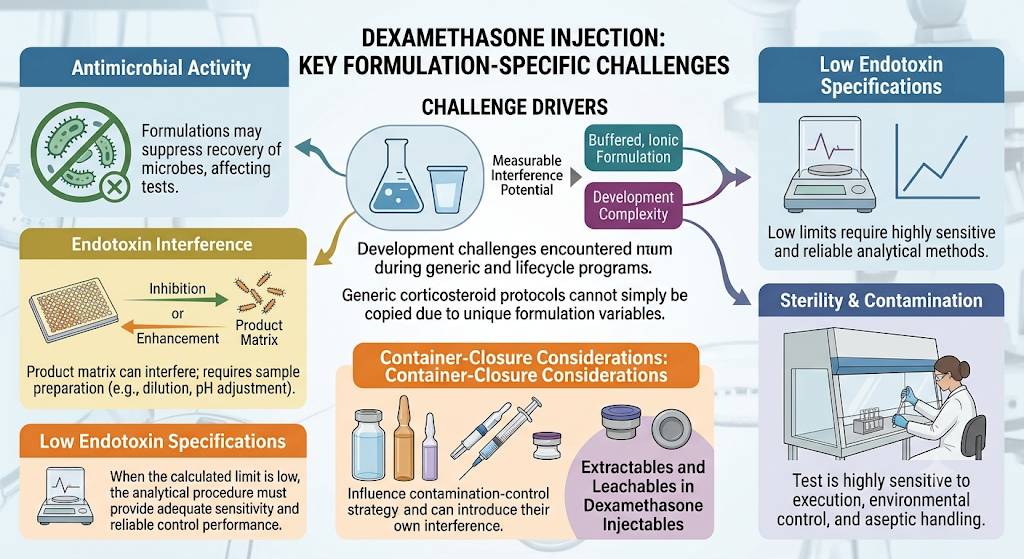
Dexamethasone injection’s aqueous, phosphate-buffered formulation and relatively high ionic strength create measurable interference potential in both assays, which is why validation can’t simply be copied from a generic corticosteroid protocol — the same formulation variables that complicate sterility and endotoxin testing also show up across other dexamethasone development challenges encountered during generic and lifecycle programs.
Common challenges encountered during method development and routine testing:
- Antimicrobial activity — some formulations suppress microbial recovery, requiring method suitability studies and validated sample-preparation strategies.
- Endotoxin interference — the product matrix may inhibit or enhance the assay, requiring dilution, pH adjustment, or other scientifically justified sample treatment.
- Low endotoxin specifications — when the calculated limit is low, the analytical procedure must provide adequate sensitivity and reliable control performance.
- Container-closure considerations — vials, ampoules, syringes, stoppers, and seals influence contamination-control strategy and can introduce their own interference; this overlaps with extractables and leachables in dexamethasone injectables evaluation for the same container-closure system.
- Aseptic test execution — sterility testing is highly sensitive to technique, requiring environmental monitoring, operator training, aseptic handling, and appropriate controls.
5: Regulatory Expectations: FDA, Health Canada, and EMA
FDA, Health Canada, and EMA all require sterility and endotoxin testing as mandatory release criteria for parenteral products, with harmonized compendial methods but jurisdiction-specific submission expectations. Important references include USP <71> Sterility Tests, USP <85> Bacterial Endotoxins Test, the corresponding European Pharmacopoeia chapters, and applicable FDA and Health Canada guidance — the exact requirements should always be checked against the current official version applicable to the target jurisdiction and product.
For a generic dexamethasone injection, the testing strategy must also align with the product’s approved or proposed formulation, manufacturing process, specifications, and overall CMC control strategy — which is precisely the documentation package assembled for a dexamethasone ANDA submission. Submissions should include method suitability validation for sterility testing, inhibition/enhancement validation for the endotoxin assay at the release dilution, justification of the endotoxin limit calculation, and stability-indicating confirmation that results remain valid across shelf life — a point that connects directly to dexamethasone injection stability programs and, where relevant, forced degradation studies for dexamethasone.
6: What Should a Pharmaceutical Laboratory Document?
A robust testing program requires more than a final pass/fail statement — documentation should allow the result to be reconstructed and independently reviewed.
Records that should be maintained:
- Sample identification, chain of custody, and batch/lot information
- Test method and SOP reference, analyst and equipment identification
- Reagent, media, and growth-promotion information
- Environmental monitoring records
- Method suitability and endotoxin standard information
- Positive and negative controls, raw analytical data, and calculations
- Deviations, investigations, and OOS/OOT assessments where applicable
- Final analytical report and quality-control review and approval
This documentation is particularly valuable during regulatory submissions, client audits, inspections, and batch-release investigations — and it forms part of the broader documentation trail supporting lifecycle management strategies for dexamethasone injectables, since method suitability and validation studies need to be revisited whenever a formulation, site, or supplier change occurs later in the product’s life.
7: Sterility & Endotoxin Testing Workflow at an Analytical Laboratory
A systematic workflow improves data reliability and reduces avoidable testing failures.
| Stage | Key Activity | Critical Focus |
|---|---|---|
| 1 | Sample receipt | Identity, integrity, storage |
| 2 | Test planning | Applicable method and specification |
| 3 | Method suitability | Product-specific interference |
| 4 | Sterility testing | Aseptic technique and controls |
| 5 | Endotoxin testing | Assay suitability and controls |
| 6 | Data review | Calculations and acceptance criteria |
| 7 | Deviation assessment | Investigation when required |
| 8 | Reporting | Traceable final report |
| 9 | QA review | Compliance and data integrity |
| 10 | Regulatory support | Submission-ready documentation |
This structured approach connects laboratory results to the broader pharmaceutical quality system, rather than treating sterility and endotoxin testing as isolated release checks.
Conclusion:
Sterility & Endotoxin Testing for Dexamethasone Injection is a fundamental, non-negotiable component of quality control for injectable corticosteroid products — sterility testing addresses the potential presence of viable microorganisms, while endotoxin testing controls the risk associated with bacterial endotoxin contamination, and neither substitutes for the other. A reliable testing program depends on appropriate compendial methodology, product-specific method suitability, validated analytical procedures, suitable controls, trained analysts, environmental control, data integrity, and comprehensive documentation.
Frequently Asked Questions:
Sterility testing evaluates the tested sample for detectable viable microorganisms, whereas endotoxin testing detects bacterial endotoxin. The two tests address different microbiological risks and should not be considered interchangeable. Both can be important for the quality assessment of sterile injectable products.
Bacterial endotoxin testing may use LAL-based technologies or appropriate recombinant reagent-based methods, depending on the applicable compendial and regulatory framework. The selected procedure should be suitable for the product matrix and demonstrate appropriate analytical performance.
Inhibition or enhancement occurs when components of the pharmaceutical formulation interfere with the endotoxin assay response. Inhibition can potentially produce falsely low results, while enhancement can produce an increased response. Appropriate method suitability testing helps identify and control these matrix effects.
The endotoxin limit is established based on factors such as the product’s route of administration, maximum dose, and applicable regulatory or pharmacopoeial requirements. A commonly used relationship is K/M, where K represents the applicable threshold pyrogenic dose and M represents the maximum dose per kilogram. The final specification should be scientifically justified for the product.
Reference
- Masferrer JL, Zweifel BS, Seibert K, Needleman P. Selective regulation of cellular cyclooxygenase by dexamethasone and endotoxin in mice. The Journal of clinical investigation. 1990 Oct 1;86(4):1375-9.https://www.jci.org/articles/view/114850
- Yuen MV, Gianturco SL, Pavlech LL, Storm KD, Mattingly AN. Dexamethasone sodium phosphate: Summary Report.https://archive.hshsl.umaryland.edu/entities/publication/13b8ec2e-af1c-4df7-a478-3684e0f48c82
- McCALLUM RE, Seale TW, Stith RD. Influence of endotoxin treatment on dexamethasone induction of hepatic phosphoenolpyruvate carboxykinase. Infection and Immunity. 1983 Jan;39(1):213-9.https://journals.asm.org/doi/abs/10.1128/iai.39.1.213-219.1983
- Pollack J, Beecher D, Pulido J, Lee Wong A. Failure of intravitreal dexamethasone to diminish inflammation or retinal toxicity in an experimental model of Bacillus cereus endophthalmitis. Current eye research. 2004 Jan 1;29(4-5):253-9.https://www.tandfonline.com/doi/abs/10.1080/02713680490516701
- Sadikot RT, Jansen ED, Blackwell TR, Zoia O, Yull F, Christman JW, Blackwell TS. High-dose dexamethasone accentuates nuclear factor-κ B activation in endotoxin-treated mice. American journal of respiratory and critical care medicine. 2001 Sep;164(5):873-8.https://academic.oup.com/ajrccm/article-abstract/164/5/873/8544630
About the Author


