

Introduction:
Synthetic Peptide Impurity Analysis is the process of detecting, characterizing and controlling structurally similar impurities that remain after peptide synthesis. It is hardest when isomeric impurities co-elute, because they can share molecular mass, produce near-identical fragmentation and behave almost identically in chromatography.
Synthetic peptides are widely used in therapeutic development and drug manufacturing, yet synthesis can introduce impurities through incomplete coupling, side reactions, epimerization and sequence-related modifications. Some differ from the target by a single feature, such as the stereochemistry of one residue.
This illustrative case study from ResolveMass Laboratories Inc. shows how ion mobility spectrometry (IMS) combined with electron-transfer dissociation (ETD) can complement conventional LC-MS/MS. The scenario is hypothetical and does not report results from a specific client project. It reflects how such an investigation can be designed and interpreted.
Summary:
- The challenge: Isomeric peptide impurities can share the same precursor mass and co-elute on reversed-phase LC, so conventional LC-MS may miss them.
- Why standard methods fall short: Identical elemental composition and similar fragmentation patterns prevent confident structural differentiation.
- Ion mobility: It adds a gas-phase separation based on ion charge, size, shape and gas-phase interactions.
- ETD: Electron-transfer dissociation produces c- and z-type backbone fragments that help localize structural differences.
- The combined workflow: LC, accurate-mass MS, ion mobility and ETD give complementary evidence for Synthetic Peptide Impurity Analysis.
- The key limitation: Neither technique guarantees separation or definitive identification of every isomer. Controls and orthogonal confirmation are required.
1: What Makes Synthetic Peptide Impurity Analysis Difficult?
It becomes difficult when an impurity has the same elemental composition as the target but a different structure or stereochemistry. Mass-based screening alone cannot see such species, and conventional chromatography may not resolve them.
During solid-phase peptide synthesis, impurities can arise from several routes:
- Incomplete coupling or deprotection and deletion sequences
- Oxidation and hydrolysis
- Aggregation-related effects
- Epimerization
The exact profile depends on the sequence, chemistry, purification process and storage conditions. Modified peptides add complexity, as seen in PEGylated peptide characterization.
What Are Co-Eluting Isomeric Peptide Impurities?
They are structurally different peptide species that leave the column at the same or nearly the same retention time while sharing a molecular formula. Common examples:
- D/L epimers: peptides differing in the stereochemistry of one or more residues
- Positional isomers: a modification or residue arrangement that differs by position
- Leucine/isoleucine isomers: identical composition and exact mass
- Other sequence-related isomers: these need residue-specific or orthogonal evidence
Not every isomer behaves the same in chromatography or ion mobility. When LC alone fails, extra analytical dimensions can supply the discrimination.
2: Why Can’t Conventional LC-MS/MS Resolve These Impurities?
Retention time and precursor mass do not necessarily reflect subtle structural differences, so co-eluting isomers overlap in the same isolation window. High-resolution MS gives accurate mass, but it cannot separate two compounds with the same exact mass. CID and HCD fragmentation can also yield overlapping spectra when the difference does not change preferred fragmentation pathways.
| Limitation | Why it matters |
|---|---|
| Limited chromatographic selectivity | Similar structures retain similarly |
| Identical precursor mass | Isomers cannot be told apart by mass alone |
| Overlapping fragment ions | Shared backbone fragments dominate spectra |
| Low-abundance impurity signals | The abundant target can mask a minor species |
| Limited structural localization | Seeing a difference does not show which residue causes it |
These limits do not make LC-MS/MS ineffective. They show when another separation mechanism or fragmentation strategy is needed.
An Illustrative Case Study Scenario
Consider a synthetic peptide candidate whose impurity appears alongside the target during reversed-phase LC-MS. It has the same precursor mass, and the initial MS/MS spectra share many product ions. The goal is to decide whether the signal is a genuine isomer and, if possible, identify the region responsible.
| Parameter | Illustrative observation or objective |
|---|---|
| Sample | Synthetic peptide with a suspected isomeric impurity |
| Initial technique | Reversed-phase LC with high-resolution MS |
| Primary challenge | Co-elution and identical precursor mass |
| Added techniques | Ion mobility spectrometry and ETD |
| Main objective | Distinguish the species and obtain structural evidence |
| Final requirement | Orthogonal confirmation and fit-for-purpose method validation |
3: How Does Ion Mobility Improve Synthetic Peptide Impurity Analysis?
Ion mobility improves Synthetic Peptide Impurity Analysis by separating gas-phase ions according to how they move through a gas under a defined field. The result may be reported as drift time, arrival-time distribution or collision cross section (CCS). Unlike LC, which relies on stationary and mobile phase interactions, it adds an independent separation dimension that can split chromatographic co-elution.
How Ion Mobility Works
After LC separation and electrospray ionization, the mobility device separates ions by:
- Charge state
- Gas-phase conformation and effective size
- Molecular shape and interaction with the buffer gas
- Instrument design and operating conditions
Isomers with different gas-phase structures may show different mobility even when retention and mass overlap. Ion mobility does not guarantee isomer separation, though. Some isomers have similar gas-phase structures, and different conformers of one peptide can produce multiple mobility features, so differences must be interpreted carefully.
What Ion Mobility Adds
The analyst compares the target and suspected impurity using:
- Precursor m/z and charge-state distribution
- Arrival times or other mobility measurements
- CCS values, where calibration supports reliable reporting
- Mobility-resolved MS/MS spectra, where available
A reproducible mobility difference supports distinguishable ion populations. If features overlap, modified chromatographic selectivity, other charge states or orthogonal methods may still be required.
4: How Does ETD Help Characterize Isomeric Peptide Impurities?
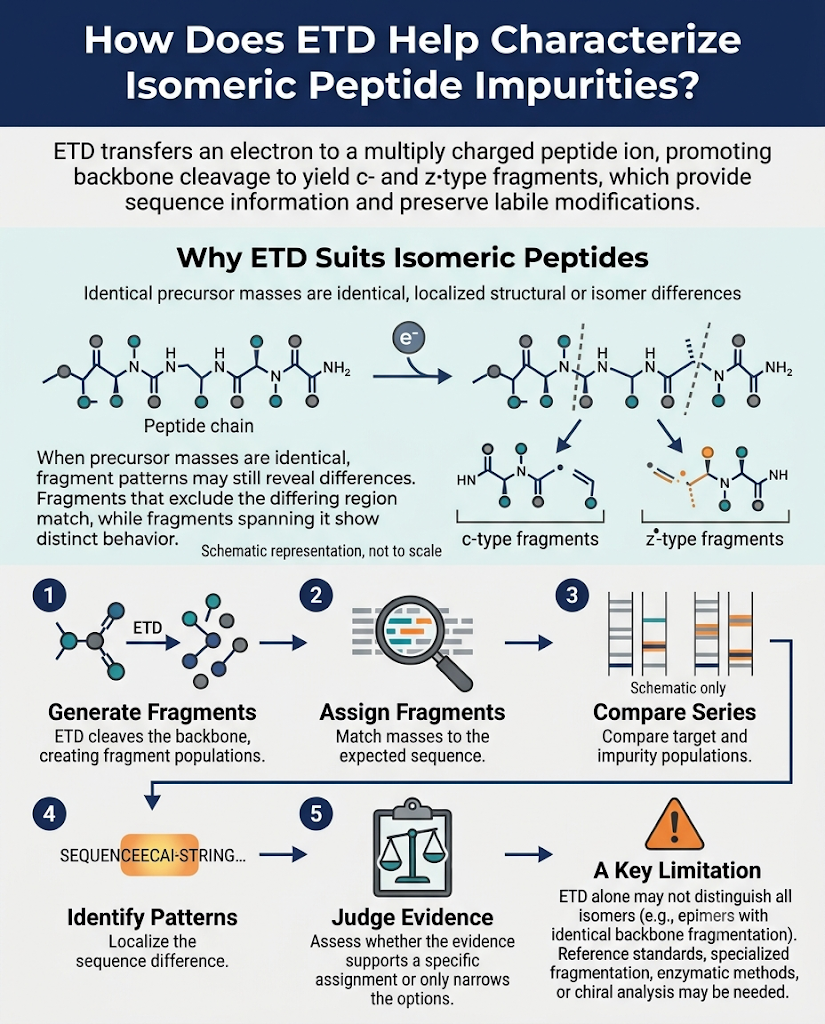
ETD transfers an electron to a multiply charged peptide ion, which promotes backbone cleavage and commonly yields c- and z-type fragments. These give sequence information and can preserve some labile modifications better than collision-based fragmentation. Performance depends on charge state, sequence, reaction conditions and instrument configuration.
Why ETD Suits Isomeric Peptides
When precursor masses are identical, fragment patterns may still reveal differences. Fragments that exclude the differing region should match, while fragments spanning it can show distinct behavior. In the proposed workflow, ETD would:
- Generate backbone fragments from the target and impurity-associated populations.
- Assign fragments using accurate mass and the expected sequence.
- Compare c- and z-type series across the two populations.
- Identify patterns consistent with a localized difference.
- Judge whether the evidence supports a specific assignment or only narrows the options.
ETD alone may not distinguish all isomers. Epimers can give very similar backbone fragmentation because sequence and composition are unchanged. Reference standards, specialized fragmentation, enzymatic methods or chiral analysis may be needed.
5: What Is the Integrated Ion Mobility and ETD Workflow?
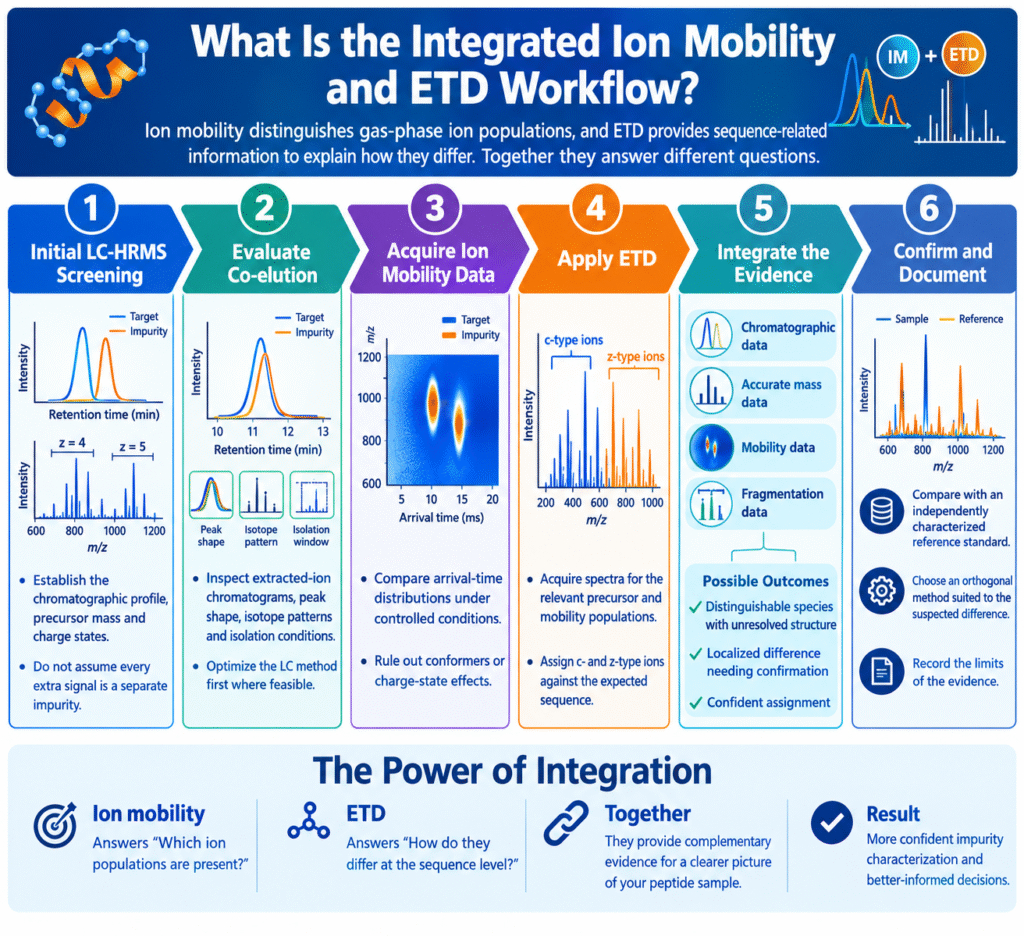
Ion mobility distinguishes gas-phase ion populations, and ETD provides sequence-related information to explain how they differ. Together they answer different questions.
- Initial LC-HRMS screening: Establish the chromatographic profile, precursor mass and charge states. Do not assume every extra signal is a separate impurity.
- Evaluate co-elution: Inspect extracted-ion chromatograms, peak shape, isotope patterns and isolation conditions. Optimize the LC method first where feasible.
- Acquire ion mobility data: Compare arrival-time distributions under controlled conditions, and rule out conformers or charge-state effects.
- Apply ETD: Acquire spectra for the relevant precursor and mobility populations, then assign c- and z-type ions against the expected sequence.
- Integrate the evidence: Combine chromatographic, accurate-mass, mobility and fragmentation data. The outcome may be distinguishable species with unresolved structure, a localized difference needing confirmation, or a sufficiently confident assignment.
- Confirm and document: Compare against an independently characterized reference standard and choose an orthogonal method suited to the suspected difference. Record the limits of the evidence.
6: What Would Demonstrate a Successful Characterization?
Success means a reproducible analytical distinction that supports a structural assignment, stated with its confidence and limits. Observing an extra peak or mobility signal is not enough.
| Evidence | What it can establish | Important limitation |
|---|---|---|
| Accurate precursor mass | Molecular formula assessment | Cannot separate exact-mass isomers |
| LC retention behavior | Separation or co-elution | Similar structures may share retention |
| Ion mobility difference | Distinguishable gas-phase populations | Does not prove identity alone |
| ETD fragment ions | Sequence and backbone evidence | Some isomers give similar spectra |
| Reference-standard comparison | Identity, when the standard is well characterized | Depends on the standard and method selectivity |
| Orthogonal structural analysis | Independent support for an assignment | The right method depends on the isomer type |
For structural confirmation, it helps to understand how techniques complement each other. See our comparison of NMR vs LC-MS for peptide characterization.
Why Does This Matter for Quality and Regulatory Compliance?
Reliable impurity characterization supports process understanding, method development and quality investigations, and it helps teams decide whether an impurity comes from synthesis, purification, handling or degradation. Conclusions should rest on documented methods, appropriate controls, traceable reference materials and fit-for-purpose validation.
- Frameworks: ICH Q2(R2) on analytical procedure validation and Q14 on analytical procedure development are useful references. Their applicability depends on the analytical objective.
- Other impurity classes: Organic isomers are only part of the picture. Catalyst and reagent residues are assessed under ICH Q3D elemental impurity assessment.
- Submissions: Expectations depend on product, development stage and intended use of the data. For filing support, see therapeutic peptide characterization for NDA and ANDA.
Treat ion mobility and ETD as complementary tools within a broader strategy, not as substitutes for validated chromatographic methods or definitive structural confirmation.
How Can ResolveMass Laboratories Inc. Support Peptide Characterization?
ResolveMass Laboratories Inc. is a Canadian analytical CRO/CDMO with focus areas in mass spectrometry, biosimilar characterization, PLGA-based drug delivery and nitrosamine testing. Our peptide characterization services are scoped around the structural question, not a fixed instrument list. Confirm the exact services and instrumentation for your project directly with the laboratory.
A useful first consultation covers:
- The peptide sequence and expected molecular mass
- The suspected impurity type and how it was detected
- Existing LC-MS/MS data and any available reference standards
- The intended outcome, such as impurity identification, sequence confirmation or method development
- Sensitivity, selectivity, documentation and regulatory requirements
That information shows whether ion mobility, ETD, alternative LC selectivity or another orthogonal technique is the right next step.
Conclusion:
Synthetic Peptide Impurity Analysis needs complementary evidence when isomeric impurities co-elute and share a precursor mass. Ion mobility adds a gas-phase separation dimension, and ETD generates sequence-related fragments that help investigate structural differences.
Frequently Asked Questions:
Collision cross section is a measure related to how an ion interacts with a buffer gas as it moves through an ion mobility device. It provides information about the ion’s effective gas-phase size and shape under specified conditions. CCS can support comparisons between peptide ions, but it should not be treated as a unique molecular identifier without supporting evidence.
Liquid chromatography separates compounds through interactions with a stationary phase and mobile phase. Ion mobility separates gas-phase ions according to their movement under defined conditions. Because the techniques rely on different separation mechanisms, combining them can provide improved selectivity for certain closely related peptide species.
Synthetic peptide impurities may arise from incomplete amino acid coupling, incomplete deprotection, deletion sequences, epimerization, oxidation, hydrolysis, and other synthesis or degradation pathways. The impurity profile depends on the peptide sequence, manufacturing conditions, purification process, and storage environment. Identifying these impurities helps researchers understand process performance and develop suitable control strategies.
ETD can provide useful peptide sequence information, but conventional ETD does not necessarily distinguish D- and L-amino acid residues because their backbone fragmentation patterns may be very similar. Confirming stereochemical differences may require chiral chromatography, comparison with characterized reference standards, specialized fragmentation methods, or other stereochemistry-sensitive analytical techniques.
Ion mobility and ETD provide complementary analytical information. Ion mobility may distinguish gas-phase ion populations, while ETD generates peptide backbone fragments that help investigate sequence-related structural differences. Combining these techniques with accurate-mass measurements and chromatographic data can strengthen impurity characterization, although definitive identification may require additional confirmation.
ETD can provide valuable structural information about peptides but may not reliably distinguish D-amino acid impurities from their L-amino acid counterparts. Both forms have identical molecular masses and often produce similar fragmentation patterns. Additional techniques, such as chiral chromatography, specialized fragmentation methods, or reference-standard comparisons, may be necessary. Combining ETD with orthogonal analytical methods can improve confidence in identifying stereoisomeric peptide impurities.
Reference
- Tomczyk N, Giles K, Richardson K, Ujma J, Palmer M, Nielsen PK, Haselmann KF. Mapping isomeric peptides derived from biopharmaceuticals using high-resolution ion mobility mass spectrometry. Analytical chemistry. 2021 Nov 29;93(49):16379-84.https://pubs.acs.org/doi/abs/10.1021/acs.analchem.1c02834
- Bonneil E, Pfammatter S, Thibault P. Enhancement of mass spectrometry performance for proteomic analyses using high‐field asymmetric waveform ion mobility spectrometry (FAIMS). Journal of Mass Spectrometry. 2015 Nov;50(11):1181-95.https://analyticalsciencejournals.onlinelibrary.wiley.com/doi/abs/10.1002/jms.3646
- Josephs RD, Martos G, Li M, Wu L, Melanson JE, Quaglia M, Beltrão PJ, Prevoo-Franzsen D, Boeuf A, Delatour V, Öztug M. Establishment of measurement traceability for peptide and protein quantification through rigorous purity assessment—a review. Metrologia. 2019 Aug 1;56(4):044006.https://iopscience.iop.org/article/10.1088/1681-7575/ab27e5/meta
- Zhao H. Development and application of high-field asymmetric waveform ion mobility spectrometry and mass spectrometry for the investigation of fibroblast growth factor signalling (Doctoral dissertation, University of Birmingham).https://etheses.bham.ac.uk/id/eprint/7022/
- Panczyk EM, Martelli C, Ridgeway ME, Ekeloef M, Hornburg D, Jones BJ, Wootton CA, Lewis MR, Pengelley S, Greisch JF, Park MA. The Rise of Trapped Ion Mobility Spectrometry: Principles, Applications, and Recent Developments. Mass Spectrometry Reviews. 2026 Jun 16.https://analyticalsciencejournals.onlinelibrary.wiley.com/doi/abs/10.1002/mas.70034
About the Author