


Introduction
From a characterization perspective, synthetic vs recombinant peptide drug characterization differs primarily in the assessment of process-related impurity profiles, stereochemical purity, and cellular contaminants, even when the target primary sequence may be identical. Synthetic peptide testing primarily focuses on deletion sequences, racemization, residual coupling reagents, and organic solvents, whereas recombinant peptide characterization places greater emphasis on host cell proteins (HCPs), genomic DNA, non-human post-translational modifications (PTMs), and biological endotoxins.
The regulatory framework for therapeutic peptides has evolved rapidly following the Food and Drug Administration (FDA) guidance governing Abbreviated New Drug Applications (ANDAs) for synthetic peptides referencing reference listed drugs (RLDs) of recombinant DNA (rDNA) origin. Under the Federal Food, Drug, and Cosmetic Act (FDCA), a peptide is defined as an alpha-amino acid polymer with a specific sequence length of 40 or fewer amino acids. This statutory threshold classifies peptides containing 40 or fewer amino acids as drugs rather than biological products, thereby establishing distinct regulatory pathways and purity requirements.
Explore our detailed guide on regulatory requirements for GLP-1 peptide characterization to understand key analytical and regulatory considerations.
When evaluating active pharmaceutical ingredient (API) sameness between synthetic generics and recombinant reference drugs—such as semaglutide, liraglutide, teriparatide, glucagon, and eptifibatide—analytical laboratories must demonstrate structural identity across primary, secondary, and tertiary levels while characterizing distinct impurity matrices. Synthetic peptides produced through solid-phase peptide synthesis (SPPS) may contain chemical artifacts such as truncation sequences, enantiomeric D-amino acid epimers, and residual reaction solvents. Recombinant peptides expressed in cell cultures such as Escherichia coli or Saccharomyces cerevisiae may contain biological contaminants, including host cell proteins, host cell DNA, viral agents, and cellular metabolic variants.
Analytical characterization requires orthogonal strategies that utilize high-resolution mass spectrometry (HRMS), nuclear magnetic resonance (NMR) spectroscopy, circular dichroism (CD), and cell-based bioassays to address potential clinical immunogenicity risks and satisfy FDA, EMA, and Health Canada regulatory requirements. Advanced contract research facilities, such as ResolveMass Laboratories Inc., apply these multi-platform characterization workflows to verify API sameness, evaluate forced degradation pathways, and characterize trace impurities for complex biopharmaceutical submissions.
Learn more about peptide physicochemical characterization services and the analytical platforms used for comprehensive peptide characterization.
Share via:
Quick Summary:
- Synthetic and recombinant peptides require different characterization strategies because their manufacturing processes generate distinct impurity profiles.
- Synthetic peptides mainly require testing for deletion/insertion sequences, truncations, racemization, residual reagents, organic solvents, and chemical degradation products.
- Recombinant peptides require greater focus on host cell proteins (HCPs), host cell DNA, endotoxins, viral contaminants, and biological processing variants or non-human PTMs.
- Orthogonal analytical techniques such as HRMS, NMR, circular dichroism (CD), chiral LC-MS, LC-MS/MS, and cell-based bioassays help establish identity, purity, structural sameness, and biological activity.
- Higher-order structure and aggregation must be compared using techniques including CD, NMR, SEC-MALS, AUC, ThT fluorescence, and DLS to identify meaningful conformational or oligomeric differences.
- Immunogenicity assessment can combine in-silico HLA-DR epitope prediction with in-vitro PBMC and TLR reporter-cell assays, particularly for novel peptide impurities.
- Regulatory characterization requires defined impurity controls and validated methods, including the FDA synthetic-peptide framework with 0.10% identification and 0.50% maximum individual impurity thresholds, alongside relevant USP and ICH requirements.
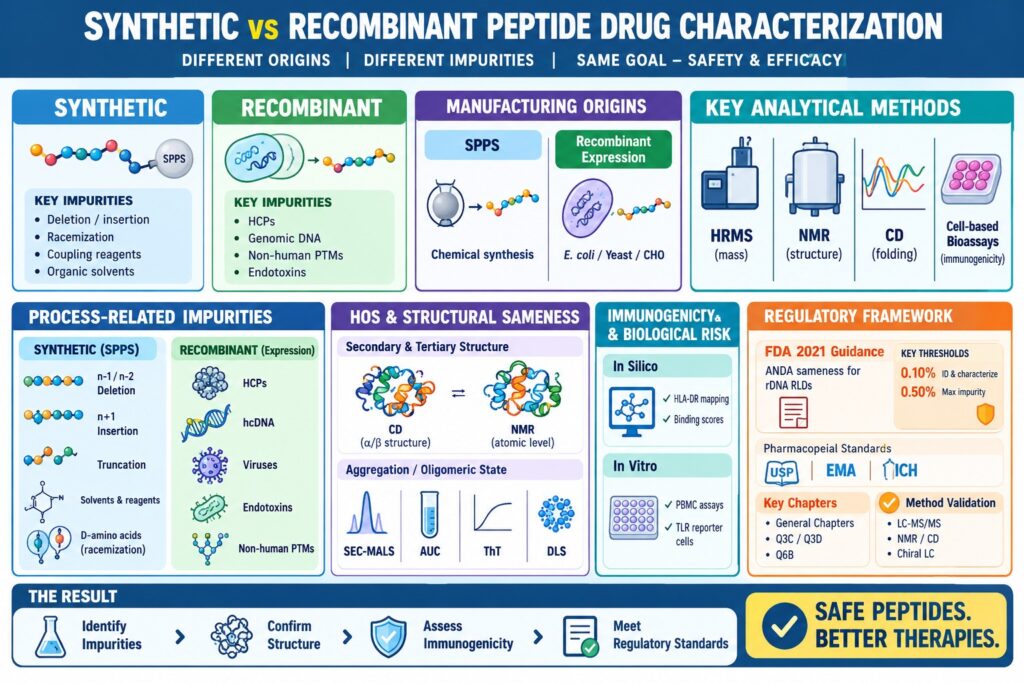
Manufacturing Origins and Analytical Impact on Synthetic vs Recombinant Peptide Drug Characterization
The manufacturing origin determines the fundamental analytical workflow for synthetic vs recombinant peptide drug characterization because chemical solid-phase synthesis produces a distinct set of chemical impurities, while recombinant microbial or cell-culture expression can introduce biological host-derived contaminants. Consequently, synthetic peptide characterization relies extensively on chiral chromatography, organic solvent profiling, and mass spectrometry for chemical sequence variants, whereas recombinant characterization requires biological immunoassays, host cell protein proteomics, and nucleic acid detection.
| Characterization Attribute | Synthetic Peptide Drugs | Recombinant Peptide Drugs | Primary Analytical Modalities |
|---|---|---|---|
| Primary Assembly Mechanism | Solid-Phase Peptide Synthesis (SPPS) or Liquid-Phase Chemical Coupling | Recombinant DNA Expression (E. coli, S. cerevisiae, CHO cells) | High-Resolution Mass Spectrometry (HRMS), Amino Acid Analysis (AAA) |
| Process-Related Impurity Matrix | Deletion, insertion, truncated sequences, residual coupling reagents, organic solvents (DMF, DCM) | Host Cell Proteins (HCPs), Host Cell DNA (hcDNA), viral contaminants, culture media additives | LC-MS/MS Shotgun Proteomics, qPCR, ELISA, Headspace GC-MS |
| Stereochemical Integrity & Chiral Purity | Risk of D-amino acid racemization during amino acid coupling/deprotection cycles | High enzymatic fidelity maintaining L-amino acid configurations exclusively | Chiral LC-MS, Marfey’s Reagent (FDAA) Derivatization |
| Post-Translational Modifications (PTMs) | Chemical modifications deliberately engineered (e.g., C-terminal amidation, fatty acid conjugation) | Biological PTMs (heterogeneous N/C-terminal processing, phosphorylation, oxidation, glycosylation) | HRMS Peptide Mapping, Top-Down/Bottom-Up Tandem MS |
| Higher-Order Structure (HOS) Verification | Requires confirmation of folding equivalency to native/rDNA bioconformation | Inherently folded by host cell machinery or optimized in vitro refolding operations | Far/Near-UV Circular Dichroism, 2D 1H-15N / 13C HSQC NMR |
| Regulatory Submission Pathway | ANDA (505(j)) pathway eligible for synthetic generics referencing rDNA RLDs | New Drug Application (NDA 505(b)(1)/(2)) or Biologics License Application (BLA) | Comprehensive API Sameness and Impurity Profiling Dossier |
Solid-phase peptide synthesis builds peptide chains sequentially from the C-terminus to the N-terminus while anchoring them to a polymeric resin bead. Each amino acid addition involves four repetitive steps: deprotection of the N-alpha protecting group (such as Fmoc or Boc), coupling of the next activated amino acid, solvent washing, and capping of unreacted chains. For a 30-to-40-residue peptide, this process requires more than 100 sequential chemical reactions. Incomplete coupling reactions generate deletion sequences missing one or more residues (n-1, n-2), incomplete deprotection can produce side-chain protecting group adducts, and capping failures can permit the formation of truncated fragments. Repeated exposure to basic deprotection reagents (e.g., piperidine) and activating chemicals can induce α-carbon racemization, converting natural L-amino acids into D-amino acid enantiomeric impurities.
Recombinant peptide production uses genetically engineered expression vectors introduced into host organisms such as bacteria or yeast. Biological translation relies on host cell ribosomal machinery, which maintains strict stereochemical fidelity for L-amino acids. However, biological expression systems introduce cellular complexity, including residual host cell proteins (HCPs), host cell genomic DNA, viral contaminants, and bacterial endotoxins. Recombinant peptides are also subject to enzymatic processing variations, including incomplete N-terminal methionine cleavage, signal peptide cleavage heterogeneity, and post-translational modifications (PTMs) such as phosphorylation or non-human glycosylation patterns.
Impurity Profile Divergence in Synthetic vs Recombinant Peptide Drug Characterization
Impurity profile characterization differs substantially between synthetic and recombinant peptides because the underlying pathways of chemical degradation and biological expression are fundamentally different. Synthetic peptide characterization focuses primarily on peptide-related deletion, insertion, and enantiomeric variants, together with organic solvents, whereas recombinant peptide characterization emphasizes host cell proteins, host cell DNA, endotoxins, and enzymatic PTM variants.
Chemical Process Impurities and Stereochemical Integrity in Synthetic Peptides
Synthetic peptide impurity profiling focuses on peptide-related impurities generated by incomplete chemical transformations or chemical degradation during synthesis and storage. These chemical impurities include:
- Deletion Sequences (n-1, n-2): Peptides that lack one or more amino acid residues because of incomplete coupling steps during solid-phase synthesis.
- Insertion Sequences (n+1): Peptides containing additional amino acid residues that may result from premature deprotection or instability of amino acid reagents.
- Truncated Sequences: Shortened peptide chains that terminate prematurely because of chemical capping reagents used during synthesis cycles.
- Chemical Degradation Variants: Modified sequences generated through methionine, cysteine, or tryptophan oxidation; asparagine or glutamine deamidation; and N-terminal pyroglutamate formation.
- Enantiomeric/Epimeric Impurities: Diastereomeric variants produced by α-carbon racemization during coupling reactions. Because epimers have identical molecular weights and similar chromatographic behavior to the target API, standard RP-HPLC may not adequately resolve them. Identification and quantification of chiral impurities therefore require advanced derivatization approaches, such as Marfey’s reagent / FDAA, or specialized chiral LC-MS/MS strategies.
Read more about chiral analysis of therapeutic peptide APIs for a deeper look at stereochemical purity assessment.
Non-peptide chemical impurities must also be quantified. Solvents used during synthesis and cleavage—including N,N-dimethylformamide (DMF), dichloromethane (DCM), piperidine, and trifluoroacetic acid (TFA)—are quantified using Headspace Gas Chromatography-Mass Spectrometry (HS-GC-MS) under ICH Q3C guidelines. Residual heavy metals and elemental impurities originating from synthetic catalysts or resin reagents are evaluated using Inductively Coupled Plasma Mass Spectrometry (ICP-MS) in accordance with ICH Q3D and USP standards. In addition, risk assessments must consider potential nitrosamine impurities introduced through secondary amine reagents, requiring specialized UHPLC-MS/MS detection methodologies.
Host Cell Contaminants and Biological Variants in Recombinant Peptides
Recombinant peptide characterization classifies impurities into product-related variants and host cell process-related contaminants. Process-related impurities originate from the biological expression host and cell culture media. Key biological impurities include:
- Host Cell Proteins (HCPs): Complex mixtures of endogenous proteins that are secreted or released following cell lysis. Residual HCPs may present immunogenicity risks, requiring bottom-up LC-MS/MS shotgun proteomics for individual protein identification along with high-sensitivity ELISA for overall content quantification.
- Host Cell DNA (hcDNA): Residual genomic DNA fragments originating from the expression host, quantified using quantitative Polymerase Chain Reaction (qPCR) to ensure that levels remain below applicable regulatory safety thresholds.
- Bacterial Endotoxins: Lipopolysaccharides derived from the outer membranes of Gram-negative host cells (E. coli), monitored using Limulus Amebocyte Lysate (LAL) assays under USP standards.
Product-related variants in recombinant peptides can arise from cellular metabolic processes or downstream isolation. These variants include N-terminal forms (e.g., retained N-formylmethionine or incomplete signal peptide cleavage), C-terminal enzymatic truncations, differential disulfide bond scrambling, and post-translational modifications (e.g., phosphorylation or heterogeneous glycosylation).
Regulatory Thresholds and API Sameness Frameworks
The FDA 2021 guidance ANDAs for Certain Highly Purified Synthetic Peptide Drug Products That Refer to Listed Drugs of rDNA Origin establishes rigorous analytical expectations for demonstrating impurity equivalence. Under this framework, a generic synthetic peptide referencing a recombinant RLD, such as semaglutide, liraglutide, teriparatide, glucagon, or eptifibatide, must satisfy defined impurity thresholds:
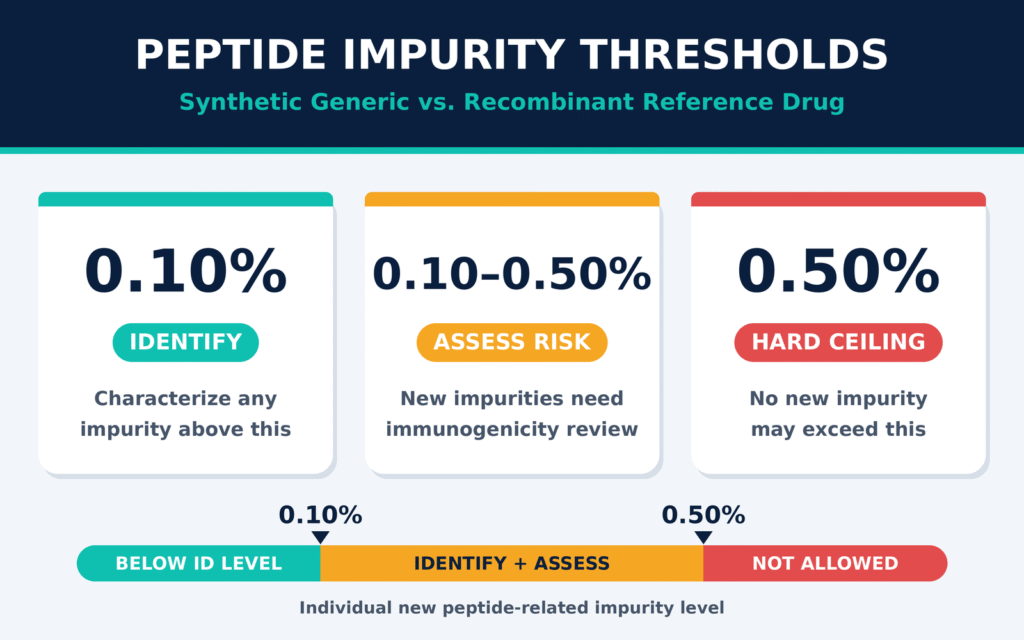
- 0.10% Identification Threshold: Any individual peptide-related impurity present at greater than 0.10% of the active ingredient must be structurally identified and characterized using HRMS and tandem MS.
- 0.50% Impurity Qualification Ceiling: No individual new peptide-related impurity in the generic synthetic peptide product may exceed 0.50%.
- Comparative Profile Requirement: Any new impurity present between 0.10% and 0.50% that is not present in the recombinant RLD must undergo a formal immunogenicity risk assessment to demonstrate that it does not increase the risk of an immune response relative to the RLD.
Explore our GLP-1 peptide impurity characterization resources for analytical approaches to identifying and evaluating peptide-related impurities.
Higher-Order Structure (HOS) and Conformational Sameness Evaluation
Higher-order structure (HOS) characterization evaluates the secondary and tertiary conformational folding of a peptide drug to determine whether a generic synthetic peptide adopts a three-dimensional architecture equivalent to that of its recombinant reference listed drug. Differences in spatial conformation can influence receptor binding affinity or promote immunogenic aggregate formation, making structural sameness verification an important component of regulatory evaluation.
Spectroscopic Profiling of Secondary and Tertiary Structure
Peptides depend on defined three-dimensional conformations to bind target receptors and exert pharmacological activity. Changes in spatial folding can affect biological potency or expose hydrophobic surfaces that promote rapid aggregation.
Far-UV Circular Dichroism (CD) spectrophotometry (190 nm to 250 nm) evaluates secondary structural elements, including α-helices, β-sheets, turns, and random coils, by measuring the differential absorption of left- and right-circularly polarized light by peptide bonds. Near-UV CD spectrophotometry (260 nm to 350 nm) evaluates tertiary structural environments surrounding aromatic residues (Phenylalanine, Tyrosine, Tryptophan) and disulfide bonds.
Learn more about CD spectroscopy for peptide secondary structure characterization and its role in evaluating peptide conformational properties.
For atomic-level spatial confirmation, multidimensional Nuclear Magnetic Resonance (NMR) spectroscopy provides detailed structural evaluation. Solution-state 2D 1H-15N and 1H-13C Heteronuclear Single Quantum Coherence (HSQC) NMR experiments generate structural fingerprints. By overlaying HSQC spectra from synthetic peptide batches with those of the recombinant RLD, scientists can evaluate chemical shift profiles and establish backbone conformational equivalency at atomic resolution.
See how 2D NMR is used for peptide characterization to obtain detailed structural information at the molecular level.
Aggregation and Oligomeric State Profiling
Self-association and aggregation represent important safety considerations for therapeutic peptides. Covalent and non-covalent aggregates may enhance immunogenicity by cross-linking B-cell receptors. Demonstrating comparable aggregation propensities between synthetic peptides and recombinant RLDs requires an orthogonal testing array:
- Size Exclusion Chromatography with Multi-Angle Light Scattering (SEC-MALS): Measures absolute molecular weight distributions in solution, separating monomeric species from soluble dimers and higher-order oligomers without depending on column calibration standards.
- Analytical Ultracentrifugation (AUC): Sedimentation velocity AUC evaluates macromolecular transport under high gravitational fields and can detect sub-visible aggregates and high-molecular-weight complexes across a broad size range.
- Thioflavin-T (ThT) Fluorescence Assays: ThT dye specifically intercalates into cross-β-sheet fibril structures, providing a quantitative measure of sub-microscopic amyloid formation.
- Dynamic Light Scattering (DLS): Evaluates hydrodynamic translational diffusion coefficients and tracks changes in particle size distribution during thermal and mechanical stress testing.
Explore our peptide aggregation analysis resources for methods used to assess aggregation and oligomeric behavior.
Immunogenicity and Biological Risk Assessment Frameworks
Immunogenicity characterization evaluates whether process-related impurities or structural variants can elicit unwanted adaptive or innate immune responses in humans. For synthetic peptides referencing recombinant RLDs, immunogenicity evaluation combines computational in silico HLA-DR epitope mapping with in vitro cell-based activation assays.
In Silico Predictive Modeling
The adaptive immune response to peptide therapeutics is driven by Major Histocompatibility Complex Class II (MHC Class II / HLA-DR) presentation on antigen-presenting cells to helper T cells. When a synthetic peptide introduces a novel impurity, such as a single residue deletion or insertion present between 0.10% and 0.50%, the altered amino acid sequence can shift downstream 9-mer binding frames. This frame shift may generate a high-affinity HLA-DR binding motif, referred to as an EpiBar, that is absent from the recombinant RLD.
In silico predictive algorithms calculate binding affinities across global HLA-DR supertypes. By entering the sequences of the API, RLD, and isolated synthetic impurities, these computational models generate cumulative binding scores. If an impurity’s predicted binding score does not exceed that of the reference sequence, the immunogenic risk is categorized as low.
In Vitro Innate and Adaptive Immune Assays
Because in silico models have limitations when evaluating non-canonical or unnatural amino acids and modified backbones, biological testing is required to support safety assessment. Adaptive immunogenicity is evaluated using human Peripheral Blood Mononuclear Cell (PBMC) assays derived from donor panels representing diverse HLA haplotypes. PBMCs are exposed to isolated peptide impurities, and T-cell activation is quantified through 3H-thymidine incorporation or ELISpot measurements of cytokine secretion (e.g., IL-2, IFN-γ).
Innate immune response impurities (IIRIs)—including trace bacterial endotoxins, host cell nucleic acids, flagellin, or synthetic chemical reagents—are screened using cell-based reporter assays. Transfected cell lines, such as RAW-Blue or HEK-Blue reporter cells expressing human Toll-Like Receptors (TLRs), quantify NF-κB pathway activation, helping verify that the generic synthetic formulation does not contain pro-inflammatory contaminants.
Regulatory Pharmacopeial Frameworks and Method Validation
Regulatory compliance for peptide drug characterization requires adherence to pharmacopeial standards established by the United States Pharmacopeia (USP), European Medicines Agency (EMA), and International Council for Harmonisation (ICH) guidelines. These standards establish validated testing methodologies designed to ensure batch-to-batch consistency, purity, identity, and potency throughout development and release phases.
| Regulatory / Pharmacopeial Chapter | Primary Scope & Objective | Key Analytical Modalities Applied |
|---|---|---|
| FDA 2021 Synthetic Peptide Guidance | Defines ANDA sameness criteria for generic synthetic peptides referencing recombinant RLDs | HRMS, CD, NMR, Bioassays, In Silico Immunogenicity |
| USP General Chapter | Guidelines for biotechnology-derived articles and peptide mapping | LC-MS/MS, Specific Enzymatic Cleavage, Mass Fingerprinting |
| USP General Chapter | Characterization of amino acid composition and total molar ratios | Acid Hydrolysis, Derivative RP-HPLC/UPLC Detection |
| USP General Chapter | Quantitative determination of total protein/peptide content | UV Spectrophotometry, Nitrogen Analysis, Colorimetric Assays |
| ICH Q6B Guidelines | Specifications for biotechnological and biological drug substances | Physicochemical Profiling, HOS, Purity, Potency Testing |
| ICH Q3C / Q3D Guidelines | Standards for residual solvents (Q3C) and elemental impurities (Q3D) | Headspace GC-MS (Q3C), ICP-MS (Q3D / USP standards) |
Executing characterization programs under these standards requires validated methods and high-resolution analytical instrumentation. Contract characterization laboratories such as ResolveMass Laboratories Inc. implement these pharmacopeial standards using orthogonal analytical pipelines—including LC-MS/MS, high-field NMR, circular dichroism, and chiral chromatography—to provide regulatory-grade documentation for pre-IND filings, generic ANDA submissions, and commercial release.
Review our peptide characterization CRO deliverables checklist to understand the analytical documentation and data package commonly expected from a characterization program.
Conclusion: Mastering Synthetic vs Recombinant Peptide Drug Characterization
Comprehensive synthetic vs recombinant peptide drug characterization requires a tailored analytical approach that directly reflects the unique chemical or biological manufacturing origin of the active pharmaceutical ingredient. By deploying validated orthogonal platforms to quantify impurities, confirm higher-order structural sameness, and assess immunogenicity risk, pharmaceutical developers can support regulatory compliance and product safety.
Understanding the structural and impurity differences between solid-phase chemical synthesis and cell-culture recombinant expression enables drug developers to design robust analytical control strategies. Partnering with experienced analytical testing laboratories can streamline regulatory processes by supporting the FDA, EMA, and Health Canada requirements for API sameness and impurity characterization. To discuss your peptide characterization, impurity profiling, or API sameness testing requirements with technical experts, visit the ResolveMass Laboratories Inc. Contact Us Page.
Frequently Asked Questions
The FDA allows certain synthetic generic peptides to reference recombinant RLDs when analytical evidence can adequately demonstrate API sameness. This evaluation may include confirmation of the primary sequence, higher-order structure, impurity profile, and immunogenicity-related characteristics. Advanced analytical technologies make it possible to compare these attributes in a comprehensive manner.
Under the FDA framework for certain synthetic peptides, peptide-related impurities present above 0.10% of the active pharmaceutical ingredient require structural identification and characterization. Analytical methods such as high-resolution mass spectrometry (HRMS) and tandem mass spectrometry are commonly used to determine the identity and properties of these impurities. This approach supports a detailed understanding of product quality.
Stereochemical impurities, including D-amino acid variants, are evaluated using specialized analytical techniques designed to separate molecules with different spatial configurations. Chiral LC-MS and derivatization approaches using Marfey’s reagent (FDAA) are commonly applied to distinguish epimeric forms. These methods help identify and characterize stereochemical variants that may not be resolved by conventional chromatography.
Higher-Order Structure (HOS) is evaluated using a combination of spectroscopic and biophysical methods. Far-UV Circular Dichroism (CD) is used to assess secondary structure, while Near-UV CD and 2D HSQC NMR provide information about tertiary conformation. Additional techniques, such as SEC-MALS and Analytical Ultracentrifugation (AUC), are used to evaluate aggregation behavior and oligomeric states.
Process-related impurities differ according to the manufacturing platform used to produce the peptide. Synthetic processes may introduce residual organic solvents, reaction reagents, and elemental impurities, whereas recombinant systems can contain Host Cell Proteins (HCPs), Host Cell DNA, viral contaminants, and endotoxins. These differences require distinct analytical approaches for impurity detection and control.
In silico HLA binding models are used to evaluate whether peptide variants or impurities have the potential to interact with MHC Class II (HLA-DR) molecules. These computational tools compare predicted binding profiles between impurities and the reference sequence. Such assessments can provide supportive information when evaluating immunogenicity-related risks.
Several USP general chapters are relevant to therapeutic peptide characterization, depending on the analytical objective. These chapters address areas such as peptide mapping, sequence verification, amino acid composition analysis, and total protein or peptide content determination. The specific chapters applied depend on the product type and the intended characterization strategy.
Comparative characterization is frequently performed for therapeutic peptides such as semaglutide, liraglutide, teriparatide, glucagon, eptifibatide, and bivalirudin. These evaluations are conducted to assess structural attributes, impurity profiles, and analytical comparability. The exact testing program is determined by product complexity and regulatory requirements.
Host Cell Proteins (HCPs) are characterized using multiple analytical methods to ensure comprehensive evaluation. High-sensitivity ELISA is commonly used to determine total HCP content, while bottom-up LC-MS/MS shotgun proteomics can identify individual protein species. These complementary techniques support the assessment of biological impurities in recombinant peptide products.
Reference:
- U.S. Food and Drug Administration. (2025). Fiscal year 2025 generic drug science and research initiatives public workshop: Session 1—Assessment challenges with complex active ingredients: Peptides & oligonucleotides [Transcript]. https://www.fda.gov/media/188041/download
- Giri, T., Sakharwade, S., Subbappa, P., Chinnakadoori, S. R., & Sharma, N. (2025). Regulatory considerations in synthetic peptide characterization: Techniques and compliance. Separation Science Plus, 8(6), e70057. https://doi.org/10.1002/sscp.70057
- De Groot, A. S., Mattei, A., Gabriel, B., Calderini, J., Roberts, B. J., Lelias, S., McAllister, M., Boyle, C., Martin, W., & Richard, G. (2025). Immunogenicity of generic peptide impurities: Current orthogonal approaches. Pharmaceutical Research, 42(5), 805–818. https://doi.org/10.1007/s11095-025-03843-1
- PL BioScience GmbH, & Stemmatters Biotecnologia E Medicina Regenerativa SA. (2025). Stable human platelet lysate composition, methods and uses thereof (European Patent No. EP4522196A1). European Patent Office. https://patents.google.com/patent/EP4522196A1/en
Get In Touch With Us
About The Author


