

Introduction:
Therapeutic peptide characterization for NDA and ANDA submissions sits at the intersection of analytical chemistry and regulatory strategy, and getting the guidance wrong at the outset can cost a sponsor months of rework. Peptides are neither small molecules nor full biologics, which means they don’t fit neatly into either regulatory playbook — FDA has had to build peptide-specific expectations on top of general drug and quality guidance to close that gap. For a CRO/CDMO like ResolveMass Laboratories, translating these overlapping frameworks into a workable analytical plan is a routine part of supporting sponsors through both the 505(b) NDA pathway and the ANDA generic pathway.
This article lays out the specific guidance documents that apply, how expectations differ between NDA and ANDA filings, and what a characterization package actually needs to contain to survive FDA and Health Canada review.
Summary:
- Therapeutic peptide characterization for NDA and ANDA submissions is governed by a mix of FDA peptide-specific guidance, ICH quality guidelines (Q6B, Q3A/B, Q11), and CTD Module 3 documentation standards.
- Synthetic peptide ANDAs follow FDA’s 2021 “highly purified synthetic peptide” guidance, which allows a generic pathway for select peptides (e.g., glucagon, liraglutide, teriparatide) if primary and higher-order structure, impurity profile, and aggregation state match the reference listed drug.
- NDA submissions for novel peptides require full structural elucidation and stability-indicating method validation under ICH Q6B, without a “sameness” comparison to an existing product.
- Health Canada applies parallel expectations through its own guidance and the ICH-harmonized CTD format, which matters for sponsors running cross-border US/Canada programs.
- A defensible characterization package typically includes amino acid sequence confirmation, higher-order structure (HOS) data, impurity and degradant profiling, and orthogonal analytical methods — assembled early enough to support both scientific and regulatory review.
1: Which Regulatory Pathway Applies to a Given Peptide?
The regulatory pathway for a therapeutic peptide depends on whether it is a novel molecule or a generic version of an already-approved product, not on its size or chemistry alone. Novel peptides — new sequences, new indications, or peptides without an existing reference listed drug (RLD) — go through the NDA pathway under Section 505(b)(1) or 505(b)(2). Peptides that copy an already-approved synthetic peptide drug can, in specific cases, go through the ANDA pathway under Section 505(j).
The distinction matters because it changes the entire analytical burden:
- NDA route: Full characterization is required to establish identity, purity, and quality from first principles — there is no existing benchmark to compare against.
- ANDA route: Characterization is comparative. The applicant must demonstrate that the generic peptide is the “same” as the RLD across sequence, impurities, and physicochemical properties.
2: What Is the Core FDA Guidance for Synthetic Peptide ANDAs?
FDA’s central guidance for peptide ANDAs is “ANDAs for Certain Highly Purified Synthetic Peptide Drug Products That Refer to Listed Drugs of rDNA Origin” (finalized May 2021), which lists eligible peptides and defines the analytical sameness standard generics must meet. It currently applies to a defined list of peptides — including glucagon, liraglutide, nafarelin, and teriparatide — that were originally approved as rDNA-derived biologics but can be legally replicated as synthetic peptides through the ANDA pathway.
Under this guidance, an ANDA sponsor must show:
| Requirement | What FDA Expects |
|---|---|
| Primary structure | Confirmed amino acid sequence identical to the RLD |
| Higher-order structure (HOS) | Comparable secondary/tertiary structure using orthogonal methods |
| Impurities | Comparable impurity profile, including process- and degradation-related impurities |
| Aggregates and particulates | Comparable levels of aggregation and sub-visible/visible particulates |
| Physicochemical properties | Comparable pharmaceutical properties (e.g., solubility, pH stability) |
Peptides outside this specific list, or peptides that were never approved as rDNA-origin biologics, generally cannot use this ANDA pathway and default to the 505(b)(2) NDA route instead.
3: What Guidance Governs Peptide Characterization in an NDA?
For novel peptide NDAs, characterization is governed primarily by ICH Q6B (“Specifications: Test Procedures and Acceptance Criteria for Biotechnological/Biological Products”), which FDA applies to peptides even though they are chemically synthesized, because the structural complexity resembles biologics more than small molecules. ICH Q6B sets the expectation for a battery of orthogonal methods covering identity, purity, potency, and impurities — not a single confirmatory test.
Supporting guidance that applies alongside Q6B includes:
- ICH Q3A(R2) / Q3B(R2) — impurity qualification thresholds, adapted for peptide-related impurities and degradants
- ICH Q1A(R2) — stability testing design for the stability-indicating methods peptides require
- ICH M4Q (CTD Module 3) — the format in which all characterization, specification, and stability data must be organized for submission
- USP General Chapters (e.g., <129>, <1057>, <1086>) — where a compendial peptide monograph exists, informing acceptable methods and specifications
Because NDA peptides have no RLD to compare against, the burden shifts toward demonstrating that the analytical package itself is scientifically sound — validated, stability-indicating, and capable of detecting product-related variants the sponsor may not yet know exist.
4: What Analytical Techniques Satisfy These Guidance Requirements?
No single analytical technique satisfies FDA or ICH expectations for peptide characterization on its own — reviewers expect an orthogonal set of methods that cross-confirm identity, purity, and structure. A typical package combines the following:
| Analytical Method | What It Confirms |
|---|---|
| Peptide mapping (LC-MS/MS) | Primary sequence, site-specific modifications |
| High-resolution mass spectrometry | Molecular mass, sequence variants, PTMs |
| Circular dichroism (CD) | Secondary structure (higher-order structure) |
| RP-HPLC / UHPLC | Purity, related substances, degradation products |
| Size-exclusion chromatography (SEC) | Aggregation state |
| Capillary electrophoresis | Charge variants, impurity resolution |
| Amino acid analysis | Quantitative composition confirmation |
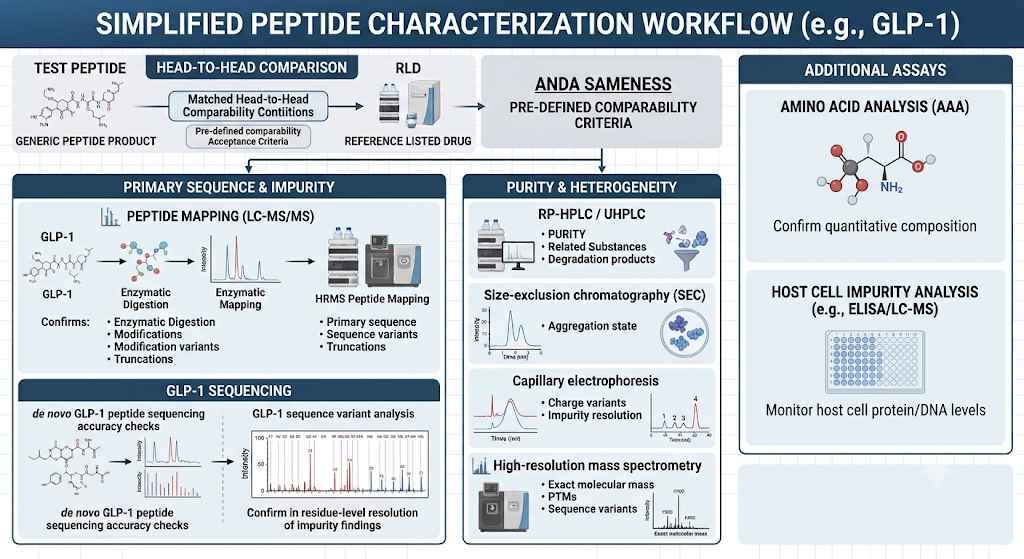
For ANDA sameness demonstrations, these same techniques are run head-to-head against the RLD under matched conditions, with pre-defined comparability acceptance criteria rather than open-ended specification-setting.
Peptide Sequencing and Mapping in Practice
Confirming primary structure is not a single test — it’s a sequencing and mapping workflow that has to hold up to regulatory scrutiny on its own. Peptide mapping of GLP-1 peptides typically starts with GLP-1 enzymatic digestion mapping to generate fragment-level coverage, followed by HRMS peptide mapping for GLP-1 to assign each fragment against the expected sequence. For sponsors comparing GLP-1 peptide mapping vs. intact mass approaches, mapping gives residue-level resolution that intact mass alone cannot, which matters directly for detecting the kind of GLP-1 impurity peptide mapping findings that regulators expect to see addressed in an impurity profile.
Beyond peptide mapping, full sequence confirmation often calls for de novo GLP-1 peptide sequencing accuracy checks and GLP-1 sequence variant analysis to catch truncations, deamidation, or synthesis-related variants before they surface as unexplained impurities later in development.
Higher-Order and Advanced Structural Techniques
Beyond mapping and sequencing, sponsors increasingly rely on native mass spectrometry for therapeutic peptide characterization to assess conformation and non-covalent interactions without disrupting higher-order structure, and on Multi-Attribute Method (MAM) for peptide characterization to monitor multiple quality attributes from a single LC-MS run rather than a series of separate assays. Peptides with non-linear backbones add another layer of complexity — cyclic peptide characterization requires ring-opening or alternative fragmentation strategies that standard linear-peptide mapping workflows aren’t built for.
5: How Does Health Canada Guidance Compare for Cross-Border Programs?
Health Canada applies analytical expectations that closely mirror FDA’s, structured around the same ICH-harmonized CTD Module 3 format, but sponsors running parallel US/Canada submissions still need to reconcile country-specific reference product and labeling requirements. For sponsors filing an NDA and a Canadian New Drug Submission (NDS) — or an ANDA and an Abbreviated New Drug Submission (ANDS) — in parallel, a single well-designed characterization study can often generate data usable in both dossiers, provided the study design accounts for both agencies’ specification and comparator expectations from the start.
6: GLP-1 Peptides as a Regulatory Characterization Case Example
GLP-1 receptor agonists are one of the clearest illustrations of how demanding peptide characterization has become, precisely because of how much regulatory and analytical activity now surrounds this class. The regulatory requirements for GLP-1 peptide characterization mirror the broader NDA/ANDA framework described above, but sponsors filing on GLP-1 analogs face additional scrutiny because of the class’s complex secondary modifications (fatty-acid acylation, PEGylation in some analogs) and its commercial profile.
A representative GLP-1 analytical package typically includes:
- Peptide sequencing of GLP-1 peptides and peptide sequencing of GLP-1 drugs to confirm primary structure across the intact analog and any acylated variant
- LC-MS characterization of GLP-1 peptides and broader analytical characterization of GLP-1 peptide drugs for identity, purity, and related-substance testing
- GLP-1 peptide impurity characterization and GLP-1 peptide impurity sequencing analysis to resolve process- and degradation-related impurities down to the sequence level
- GLP-1 peptide stability analytical methods to support stability-indicating specifications required under ICH Q1A(R2)
For sponsors working with a well-characterized analog such as semaglutide, semaglutide peptide mapping illustrates how mapping data is used to confirm sequence integrity and detect site-specific modifications across a fatty-acid-conjugated GLP-1 backbone — a workflow that generalizes to other acylated peptides in the class.
Given the volume of GLP-1 development activity, sponsors frequently work through a GLP-1 peptide characterization regulatory requirements review early, and many choose to outsource GLP-1 peptide sequencing services to a specialized CRO for GLP-1 peptide characterization rather than build this capability in-house, given the GLP-1 peptide sequencing challenges around fatty-acid side-chain analysis and low-abundance impurity detection. A defined GLP-1 analog peptide sequencing workflow, paired with the right GLP-1 peptide sequencing analytical technique for each attribute, is what ultimately keeps a submission on schedule. Sponsors evaluating partners for this work can also review dedicated GLP-1 peptide sequencing CRO services to understand what a complete scope of work should include.
7: Choosing the Right CRO Partner for Peptide Characterization
Most sponsors outsource peptide characterization rather than build the full orthogonal method set in-house, which makes CRO selection itself a regulatory risk-management decision. Before issuing an RFP, it helps to work from a peptide characterization CRO deliverables checklist so the scope of work maps directly to what FDA or Health Canada will expect in the final dossier, and to understand the specifications to provide when outsourcing peptide characterization so the CRO can scope methods correctly from the first quote.
The right analytical partner should be able to support a program from early development through submission — including peptide characterization CRO services for IND submission — so that method development, validation, and specification-setting stay consistent as the program advances toward an NDA or ANDA filing. ResolveMass’s broader peptide characterization services are built around this full-lifecycle approach.
8: What Are Common Pitfalls in Peptide Characterization Packages?
The most common reason peptide NDA and ANDA submissions face analytical deficiencies is an incomplete or non-orthogonal method set rather than a single failed test. Recurring issues include:
- Relying on a single technique (e.g., HPLC purity alone) without HOS or aggregation data
- Under-characterizing process-related impurities specific to solid-phase peptide synthesis
- Stability methods that aren’t demonstrably stability-indicating
- ANDA comparability studies run against mismatched RLD lots or under non-equivalent conditions
- CTD Module 3 documentation that doesn’t clearly map data back to specification justification
9: How ResolveMass Supports NDA and ANDA Peptide Programs
ResolveMass Laboratories works with sponsors on both sides of the peptide regulatory divide — building full characterization packages for novel peptide NDAs and comparative sameness studies for synthetic peptide ANDAs. Our analytical scope covers peptide mapping, high-resolution mass spectrometry, higher-order structure analysis, impurity and degradant profiling, and nitrosamine risk assessment, with data organized to map directly into CTD Module 3 for FDA and Health Canada submissions.
Conclusion:
Therapeutic peptide characterization for NDA and ANDA submissions is not governed by a single rulebook — it draws on FDA’s peptide-specific ANDA guidance, ICH Q6B and related quality guidelines, and CTD Module 3 formatting requirements, applied differently depending on whether the filing is a novel NDA or a comparative ANDA. Sponsors who map their analytical strategy to the correct guidance set from the start avoid the deficiency letters and repeat studies that come from an incomplete or mismatched characterization package.
Frequently Asked Questions:
There is no single FDA guidance that governs every aspect of therapeutic peptide characterization.
Sponsors should consider applicable FDA regulations, guidance documents, product-specific guidances (PSGs), and ICH quality guidelines.
The appropriate framework depends on the peptide, manufacturing route, dosage form, and regulatory pathway.
For generic peptides, the latest molecule-specific FDA PSG can be particularly important.
Regulatory expectations should be reviewed using the most current FDA recommendations before submission.
ICH Q6B provides a useful framework for characterization of biological and biotechnological products.
It addresses physicochemical characteristics, biological activity, purity, and impurities.
For peptides within its scope, these principles can help structure a comprehensive characterization strategy.
However, applicability should be assessed according to the specific peptide and regulatory classification.
FDA guidance and product-specific requirements should also be considered alongside ICH Q6B.
Peptide mapping provides detailed information about the primary structure and amino acid sequence of a therapeutic peptide.
It can help detect sequence variants, truncations, modifications, and other molecular differences.
When combined with LC-MS/MS, peptide mapping can provide highly specific structural evidence.
For ANDA development, it can also support comparison between the proposed product and the reference product.
This makes peptide mapping an important component of many regulatory characterization programs.
Therapeutic peptide impurity evaluation can include deletion sequences, truncations, sequence variants, and degradation products.
Oxidized, deamidated, epimerized, or otherwise modified peptide species may also require investigation.
Manufacturing-related impurities can include residual reagents, solvents, and process-related substances.
Aggregates and other higher-molecular-weight species may also need evaluation.
The final impurity strategy should be based on product-specific risks and regulatory expectations.
Reference
- Wu L. Regulatory considerations for peptide therapeutics.https://books.rsc.org/books/edited-volume/801/chapter/540098
- Rastogi S, Shukla S, Kalaivani M, Singh GN. Peptide-based therapeutics: quality specifications, regulatory considerations, and prospects. Drug Discovery Today. 2019 Jan 1;24(1):148-62.https://www.sciencedirect.com/science/article/pii/S1359644618302514
- Patel S, Patel Y, Adodariya M, Shahiwala A, Mehta P. Regulatory guidance on therapeutic proteomics and genomics. InChallenges in Delivery of Therapeutic Genomics and Proteomics 2025 Jan 1 (pp. 555-585). Academic Press.https://www.sciencedirect.com/science/chapter/edited-volume/pii/B9780443274169000034
- Giri T, Sakharwade S, Subbappa P, Chinnakadoori SR, Sharma N. Regulatory considerations in synthetic peptide characterization: Techniques and compliance. Separation Science Plus. 2025 Jun;8(6):e70057.https://analyticalsciencejournals.onlinelibrary.wiley.com/doi/abs/10.1002/sscp.70057
- Mitra MS, DeMarco S, Holub B, Thiruneelakantapillai L, Thackaberry EA. Development of peptide therapeutics: A nonclinical safety assessment perspective. Regulatory Toxicology and Pharmacology. 2020 Nov 1;117:104766.https://www.sciencedirect.com/science/article/pii/S0273230020301926
- Darji P. What Purity Specification Is Acceptable for a Therapeutic Peptide API in an ANDA or NDA Submission?.https://resolvemass.ca/therapeutic-peptide-api-purity-specification
About the Author


