

Introduction: The Most Overlooked Challenge in E&L Science
Unknown Peak Identification in Extractables and Leachables (E&L) testing is among the most technically challenging aspects of pharmaceutical packaging science. Despite its importance, it is often handled inadequately because many investigations lack a systematic and scientifically robust approach.
No matter how carefully an E&L study is designed, unknown peaks will inevitably appear. These peaks may emerge in GC-MS total ion chromatograms, LC-MS base peak chromatograms, or ICP-MS elemental profiles. The chemical species responsible for these signals may range from harmless residual solvents and recognized antioxidant degradation products to potentially genotoxic impurities with serious implications for patient safety. Regardless of the source, the analytical concern remains the same: an unidentified chemical entity requiring thorough investigation.
What differentiates a scientifically defensible E&L submission from one that faces regulatory scrutiny is not the absence of unknown peaks, but the rigor and quality of the investigative process used after those peaks are detected. This article provides a comprehensive, step-by-step framework intended for analytical scientists, regulatory chemists, and E&L study leaders who require a structured methodology for investigating unknown peaks effectively.
To understand the broader regulatory context and how these investigations impact New Drug Applications (NDAs) and Abbreviated New Drug Applications (ANDAs), you can read more about extractables and leachables el testing for drug safety for nda anda submissions.
Share via:
📋 Article Summary — Key Takeaways:
- Investigating unidentified peaks in E&L assessments demands a systematic, multi-stage workflow rather than relying on unsystematic trial-and-error approaches.
- Before beginning any structural interpretation, analysts must first confirm that the detected signal represents a genuine leachable and not an instrument- or laboratory-related artifact.
- Accurate mass measurements, isotope distribution analysis, and MS/MS fragmentation behavior play a central role in proposing and refining possible chemical structures.
- Establishing a clear relationship between extractables data and leachables findings is critical for confirming the likely source of the detected compound.
- The Analytical Evaluation Threshold (AET) serves as the key decision point for prioritizing investigations, and compounds detected below this limit often do not require complete identification.
- The ultimate objective of an unknown peak investigation is a scientifically justified toxicological evaluation, rather than structural characterization alone.
- Frequently encountered sources of unidentified compounds include polymer breakdown products, manufacturing additives, adhesive-related chemicals, and interactions involving secondary packaging materials.
- For regulatory acceptance, a traceable and thoroughly documented investigation process is just as important as the final analytical conclusion itself.
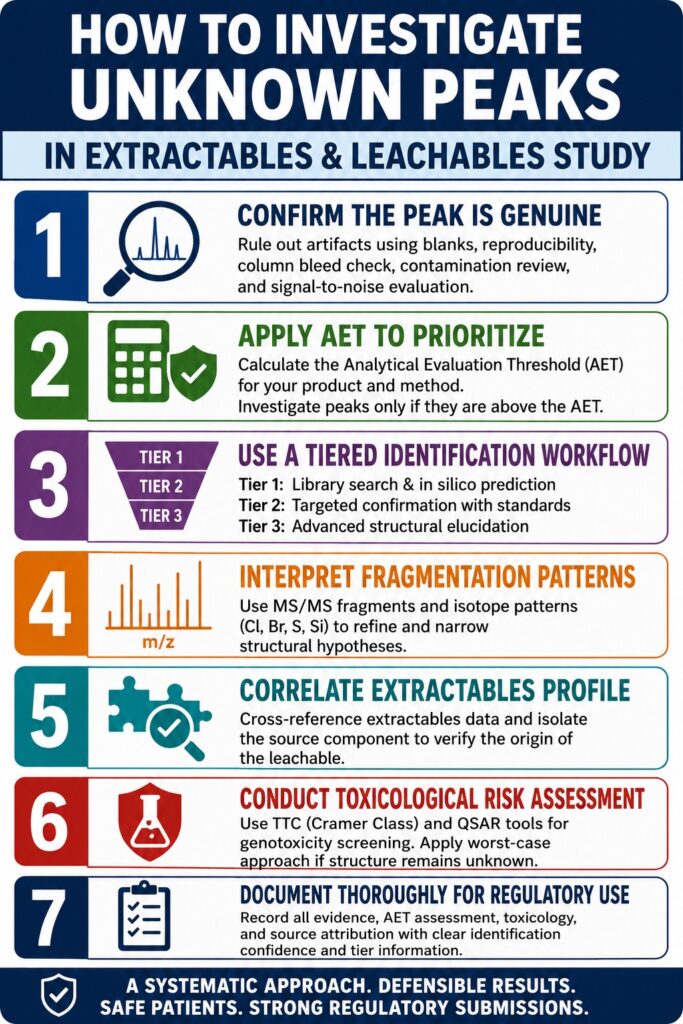
Step 1 — Confirm That the Peak Is Genuine Before Investigating the Chemistry
The first and most important question is not, “What compound is this?” but rather, “Is this peak analytically real?”
A considerable percentage of unknown peaks observed during E&L analysis originate from analytical artifacts rather than true extractables or leachables. These artifacts may arise from instrument contamination, solvent impurities, column bleed, laboratory consumables, or environmental background contamination.
How to Differentiate Real Peaks from Analytical Artifacts
Before assigning chemical relevance to any unknown peak, apply the following verification steps systematically:
- Blank Subtraction
Compare the sample chromatogram against both a solvent blank and a method blank analyzed under identical conditions. Any peak present in the blank should initially be treated as a background contaminant or analytical artifact rather than a true extractable or leachable.
- Reproducibility Assessment
Analyze the same sample extract in triplicate. A legitimate extractable or leachable compound should consistently appear at the same retention time with comparable peak intensity or area. Peaks that appear inconsistently or vary significantly are often associated with carryover, transient contamination, or instrumental noise.
- Column Bleed Evaluation
GC columns, especially under elevated oven temperatures, can release polysiloxane oligomers that produce characteristic ions at m/z 207, 281, and 355. Before initiating structural elucidation, verify whether the unknown signal matches known column bleed profiles.
- Laboratory Plasticizer Contamination
Phthalates, adipates, and phosphate esters are widespread contaminants in analytical laboratories. If the unknown compound elutes within a typical phthalate retention window and exhibits expected MS/MS fragmentation patterns, contamination from gloves, tubing, septa, or sample vials should be considered before implicating the packaging material.
- Signal-to-Noise Ratio Review
Unknown peaks with a signal-to-noise ratio below 10:1 in full-scan acquisition mode should be interpreted cautiously. Only reproducible peaks with reliable and interpretable mass spectra should proceed into the identification workflow.
⚠ Common Pitfall
Attempting structural elucidation on analytical artifacts consumes substantial laboratory resources and can introduce misleading conclusions into regulatory documentation. Eliminating artifacts is not a shortcut; it is an essential scientific requirement.
For a deeper dive into establishing robust experimental designs that minimize these artifacts, explore our overview on resolvemass extractables and leachables testing.
Step 2 — Apply the Analytical Evaluation Threshold (AET) to Prioritize Investigations
Peaks detected below the Analytical Evaluation Threshold (AET) generally do not require complete structural identification. This threshold is a regulatory-accepted decision boundary intended to guide investigative prioritization efficiently.
According to the PQRI 2006 framework and reinforced by draft ICH Q3E guidance, the AET is calculated as a fraction of the Safety Concern Threshold (SCT), commonly one-tenth of the SCT, while accounting for analytical uncertainty.
Correct Calculation and Application of the AET
| Threshold Type | Typical Concentration Level | Regulatory Expectation |
|---|---|---|
| AET (Analytical Evaluation Threshold) | Often 0.1–1.5 µg/day | Peaks below AET generally require identification only if structurally concerning |
| SCT (Safety Concern Threshold) | 1.5 µg/day (parenteral/inhalation) to 150 µg/day (oral) | Peaks above SCT require toxicological assessment |
| Qualification Threshold (QT) | Route-dependent per draft ICH Q3E | Structural identification and qualification required |
| Reporting Threshold | Method- and laboratory-specific | Peaks are reported; concentration determines next actions |
The AET is not a universal fixed value. It must be calculated individually for:
- Each drug product
- Each route of administration
- Each dosage regimen
- Each analytical technique used, including GC-MS, LC-MS, and ICP-MS
Applying a generic AET across multiple products or analytical methods is a common deficiency observed during regulatory review.
🔬 Expert Insight
Inhalation and parenteral products typically require substantially lower AET values than oral dosage forms. As a result, significantly more unknown peaks exceed the evaluation threshold in these product categories. Therefore, E&L analytical strategies must be aligned with the intended route of administration rather than solely with instrumental sensitivity.
For specialized guidance on handling the stringent thresholds associated with respiratory therapies, refer to our comprehensive guide on el testing for inhalation and nasal drug products.
Step 3 — Use a Tiered Workflow for Unknown Peak Identification
Unknown peak investigations in E&L studies should follow a structured Tier 1 → Tier 2 → Tier 3 escalation model. Each successive tier requires more analytical effort and resources and should only be initiated when the previous level fails to produce a confident structural assignment.
Tier 1 — Library Matching and In Silico Prediction
Begin by searching acquired mass spectra against established databases such as:
- NIST
- Wiley
- mzCloud
For LC-HRMS datasets, perform accurate mass formula generation using a mass accuracy tolerance of ≤5 ppm. Follow this with in silico fragmentation analysis using tools such as:
- MetFrag
- SIRIUS + CSI:FingerID
- MS-FINDER
Document all plausible candidate structures, associated match scores, and evaluate whether the proposed structures are chemically reasonable based on the known polymer composition of the packaging system under investigation.
Tier 2 — Targeted Analytical Confirmation
If Tier 1 produces one or more credible structural hypotheses, obtain authentic reference standards whenever possible.
Confirm the proposed identity using:
- Co-elution studies
- Retention time comparison
- MS/MS fragmentation matching
Typical retention time acceptance criteria include:
- ±0.1 minutes for LC methods
- ±0.05 minutes for GC methods
Quantification should be performed using external or internal standard methodologies.
If authentic standards are unavailable commercially, structurally related analog standards may be used for semi-quantitative estimation, provided the approach is fully documented.
Tier 3 — Advanced Structural Elucidation
For compounds that remain unresolved after Tier 2, particularly:
- High molecular weight oligomers
- Novel degradation products
- Non-library compounds
Advanced analytical techniques may be necessary, including:
- HR-MS/MS ion mapping
- Nuclear Magnetic Resonance (NMR)
- GC×GC-TOFMS
- Preparative LC isolation followed by off-line spectroscopy
This stage often requires expert interpretation and may involve proposing previously unreported structures.
Executing this tiered workflow requires top-tier expertise and specialized instrumentation. Learn how to select the right partner for your project by reading about the best cro for extractables and leachables el testing in canada.
Step 4 — Interpret Fragmentation Patterns to Refine Structural Hypotheses
Mass spectrometric fragmentation analysis is one of the most powerful tools for narrowing structural possibilities before reference standards are obtained.
Fragmentation Behavior by Compound Class
The following compound categories are frequently encountered in polymer-based packaging systems:
| Compound Class | Diagnostic MS/MS Features | Typical Packaging Source |
|---|---|---|
| Irganox / Hindered Phenol Antioxidants | Loss of tert-butyl (−56 Da), alkyl chain loss, m/z 219 base peak | Polyolefins, PVC, elastomers |
| Phosphite / Phosphate Antioxidants | Loss of aryl/alkyl-O groups, phosphorus fragments, neutral loss of 170 Da | Polypropylene, HDPE |
| Fatty Acid Amide Slip Agents | m/z 72 amide fragment, [M+H-H₂O]⁺ | Films, LDPE, polypropylene |
| Silicone Oligomers | Si-O cluster ions, D4–D7 cyclic ions at m/z 296–518 | Stoppers, plunger tips, O-rings |
| Polyethylene / PP Oligomers | Repeating 28 Da losses, alkane/alkene series | Polyolefin packaging |
| UV Stabilizers (Benzotriazoles) | Nitrogen-containing fragments, m/z 225–315 region | Multi-layer films |
| Phthalate Plasticizers | m/z 149 diagnostic ion, m/z 167, fragment at 205 | PVC, adhesives, inks |
Using Isotope Patterns for Structural Confirmation
Accurate mass measurements alone are insufficient for confident identification in complex matrices. Isotope distribution analysis provides additional structural evidence.
- Chlorine-Containing Compounds
An M+2 isotope peak at approximately one-third the intensity of the parent ion strongly suggests the presence of a chlorine atom.
- Bromine-Containing Compounds
An M+2 isotope peak nearly equal in intensity to the molecular ion indicates bromine incorporation.
- Sulfur-Containing Compounds
Sulfur-containing molecules display elevated M+2 abundance due to the natural occurrence of ³⁴S.
- Silicon-Containing Compounds
Siloxanes and silicones can be recognized through characteristic silicon isotope patterns involving:
- ²⁸Si
- ²⁹Si
- ³⁰Si
Chemical behavior during fragmentation is heavily influenced by the vehicle used for extraction. For more on selecting appropriate extraction environments, see our analysis on solvents for extractables studies.
Step 5 — Correlate the Extractables Profile to Verify Compound Origin
A leachable compound can only be confidently attributed to a packaging component when a corresponding extractable is identified from that same material during extractables testing.
When investigating an unknown leachable:
Cross-Reference Extractables Data
Determine whether the same compound, or a structurally related analogue, appears in the extractables profile of the individual packaging component.
If absent, investigate alternative origins such as:
- Drug product excipients
- Manufacturing residues
- Environmental contamination
- Secondary packaging sources
Isolate the Source Component
For systems containing multiple packaging components such as:
- Containers
- Closures
- Liners
- Multi-layer films
Conduct component-specific extractables studies to identify the exact source.
Assess Extraction Conditions
Aggressive extraction conditions intentionally exaggerate material release potential. If a compound appears only under exaggerated extraction conditions but not during real-time leachables studies, this distinction must be clearly documented and incorporated into the toxicological assessment.
Investigate Interaction Products
Some leachables are generated through chemical reactions occurring during product storage. These compounds may result from interactions between:
- Extractables and formulation components
- Oxygen exposure
- Light exposure
- Moisture-induced degradation
Such compounds may not appear directly in extractables studies and often require advanced chemical reasoning.
The detection of an unknown leachable without a matching extractable should never be dismissed automatically. Instead, it should initiate investigation into degradation pathways, formulation interactions, or contamination mechanisms.
This correlation process is particularly critical for complex container-closure systems. To understand how this applies to modern delivery devices, read our breakdown on el testing for pre-filled syringes
or explore our findings on extractables and leachables testing for autoinjectors.
Step 6 — Conduct Toxicological Risk Assessment for Unidentified Peaks
Complete structural identification is not always achievable, particularly for complex oligomeric species or novel degradation products. In such cases, a conservative toxicological evaluation using a worst-case approach is necessary.
TTC (Threshold of Toxicological Concern) Strategy
The TTC framework assigns safety thresholds based on predicted structural class, even when the full structure remains unknown.
| Cramer Class | Structural Characteristics | Oral TTC (µg/day) | Regulatory Implication |
|---|---|---|---|
| Class I | Simple structures without concerning features | 1,800 µg/day | Low concern |
| Class II | Moderate structural complexity | 540 µg/day | Identification recommended |
| Class III | Reactive or structurally complex compounds | 90 µg/day | Full toxicological evaluation required |
| Genotoxic Alert | Epoxides, aziridines, Michael acceptors | 1.5 µg/day | Immediate investigation required |
Even partial structural information derived from mass spectrometry may allow assignment into a Cramer Class using QSAR methodologies, enabling a scientifically justified risk assessment.
Genotoxicity Screening for Unknown Peaks
Any unidentified peak exceeding the AET should undergo in silico genotoxicity evaluation before finalizing the study report.
Commonly used software platforms include:
- Derek Nexus
- SARAH Nexus
- Toxtree
These tools evaluate:
- Structural alerts
- Mutagenic potential
- Reactive functional groups
Interpretation of Results
- Negative results from two independent QSAR systems provide regulatory support for classifying the compound as non-genotoxic.
- Positive alerts do not automatically indicate toxicity, but they may require additional testing such as:
- Ames assay
- Micronucleus assay
Always document:
- Software version
- Rule set version
- SMILES notation or molecular formula used
Incomplete documentation in this area is a frequent FDA inspection observation.
Regulatory groups look closely at how these thresholds are established. To learn more about standard expectations, see our article on extractables and leachables in pharmaceutical products.
Step 7 — Properly Document the Investigation for Regulatory Submission
Regulatory authorities evaluate both the analytical outcome and the scientific rigor of the investigative process. Poor documentation can be as problematic as an incorrect structural assignment.
Each unknown peak investigation should include:
Peak Identification Number
A unique identifier linking the peak across:
- Analytical methods
- Reports
- Tables
- Chromatograms
Retention Time and Analytical Conditions
Document all chromatographic and mass spectrometric parameters under which the peak was detected.
Identification Confidence Level
Use standardized USP <1663> and USP <1664> terminology:
- Identified
- Characterized
- Structure Unknown
Also specify which analytical tier was completed.
Spectral Evidence
Include:
- Annotated spectra
- Accurate mass measurements
- Isotope pattern analysis
- Library match scores
AET Assessment
Clearly state whether the peak is:
- Above the AET
- Below the AET
Also provide the basis for the AET calculation.
Toxicological Assessment
Even for unidentified compounds, document:
- TTC classification
- QSAR assessment
- Patient exposure estimate
- Safety rationale
Source Attribution
Identify the packaging component believed to be responsible and provide extractables correlation evidence.
📌 Regulatory Insight
USP <1663> and USP <1664> establish the terminology and documentation standards regulators commonly use when reviewing E&L submissions. Reports using inconsistent terminology or unsupported identification claims are frequently challenged during CTD Module 3 review.
To ensure compliance with these specific compendial chapters, review our dedicated summary on usp extractables and leachables.
Most Common Sources of Unknown Peaks — Diagnostic Reference
In practical E&L investigations, most unknown peaks originate from a limited number of recurring source categories.
| Source Category | Typical Compounds | Common Detection Method |
|---|---|---|
| Antioxidant Degradation Products | Irganox 1076 oxidation products, Irgafos 168 oxide | LC-HRMS |
| Polymer Degradation Products | PP oligomers, LDPE waxes, PTFE pyrolysis products | GC-MS, GC-FID |
| Silicone Lubricants | PDMS cyclic oligomers D4–D12 | GC-MS |
| Adhesive and Laminate Components | Urethane oligomers, acrylates, epoxy compounds | LC-HRMS, GC-MS |
| Printing Ink Residues | Benzophenone, thioxanthone photoinitiators | LC-MS/MS |
| Vulcanization Residues | Benzothiazoles, thiuram disulfides | LC-MS/MS, GC-MS |
| Formulation Interaction Products | Esterification and oxidation products | LC-HRMS |
Conclusion: Rigorous Unknown Peak Investigation Is Essential in E&L Science
Unknown peak investigation is not a secondary activity in Extractables and Leachables studies. It represents one of the most critical scientific and regulatory components of the entire discipline.
An unidentified peak that is ignored represents an unassessed risk. A peak that is incorrectly assigned creates regulatory liability. In contrast, a peak investigated through a structured and scientifically defensible process demonstrates analytical credibility and regulatory preparedness.
Effective Unknown Peak Identification in Extractables and Leachables testing requires far more than advanced instrumentation alone. It demands expertise across multiple disciplines, including:
- Polymer chemistry
- Pharmaceutical manufacturing
- Mass spectrometric interpretation
- Toxicological risk assessment
- Regulatory science
This multidisciplinary expertise is precisely why experienced E&L professionals remain highly valuable and increasingly difficult to replace.
Budgeting for these rigorous chemical investigations is a vital part of project planning. For an overview of financial planning in this space, read our breakdown on the cost of extractables and leachables testing.
Whether preparing a pre-submission E&L package for an IND application or responding to regulatory questions during NDA review, the framework presented here provides a scientifically rigorous foundation for investigating and documenting unknown peaks in a defensible and regulatory-compliant manner.
Frequently Asked Questions (FAQs)
Extractables are chemical compounds released from packaging materials under aggressive laboratory extraction conditions, such as high temperatures or strong solvents. Leachables, in contrast, are compounds that migrate into the pharmaceutical product during actual storage and use conditions. This distinction is critical because not every extractable becomes a leachable that reaches the patient. During unknown peak investigations, scientists must confirm whether a detected compound is truly present in the drug product before performing a complete toxicological risk assessment.
Regulatory expectations depend largely on the concentration of the unknown peak relative to thresholds such as the AET and SCT. Peaks exceeding the SCT generally require complete structural confirmation using authentic reference standards and analytical verification. Peaks detected between the AET and SCT may only require partial characterization if the structural class can be reasonably assigned. For peaks below the AET, routine reporting is often sufficient unless there is evidence of genotoxic concern. USP <1663> classifies identification confidence into three categories: Identified, Characterized, and Structure-Unknown.
In some cases, even extensive Tier 3 investigations fail to fully identify an unknown compound. When this occurs, the peak is categorized as “Structure-Unknown,” and a conservative toxicological strategy is applied. Scientists use available information such as molecular formula, fragmentation patterns, and heteroatom content to estimate the compound’s risk profile under the TTC framework. The substance is then assigned to the most conservative applicable Cramer Class to establish an acceptable safety threshold. Regulatory agencies generally accept this approach when the scientific justification is properly documented.
In silico tools such as library matching, formula prediction, and fragmentation modeling are extremely valuable for generating structural hypotheses during unknown peak investigations. However, these tools alone are usually not sufficient for definitive identification under regulatory expectations. Confirmed identification typically requires reference standard analysis, retention time matching, and MS/MS spectral confirmation. In situations where standards are unavailable, especially for lower-risk peaks, regulators may accept in silico characterization combined with analogue-based quantification if the supporting evidence is scientifically sound and thoroughly documented.
LC-HRMS platforms, including Orbitrap and Q-TOF systems, are considered highly effective for investigating unknown leachables in aqueous pharmaceutical formulations. These systems provide accurate mass measurements, isotope distribution analysis, and high-quality fragmentation data within a single analysis. For volatile compounds, headspace GC-MS or SPME-GC-MS methods are commonly preferred. ICP-MS is typically used for inorganic or elemental leachables, particularly when metal speciation is required. Since no single analytical technique can detect every possible compound, a multi-platform strategy is generally recommended for comprehensive E&L characterization.
Nitrosamine-related unknowns are handled with exceptional urgency because many nitrosamines are classified as potent genotoxic impurities. Regulatory agencies such as the FDA and EMA have established extremely low acceptable intake limits for these compounds, sometimes in the nanogram-per-day range. Any unknown peak showing characteristics consistent with nitrosamine chemistry, including specific fragmentation behavior or nitroso functional groups, must be investigated immediately. Confirmatory testing is usually prioritized before study completion due to the significant patient safety implications associated with nitrosamine exposure.
When the same unknown peak consistently appears in several packaging lots, it often indicates a recurring material-related source rather than random contamination. In such situations, the study design should be expanded to include component-specific extraction studies for liners, closures, adhesives, or individual polymer layers. Collaboration with material suppliers also becomes essential to review additive compositions, manufacturing aids, and processing records. If the compound cannot be linked to declared materials, a formal supplier investigation may be necessary under the material qualification process.
Drug formulations can chemically interact with packaging-related compounds and generate entirely new leachable species that are absent in the original extractables profile. Formulations with acidic or alkaline pH may accelerate hydrolysis, oxidation, or degradation reactions involving packaging additives. Products containing alcohols or surfactants can significantly enhance the extraction and solubilization of lipophilic compounds from packaging materials. As a result, E&L studies should use formulation-representative solvents whenever possible to better simulate real product interactions and improve the relevance of the analytical data.
Reference:
- U.S. Food and Drug Administration. (2025). Q3E guideline for extractables and leachables: Draft guidance for industry. FDA
- Murat, P., Puttaswamy, S. H., Ferret, P.-J., Coslédan, S., & Simon, V. (2020). Identification of potential extractables and leachables in cosmetic plastic packaging by microchambers-thermal extraction and pyrolysis-gas chromatography-mass spectrometry. Molecules, 25(9), 2115. https://doi.org/10.3390/molecules25092115
- United States Pharmacopeia. (n.d.). Extractables and leachables. USP. https://www.usp.org/impurities/extractables-and-leachables
Get In Touch With Us
About The Author


