

Introduction: Why ICP-MS Is Essential in E&L Investigations
Whenever a drug product comes into contact with a container-closure system, manufacturing equipment surface, or packaging material, that interaction can introduce changes to the product composition. Elemental migration can occur from these materials into the pharmaceutical product, sometimes in predictable ways and sometimes unexpectedly. Regulatory frameworks such as ICH Q3D, USP <232>/<233>, ISO 10993-18, and EMA/CHMP/SWP guidance documents were established because even trace or ultra-trace levels of certain elemental impurities may pose significant toxicological risks. ICP-MS in Extractables & Leachables analysis has therefore become the analytical standard for identifying and quantifying elemental contaminants at the extremely low concentrations required by these regulations.
At ResolveMass Laboratories Inc., we have consistently observed that the reliability and integrity of ICP-MS data are just as important as obtaining the data itself. Regulatory reviewers evaluate not only whether testing was performed, but also whether the analytical approach is scientifically defensible and methodologically sound. This article examines the technical and regulatory importance of ICP-MS in E&L investigations in greater depth.
Share via:
Quick Summary:
- ICP-MS plays a critical role in Extractables & Leachables (E&L) investigations by enabling ultra-trace, multi-element detection at sub-ppb levels, which is essential for evaluating patient safety in accordance with ICH Q3D and USP <232>/<233> requirements.
- Effective E&L studies rely on stepwise analytical strategies that include extraction or leaching simulations, preliminary screening, and final quantitative confirmation. Within this workflow, ICP-MS remains the primary analytical technique for accurate elemental characterization.
- Toxicological and regulatory thresholds such as PDEs, AILs, and SCLs are directly dependent on reliable ICP-MS quantification. Inaccurate elemental measurements can result in flawed compliance decisions or unnecessary product reformulation efforts.
- Scientifically robust ICP-MS E&L analysis depends on several critical technical factors, including optimized plasma parameters, appropriate internal standard selection, validated interference correction methods, and proper matrix matching during calibration and quantitation.
- Incomplete or poorly supported ICP-MS datasets remain one of the leading causes of regulatory information requests from agencies such as the FDA and Health Canada during pharmaceutical application reviews.
- ResolveMass Laboratories Inc. provides GMP-compliant and fully validated ICP-MS analytical services for pharmaceutical elemental impurity assessments and comprehensive Extractables & Leachables investigations.
The Regulatory Framework Driving ICP-MS Requirements in E&L Studies
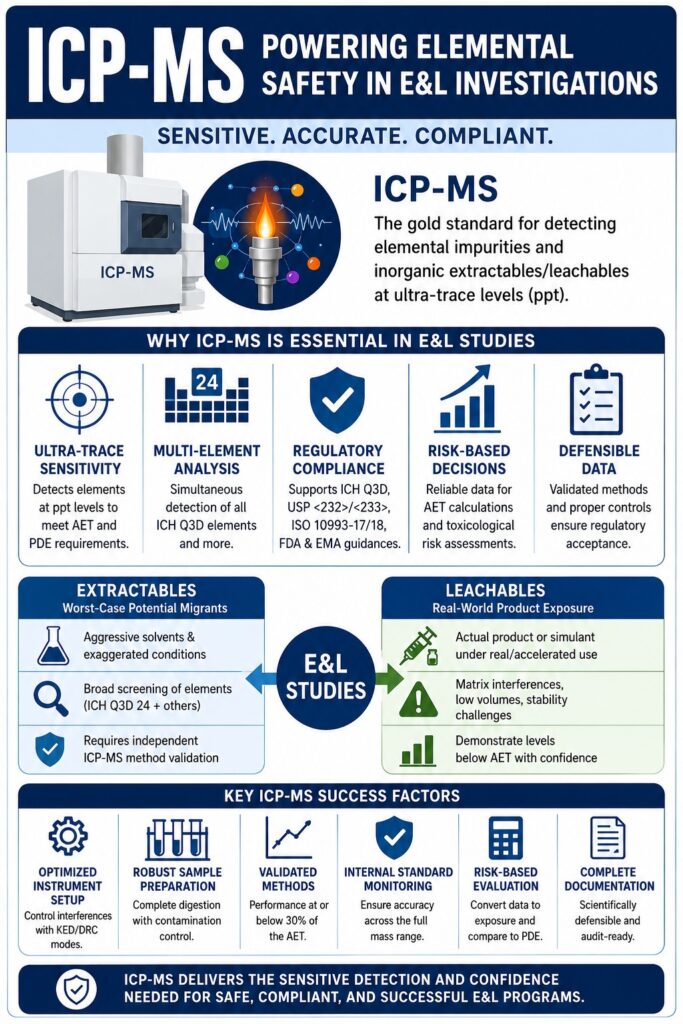
ICP-MS is widely required in elemental impurity and E&L investigations because no other routine analytical technique offers simultaneous multi-element detection at parts-per-trillion (ppt) sensitivity within complex pharmaceutical matrices.
The global regulatory structure governing elemental impurities and E&L assessments is highly interconnected:
| Guideline / Standard | Scope | ICP-MS Relevance |
|---|---|---|
| ICH Q3D (R2) | Elemental impurities in drug products | Defines PDEs and requires detection at ≤30% of PDE |
| USP <232> | Elemental impurity limits | Establishes Permitted Daily Exposures (PDEs) for 24 elements |
| USP <233> | Elemental impurity procedures | Identifies ICP-MS and ICP-OES as compendial techniques |
| ISO 10993-17 | Toxicological risk assessment for medical devices | AET/SCL calculations depend on analytical sensitivity |
| ISO 10993-18 | Chemical characterization of medical device materials | Supports E&L study design and inorganic extractables analysis |
| FDA Guidance on Container-Closure Integrity | Packaging for parenteral and inhalation products | Requires quantification of leachable metals at the AET |
The Analytical Evaluation Threshold (AET) is a central concept in these investigations. For a typical oral pharmaceutical product administered at 10 g/day, the AET for arsenic (As) under ICH Q3D is approximately 1.5 µg/g within the finished product. In contrast, parenteral products have substantially lower PDE values, often by a factor of 100, which reduces the AET into the ng/g range. These sensitivity requirements place the analysis firmly within the operational range of ICP-MS and beyond the practical capability of ICP-OES.
For a deeper look into compliance strategies and baseline expectations under these standards, review our overview on USP Extractables and Leachables.
Extractables vs. Leachables: Why ICP-MS Approaches Must Differ
Although extractables and leachables are closely related from a chemical perspective, they present different analytical challenges. Consequently, ICP-MS strategies must be specifically tailored to each study type.
Extractables studies intentionally apply aggressive solvents such as 0.1% HCl, 0.1% NaOH, ethanol mixtures, or isopropanol under exaggerated conditions including elevated temperatures and extended exposure times. The objective is to generate a worst-case profile of potential chemical migrants from the material. Within ICP-MS workflows, this creates several technical considerations:
- Elevated acid concentrations often require careful offline or online dilution to protect the instrument interface and cones.
- Total dissolved solids (TDS) levels may exceed 0.2%, which is commonly regarded as the upper threshold for maintaining stable plasma conditions.
- Broad elemental screening is typically required across all 24 ICH Q3D elements, along with additional metals such as Ti, Sn, Cr, Mo, and Co depending on the material composition.
Learn how solvent selection impacts testing severity and instrument setup by reading about Solvents for Extractables Studies.
Leachables studies differ significantly because they involve the actual drug product or a representative formulation simulant under real-time or accelerated storage conditions. These studies introduce a different set of analytical challenges:
- Drug formulation matrices may create severe polyatomic interferences. For example, chloride-containing formulations can generate ³⁵Cl¹⁶O⁺ at m/z 51, which interferes with ⁵¹V analysis.
- Protein therapeutics and lipid emulsions can carbonize on the ICP-MS cones, affecting long-term instrument stability.
- Low-volume dosage formats, such as 0.5 mL pre-filled syringes, require micro-digestion strategies to generate sufficient sample material.
- Statistical evidence must demonstrate that elemental leachables remain below the AET with appropriate analytical confidence.
The ICP-MS method used for extractables studies must be independently validated from the method used for leachables studies. Regulatory agencies frequently identify the use of a single validation package for both matrices as a significant deficiency during audits and submissions.
Discover how real-time monitoring works under long-term storage conditions in our article on Leachables Monitoring During Stability Studies.
Technical Execution: Building a Defensible ICP-MS E&L Dataset
Producing regulatorily defensible ICP-MS data for E&L investigations depends on several critical technical components.
1. Plasma Tuning and Instrument Mode Optimization
ICP-MS systems operating in standard mode, collision cell mode (KED), and reaction cell mode (DRC) generate different interference profiles. Appropriate mode selection is therefore essential for accurate elemental quantitation.
- Arsenic (m/z 75): Standard mode analysis is affected by ⁴⁰Ar³⁵Cl⁺ interference in chloride-containing matrices. KED mode or H₂/He collision gas operation is generally required for reliable arsenic quantification.
- Selenium (m/z 78/80): Interferences such as ⁴⁰Ar₂⁺ at m/z 80 and ⁴⁰Ar³⁸Ar⁺ at m/z 78 require either KED operation or mass-shift DRC methods that convert Se to SeO⁺ at m/z 96.
- Vanadium (m/z 51): Chloride-containing saline matrices generate substantial ³⁵Cl¹⁶O⁺ interference, making correction equations or reaction cell chemistry necessary.
- Chromium (m/z 52/53): High-carbon organic matrices can produce ⁴⁰Ar¹²C⁺ interference, requiring careful isotope selection and carbon monitoring.
Selection of analytical isotopes should always be scientifically justified and documented rather than relying solely on default software settings.
2. Internal Standard Selection and Monitoring
Internal standards (IS) serve a critical role in ICP-MS E&L methods. In addition to correcting instrumental drift, they provide essential monitoring for matrix effects and help identify analytical issues before data reporting.
A well-designed internal standard scheme should cover the full mass range:
| Internal Standard | Mass Range Covered | Notes |
| ⁶Li or ⁹Be | Low mass (< m/z 40) | Rarely present in pharmaceutical matrices |
| ⁴⁵Sc or ⁷²Ge | Mid-low mass (40–75) | Sc preferred; Ge suitable for organic-rich matrices |
| ¹⁰³Rh | Mid mass (75–120) | Common universal pharmaceutical IS |
| ¹¹⁵In | Mid-high mass (100–150) | Stable with low natural background |
| ¹⁸⁵Re or ¹⁸⁷Re | High mass (150–210) | Effective coverage for Hg, Pb, Bi, and U |
Internal standard recoveries outside predefined acceptance ranges, typically ±20–30% depending on the validated method, should trigger investigation before final data release. Matrix-induced IS suppression remains one of the most underestimated causes of falsely low elemental impurity reporting.
3. Method Validation Under USP <233> and ICH Q2(R2)
USP <233> establishes several mandatory validation criteria for ICP-MS elemental impurity methods:
- Specificity: Demonstration that no matrix interference exists at the reporting threshold
- Linearity: Validation across at least one order of magnitude surrounding the AET
- Range: Confirmation that the method performs both below and above the AET
- Accuracy (Recovery): Spike recoveries typically ranging from 70–150%, or tighter where product specifications require
- Precision: Repeatability with %RSD generally ≤20% at the AET
- Limit of Quantitation (LOQ): LOQ must be ≤30% of the AET while maintaining acceptable precision and accuracy
- Robustness: Stability of analytical performance under small variations in plasma settings, dilution conditions, and acid concentrations
Importantly, these validation requirements apply separately to each matrix type. A method validated for aqueous leachables from a PET container cannot automatically be considered suitable for lipid-based injectable products.
For a complete guide on how analytical limits are set and justified during validation, explore our deep dive into the AET for Extractables and Leachables Studies.
4. Sample Preparation and Digestion Strategy
ICP-MS data quality is fundamentally dependent on the quality of sample preparation. Digestion protocols for E&L investigations must accomplish several objectives:
- Complete dissolution of inorganic particulates that may contain surface-bound elemental contaminants
- Prevention of elemental loss during digestion, particularly for volatile analytes such as Hg, As, and Se, which require sealed-vessel microwave digestion using HNO₃/HCl under controlled temperature conditions
- Matrix matching between calibration standards and digestates to compensate for differences in acid composition and viscosity
- Continuous procedural blank monitoring, since environmental contamination during digestion frequently contributes to false-positive findings for Pb, Cr, and Zn
For mercury analysis specifically, cold vapor atomic fluorescence spectrometry (CV-AFS) may occasionally be preferred over ICP-MS due to its superior mercury-specific sensitivity and reduced susceptibility to tungsten oxide interferences.
5. Risk-Based Interpretation of ICP-MS Results
ICP-MS data alone do not establish product safety. Analytical results must be integrated into a toxicological risk assessment framework.
The standard workflow is as follows:
Measured concentration (µg/g or µg/mL)
↓
× Daily product intake (g/day or mL/day)
↓
= Daily elemental exposure (µg/day)
↓
÷ PDE (µg/day) from ICH Q3D or USP <232>
↓
= Safety Concern Index (SCI) or % PDE
↓
If SCI < 1 (or < 30%) → Pass
If SCI ≥ 1 → Further risk assessment, reformulation, or scientific justification required
Calculation errors remain a common regulatory concern. Incorrect route-of-administration PDEs, inaccurate dosing assumptions, or failure to combine exposure contributions from multiple sources can all produce misleading safety conclusions despite analytically sound ICP-MS measurements.
Frequent ICP-MS E&L Deficiencies Observed in Regulatory Submissions
Several recurring deficiencies are commonly identified during regulatory review of pharmaceutical submissions:
- Incomplete elemental panels: Failure to include relevant Class 2A and 2B elements such as Co, V, Ni, Tl, Au, Pd, Ir, Os, Rh, Ru, Se, and Ag associated with catalysts or packaging materials
- Lack of leachables matrix validation: Validation performed only for extractables matrices without demonstrating equivalent performance in the final drug product
- Incorrect AET calculations: Use of oral PDEs for parenteral products or failure to include cumulative exposure from excipients, packaging, and manufacturing equipment
- Unresolved spectral interferences: Reporting vanadium concentrations in chloride-containing IV formulations without addressing ClO⁺ correction strategies
- Insufficient LOQ justification: Reporting analytes as “below LOQ” without demonstrating that the LOQ satisfies the ≤30% AET requirement with acceptable method performance
- Lack of extractables-leachables correlation: Identification of leachable metals without any corresponding extractable source, which regulators often consider scientifically questionable
Read our analysis of real-world regulatory feedback and warning letters in FDA Extractables and Leachables Case Studies.
ICP-MS Within the Broader E&L Analytical Strategy
ICP-MS functions as one component within a comprehensive E&L characterization program. It serves as the primary inorganic analytical platform while complementary techniques address organic compounds and material characterization.
| Analytical Technique | Role in E&L Program | Relationship to ICP-MS |
| GC-MS / GC-FID | Volatile and semi-volatile organic extractables | Complementary parallel analysis |
| LC-MS / LC-UV | Non-volatile organic leachables, antioxidants, plasticizers | Complementary parallel analysis |
| ICP-OES | Quantitation of major elements and confirmation studies | Sometimes complementary for high concentrations |
| XRF | Screening of solid materials for elemental composition | Useful upstream screening tool |
| TGA-MS | Thermal stability and volatile inorganic species analysis | Supplementary support technique |
| TOC | Measurement of total organic carbon burden | Non-elemental assessment |
A scientifically complete E&L package integrates ICP-MS data with organic analytical findings and toxicological risk assessments. Regulatory agencies increasingly expect a unified safety narrative rather than isolated analytical datasets. Submissions that separate elemental impurity data from broader E&L toxicological interpretation often fail to meet the intent of ICH Q3D, ISO 10993-17, and FDA Container-Closure guidance.
Understand how mass spectrometry options compare when tackling the organic side of an E&L program by reading GC-MS vs. LC-MS in Extractables and Leachables Testing.
ResolveMass Laboratories: Scientifically Defensible ICP-MS E&L Services
At ResolveMass Laboratories Inc., our ICP-MS E&L and elemental impurity programs are designed directly around current regulatory expectations rather than adapted after development. Our scientific teams establish extraction protocols based on the specific material-contact scenario, validate methods using the actual leachables matrix, apply appropriate interference mitigation strategies, and provide data packages structured for regulatory review.
Our expertise includes:
- Pharmaceutical container-closure systems including glass, elastomers, plastics, and coated closures
- Single-use bioprocessing systems including bags, tubing, connectors, and filtration assemblies
- Medical device extractables studies aligned with ISO 10993-18
- Drug substance elemental impurity risk assessments under ICH Q3D Option 1 and Option 2
- Parenteral and ophthalmic leachables investigations involving low-volume, high-sensitivity analysis
For projects managed within specific regional regulatory boundaries, learn more about choosing the Best CRO for Extractables and Leachables (E&L) Testing in Canada
or explore our compliance frameworks for E&L Testing in the United States.
Conclusion: ICP-MS Is the Core Analytical Platform for Modern E&L Programs
Regulatory expectations surrounding ICP-MS in Extractables & Leachables investigations have advanced substantially in recent years. Agencies including the FDA, Health Canada, and EMA now expect far more than simple numerical compliance. Reviewers increasingly require evidence of validated methods, interference-controlled analysis, matrix-matched calibration, complete elemental coverage, and a scientifically justified safety narrative that clearly links measured concentrations to patient exposure and toxicological thresholds.
An ICP-MS E&L program that cannot confidently answer the question, “How do you know your method accurately quantifies this element at the AET within this specific matrix?” is unlikely to withstand regulatory scrutiny. Establishing that level of scientific defensibility requires integrated expertise in instrumentation, method development, and regulatory science working together throughout the project lifecycle.
At ResolveMass Laboratories Inc., we bring all of these capabilities together for every E&L engagement. Whether your program requires expansion of an elemental panel, validation of leachables methods, optimization of interference correction strategies, or broader ICP-MS regulatory support, our team can help strengthen the scientific integrity of your E&L program.
To learn more about customized analytical protocols for complex delivery systems, explore our specialized services for E&L Testing for Pre-Filled Syringes
and Extractables and Leachables Testing for Autoinjectors.
Frequently Asked Questions (FAQs)
ICP-MS is preferred for parenteral leachables testing because parenteral products have extremely low Permitted Daily Exposure (PDE) limits compared to oral formulations. These lower limits reduce the Analytical Evaluation Threshold (AET) into the nanogram-per-gram range, which exceeds the sensitivity capabilities of ICP-OES. While ICP-OES is suitable for higher elemental concentrations, it generally cannot achieve the ultra-trace detection levels required for Pb, As, Cd, and Hg in injectable products. ICP-MS provides the sensitivity necessary to accurately quantify these elements without relying on impractically large sample volumes.
A comprehensive ICP-MS E&L screening panel should include all 24 elemental impurities identified under ICH Q3D guidelines. This includes Class 1, Class 2A, Class 2B, and Class 3 elements that may originate from catalysts, packaging materials, processing equipment, or formulation components. In medical device and combination product studies, additional elements may also need to be evaluated depending on the material composition. A scientifically defensible screening strategy should therefore address both regulatory requirements and material-specific elemental risks.
A Permitted Daily Exposure (PDE) represents the maximum acceptable daily intake of a specific elemental impurity based on toxicological assessment and route of administration. The Analytical Evaluation Threshold (AET), by contrast, is the analytical reporting threshold calculated from the PDE and the maximum daily dose of the product. The AET determines the concentration level that the ICP-MS method must reliably detect and quantify during analysis. In simple terms, the PDE defines the toxicological safety limit, while the AET establishes the analytical target needed to support that safety assessment.
ICH Q3D and ISO 10993 frameworks address different regulatory objectives and therefore cannot always be directly interchangeable. ICH Q3D focuses primarily on pharmaceutical elemental impurity exposure using PDE-based risk assessment, whereas ISO 10993 evaluates medical device safety using toxicological concepts such as TDI and Margin of Exposure (MoE). Additionally, study design, material-contact conditions, and extraction strategies may differ significantly between the two standards. For combination products, additional scientific justification or supplementary studies are often necessary to bridge both regulatory expectations.
Several elemental impurities are routinely associated with pharmaceutical packaging and manufacturing materials. Chromium and nickel are commonly linked to stainless steel processing equipment, while barium, titanium, and tin may originate from glass components or rubber additives. Zinc and calcium are frequently associated with elastomeric closures, and antimony or cobalt can migrate from PET-based packaging systems. Platinum-group metals such as palladium and platinum may also appear due to catalyst residues present in elastomer manufacturing processes.
Mercury presents unique analytical challenges because of its volatility, adsorption tendencies, and strong memory effects within sample introduction systems. To minimize elemental loss, laboratories typically use sealed-vessel microwave digestion combined with gold stabilizers to preserve mercury throughout sample preparation. Rapid sample analysis following digestion is also important to reduce instability over time. In some E&L investigations, cold vapor atomic fluorescence spectrometry (CV-AFS) may be used alongside ICP-MS because of its exceptional mercury sensitivity and reduced spectral interference concerns.
USP <233> requires independent validation for every procedure-matrix combination used in elemental impurity testing. Extractables studies generally involve aggressive extraction solvents, whereas leachables studies analyze the actual pharmaceutical formulation or a representative simulant matrix. As a result, parameters such as recovery, precision, specificity, and LOQ must be demonstrated separately for each matrix type. A method validated only for extractables cannot automatically be considered suitable for leachables analysis without additional supporting validation data.
Polyatomic interferences can significantly compromise the accuracy of ICP-MS measurements when pharmaceutical matrices contain salts, organics, or complex excipients. For example, chloride-containing formulations can interfere with arsenic and vanadium analysis, while organic matrices may affect chromium detection through carbon-based interferences. Selenium analysis is also impacted by argon-based polyatomic species formed within the plasma. To overcome these challenges, laboratories rely on collision/reaction cell technology, optimized gas selection, and validated interference-correction strategies tailored to the specific matrix being analyzed.
Reference:
- International Council for Harmonisation of Technical Requirements for Pharmaceuticals for Human Use. (2022, April 26). ICH harmonised guideline Q3D(R2): Guideline for elemental impurities. https://database.ich.org/sites/default/files/Q3D-R2_Guideline_Step4_2022_0308.pdf
- United States Pharmacopeia. (2016). 〈232〉 Elemental impurities—Limits. In USP 39–NF 34. United States Pharmacopeial Convention. https://www.usp.org/sites/default/files/usp/document/our-work/chemical-medicines/key-issues/c232-usp-39.pdf
- International Organization for Standardization. (2023). ISO 10993-17:2023 biological evaluation of medical devices — Part 17: Toxicological risk assessment of medical device constituents. https://www.iso.org/standard/75323.html
- International Organization for Standardization. (2020). ISO 10993-18:2020 biological evaluation of medical devices — Part 18: Chemical characterization of medical device materials within a risk management process. https://cdn.standards.iteh.ai/samples/64750/9b92d06fc094405790ae06701269b7d4/ISO-10993-18-2020.pdf
- U.S. Food and Drug Administration. (1999, May). Container closure systems for packaging human drugs and biologics: Chemistry, manufacturing, and controls documentation — Guidance for industry. U.S. Department of Health and Human Services. https://www.fda.gov/media/70788/download
- U.S. Food and Drug Administration. (2015, July). Analytical procedures and methods validation for drugs and biologics: Guidance for industry. U.S. Department of Health and Human Services. https://www.fda.gov/regulatory-information/search-fda-guidance-documents/analytical-procedures-and-methods-validation-drugs-and-biologics
- European Medicines Agency. (2008, February 21). Guideline on the specification limits for residues of metal catalysts or metal reagents. https://www.ema.europa.eu/en/documents/scientific-guideline/guideline-specification-limits-residues-metal-catalysts-or-metal-reagents_en.pdf
Get In Touch With Us
About The Author


