

Introduction
Headspace GC-MS for Volatile Nitrosamine Analysis is a sophisticated and highly selective analytical technique widely employed to identify and quantify trace concentrations of mutagenic N-nitrosamine impurities in pharmaceutical products. The detection of N-nitrosodimethylamine (NDMA) and N-nitrosodiethylamine (NDEA) in angiotensin II receptor blockers (ARBs), including valsartan, as well as in medications such as metformin and ranitidine, resulted in extensive global recalls and highlighted the urgent need for highly sensitive analytical strategies. Owing to their volatility and semi-volatility, nitrosamines possess physicochemical properties that make them particularly suitable for analysis by gas chromatography coupled with mass spectrometry (GC-MS) using headspace sampling techniques.
Curious about why these compounds are a top regulatory concern? Read our complete overview on what nitrosamines are and how they form.
Through controlled thermal equilibration, volatile impurities are transferred into the gaseous phase, allowing efficient separation from non-volatile active pharmaceutical ingredients (APIs) and formulation excipients. This approach significantly reduces matrix-related interferences while eliminating the need for labor-intensive liquid-liquid extraction procedures. In addition, Headspace GC-MS for Volatile Nitrosamine Analysis protects chromatographic systems from contamination caused by non-volatile components and consistently delivers the sub-part-per-million (ppm) sensitivity necessary for regulatory compliance and patient safety assurance.
Not sure if your product portfolio requires screening? Find out if all drug products need a nitrosamine risk assessment.
Share via:
Article Summary:
- Headspace GC-MS is the preferred analytical technique for detecting volatile nitrosamine impurities such as NDMA, NDEA, NDIPA, and NEIPA at trace levels in pharmaceutical products, offering high sensitivity with minimal matrix interference.
- The method is widely accepted by FDA, EMA, and USP for regulatory compliance, with stringent limit of quantitation (LOQ) requirements to ensure nitrosamine levels remain below established acceptable intake limits.
- Robust method development involves optimizing sample preparation, headspace equilibration, extraction solvents (e.g., DMSO), GC columns (DB-WAX), and GC-MS operating parameters to achieve reliable and reproducible results.
- Electron Impact (EI) ionization combined with SIM or MRM detection, particularly on triple-quadrupole GC-MS/MS systems, provides highly selective and accurate quantification of trace nitrosamines.
- To prevent false-positive nitrosamine formation during analysis, laboratories use nitrite scavengers (such as sulfamic acid or ascorbic acid) and Full Evaporation Static Headspace (FE-SHS) techniques, significantly improving analytical accuracy.
- Method validation follows ICH Q2(R1) guidelines, evaluating parameters including specificity, linearity, sensitivity (LOD/LOQ), accuracy, precision, recovery, and matrix effects, while stable isotope-labeled internal standards enhance quantitative reliability.
- Accredited laboratories equipped with advanced GC-MS/MS and HRMS technologies, such as ResolveMass Laboratories, provide regulatory-compliant nitrosamine testing, customized method development, and reference standard synthesis to support global pharmaceutical quality and patient safety.
Regulatory Landscape and Acceptance of Headspace GC-MS for Volatile Nitrosamine Analysis
Headspace GC-MS for Volatile Nitrosamine Analysis has gained broad regulatory recognition from the US Food and Drug Administration (FDA), the European Medicines Agency (EMA), and the United States Pharmacopeia (USP). These organizations recognize the technique as a key analytical approach for demonstrating compliance with stringent acceptable intake (AI) limits established for nitrosamine impurities. USP General Chapter <> specifically describes Procedure 2 as a validated headspace GC-MS/MS (triple-quadrupole) method intended for the quantification of NDMA, NDEA, N-nitrosodiisopropylamine (NDIPA), and N-nitrosoethylisopropylamine (NEIPA) in selected sartan drug products.
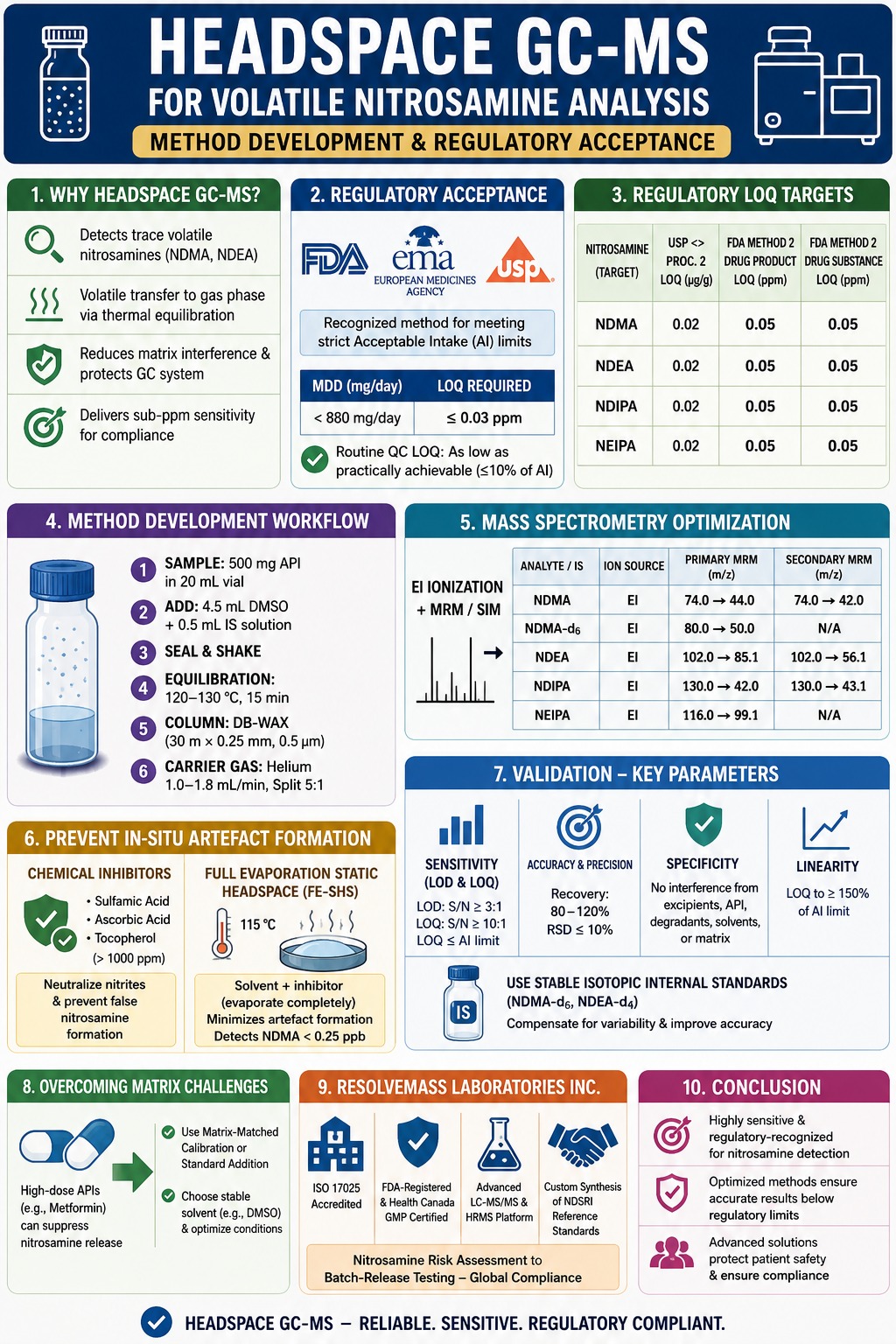
Regulatory expectations require analytical methods to possess sufficient sensitivity to detect nitrosamine impurities at concentrations equal to or below the established acceptable limits, which are determined based on the maximum daily dose (MDD) of the pharmaceutical product. FDA and EMA recommendations indicate that products with an MDD below 880 mg/day should achieve a limit of quantitation (LOQ) of ≤ 0.03 ppm. For routine quality control applications, the LOQ should be maintained at the lowest practically achievable level and, whenever possible, should not exceed 10% of the calculated acceptable intake threshold.
Understand the operational differences between nitrosamine alert limits vs. action limits to maintain compliance.
The FDA has also released several validated analytical procedures specifically designed for nitrosamine determination. FDA Method 1 utilizes headspace GC/MS for the measurement of NDMA and NDEA, whereas FDA Method 2 broadens analytical coverage to include NDIPA and NEIPA through the use of single quadrupole (GC/SQ) instrumentation operating in Selected Ion Monitoring (SIM) mode.
The table below summarizes the performance requirements and target detection limits associated with major regulatory headspace GC-MS methods.
| Target Nitrosamine | Chemical Abbreviation | USP <> Procedure 2 LOQ (µg/g) | FDA Method 2 Drug Product LOQ (ppm) | FDA Method 2 Drug Substance LOQ (ppm) |
|---|---|---|---|---|
| N-Nitrosodimethylamine | NDMA | 0.02 | 0.05 | 0.05 |
| N-Nitrosodiethylamine | NDEA | 0.02 | 0.05 | 0.05 |
| N-Nitrosodiisopropylamine | NDIPA | 0.02 | 0.05 | 0.05 |
| N-Nitrosoethylisopropylamine | NEIPA | 0.02 | 0.05 | 0.05 |
Advanced Method Development in Headspace GC-MS for Volatile Nitrosamine Analysis
Developing a robust Headspace GC-MS for Volatile Nitrosamine Analysis method requires careful optimization of vial equilibration conditions, appropriate selection of high-boiling extraction solvents, and the use of specialized chromatographic columns capable of delivering sub-part-per-billion (ppb) sensitivity. Short-chain nitrosamines such as NDMA and NDEA exhibit high water solubility, making organic solvents such as dimethyl sulfoxide (DMSO) and N-methylpyrrolidone (NMP) particularly valuable during sample preparation. These solvents efficiently dissolve complex API matrices while maintaining low volatility under headspace operating conditions, thereby minimizing the risk of solvent-related interference within the mass spectrometer.
Partner with experts to design custom workflows using our nitrosamine method development and validation services.
A typical sample preparation workflow includes accurately weighing the pharmaceutical material, for example 500 mg of API, into a 20 mL headspace vial. Subsequently, 4.5 mL of DMSO is added, followed by 0.5 mL of a stable isotope-labeled internal standard solution. The vial is immediately sealed using a crimp cap and subjected to agitation to ensure complete sample homogenization. To maximize analyte partitioning into the vapor phase, the headspace autosampler is generally operated at an equilibration temperature ranging from 120 °C to 130 °C with an incubation period of approximately 15 minutes.
Chromatographic performance is strongly influenced by stationary phase selection. Since volatile nitrosamines exhibit significant polarity, highly polar polyethylene glycol (PEG)-based columns such as DB-WAX (30 m × 0.25 mm, 0.5 µm) are commonly utilized to achieve efficient separation, improved peak symmetry, and sufficient analyte retention. The GC system is typically operated under constant helium flow conditions, often between 1.0 and 1.8 mL/min, while employing a split injection ratio such as 5:1 to maintain an optimal balance between analytical sensitivity and column loading capacity.
Optimizing Mass Spectrometry Parameters
Optimization of mass spectrometry settings in Headspace GC-MS for Volatile Nitrosamine Analysis involves the strategic use of Electron Impact (EI) ionization together with Multiple Reaction Monitoring (MRM) or Selected Ion Monitoring (SIM) acquisition modes. These approaches enable the selective monitoring of characteristic mass-to-charge (m/z) transitions, providing highly reliable identification and quantification of target nitrosamines.
In single quadrupole instruments, SIM mode enhances analytical sensitivity by monitoring predefined ions associated with each analyte, thereby improving the signal-to-noise ratio. However, triple-quadrupole (QqQ) mass spectrometry systems, as recommended in USP <> Procedure 2, provide a higher level of selectivity by tracking precursor-to-product ion transitions, significantly reducing the possibility of interference from matrix components.
For accurate identification and quantitative analysis, the following MRM transitions are frequently optimized for target nitrosamines and their isotope-labeled internal standards.
| Analyte / Internal Standard | Ionization Source | Primary MRM Transition (m/z) | Secondary MRM Transition (m/z) |
|---|---|---|---|
| NDMA | Electron Impact (EI) | 74.0 → 44.0 | 74.0 → 42.0 |
| NDMA-d6 | Electron Impact (EI) | 80.0 → 50.0 | N/A |
| NDEA | Electron Impact (EI) | 102.0 → 85.1 | 102.0 → 56.1 |
| NDIPA | Electron Impact (EI) | 130.0 → 42.0 | 130.0 → 43.1 |
| NEIPA | Electron Impact (EI) | 116.0 → 99.1 | N/A |
Mitigating In-Situ Artefact Formation During Headspace Extraction
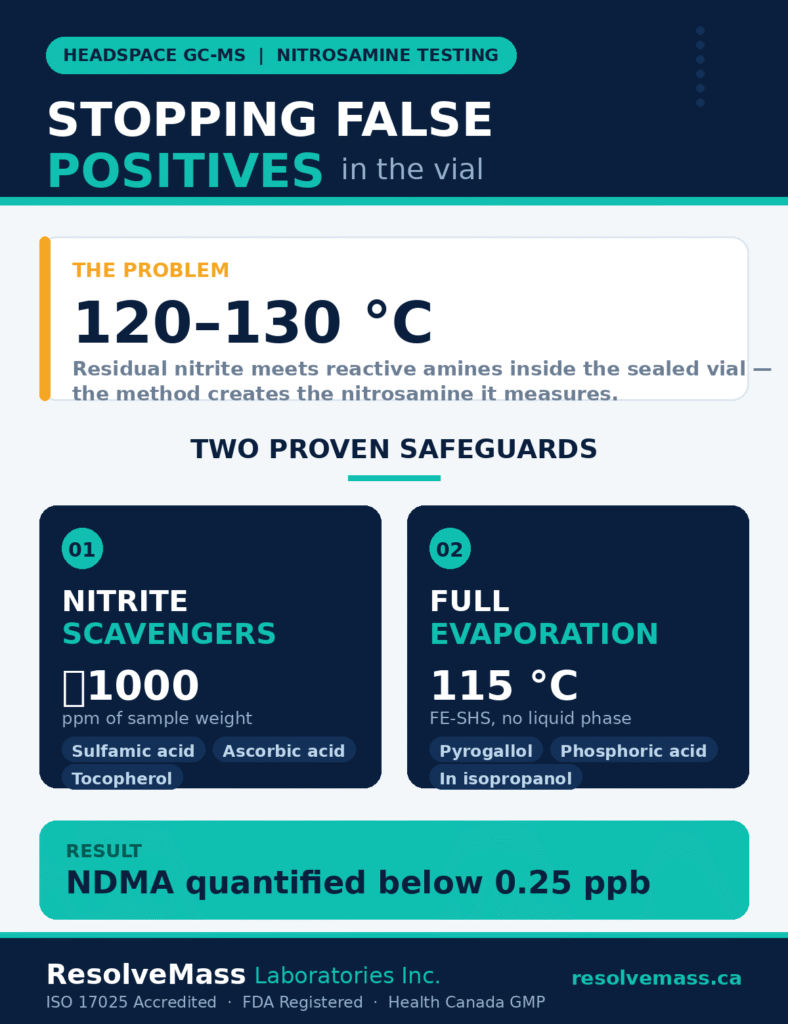
Mitigation of in-situ artefact formation during headspace extraction is commonly achieved through the incorporation of chemical nitrosation inhibitors such as sulfamic acid or ascorbic acid, as well as through the application of Full Evaporation Static Headspace (FE-SHS) methodologies. One of the most significant analytical challenges associated with conventional headspace GC-MS is the possibility that the analytical procedure itself may generate nitrosamines during sample preparation. When pharmaceutical formulations containing residual nitrites and reactive secondary or tertiary amines are exposed to elevated equilibration temperatures, typically between 120 °C and 130 °C, thermal degradation processes and rapid nitrosation reactions may occur inside the sealed headspace vial. This phenomenon is particularly relevant for APIs such as ranitidine and metformin, where artificial nitrosamine generation can produce false-positive findings and lead to inaccurate quantification.
Learn more about the chemical mechanics of artificial generation in nitrosamine formation pathways during API synthesis.
To minimize this risk, analytical scientists routinely incorporate nitrite scavengers into the sample preparation workflow before thermal equilibration. The use of sulfamic acid, ascorbic acid, or tocopherol at concentrations greater than 1000 ppm relative to sample weight effectively neutralizes residual nitrite species. By eliminating the reactive nitrosating agents required for NDMA formation, these additives suppress artefactual nitrosamine generation and improve the reliability of analytical results.
An alternative and increasingly adopted strategy is the implementation of Full Evaporation Static Headspace (FE-SHS) technology. Unlike conventional headspace techniques, FE-SHS eliminates the dependence on liquid-gas partitioning behavior. In this approach, a small quantity of a highly volatile solvent containing a nitrosation inhibitor, such as pyrogallol and phosphoric acid dissolved in isopropyl alcohol, is introduced to a finely powdered solid sample. During thermal treatment, typically at approximately 115 °C, both the solvent and target analytes evaporate completely into the headspace while the solid matrix remains unaffected. By minimizing prolonged aqueous-phase interactions that promote nitrosation reactions, FE-SHS effectively prevents in-situ artefact formation and frequently enables NDMA quantification at concentrations below 0.25 ppb.
Validation Protocols for Headspace GC-MS for Volatile Nitrosamine Analysis
Validation of Headspace GC-MS for Volatile Nitrosamine Analysis requires strict compliance with ICH Q2(R1) guidelines and involves comprehensive assessment of analytical performance characteristics including specificity, linearity, accuracy, sensitivity, matrix effects, and signal-to-noise performance. Given the exceptionally low action limits established by global regulatory agencies for nitrosamine impurities, demonstrating method robustness and reliability is essential for regulatory acceptance.
Read our guide on genotoxic impurity testing under ICH M7 and nitrosamine guidelines to streamline your validation studies.
Sensitivity (LOD and LOQ)
The limit of detection (LOD) is defined as the lowest analyte concentration capable of producing a signal-to-noise (S/N) ratio of at least 3:1. Similarly, the limit of quantitation (LOQ) is established as the lowest concentration that consistently achieves an S/N ratio of 10:1 or greater while maintaining acceptable accuracy and precision. The analytical LOQ must be equal to or lower than the applicable regulatory acceptable intake threshold. Validation studies typically include spike-recovery experiments demonstrating recovery values between 80% and 120%, together with a relative standard deviation (RSD) not exceeding 10% across replicate analyses.
Specificity and Matrix Effects
Method specificity requires the unambiguous identification of target nitrosamines without interference from excipients, active ingredients, degradation products, solvents, or other formulation components. Particular attention must be given to matrix effects, which can artificially suppress or enhance analyte volatility and subsequently impact analytical accuracy. Continuous monitoring and evaluation of matrix-related influences are therefore critical components of method validation.
Linearity and Internal Standardization
The analytical method must demonstrate linearity across a concentration range extending from the validated LOQ to at least 150% of the established Acceptable Intake limit. Stable isotope-labeled internal standards, including NDMA-d6 and NDEA-d4, are routinely incorporated into the analytical procedure. Because these isotopically labeled compounds exhibit nearly identical physicochemical behavior to their native counterparts, they effectively compensate for extraction variability, headspace partitioning fluctuations, and ionization efficiency changes within the mass spectrometer, thereby improving quantitative accuracy and precision.
Overcoming Complex Matrix Challenges in Pharmaceutical Drug Products
Addressing complex matrix effects in pharmaceutical formulations requires carefully designed sample preparation approaches and advanced chromatographic strategies to ensure that high-dose APIs and polymeric excipients do not adversely affect nitrosamine recovery. Although Headspace GC-MS for Volatile Nitrosamine Analysis inherently minimizes contamination of the analytical column by non-volatile matrix components, the transfer efficiency of volatile nitrosamines from the liquid phase into the gaseous phase remains highly dependent on matrix composition and viscosity.
In high-dose drug products such as metformin formulations, where the API content may exceed 1000 mg per dosage unit, the substantial amount of active ingredient can alter solvent characteristics and affect analyte partitioning behavior. As a result, the release of NDMA and related nitrosamines into the headspace may be partially suppressed, potentially leading to inaccurate quantification if not properly addressed. To overcome these challenges, analysts frequently employ matrix-matched calibration standards or standard addition techniques to ensure accurate impurity measurement.
Discover how matrix complexities are handled in our case study on nitrosamine testing for a metformin generic.
In addition, careful selection of an appropriate extraction solvent is essential. Solvents such as DMSO must be capable of completely dissolving the API while remaining chemically stable under elevated headspace temperatures. Achieving this balance often requires extensive forced-degradation studies and optimization experiments during method development to ensure reliable analytical performance across a variety of pharmaceutical formulations.
ResolveMass Laboratories Inc.: Excellence in Nitrosamine Impurity Testing
ResolveMass Laboratories Inc. provides regulatory-compliant nitrosamine impurity testing through ISO 17025 accredited, FDA-registered, and Health Canada GMP-certified facilities equipped with advanced analytical instrumentation. Located in Laval, Québec, the laboratory offers comprehensive analytical services ranging from initial nitrosamine risk assessments to routine batch-release testing for pharmaceutical products intended for global markets.
When compendial methods prove unsuitable because of complex matrix interferences, specialized Contract Research Organizations (CROs) play a critical role in developing and validating customized analytical solutions. ResolveMass Laboratories Inc. maintains a sophisticated analytical platform that includes Sciex Triple Quad 6500+ LC-MS/MS systems for ultra-trace quantification and Thermo Scientific Orbitrap Exploris 120 High-Resolution Mass Spectrometry (HRMS) instruments for structural characterization and unknown impurity identification. The laboratory’s Health Canada Drug Establishment Licence (DEL 3-002945-A) and FDA Establishment ID (3042696771) support the generation of regulatory-ready analytical data aligned with ICH, USP, and EMA requirements.
Learn more about the strategic benefits of outsourcing nitrosamine testing to a specialized CRO.
In addition to volatile nitrosamine testing, the organization offers specialized custom synthesis services for Nitrosamine Drug Substance-Related Impurities (NDSRIs). Since NDSRIs are often unique to individual APIs, commercially available reference standards may not exist. ResolveMass Laboratories Inc. develops and synthesizes custom NDSRI reference materials internally, facilitating precise analytical method validation and helping pharmaceutical developers accelerate project timelines without relying on external suppliers.
Understand the critical differences between complex NDSRIs vs. simple nitrosamines.
Conclusion
The implementation of Headspace GC-MS for Volatile Nitrosamine Analysis provides pharmaceutical manufacturers and developers with a highly sensitive, scientifically robust, and regulatory-recognized approach for detecting and quantifying carcinogenic nitrosamine impurities. Through the careful optimization of extraction conditions, utilization of highly polar chromatographic columns, and application of targeted mass spectrometric detection strategies, analytical laboratories can reliably identify trace-level nitrosamines at concentrations well below regulatory thresholds established by the FDA, EMA, and USP.
Furthermore, the incorporation of nitrite scavengers and advanced Full Evaporation Static Headspace methodologies effectively addresses the long-standing challenge of in-situ artefact formation, thereby improving data integrity and reducing the likelihood of false-positive results. As global regulatory agencies continue to strengthen nitrosamine control requirements and establish increasingly stringent acceptable intake limits, access to accredited, GMP-compliant analytical laboratories equipped with advanced mass spectrometry technologies becomes increasingly important for ensuring regulatory compliance and protecting patient safety.
From early-stage formulation development through commercial product release, comprehensive nitrosamine testing plays a vital role in maintaining product quality and safeguarding pharmaceutical supply chains. Organizations that combine advanced analytical expertise, custom impurity synthesis capabilities, and regulatory-compliant testing infrastructure are well positioned to support the evolving requirements of the pharmaceutical industry.
For expert method development, NDSRI impurity synthesis, and GMP-compliant analytical testing, please contact ResolveMass Laboratories Inc.:
Contact ResolveMass Laboratories Inc.
Frequently Asked Questions (FAQs)
USP <> Procedure 2 provides a validated analytical framework for the determination of volatile nitrosamines using headspace GC-MS/MS technology. The procedure establishes requirements for detecting compounds such as NDMA, NDEA, NDIPA, and NEIPA with high selectivity and sensitivity. By defining performance expectations and analytical parameters, it helps laboratories generate data that meet regulatory standards and quality requirements.
DMSO is frequently selected because it can dissolve a broad range of pharmaceutical compounds while remaining stable at elevated headspace temperatures. Its high boiling point allows samples to be heated effectively without generating excessive solvent vapor that could interfere with detection. This characteristic helps maintain consistent analyte recovery and supports accurate nitrosamine quantification in complex pharmaceutical matrices.
In-situ nitrosamine formation can occur when residual nitrites present in a pharmaceutical sample react with susceptible amine-containing compounds during thermal equilibration. Elevated temperatures inside the headspace vial may accelerate these chemical reactions, resulting in nitrosamines that were not originally present in the product. Such artefacts can produce misleading results and overestimate impurity concentrations if not properly controlled.
Analytical scientists often add nitrite-scavenging compounds such as sulfamic acid or ascorbic acid during sample preparation to suppress unwanted nitrosation reactions. These additives neutralize residual nitrites before heating begins, preventing them from reacting with amines in the sample. This strategy improves data accuracy and reduces the possibility of false-positive nitrosamine findings.
For triple-quadrupole GC-MS/MS systems operating with Electron Impact (EI) ionization, NDMA is commonly monitored using characteristic precursor-to-product ion transitions. The primary transition generally involves m/z 74.0 → 44.0, while m/z 74.0 → 42.0 is frequently used as a confirmatory transition. Monitoring multiple transitions enhances analytical confidence and supports reliable compound identification.
Stable isotope-labeled internal standards are essential because they closely mimic the behavior of target nitrosamines throughout the analytical process. These compounds compensate for variations in extraction efficiency, sample preparation, headspace partitioning, and ionization performance. Their use improves quantitative accuracy and ensures greater consistency across multiple analyses and sample batches.
Full Evaporation Static Headspace (FE-SHS) GC-MS is a specialized headspace technique in which a very small amount of solvent is used, allowing complete evaporation of both the solvent and analytes during analysis. This approach minimizes liquid-phase interactions that can contribute to degradation or artefact formation. In many applications, FE-SHS provides enhanced sensitivity and improved detection of ultra-trace nitrosamine impurities.
Headspace GC-MS is generally not the preferred technique for Nitrosamine Drug Substance-Related Impurities (NDSRIs) because these compounds are often larger, less volatile, and more thermally sensitive than simple volatile nitrosamines. Their physicochemical properties make them better suited for Liquid Chromatography-Mass Spectrometry (LC-MS/MS) analysis. LC-based methods provide the sensitivity and selectivity required for accurate NDSRI characterization and quantification.
A laboratory performing nitrosamine impurity testing should operate within a robust quality management framework and demonstrate technical competence through recognized accreditations. ISO/IEC 17025 accreditation is widely regarded as a key indicator of analytical reliability, while GMP compliance further supports data integrity and regulatory acceptance. Facilities recognized by agencies such as the FDA and Health Canada are often preferred for pharmaceutical testing programs requiring regulatory submission.
Reference:
- U.S. Food and Drug Administration. (2019). Immunogenicity testing of therapeutic protein products—Developing and validating assays for anti-drug antibody detection: Guidance for industry. U.S. Department of Health and Human Services. https://www.fda.gov/media/124025/download
- United States Pharmacopeia. (2019). General chapter <1469> nitrosamine impurities: Content and rationale [PDF]. United States Pharmacopeial Convention. https://www.usp.org/sites/default/files/usp/document/stakeholder-forum/pnp/highlights-of-1469-nitrosamine-impurities.pdf
- European Medicines Agency. (2020). Nitrosamine impurities in human medicinal products: Assessment report (EMA/369136/2020). European Medicines Agency. https://www.ema.europa.eu/en/documents/opinion-any-scientific-matter/nitrosamines-emea-h-a53-1490-assessment-report_en.pdf
- Fritzsche, M., Blom, G., Keitel, J., Harrison, M., Moore, A., O’Neill, N., & Schlingemann, J. (2022). NDMA analytics in metformin products: Comparison of methods and pitfalls. European Journal of Pharmaceutical Sciences, 168, 106026. https://doi.org/10.1016/j.ejps.2021.106026
- Mylan Laboratories Limited. (2023). Method for analyzing trace levels of semi-volatile nitrosamines in solid samples (WO Patent No. WO2023287670A1). World Intellectual Property Organization. https://patents.google.com/patent/WO2023287670A1/en
Get In Touch With Us
About The Author


