

Introduction
Counter-Ion Analysis Services for Peptide APIs provide essential quantitative determinations of non-peptidic ionic species—specifically trifluoroacetate (TFA), acetate, and chloride—that electrostatically bind to protonated basic amino acid residues during chemical synthesis and purification. These specialized analytical services are essential for accurately calculating Net Peptide Content (NPC), establishing batch-to-batch chemical equivalence, and meeting stringent batch-release criteria required by global regulatory agencies.
During Solid-Phase Peptide Synthesis (SPPS) using Fluorenylmethyloxycarbonyl (Fmoc) chemistry, concentrated trifluoroacetic acid is used to cleave the fully assembled peptide chain from the polymeric solid support and remove acid-labile side-chain protecting groups. This chemical cleavage leaves basic functional groups—including the N-terminal α-amino group, the ε-amino group of Lysine, the guanidino group of Arginine, and the imidazole ring of Histidine—fully protonated, resulting in the formation of stable ionic salts with trifluoroacetate anions. In addition, preparative reversed-phase high-performance liquid chromatography (RP-HPLC) routinely uses 0.1% v/v TFA as a volatile ion-pairing agent to enhance chromatographic peak shape and resolution.
Because residual TFA may exhibit cellular toxicity, influence secondary peptide conformation, affect long-term drug product stability, and contribute to localized injection-site reactogenicity, manufacturing processes frequently incorporate counter-ion exchange steps to convert trifluoroacetate salts into pharmaceutically acceptable counter-ions such as acetate or chloride. Accurate quantification of both residual process impurities and intended salt forms is essential because counter-ion mass can constitute a substantial portion of the gross lyophilized powder weight, directly affecting drug dosage calculations and formulation potency.
Explore peptide physicochemical characterization approaches for evaluating key properties that influence peptide API quality and performance:
Peptide Physicochemical Characterization Services
Share via:
Quick Summary:
- What it is: Counter-ion analysis measures the ions that stick to the basic amino acids in a peptide API during synthesis and purification, mainly TFA, acetate, and chloride.
- Where TFA comes from: TFA is used to cleave the peptide from the resin in SPPS and as an ion-pairing agent in RP-HPLC. Manufacturers often exchange it for safer acetate or chloride salts.
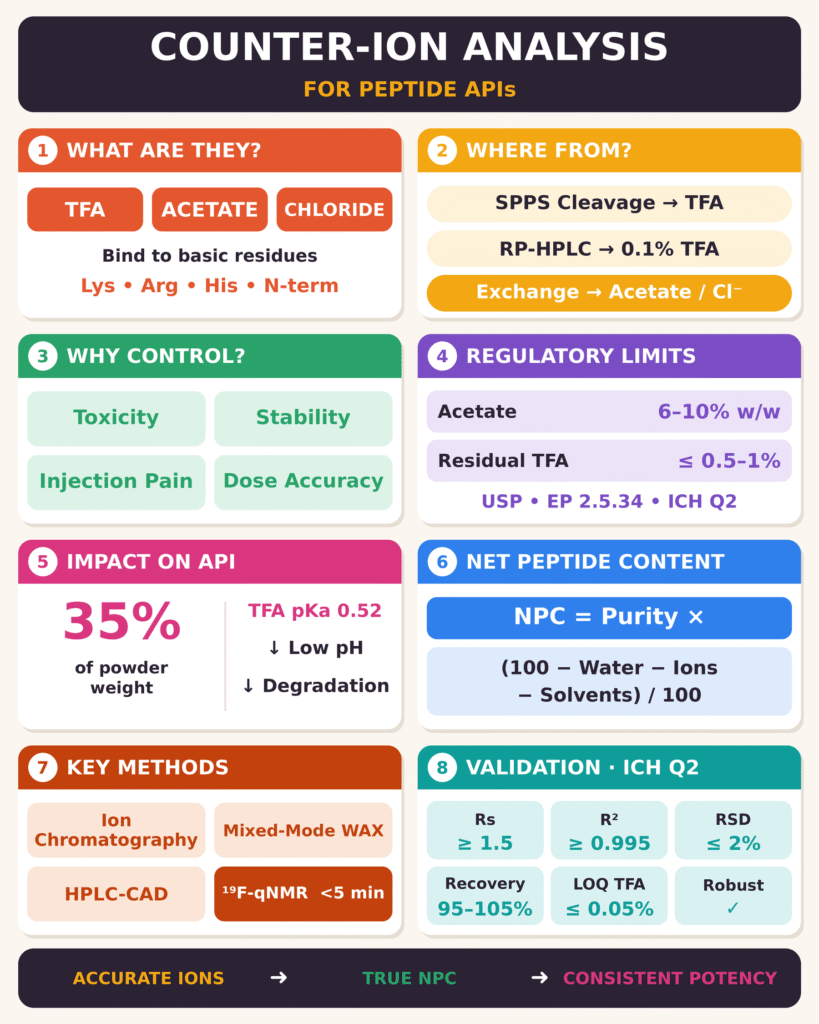
- Why it matters: Leftover TFA can be toxic, lower the pH (pKa 0.52), speed up peptide degradation, and cause injection-site pain. Counter-ions can also make up to 35% of the powder weight, which affects dosing.
- Regulatory limits: USP, EP 2.5.34, and EMA guidance typically set acetate at 6–10% w/w and residual TFA at ≤0.5–1.0% w/w. Methods must be validated under ICH Q2(R1) for IND, NDA, and ANDA filings.
- Net Peptide Content (NPC): NPC is the true amount of active peptide after subtracting water, counter-ions, and residual solvents. Getting the counter-ion content wrong leads directly to potency errors between batches.
- Key methods: Suppressed ion chromatography, mixed-mode WAX HPLC, charged aerosol detection (CAD), and ¹⁹F-qNMR are the main tools. ¹⁹F-qNMR measures TFA in under 5 minutes with no interference from the peptide.
- Validation criteria: Methods must show resolution ≥1.5, R² ≥0.995, RSD ≤2%, recovery of 95–105%, and TFA detection down to ≤0.05% w/w, and they must stay robust under small changes in conditions.
Regulatory Framework and Compendial Standards for Counter-Ion Analysis Services for Peptide APIs
Regulatory guidelines enforced by the US Food and Drug Administration (FDA) and European Medicines Agency (EMA) require comprehensive quantitative profiling of counter-ions present in active pharmaceutical ingredients. Utilizing Counter-Ion Analysis Services for Peptide APIs supports compliance with United States Pharmacopeia (USP) general chapters and <503.1>, European Pharmacopoeia (EP) method 2.5.34, and International Council for Harmonisation (ICH) guidelines.
United States Pharmacopeia chapter (“Acetic Acid in Peptides”) and EP monograph 2.5.34 (“Acetic Acid in Synthetic Peptides”) describe validated liquid chromatographic procedures using C18 stationary phases (USP L1 packing) combined with low-wavelength ultraviolet (UV) detection at 210 nm. Compendial monographs for commercial synthetic peptide acetate salts generally specify an allowable acetate content between 6.0% and 10.0% w/w, although limits may extend to 15.0% w/w depending on the density of basic residues within the peptide sequence.
When a synthetic peptide is manufactured and released as an acetate or chloride salt, residual trifluoroacetate is classified as a process-related organic impurity. Regulatory frameworks published by the EMA require residual TFA in commercial API release lots to be controlled below strict safety thresholds—typically ≤ 0.5% w/w or ≤ 1.0% w/w, depending on the daily therapeutic dose. Method validation protocols supporting Investigational New Drug (IND), New Drug Application (NDA), and Abbreviated New Drug Application (ANDA) submissions must be performed under cGMP conditions in accordance with ICH Q2(R1) guidelines.
Review regulatory considerations for comprehensive GLP-1 peptide characterization and analytical documentation:
Regulatory Requirements for GLP-1 Peptide Characterization
| Regulatory Monograph / Guideline | Target Analytes | Primary Analytical Methodology | Compendial Acceptance Criteria |
|---|---|---|---|
| USP Acetic Acid / Acetate | Acetic acid / Acetate | RP-HPLC-UV (210 nm, C18 L1 Column) | Typically 6.0%–10.0% w/w |
| USP <503.1> | Trifluoroacetic Acid (TFA) | RP-HPLC-UV or Ion Chromatography | Report result / API-specific limits |
| EP 2.5.34 | Acetic Acid in Peptides | LC-UV with Gradient Elution | Monograph dependent (6.0%–10.0%) |
| EMA Synthetic Peptide Guideline | Residual TFA / Process Ions | Validated IC, LC-MS, or 19F-NMR | ≤ 0.5% w/w to ≤ 1.0% w/w |
| ICH Q2(R1) | All Counter-Ion Methods | Method Validation Protocol | Compliant Specificity, Linearity, Precision |
Impact of Counter-Ions on Peptide API Stoichiometry, Stability, and Net Peptide Content
Counter-ions influence the physicochemical behavior, solid-state stability, aqueous solubility, and formulation pH of peptide therapeutics by binding electrostatically to cationic amino acid side chains. Precise quantification of counter-ions is mandatory because non-peptidic salt mass can account for up to 35% of the total dry powder weight, directly affecting active drug payload calculations.
In unexchanged post-cleavage peptide preparations, trifluoroacetate salts can represent a substantial proportion of the total cake mass. The theoretical stoichiometry of counter-ion binding is determined by the number of basic amino acids containing protonated side chains at the processing pH. However, experimental evaluations indicate that lyophilized peptides can frequently occlude excess non-stoichiometric free acid molecules within the amorphous solid matrix, resulting in measured counter-ion mass fractions that exceed theoretical stoichiometric calculations.
The strong acidity of residual TFA (pKa = 0.52) can significantly decrease the local pH upon aqueous reconstitution, potentially catalyzing rapid peptide degradation through sequence-specific pathways, including deamidation of Asn/Gln residues, aspartimide formation, methionine oxidation, or peptide bond cleavage. Exchanging trifluoroacetate for weaker organic acids such as acetate (pKa = 4.76) or inorganic ions such as chloride produces a near-neutral pH environment, which can improve physical stability and reduce injection-site pain.
Learn more about analytical strategies used to evaluate peptide stability and monitor degradation-related changes:
GLP-1 Peptide Stability Analytical Methods
Accurate characterization of the bulk active substance requires determination of the Net Peptide Content (NPC). Net Peptide Content represents the precise percentage of pure, active peptide molecule present within a gravimetrically weighed API sample, excluding counter-ions, moisture, and residual solvents. The complete mass-balance relationship is expressed mathematically as:
Net Peptide Content (%) = Chromatographic Purity (%) × [(100 − (% Water + % Counter-Ions + % Residual Solvents)) / 100]
Variations in counter-ion content directly alter the calculated Net Peptide Content. Failure to account for differences in counter-ion weight can introduce systematic errors during final dosage-form compounding, potentially resulting in batch-to-batch potency non-conformance.
Review the distinction between peptide drug substance and drug product characterization when establishing comprehensive analytical control strategies:
Peptide Drug Substance vs Drug Product Characterization
Advanced Analytical Methodologies for Counter-Ion Analysis Services for Peptide APIs
Advanced Counter-Ion Analysis Services for Peptide APIs utilize high-performance separation and spectroscopic techniques—including suppressed Ion Chromatography (IC), Mixed-Mode Weak Anion Exchange (WAX) HPLC, Charged Aerosol Detection (CAD), and quantitative Fluorine NMR (19F-NMR)—to achieve accurate quantification across complex peptide matrices. These orthogonal platforms can resolve volatile, non-chromophoric, and inorganic anions that cannot be reliably evaluated using standard reversed-phase UV methods alone.
Ion Chromatography with Suppressed and Non-Suppressed Conductivity
Ion Chromatography (IC) coupled with conductometric detection serves as a primary analytical approach for multi-anion quantification, enabling the separation of chloride, acetate, formate, and trifluoroacetate within a single analytical run. Electrolytic suppression decreases baseline eluent conductivity while increasing analyte response, providing low microgram-per-liter (μg/L) limits of quantitation for residual counter-ions.
In suppressed IC systems, such as HIC-ESP configurations, an electrolytic background suppressor continuously converts conductive eluent cations (Na+ from carbonate/bicarbonate mobile phases) into low-conductivity species (H2O or H2CO3), while converting analyte anions into their highly conductive acid equivalents. This mechanism improves the signal-to-noise ratio and enables trace-level determination of residual TFA and chloride.
For routine quality control screening, non-suppressed IC (HIC-NS) uses organic acid eluents, such as p-hydroxybenzoic acid buffered with Bis-Tris, and operates at higher baseline conductivity. This approach provides robust, cost-effective milligram-per-liter (mg/L) performance without the need for specialized suppressor hardware.
Explore advanced analytical characterization approaches for therapeutic peptides and complex peptide matrices:
CRO for GLP-1 Peptide Characterization
Mixed-Mode Weak Anion Exchange Chromatography and Reversed-Phase HPLC
Mixed-Mode Weak Anion Exchange (WAX) chromatography combines hydrophobic C18 alkyl chains with tertiary amine anion-exchange functional groups on a single silica packing material to separate hydrophilic counter-ions from hydrophobic peptide backbones. This dual-retention mechanism addresses the limitations of standard C18 reversed-phase columns, which have limited ability to retain small organic anions beyond the solvent front.
Under conventional USP protocols, acetic acid is separated on C18 stationary phases using aqueous phosphate mobile phases at pH 2.5–3.0, with detection of the carbonyl chromophore at 210 nm. However, co-eluting polar synthesis impurities can interfere with integration accuracy. Mixed-mode WAX columns, such as Acclaim Mixed-Mode WAX-1, retain acetate through electrostatic interactions with tertiary amine groups, allowing independent control of counter-ion retention by adjusting mobile phase ionic strength, buffer concentration, and organic modifier ratios. This approach enables simultaneous determination of parent peptide concentration and acetate content in a single chromatographic injection, producing spike recoveries between 98% and 105%.
Explore comprehensive peptide impurity characterization strategies for identifying and assessing process- and product-related impurities:
GLP-1 Peptide Impurity Characterization
Universal Aerosol Detection and Fluorine NMR Spectroscopy
Charged Aerosol Detection (CAD) and quantitative Fluorine NMR (19F-qNMR) provide universal and highly specific detection platforms for counter-ions that lack strong UV chromophores or present co-elution challenges. CAD quantifies non-volatile and weakly absorbing anions based on mass-proportional aerosol particle charge, whereas 19F-qNMR provides direct spectroscopic quantification of trifluoroacetate without requiring physical chromatographic separation.
Liquid chromatography coupled with CAD operates by nebulizing column effluent with nitrogen gas to produce uniform aerosol droplets. As volatile mobile-phase solvents evaporate, dry analyte particles remain and pass through a reaction chamber, where they interact with corona-ionized nitrogen gas. The charge transferred to the particles is measured using a high-precision electrometer, generating a signal proportional to the total analyte mass independently of chemical structure or chromophore presence.
For trifluoroacetate quantification, quantitative Fluorine Nuclear Magnetic Resonance (19F-qNMR) provides a rapid and highly specific spectroscopic alternative. Because synthetic peptides and standard pharmaceutical excipients do not contain fluorine atoms, 19F-NMR spectra provide a clean, sharp singlet resonance for the trifluoromethyl group (−CF3) at approximately −75.0 ppm relative to internal standards such as sodium triflate or trifluoroethanol. Comparison of integrated peak areas against certified reference standards provides precise TFA weight percentages in less than 5 minutes of acquisition time while avoiding column fouling and retention drift.
Explore advanced NMR-based approaches for structural and chemical characterization of peptide APIs:
2D NMR for Peptide Characterization
Method Validation Requirements Under ICH Q2(R1) Guidelines
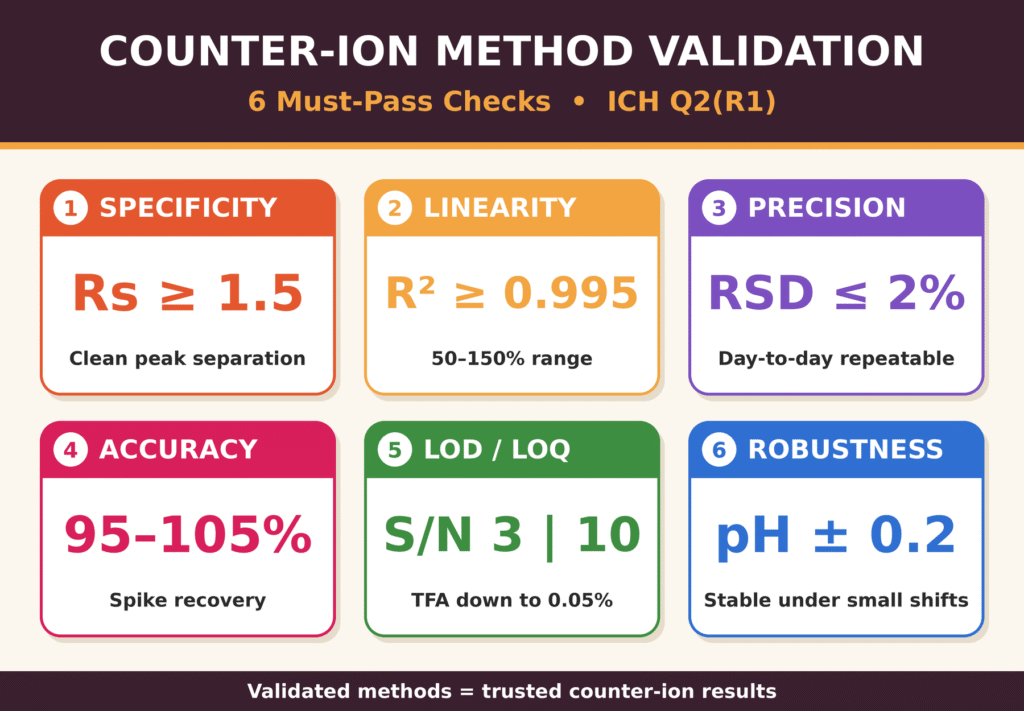
Analytical methods developed for counter-ion assays must undergo formal validation in compliance with ICH Q2(R1) parameters to support regulatory filings for IND, NDA, and ANDA submissions. Validation protocols verify method specificity, linearity, precision, accuracy, and robustness across predefined operational ranges.
Specificity: The analytical method must demonstrate baseline resolution (Rs ≥ 1.5) between target counter-ion peaks (acetate, TFA, chloride) and adjacent signals originating from peptide impurities, residual solvents, and formulation excipients. Peak purity must be confirmed using Photodiode Array (PDA) spectral analysis or Mass Spectrometry.
Linearity and Operational Range: Calibration response curves evaluated across 50% to 150% of the nominal target counter-ion working concentration must demonstrate a linear regression correlation coefficient of R2 ≥ 0.995.
Precision: System repeatability (intra-day) and intermediate precision (inter-day across different analysts and instruments) must produce a percent relative standard deviation (% RSD) of ≤ 2.0% for peak area responses.
Accuracy and Recovery: Recovery studies performed by spiking known quantities of counter-ion standards into peptide API matrices across low, mid, and high concentration levels must demonstrate mean recoveries within 95.0% to 105.0%.
Limits of Detection (LOD) and Quantitation (LOQ): Limits calculated using signal-to-noise metrics (S/N ≥ 3:1 for LOD and S/N ≥ 10:1 for LOQ) must provide sufficient sensitivity to detect residual TFA down to ≤ 0.05% w/w.
Robustness: Small, deliberate variations in key operational parameters—such as mobile phase pH (± 0.2 units), column temperature (± 5°C), and eluent flow rate (± 10%)—must not change retention times or recovery values beyond established system suitability limits.
Review key deliverables that can help structure analytical characterization packages and CRO-generated peptide testing reports:
Peptide Characterization CRO Deliverables Checklist
Technical Comparison of Analytical Platforms for Counter-Ion Quantification
Selecting the appropriate analytical platform for counter-ion quantification requires assessment of analyte chemical properties, required detection sensitivity, matrix complexity, and regulatory compliance requirements. The comparative matrix below summarizes key operational capabilities and performance specifications across the primary analytical techniques.
| Performance Parameter | Suppressed Ion Chromatography (HIC-ESP) | Mixed-Mode WAX HPLC-UV | HPLC with Charged Aerosol Detection (CAD) | Quantitative Fluorine NMR (19F-qNMR) |
|---|---|---|---|---|
| Primary Target Ions | TFA, Acetate, Chloride, Formate, Sulfate | Acetate, TFA, Hydrophilic Organic Acids | Chloride, Acetate, Methanesulfonate, TFA | Trifluoroacetate (TFA) exclusively |
| Detection Principle | Electrolytic Suppressed Conductivity | Low-UV Absorbance (210 nm) | Aerosol Corona Charging Electrometry | Larmor Frequency RF Resonance |
| Limit of Quantitation (LOQ) | Very High (≤ 0.1 μg/mL) | Moderate (≈ 5.0 μg/mL) | High (≈ 0.5 μg/mL) | High (≤ 0.01% w/w TFA) |
| Analysis Time | 15–25 minutes per sample | 15–30 minutes per sample | 10–20 minutes per sample | < 5 minutes per sample |
| Sample Preparation | Aqueous dilution; 0.22 μm filtration | Dilution in aqueous mobile phase | Dilution in volatile solvents | Dissolution in D2O or DMSO-d6 with IS |
| Matrix Interferences | Minimal (suppressor removes background) | Moderate (co-elution with polar impurities) | Minimal (non-volatile components separated) | Zero (no fluorine in natural peptide backbones) |
| Compendial Alignment | USP, EP general methods | USP, EP 2.5.34 | Recognized universal platform | Orthogonal reference technique |
Strategic Conclusion on Counter-Ion Analysis Services for Peptide APIs
Partnering with expert Counter-Ion Analysis Services for Peptide APIs provides rigorous quality control, precise Net Peptide Content determination, and regulatory compliance support throughout the various stages of peptide drug development. Advanced analytical workflows that combine suppressed IC, mixed-mode LC-MS/MS, and 19F-qNMR can help mitigate development risks associated with counter-ion variability and toxicological impurities.
As peptide therapeutics continue to advance toward longer sequences, cyclic structures, and complex peptide-drug conjugates (PDCs), controlling counter-ion profiles remains essential for maintaining batch-to-batch consistency and drug product stability. ResolveMass Laboratories Inc. provides advanced characterization platforms and ICH Q2(R1)-validated testing protocols designed to address challenging counter-ion quantification requirements. Rigorous counter-ion testing supports clinical development programs, facilitates regulatory submissions, and helps maintain consistent potency across finished drug product lots.
Explore additional peptide characterization strategies for complex peptide structures and advanced therapeutic development programs:
Cyclic Peptide Characterization
For technical consultation, custom analytical method development, or regulatory testing support, visit the ResolveMass Laboratories Contact Page.
Frequently Asked Questions
Acetate levels in peptide APIs are commonly controlled within pharmacopeial ranges of approximately 6.0% to 10.0% w/w under applicable USP and EP 2.5.34 requirements. The actual specification may vary according to the peptide’s molecular structure, theoretical salt stoichiometry, and number of basic amino acid residues.
Residual TFA can substantially reduce formulation pH because of its strong acidity (pKₐ = 0.52), potentially affecting peptide stability and promoting degradation pathways. It may also interfere with cellular assay results and, when present at inappropriate levels in injectable formulations, contribute to localized irritation or injection-site discomfort.
Suppressed Ion Chromatography uses an electrolytic suppressor to reduce background conductivity before detection, improving signal-to-noise performance and enabling low-level counter-ion measurement. Non-suppressed IC does not use this suppression step and generally operates with higher background conductivity, making it suitable for routine milligram-per-liter (mg/L) analysis.
Net Peptide Content is determined by combining chromatographic purity with the mass fraction remaining after accounting for measured water, counter-ions, and residual solvents. The calculation therefore removes these non-peptide components from the total API mass to estimate the actual amount of active peptide present in the weighed sample.
Mixed-mode Weak Anion Exchange (WAX) chromatography provides both hydrophobic and anion-exchange retention mechanisms, allowing small ionic species such as acetate to remain on the column. In contrast, standard C18 RP-HPLC may provide insufficient retention for highly polar counter-ions, increasing the risk of solvent-front interference and poor separation.
19F-qNMR can provide direct quantitative measurement of TFA because the trifluoromethyl signal offers high chemical specificity. However, it cannot replace chromatographic approaches when the analytical requirement includes simultaneous measurement of non-fluorinated counter-ions such as acetate or chloride.
Chloride analysis requires careful control of potential environmental and laboratory contamination because trace chloride can affect quantitative results. Ultra-pure deionized water with a resistivity of 18.2 MΩ·cm and appropriately cleaned laboratory equipment should be used, with all sample-contact materials verified for suitability.
Replacing TFA with acetate or chloride changes the ionic environment surrounding the peptide and can influence its intermolecular interactions and solid-state characteristics. These changes may affect pH-dependent solubility, dissolution behavior, and the acidity of the resulting peptide solution.
Counter-ion analytical methods should demonstrate appropriate specificity, linearity, precision, accuracy, and robustness in accordance with ICH Q2(R1). Typical performance criteria include Rₛ ≥ 1.5, R² ≥ 0.995, %RSD ≤ 2.0%, and recovery within 95.0%–105.0%, with sensitivity appropriate to the applicable specification.
Reference:
- United States Pharmacopeia. (n.d.). Reference standards to support the quality of synthetic peptide therapeutics. USP. PDF document
- European Medicines Agency. (2024). Guideline on the development and manufacture of synthetic peptides. European Medicines Agency. PDF document
- Tovi, A., Eidelman, C., Shushan, S., Elster, S., Alon, H., Ivchenko, A., Butilca, G.-M., & Zaoui, G. (2010). A counterion exchange process for peptides (European Patent No. EP1709065B1). European Patent Office. Google Patents
- Sanada, H., Kikuno, T., Kitamura, K., Hashimoto, K., & Mishima, M. (2023). Derivation of permitted daily exposure value for trifluoroacetic acid as an impurity in pharmaceutical products. Fundamental Toxicological Sciences, 10(7), 307–313. https://doi.org/10.2131/fts.10.307
- U.S. Food and Drug Administration. (2019). Liquid chromatography-tandem mass spectrometry (LC-MS/MS) method for the determination of NDMA in ranitidine drug substance and solid dosage drug product. FDA document
- Ilko, D., Nap, C. J., Holzgrabe, U., & Almeling, S. (2014). Validation and application of an HPLC-CAD-TOF/MS method for identification and quantification of pharmaceutical counterions. Pharmeuropa Bio & Scientific Notes, 2014, 81–91. ResearchGate article
Get In Touch With Us
About The Author


