

Introduction:
Clinical Trial Material Manufacturing for Phase I and II is a critical part of drug development because clinical studies depend on a consistent, safe and timely supply of investigational medicinal products. A well-designed manufacturing strategy lets pharmaceutical and biotechnology companies support early trials while managing uncertainty in formulation, dose selection, patient recruitment, product stability and regulatory expectations.
A CDMO provides specialized development and manufacturing capabilities that help sponsors move an investigational product from the laboratory into clinical evaluation. Depending on scope, services may include formulation development, process optimization, analytical method development, GMP manufacturing, quality control testing, packaging, labeling and clinical supply management.
Unlike commercial manufacturing, early-phase production often runs with limited process knowledge, evolving protocols and uncertain demand. Phase I studies may involve first-in-human dosing and dose escalation. Phase II studies generally evaluate preliminary efficacy, dose selection and safety in a broader patient population.
Supply planning must therefore balance speed, quality, flexibility and cost. ResolveMass Laboratories Inc., a Canadian analytical CRO/CDMO, contributes analytical testing and characterization support within a clearly defined development program. Our work in biosimilar characterization, mass spectrometry, PLGA-based drug delivery and nitrosamine testing helps sponsors generate the evidence needed to judge investigational product quality. Manufacturing responsibilities and GMP release activities should be assigned to appropriately qualified manufacturing and quality organizations.
Summary:
- Clinical Trial Material Manufacturing for Phase I and II requires flexible production planning, appropriate quality controls and reliable clinical supply management.
- Phase I prioritizes patient safety, initial clinical supply and rapid execution. Phase II typically needs larger quantities, additional batches and better process consistency.
- A Contract Development and Manufacturing Organization (CDMO) can support formulation development, analytical testing, drug product manufacturing, packaging, labeling and clinical supply coordination.
- Effective planning accounts for the clinical protocol, enrollment, dosing schedules, lead times, shelf life, stability data and regulatory requirements.
- Risk-based quality management, GMP compliance, batch traceability and change control protect product quality throughout clinical development.
- Early coordination between sponsors, CDMOs, analytical laboratories, clinical teams and logistics providers reduces delays and avoids unnecessary manufacturing cost.
- A scalable supply strategy prepares sponsors for Phase III and commercial manufacturing without committing prematurely to large-scale production.
1: What Is Clinical Trial Material Manufacturing for Phase I and II?
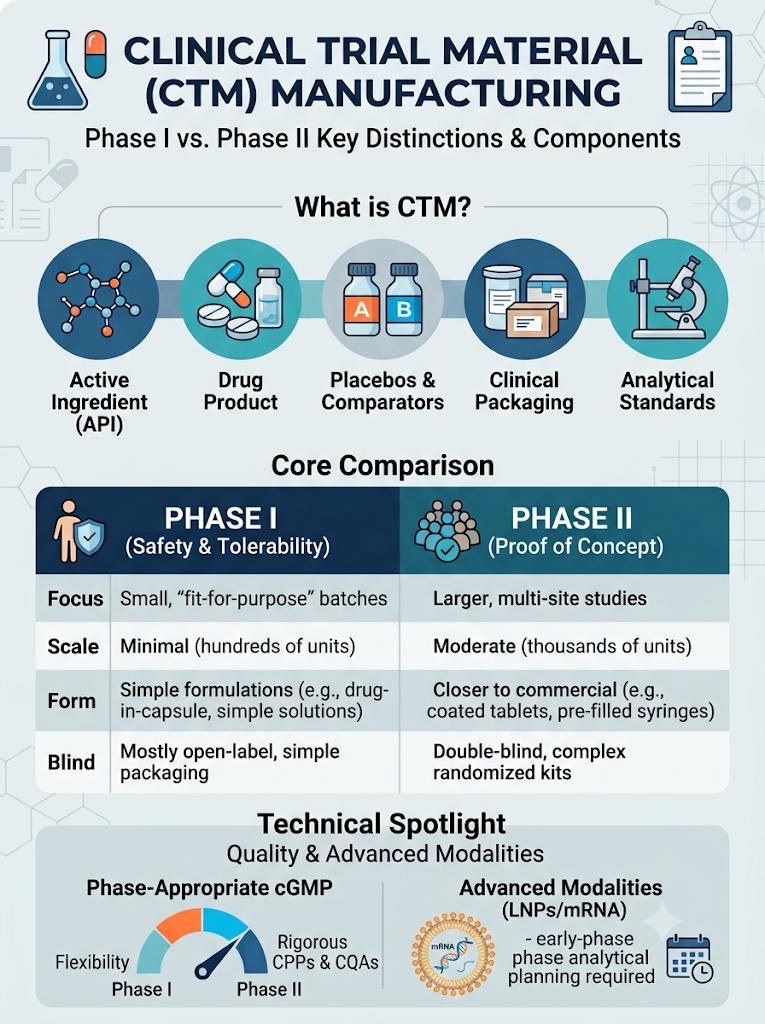
Clinical Trial Material Manufacturing for Phase I and II is the preparation, testing, packaging and supply of investigational drug product, in quantities suited to early human studies. The process must deliver suitable quality and traceability while accommodating changing development needs.
Clinical trial materials may include:
- Drug substance: the active pharmaceutical ingredient (API) used to make the investigational product.
- Drug product: the formulated dosage form, such as a tablet, capsule, injection, oral solution or lyophilized product.
- Placebo and comparator products: materials for blinded, controlled or comparative studies, when applicable.
- Clinical packaging components: containers, closures, labels and configurations suited to the study.
- Reference and analytical materials: standards and other materials for quality control, characterization and stability testing.
The right approach depends on the molecule, dosage form, route of administration, protocol and regulatory framework. Advanced modalities add further complexity. For example, lipid nanoparticle (LNP) formulation and characterization requires close control of particle attributes, so analytical planning must start well before the first clinical batch.
Before production begins, the CDMO should establish a project-specific plan covering responsibilities, quality requirements, timelines, documentation, testing and delivery arrangements. Sponsors should also understand the available CDMO contract models, since the model chosen affects cost, flexibility and how responsibility is shared.
2: How Do Phase I and Phase II Manufacturing Requirements Differ?
Phase I manufacturing emphasizes rapid preparation of an appropriately characterized investigational product. Phase II needs a more developed supply strategy to support broader clinical evaluation and potentially greater material demand.
| Planning factor | Phase I clinical supply | Phase II clinical supply |
|---|---|---|
| Primary objective | Support initial human studies and dose escalation | Support dose-ranging, efficacy and expanded safety studies |
| Batch quantities | Often relatively small and protocol-dependent | May require larger or more frequent batches |
| Formulation | May be exploratory or still being refined | May be refined based on Phase I findings |
| Process development | Establish a suitable, controlled process | Improve reproducibility and process understanding |
| Analytical testing | Establish appropriate quality and safety-related controls | Strengthen methods and specifications as development progresses |
| Stability strategy | Generate initial stability evidence and storage conditions | Expand stability knowledge to cover study duration and supply planning |
| Packaging and labeling | Support initial study design and blinding | Accommodate larger enrollment, multiple sites or extra treatment arms |
| Supply forecasting | Based on early enrollment estimates and dosing assumptions | Incorporates emerging clinical data and updated enrollment projections |
These are general planning patterns, not universal regulatory distinctions. Exact requirements depend on the product, jurisdiction, risk profile and development stage.
A Phase I injectable biologic may need substantial characterization and specialized handling even when only a small quantity is made. A Phase II oral product may instead need multiple strengths, additional packaging configurations and more extensive supply coordination.
A practical rule is to design Phase I material so it can be bridged to Phase II. If the formulation, container and key analytical methods change completely between phases, work may need repeating and the differences explained to regulators. This is the logic behind phase-appropriate CMC development at a CDMO: scale control to the stage of development without losing comparability.
3: What Are the Key Steps in Phase I and II Supply Planning?
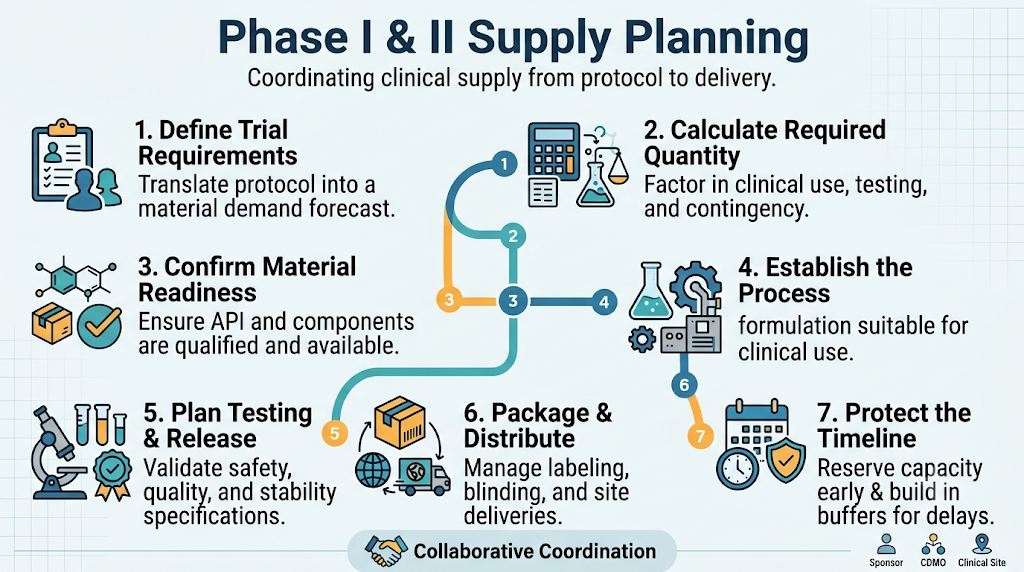
Effective supply planning starts with the clinical protocol and works backward from the required delivery date. Sponsors and CDMOs should integrate manufacturing, testing, packaging, release and distribution into one coordinated schedule.
1. How Do You Define Clinical Trial Requirements?
Translate the protocol into a material demand forecast by reviewing patient numbers, treatment arms, dose levels, treatment duration, visit schedules and planned enrollment. Key inputs include:
- Estimated patients and participating clinical sites
- Dose strengths, dosing frequency and treatment duration
- Number of dose-escalation cohorts or treatment arms
- Anticipated screening failures, withdrawals and replacement participants
- Retention samples, analytical samples and reference requirements
- Packaging, blinding and randomization requirements
A useful starting point is to estimate the total number of patient doses, then convert that into finished-product units and manufacturing quantities.
2. How Do You Calculate the Required Manufacturing Quantity?
Manufacturing quantity should cover expected clinical use, packaging losses, testing needs and a justified contingency. Avoid overproduction, because investigational products may have limited shelf life or become obsolete when the protocol changes.
Required supply = expected patient doses + justified contingency + testing and retention requirements + expected manufacturing and packaging losses.
For example, if a study needs 1,000 patient doses, the sponsor may need extra units to cover contingency and operational losses. Set the final quantity from documented assumptions, not an arbitrary percentage, and review the forecast as enrollment, dosing schedules and clinical outcomes become clearer. Biologics and sterile injectables often need more overage because of fill losses and extensive testing.
3. How Do You Confirm API Availability and Material Readiness?
API availability can become a critical-path issue, especially for complex molecules, low-yield synthesis routes, temperature-controlled materials or products with specialized storage needs. Before scheduling GMP manufacturing, confirm:
- API quantity and availability date
- Identity, purity, impurity profile and relevant quality documentation
- Supplier qualification and material traceability
- Availability and quality of excipients and packaging components
- Required material testing and acceptance criteria
- Storage conditions, retest dates and expiry or use-by considerations
Identify supply constraints early, particularly where API synthesis, specialized excipients or imported components have long lead times.
4. How Do You Establish the Manufacturing Process?
The process should suit the intended clinical use and be controlled enough to produce material that meets predefined quality requirements. The development approach should reflect the product’s complexity and the process knowledge available. Activities may include formulation screening, process parameter evaluation, scale-up assessment, equipment selection and definition of in-process controls.
Document critical process parameters and relevant quality attributes where appropriate. Evaluate any change to formulation, equipment, process or site through a documented quality system.
5. How Do You Plan Analytical Testing and Quality Release?
Analytical testing shows whether clinical trial material meets specifications and is suitable for its intended use. Testing should be scientifically justified, documented and appropriate to the product and stage. Depending on the dosage form, the program may include:
- Identification and assay of the active ingredient
- Related substances and degradation products
- Dissolution or drug-release testing, where applicable
- Content uniformity and dosage-unit testing
- Microbial limits, sterility and endotoxin testing, where applicable
- Residual solvents, elemental impurities and other risk-based assessments
- Nitrosamine risk assessment, with testing where risk is identified
- Stability testing and verification of storage conditions
Methods should be fit for purpose now and ready to mature later. Frameworks such as ICH Q2(R2) and ICH Q14 guide analytical validation and lifecycle development, and Phase II is typically when methods move toward full validation.
The sponsor, CDMO and testing laboratory should agree on methods, specifications, sample quantities, timelines and responsibilities before manufacturing starts. Batch disposition and release must remain with the appropriately authorized quality function.
6. How Do You Coordinate Packaging, Labeling and Distribution?
Clinical packaging protects product integrity and supports correct administration, traceability and blinding. Decisions should reflect dosage form, storage requirements, study design and the number of sites. Plan for:
- Primary container compatibility and container-closure integrity, when relevant
- Label content and country-specific requirements
- Kit assembly, randomization and blinding controls
- Expiry or retest information supported by available data
- Temperature monitoring and shipping qualification, where appropriate
- Site delivery schedules, inventory tracking and returns or reconciliation
Decide early whether you need placebo, blinded packaging or a comparator, since sourcing a comparator can take as long as making your own drug. A finished batch is not automatically ready for clinical use. Testing, quality disposition, documentation, packaging, labeling and distribution must all be completed as applicable.
7. How Do You Protect the Timeline?
Lock drug substance availability, reserve CDMO capacity early and agree on decision points in writing. A typical early-phase schedule runs from technical transfer and gap assessment, through method qualification and any engineering run, to GMP manufacture, release testing, packaging and labeling, and distribution to sites. Build in buffer for deviation investigations and regulatory queries, the usual causes of slips.
4: What Analytical, CMC and Regulatory Requirements Apply?
Early-phase clinical supply must be made under phase-appropriate GMP, tested with suitable methods and documented well enough to support an IND, an IMPD or a Health Canada clinical trial application. Regulators expect quality to scale with risk and stage, but they never relax expectations on subject safety.
In the United States, FDA’s 2008 guidance on CGMP for Phase 1 investigational drugs describes a flexible approach for early studies, and 21 CFR Parts 210 and 211 form the broader GMP framework. In Canada, Health Canada applies its GMP guidance to clinical trial drugs under the Food and Drug Regulations. In Europe, EU GMP Annex 13 governs investigational medicinal products. Your CDMO should know which of these your sites and submissions require.
| Test area | Purpose | Typical phase-appropriate approach |
|---|---|---|
| Identity and assay | Confirm the right drug at the right strength | Qualified methods in Phase I, validation progressing in Phase II |
| Purity and impurities | Control degradation and process impurities | Orthogonal methods, often HPLC and mass spectrometry |
| Nitrosamine risk | Assess potential nitrosamine formation | Risk assessment, with testing where risk is identified |
| Dosage-form performance | Dissolution, particle size, release, content uniformity | Fit-for-purpose, tied to formulation |
| Microbial and sterility controls | Protect patient safety | As applicable to the dosage form |
| Stability | Support shelf life and in-use periods | Short-term in Phase I, extended in Phase II |
The CMC section of a submission describes the drug substance, drug product, process, controls and stability. Reviewers want to see that the material is safe to dose, well characterized for its stage and made under controlled conditions. ICH Q1A(R2) guides stability design, and ICH Q8 to Q11 principles become more relevant as Phase II data build toward later phases. Keep a clear record of every formulation, process and method change between batches, which makes later comparability work far easier.
For complex products such as biosimilars, peptides and PLGA-based depots, mass spectrometry and orthogonal characterization help show that early batches are well understood and that later batches remain comparable.
5: What Are the Most Common Supply Planning Risks?
The most common risks are under-sized batches, late discovery of analytical or stability gaps, drug substance shortages and uncontrolled changes between phases. Most are preventable through early alignment among the sponsor, CDMO and clinical team.
| Risk | Why it happens | How to reduce it |
|---|---|---|
| Batch too small | Forecast ignores overage or amendments | Plan to a high-case forecast and review at each protocol change |
| Method not ready | Methods developed late or for one batch only | Start qualification during formulation development |
| Stability shortfall | Shelf life too short for Phase II duration | Begin stability early and align pull points to protocol timelines |
| Formulation change between phases | Phase I recipe is not scalable | Choose a scalable formulation or plan a comparability bridge |
| Drug substance delays | API supply not secured | Confirm quantity, quality and release status before scheduling |
| Labeling and packaging changes | Late country additions or comparators | Freeze packaging design early and confirm regional requirements |
| Impurity or nitrosamine surprise | Risk assessment skipped | Complete the risk assessment before the first GMP batch |
| Unclear responsibilities | Roles not defined in writing | Agree responsibilities in CDMO quality agreements before work starts |
Treat every deviation as both a quality event and a schedule event. A well-run investigation protects the data, and an early conversation with the sponsor protects the timeline.
6: How Do You Choose a CDMO for Early-Phase Clinical Supply?
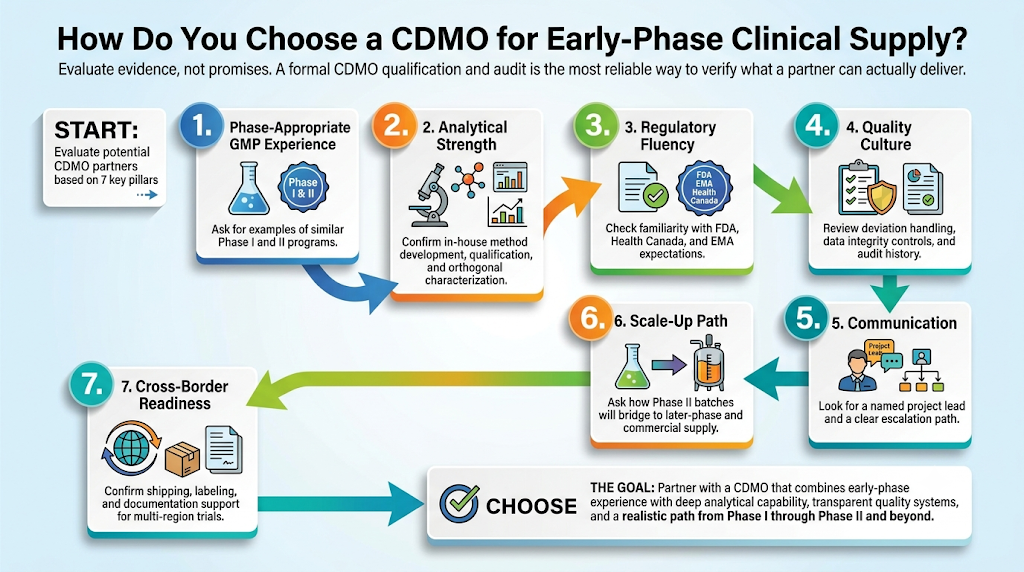
Choose a CDMO that combines early-phase experience with deep analytical capability, transparent quality systems and a realistic path from Phase I through Phase II and beyond. Evaluate evidence, not promises. A formal CDMO qualification and audit is the most reliable way to verify what a partner can actually deliver.
- Phase-appropriate GMP experience: ask for examples of similar Phase I and II programs.
- Analytical strength: confirm in-house method development, qualification and orthogonal characterization.
- Regulatory fluency: check familiarity with FDA, Health Canada and EMA expectations.
- Quality culture: review deviation handling, data integrity controls and audit history.
- Communication: look for a named project lead and a clear escalation path.
- Scale-up path: ask how Phase II batches will bridge to later-phase and commercial supply.
- Cross-border readiness: confirm shipping, labeling and documentation support for multi-region trials.
Why Work With ResolveMass Laboratories Inc.?
ResolveMass is a Canadian analytical CRO/CDMO with scientific depth in the areas where early supply decisions are hardest to reverse:
- Biosimilar characterization, including mass spectrometry-based comparability evidence
- PLGA-based drug delivery systems, from polymer characterization to long-acting formulations
- Mass spectrometry and orthogonal analytics, which give early batches a defensible quality profile
- Nitrosamine risk assessment and testing, so impurity concerns are addressed before the first GMP batch
- Cross-border regulatory thinking, supporting programs that must satisfy both FDA and Health Canada expectations
Because analytical and development expertise sit together, gaps in methods, stability or impurity control are found while they are still cheap to fix.
Conclusion:
Clinical Trial Material Manufacturing for Phase I and II works best when supply planning, analytical readiness and regulatory strategy are built together from day one. Forecast demand from the protocol, add justified contingency, size batches for the full early-phase plan, and make sure methods and stability data are ready before the first GMP batch. Document every change so the program stays comparable as it grows.
Frequently Asked Questions:
Applicable GMP requirements may cover personnel training, facility controls, equipment qualification, batch documentation, material traceability, contamination prevention, deviation management, quality control, and authorized batch disposition. Specific requirements depend on the product and regulatory jurisdiction.
Stability is assessed using scientifically justified studies under defined storage conditions to evaluate changes in product quality over time. Results help establish appropriate storage conditions, retest periods or shelf life, and expiry dating in accordance with applicable requirements.
Common causes include API shortages, formulation challenges, manufacturing deviations, analytical method issues, unexpected stability results, packaging component delays, regulatory changes, and incomplete documentation. Early risk assessment and coordinated project management can help minimize delays.
A CDMO and sponsor can reduce shortages through demand forecasting, inventory monitoring, realistic lead-time estimates, contingency planning, enrollment tracking, and timely scheduling of additional batches when justified.
They may be suitable only when the product, formulation, manufacturing process, quality attributes, stability, and applicable regulatory requirements support their intended use. Changes introduced between phases should be evaluated to determine whether additional comparability or supporting studies are necessary.
Reference
- Lowdell MW. Considerations for manufacturing of cell and gene medicines for clinical development. Cytotherapy. 2025 Jul 1;27(7):874-83.https://www.sciencedirect.com/science/article/pii/S1465324924009411
- Bachelet C, Ladhari N, Fouassier A, Negre H, Picard L. ENABLING SEAMLESS CLINICAL-TO-COMMERCIAL MANUFACTURING OF CELL AND GENE THERAPIES: AN END-TO-END ATMP CDMO APPROACH. Cytotherapy. 2026 May 1;28(5):102460.https://www.sciencedirect.com/science/article/pii/S1465324926004214
- Ferreira RS, Morales MM, Barretti P, Barraviera B. Launching a CDMO in Brazil aiming to develop biopharmaceuticals for clinical trials. Journal of Venomous Animals and Toxins including Tropical Diseases. 2022 Jun 6;28:e20220017.https://www.scielo.br/j/jvatitd/a/bR7KGg6xkj6wTmhgcXGx4NH/?lang=en
- Platz A, Buettner K, Roessler S, Sonnernberg S, Schaefer T, Schmidt A. Development from a Cord Blood Bank to a Contract Development and Manufacturing Organization (CDMO) for ATMP. Cytotherapy. 2025 May 1;27(5):S100-1.https://www.sciencedirect.com/science/article/pii/S1465324925002804
- Edwards EE. Long range planning of biologics process development and clinical trial material supply process (Doctoral dissertation, Massachusetts Institute of Technology).https://dspace.mit.edu/handle/1721.1/66068
About the Author


