

Introduction
A well-prepared Common Technical Document (CTD) Module 3 serves as a comprehensive, reviewer-ready Chemistry, Manufacturing, and Controls (CMC) quality dossier. It demonstrates product safety, batch-to-batch reproducibility, and consistent quality control throughout the drug lifecycle. Professional Regulatory CMC Writing Services connect laboratory analytical datasets with global regulatory expectations by converting complex manufacturing documentation into a harmonized dossier that complies with International Council for Harmonisation (ICH) M4Q guidelines.
Organizations developing regulatory submissions can strengthen their technical documentation through comprehensive CMC services that support quality dossier preparation and regulatory compliance.
In global regulatory submissions, including New Drug Applications (NDAs), Biologics License Applications (BLAs), Investigational New Drugs (INDs), Investigational Medicinal Product Dossiers (IMPDs), and Marketing Authorization Applications (MAAs), Module 3 serves as the primary technical foundation reviewed by regulatory authorities such as the U.S. Food and Drug Administration (FDA), European Medicines Agency (EMA), and Pharmaceuticals and Medical Devices Agency (PMDA). Regulatory submissions must demonstrate precise alignment among critical material attributes (CMAs), critical process parameters (CPPs), and critical quality attributes (CQAs) in accordance with ICH Q8(R2) through Q14 guidelines. Preparing a submission-ready dossier requires detailed document granularity, the elimination of conflicting data, and the integration of emerging standards, including FDA Pharmaceutical Quality – Chemistry, Manufacturing & Controls (PQ/CMC) FHIR models and the draft ICH M4Q(R2) framework.
Share via:
Quick Summary:
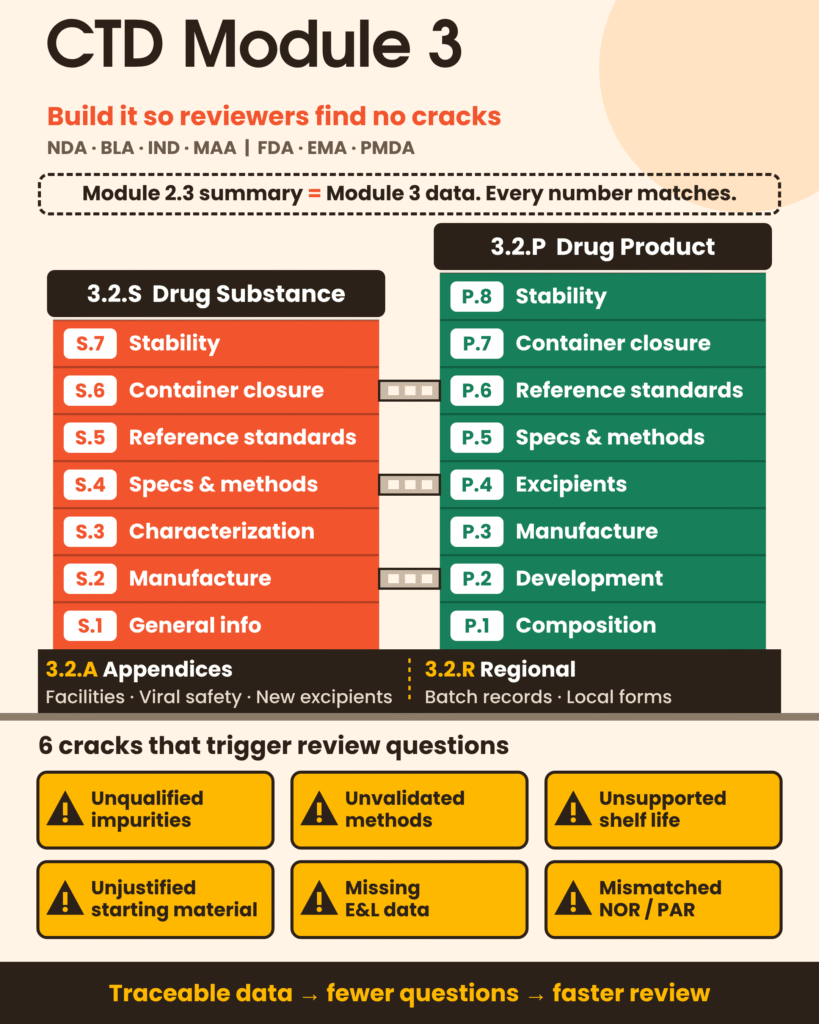
- What Module 3 is: It is the CMC quality dossier at the core of NDA, BLA, IND and MAA submissions. It is written to ICH M4Q and reviewed by agencies such as the FDA, EMA and PMDA to confirm product safety, consistency and quality control.
- Drug substance (3.2.S): This part covers the API’s identity, manufacturing route, process controls and starting-material justification under ICH Q11. For biologics, it also covers cell bank and viral safety details.
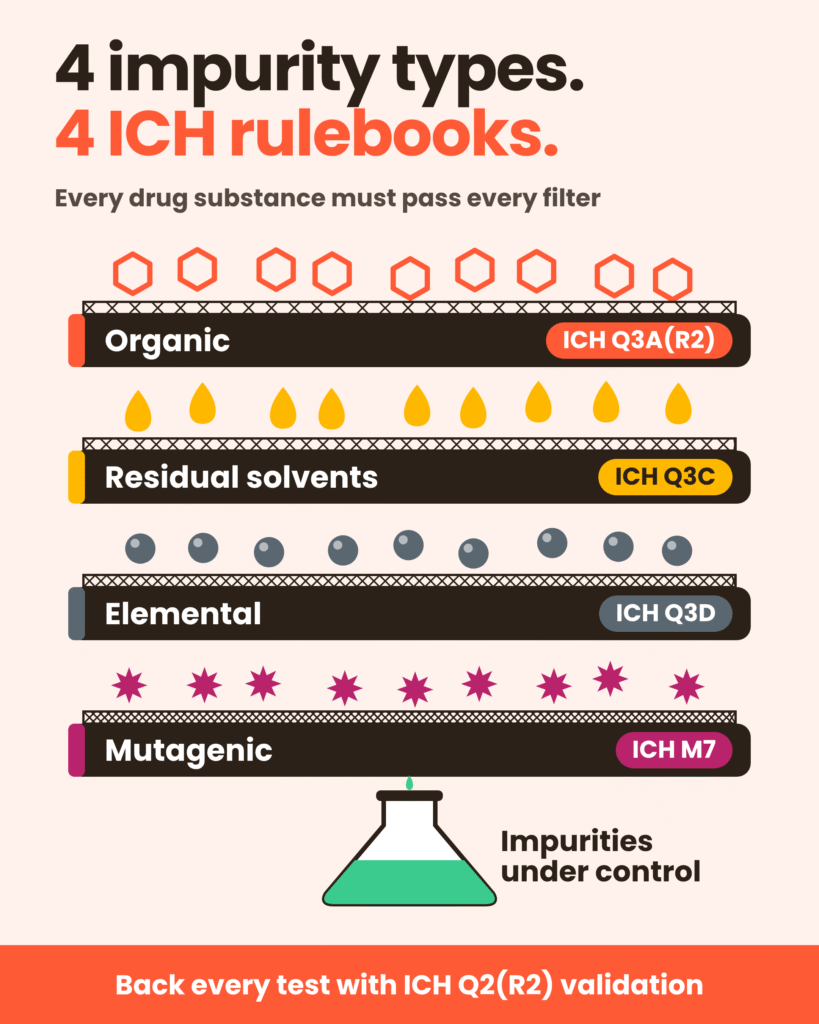
- Impurities and methods: Impurity control should follow ICH Q3A, Q3C, Q3D and M7. All analytical methods need validation to ICH Q2(R2), and compendial methods need verification under actual conditions of use.
- Drug product (3.2.P): This part justifies the formulation and excipient choices and documents excipient controls, including TSE/BSE assessments where relevant. It also covers manufacturing and PPQ validation, release and shelf-life specifications, E&L data for packaging, and stability.
- Granularity and consistency: Correct eCTD granularity makes post-approval changes easier. The Module 2.3 Quality Overall Summary must match Module 3 exactly, since mismatched specs, sites or stability data trigger avoidable review questions.
- Appendices and regional data: 3.2.A covers facilities, adventitious-agent safety and novel excipients. 3.2.R holds region-specific documents such as executed batch records.
- Avoiding deficiencies: Early gap assessments help catch common issues before submission. These include unqualified impurities, unvalidated methods, unsupported shelf life, unjustified starting materials, missing E&L data, and inconsistent NOR/PAR ranges. Data traceability and standard templates also help the dossier get through review faster.
Strategic Structuring of 3.2.S in Regulatory CMC Writing Services
Section 3.2.S establishes the chemical, physical, biological, and manufacturing quality controls for the active pharmaceutical ingredient (API), ensuring the safety, identity, and consistency of the drug substance. Specialized Regulatory CMC Writing Services structure these subsections to demonstrate that the essential properties of the active substance remain consistent throughout clinical development and commercial-scale manufacturing.
Active Pharmaceutical Ingredient Synthesis and Process Control
Section 3.2.S.2 provides a detailed account of the complete synthetic route, cell culture process, critical process parameters, and raw material control limits in accordance with ICH Q11 standards. Regulatory authors incorporate comprehensive process flow diagrams, scientific justifications for starting materials, manufacturing scale parameters, and intermediate controls to demonstrate process robustness and the ability to remove or reduce impurities during production.
Detailed documentation of API manufacturing processes is essential for establishing consistent drug substance quality. Additional support for drug substance CMC documentation can help organizations present manufacturing information in a scientifically justified regulatory format.
The selection of chemical starting materials requires thorough scientific justification to prevent unidentified or insufficiently characterized impurities from carrying over into the final active substance. For biological and biotechnological products, Section 3.2.S.2.3 requires extensive documentation covering cell bank origin, strain purity, passage stability, and adventitious virus screening. These details establish the biological integrity of the production system and demonstrate that appropriate controls are maintained throughout the manufacturing process.
Characterization and Impurity Control Strategies in Regulatory CMC Writing Services
Sections 3.2.S.3 and 3.2.S.4 establish the complete physical, chemical, stereochemical, and structural identity of the drug substance, together with its associated impurity profile. Regulatory CMC Writing Services develop scientifically justified impurity control strategies that comply with ICH Q3A(R2) for organic impurities, ICH Q3C for residual solvents, ICH Q3D for elemental impurities, and ICH M7 for mutagenic impurities.
A scientifically supported impurity assessment helps establish appropriate identification, qualification, and acceptance limits. Organizations can strengthen this documentation through specialized impurity profiling in CMC to address potential quality and safety concerns.
Analytical procedures described in Section 3.2.S.4.2 must be supported by comprehensive validation documentation in accordance with ICH Q2(R2) standards. These validation reports should address specificity, linearity, range, precision, accuracy, limits of detection and quantitation, and method robustness. For compendial testing procedures, suitability must also be verified under actual operating conditions to establish their reliability and reproducibility within the intended laboratory environment.
| Subsection | Section Title | Primary Technical Deliverables | Governing Guidelines |
|---|---|---|---|
| 3.2.S.1 | General Information | Nomenclature, CAS number, chemical structure, molecular weight, stereochemistry, and general physicochemical properties. | ICH M4Q, ICH Q6A/B |
| 3.2.S.2 | Manufacture | Manufacturer roles, process flowcharts, synthetic or biological descriptions, material controls, CPP definitions, and process validation. | ICH Q11, ICH Q5A/D |
| 3.2.S.3 | Characterization | Structural elucidation, physical polymorph analysis, biological activity assays, and comprehensive impurity profiling. | ICH Q6A/B, ICH Q3A/C/D, ICH M7 |
| 3.2.S.4 | Control of Drug Substance | Release specification tables, analytical methodologies, ICH Q2 validation reports, batch analyses, and specification justifications. | ICH Q2(R2), ICH Q6A/B |
| 3.2.S.5 | Reference Standards | Primary and secondary reference standard source details, characterization certificates, purity assignments, and qualification protocols. | ICH Q6A/B |
| 3.2.S.6 | Container Closure System | Packaging material construction, food-contact compliance, extractables/leachables evaluations, and barrier protection data. | USP |
| 3.2.S.7 | Stability | Real-time, accelerated, and stress stability data, degradation pathway profiles, and retest period justifications. | ICH Q1A(R2), ICH Q1B, ICH Q5C |
Building a Resilient 3.2.P Section with Regulatory CMC Writing Services
Section 3.2.P establishes the comprehensive quality framework for the finished dosage form, covering formulation stability, manufacturing controls, container compatibility, and product performance. Professional Regulatory CMC Writing Services translate pharmaceutical development knowledge into scientifically justified and validated manufacturing controls that support consistent product quality and batch-to-batch reproducibility.
Formulation Rationale and Excipient Compatibility
Sections 3.2.P.1 through 3.2.P.4 describe the qualitative and quantitative composition of the formulation and provide scientific justification for selecting functional excipients in relation to the target product quality profile. Regulatory authors document excipient compatibility studies, potential degradation risks, and relevant functional characteristics, including binder dissolution rates and disintegrant kinetics. This information demonstrates that the selected formulation components are appropriate for maintaining the intended product performance and stability.
Excipient control documentation in Section 3.2.P.4 establishes compliance with applicable compendial requirements, including USP, Ph. Eur., and JP, or provides detailed information about novel excipient dossiers under Section 3.2.A.3. For excipients containing animal-derived components, Transmissible Spongiform Encephalopathy (TSE) and Bovine Spongiform Encephalopathy (BSE) risk evaluations must be included to demonstrate compliance with international safety expectations and applicable regulatory requirements.
Manufacturing Process Validation and Finished Product Controls
Sections 3.2.P.3 and 3.2.P.5 describe the manufacturing unit operations, in-process controls, batch master records, process performance qualification, and finished dosage form release specifications. Regulatory writing ensures that Process Performance Qualification (PPQ) protocols provide sufficient evidence of consistent manufacturing performance and demonstrate that operating parameters remain controlled within established normal operating ranges.
Effective manufacturing documentation also requires coordinated technical execution and appropriate quality oversight. Organizations can strengthen their development and manufacturing activities through integrated CMC CRO services that support pharmaceutical development and analytical requirements.
Finished drug product controls documented in Section 3.2.P.5 establish the release and shelf-life acceptance criteria using clinical safety information, historical batch analytical results, and statistical degradation modeling. Primary container closure systems described in Section 3.2.P.7 require appropriate extractable and leachable (E&L) safety assessments in accordance with applicable USP standards to evaluate potential interactions between packaging components and the finished drug product.
Packaging compatibility assessments should address potential chemical interactions between pharmaceutical formulations and their contact materials. Comprehensive extractables and leachables evaluations provide supporting evidence for assessing material-related risks and maintaining product quality.
| Subsection | Section Title | Key Technical Expectations & Review Focus | Governing Guidelines |
|---|---|---|---|
| 3.2.P.1 | Description and Composition | Quantitative composition tables, component functional classifications, dosage form definitions, and overage explanations. | ICH M4Q(R1) |
| 3.2.P.2 | Pharmaceutical Development | Design of Experiments (DoE) data, CQA/CMA identification, formulation optimization narratives, and clinical bio-bridging data. | ICH Q8(R2), ICH Q9(R1), ICH Q10 |
| 3.2.P.3 | Manufacture | Commercial manufacturing site data, flowcharts, batch formulas, in-process controls, hold times, and PPQ validation protocols. | ICH Q7, ICH Q10 |
| 3.2.P.4 | Control of Excipients | Compendial testing references, non-compendial validations, TSE/BSE safety certificates, and novel excipient cross-references. | ICH Q6A, Regional Pharmacopeias |
| 3.2.P.5 | Control of Drug Product | Release and shelf-life specification tables, validated test procedures, pivotal batch analytical results, and specification rationale. | ICH Q6A/B, ICH Q2(R2), ICH Q3C/D |
| 3.2.P.6 | Reference Standards | Technical characterization, primary/secondary standard controls, and inventory tracking procedures for drug product assays. | ICH Q6A/B |
| 3.2.P.7 | Container Closure System | Packaging component specifications, construction schematics, material integrity assessments, and extractables/leachables data. | USP |
| 3.2.P.8 | Stability | Long-term, intermediate, and accelerated stability data, photostability, in-use testing, degradation trending, and shelf-life assignment. | ICH Q1A(R2), ICH Q1B, ICH Q1E, ICH Q5C |
Granularity, Appendices, and Cross-Dossier Data Consistency
Maintaining appropriate document granularity and consistency across the regulatory dossier helps prevent administrative delays and technical information requests during regulatory review. A properly organized file structure also simplifies electronic submission compilation and supports efficient management of post-approval lifecycle changes.
Granularity Frameworks and Data Alignment
Electronic Common Technical Document (eCTD) granularity requirements divide CTD Module 3 into individual, self-contained electronic files that comply with regional submission system requirements. Appropriate leaf-level granularity enables sponsors to implement post-approval changes, including manufacturing process modifications and specification tightening, without unnecessarily affecting other documents within the dossier.
Summary statements presented in CTD Module 2.3 (Quality Overall Summary) must remain consistent with the supporting technical information provided in Module 3. Differences in specification values, batch scale ranges, manufacturing site names, or stability storage durations between the summary and detailed sections can result in avoidable regulatory review questions. Maintaining accurate cross-references and verifying data consistency across all modules are therefore essential for preparing a reliable submission.
Managing Appendices and Regional Requirements
Sections 3.2.A and 3.2.R contain specialized technical assessments, facility-related safety information, and jurisdiction-specific regulatory documentation required to support the overall quality dossier.
- Section 3.2.A.1 (Facilities and Equipment): Documents HVAC environmental classifications, cleanroom pressure cascades, equipment cross-contamination controls, and facility floor schematics. This information is particularly relevant to biological products and sterile pharmaceutical manufacturing operations.
- Section 3.2.A.2 (Adventitious Agents Safety Evaluation): Includes viral clearance factor calculations (log10 reduction values), viral safety study protocols, cell bank viral testing results, and TSE/BSE risk assessments to demonstrate appropriate controls against potential biological contamination.
- Section 3.2.A.3 (Novel Excipients): Provides detailed characterization, safety, and specification information for non-compendial excipients. The documentation is structured using a format comparable to that of a drug substance dossier.
- Section 3.2.R (Regional Information): Contains jurisdiction-specific documentation, including executed batch records, process validation schemes, medical device combination documentation, and regional administrative forms required by individual regulatory authorities.
Mitigating Critical Review Triggers with Regulatory CMC Writing Services
Reducing regulatory review deficiencies requires early identification and resolution of analytical validation gaps, insufficient scientific justifications, and inadequately supported specifications. These issues can contribute substantially to first-cycle regulatory questions and may delay the review process. Regulatory CMC Writing Services conduct comprehensive technical gap assessments to identify documentation weaknesses and resolve potential deficiencies before the final submission dossier is locked.
Early identification of documentation gaps is particularly important for IND and NDA submissions, where unresolved quality issues can generate additional regulatory questions. A structured approach to identifying CMC deficiencies in IND and NDA submissions helps sponsors address potential weaknesses before submission.
| Common CMC Deficiency | Operational & Safety Impact | Proactive Writing & Mitigation Strategy |
|---|---|---|
| Inadequate Impurity Qualification | Impurity limits exceed ICH Q3A/B qualification thresholds without an appropriate toxicological evaluation. | Perform ICH M7 mutagenic risk assessments, complete structural characterization, and incorporate appropriate toxicological bridging studies. |
| Unvalidated Analytical Procedures | Missing precision or robustness data, or the use of compendial methods without verification for the specific drug product. | Complete analytical method validation in accordance with ICH Q2(R2) before dossier finalization and document the verification of relevant analytical parameters. |
| Misaligned Retest/Shelf-Life Claims | Assigned expiry dates are not adequately supported by real-time stability data or involve parameters that exceed established acceptance limits. | Apply statistical linear regression and degradation trending in accordance with ICH Q1E to justify shelf life and align release specifications with observed degradation patterns. |
| Unjustified Starting Materials | Advanced intermediates are designated as starting materials at later synthesis stages without sufficient scientific justification, potentially reducing oversight of upstream manufacturing steps. | Apply ICH Q11 starting material selection principles during early development and provide detailed purge studies demonstrating the fate and clearance of upstream impurities. |
| Missing Extractable/Leachable Data | Potential leachables from primary packaging components or single-use processing systems have not been adequately evaluated. | Conduct controlled extraction studies in accordance with applicable USP standards and perform leachable assessments aligned with maximum daily dose limits. |
| Inconsistent Parameter Ranges | Differences exist between routine operating ranges and validated proven acceptable ranges across manufacturing documentation. | Clearly define Normal Operating Ranges (NORs) and Proven Acceptable Ranges (PARs) and maintain consistency across Sections 3.2.S.2 and 3.2.P.3. |
Technical Execution in Regulatory CMC Writing Services
Effective regulatory CMC authoring requires continuous data verification, standardized documentation templates, and the early integration of regulatory intelligence. Professional regulatory writing teams implement structured internal quality review procedures to confirm that figures, analytical tables, batch manufacturing records, and protocol descriptions remain accurate and consistent throughout every section of the regulatory submission.
In addition to accurate dossier preparation, reliable analytical methods are essential for supporting the technical information submitted to regulatory authorities. Organizations can strengthen their analytical documentation through analytical method development and validation for IND and NDA submissions, ensuring that testing procedures are appropriately supported by scientific evidence.
Regulatory writers must establish complete data traceability, connecting original laboratory records and analytical results with the corresponding information presented in summary dossiers. Implementing standardized submission templates, coordinating authoring workflows, and systematically verifying cross-dossier references helps ensure that CTD Module 3 complies with electronic submission requirements and successfully completes initial technical validation checks. These practices also improve document quality, minimize inconsistencies, and support a more efficient regulatory review process.
Conclusion
A thoroughly prepared CTD Module 3 converts complex chemistry and manufacturing information into a structured, reviewer-ready dossier that demonstrates product safety, effective process control, and consistent quality throughout the drug lifecycle. Engaging experienced Regulatory CMC Writing Services helps biopharmaceutical organizations develop harmonized regulatory dossiers that comply with international standards, reduce avoidable review questions, and support more efficient approval timelines.
Biopharmaceutical sponsors must maintain appropriate document granularity, ensure that summary sections accurately reflect the supporting technical data, and prepare for evolving regulatory expectations, including ICH M4Q(R2) and FDA PQ/CMC electronic data structures. For specialized assistance with regulatory authoring, documentation management, and the preparation of submission-ready Module 3 dossiers, contact the regulatory team at ResolveMass Laboratories Inc. directly through our Contact Page.
Frequently Asked Questions
Section 3.2.S addresses the Active Pharmaceutical Ingredient (API), including its manufacturing process, chemical characterization, impurity control, specifications, and stability. In contrast, Section 3.2.P focuses on the finished dosage form, covering formulation development, excipient selection, manufacturing controls, product specifications, packaging systems, and shelf-life evaluation. Both sections provide complementary information needed to establish overall product quality.
The ICH M4Q guideline defines the harmonized structure and organization of the quality information presented in CTD Module 3. It helps pharmaceutical companies prepare consistent regulatory documentation that can be used across multiple international markets. Following this framework supports regulatory assessments by authorities such as the FDA, EMA, PMDA, and Health Canada while reducing differences in dossier organization.
The draft ICH M4Q(R2) revision proposes updates to the organization and presentation of pharmaceutical quality information to accommodate evolving manufacturing technologies and regulatory expectations. Its scope addresses areas such as advanced manufacturing approaches, continuous process verification, and lifecycle management of quality data. These proposed changes are intended to improve how technical manufacturing information is structured and assessed within regulatory submissions.
Module 2.3, known as the Quality Overall Summary, presents an organized overview of the detailed CMC information documented in Module 3. Both sections must contain matching information regarding specifications, manufacturing sites, batch sizes, analytical methods, and stability data. Any discrepancies can create uncertainty during regulatory assessment, resulting in additional Information Requests (IRs) and potentially extending the review timeline.
Analytical method validation information is included in the relevant drug substance and drug product control sections, particularly Sections 3.2.S.4.3 and 3.2.P.5.3. The supporting documentation must follow ICH Q2(R2) requirements and demonstrate essential validation characteristics, including specificity, precision, accuracy, linearity, range, limits of detection and quantitation (LOD/LOQ), and robustness. These records establish that analytical procedures are suitable for their intended testing purposes.
Section 3.2.A.2 provides evidence supporting the safety of biological materials against potential adventitious agent contamination. It includes information on viral safety, mycoplasma testing, and Transmissible Spongiform Encephalopathy (TSE/BSE) risk assessments, where applicable. Documentation may also cover viral clearance studies, experimental procedures, clearance factor calculations, and validation of viral inactivation steps used during biological manufacturing.
Regulatory submissions may encounter significant deficiencies when analytical methods lack adequate validation, impurity profiles are insufficiently characterized, or starting material selection is not scientifically justified. Other concerns include incomplete extractables and leachables assessments, inadequate stability evidence, and insufficient validation of manufacturing hold times. Conducting detailed technical reviews and verifying supporting data before submission can help identify and address these issues.
Quality by Design (QbD), as described under ICH Q8(R2), provides a systematic approach to documenting pharmaceutical development activities in Section 3.2.P.2. Authors establish the Quality Target Product Profile (QTPP) and use Design of Experiments (DoE) studies to evaluate relationships among Critical Material Attributes (CMAs), Critical Process Parameters (CPPs), and Critical Quality Attributes (CQAs). This information supports formulation optimization, process understanding, and the establishment of an appropriate design space.
Section 3.2.R contains additional regulatory documentation required by individual national or regional authorities that is not covered by the harmonized core CTD structure. Depending on the jurisdiction, this section may include executed batch records, process validation documentation, specific medical device combination product information, and regional administrative forms. These requirements differ because regulatory authorities apply additional national standards and submission procedures to address their specific regulatory needs.
Reference:
- International Council for Harmonisation of Technical Requirements for Pharmaceuticals for Human Use. (n.d.). CTD: The Common Technical Document. https://www.ich.org/page/ctd
- U.S. Food and Drug Administration. (n.d.). Pharmaceutical quality – Chemistry, manufacturing & controls (PQ/CMC). U.S. Department of Health and Human Services. https://www.fda.gov/industry/fda-data-standards-advisory-board/pharmaceutical-quality-chemistry-manufacturing-controls-pqcmc
- International Council for Harmonisation of Technical Requirements for Pharmaceuticals for Human Use. (2003, July 1). ICH M4Q: Common technical document for the registration of pharmaceuticals for human use—Quality (Step 5). European Medicines Agency. https://www.ema.europa.eu/en/documents/scientific-guideline/ich-m4q-common-technical-document-registration-pharmaceuticals-human-use-quality-step-5_en.pdf
- U.S. Food and Drug Administration. (2001, August). M4Q: The CTD—Quality: Guidance for industry. U.S. Department of Health and Human Services, Center for Drug Evaluation and Research. https://www.fda.gov/media/71581/download
Get In Touch With Us
About The Author