


Introduction:
ADME bioanalytical testing services are the analytical foundation that tells a drug developer whether a molecule behaves the way it needs to inside a living system — how fast it is absorbed, where it distributes, how it is metabolized, and how efficiently it is cleared. Every PK study, every toxicology package, and every regulatory submission for an IND, NDA, or BLA rests on the credibility of this underlying bioanalytical data. Choosing the right CRO for ADME testing is not a procurement decision; it is a scientific risk decision that shapes whether a program moves forward on schedule or stalls under an FDA, Health Canada, or EMA data query.
This article breaks down what ADME bioanalytical testing actually involves, the technical capabilities a CRO must demonstrate, and the practical questions drug developers should ask before handing a program to an outsourced partner.
Summary:
- ADME bioanalytical testing services measure how a drug is absorbed, distributed, metabolized, and excreted, forming the scientific backbone of every pharmacokinetic (PK) and toxicokinetic (TK) study submitted to regulators.
- A capable CRO combines validated LC-MS/MS platforms, regulated bioanalytical method validation (GLP/FDA/EMA-aligned), and matrix-specific extraction expertise to generate defensible ADME data.
- Drug developers should evaluate a CRO on method validation rigor, species/matrix flexibility, metabolite identification capability, sample throughput, and regulatory submission experience — not price alone.
- Modality matters: small molecules, peptides, biosimilars, mRNA therapeutics, and rare disease programs each demand different bioanalytical strategies.
- ResolveMass Laboratories supports ADME and bioanalytical programs with mass spectrometry-driven method development, regulated bioanalysis, and biomarker and metabolite profiling built for biosimilars, small molecules, peptides, oligonucleotides, and PLGA-based delivery systems.
1: What Does ADME Bioanalytical Testing Actually Measure?
ADME testing quantifies drug concentrations and metabolites across biological matrices to characterize four pharmacokinetic pillars: Absorption, Distribution, Metabolism, and Excretion. Each pillar answers a distinct regulatory and development question.
| ADME Component | Core Question Answered | Typical Matrix |
|---|---|---|
| Absorption | How much drug reaches systemic circulation, and how fast? | Plasma, serum |
| Distribution | Where does the drug travel in the body, including target tissue penetration? | Plasma, tissue homogenate, CSF |
| Metabolism | What metabolites form, and are any pharmacologically active or toxic? | Plasma, liver microsomes, hepatocytes, urine |
| Excretion | How is the drug and its metabolites eliminated? | Urine, feces, bile |
These four data streams feed directly into dose-selection models, drug-drug interaction assessments, and the safety margins used in IND-enabling toxicology packages.
2: Why Bioanalytical Method Validation Is Non-Negotiable
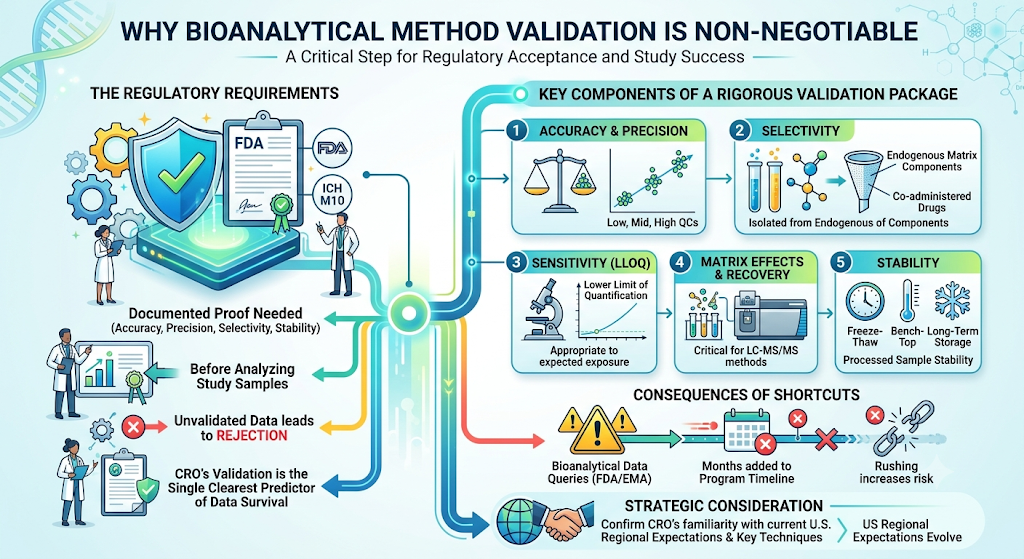
Bioanalytical method validation is non-negotiable because unvalidated or poorly validated assays produce data regulators will not accept, regardless of how sound the underlying chemistry is. The FDA Bioanalytical Method Validation Guidance and ICH M10 both require documented proof that a method is accurate, precise, selective, and stable across the concentration range relevant to the study before a single study sample is analyzed. A CRO’s approach to bioanalytical method development and validation is usually the single clearest predictor of whether a data package will survive regulatory scrutiny.
A rigorous validation package typically demonstrates:
- Accuracy and precision across low, mid, and high quality control concentrations
- Selectivity against endogenous matrix components and co-administered drugs
- Sensitivity, with a lower limit of quantification (LLOQ) appropriate to expected exposure
- Matrix effects and recovery, particularly critical for LC-MS/MS methods
- Stability, including freeze-thaw, bench-top, long-term storage, and processed sample stability
Skipping or rushing any of these steps is one of the most common reasons sponsors receive bioanalytical data queries during FDA or EMA review, which can add months to a program timeline. Sponsors developing in the US specifically should confirm a CRO’s familiarity with current bioanalytical method development key techniques in the United States, since regional expectations continue to evolve.
3: What Analytical Platforms Should a CRO Bring to ADME Work?
The right analytical platform depends on the molecule class, but LC-MS/MS remains the workhorse for ADME bioanalytical testing because it delivers the sensitivity and specificity needed to quantify parent drug and metabolites simultaneously. A CRO offering dedicated LC-MS/MS bioanalytical services should be able to demonstrate triple-quadrupole and high-resolution platforms side by side, since different study phases often call for different levels of structural resolution.
A CRO’s ADME capability should typically include:
- Triple quadrupole LC-MS/MS for small-molecule and metabolite quantification
- High-resolution MS (Q-TOF or Orbitrap-class) for metabolite identification and structural elucidation
- Ligand-binding assays (LBA) or hybrid LBA-LC-MS workflows for biologics and peptides
- Species-specific and matrix-specific method adaptation (rodent, non-rodent, human)
Sponsors developing peptide-based or biosimilar candidates should specifically confirm the CRO’s experience with hybrid LBA-LC-MS workflows. For biosimilar programs in particular, LC-MS/MS services for biosimilar characterization need to layer comparability requirements on top of standard quantification, since standard small-molecule LC-MS/MS approaches often lack the specificity needed for large or modified molecules.
4: Metabolite Identification: Where Generalist CROs Fall Short
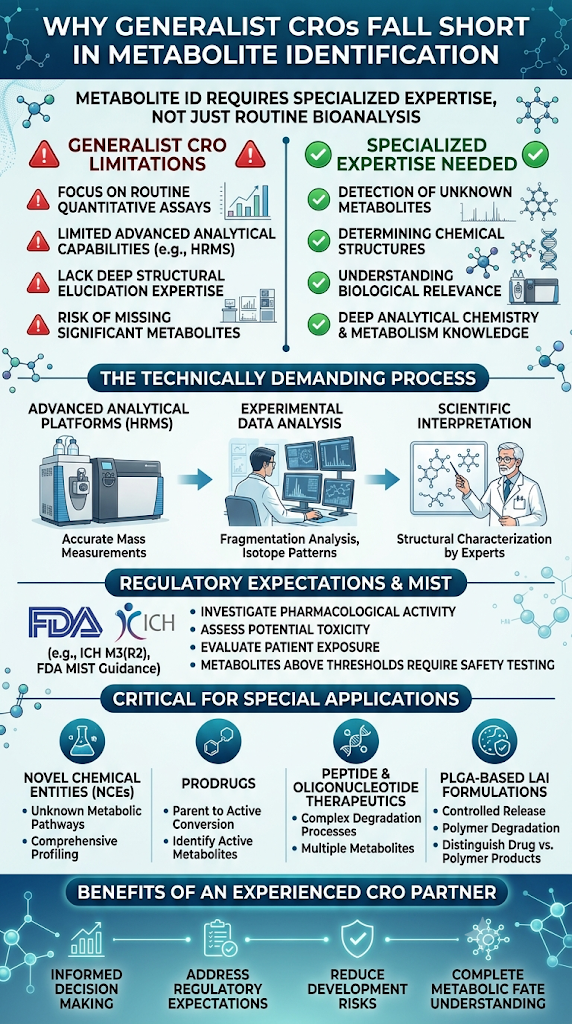
Metabolite identification requires specialized expertise in structural elucidation, making it one of the most technically demanding aspects of ADME Bioanalytical Testing Services. While many generalist CROs excel at routine quantitative bioanalysis, they may lack the advanced analytical capabilities needed to identify unknown metabolites, characterize their structures, and assess their potential impact on drug safety and efficacy.
Unlike standard bioanalytical assays that quantify known compounds, metabolite identification involves detecting previously unknown metabolites, determining their chemical structures, and understanding their biological relevance. This process relies on advanced high-resolution mass spectrometry (HRMS), accurate mass measurements, fragmentation analysis, isotope pattern evaluation, and experienced interpretation by analytical scientists.
Comprehensive metabolite identification is particularly important because regulatory agencies expect sponsors to investigate metabolites that may contribute to pharmacological activity, toxicity, or patient exposure. Metabolites exceeding the exposure thresholds described in ICH M3(R2) and the FDA’s Metabolites in Safety Testing (MIST) guidance may require additional nonclinical safety evaluation before a drug can progress through development.
This level of scientific interpretation requires far more than a validated quantitative LC-MS/MS assay—it demands deep expertise in analytical chemistry, drug metabolism, and structural characterization.
Metabolite identification becomes especially critical for:
- Novel Chemical Entities (NCEs): New drug candidates often have unknown metabolic pathways, requiring comprehensive metabolite profiling to identify and characterize previously unreported metabolites.
- Prodrugs: Since the administered compound is converted into the active therapeutic molecule in vivo, developers must accurately identify both the parent drug and its active metabolites while understanding the conversion pathway.
- Peptide and Oligonucleotide Therapeutics: These complex molecules undergo unique enzymatic degradation processes that generate multiple metabolites, requiring sophisticated HRMS workflows and structural interpretation.
- PLGA-Based Long-Acting Injectable (LAI) Formulations: Depot formulations introduce additional complexity due to controlled drug release, polymer degradation, and localized metabolism. Comprehensive metabolite profiling helps distinguish between drug-related metabolites, polymer degradation products, and formulation-specific transformation pathways.
An experienced CRO equipped with advanced HRMS platforms and scientists specializing in metabolite identification can provide a complete understanding of a drug’s metabolic fate. This enables drug developers to make informed decisions, address regulatory expectations, and reduce the risk of unexpected findings during later stages of development.
5: PK and TK Studies: Where ADME Data Gets Used
PK and TK studies use ADME bioanalytical data to establish dose-exposure relationships and safety margins that regulators require before a compound can advance into or through clinical trials. A dedicated bioanalytical CRO for PK and TK services needs to coordinate sample collection schedules, species selection, and assay sensitivity with the toxicology study design from the outset, rather than adapting a generic assay after the fact.
Misalignment between the bioanalytical method and the study design is a common, avoidable source of rework — for example, an LLOQ set too high to capture terminal elimination phase concentrations, or a sampling matrix that cannot be reconciled with the toxicology protocol.
6: Biomarker Bioanalytical Services: Supporting Mechanism and Safety Data
Biomarker bioanalytical services measure pharmacodynamic and safety-related biomarkers alongside standard ADME data to support mechanism-of-action claims and early efficacy signals. This is distinct from PK bioanalysis, since biomarker assays often measure endogenous analytes with their own baseline variability and matrix interference challenges. CROs offering integrated biomarker bioanalytical services alongside PK bioanalysis let sponsors avoid splitting a single study’s sample sets across multiple vendors and matrix-handling protocols.
Regulatory expectations for biomarker assays differ from standard PK bioanalysis, and sponsors submitting to both agencies should confirm the CRO’s experience with biomarker bioanalytical services for FDA and Health Canada submissions, since fit-for-purpose validation expectations vary by regulatory context and biomarker category (exploratory vs. safety vs. efficacy). A biomarker-focused bioanalytical CRO should be able to articulate which validation tier applies to a given biomarker before study start, not after data review.
7: ADME Testing Across Modalities: Not a One-Size-Fits-All Service
ADME testing requirements differ substantially by modality, and a CRO’s depth in one area does not guarantee competence in another. Small molecules, peptides, biosimilars, mRNA therapeutics, and PLGA-based depot formulations each introduce distinct bioanalytical challenges:
| Modality | Key Bioanalytical Challenge |
|---|---|
| Small molecules | Multiple metabolic pathways can complicate metabolite profiling |
| Peptides | Enzymatic degradation in matrix requires protease inhibitors and hybrid LBA-LC-MS quantification |
| Biosimilars | PK/PD comparability data must be layered on top of standard ADME characterization |
| mRNA/oligonucleotide therapeutics | Novel delivery mechanisms and degradation pathways require purpose-built extraction and detection methods |
| PLGA-based depot formulations | Release-rate-linked PK sampling schedules replace a single absorption phase |
Peptide programs specifically benefit from a CRO with dedicated peptide bioanalytical services experience, since generic small-molecule extraction protocols frequently fail to account for in-matrix enzymatic degradation. mRNA and other nucleic-acid-based therapeutics present an even newer set of challenges, and sponsors should look specifically for bioanalytical method development for mRNA therapeutics experience rather than assuming standard LC-MS/MS methods will transfer directly.
8: Therapeutic Area Considerations: Oncology and Rare Disease
Therapeutic area shapes bioanalytical strategy as much as modality does, particularly in oncology and rare disease programs where sample volume and patient population size are constrained. Oncology clinical trials often involve combination therapies, narrow therapeutic windows, and complex drug-drug interaction profiles, which is why sponsors typically seek a bioanalytical CRO for oncology clinical trials with specific experience managing multi-analyte panels under tight sample constraints.
Rare disease programs raise a different challenge: small patient populations mean every sample is precious, and re-dosing or repeat sampling is rarely an option. A CRO offering dedicated bioanalytical services for rare disease programs should be able to demonstrate micro-sampling techniques and assay sensitivity optimized to work within these constraints, since a failed assay on a rare disease sample can mean the data point is unrecoverable.
9: Sample Throughput and Turnaround: A Practical Constraint
Sample throughput directly determines how quickly a sponsor receives usable data, and it becomes a critical bottleneck in large multi-arm or multi-timepoint studies. CROs with scalable bioanalytical sample throughput capacity can run large sample batches without extending validated method performance beyond its tested range — a shortcut that compromises data quality even when it appears to save time.
Sponsors should ask a prospective CRO for their actual sample-to-report turnaround on a comparable study, not a general estimate, since throughput claims are only meaningful in the context of a specific matrix, analyte count, and regulatory tier.
10: Rapid Proof-of-Concept and Early-Phase Programs
Early-phase and proof-of-concept programs need bioanalytical support that moves fast without sacrificing the data integrity required for later regulatory submissions. CROs offering bioanalytical services for rapid proof-of-concept studies typically use abbreviated, fit-for-purpose validation appropriate for discovery-stage decision-making, while flagging which elements will need full regulatory validation before an IND-enabling study.
This distinction matters: a proof-of-concept assay and a GLP-validated regulatory assay are not the same deliverable, and sponsors should be clear with their CRO about which tier a given study requires.
11: Cost-Effectiveness Without Cutting Scientific Corners
Cost-effectiveness in bioanalytical testing comes from efficient study design and platform selection, not from skipping validation steps. Cost-effective bioanalytical services generally achieve savings through smart method reuse across study phases, appropriately scaled validation tiers, and batching strategies — not through reduced QC rigor, which ultimately costs more in rework and regulatory delay.
Drug developers should treat unusually low bioanalytical quotes as a signal to ask more questions, not fewer, about what validation steps are actually included.
12: Regulatory Alignment: FDA, Health Canada, EMA, and GLP Requirements
Regulatory alignment matters because ADME bioanalytical data is scrutinized against specific guidance documents, and a CRO unfamiliar with current expectations creates submission risk. The FDA’s Bioanalytical Method Validation Guidance and ICH M10 harmonize most core validation expectations between the US and EU, but nuances remain in areas like incurred sample reanalysis (ISR) requirements and matrix-specific stability data.
Programs intended for pivotal submission require GLP bioanalytical services conducted under a documented quality system, distinct from exploratory or discovery-tier work. For sponsors preparing a final data package, regulated bioanalytical services for NDA and BLA submission require a level of documentation, audit trail, and cross-validation rigor that exploratory studies simply don’t need. CROs with established bioanalytical services across North America are generally better positioned to navigate both FDA and Health Canada expectations within a single program.
13: How Should Drug Developers Evaluate a CRO for ADME Bioanalytical Testing Services?
Drug developers should evaluate a CRO for ADME bioanalytical testing services on six factors: regulatory validation experience, platform breadth, matrix and species flexibility, metabolite ID capability, sample throughput, and data turnaround against study timelines. Price should be a secondary filter applied only after these scientific criteria are satisfied.
Practical due-diligence questions to ask a prospective CRO:
- Can you show a validation package from a comparable molecule class submitted to FDA, Health Canada, or EMA?
- What is your typical turnaround from sample receipt to final data report for a GLP toxicokinetic study?
- Do you support both quantitative bioanalysis and qualitative metabolite identification under one program, or will this require a second vendor?
- How do you handle matrix effects and cross-validation when a study spans multiple species or dosing phases?
- What quality system governs your bioanalytical work — GLP, GCP, or both, depending on study phase?
14: The Case for an Integrated Chemistry and Bioanalytical CRO
An integrated chemistry and bioanalytical CRO reduces handoff risk by keeping formulation, analytical characterization, and bioanalysis under one scientific team rather than splitting the work across vendors with different data standards. An integrated chemistry and bioanalytical CRO model is particularly valuable for complex modalities like PLGA-based depots or peptide conjugates, where formulation chemistry directly informs how the bioanalytical method needs to be designed.
Sponsors evaluating bioanalytical outsourcing partners more broadly should weigh this integration against the alternative of managing multiple specialized vendors — the latter can offer deeper niche expertise but introduces more coordination overhead and potential data inconsistency between labs.
15: AI and the Next Generation of Bioanalytical Strategy
AI-assisted drug discovery is beginning to reshape how bioanalytical strategies are planned, particularly in predicting likely metabolite structures and prioritizing analyte panels before wet-lab work begins. A bioanalytical CRO supporting AI-driven drug discovery programs can help translate computational predictions into targeted, validated assays more efficiently than a purely reactive bioanalytical workflow, shortening the loop between in silico hypothesis and confirmed experimental data.
16: Building an Outsourced ADME Bioanalytical Partnership That Reduces Program Risk
An outsourced ADME bioanalytical testing partnership reduces program risk when the CRO is engaged early enough to align method development with study design, not brought in after protocols are locked. Early engagement allows the CRO to flag matrix limitations, sensitivity gaps, or species-specific challenges before a costly in-life study begins, rather than discovering them during data review. Sponsors comparing outsourced bioanalytical services providers should prioritize this kind of early scientific collaboration over vendors positioned purely as sample-processing capacity. For a broader view of what a full-service partner should offer across a program’s lifecycle, it’s worth reviewing a CRO’s complete bioanalytical services portfolio rather than evaluating a single assay in isolation.
ResolveMass Laboratories works with drug developers across small-molecule, peptide, biosimilar, mRNA, and PLGA-based programs to build ADME and bioanalytical testing strategies grounded in mass spectrometry expertise and regulated method validation. The goal in every engagement is the same: generate ADME data that holds up under FDA, Health Canada, and EMA scrutiny the first time, without unnecessary rework or timeline slippage.
Conclusion:
ADME bioanalytical testing services determine whether a drug candidate’s pharmacokinetic story is credible enough to support regulatory approval, and the CRO chosen to generate that data carries real program risk. Drug developers should look past turnaround-time marketing and price sheets to evaluate a CRO’s validation rigor, platform breadth, metabolite identification depth, throughput capacity, and modality-specific experience — whether the program involves small molecules, peptides, biosimilars, mRNA therapeutics, oncology combinations, or rare disease populations. A CRO that engages early, validates thoroughly, and understands the nuances across these modalities is a scientific partner, not just a lab-for-hire.
Frequently Asked Questions:
ADME studies evaluate how a drug is absorbed, distributed, metabolized, and excreted within the body, providing a comprehensive understanding of its biological fate. Pharmacokinetic (PK) studies, on the other hand, focus on measuring drug concentrations over time and calculating parameters such as Cmax, Tmax, AUC, half-life, and clearance. While PK studies rely on bioanalytical data, ADME studies encompass a broader evaluation of drug disposition and metabolism throughout the development process.
ADME Bioanalytical Testing Services should begin during the early discovery stage and continue throughout preclinical and clinical development. Early ADME data help identify promising drug candidates, optimize formulations, and reduce the risk of late-stage failures. Ongoing bioanalytical testing also supports dose selection, toxicology studies, clinical trials, and regulatory submissions by providing accurate pharmacokinetic and metabolism data.
Yes. ADME Bioanalytical Testing Services play a vital role in generic drug development by supporting bioequivalence (BE) studies and pharmacokinetic comparisons between generic and reference products. Accurate bioanalytical methods ensure that systemic drug exposure meets regulatory acceptance criteria, helping manufacturers successfully prepare ANDA submissions and demonstrate therapeutic equivalence.
An ideal ADME CRO should offer experienced scientists, advanced LC-MS/MS and HRMS instrumentation, GLP-compliant laboratories, validated analytical methods, strong regulatory expertise, reliable project management, and transparent communication. The ability to support both small molecules and biologics while delivering regulatory-ready reports is also an important consideration when selecting a long-term development partner.
Several factors can influence analytical accuracy, including matrix effects, sample degradation, low analyte concentrations, metabolite interference, carryover, ion suppression, and improper sample handling. Experienced CROs address these challenges through optimized sample preparation, rigorous quality control procedures, stable isotope-labeled internal standards, and validated analytical methods that ensure reliable and reproducible results.
Reference
- Wang YT, Maes EM, Heinle L, Ruterbories K, Doktor S, Larsen M, Olson A, Lee A, Van Handel C, Ji QC, Desino K. Integrity and efficiency: AbbVie’s journey of building an integrated nonregulated bioanalytical laboratory. Bioanalysis. 2023 Feb 1;15(3):161-76.https://www.tandfonline.com/doi/abs/10.4155/bio-2023-0012
- Pritchard JF, Anderson SR, Breuckner C, Premkumar ND, Polli JW. Conference report: a hitchhiker’s guide to outsourcing ADME studies: the inside of outsourcing.https://www.tandfonline.com/doi/abs/10.4155/bio.12.328
- Wan H. What ADME tests should be conducted for preclinical studies?. ADMET and DMPK. 2013 Aug 29;1(3):19-28.https://hrcak.srce.hr/112504
- Rajapaksha RD, Farmer JT. Regulatory and scientific considerations in PK and biomarker assay validation: lessons from bioanalytical practice. Bioanalysis. 2026 Feb 11;18(3):293-311.https://www.tandfonline.com/doi/abs/10.1080/17576180.2026.2658614
About the Author


