
.
.
.
Antibody Drug Conjugate (ADC) Services
Advanced Analytical Solutions for Antibody Drug Conjugate Development
Antibody Drug Conjugate (ADC) Services are essential for the successful development of targeted biologic therapies that combine the specificity of monoclonal antibodies with the potency of highly active cytotoxic payloads. At ResolveMass Laboratories Inc., we provide comprehensive analytical and bioanalytical solutions that support pharmaceutical, biotechnology, and biopharmaceutical companies throughout every stage of ADC development. Our scientific expertise in advanced mass spectrometry, protein characterization, and regulatory-focused analytical testing helps generate reliable data that accelerates research, supports regulatory submissions, and minimizes development risks.
Share via:
Comprehensive Analytical Support for ADC Development
Developing an antibody-drug conjugate requires precise analytical characterization to ensure product quality, efficacy, stability, and safety. ADC molecules present unique analytical challenges due to their structural complexity, heterogeneous drug loading, linker chemistry, and potential degradation pathways.
ResolveMass Laboratories provides customized analytical strategies designed specifically for these challenges. Our scientists develop fit-for-purpose methods that generate accurate, reproducible, and regulatory-ready data using advanced LC-MS/MS, high-resolution mass spectrometry, peptide mapping, intact protein analysis, and other orthogonal analytical technologies.
Whether supporting discovery research, process development, comparability studies, or late-stage development, our analytical workflows are tailored to meet project-specific objectives while maintaining scientific rigor.
Our Antibody Drug Conjugate (ADC) Services Include
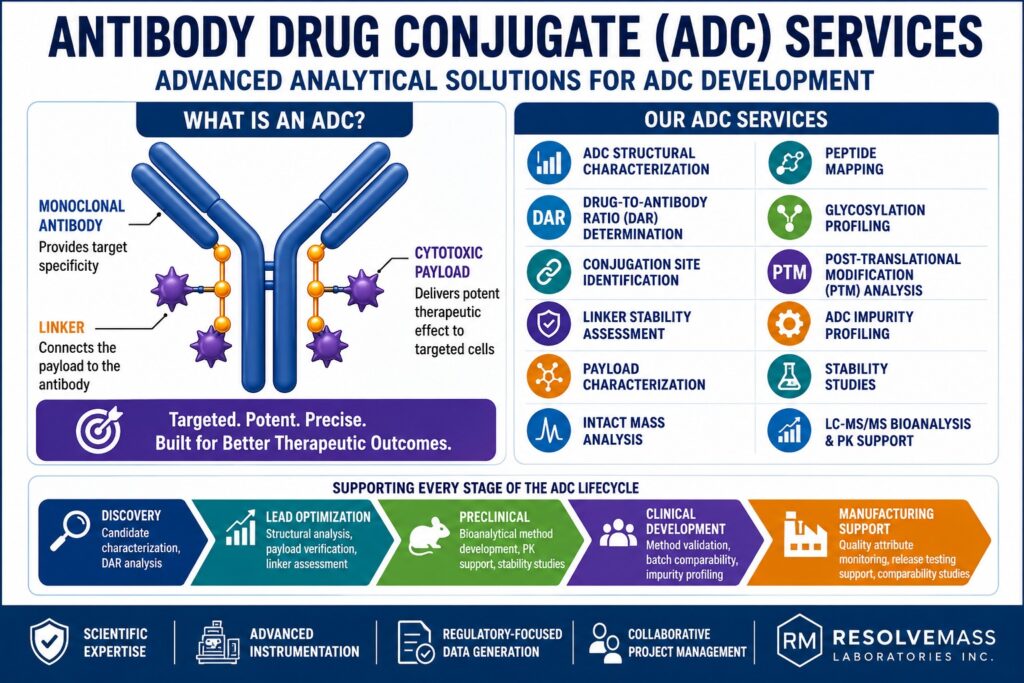
- ADC structural characterization
- Drug-to-antibody ratio (DAR) determination
- Conjugation site identification
- Linker stability assessment
- Payload characterization
- Intact mass analysis
- Peptide mapping
- Glycosylation profiling
- Post-translational modification (PTM) analysis
- ADC impurity profiling
- Stability studies
- LC-MS/MS bioanalysis
- Pharmacokinetic (PK) support
- Biomarker analysis
- Comparative analytical studies
- Method development and validation
Advanced Mass Spectrometry Expertise
Modern ADC characterization requires analytical methods capable of detecting subtle molecular differences that may influence therapeutic performance. ResolveMass specializes in high-resolution mass spectrometry workflows that provide detailed molecular insights into ADC structure and quality attributes.
Our laboratory supports comprehensive characterization of antibodies, conjugated payloads, linker integrity, sequence confirmation, peptide mapping, glycan analysis, and critical quality attributes (CQAs). By integrating multiple orthogonal analytical techniques, we help clients obtain a complete understanding of their ADC products throughout development.
Our scientists work closely with sponsors to design customized analytical approaches based on molecule type, conjugation strategy, and regulatory expectations.
Why Choose ResolveMass Laboratories Inc.?
Scientific Expertise
Our multidisciplinary team possesses extensive experience in mass spectrometry, protein chemistry, biologics characterization, and complex bioanalytical testing.
Tailored Analytical Strategies
Every ADC molecule is unique. We develop customized analytical workflows rather than relying on standardized testing packages.
Advanced Instrumentation
State-of-the-art LC-MS/MS and high-resolution mass spectrometry platforms enable highly sensitive and accurate characterization of complex biologics.
Regulatory-Oriented Data Generation
Our analytical studies are designed to support regulatory submissions by producing well-documented, reproducible, and scientifically defensible results.
Collaborative Project Management
We work as an extension of your development team, maintaining transparent communication throughout every stage of the project.
Supporting Every Stage of the ADC Lifecycle
Our analytical services support organizations from early discovery through clinical development and commercialization.
| Development Stage | Analytical Support |
|---|---|
| Discovery | Candidate characterization, DAR analysis, conjugation confirmation |
| Lead Optimization | Structural analysis, payload verification, linker assessment |
| Preclinical | Bioanalytical method development, PK support, stability studies |
| Clinical Development | Method validation, batch comparability, impurity profiling |
| Manufacturing Support | Quality attribute monitoring, release testing support, comparability studies |
Regulatory-Focused Analytical Excellence
As regulatory expectations for complex biologics continue to evolve, robust analytical characterization has become increasingly important for successful product development. Comprehensive understanding of molecular structure, conjugation chemistry, product heterogeneity, and stability is critical for demonstrating product quality and consistency.
ResolveMass Laboratories develops analytical strategies aligned with current industry expectations and scientific best practices. Our documentation, method development approach, and data quality are designed to support clients preparing regulatory submissions across global markets.
Related ADC Resources
To learn more about our expertise in antibody-drug conjugates, explore these resources:
- Antibody Sequencing for Antibody Drug Conjugates (ADCs): Optimizing Precision in Targeted Therapies
https://resolvemass.ca/antibody-sequencing-for-antibody-drug-conjugates-adcs-optimizing-precision-in-targeted-therapies/ - Antibody Drug Conjugate Bioanalytical Services
https://resolvemass.ca/antibody-drug-conjugate-bioanalytical-services/ - ADC Bioanalysis
https://resolvemass.ca/adc-bioanalysis/
Partner with ResolveMass for Reliable Antibody Drug Conjugate (ADC) Services
Successful development of complex biologics depends on scientifically sound analytical data generated through robust methodologies and experienced technical teams. ResolveMass Laboratories Inc. delivers comprehensive Antibody Drug Conjugate (ADC) Services that help biopharmaceutical innovators confidently characterize, evaluate, and advance their ADC candidates through every stage of development. From early molecular characterization to advanced LC-MS/MS bioanalysis and regulatory-focused analytical support, our customized solutions are designed to provide accurate, reproducible, and actionable results that accelerate development timelines.
Frequently Asked Questions
An antibody-drug conjugate (ADC) is a targeted biopharmaceutical designed to deliver a highly potent therapeutic agent directly to cancer cells while minimizing damage to healthy tissues. An ADC combines a monoclonal antibody that recognizes a specific tumor antigen, a chemical linker, and a cytotoxic payload. This targeted approach improves treatment precision and has become an important strategy in modern oncology.
One well-known example of an ADC is trastuzumab emtansine (T-DM1, Kadcyla®), which is approved for treating HER2-positive breast cancer. Other clinically approved ADCs include brentuximab vedotin (Adcetris®) for certain lymphomas and trastuzumab deruxtecan (Enhertu®) for HER2-expressing cancers. These therapies demonstrate how targeted drug delivery can improve treatment outcomes while reducing systemic toxicity.
An antibody-drug conjugate (ADC) is a targeted biologic therapy that combines the specificity of monoclonal antibodies with the potency of small-molecule cytotoxic drugs. Unlike conventional chemotherapy, ADCs selectively bind to cancer cells expressing a particular antigen before releasing their therapeutic payload. This combination enables highly targeted treatment for several cancers.
ADCs are not traditional chemotherapy, although they contain highly potent chemotherapy-like payloads. Their distinguishing feature is targeted delivery, where the cytotoxic agent is transported directly to tumor cells using a monoclonal antibody. Because of this selective mechanism, ADCs are generally classified as targeted anticancer therapies rather than conventional chemotherapy.
An antibody-drug conjugate consists of three essential components: a monoclonal antibody that identifies cancer-specific antigens, a chemical linker that securely connects the drug to the antibody, and a potent cytotoxic payload that destroys targeted cancer cells after internalization. The careful design of each component is critical for achieving optimal efficacy, stability, and safety.
ADCs are generally designed to be less toxic than conventional chemotherapy because they selectively deliver their payload to cancer cells instead of exposing the entire body to cytotoxic drugs. While ADCs can still produce side effects, including fatigue, blood count changes, and liver toxicity, their targeted mechanism often results in improved tolerability and a wider therapeutic window compared with traditional chemotherapy.
ADCs work by first binding to a specific antigen on the surface of cancer cells through their monoclonal antibody component. The ADC-antigen complex is then internalized into the cell, where the linker is cleaved or degraded, releasing the cytotoxic payload. The released drug disrupts critical cellular processes, leading to cancer cell death while minimizing effects on most healthy tissues.
Reference:
- Chen, B., Zheng, X., Wu, J., Chen, G., Yu, J., Xu, Y., Wu, W. K. K., Tse, G. M. K., To, K. F., & Kang, W. (2025). Antibody–drug conjugates in cancer therapy: Current landscape, challenges, and future directions. Molecular Cancer, 24, 279. https://doi.org/10.1186/s12943-025-02489-2
- Wang, R., Hu, B., Pan, Z., Mo, C., Zhao, X., Liu, G., Hou, P., Cui, Q., Xu, Z., Wang, W., Yu, Z., Zhao, L., He, M., Wang, Y., Fu, C., Wei, M., & Yu, L. (2025). Antibody-drug conjugates (ADCs): Current and future biopharmaceuticals. Journal of Hematology & Oncology, 18(1), 51. https://doi.org/10.1186/s13045-025-01704-3
- P., S., Prabakaran, M., & Bhattacharya, S. (2025). Antibody-drug conjugates (ADCs). In Spatially Variable Genes in Cancer (pp. 429–446). IGI Global. https://doi.org/10.4018/979-8-3693-7728-4.ch016
- Xie, B., Chen, C., Cai, H., Wang, L., Chen, M., Liu, J., Wu, F., & Huang, W. (2025). Application and progress of antibody-drug conjugates (ADCs) in the treatment of metastatic triple-negative breast cancer. Targeted Oncology, 13(4), 919–937. https://doi.org/10.1007/s40487-025-00379-7