


Introduction:
Bioanalytical Method Transfer Between CROs is one of the most operationally demanding activities in clinical drug development, particularly during Phase II oncology programs where patient enrollment, PK data generation, and regulatory timelines are already underway. A poorly executed transfer can introduce assay variability, delay patient sample analysis, compromise pharmacokinetic data, and put a regulatory submission at risk.
Oncology bioanalytical assays frequently quantify highly potent small molecules, monoclonal antibodies, antibody-drug conjugates (ADCs), peptide therapeutics, biomarkers, metabolites, or combination therapies. Any interruption in assay performance can affect dose-escalation decisions, exposure-response analysis, and the overall pace of clinical development.
This case study describes how a sponsor successfully transitioned bioanalytical activities from one CRO to another during an active Phase II oncology trial — without interrupting dosing, enrollment, or data continuity — and how the same structured approach applies to any sponsor considering a mid-study change of analytical partner.
Summary:
- Bioanalytical Method Transfer Between CROs is sometimes necessary during Phase II oncology studies when capacity, quality, or operational issues force a sponsor to change analytical partners mid-trial.
- Changing CROs mid-study carries real risks — assay variability, sample turnaround delays, and compromised PK data — but these risks are manageable with a structured transfer plan.
- A real-world case study of a kinase inhibitor Phase II oncology program shows how a validated LC-MS/MS assay was transferred between two CROs with zero disruption to patient enrollment or dosing decisions.
- FDA, EMA, and ICH guidelines set clear expectations for documentation, cross-validation, and change control during a method transfer.
- The critical steps — technical assessment, knowledge transfer, laboratory readiness, partial validation, cross-validation, and incurred sample reanalysis (ISR) — are what separate a smooth transfer from a data integrity risk.
- Robust documentation, cross-validation, and dedicated project management are what ultimately minimize regulatory risk during transfer.
- ResolveMass Laboratories supports seamless bioanalytical method transfer while preserving data integrity and keeping study timelines on track.
1: Why Would a Sponsor Transfer Bioanalytical Methods Between CROs?
Sponsors transfer bioanalytical methods between CROs to reduce risk, improve quality, increase analytical capacity, or resolve project delays — rarely for a single isolated reason.
Common drivers include:
- CRO acquisition or restructuring
- Sample throughput and capacity limitations
- Long sample turnaround times
- Quality management concerns
- Data integrity observations
- Expansion into global clinical sites, requiring broader bioanalytical services across North America
- Need for advanced LC-MS/MS instrumentation
- Better regulatory inspection history
- Cost optimization
- Need for additional scientific expertise, including AI-enabled drug discovery support
Although changing CROs may appear risky on paper, proper planning — and choosing a partner experienced in bioanalytical outsourcing and outsourced bioanalytical services — can significantly reduce the impact on an ongoing clinical study.
2: Why Are Phase II Oncology Programs Particularly Sensitive to Method Transfer?
Phase II oncology studies generate the critical clinical evidence used to decide whether a therapy advances toward pivotal trials, so any inconsistency introduced during a method transfer can compromise months of accumulated data.
Typical bioanalytical activities supporting these decisions, and a dedicated bioanalytical CRO for oncology clinical trials, include:
| Bioanalytical Activity | Importance |
|---|---|
| Pharmacokinetic (PK) analysis | Dose optimization |
| Biomarker analysis | Mechanism of action |
| Anti-drug antibody testing | Immunogenicity |
| Metabolite profiling | Safety evaluation |
| Exposure-response analysis | Clinical decision making |
| Population PK modeling | Dose selection |
| Bioequivalence assessments | Comparative studies |
3: Case Study: Transferring a Kinase Inhibitor PK Assay Mid-Trial
Project Background
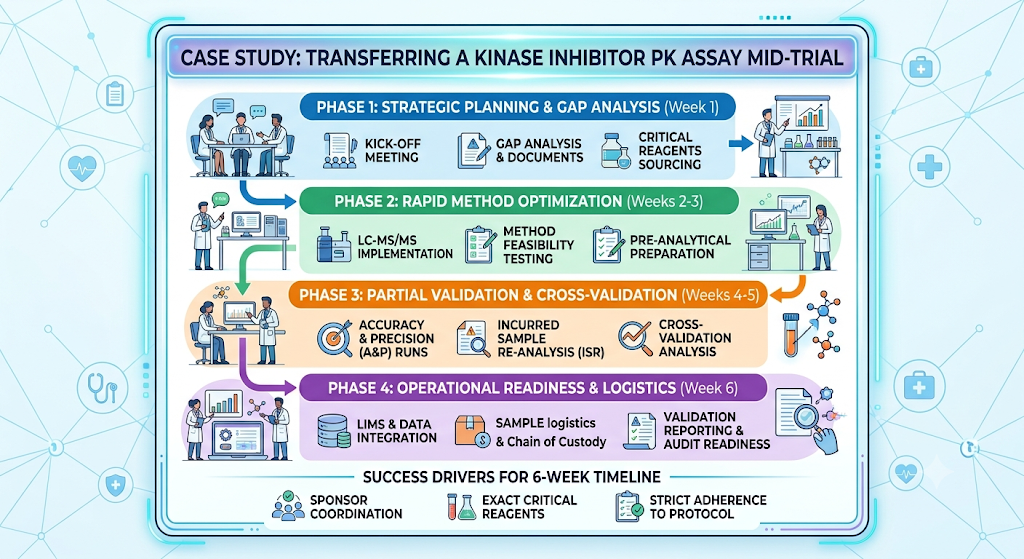
A biotechnology company developing a novel kinase inhibitor for metastatic solid tumors had initiated a multinational Phase II clinical trial spanning more than 60 clinical sites. The originating CRO had developed and validated an LC-MS/MS assay for plasma drug quantification, and approximately 40% of patient samples had already been analyzed when operational challenges at that lab put the study timeline at risk. To protect the program, the sponsor made the decision to transfer the bioanalytical method to a new CRO.
Project Challenges
The transfer had to be executed against a demanding set of constraints:
- Ongoing patient enrollment
- Thousands of stored plasma samples
- An existing validated LC-MS/MS assay with multiple calibration ranges
- A stable isotope-labeled internal standard
- Strict sample turnaround time requirements
- Regulatory audit readiness
- No interruption to clinical dosing decisions
Objectives of the Transfer
The sponsor set clear, measurable objectives for the receiving lab:
- Maintain analytical consistency
- Avoid re-analysis of previously tested samples
- Preserve historical PK comparability
- Minimize trial delays
- Ensure regulatory acceptance
- Maintain chain of custody
- Complete the transfer within six weeks
4: What Steps Does a Bioanalytical Method Transfer Actually Involve?
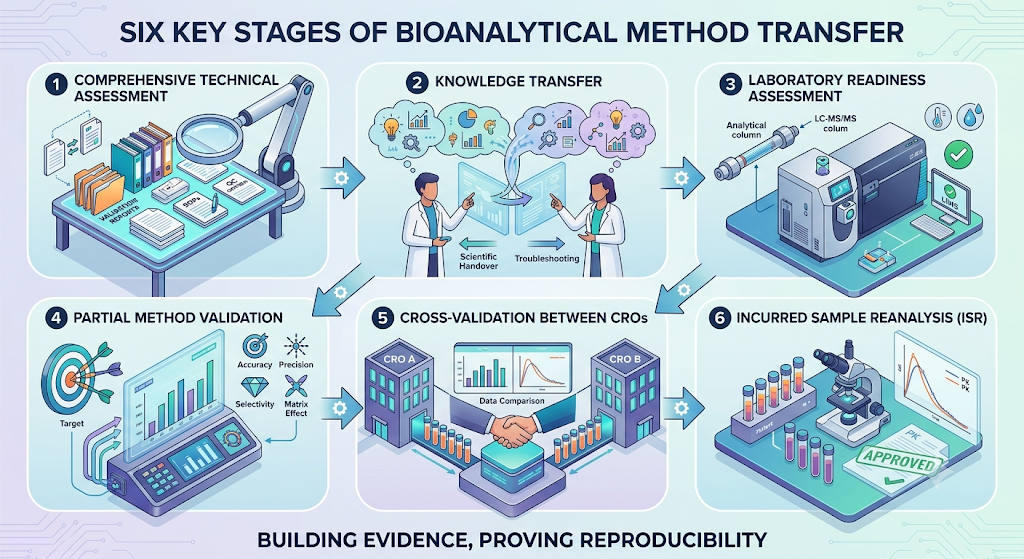
A successful method transfer moves through six connected stages — technical assessment, knowledge transfer, laboratory readiness, partial validation, cross-validation, and incurred sample reanalysis — each building the evidence needed to prove the receiving lab can reproduce the sending lab’s data.
Step 1: Comprehensive Technical Assessment
The receiving CRO began with a detailed assessment of all analytical documentation, including method validation reports, SOPs, sample preparation procedures, calibration standards, QC acceptance criteria, chromatographic conditions, instrument settings, stability studies, matrix effect evaluations, and incurred sample reanalysis (ISR) results from the original method development and validation work. This review surfaced the variables that would need independent verification before routine sample analysis could resume.
Step 2: Knowledge Transfer Between Scientific Teams
A structured scientific handover minimized the loss of institutional knowledge. Discussions between the sending and receiving teams covered historical assay challenges, matrix variability, extraction efficiency, troubleshooting history, instrument maintenance, internal standard preparation, critical process parameters, and analyst training records. This collaborative approach considerably shortened the receiving lab’s learning curve.
Step 3: Laboratory Readiness Assessment
Before implementing the method, the receiving laboratory confirmed compatibility across LC-MS/MS platform equivalency, analytical column availability, mobile phase composition, sample extraction equipment, laboratory environmental controls, analyst competency, LIMS compatibility, and electronic data integrity systems — the same platform depth that underpins ResolveMass’s broader LC-MS/MS bioanalytical services.
Step 4: Partial Method Validation
Rather than performing an entirely new validation, current regulatory guidance generally supports partial validation after a method transfer, provided equivalency is demonstrated.
| Parameter | Assessment |
|---|---|
| Accuracy | Verified |
| Precision | Verified |
| Selectivity | Confirmed |
| Sensitivity | Confirmed |
| Carryover | Assessed |
| Matrix effect | Re-evaluated |
| Recovery | Compared |
| Dilution integrity | Confirmed |
| Stability | Verified |
| Calibration performance | Confirmed |
Results demonstrated full equivalency with the original validated method, consistent with the standards applied across ResolveMass’s bioanalytical method development and validation work.
Step 5: Cross-Validation Between CROs
Cross-validation was the most important phase of the transfer. Identical samples — calibration standards, QC samples, patient plasma, stability samples, dilution samples, and reinjection samples — were analyzed independently by both laboratories, and excellent agreement between the two confirmed analytical comparability before the receiving lab took over sample analysis.
Step 6: Incurred Sample Reanalysis (ISR)
ISR provided additional confidence that patient samples generated equivalent results after transfer. Evaluation demonstrated high reproducibility, excellent inter-laboratory agreement, minimal analytical bias, and consistent pharmacokinetic profiles — reassuring the sponsor that historical data remained valid and did not need to be discarded or repeated.
5: What Are the Major Risks During Bioanalytical Method Transfer Between CROs?
The major risks in a CRO-to-CRO bioanalytical transfer are instrument differences, analyst variability, reagent variability, and documentation gaps — and each has a well-established mitigation strategy.
| Risk | Mitigation Strategy |
|---|---|
| Instrument differences | Instrument qualification |
| Analyst variability | Hands-on training |
| Reagent variability | Common reagent sourcing |
| Calibration shifts | Cross-validation |
| Sample degradation | Controlled shipment |
| Documentation gaps | Complete QA review |
| Data migration issues | LIMS verification |
| Regulatory concerns | Thorough audit trail |
6: What Do FDA, EMA, and ICH Expect From a Bioanalytical Method Transfer?
Health authorities expect sponsors to demonstrate continuity of analytical performance throughout the study, supported by a documented transfer plan, scientific justification, cross-validation, and a formal risk assessment.
Key regulatory expectations include:
- Documented transfer plan
- Scientific justification
- Cross-validation
- Partial validation where appropriate
- Data integrity
- Audit trail preservation
- Change control documentation
- QA approval
- Risk assessment
- Final transfer report
Proper documentation at each of these points helps support future NDA, BLA, IND, and marketing authorization submissions — the same rigor ResolveMass applies through its regulated bioanalytical services for NDA and BLA submission.
7: What Were the Outcomes of This Method Transfer?
The transfer achieved every predefined objective: no interruption to patient enrollment, no missed analytical timelines, successful cross-validation, and zero critical QA findings.
- No interruption of patient enrollment
- No missed analytical timelines
- Successful cross-validation
- Comparable PK results
- Zero critical QA findings
- Regulatory inspection readiness maintained
- Historical data preserved
- Clinical milestone achieved on schedule
Most importantly, patient safety assessments remained uninterrupted throughout the entire transfer process.
8: What Are the Best Practices for a Successful Bioanalytical Method Transfer?
The organizations that transfer methods most successfully develop a detailed transfer plan, engage both CRO teams early, and maintain complete documentation from day one — rather than treating any one of these as optional.
- Develop a detailed transfer plan. Include technical, regulatory, quality, logistics, and project management activities before transfer begins.
- Engage both CRO teams early. Frequent scientific discussions reduce misunderstandings and accelerate implementation.
- Maintain complete documentation. Ensure all validation reports, SOPs, raw data, instrument settings, and change records are available and traceable.
- Perform cross-validation. Cross-validation provides objective evidence that both laboratories generate comparable analytical results.
- Monitor performance continuously. Review QC trends, calibration curves, ISR outcomes, and assay performance throughout the transition period.
- Establish strong quality oversight. Quality Assurance should oversee every stage, including deviation management, documentation review, and final approval.
9: How Does ResolveMass Laboratories Support Bioanalytical Method Transfer?
At ResolveMass Laboratories, bioanalytical method transfer is managed through a structured, science-driven approach designed to minimize operational risk while preserving analytical consistency across the full life of a program.
Capabilities supporting a seamless transfer include:
- Bioanalytical method development and validation, including key techniques used across the United States
- LC-MS/MS assay transfer, supported by dedicated LC-MS/MS services for biosimilars
- Partial and full method validation
- Cross-validation studies
- Bioanalytical CRO services for PK and TK studies
- Biomarker bioanalytical services, including programs aligned to FDA and Health Canada requirements through a dedicated biomarker bioanalytical CRO
- Peptide and protein bioanalysis
- Oncology bioanalytical support
- GLP-compliant bioanalytical services and GMP-compliant laboratory operations
- Comprehensive QA oversight
- Regulatory-ready documentation
- Customized project management for global clinical studies, backed by an integrated chemistry and bioanalytical CRO model and broader bioanalytical services
Our multidisciplinary scientific team works closely with sponsors to keep method performance consistent throughout every stage of clinical development, including emerging modalities like mRNA therapeutics and programs that need a rapid proof-of-concept turnaround.
Conclusion:
A successful Bioanalytical Method Transfer Between CROs requires far more than simply moving an assay from one laboratory to another. It demands comprehensive planning, scientific collaboration, rigorous cross-validation, quality oversight, and meticulous documentation to ensure analytical continuity throughout clinical development.
As demonstrated in this Phase II oncology case study, a well-executed transfer can preserve pharmacokinetic data integrity, maintain regulatory compliance, avoid delays in patient care, and keep development milestones on track. By combining experienced scientific teams, validated analytical platforms, and robust quality systems, sponsors can confidently transition bioanalytical activities without compromising study outcomes.
Frequently Asked Questions:
Bioanalytical Method Transfer Between CROs is the process of transferring a validated bioanalytical assay, along with its associated procedures, documentation, and performance criteria, from one Contract Research Organization (CRO) to another. The objective is to ensure the receiving CRO can generate data that is scientifically equivalent, reproducible, and compliant with regulatory expectations without disrupting ongoing clinical studies.
Companies may transfer methods due to several reasons, including:
– Limited analytical capacity at the existing CRO
– Project timeline delays
– Expansion into global clinical studies
– Requirement for specialized instrumentation
– Business mergers or acquisitions
– Improved regulatory inspection history
– Cost optimization
– Need for advanced scientific expertise
The goal is to maintain data quality while supporting uninterrupted clinical development.
Some of the most common challenges include:
– Maintaining assay reproducibility
– Ensuring comparable calibration curves
– Instrument-to-instrument variability
– Differences in analyst techniques
– Sample stability during transportation
– Documentation completeness
– Maintaining regulatory compliance
– Preserving historical pharmacokinetic (PK) data consistency
Proper planning and cross-validation help mitigate these risks.
Not always. If the analytical method has already been fully validated and no major changes are introduced, a partial validation combined with cross-validation is often sufficient. The extent of validation depends on factors such as:
– Changes in instrumentation
– Laboratory environment
– Sample matrix
– Analytical platform
– Regulatory requirements
Sponsors should determine the appropriate validation strategy through a documented risk assessment.
Cross-validation is the process of analyzing identical samples at both the transferring and receiving CROs to demonstrate that the assay performs consistently in each laboratory.
It typically compares:
– Calibration standards
– Quality control samples
– Clinical study samples
– Stability samples
Successful cross-validation provides confidence that historical and future data are directly comparable.
The timeline depends on the complexity of the assay and project requirements. In most cases:
– Simple LC-MS/MS assays: 2–4 weeks
– Complex small-molecule assays: 4–6 weeks
– Biomarker or ligand-binding assays: 6–10 weeks
– Highly specialized oncology or biologics assays: 8–12 weeks
Early planning and strong communication can significantly reduce delays.
Reference
- Deshpande K, Hong M, Ware M, Li M, Dysinger M. Managing the transition: switching bioanalytical laboratories during a clinical trial–a sponsor’s perspective. Bioanalysis. 2025 Dec 17;17(24):1769-77.https://www.tandfonline.com/doi/abs/10.1080/17576180.2026.2617265
- Sarvaiya H, Niu S, Ladror DT, Wang Y, Maji D, Wolke M, Natarajan P, Jenkins GJ. Bioanalytical strategy for the characterization and bioanalysis of biologics: a global, nonregulated bioanalytical lab perspective. Bioanalysis. 2023 Feb 1;15(3):133-48.https://www.tandfonline.com/doi/abs/10.4155/bio-2022-0215
- Wilson A, Silvester S, Woods K. A community of practice approach to bioanalysis delivery: the role of the Preclinical Bioanalysis and Toxicokinetics department at AstraZeneca. Bioanalysis. 2014 May 1;6(10):1329-37.https://www.tandfonline.com/doi/abs/10.4155/bio.14.106
- Yu X, Gusev AI. CRO benchmarking for clinical biomarker analysis outsourcing. Bioanalysis. 2019 Jul 1;11(14):1309-13.https://www.tandfonline.com/doi/full/10.4155/bio-2019-0123
- Hersey S, Keller S, Mathews J, King L, Bandukwala A, Berisha F, Birchler M, Bower J, Clausen V, Duarte J, Garofolo F. 2021 white paper on recent issues in bioanalysis: ISR for biomarkers, liquid biopsies, spectral cytometry, inhalation/oral & multispecific biotherapeutics, accuracy/LLOQ for flow cytometry (Part 2–recommendations on biomarkers/CDx assays development & validation, cytometry validation & innovation, biotherapeutics PK LBA regulated bioanalysis, critical reagents & positive controls generation). Bioanalysis. 2022 May 1;14(10):627-92.https://www.tandfonline.com/doi/abs/10.4155/bio-2022-0080
About the Author


