


Introduction
When conducting Bioanalytical Method Transfer Services during an ongoing development program, biopharmaceutical sponsors should anticipate a highly structured process involving partial validation, statistical cross-validation, and extensive regulatory documentation to maintain data integrity while avoiding disruptions to clinical timelines. This transition extends far beyond the administrative transfer of standard operating procedures. It requires careful harmonization of analytical platforms, detailed matrix assessments, and comprehensive stability evaluations in accordance with the globally recognized ICH M10 guideline. The decision to replace or add a Contract Research Organization (CRO) while a clinical study is underway introduces potential risks related to chain-of-custody management and dataset comparability. However, continuing to rely on an underperforming analytical program often presents a significantly greater risk to the success of a drug development program and eventual regulatory approval.
Learn how structuring a resilient, high-performance alliance can mitigate risk and streamline mid-program transitions by visiting our Bioanalytical CRO Partnerships Guide.
The regulatory framework governing outsourced bioanalytical testing underwent a major transformation following the adoption of the ICH M10 guideline, which aligned the expectations of key regulatory authorities, including the FDA, EMA, and Health Canada. Under this harmonized framework, demonstrating analytical consistency between historical datasets and newly generated data requires the application of sophisticated statistical approaches capable of identifying and quantifying inter-laboratory bias. This article examines the technical alignment activities, regulatory requirements, and statistical assessments that biopharmaceutical organizations should expect when undertaking a mid-program CRO transition to ensure continuity and compliance throughout the development lifecycle.
Share via:
Article Summary:
- Bioanalytical Method Transfer Services ensure seamless transition between CROs during ongoing clinical programs while maintaining ICH M10 compliance, data integrity, and regulatory acceptance.
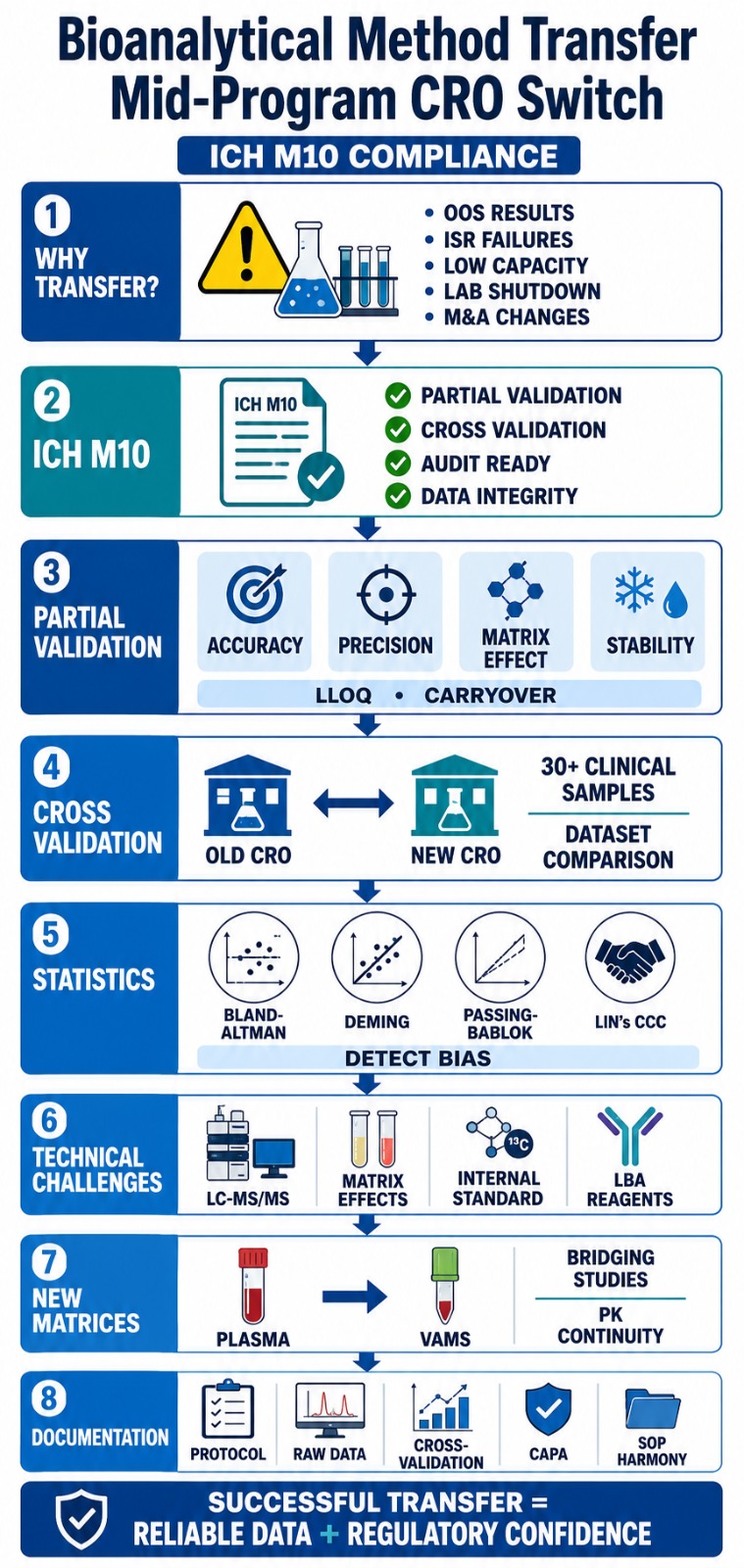
- Common reasons for mid-program CRO transfer include OOS results, ISR failures, laboratory shutdowns, limited analytical capacity, and strategic business changes such as mergers or vendor consolidation.
- ICH M10 requires partial validation at the receiving laboratory to verify assay performance, including accuracy, precision, matrix effects, carryover, stability, and LLOQ using the new laboratory’s equipment and procedures.
- Cross-validation is essential when combining datasets from different laboratories or analytical methods. It typically involves at least 30 incurred clinical samples to demonstrate comparability of results for regulatory submissions.
- Advanced statistical tools such as Bland-Altman analysis, Deming regression, Passing-Bablok regression, and Lin’s Concordance Correlation Coefficient (CCC) are used to detect analytical bias and confirm dataset interchangeability.
- Major technical challenges include matrix effects, LC-MS/MS platform differences, internal standard optimization, ligand-binding assay (LBA) reagent bridging, and validation of new sampling matrices such as VAMS.
- Regulatory success depends on comprehensive documentation, including transfer protocols, raw data traceability, cross-validation reports, SOP harmonization, and CAPA records to ensure audit readiness and uninterrupted clinical development.
What Operational and Technical Triggers Necessitate Mid-Program Bioanalytical Method Transfer Services?
Mid-program Bioanalytical Method Transfer Services are most commonly initiated due to persistent out-of-specification (OOS) results, recurring failures during Incurred Sample Reanalysis (ISR), unexpected laboratory capacity limitations, or strategic corporate restructuring activities. Identifying these warning signs at an early stage allows clinical development and pharmacology teams to transition to a more reliable analytical partner before critical regulatory deadlines or sample stability windows are adversely affected.
Resolve recurring analytical discrepancies and safeguard your pharmacokinetic datasets with our Incurred Sample Reanalysis (ISR) Services.
The decision to initiate a method transfer is rarely made without careful consideration because bridging analytical datasets across different facilities requires substantial scientific oversight and governance. Nevertheless, the consequences of regulatory scrutiny or rejection resulting from compromised data integrity often outweigh the operational challenges associated with changing laboratories during an active study. The technical and operational factors that commonly drive such transitions generally fall into several major categories requiring prompt corrective action.
| Transition Trigger | Technical Indicator | Primary Operational Risk | Regulatory Impact |
|---|---|---|---|
| Quality Control & Assay Failures | Elevated OOS findings, unresolved calibration failures, or recurring Incurred Sample Reanalysis (ISR) discrepancies exceeding the ±20% acceptance criteria. | Significant delays to analytical timelines, increased project expenditures, and depletion of valuable sample inventory. | Serious concerns regarding data integrity that may jeopardize acceptance of pivotal pharmacokinetic (PK) datasets. |
| Operational Disruptions | Unexpected laboratory shutdowns, aging instrument infrastructure, or the abrupt loss of critical scientific personnel. | Interruption of sample extraction, processing, analysis, and reporting activities. | Chain-of-custody challenges, Good Laboratory Practice (GLP) deviations, and risks to long-term sample integrity. |
| Capacity Limitations | Inability of a service provider to scale LC-MS/MS or ligand-binding assay (LBA) operations as a development program advances from Phase I studies to multinational Phase III trials. | Delayed PK reporting, clinical bottlenecks, and postponed dose-escalation decisions. | Delayed submission schedules and extended development timelines. |
| Strategic Business Decisions | Mergers, acquisitions, or broader vendor consolidation initiatives across a biopharmaceutical portfolio. | Misalignment of standard operating procedures (SOPs), extraction workflows, and analytical practices between existing and newly integrated facilities. | Requirement for extensive bridging studies, partial validations, and cross-validation exercises to demonstrate comparability. |
When these circumstances arise, sponsors must rapidly assess the technical capabilities of the receiving CRO. Particular attention should be given to analytical platform expertise, ensuring that capabilities involving conventional high-performance liquid chromatography (HPLC), microflow LC-MS/MS systems, or specialized immunoassay technologies meet or surpass those available at the originating laboratory.
How Does the ICH M10 Guideline Dictate Regulatory Expectations for Mid-Study Transitions?
The ICH M10 guideline specifies that the transfer of any validated bioanalytical method to a different laboratory automatically requires partial validation to demonstrate that the receiving facility can reliably reproduce the established assay performance. This regulatory expectation requires the receiving CRO to independently confirm essential performance characteristics, including the lower limit of quantitation (LLOQ), accuracy, precision, matrix effects, dilution integrity, and other critical assay parameters using its own instrumentation, workflows, and operating procedures.
Review our comprehensive breakdown of the regulatory requirements under the ICH M10 Bioanalytical Method Validation Guidelines.
Formally adopted in May 2022 and implemented globally beginning in January 2023, the ICH M10 guideline replaced a fragmented collection of regional requirements with a harmonized framework applicable to nonclinical toxicokinetic investigations and all stages of clinical development. Before this harmonization effort, differences between FDA and EMA expectations regarding dilution linearity, stability evaluations, and cross-validation requirements often created substantial challenges for sponsors pursuing multinational submissions. Under the current regulatory framework, a receiving laboratory cannot simply rely on or adopt the originating laboratory’s validation package. Instead, it must generate its own independently verifiable and audit-ready dataset demonstrating that the assay performs appropriately within its environment.
Understand the key nuances and compliance strategies between agencies with our analysis of EMA vs. FDA Bioanalytical Method Validation Differences.
As part of the partial validation process during a method transfer, the receiving laboratory must assess several critical assay characteristics. For chromatographic methods such as LC-MS/MS, both accuracy and precision are evaluated using at least four quality control (QC) concentration levels. These include the LLOQ, low QC (within three times the LLOQ), medium QC (typically representing 30–50% of the calibration range), and high QC (at least 75% of the upper limit of quantitation). Acceptance criteria require within-run and between-run accuracy to remain within ±15% of nominal concentrations, except at the LLOQ level where a ±20% deviation is considered acceptable.
Evaluation of matrix effects is another essential component of the transfer process. Matrix effects occur when endogenous components within biological fluids alter the analytical response of the target analyte. To assess this risk, the receiving CRO must analyze at least three replicates of both low- and high-concentration QC samples prepared from a minimum of six independent matrix sources. This assessment helps ensure that variability among plasma or serum donors does not introduce systematic analytical bias that could affect study conclusions.
Carry-over assessment is equally important and must be performed by injecting blank samples immediately after the highest calibration standard. Regulatory acceptance criteria require that any observed analyte response in the blank sample does not exceed 20% of the analyte response at the LLOQ and does not exceed 5% of the internal standard (IS) response. Compliance with these criteria confirms that residual analyte from preceding injections does not compromise analytical accuracy.
Stability testing represents one of the more technically demanding aspects of a mid-program method transfer. Although the ICH M10 guideline indicates that stability data generated at one facility may not necessarily require complete repetition at another location, any differences in sample handling procedures, processing timelines, storage conditions, or analytical workflows may necessitate additional stability assessments. Consequently, the receiving laboratory is frequently required to confirm bench-top stability, long-term storage stability, and freeze-thaw stability under conditions that closely replicate the actual clinical sample lifecycle. In addition, the duration for which processed samples remain in the autosampler must be evaluated as part of an integrated stability assessment rather than by simply summing individual storage intervals. This comprehensive approach ensures that all stability conclusions accurately reflect real-world sample management practices and support the reliability of generated bioanalytical data.
Discover proven strategies to evaluate and maintain analyte stability during transfer by exploring Stability Testing in Bioanalysis.
When is Cross-Validation Required Versus Partial Validation in Bioanalytical Method Transfer Services?
Partial validation is performed to demonstrate that a receiving laboratory can successfully reproduce the performance of an established bioanalytical assay using spiked quality control samples. Cross-validation, in contrast, becomes necessary whenever datasets generated by different laboratories or analytical methodologies must be directly compared and integrated within the same clinical development program. Sponsors should anticipate performing both activities when a newly engaged CRO and a legacy CRO simultaneously analyze incurred clinical samples that will ultimately contribute to a single regulatory submission package.
Learn how to prevent, identify, and recover from validation setbacks with our guide on Bioanalytical Method Validation Failures.
Although the terms are frequently used interchangeably within the industry, partial validation and cross-validation fulfill fundamentally different regulatory purposes under the ICH M10 framework. Method transfer activities, which are supported through partial validation, are intended to confirm that the receiving laboratory’s instrumentation, analytical personnel, reagents, and operational procedures are capable of reproducing the established assay performance. This process primarily depends on spiked calibration standards and quality control samples prepared in blank or surrogate matrices under controlled conditions.
Cross-validation serves a different objective by examining whether datasets generated from separate laboratories or analytical methods are sufficiently comparable for combined interpretation. This assessment becomes mandatory when multiple bioanalytical methods are employed within a single clinical study or when data generated from different validated methods across separate studies must be integrated to support dosing recommendations, efficacy assessments, pharmacokinetic evaluations, or product labeling decisions.
| Evaluation Parameter | Partial Validation (Method Transfer) | Cross-Validation (Inter-Laboratory Comparison) |
|---|---|---|
| Primary Scientific Objective | Demonstrate that the receiving laboratory can reproduce the technical performance of the original method. | Demonstrate that datasets produced by different laboratories or analytical platforms are statistically comparable and interchangeable. |
| Regulatory Trigger | Transfer of a method from an internal laboratory to a CRO, relocation of analytical testing to a new site, or implementation of minor assay modifications. | Use of multiple laboratories within the same clinical study or transition from one analytical technology, such as a ligand-binding assay, to another, such as LC-MS/MS. |
| Required Sample Types | Spiked Quality Control (QC) samples and standardized calibration standards. | A combination of spiked QC samples and incurred clinical study samples obtained from patients. |
| Sample Size Expectations | Standard validation runs involving LLOQ, low, medium, and high QC levels analyzed in replicate. | A recommended minimum of 30 incurred clinical samples covering the full calibration range. |
| Acceptance Thresholds | Defined acceptance criteria such as ±15% accuracy and precision, with ±20% permitted at the LLOQ. | No predefined pass/fail criteria; assessment is based on statistical modeling and clinical significance. |
The use of incurred clinical samples during cross-validation is particularly important because spiked quality control samples cannot fully replicate the complexity of biological specimens collected from study participants. Incurred samples contain naturally formed metabolites, variations in protein binding, endogenous biological components, and concomitant medications that may influence extraction efficiency or analytical response differently across laboratories. By evaluating at least 30 incurred clinical samples at both the originating and receiving laboratories, sponsors gain the ability to identify subtle discrepancies that may remain undetected during conventional partial validation exercises. This approach provides greater confidence that clinical datasets remain scientifically comparable throughout the study lifecycle.
Which Statistical Tools Best Evaluate Bias During Bioanalytical Method Transfer Services?
The most widely accepted statistical approaches for evaluating inter-laboratory bias during Bioanalytical Method Transfer Services include Bland-Altman analysis, Deming regression, and Passing-Bablok regression. These methodologies are particularly valuable because they account for measurement variability originating from both analytical laboratories. Since the ICH M10 guideline intentionally avoids prescribing rigid pass/fail acceptance criteria for cross-validation studies, these advanced statistical techniques provide the detailed bias assessment required to determine whether datasets can be considered interchangeable for clinical and regulatory purposes.
Historically, regional bioanalytical guidance documents, including the 2011 EMA guideline, established fixed acceptance thresholds for cross-validation activities. These requirements generally stipulated that at least two-thirds of study samples must fall within 20% of the mean value when compared across methods or laboratories. The finalized ICH M10 guideline deliberately moved away from these universal numerical limits, acknowledging that the clinical significance of analytical bias varies considerably depending on the pharmacological characteristics of a drug and its therapeutic window. For example, a 15% inter-laboratory bias may have minimal impact on the clinical interpretation of a broad-spectrum antibiotic, whereas the same degree of bias could have serious consequences for an oncology product with a narrow therapeutic index.
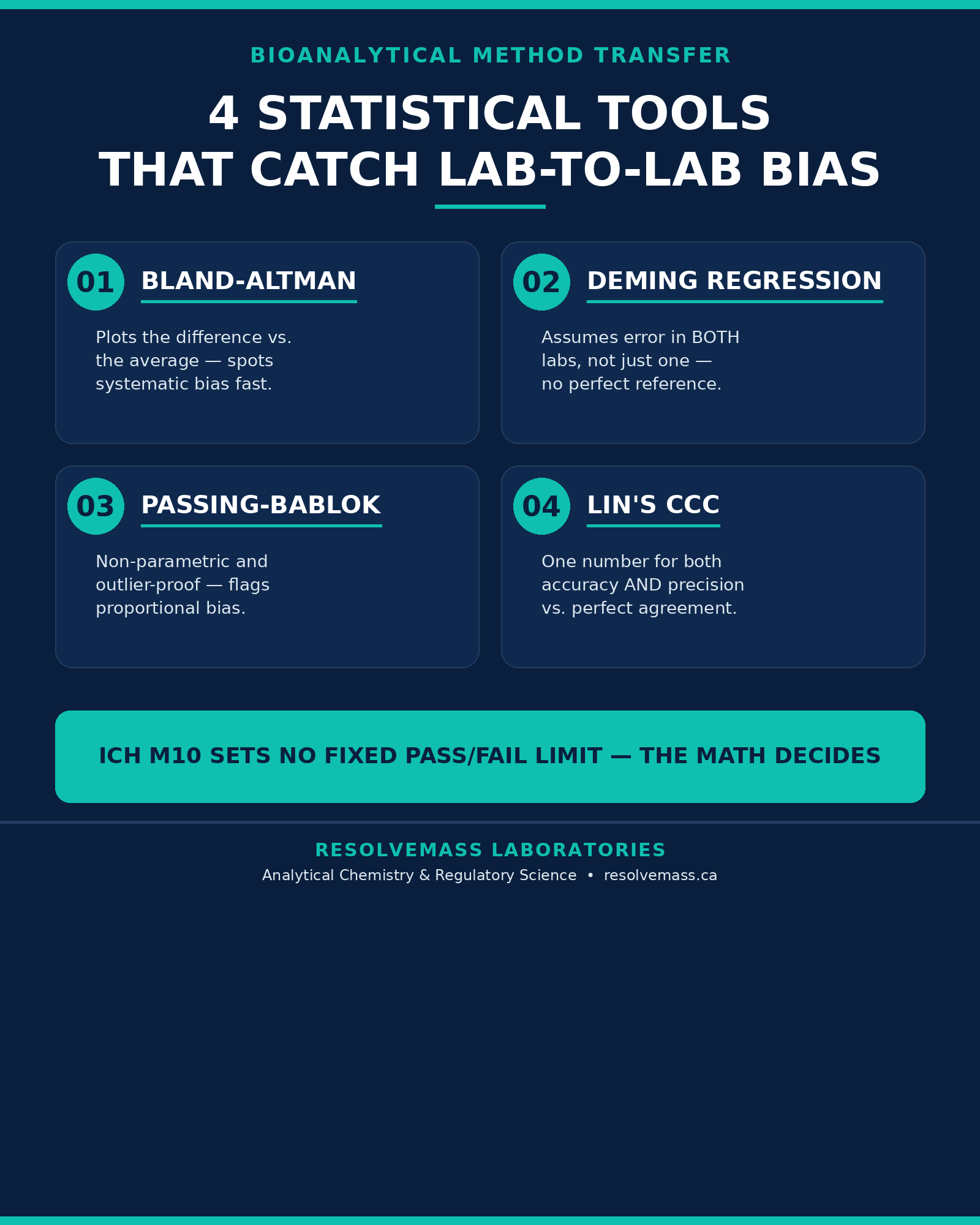
As a result, sponsors are now expected to collaborate closely with biostatistical experts and clinical pharmacologists to apply advanced statistical methodologies capable of identifying systematic, proportional, or concentration-dependent analytical bias.
Bland-Altman Analysis
Bland-Altman analysis is a graphical method used to evaluate agreement between two quantitative measurement procedures. The technique involves plotting the difference between measurements generated by the legacy laboratory and the receiving CRO against the average of the two measurements. This visualization allows investigators to quickly identify systematic trends and assess the extent of agreement between laboratories.
The limits of agreement are typically calculated as the mean difference plus or minus 1.96 times the standard deviation of the observed differences. When the data points are distributed randomly around the zero-difference line, the laboratories are generally considered to demonstrate good agreement. Conversely, a consistent shift above or below the zero line indicates the presence of systematic bias that may require further investigation.
Deming Regression
Traditional ordinary least squares (OLS) regression assumes that the reference method is free from measurement error, an assumption that is rarely valid in bioanalytical testing. Both the originating laboratory and the receiving laboratory introduce some degree of analytical variability into the dataset.
Deming regression addresses this limitation by accounting for measurement error in both variables being compared. By incorporating uncertainty associated with measurements from both laboratories, this regression model provides a more accurate estimate of the true relationship between datasets. The resulting slope and intercept values help determine whether meaningful systematic differences exist between analytical sites and whether correction factors may be necessary.
Passing-Bablok Regression
Passing-Bablok regression is frequently used during complex bioanalytical transfers because it is a robust non-parametric statistical method that performs well in the presence of outliers and heteroscedasticity, where variability changes across the concentration range.
This technique is particularly valuable for identifying two important forms of analytical bias. A slope that deviates significantly from 1.0 suggests proportional bias, indicating that differences between laboratories change as analyte concentrations increase or decrease. An intercept that differs substantially from zero indicates constant bias, reflecting a consistent measurement offset across the entire concentration range. Because of its robustness and minimal assumptions regarding data distribution, Passing-Bablok regression is often considered highly reliable for evaluating method comparability.
Lin’s Concordance Correlation Coefficient (CCC)
Lin’s Concordance Correlation Coefficient (CCC) provides a quantitative measure of agreement by simultaneously assessing both precision and accuracy. The metric evaluates how closely paired observations align with the theoretical 45-degree line representing perfect concordance.
Unlike correlation coefficients that measure only the strength of association between datasets, CCC determines whether measurements are both highly correlated and sufficiently close to one another in absolute value. As a result, it offers a comprehensive assessment of analytical comparability and is frequently used to support conclusions regarding dataset interchangeability.
Following completion of these statistical evaluations, the resulting analyses are typically reviewed by the sponsor’s clinical pharmacology and biostatistics teams. The sponsor is generally expected to prepare a dedicated technical report summarizing the observed percentage bias, interpreting the statistical findings, and providing a scientific justification regarding whether the datasets can be combined for regulatory submissions and clinical decision-making. This documentation becomes an essential component of the overall method transfer package and serves as critical evidence during regulatory inspections and submission reviews.
What Are the Key Technical Challenges When Transferring LC-MS/MS and Ligand-Binding Assays?
The most significant technical challenges encountered during Bioanalytical Method Transfer Services involve controlling matrix effects across diverse biological sample populations, aligning differences in LC-MS/MS instrument performance, and conducting comprehensive reagent lot-to-lot bridging studies for Ligand-Binding Assays (LBAs). Biopharmaceutical sponsors must also proactively address issues related to isotopic interference involving internal standards and variations in extraction recovery to minimize the risk of concentration-dependent bias emerging at the receiving laboratory.
Discover specialized techniques to identify and overcome ionization suppression or enhancement with our technical article on Matrix Effects in LC-MS/MS Bioanalysis.
Transferring an assay during an active clinical program often reveals subtle weaknesses in the robustness of the original analytical method. Even seemingly minor differences in laboratory procedures, such as vortex mixing duration, centrifugation parameters, incubation times, or reagent pH, can generate substantial analytical variability if not properly controlled during the transfer process.
For chromatographic assays, differences in instrument platforms represent one of the most critical concerns. Moving a validated method from a conventional high-performance liquid chromatography (HPLC) system to a modern microflow LC-MS/MS platform can significantly alter analytical performance characteristics, including signal-to-noise ratios and sensitivity. Microflow LC-MS/MS technology offers substantial advantages by reducing solvent consumption and minimizing ion source contamination, often delivering sensitivity improvements that greatly exceed those of traditional analytical configurations. However, this enhanced sensitivity can also increase the detection of background chemical noise and previously undetected co-eluting compounds. Consequently, the receiving CRO frequently must optimize chromatographic gradients, ionization conditions, source parameters, and mass spectrometric settings to maintain assay performance while avoiding unintended analytical interference.
Variability within biological matrices presents another major challenge during method transfers. Human plasma and serum composition can differ considerably depending on donor demographics, geographic origin, dietary habits, disease state, and concomitant medication use. Endogenous matrix components that co-elute with the target analyte may cause significant ion suppression or ion enhancement within the electrospray ionization (ESI) source, potentially affecting analytical accuracy and reproducibility.
To address these concerns, the receiving CRO must evaluate assay performance using at least six independent lots of biological matrix. Regulatory expectations typically include the assessment of both lipemic and hemolyzed matrices to confirm that extraction recovery and analyte quantification remain consistent across a wide range of biological conditions. These studies help demonstrate that the method is sufficiently robust to support diverse clinical populations without introducing systematic bias.
The performance of the internal standard (IS) is equally important throughout the transfer process. In LC-MS/MS bioanalysis, stable isotope-labeled (SIL) internal standards are commonly employed to compensate for extraction variability and matrix-related effects. However, isotopic cross-talk can occur when naturally occurring isotopes of the analyte contribute to the signal of the internal standard or when isotopic overlap affects analyte detection. Such interactions can compromise calibration curve linearity and quantitative accuracy.
During a laboratory transfer, differences in mass spectrometer resolution and selectivity may intensify these challenges. As a result, analysts are often required to re-evaluate and optimize precursor-to-product ion transitions, collision energies, and acquisition parameters to ensure that the internal standard continues to function as intended within the new analytical environment.
For large molecules and biologic therapeutics measured using Ligand-Binding Assays (LBAs), the technical focus shifts from chromatographic performance to critical reagent management. The accuracy and reliability of an LBA depend heavily on the binding characteristics of specialized capture and detection antibodies. If the originating CRO relied on a specific monoclonal antibody lot that is unavailable to the receiving laboratory, a significant reagent change is introduced into the analytical system.
Under the ICH M10 framework, the introduction of critical reagents derived from a new manufacturing batch or production process requires additional scientific evaluation. A comprehensive partial validation is typically necessary to confirm that binding affinity, specificity, sensitivity, and overall assay performance remain unaffected. In many situations, a dedicated reagent lot-to-lot bridging study must also be conducted to verify that the assay’s calibration range and dynamic response characteristics remain comparable to those established during the original validation.
How Does the Transition to Novel Matrices Like VAMS Impact Bioanalytical Method Transfer Services?
Transitioning a bioanalytical program from conventional venous plasma sampling to alternative matrices such as Volumetric Absorptive Microsampling (VAMS) or quantitative dried blood spots (qDBS) introduces additional complexities that require extensive bridging studies and cross-validation activities. These evaluations are necessary to establish reliable relationships between blood-based and plasma-based measurements while ensuring that pharmacokinetic interpretations remain scientifically valid. Statistical approaches such as Passing-Bablok regression play a critical role in confirming that analyte recovery and clinical decision-making are not adversely affected by hematocrit-related variability associated with capillary blood collection.
Learn how to validate methods across complex or non-traditional biological samples with our Tissue and CSF Bioanalytical Services.
The growing adoption of microsampling technologies is being driven by increasing demand for patient-friendly sampling approaches, particularly within therapeutic drug monitoring (TDM) programs and pediatric clinical studies. These methods offer significant advantages in terms of patient convenience, reduced blood volume requirements, and improved compliance. However, when a sponsor elects to change biological matrices during an ongoing development program, the ICH M10 guideline explicitly requires cross-validation to establish the relationship between the historical matrix and the newly introduced sampling approach.
Traditional dried blood spot (DBS) methodologies are well known for their susceptibility to hematocrit-related effects. Variations in red blood cell concentration can alter blood viscosity, spot spreading characteristics, and extraction efficiency, potentially affecting quantitative accuracy. VAMS technology was specifically developed to reduce these limitations by utilizing hydrophilic polymer-based sampling tips designed to collect fixed sample volumes, such as 10 µL or 30 µL, regardless of hematocrit variation.
Despite these advantages, integrating VAMS-generated data with historical plasma datasets remains a complex undertaking. Drug distribution characteristics frequently differ between capillary whole blood and plasma due to variations in partitioning behavior and protein binding. Therefore, direct comparison of concentrations obtained from the two matrices is often inappropriate without additional statistical analysis.
To support the incorporation of VAMS data into an existing pharmacokinetic dataset, analysts typically perform Passing-Bablok regression analyses and Bland-Altman bias assessments using paired patient samples collected in both matrices. These evaluations help determine whether systematic or proportional bias exists between the two sampling approaches. When significant bias is identified, mathematical conversion factors (CF) or regression-derived correction equations may be applied to estimate equivalent plasma concentrations (EPC). This approach enables sponsors to maintain continuity in pharmacokinetic interpretation while preserving the integrity of longitudinal clinical data generated throughout the development program.
How Should Sponsors Structure Documentation to Ensure Regulatory Defensibility?
Achieving regulatory defensibility during a bioanalytical method transfer requires sponsors to develop a comprehensive and fully traceable documentation package. This package should include the original validation report, a predefined transfer and bridging protocol, and a dedicated cross-validation report containing all statistical analyses used to evaluate analytical comparability. In addition, sponsors must maintain detailed records documenting standard operating procedure (SOP) harmonization activities, audit trail reviews, and any corrective and preventive action (CAPA) initiatives implemented during the transition process.
Ensure robust data package preparation for pivotal trials by exploring our Phase II & Phase III Bioanalytical CRO Services.
Regulatory agencies such as the FDA and EMA evaluate far more than the final analytical results generated during a method transfer. Inspectors carefully examine the scientific governance framework used to manage the transition and verify that all activities were conducted in a controlled, documented, and reproducible manner. Undocumented procedural changes, unexplained parameter adjustments, missing chain-of-custody records, or unapproved deviations from the transfer protocol can significantly undermine confidence in the resulting data.
To support a defensible regulatory position, sponsors should ensure that their documentation strategy incorporates several essential elements.
The Pre-Transfer Protocol
A formal pre-transfer protocol should clearly define the scope of the transfer activities, outline all partial validation requirements, establish acceptance criteria consistent with ICH M10 expectations, and specify the responsibilities of both the originating and receiving CROs. This document serves as the foundational roadmap for all transfer-related activities and provides inspectors with evidence that the process was planned and executed systematically.
Raw Data Traceability
Complete traceability of analytical data is essential. Sponsors should maintain access to all instrument audit trails, raw chromatographic files, integration records, acquisition parameters, and LBA plate-read outputs generated by both laboratories. During inspections, regulators routinely review these records to confirm that data processing activities were conducted appropriately and that peak integrations or analytical results were not manipulated to achieve acceptable outcomes.
The Standalone Cross-Validation Report
Rather than incorporating cross-validation findings as a supplementary section within a broader clinical study report, many experts recommend developing an independent cross-validation report. A standalone report provides clear documentation of all statistical evaluations and facilitates regulatory review. It also enables the same comparability assessment to be referenced across multiple clinical submissions while maintaining appropriate confidentiality protections when multiple CROs are involved.
Deviation and CAPA Documentation
Any sample, analytical run, or validation parameter that fails to satisfy predefined acceptance criteria during the transfer process should trigger a formal root-cause investigation. The resulting documentation must clearly describe the observed issue, the investigative approach undertaken, the scientific rationale used to determine the root cause, and the corrective actions implemented to prevent recurrence. Comprehensive CAPA documentation demonstrates effective quality management and provides regulators with evidence that analytical risks were properly identified and controlled before routine sample analysis resumed.
Conclusion
Bioanalytical Method Transfer Services occupy a uniquely important position at the intersection of analytical science, statistical evaluation, and regulatory compliance. As biopharmaceutical organizations increasingly encounter situations requiring mid-program CRO transitions, the harmonized framework established by the ICH M10 guideline has significantly strengthened expectations regarding method transfer governance. The guideline has reduced ambiguity surrounding laboratory transitions by establishing clear requirements for partial validation and scientifically rigorous cross-validation activities.
Modern method transfers involve far more than reproducing an existing standard operating procedure at a different location. Successful implementation requires a proactive and scientifically grounded strategy that addresses matrix effects, aligns LC-MS/MS and ligand-binding assay performance, manages critical reagents, and utilizes advanced statistical methodologies such as Deming regression and Passing-Bablok regression to characterize analytical bias objectively.
By emphasizing technical harmonization, comprehensive validation activities, and audit-ready documentation, sponsors can successfully bridge historical datasets with newly generated analytical data while maintaining regulatory confidence. This disciplined approach helps avoid costly development delays, preserves the integrity of pharmacokinetic and safety datasets, and supports uninterrupted clinical progress throughout the development lifecycle.
Whether driven by strategic business initiatives, operational disruptions, laboratory capacity constraints, or evolving program requirements, a carefully executed Bioanalytical Method Transfer Services strategy enables sponsors to maintain continuity and confidence in their analytical programs while minimizing regulatory risk.
ResolveMass Laboratories Inc. provides the scientific expertise and regulatory knowledge required to support complex, ICH M10-compliant laboratory transitions. To ensure the continuity, integrity, and regulatory defensibility of your analytical data during a mid-program CRO transition, connect with the specialized scientific team at ResolveMass Laboratories Inc. through our contact page.
Advanced FAQs on Bioanalytical Method Transfer Services
During partial validation, the receiving CRO must demonstrate that samples with concentrations above the upper limit of quantitation (ULOQ) can be diluted and analyzed accurately without compromising assay performance. This is typically achieved by preparing quality control samples above the calibration range and diluting them using blank matrix at predefined dilution factors expected during routine sample analysis. The diluted samples are then evaluated for accuracy and precision, which must remain within established acceptance criteria to confirm reliable quantitation after dilution.
Deming regression is an advanced statistical technique used during cross-validation because it accounts for analytical variability in both laboratories being compared. Unlike conventional regression methods that assume one laboratory generates error-free results, Deming regression recognizes that measurement uncertainty exists on both sides. This approach provides a more accurate assessment of constant and proportional bias, helping sponsors determine whether datasets generated by different CROs can be combined for pharmacokinetic, efficacy, or regulatory evaluations.
Ligand-Binding Assays depend heavily on specialized biological reagents such as capture and detection antibodies. When a method is transferred to a new CRO, the original reagent lot may no longer be available, requiring the use of a different lot or manufacturing source. To ensure assay consistency, the receiving laboratory performs reagent bridging studies and partial validation activities to verify that sensitivity, specificity, binding characteristics, and dynamic range remain comparable to historical performance. These studies help maintain continuity between legacy and newly generated data.
Yes. Transitioning from conventional venous plasma collection to Volumetric Absorptive Microsampling (VAMS) or other microsampling techniques constitutes a change in biological matrix and therefore requires cross-validation under the ICH M10 framework. Paired patient samples are typically analyzed to evaluate differences between plasma and capillary blood measurements. Statistical tools such as Passing-Bablok regression and Bland-Altman analysis are then used to assess bias and establish appropriate conversion models when necessary.
Matrix effects are evaluated to determine whether endogenous compounds present in biological samples influence analyte ionization and quantitative accuracy. During a method transfer, analysts assess low- and high-concentration quality control samples prepared using multiple independent lots of biological matrix, including challenging matrices such as lipemic and hemolyzed plasma. Consistent accuracy and precision across all tested matrices demonstrate that the method can withstand biological variability without experiencing significant ion suppression or ion enhancement.
Passing-Bablok regression is widely used in complex method transfer studies because it is a robust non-parametric statistical approach that does not rely on assumptions regarding data distribution. The method is particularly effective when datasets contain outliers or exhibit unequal variability across concentration ranges. By providing reliable estimates of both systematic and proportional bias, Passing-Bablok regression offers a scientifically sound approach for evaluating comparability between analytical methods or laboratories.
Under ICH M10 expectations, partial validation typically requires the evaluation of at least four quality control concentration levels, including the lower limit of quantitation (LLOQ), low QC, medium QC, and high QC. These QC samples are used to assess assay accuracy and precision under the conditions employed by the receiving laboratory. Replicate analyses are performed across multiple runs and, when appropriate, across different days to demonstrate that the method remains reliable, reproducible, and fit for its intended purpose.
Internal Standard (IS) performance is carefully monitored during a method transfer because differences in extraction procedures, instrument configurations, and ionization conditions can affect response consistency. Scientists evaluate potential isotopic interference, extraction recovery, and signal stability while optimizing mass spectrometric parameters when necessary. Continuous assessment of internal standard performance helps ensure reliable normalization of analyte responses and minimizes the impact of matrix-related variability on quantitative results.
An inspection-ready method transfer package should include the original validation documentation, a predefined transfer protocol, complete raw analytical data, audit trails, chromatograms, and all records generated during partial validation and cross-validation activities. In addition, the package should contain detailed statistical evaluations, deviation investigations, and corrective and preventive action (CAPA) documentation. Maintaining comprehensive, traceable, and well-organized records demonstrates regulatory compliance and provides strong support during FDA, EMA, or Health Canada inspections.
Reference:
- International Council for Harmonisation of Technical Requirements for Pharmaceuticals for Human Use. (2022). ICH harmonised guideline M10: Bioanalytical method validation and study sample analysis (Final version, adopted May 24, 2022). ICH. ICH M10 Guideline PDF
- Fjording, M. S., Goodman, J., & Briscoe, C. (2025). Cross-validation of pharmacokinetic assays post-ICH M10 is not a pass/fail criterion. Bioanalysis, 17(1), 1–5. https://doi.org/10.1080/17576180.2024.2418284
- International Council for Harmonisation of Technical Requirements for Pharmaceuticals for Human Use. (2022, November 23). ICH M10: Bioanalytical method validation and study sample analysis—Step 4 presentation. ICH. https://database.ich.org/sites/default/files/ICH_M10_Step_4_Presentation_2022_1123.pdf
- U.S. Food and Drug Administration. (2022, November). M10 bioanalytical method validation and study sample analysis: Guidance for industry. U.S. Department of Health and Human Services. https://www.fda.gov/media/167335/download
- U.S. Food and Drug Administration. (2022, November). M10 bioanalytical method validation and study sample analysis: Guidance for industry. U.S. Department of Health and Human Services. https://www.fda.gov/media/167335/download
- European Medicines Agency. (2019, March 14). Draft ICH guideline M10 on bioanalytical method validation – Step 2b (EMA/CHMP/ICH/172948/2019). European Medicines Agency. https://www.ema.europa.eu/en/documents/scientific-guideline/draft-ich-guideline-m10-bioanalytical-method-validation-step-2b_en.pdf
Get In Touch With Us
About The Author


