

Introduction
Developing a Nitrosamine Testing Program from scratch for a multi-product generic drug portfolio requires a well-organized, cross-functional strategy that brings together toxicological risk assessment, high-sensitivity mass spectrometry, analytical method development, and regulatory lifecycle management. Implementing such a program across a portfolio of 15 generic products helps maintain compliance with regulatory expectations established by the U.S. Food and Drug Administration (FDA) and European Medicines Agency (EMA), while also reducing the risks associated with batch rejection, product recalls, and Abbreviated New Drug Application (ANDA) delays.
To understand the fundamental chemistry and regulatory origins of these impurities, read our foundational guide on what nitrosamines are and why they pose compliance risks.
The regulatory approach to mutagenic impurities changed significantly after the worldwide detection of N-nitrosodimethylamine (NDMA) and N-nitrosodiethylamine (NDEA) in angiotensin II receptor blockers, histamine-2 receptor antagonists, and biguanide anti-diabetic medications. As regulatory evaluation expanded, attention moved beyond conventional small-molecule nitrosamines toward more structurally complex Nitrosamine Drug Substance-Related Impurities (NDSRIs). These impurities can form directly from active pharmaceutical ingredients (APIs) containing secondary or tertiary amine groups and generally exhibit structural relationships to the parent drug molecule.
Explore the key chemical and structural differences in our article on NDSRIs vs simple nitrosamines.
For generic drug manufacturers responsible for diverse and complex product portfolios, one of the primary challenges is establishing sufficiently rigorous testing without unnecessarily increasing analytical expenditure or creating laboratory capacity constraints. A centralized, high-throughput analytical testing program requires a detailed review of chemical structures, raw material sources, manufacturing and synthetic pathways, excipient composition, and finished dosage storage conditions for each product. Specialized contract research organizations such as ResolveMass Laboratories Inc. can provide the mass spectrometry infrastructure, analytical method validation capabilities, and regulatory expertise required to address these complex testing and compliance requirements.
Share via:
Quick Summary:
- Portfolio-wide risk assessment: A 15-product generic drug portfolio requires systematic evaluation of API structures, raw materials, excipients, manufacturing processes, and packaging to identify potential nitrosamine formation risks.
- Risk-based prioritization: Products are categorized by nitrosamine formation potential, while the CPCA helps estimate acceptable intake limits and establish appropriate analytical sensitivity.
- Ultra-trace analytical testing: LC-MS/MS, GC-MS/MS, and HRMS are selected based on impurity characteristics. Stable-isotope internal standards, optimized chromatography, and sample clean-up improve detection reliability.
- Method validation and data integrity: Analytical methods are validated for specificity, accuracy, precision, linearity, and LOQ under ICH Q2(R2). ALCOA+ principles and 21 CFR Part 11 support secure, traceable, and audit-ready data.
- Regulatory lifecycle management: Nitrosamine testing is integrated into commercial release, stability monitoring, change control, and eCTD Module 3 submissions to maintain ongoing regulatory compliance.
- 24-week implementation roadmap: The program progresses through portfolio mapping → method development → validation → confirmatory testing → control strategy, creating a structured path from risk assessment to routine testing.
- Overall objective: Combining toxicological assessment, advanced mass spectrometry, and regulatory controls helps reduce batch rejection, product recalls, ANDA delays, and potential patient safety risks.
Risk Assessment Framework for Building a Nitrosamine Testing Program from Scratch
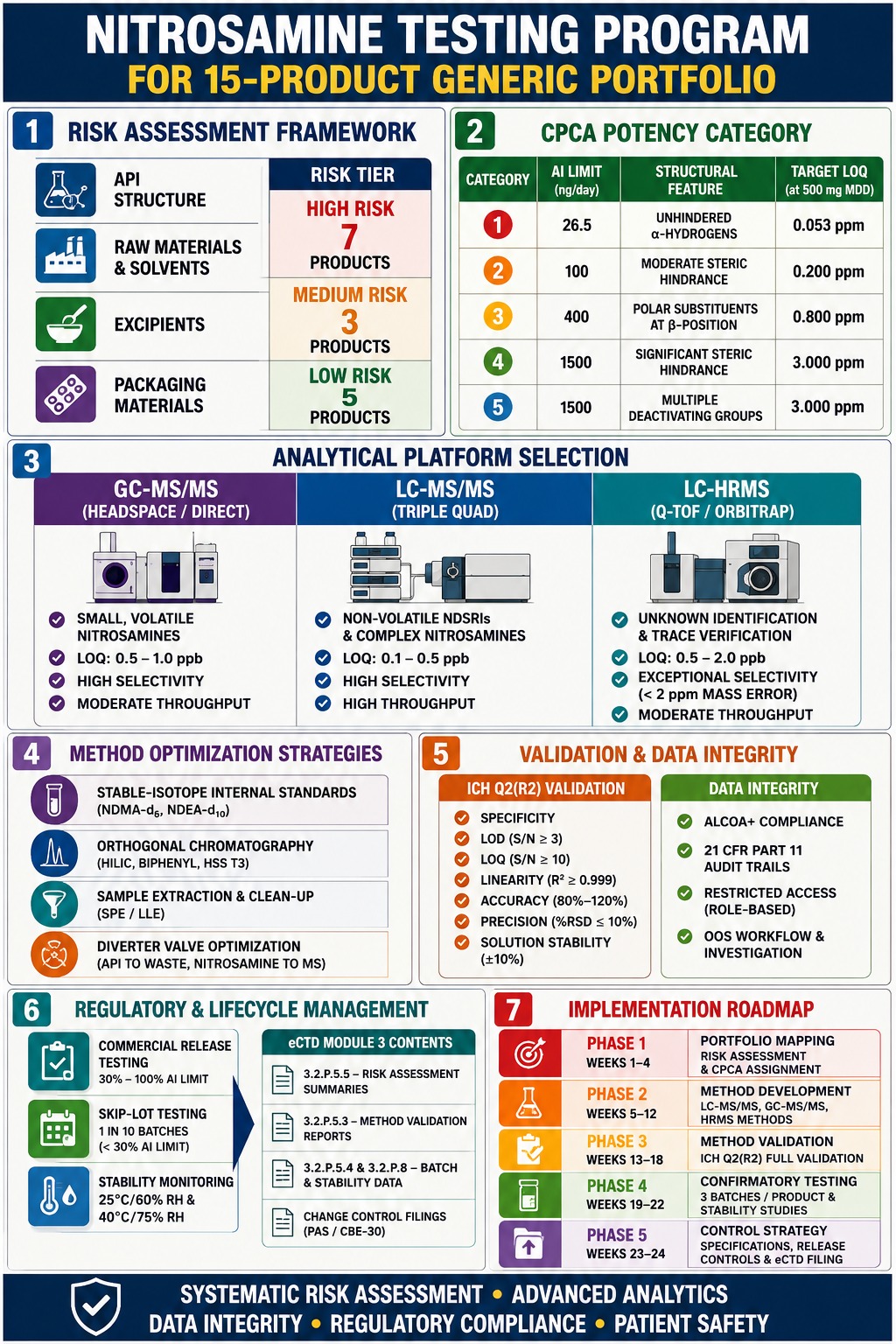
A comprehensive chemical and toxicological risk assessment examines the chemical structures of active pharmaceutical ingredients, raw material sources, excipient nitrite levels, and manufacturing conditions to assign products to practical risk categories. This systematic approach allows manufacturers to identify products with greater nitrosamine formation potential, prioritize analytical resources, and establish efficient method development workflows across a 15-product portfolio.
Discover if your entire product line requires immediate evaluation in our guide on whether all drugs need a nitrosamine risk assessment.
Evaluating Synthetic Routes, Amine Sources, and Nitrosating Agents
Assessment of nitrosation hazards begins with a detailed examination of the synthetic pathway to identify secondary and tertiary amine functional groups that may interact with trace nitrites or other nitrosating reagents during manufacturing. Nitrosating agents, including sodium nitrite (NaNO₂), nitrogen oxides (NOₓ), and nitric acid, may react with secondary, ter/.tiary, or quaternary amines under acidic conditions and result in the formation of carcinogenic nitrosamines.
Examine trace reaction mechanisms during API processing in our paper on nitrosamine formation pathways during API synthesis.
For a representative 15-product generic portfolio, the major potential sources of nitrosamine risk may include:
- API Chemical Structure: The presence of aliphatic or aromatic secondary or tertiary amine functional groups that can participate directly in reactions leading to NDSRIs.
- Raw Materials and Solvents: Recovered solvents, including dimethylformamide and dichloromethane, may contain trace secondary amines, while process water may introduce nitrite contamination.
- Excipients: Trace quantities of nitrite impurities may be present in commonly used excipients such as microcrystalline cellulose, dibasic calcium phosphate, crospovidone, and magnesium stearate.
- Primary Packaging: Blister packaging lidding foils containing nitrocellulose coatings may undergo degradation and generate NOₓ gas during heat-sealing operations.
| Product ID | Generic Active Ingredient | Dosage Form | Structural Amine Class | Potential Nitrosamine / NDSRI | Initial Risk Tier |
|---|---|---|---|---|---|
| PROD-01 | Amitriptyline HCl | Oral Tablet | Tertiary Amine | N-nitroso-desmethyl-amitriptyline | High Risk |
| PROD-02 | Duloxetine HCl | Delayed-Release Capsule | Secondary Amine | N-nitroso-duloxetine | High Risk |
| PROD-03 | Ciprofloxacin | Oral Tablet | Secondary Amine (Piperazine) | N-nitroso-ciprofloxacin / NPZ | High Risk |
| PROD-04 | Fluoxetine HCl | Oral Capsule | Secondary Amine | N-nitroso-fluoxetine | High Risk |
| PROD-05 | Sertraline HCl | Oral Tablet | Secondary Amine | N-nitroso-sertraline | High Risk |
| PROD-06 | Metformin HCl | Extended-Release Tablet | Secondary Amine (Biguanide) | NDMA / N-nitrosodimethylamine | High Risk |
| PROD-07 | Amlodipine Besylate | Oral Tablet | Primary Amine / Tertiary Center | N-nitroso-amlodipine | Medium Risk |
| PROD-08 | Sitagliptin Phosphate | Oral Tablet | Secondary Amine (Triazolopiperazine) | NTTP | Medium Risk |
| PROD-09 | Atomoxetine HCl | Oral Capsule | Secondary Amine | N-nitroso-atomoxetine | Medium Risk |
| PROD-10 | Ranitidine HCl | Oral Tablet | Tertiary Amine | NDMA | High Risk |
| PROD-11 | Abacavir Sulfate | Oral Solution | Secondary Amine | N-nitroso-abacavir | Low Risk |
| PROD-12 | Albuterol Sulfate | Inhalation Solution | Secondary Amine | N-nitroso-albuterol | Low Risk |
| PROD-13 | Acebutolol HCl | Oral Capsule | Secondary Amine | N-nitroso-acebutolol | Low Risk |
| PROD-14 | Acarbose | Oral Tablet | Secondary Amine | N-nitroso-acarbose | Low Risk |
| PROD-15 | Arformoterol Tartrate | Nebulizer Solution | Secondary Amine | N-nitroso-arformoterol | Low Risk |
Read our detailed analysis on nitrosamine testing for a metformin generic to see a practical application of evaluating high-risk biguanide products.
Carcinogenic Potency Categorization Approach (CPCA) and NDSRI Classification
The Carcinogenic Potency Categorization Approach (CPCA) is used to estimate predicted Acceptable Intake (AI) limits by assessing structural characteristics of nitrosamine compounds. The resulting potency categorization helps establish the analytical Limit of Quantification (LOQ) required for each product. Structural characteristics, including activating groups such as neighboring alkyl chains and deactivating features such as electron-withdrawing carboxylic acids or steric hindrance, are evaluated to determine the expected potency category of the compound.
The Maximum Daily Dose (MDD) of the drug product is an important factor in establishing the required analytical Limit of Quantification (LOQ), expressed in parts per million (ppm). The toxicological relationship can be represented as follows:
LOQ (ppm) = Acceptable Intake (ng/day) / Maximum Daily Dose (mg/day)
| CPCA Potency Category | Predicted AI Limit | Structural Feature Examples | Representative Drug Impurity | Target LOQ at 500 mg MDD |
|---|---|---|---|---|
| Category 1 | 26.5 ng/day | Unhindered α-hydrogens, no deactivating groups | N-nitroso-desmethyl-amitriptyline | 0.053 ppm |
| Category 2 | 100 ng/day | Moderate steric hindrance or electron-withdrawing groups | N-nitroso-duloxetine | 0.200 ppm |
| Category 3 | 400 ng/day | Chains with polar substituents at β-position | N-nitroso-amoxapine | 0.800 ppm |
| Category 4 | 1500 ng/day | Significant steric hindrance surrounding nitroso group | N-nitroso-acebutolol | 3.000 ppm |
| Category 5 | 1500 ng/day | Multiple deactivating structural features present | N-nitroso-amlodipine | 3.000 ppm |
Learn the step-by-step toxicological methodology in our article on how to calculate Acceptable Intake (AI) limits for nitrosamines.
Method Development Strategy for Ultra-Trace Nitrosamine Quantification
Ultra-trace nitrosamine quantification requires the selection and optimization of highly sensitive analytical platforms, including LC-MS/MS, GC-MS/MS, and HRMS. These systems must be capable of achieving Limits of Quantification substantially below the applicable regulatory thresholds. Conventional High-Performance Liquid Chromatography with Ultraviolet detection (HPLC-UV) generally does not provide the sensitivity and selectivity needed for reliable trace-level nitrosamine analysis.
Instrumentation Selection: LC-MS/MS vs. GC-MS/MS and HRMS
The appropriate analytical platform—LC-MS/MS, GC-MS/MS, or LC-HRMS—should be selected according to the volatility, thermal stability, molecular characteristics, and structural complexity of the target nitrosamine or NDSRI.
- Liquid Chromatography Triple Quadrupole Tandem Mass Spectrometry (LC-MS/MS): This platform operates using Electrospray Ionization (ESI) or Atmospheric Pressure Chemical Ionization (APCI) and typically applies Multiple Reaction Monitoring (MRM). It is particularly suitable for non-volatile, thermally labile, and high-molecular-weight NDSRIs.
- Gas Chromatography Tandem Mass Spectrometry (GC-MS/MS): This approach can use Headspace or Direct Injection with Electron Ionization (EI) or Chemical Ionization (CI). It is particularly useful for volatile, low-molecular-weight nitrosamines, including NDMA, NDEA, NDIPA, and NDBA.
- High-Resolution Mass Spectrometry (LC-HRMS / Quadrupole-Time-of-Flight): This technology provides accurate mass measurements with sub-2 ppm mass error and can help distinguish isobaric interferences in complex active formulations.
| Analytical Parameter | GC-MS/MS (Headspace / Direct) | LC-MS/MS (Triple Quadrupole) | LC-HRMS (Q-TOF / Orbitrap) |
|---|---|---|---|
| Primary Target Class | Small, volatile nitrosamines (NDMA, NDEA) | Non-volatile NDSRIs & complex nitrosamines | Unknown identification & trace verification |
| Sensitivity (LOQ) | 0.5–1.0 ppb | 0.1–0.5 ppb | 0.5–2.0 ppb |
| Selectivity | High (EI/CI ionization) | High (MRM Transitions) | Exceptional (Accurate Mass < 2 ppm) |
| Thermal Artifact Risk | High (thermal degradation during injection) | None (ambient liquid separation) | None (ambient liquid separation) |
| Sample Throughput | Moderate (15–25 min/sample) | High (5–12 min/sample) | Moderate (15–30 min/sample) |
Mitigating Matrix Suppression and Interference in Analytical Assays
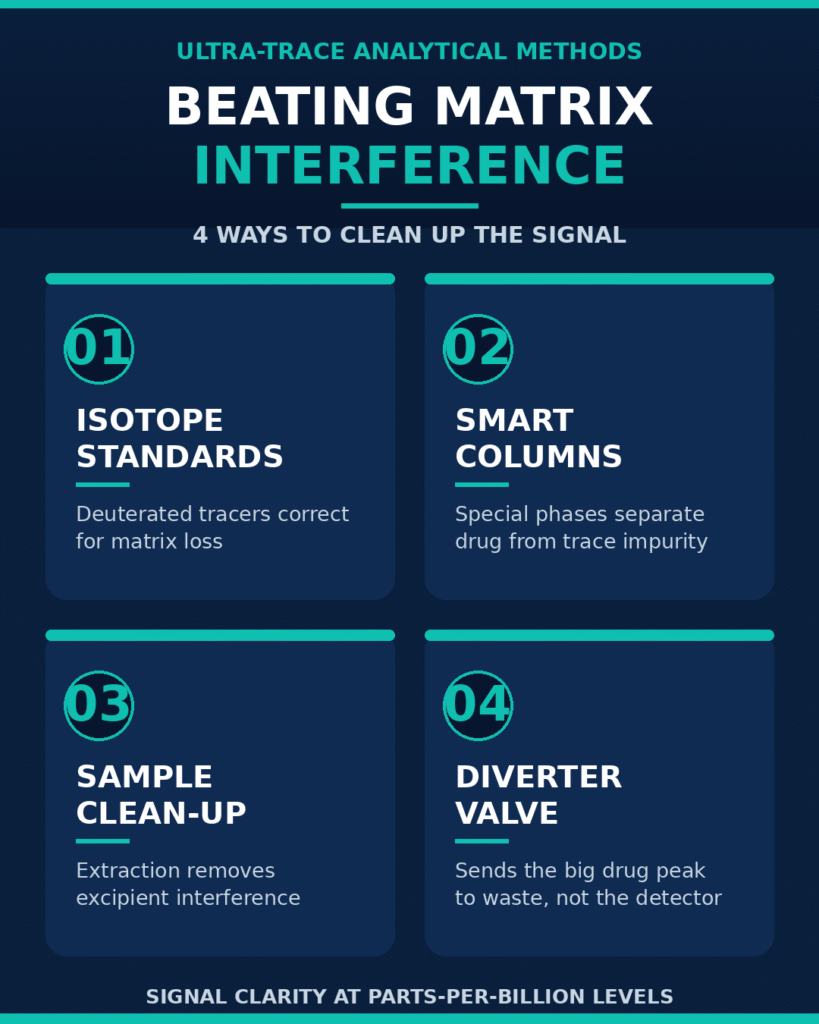
Matrix suppression and co-elution can compromise the reliability of trace-level analytical measurements. Addressing these challenges requires appropriate sample preparation, chromatographic separation, and internal-standard strategies. Techniques such as solid-phase extraction, divert-valve chromatographic configurations, and stable-isotope internal standards can improve assay performance. High concentrations of active pharmaceutical ingredients entering the mass spectrometry source may contaminate system components and reduce the ionization response of trace-level impurities.
Important method optimization approaches include:
- Stable-Isotope Labeled Internal Standards (SIL-IS): Deuterated or 13C-labeled analogues, such as NDMA-d₆ and NDEA-d₁₀, can be incorporated to compensate for matrix effects, extraction losses, and variations in ionization efficiency.
- Orthogonal Chromatographic Separation: Specialized stationary phases, including Hydrophilic Interaction Liquid Chromatography (HILIC), Biphenyl, and High-Strength Silica (HSS) T3 columns, can provide improved separation between parent APIs and trace nitrosamines.
- Sample Extraction and Clean-Up: Solid-Phase Extraction (SPE) or liquid-liquid extraction (LLE) can be used to isolate target nitrosamines while reducing contributions from interfering excipients and active drug substances.
- Diverter Valve Optimization: The high-concentration API peak can be directed to waste, while the chromatographic window containing the nitrosamine is routed into the mass spectrometer source. This configuration helps minimize detector saturation and reduces matrix contamination.
Partner with our analytical teams using our specialized nitrosamine method development and validation services.
Validation Standards and Data Integrity for Building a Nitrosamine Testing Program from Scratch
Analytical validation demonstrates that nitrosamine testing methods can consistently meet established requirements for sensitivity, accuracy, precision, and selectivity across relevant drug product matrices. In parallel, the analytical program must operate under strict data governance and integrity controls to ensure that generated results are reliable, traceable, and suitable for regulatory review.
Method Validation Protocols under ICH Q2(R2)
Method validation conducted under ICH Q2(R2) evaluates critical performance characteristics, including specificity, linearity, accuracy, repeatability, intermediate precision, and lower limits of quantification. These parameters collectively establish whether the analytical procedure is appropriate for its intended nitrosamine testing application.
| Validation Parameter | ICH Q2(R2) Acceptance Criteria | Technical Evaluation Strategy |
|---|---|---|
| Specificity / Selectivity | No interfering peaks > 10% of LOQ peak area at retention window | Evaluate blank, placebo, API, and spiked samples |
| Limit of Detection (LOD) | Signal-to-Noise (S/N) ratio ≥ 3:1 | Dilution series of target nitrosamines in matrix |
| Limit of Quantification (LOQ) | S/N ≥ 10:1; Precision %RSD ≤ 10%; Accuracy 80–120% | Lowest validated concentration in drug matrix |
| Linearity | Correlation coefficient R² ≥ 0.999 over range | Minimum 5 concentration levels (30% to 150% of limit) |
| Accuracy (Recovery) | Mean recovery 80.0%–120.0% at LOQ, 100%, and 150% | Spike recovery trials in triplicate across 3 levels |
| Repeatability Precision | %RSD ≤ 10.0% for 6 replicate preparations | Assay six independently prepared spiked samples at target |
| Solution Stability | Sample response within ±10% of initial value | Test prepared samples stored at room temp and 2–8°C over 48h |
Review our comprehensive breakdown on genotoxic impurity testing under ICH M7 guidelines.
ALCOA+ Compliance and 21 CFR Part 11 Data Governance
Compliance with ALCOA+ data integrity principles requires secure audit trails, controlled system access, and documented Out-of-Specification (OOS) investigation procedures within compliant LIMS and mass spectrometry software. During nitrosamine-related inspections and audits, regulators may examine electronic analytical systems to confirm that data remain attributable, legible, contemporaneous, original, and accurate throughout their lifecycle.
Essential data integrity measures include:
- 21 CFR Part 11 Audit Trails: Computer-generated audit trails should continuously document the creation, modification, and deletion of analytical sequence files, integration parameters, and other relevant electronic records.
- Restricted System Access: Role-based access controls should prevent unauthorized laboratory analysts from modifying baseline integrations, system clocks, file locations, or other critical analytical settings.
- Structured Out-of-Specification (OOS) Workflows: Any initial analytical result exceeding the specified acceptable intake limit should trigger a formal scientific investigation. The investigation should assess potential laboratory contamination and other assignable causes before a final batch disposition decision is made.
Regulatory Integration and Lifecycle Management
Effective lifecycle management connects routine commercial batch testing, stability monitoring, analytical controls, and change management activities with regulatory eCTD submissions. This approach helps maintain continued compliance as manufacturing processes, suppliers, formulations, and product conditions evolve.
Commercial Release Testing and Stability Program Integration
Including nitrosamine testing within commercial release and stability programs provides continued oversight of batch quality and helps monitor potential nitrosamine formation throughout the product shelf life. When confirmatory testing demonstrates that nitrosamine concentrations consistently exceed 10% of the Acceptable Intake (AI) limit, manufacturers should establish appropriate routine batch release testing or implement suitable commercial control strategies.
Routine quality control approaches may include:
- Commercial Release Testing: Routine LC-MS/MS release testing can be performed on finished drug product batches when nitrosamine concentrations fall within the range of 30% to 100% of the AI limit.
- Skip-Lot Testing: Regulatory approval may be sought for periodic testing, such as testing 1 in 10 batches, when historical results from consecutive commercial-scale batches consistently demonstrate nitrosamine concentrations below 30% of the AI limit.
- Stability Program Integration: Nitrosamine formation should be evaluated during formal ICH stability testing, including 25°C/60% RH long-term and 40°C/75% RH accelerated conditions. Factors such as storage temperature, humidity, and interactions with primary packaging may promote nitrosation during the product shelf life.
Read our full overview on developing nitrosamine control strategies for ongoing release and stability management.
Navigating eCTD Module 3 Submissions and ANDA Compliance
Preparation of regulatory submission packages involves assembling risk assessment documentation, analytical validation reports, batch analysis results, and stability data within the appropriate sections of eCTD Module 3. Complete documentation allows regulators to evaluate the scientific rationale, analytical controls, and ongoing management of nitrosamine risks.
Key components of the regulatory submission package include:
- Risk Assessment Summaries (eCTD 3.2.P.5.5): Documentation describing the scientific rationale and assessment of API synthesis, excipient nitrites, and packaging materials.
- Analytical Method Validation Reports (eCTD 3.2.P.5.3): Detailed validation documentation demonstrating method sensitivity, specificity, precision, and other applicable performance characteristics.
- Batch Analysis and Stability Data (eCTD 3.2.P.5.4 & 3.2.P.8): Analytical findings generated from commercial-scale manufacturing batches and ongoing stability studies.
- Change Control Filings: Documentation of manufacturing or formulation changes, such as switching excipient suppliers to low-nitrite grades or adding antioxidants such as ascorbic acid, through applicable Prior Approval Supplements (PAS) or Changes Being Effected (CBE-30) filings.
Review real-world regulatory impacts in our detailed nitrosamine drug recalls analysis.
Implementation Roadmap for Building a Nitrosamine Testing Program from Scratch
A portfolio-wide nitrosamine testing program can be implemented through a structured 24-week framework covering portfolio risk assessment, analytical method development, method validation, confirmatory testing, and regulatory control implementation.
| Project Phase | Timeline | Operational Objectives | Core Deliverables |
|---|---|---|---|
| Phase 1: Portfolio Mapping | Weeks 1–4 | Screen all 15 APIs, synthetic routes, excipients, and primary packaging for potential nitrosamines. | Risk Assessment Reports & CPCA Potency Category Assignments. |
| Phase 2: Method Development | Weeks 5–12 | Develop LC-MS/MS, GC-MS/MS, and HRMS methods; optimize extraction and mass spectrometry parameters. | Analytical Method Development Reports & Testing Procedures. |
| Phase 3: Method Validation | Weeks 13–18 | Execute full validation under ICH Q2(R2) guidelines; verify LOQ sensitivity, accuracy, and linearity. | Final Analytical Method Validation Reports. |
| Phase 4: Confirmatory Testing | Weeks 19–22 | Test 3 commercial batches per product; evaluate initial stability samples under ICH conditions. | Confirmatory Testing Certificates of Analysis & Stability Baselines. |
| Phase 5: Control Strategy | Weeks 23–24 | Update finished product specifications, implement release controls, and file eCTD modules. | Module 3 Regulatory Submissions & Change Control Filings. |
See how to manage project phases efficiently in our breakdown of the nitrosamine testing timeline.
Conclusion
Establishing a Nitrosamine Testing Program from scratch for a 15-product generic portfolio provides a structured mechanism for maintaining regulatory compliance, reducing the potential for supply chain disruptions, and supporting patient safety through systematic risk assessment and high-sensitivity analytical testing. By combining advanced mass spectrometry platforms, including LC-MS/MS, GC-MS/MS, and HRMS, with the Carcinogenic Potency Categorization Approach (CPCA), generic drug manufacturers can systematically evaluate nitrosamine contamination risks and develop appropriate analytical and control strategies.
A well-designed program also provides a framework for integrating risk assessment, analytical method development, validation, commercial batch testing, stability monitoring, data integrity, and regulatory submissions into a single lifecycle approach. Partnering with qualified analytical laboratories such as ResolveMass Laboratories Inc. can provide access to specialized analytical infrastructure, method validation expertise, and regulatory knowledge needed to support product quality and facilitate efficient regulatory approval.
Learn about partnering with a specialized CRO in our guide to outsourcing nitrosamine testing to a CRO.
To learn more about custom analytical method development, method validation, and nitrosamine risk evaluation strategies for generic drug portfolios, contact our analytical testing team directly: Contact us.
Frequently Asked Questions (FAQs)
For novel NDSRIs, the Acceptable Intake (AI) can be established using the FDA Carcinogenic Potency Categorization Approach (CPCA). The approach assesses structural characteristics surrounding the nitroso group, including activating and deactivating features, to assign the impurity to a potency category. These categories provide corresponding AI limits ranging from 26.5 ng/day to 1500 ng/day.
Standard HPLC-UV generally does not provide the sensitivity or selectivity needed for detecting nitrosamines at ultra-trace concentrations. Complex pharmaceutical matrices can also produce background signals that interfere with low-level UV detection. LC-MS/MS provides substantially greater analytical selectivity and sensitivity, making it more suitable for regulatory nitrosamine quantification at sub-ppm or ppb levels.
Stable-isotope labeled internal standards (SIL-IS), including deuterated or 13C-labeled analogues, compensate for variations occurring during sample preparation and LC-MS/MS analysis. They help correct for extraction losses, matrix suppression, and differences in ionization efficiency. Using an appropriate SIL-IS improves the accuracy, consistency, and reproducibility of nitrosamine measurements in complex drug product matrices.
The CPCA offers a structured scientific method for estimating the carcinogenic potency of certain NDSRIs based on their molecular structure. It enables manufacturers to establish appropriate AI limits without relying on lengthy and resource-intensive carcinogenicity studies for every newly identified impurity. The resulting AI value also helps laboratories define suitable analytical LOQ targets for routine testing.
A commercial batch exceeding the established AI limit should be placed on hold while an Out-of-Specification (OOS) investigation is initiated to determine the cause. The manufacturer should evaluate the affected batch, investigate potential root causes, and determine whether regulatory notification or additional market action is necessary. Corrective measures may include process changes, excipient supplier evaluation, formulation modifications, or the use of nitrosation inhibitors.
Nitrosamine risk assessments and analytical controls are increasingly important components of an ANDA regulatory strategy. Inadequate risk evaluation, inappropriate analytical methods, or insufficient validation data may result in FDA deficiencies and additional review cycles. Providing validated LC-MS/MS methods together with comprehensive supporting data in eCTD Module 3 can help minimize avoidable regulatory delays.
A nitrosamine risk assessment should be revisited whenever a change could affect the potential formation or introduction of nitrosamine impurities. Relevant triggers include modifications to API synthetic routes, raw material or excipient suppliers, manufacturing processes, and primary packaging materials. Reassessment is also necessary when regulatory authorities issue new guidance, limits, or expectations concerning nitrosamine impurities.
Small-molecule nitrosamines such as NDMA and NDEA are generally low-molecular-weight compounds that may originate from process-related materials, solvents, reagents, or other manufacturing inputs. NDSRIs are structurally associated with the API and are typically larger, less volatile compounds. Because of these differences, NDSRIs often require targeted LC-MS/MS methods designed around the specific drug substance-related impurity.
Excipients may introduce trace levels of inorganic nitrites that can participate in nitrosation reactions involving susceptible amine-containing APIs. Their composition and impurity profile therefore need to be considered during nitrosamine risk assessment and formulation development. Certain antioxidants, including ascorbic acid and alpha-tocopherol, may help inhibit nitrosation and reduce the potential for NDSRI formation during storage.
Reference:
- U.S. Food and Drug Administration. (2026, August 6). CDER nitrosamine impurity acceptable intake limits. https://www.fda.gov/regulatory-information/search-fda-guidance-documents/cder-nitrosamine-impurity-acceptable-intake-limits
- European Medicines Agency. (2025, July 29). Nitrosamine impurities. EMA
- U.S. Food and Drug Administration. (2023, August). Recommended acceptable intake limits for nitrosamine drug substance-related impurities: Guidance for industry. FDA
- Manchuri, K. M., Kuril, A. K., Shaik, M. A., Gopireddy, V. S. R., & Sultana, N. (2025). An update on latest regulatory guidelines and analytical methodologies for N-nitrosamine impurities in pharmaceutical products – 2024. Medical Gas Research, 15(4), 535–543. https://doi.org/10.4103/mgr.MEDGASRES-D-24-00124
- U.S. Pharmacopeia. (n.d.). Guidance, documents, resources. Nitrosamines Exchange. https://nitrosamines.usp.org/c/guidance-documents-resources/20
- U.S. Food and Drug Administration. (2023, August). Recommended acceptable intake limits for nitrosamine drug substance-related impurities (NDSRIs): Guidance for industry. Center for Drug Evaluation and Research. FDA document
Get In Touch With Us
About The Author


