


Introduction
Implementing an advanced Charge Variant Analysis Service for Biosimilars generates the essential comparative analytical evidence required to establish structural similarity and comparability between a biosimilar candidate and its reference product. Biopharmaceuticals, especially monoclonal antibodies (mAbs) and recombinant fusion proteins, naturally display charge microheterogeneity because of the complex enzymatic and chemical post-translational modifications (PTMs) that can occur during cell culture and downstream purification. Regulatory authorities worldwide, including the U.S. Food and Drug Administration (FDA) and the European Medicines Agency (EMA), expect comprehensive head-to-head structural characterization within the “totality of evidence” framework. Consequently, high-resolution charge variant profiling represents a fundamental element of a robust biosimilar submission package.
The relative abundance of individual charge isoforms can influence a biopharmaceutical’s higher-order structure, biological activity, target binding affinity, pharmacokinetics (PK), and immunogenicity. To meet stringent expectations outlined in guidelines such as ICH Q5E and ICH Q6B, biopharmaceutical analytical programs need orthogonal separation methods that can effectively distinguish acidic, basic, and neutral proteoforms. Modern analytical workflows combine imaged capillary isoelectric focusing (icIEF) and cation exchange chromatography (CEX) with online native high-resolution mass spectrometry (MS). This integrated strategy extends conventional quality control release testing into comprehensive qualitative and quantitative proteoform characterization.
Explore our dedicated charge variant analysis in biosimilars mass spectrometry approaches for heterogeneity to see how we resolve complex proteoforms.
Share via:
Quick Summary:
- Charge variant analysis is essential for demonstrating structural similarity and comparability between a biosimilar and its reference product.
- Charge heterogeneity arises from post-translational modifications (PTMs), creating acidic, basic, and main peak proteoforms that can affect structure, activity, PK, and immunogenicity.
- Acidic variants commonly result from deamidation, sialylation, glycation, and hinge cleavage, while basic variants may arise from lysine retention, oxidation, cyclization, and aggregation.
- CEX-HPLC and icIEF provide complementary separation principles: CEX separates by surface-charge interactions, while icIEF separates by isoelectric point (pI).
- Online CEX-MS and icIEF-MS enable direct mass identification and quantitative characterization of co-eluting proteoforms, reducing sample-preparation artifacts.
- Regulatory assessment uses a tiered approach: Tier 1 equivalence testing, Tier 2 quality ranges, and Tier 3 graphical comparisons, with charge variants commonly evaluated under Tier 2.
- Continuous charge profiling supports process stability, QbD optimization, and regulatory compliance, while experienced analytical laboratories provide validated methods and stronger biosimilar comparability packages.
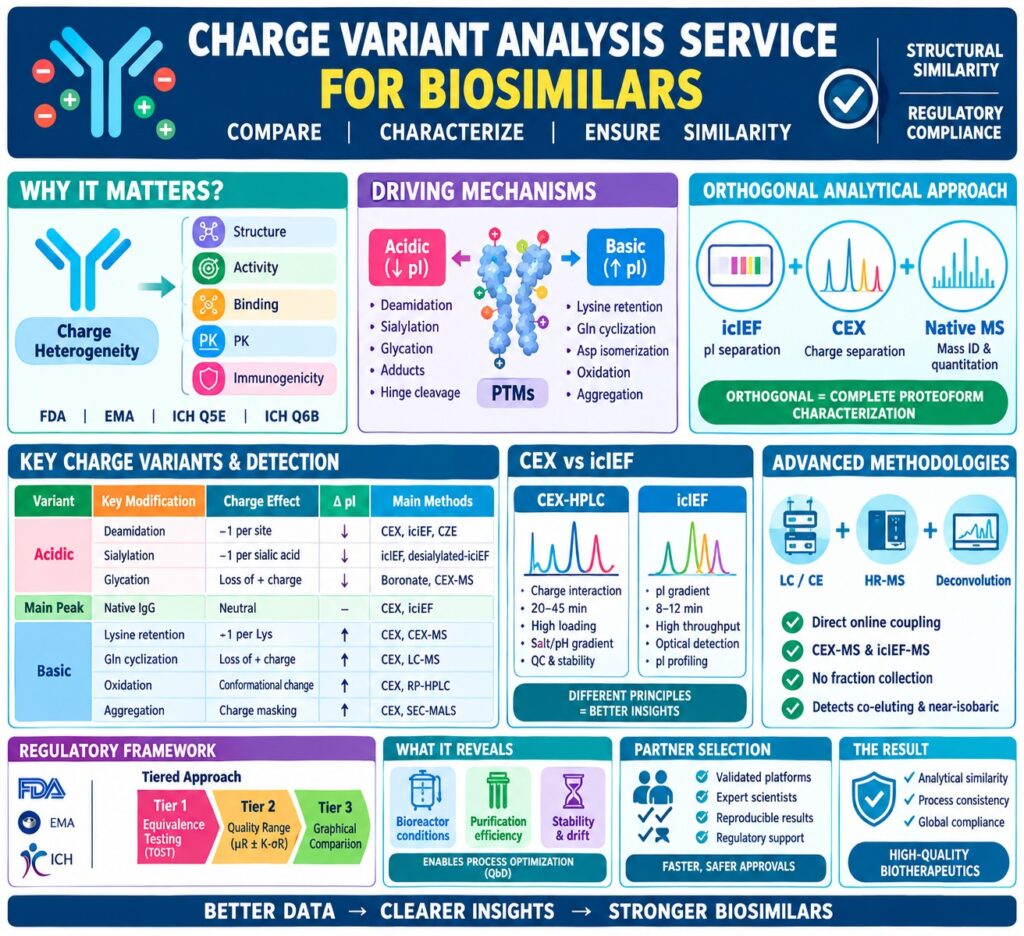
Molecular Mechanisms Driving Biopharmaceutical Charge Heterogeneity
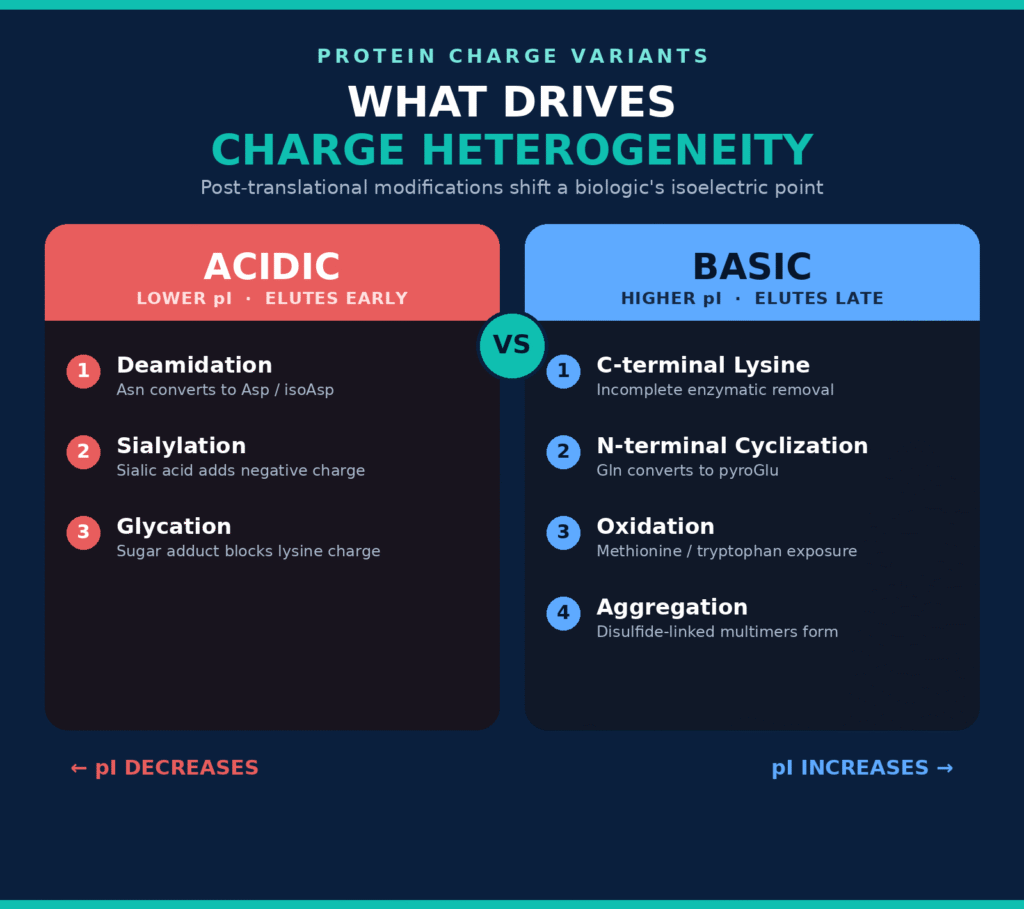
Biopharmaceutical charge heterogeneity originates from enzymatic and chemical post-translational modifications (PTMs) that alter the net surface charge or isoelectric point (pI) of monoclonal antibodies and therapeutic proteins. As these modifications change the molecular charge state, they generate distinct acidic species with a lower pI and basic species with a higher pI compared with the native main proteoform.
Characterizing the molecular factors responsible for charge heterogeneity is essential for defining Critical Quality Attributes (CQAs) and developing a regulatory-compliant Quality Target Product Profile (QTPP). Acidic variants have a lower apparent pI than the native protein and generally elute earlier in cation exchange chromatography. Important chemical mechanisms associated with acidic species include asparagine deamidation, which converts uncharged asparagine into negatively charged aspartic or isoaspartic acid, terminal sialylation of N-linked glycans, non-enzymatic glycation involving reducing sugars, covalent adduct formation, and cleavage within the hinge-region peptide.
Learn more about defining and testing critical quality attributes (CQAs) in biosimilars across your development pipeline.
In contrast, basic variants have a higher apparent pI and generally elute later during CEX separation. Basic modifications can primarily result from incomplete enzymatic removal of C-terminal lysine residues by host-cell carboxypeptidases, unblocked N-terminal glutamine or glutamic acid residues, aspartate isomerization, methionine or tryptophan oxidation, as well as non-covalent or disulfide-linked aggregation.
Learn how to accurately evaluate degradation pathways using aggregation analysis in biosimilars to maintain product stability.
| Variant Category | Specific Post-Translational Modification (PTM) | Net Charge Effect | Impact on Isoelectric Point (pI) | Primary Separation & Detection Technique |
|---|---|---|---|---|
| Acidic Variant | Asparagine Deamidation (Asn → Asp/isoAsp) | Net negative charge increase (-1 per site) | Shift to lower pI (Δ pI < 0) | CEX-HPLC, icIEF, CZE, CEX-MS |
| Acidic Variant | Terminal Sialylation (N-acetylneuraminic acid) | Net negative charge increase (-1 per sialic acid) | Shift to lower pI (Δ pI < 0) | icIEF, Desialylated-icIEF, CEX-HPLC |
| Acidic Variant | Non-enzymatic Glycation (Lysine adduct) | Loss of basic amine positive charge | Shift to lower pI (Δ pI < 0) | Boronate Affinity, CEX-MS, icIEF-MS |
| Main Peak | Fully processed, unmodified intact IgG proteoform | Baseline neutral structural state | Native reference pI (typically pH 7.8–9.0) | CEX-HPLC, icIEF |
| Basic Variant | C-terminal Lysine Retention (+1 or +2 Lys) | Net positive charge increase (+1 per Lysine) | Shift to higher pI (Δ pI > 0) | CEX-HPLC, CEX-MS, icIEF |
| Basic Variant | N-terminal Glutamine Cyclization (Gln → pyroGlu) | Loss of primary amine charge | Slight shift to higher pI / altered retention | CEX-HPLC, LC-MS peptide mapping |
| Basic Variant | Methionine / Tryptophan Oxidation | Conformational rearrangement exposing basic residues | Variable shift to higher pI | CEX-HPLC, RP-HPLC, Native MS |
| Basic Variant | Protein Aggregation / Multimerization | Masking of surface charges / conformational exposure | Shift to higher pI / peak broadening | CEX-HPLC, SEC-MALS, SV-AUC |
Technical Comparison: Imaged Capillary Isoelectric Focusing (icIEF) vs. Cation Exchange Chromatography (CEX)
Imaged capillary isoelectric focusing (icIEF) differentiates charge variants according to their net isoelectric point (pI) as they focus within an ampholyte-generated capillary pH gradient. Cation exchange chromatography (CEX), in comparison, separates proteoforms according to differences in their electrostatic surface-charge interactions with a stationary-phase resin. Because the two approaches rely on distinct separation principles, their combined application provides an important orthogonal analytical strategy for comprehensive biopharmaceutical characterization.
CEX-HPLC remains a key analytical technique for quality control (QC) release testing and stability investigations because of its chromatographic resolution (Rₛ ≥ 1.5–3.0), substantial sample loading capacity, and strong operational robustness. CEX column separations can be performed using conventional salt displacement gradients, such as NaCl or KCl, or volatile pH gradients. In salt-gradient methods, proteins are separated according to differences in local charge density. With pH-gradient methods, protein elution occurs as the mobile-phase pH approaches the molecule’s apparent pI. This mechanism can provide narrower peaks and improved recovery of native proteoforms.
Imaged capillary isoelectric focusing (icIEF) offers a rapid, high-throughput separation approach, with a typical analysis time of approximately 8–12 minutes per run, while providing strong quantitative precision (% CV < 2%). Through whole-column optical absorption imaging, icIEF avoids the physical mobilization step used in conventional capillary isoelectric focusing (cIEF) instruments. Eliminating this step helps minimize hydrodynamic band broadening and associated resolution losses. The optical detection system also enables real-time determination of apparent pI values using internal chemical markers for calibration.
Discover our complete range of biosimilar characterization services designed for global compliance.
| Analytical Parameter | Cation Exchange Chromatography (CEX-HPLC) | Imaged Capillary Isoelectric Focusing (icIEF) |
|---|---|---|
| Primary Separation Mechanism | Electrostatic surface charge interaction with stationary phase | Migration along capillary pH gradient to net zero charge (pI) |
| Typical Analysis Time | 20 to 45 minutes per sample run | 8 to 12 minutes per sample run |
| Separation Medium | Functionalized porous resin (sulfopropyl / carboxymethyl) | Free solution carrier ampholytes in fused-silica capillary |
| Quantification Metric | UV chromatographic peak area percentage (%) | Whole-column UV optical density peak area percentage (%) |
| pI Determination | Indirect (retention time correlation against standards) | Direct (pI calculation against calibrated internal markers) |
| Method Reproducibility | High (% CV ≈ 1.5–3.0%) | Superior (% CV < 2.0%) |
| Preparative Isolation | High capacity (enables fraction collection for bioassays) | Analytical scale (microfluidic MS coupling available) |
| Primary Regulatory Role | QC release testing, stability indication, preparative fractioning | Batch-to-batch comparability, high-throughput screening, pI profiling |
Methodological Advances in Charge Variant Analysis Service for Biosimilars
An advanced Charge Variant Analysis Service for Biosimilars incorporates direct online coupling of liquid chromatography and capillary electrophoresis with high-resolution mass spectrometry through platforms such as CEX-MS and icIEF-MS, together with sliding-window deconvolution algorithms. This hyphenated analytical strategy enables rapid qualitative and quantitative characterization of co-eluting proteoforms without relying on time-consuming offline fraction collection.
In conventional workflows, identifying the precise post-translational modification responsible for a particular CEX or icIEF peak often required preparative fraction collection followed by sample concentration, desalting, and multiple stages of peptide mapping or intact mass analysis. Such extended workflows could introduce sample-preparation-related artifacts, including non-enzymatic deamidation or oxidation caused by prolonged incubation. These artifacts could potentially affect the accuracy of the final characterization results.
Direct online integration of charge separation platforms with native high-resolution mass spectrometry (HR-MS) addresses many of these analytical challenges and has become an important approach for detailed charge variant characterization. By using volatile, low-ionic-strength pH-gradient buffer systems, including ammonium acetate or ammonium formate, CEX chromatography can be coupled directly to Orbitrap or Time-of-Flight (ToF) mass spectrometers operated in positive electrospray ionization (ESI+) mode.
Review our capabilities in high-resolution native mass spectrometry for biosimilars to preserve intact molecular structures.
In addition, microfluidic chip-based icIEF systems that are directly interfaced with UV and mass spectrometry, such as the Intabio ZT platform, can provide charge separation, optical quantitation, and mass identification within a single analytical workflow. When combined with sliding-window spectral deconvolution, native HR-MS can characterize co-eluting charge variants, near-isobaric proteoforms, and complex N-glycan distributions with high mass accuracy.
Read about our advanced proteomics approach for biosimilars to resolve difficult sequence variations and modifications.
Regulatory Frameworks: Tiered Analytical Similarity and Acceptable Charge Ranges
Regulatory agencies worldwide assess charge variant comparability through risk-based, tiered statistical approaches in which charge-related attributes are commonly treated as Tier 2 Critical Quality Attributes (CQAs) and evaluated using Quality Range (QR) criteria. This approach helps determine whether the charge profile of a biosimilar remains within predefined limits established from multiple lots of the reference product. These limits can be represented by μR ± K · σR.
Regulatory frameworks from organizations such as the FDA, EMA, and ICH, particularly ICH Q5E and ICH Q6B, expect biosimilar developers to establish analytical comparability across a broad range of quality attributes. The attributes are categorized according to risk assessments that consider their potential influence on clinical performance:
- Tier 1 (Equivalence Testing): This tier is intended for CQAs associated with the greatest clinical risk, generally including primary mechanism-of-action biological potency and binding assays. Tier 1 characteristics undergo formal statistical equivalence testing using Two One-Sided Tests (TOST) and predefined equivalence margins, such as ± 1.5 · σR.
- Tier 2 (Quality Range Approach): This approach is used for moderate-to-high risk structural and physicochemical attributes, including charge variant distributions such as acidic, basic, and main peak percentages, higher-order structure, and glycosylation profiles. The relevant biosimilar quality attributes are evaluated against a Quality Range expressed as:Quality Range = μR ± K · σRIn this equation, μR denotes the sample mean calculated from the reference product lots, σR represents the standard deviation obtained across reference product batches, and K is a statistical multiplier. A value of K = 3 is commonly applied, although the multiplier may be adjusted between 1.5 and 3.0 depending on the available sample size and the criticality of the specific attribute.
- Tier 3 (Graphical Comparison): This tier is generally applied to lower-risk attributes or structural fingerprints that are not readily evaluated through quantitative statistical testing. Assessment is typically performed through visual overlays and descriptive side-by-side comparisons.
Read our breakdown on aligning with ICH Q6B guidelines for biological characterisation to satisfy regulatory requirements.
Because relatively small changes in C-terminal lysine truncation or N-terminal cyclization generally have limited effects on target binding affinity or clinical safety, charge heterogeneity is commonly assessed using Tier 2 quality ranges. However, an acidic variant associated with substantial deamidation within the complementarity-determining regions (CDRs), or a variant containing potentially immunogenic glycan adducts, may receive a higher risk classification. In such circumstances, regulatory authorities may treat the specific attribute as Tier 1 and require more stringent equivalence testing.
Data Interpretation: What Charge Heterogeneity Profiling Reveals About Bioprocess Stability
Quantitative monitoring of acidic and basic charge variants can provide valuable information about bioreactor operating conditions, downstream purification efficiency, and long-term product stability. Changes in individual charge-variant peaks can act as early indicators of process drift, thermal stress, pH variation, and specific chemical degradation pathways.
During biosimilar process development, maintaining charge variant distributions within the target ranges established from the reference product requires close control of process conditions. An unexpected increase in acidic species may indicate elevated bioreactor culture temperatures, prolonged harvest hold periods, or changes in culture pH. These conditions can accelerate non-enzymatic asparagine deamidation. An increase in acidic peak abundance may also be associated with dissolved carbon dioxide accumulation or nutrient depletion during fermentation, potentially contributing to changes in sialylation patterns.
Learn more about stress testing through forced degradation of biosimilars to identify degradation pathways early.
In comparison, changes in the basic variant profile can frequently indicate alterations in downstream processing or differences in host-cell enzymatic activity. For instance, an increase in basic species containing uncleaved C-terminal lysine residues may indicate inadequate activity of endogenous basic carboxypeptidases during cell culture. Likewise, an increase in basic peak areas during forced degradation or stability studies can indicate protein aggregation, aspartate isomerization, or methionine oxidation resulting from light exposure, elevated temperature, or trace oxidation catalysts. Continuous monitoring of charge profiles using CEX and icIEF therefore provides valuable feedback for process optimization within a Quality by Design (QbD) framework.
Strategic Selection of a Contract Research Laboratory for Biosimilar Comparability
Selecting an appropriately qualified contract research organization can give biosimilar developers access to validated icIEF, CEX-HPLC, and native mass spectrometry platforms designed to support stringent ICH Q5E regulatory expectations. Collaboration with experienced analytical scientists can streamline biosimilarity testing while helping reduce technical uncertainties and potential regulatory submission risks.
Establishing analytical similarity involves the assessment of multiple reference product batches together with biosimilar candidate lots throughout different stages of development. Producing consistent and reproducible analytical results across extensive sample sets requires dedicated instrumentation, standardized analytical procedures, and specialized knowledge of native mass spectrometry and capillary electrophoresis.
Partner with us for expert biosimilar comparability study design and CRO support service to simplify your testing roadmap.
A specialized Charge Variant Analysis Service for Biosimilars offers the analytical capabilities needed for preparative fraction isolation, online icIEF-MS proteoform characterization, and formal statistical Tier 2 Quality Range modeling. In addition, experienced characterization partners can support biosimilar sponsors in developing scientifically defensible comparability packages that are capable of addressing regulatory expectations and withstanding detailed review by global health authorities.
Learn how our end-to-end biosimilar analytical package for a regulatory submission helps build a complete totality-of-evidence dossier.
Conclusion
Comprehensive characterization of charge heterogeneity is a fundamental component of biosimilar development because it supports the demonstration of analytical similarity, process consistency, and compliance with global regulatory expectations. Employing a specialized Charge Variant Analysis Service for Biosimilars enables robust head-to-head characterization through the complementary use of icIEF, CEX, and native mass spectrometry technologies.
The incorporation of native online mass spectrometry approaches, including icIEF-UV/MS and CEX-MS, further enhances charge variant characterization by enabling direct mass assignment and detailed proteoform mapping while reducing the potential for sample-preparation-related artifacts. When charge variant results are interpreted within a Quality by Design (QbD) framework and assessed using Tier 2 Quality Range statistical modeling, these measurements provide important evidence regarding process stability and structural comparability. Working with an experienced analytical laboratory gives biopharmaceutical developers access to advanced instrumentation, orthogonal analytical methodologies, and regulatory expertise that can support efficient approval pathways and the development of high-quality biotherapeutics.
Streamline your dossier preparation with our biosimilar analytical characterization service tailored for international regulatory standards.
To discuss customized analytical similarity testing packages, method validation, or advanced native CEX-MS/icIEF-MS characterization, contact the analytical experts directly via the ResolveMass Laboratories Contact Page.
Frequently Asked Questions (FAQs)
Charge heterogeneity is generally evaluated as a Tier 2 Critical Quality Attribute (CQA) because many charge-related changes primarily indicate process consistency and product stability rather than directly affecting biological potency. Attributes such as C-terminal lysine retention and N-terminal cyclization are therefore commonly assessed using statistical Quality Range (QR) criteria. The QR is typically represented as μR ± K · σR rather than through formal Tier 1 equivalence testing.
Online CEX-MS connects cation exchange chromatography directly with high-resolution native mass spectrometry using volatile, low-ionic-strength pH gradient buffers. This configuration enables mass characterization of separated species without requiring offline fraction collection, concentration, or desalting. Reducing these handling steps also minimizes the possibility of sample-preparation-related artifacts, including non-enzymatic deamidation and oxidation.
Acidic charge variants generally arise from post-translational modifications (PTMs) that increase negative charge or decrease the apparent pI of the protein. Important contributors include asparagine deamidation (Asn → Asp/isoAsp), terminal N-glycan sialylation, non-enzymatic glycation, and covalent adduct formation. Hinge-region peptide cleavage can also contribute to the formation of acidic species that elute earlier during charge-based separation.
An increase in basic charge variants can result from incomplete removal of C-terminal lysine residues by host-cell carboxypeptidases, unblocked N-terminal glutamine residues, aspartate isomerization, and protein aggregation. Variations in fermentation conditions, bioreactor temperature, culture duration, and hold times can influence these species. Downstream purification and processing conditions may further contribute to changes in basic peak abundance.
Whole-column optical imaging in icIEF measures UV absorbance throughout the capillary without requiring the physical mobilization step used in traditional cIEF systems. Eliminating mobilization helps reduce hydrodynamic band broadening and associated resolution loss. The approach also supports rapid analysis, typically within 8–12 minutes, while providing strong quantitative precision with % CV values below 2%.
Highly glycosylated biopharmaceuticals can display substantial charge microheterogeneity because of differences in terminal sialic acid content. Enzymatic desialylation removes these terminal sialic acid residues and simplifies the resulting charge profile. This allows analytical scientists to better distinguish charge differences arising from the protein backbone and identify underlying core proteoforms.
United States Pharmacopeia (USP) Chapters addressing biopharmaceutical analytical procedures can provide relevant standards and analytical expectations for methods used to characterize charge variants. Such guidance can support the development and validation of techniques including CEX-HPLC and capillary electrophoresis (cIEF/icIEF). Appropriate USP alignment contributes to method robustness, system suitability, and consistent analytical performance for release and stability testing.
A statistically meaningful Quality Range should be established using an appropriate number of representative reference product lots rather than relying on a single batch. In practice, developers may evaluate 10 or more independent commercial reference product batches when sufficient material and historical information are available. Sampling across manufacturing years and relevant geographic markets can help capture the natural variability of the originator product.
Yes, certain microfluidic icIEF platforms can combine charge separation, whole-column UV detection, and native mass spectrometry within an integrated analytical workflow. Systems such as the Intabio ZT platform enable icIEF-UV/MS analysis for direct characterization of focused charge species. This approach provides rapid mass confirmation and proteoform identification while reducing the need for manual fraction isolation.
Reference:
- Millán-Martín, S., Carillo, S., Füssl, F., Sutton, J., Gazis, P., Cook, K., Scheffler, K., & Bones, J. (2021). Optimisation of the use of sliding window deconvolution for comprehensive characterisation of trastuzumab and adalimumab charge variants by native high resolution mass spectrometry. European Journal of Pharmaceutics and Biopharmaceutics, 158, 83–95. https://doi.org/10.1016/j.ejpb.2020.11.006
- Wen, X., Liu, A. P., Song, J., Leng, C., Wang, J., Russo, B., Thiagarajan, G., Wang, H., Dow, X. Y., Hua, X., Ao, X., Mittal, S., Gennaro, L., & Gunawan, R. (2025). Enzymatic desialylation enables reliable charge variant characterization of highly glycosylated and sialylated Fc fusion proteins. ACS Pharmacology & Translational Science, 8(2), 394–408. https://doi.org/10.1021/acsptsci.4c00460
- Shah, A., Shah, P., Johnson, A., Bender, J., Gumerov, D., Ding, J., Mack, S., Stone, M. D., & Ostrowski, M. A. (2025). Accelerating characterization of therapeutic antibodies: A comparative assessment of icIEF-UV/MS and the traditional fractionation workflow. Journal of the American Society for Mass Spectrometry, 36(8), 1641–1649. https://doi.org/10.1021/jasms.5c00058
- Zhang, E., Xie, L., Qin, P., Lu, L., Xu, Y., Gao, W., Wang, L., Xie, M. H., Jiang, W., & Liu, S. (2020). Quality by design–based assessment for analytical similarity of adalimumab biosimilar HLX03 to Humira®. The AAPS Journal, 22(3), Article 69. https://doi.org/10.1208/s12248-020-00454-z
- Nupur, N., Joshi, S., Gulliarme, D., & Rathore, A. S. (2022). Analytical similarity assessment of biosimilars: Global regulatory landscape, recent studies and major advancements in orthogonal platforms. Frontiers in Bioengineering and Biotechnology, 10, 832059. https://doi.org/10.3389/fbioe.2022.832059
- Chow, S.-C., Song, F., & Bai, H. (2016). Analytical similarity assessment in biosimilar studies. The AAPS Journal, 18(3), 670–677. https://doi.org/10.1208/s12248-016-9882-5
Get In Touch With Us
About The Author


