


Introduction
Charge Variant Profiling by icIEF identified a critical comparability failure in an adalimumab biosimilar candidate by detecting an unacceptable 11.3% increase in acidic charge isoforms associated with complementarity-determining region (CDR) deamidation that was not detected by standard chromatographic and intact mass spectrometry screening methods. This high-resolution analytical approach generated the critical physicochemical evidence required under International Council for Harmonisation (ICH) Q5E guidelines to stop the clinical progression of a non-comparable drug lot, thereby preventing potential downstream therapeutic non-equivalence.
Monoclonal antibodies (mAbs), including adalimumab, a fully human IgG1 targeting tumor necrosis factor-alpha (TNF-alpha), exhibit inherent structural heterogeneity resulting from enzymatic and non-enzymatic post-translational modifications (PTMs) occurring during cell culture, downstream purification, and storage. These modifications can alter the net surface charge distribution of the protein and generate distinct acidic, main, and basic charge isoforms. Because charge variants constitute a Critical Quality Attribute (CQA) that can directly influence target binding affinity, biological potency, pharmacokinetics (PK), and safety, regulatory frameworks require comprehensive analytical evidence demonstrating profile equivalence between a proposed biosimilar and its reference product (Humira). Characterizing these molecular species through Charge Variant Profiling by icIEF provides rapid, highly reproducible, and absolute pI-based separation, supporting stringent biopharmaceutical comparability requirements.
Explore peptide analytical testing services for advanced analytical characterization support.
Share via:
Quick Summary:
- Charge Variant Profiling by icIEF can detect subtle charge heterogeneity in adalimumab biosimilars that may be missed by standard chromatography and intact mass spectrometry.
- Charge variants are a critical quality attribute (CQA) because acidic, main, and basic isoforms can affect antibody binding potency, pharmacokinetics, stability, and safety.
- Acidic variants, particularly Asn-55 deamidation in VH CDR2, can lower the pI and potentially reduce TNF-α binding. Basic variants can arise from C-terminal lysine retention, uncyclized glutamine, and succinimide intermediates.
- icIEF provides rapid, high-resolution pI-based separation, typically in 8–12 minutes, with strong precision and no mobilization step, supporting comparability, release, and stability testing.
- In the 2,000 L scale-up case, acidic variants increased to 29.5% vs. a 21.5% limit, while relative TNF-α binding potency fell to 74%. Further testing linked the failure to 34.8% Asn-55 deamidation.
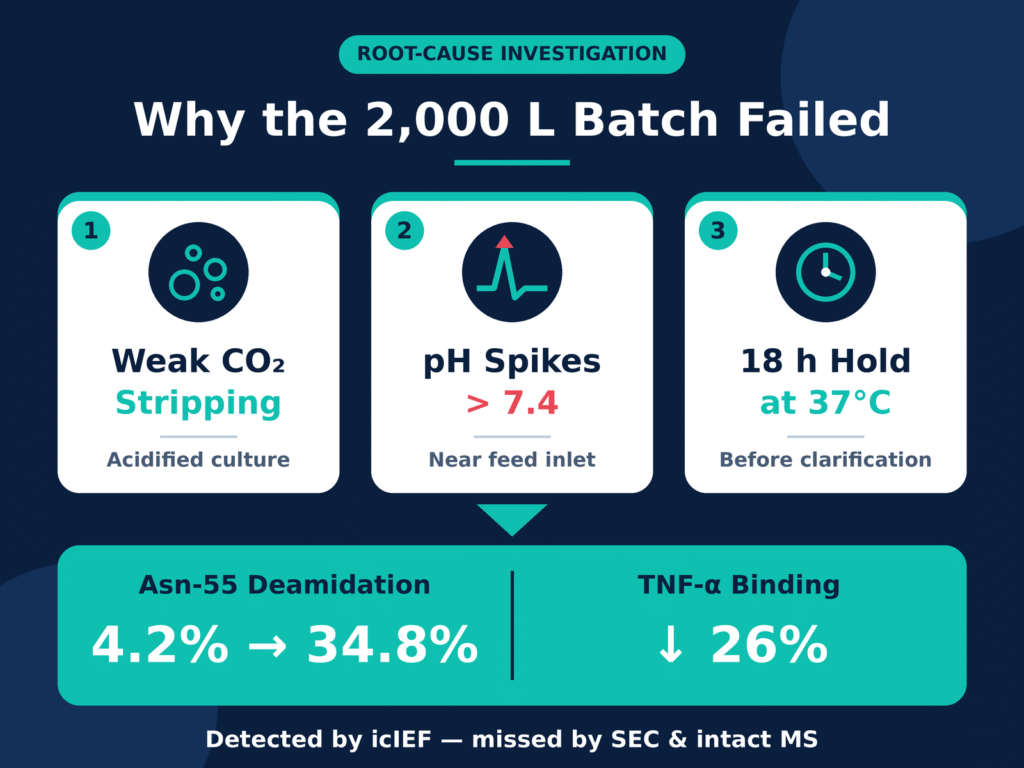
- The root cause was associated with scale-up process conditions, including inefficient CO₂ stripping, transient pH spikes, and an extended 37°C post-harvest hold, which accelerated deamidation.
- Mitigation includes tighter bioreactor pH and temperature control, rapid harvest cooling and shorter hold times, orthogonal icIEF-MS characterization, and reference-product tolerance intervals using multiple batches to support ICH Q5E comparability.
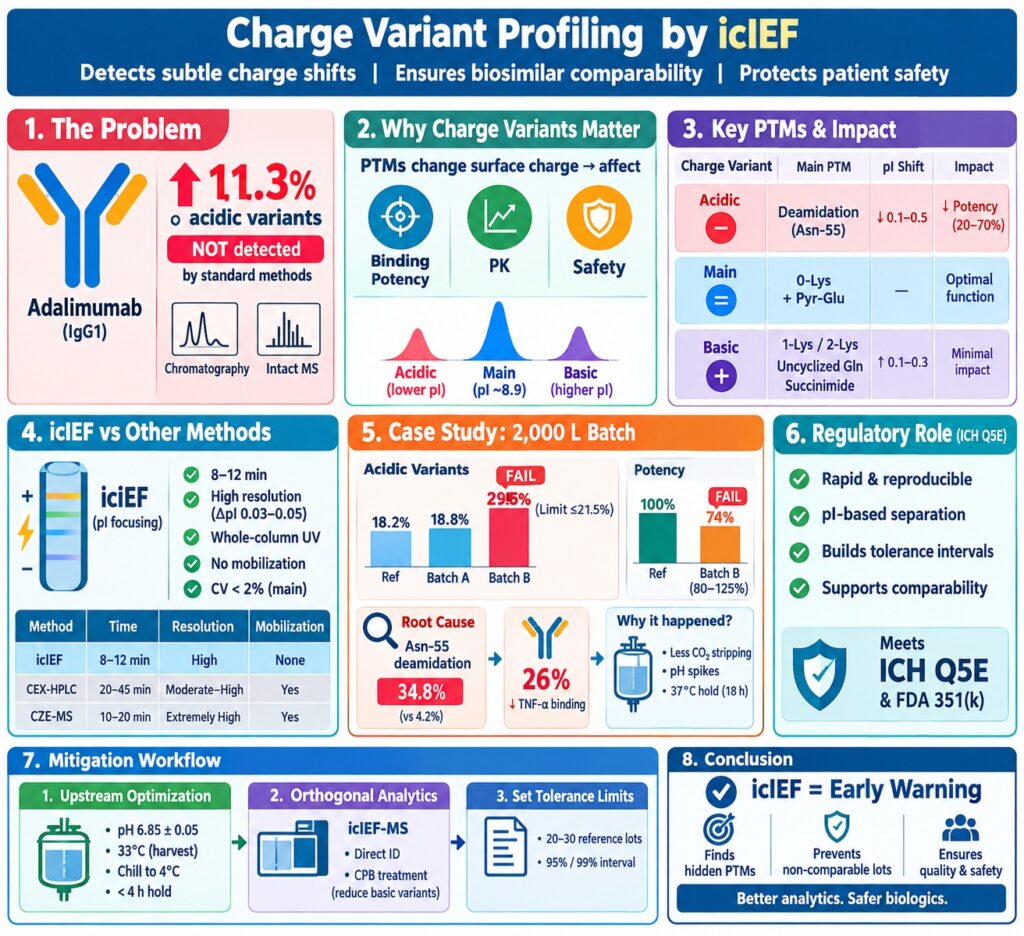
Critical Quality Attributes and Charge Heterogeneity in Adalimumab Biosimilarity
Adalimumab biosimilarity requires maintaining a controlled distribution of acidic, main, and basic charge variants because post-translational modifications (PTMs) can directly influence antigen binding potency, pharmacokinetics, and structural stability. Characterization of these isoforms helps establish whether subtle enzymatic and non-enzymatic modifications, including CDR deamidation and C-terminal lysine retention, remain within predefined reference ranges.
The theoretical isoelectric point (pI) of intact adalimumab is centered near 8.9. In an optimized charge variant profile, the predominant main peak represents the fully processed proteoform lacking both heavy-chain C-terminal lysine residues, designated as the 0-Lys or Lys0 form, while also exhibiting complete N-terminal glutamine cyclization to pyroglutamic acid. Any deviation from this central molecular population can modify the surface charge density and electrostatic interaction characteristics of the antibody.
Learn more about reference listed drug sourcing and reverse engineering for comparative development programs.
Acidic variants are molecular species that focus at lower pI values than the main peak as a result of modifications that introduce negative charges or eliminate positive charges. Asparagine deamidation is a major contributor to acidic heterogeneity in IgG1 antibodies. This reaction occurs when the neutral asparagine side chain undergoes hydrolysis through a cyclic succinimide intermediate, producing negatively charged aspartic acid or isoaspartic acid. In adalimumab, deamidation within the variable region, particularly at the Asn-55 hotspot in the heavy-chain complementarity-determining region 2 (VH CDR2), can produce steric and electrostatic changes that reduce TNF-alpha binding potency by 20% to 70%. Other contributors to the acidic region include terminal N-glycan sialylation, which adds N-acetylneuraminic acid residues, and non-enzymatic lysine glycation through Maillard reactions involving residual culture glucose.
Review impurity control strategies under ICH Q3A for additional guidance on impurity assessment and control.
Basic variants comprise molecular species with higher pI values caused by the addition of net positive charges or the removal of acidic groups. Incomplete enzymatic cleavage of C-terminal heavy-chain lysines by host cell carboxypeptidase B (CPB) during cell culture can result in populations retaining one (1-Lys) or two (2-Lys) terminal lysines, shifting their distribution toward the basic region. Uncyclized N-terminal glutamine residues, which retain a free positive amino group, and succinimide intermediates generated during incomplete deamidation pathways can also contribute to the basic peak area.
| Charge Isoform Group | Specific Post-Translational Modification (PTM) | Chemical Mechanism | Shift in Isoelectric Point (pI) | Impact on Potency, PK, or Safety |
|---|---|---|---|---|
| Acidic Variants | Asparagine Deamidation (e.g., Asn-55 in VH CDR2) | Succinimide intermediate conversion to Asp/isoAsp | Shift to lower pI (-0.1 to -0.5 units) | 20–70% reduction in TNF-alpha binding potency; potential risk of immunogenicity |
| Acidic Variants | Terminal N-Glycan Sialylation | Addition of negatively charged sialic acid (Neu5Ac) | Shift to lower pI (-0.1 to -0.3 units per Neu5Ac) | Accelerated hepatic clearance through asialoglycoprotein receptors; minimal binding impact |
| Acidic Variants | Lysine Glycation | Non-enzymatic condensation of glucose with Lys amino groups | Neutralization of the basic amine (-0.1 pI shift) | Low impact at 1–5% levels; potential steric hindrance when located in the CDR |
| Main Peak | Fully Processed IgG1 (0-Lys, Pyr-Glu) | Enzymatic CPB removal of terminal Lys; Gln cyclization | Baseline reference pI (approximately 8.9) | Optimal antigen binding, FcRn recycling, and structural stability |
| Basic Variants | C-Terminal Lysine Retention (1-Lys / 2-Lys) | Incomplete CPB cleavage during cell culture fermentation | Shift to higher pI (+0.1 to +0.3 units) | No significant impact on target binding or PK; rapidly cleaved by endogenous serum CPB |
| Basic Variants | Uncyclized N-Terminal Glutamine | Incomplete conversion of N-terminal Gln to pyroglutamate | Retention of free positive amino group (+0.1 pI shift) | Negligible impact on target potency; monitored for process consistency |
| Basic Variants | Aspartate Succinimide Intermediate | Dehydration of Asp/Asn before hydrolysis | Shift to higher pI (+0.1 to +0.2 units) | Unstable intermediate; may indicate degradation stress or formulation pH drift |
The Role of Charge Variant Profiling by icIEF in Regulatory Comparability (ICH Q5E)
Charge Variant Profiling by icIEF supports ICH Q5E regulatory comparability requirements by providing rapid, highly reproducible, whole-column pI-based separations without the secondary interaction artifacts or mobilization delays associated with conventional chromatographic approaches. This analytical capability enables biosimilar developers to establish statistical tolerance intervals that can be used to assess lot-to-lot consistency and equivalence with the reference product.
Under ICH Q5E guidance, sponsors demonstrating comparability following manufacturing scale-up, site transfer, or biosimilar development must demonstrate that relevant quality attributes remain within validated tolerance intervals established from reference product batches. Traditional Cation Exchange Chromatography (CEX-HPLC) separates charge variants according to differential surface-charge interactions with a stationary-phase resin. However, the technique generally requires extended gradient run times of approximately 20–45 minutes and can be influenced by secondary non-electrostatic interactions with the resin. These interactions may broaden peaks or modify apparent retention times.
Explore technology transfer to GMP CDMO support for manufacturing transitions.
Imaged capillary isoelectric focusing (icIEF) addresses several of these operational limitations by focusing proteins according to their intrinsic isoelectric point (pI) within a capillary containing carrier ampholytes under an applied electric field. The instrument records whole-column images using UV absorption at 280 nm or native fluorescence, eliminating the fluidic mobilization step required by traditional capillary isoelectric focusing (cIEF). This configuration enables rapid separations, typically within 8–12 minutes, with high resolving power (ΔpI ≤ 0.03–0.05 units) and strong peak-area repeatability. Coefficients of variation (CV) can remain below 2% for main species and below 5% for minor variants.
Explore peptide analytical testing services for complementary analytical characterization capabilities.
| Operational Parameter | Imaged Capillary Isoelectric Focusing (icIEF) | Cation Exchange Chromatography (CEX-HPLC) | Capillary Zone Electrophoresis-MS (CZE-MS) |
|---|---|---|---|
| Separation Mechanism | Isoelectric point (pI) focusing in an ampholyte pH gradient | Surface charge density and resin binding affinity | Electrophoretic mobility based on charge-to-size ratio |
| Typical Analysis Time | 8–12 minutes per sample | 20–45 minutes per sample | 10–20 minutes per sample |
| Resolving Power | High (ΔpI resolution of 0.03–0.05 units) | Moderate to high (Rs = 1.5–3.0) | Extremely high (proteoform resolution) |
| Main Peak Precision | CV < 2.0% area percent | CV < 3.0% area percent | CV < 5.0% area percent |
| Mobilization Requirement | None (whole-column real-time UV imaging) | N/A (elution through salt or pH gradient) | N/A (direct electrospray transport) |
| Primary Regulatory Role | High-throughput release, comparability, and stability | QC batch release and preparative fraction collection | Direct proteoform structural assignment |
Case Study: How Charge Variant Profiling by icIEF Uncovered Sub-Visible Heterogeneity Drift
Charge Variant Profiling by icIEF detected an out-of-specification accumulation of acidic variants reaching 29.5% in a 2,000 L scale-up batch of an adalimumab biosimilar. The analysis revealed a critical potency-impairing PTM that had not been detected through standard SEC-HPLC and intact mass spectrometry analyses. Further investigation traced the finding to a 34.8% level of site-specific deamidation at the Asn-55 residue within the VH CDR2 loop, which was associated with a 26% reduction in relative TNF-alpha binding potency.
A biopharmaceutical development programme initiated process scale-up from a 200 L pilot-scale bioreactor (Batch A) to a 2,000 L commercial-scale production vessel (Batch B). Initial standard analytical characterization of Batch B demonstrated acceptable alignment with the reference product (Humira) and historical pilot batches across several primary structural characteristics:
- Size-Exclusion High-Performance Liquid Chromatography (SEC-HPLC) confirmed monomer purity greater than 98.5%, with aggregate levels below 0.5%.
- Intact Mass Spectrometry using LC-MS verified the predicted primary sequence mass (148,000 ± 5 Da) without evidence of clipping or extensive fragmentation.
- Capillary Electrophoresis-Sodium Dodecyl Sulfate (CE-SDS) under non-reducing conditions demonstrated comparable intact IgG percentage purity.
However, when Charge Variant Profiling by icIEF was performed using both a broad pH 3–10 ampholyte blend and a narrow pH 8–10.5 ampholyte blend, an abnormal electropherogram profile was observed for Biosimilar Batch B. Biosimilar Batch A closely matched the reference product profile, showing 18.2% acidic variants, 68.5% main peak, and 13.3% basic species. In contrast, Biosimilar Batch B demonstrated a substantial shift in charge isoform distribution. The total acidic variant fraction increased to 29.5%, exceeding the upper regulatory specification limit of 21.5% established from 30 reference product batches using 95/99% tolerance intervals. At the same time, the main bioactive peak decreased to 58.1%.
| Parameter / Peak Identity | Reference Product Baseline (Mean ± SD, n=30) | Biosimilar Batch A (Pilot 200 L) | Biosimilar Batch B (Commercial 2,000 L) | Regulatory Specification (ICH Q5E Limit) |
|---|---|---|---|---|
| Total Acidic Variants (%) | 18.2% ± 1.5% | 18.8% | 29.5% (Non-Comparable) | NMT 21.5% (95/99% Tolerance Interval) |
| Main Peak (pI approximately 8.9) (%) | 68.5% ± 2.0% | 67.9% | 58.1% (Non-Comparable) | NLT 64.5% |
| Total Basic Variants (%) | 13.3% ± 1.2% | 13.3% | 12.4% | NMT 16.0% |
| Relative TNF-alpha Binding (%) | 100% ± 5% | 99% | 74% (Potency Failure) | 80%–125% |
| Comparability Outcome | Reference Standard | PASS | FAIL (Critical Failure) | Regulatory Requirement |
To determine the molecular root cause of the acidic variant increase, the analytical team performed offline fraction collection using preparative isoelectric focusing, followed by high-resolution Liquid Chromatography-Tandem Mass Spectrometry (LC-MS/MS) peptide mapping. The investigation demonstrated that the increased acidic peak area resulted from site-specific asparagine deamidation at the Asn-55 residue within the VH CDR2 loop. Quantitative peptide mapping showed that Asn-55 deamidation increased from a baseline value of 4.2% in reference lots to 34.8% in Biosimilar Batch B.
Subsequent Surface Plasmon Resonance (SPR) binding kinetics and cell-based TNF-alpha neutralization assays demonstrated a 26% reduction in relative biological potency for Batch B. Because Asn-55 is directly involved in antigen contact, introduction of a negative charge through conversion of neutral Asn to acidic Asp/isoAsp can alter the electrostatic environment of the binding pocket and adversely affect antigen interaction.
Root-cause investigation associated the failure with bioreactor process dynamics during the 2,000 L scale-up:
- Dissolved carbon dioxide (dCO2) stripping was less efficient in the larger vessel, resulting in localized acidification of the culture medium.
- Operators increased sodium carbonate additions to compensate for the altered culture conditions, inadvertently exposing cells to transient micro-pH spikes (pH > 7.4) near the feed inlet.
- The elevated temperature of 37°C, maintained during an extended 18-hour post-harvest hold before primary clarification, substantially accelerated non-enzymatic deamidation kinetics involving the sensitive Asn-Gly sequence motif at Asn-55.
Analytical Strategy and Root-Cause Mitigation Workflows
Resolving a charge variant comparability failure requires an integrated mitigation workflow that combines bioreactor parameter optimization, offline fraction characterization, and online icIEF-mass spectrometry hyphenation. By integrating upstream culture controls with real-time icIEF analytical feedback, biopharmaceutical developers can reduce acidic variant drift and maintain product comparability across different manufacturing scales.
To prevent recurrence of comparability failures and re-establish analytical equivalence, biopharmaceutical development programmes should implement a multi-tiered mitigation strategy.
Upstream Bioprocess Optimization
Tightening bioreactor pH control to 6.85 ± 0.05 during the late-fed batch phase can reduce the rate of the hydroxide-catalyzed succinimide intermediate reaction. Reducing vessel culture temperature from 37°C to 33°C during harvest was associated with a more than three-fold reduction in deamidation rates. Chilling the harvest broth to 4°C immediately following cell discharge and limiting hold times to less than 4 hours can minimize non-enzymatic PTM accumulation before Protein A capture.
Learn more about scaling a GLP-1 analog from preclinical synthesis to GMP manufacturing.
Orthogonal Analytical Validation
Implementing online icIEF-MS through specialized microfluidic chip interfaces or chemical mobilization-free transfer capillaries enables direct mass-based identification of proteoforms without the need for labor-intensive preparative gel fractionation. In addition, treatment of raw samples with exogenous CPB before icIEF profiling cleaves basic C-terminal lysines (1-Lys and 2-Lys) back to the 0-Lys main form. This approach simplifies electropherograms by reducing basic-region complexity, allowing subtle acidic deamidation shifts to be quantified more effectively.
Explore GMP peptide API manufacturing services for integrated development and manufacturing support.
Regulatory Tolerance Limit Definition
Establishing formal release specifications requires comprehensive profiling of at least 20 to 30 unique reference product batches representing multiple manufacturing years and distribution regions. Application of statistical tolerance intervals, using 95% coverage with 99% confidence, provides objective analytical similarity boundaries that support ICH Q5E and FDA 351(k) guidance requirements.
Explore peptide stability testing services for stability-program support and analytical monitoring.
Conclusion
Charge Variant Profiling by icIEF represents an important analytical platform for identifying subtle shifts in charge heterogeneity and supporting compliance with ICH Q5E comparability requirements during biosimilar development. The findings from this case study demonstrate how high-resolution pI profiling can identify potentially high-risk, non-comparable antibody lots before they progress further into clinical development, thereby supporting product quality and patient safety.
Explore clinical trial material supply for peptide programs for clinical-stage manufacturing support.
Relying exclusively on lower-resolution structural screening or secondary size-exclusion methods may allow critical, potency-impairing PTMs to remain undetected during early development stages. Charge Variant Profiling by icIEF provides an additional analytical quality gate by enabling detailed assessment of charge heterogeneity and helping confirm that manufacturing process changes maintain comparability with the originator product throughout the biopharmaceutical product lifecycle.
Learn more about extractables and leachables testing for peptide injectables for injectable product-development requirements.
To consult with specialized analytical scientists and explore custom biopharmaceutical characterization strategies, visit the ResolveMass Laboratories team at ResolveMass Laboratories Contact.
Frequently Asked Questions (FAQs)
icIEF provides rapid charge variant analysis, with typical run times of approximately 8–12 minutes compared with 20–45 minutes for CEX-HPLC. Because proteins are separated according to their intrinsic pI, icIEF provides direct pI-based characterization while avoiding potential secondary interactions with chromatographic resins. It also provides strong peak-area repeatability and is well suited for mAb characterization, comparability, and stability studies.
Acidic variants can affect adalimumab function when modifications occur at structurally important sites within the antibody. For example, deamidation at Asn-55 in the VH CDR2 can alter the local charge environment and reduce TNF-alpha binding and neutralization activity. Other acidic modifications, including increased sialylation, may influence pharmacokinetic behavior by affecting antibody clearance.
Basic variants commonly arise from incomplete enzymatic removal of C-terminal heavy-chain lysine residues, resulting in 1-Lys and 2-Lys species. Other contributors include incomplete cyclization of N-terminal glutamine to pyroglutamate and the formation of certain succinimide intermediates. These modifications increase the proportion of molecular species exhibiting higher pI values than the main peak.
Charge variant acceptance criteria are generally developed by characterizing multiple representative batches of the reference product using qualified or validated analytical methods. Historical batch data can be evaluated statistically to establish appropriate ranges for acidic, main, and basic isoforms. Tolerance intervals, such as 95% coverage with 99% confidence, can then support scientifically justified comparability assessments under ICH Q5E.
Yes, icIEF can be integrated with mass spectrometry to combine charge-based separation with molecular mass characterization. icIEF-MS configurations may use microfluidic interfaces or mobilization-free transfer approaches to connect focused charge species with MS detection. This enables more direct structural investigation of individual charge populations and can reduce reliance on extensive offline fraction collection.
Carboxypeptidase B (CPB) enzymatically removes C-terminal lysine residues from antibody heavy chains before charge variant analysis. Converting 1-Lys and 2-Lys species into the 0-Lys form reduces the contribution of C-terminal lysine heterogeneity to the basic region. This can simplify the icIEF profile and make other charge-altering modifications, including deamidation and glycation, easier to evaluate.
Bioreactor parameters such as pH, temperature, dissolved carbon dioxide (dCO2), culture duration, and nutrient availability can influence the formation of antibody PTMs. Conditions involving elevated pH or temperature may accelerate non-enzymatic asparagine deamidation, while increased glucose availability can promote lysine glycation. Careful control of these parameters is therefore important for maintaining a consistent charge variant profile.
Conventional cIEF focuses protein species according to their pI and generally requires a subsequent chemical or pressure-based mobilization step so that the focused zones can reach a detector. This additional step can introduce band broadening and affect resolution. icIEF instead uses whole-column imaging to detect the focused proteins directly within the capillary, eliminating the need for post-focusing mobilization.
Charge variant analysis is an important component of biosimilar comparability because charge heterogeneity can reflect differences in protein structure, post-translational modifications, purity, and manufacturing consistency. Significant changes in acidic, main, or basic populations may indicate alterations that warrant further structural and functional investigation. Combining charge profiling with orthogonal analytical techniques therefore supports a comprehensive assessment of biosimilarity and product quality.
Reference:
- Gurel, B., Berksoz, M., Capkin, E., Parlar, A., Corbacioglu Pala, M., Ozkan, A., Capan, Y., Daglikoca, D. E., & Yuce, M. (2022). Structural and functional analysis of CEX fractions collected from a novel Avastin® biosimilar candidate and its innovator: A comparative study. Pharmaceutics, 14(8), 1571. https://doi.org/10.3390/pharmaceutics14081571
- International Council for Harmonisation of Technical Requirements for Pharmaceuticals for Human Use. (2005). Q5E: Comparability of biotechnological/biological products—Step 5. European Medicines Agency. EMA guideline
- International Council for Harmonisation of Technical Requirements for Pharmaceuticals for Human Use. (2004). ICH harmonised tripartite guideline: Comparability of biotechnological/biological products subject to changes in their manufacturing process (Q5E). ICH Q5E Guideline PDF
- Füssl, F., Trappe, A., Cook, K., Scheffler, K., Fitzgerald, O., & Bones, J. (2019). Comprehensive characterisation of the heterogeneity of adalimumab via charge variant analysis hyphenated on-line to native high resolution Orbitrap mass spectrometry. mAbs, 11(1), 116–128. https://doi.org/10.1080/19420862.2018.1531664
- Lee, J. J., Lee, N., Seo, Y. J., & Kim, I. (2023). Consistency of product quality for SB5, an adalimumab biosimilar. BioDrugs, 37(2), 271–277. https://doi.org/10.1007/s40259-023-00581-x
- He, X., ElNaggar, M., Ostrowski, M. A., Guttman, A., Gentalen, E., & Sperry, J. (2022). Evaluation of an icIEF-MS system for comparable charge variant analysis of biotherapeutics with rapid peak identification by mass spectrometry. Electrophoresis, 43(11), 1215–1222. https://doi.org/10.1002/elps.202100295
Get In Touch With Us
About The Author


