


Introduction
The development of a multiplexed bioanalytical panel for a combination immunotherapy clinical program requires the simultaneous quantitative assessment of multiple pharmacokinetic (PK) and pharmacodynamic (PD) biomarkers while maintaining full compliance with globally recognized regulatory frameworks such as ICH M10. This integrated analytical strategy enables the consolidation of complex biomarker measurements into a single assay platform, helping conserve valuable patient samples while streamlining clinical development timelines. Contemporary oncology research increasingly depends on combination treatment strategies that integrate immune checkpoint inhibitors—such as anti-PD-1 or anti-CTLA-4 monoclonal antibodies—with co-stimulatory agonists, therapeutic cytokines, or targeted bi-specific antibodies to address mechanisms of primary therapeutic resistance. The assessment of these multifaceted treatment regimens requires comprehensive monitoring of intricate immune responses, including transient cytokine release, downstream inflammatory signaling pathways, and systemic immune activation, all while preserving limited clinical sample volumes.
Conventional singleplex bioanalytical techniques, including standard Enzyme-Linked Immunosorbent Assays (ELISAs), often require substantial sample volumes, increase analytical workload, and introduce variability between separate assay runs and study endpoints. Multiplexed bioanalytical technologies address these limitations by enabling the simultaneous evaluation of numerous biomarkers within a single reaction vessel or micro-volume analytical format. Despite these advantages, integrating multiple immunoassays into one panel introduces significant analytical complexities, including antibody cross-reactivity, matrix-related signal suppression, and large differences in physiological concentration ranges among target analytes. This case study presents a detailed bioanalytical assessment of the design, optimization, validation, and clinical implementation of a multiplexed biomarker panel deployed in a Phase I/II combination immunotherapy study conducted under International Council for Harmonisation (ICH) M10 guidance.
Accelerate your pipeline with an Integrated Chemistry and Bioanalytical CRO Partnership to consolidate complex biomarker assays and streamline development timelines.
Share via:
Article Summary:
- Multiplexed bioanalytical panels enable simultaneous measurement of multiple PK/PD biomarkers, reducing sample volume, analytical workload, and clinical development time.
- Key technical challenges include antibody cross-reactivity, matrix interference, dynamic-range mismatch, and reagent lot variability, addressed through cross-talk studies, MRD optimization, blocking reagents, and lot bridging.
- MSD, Luminex, Olink PEA, and LC-MS/MS offer different advantages based on sensitivity, sample volume, multiplex capacity, and clinical validation requirements.
- Method optimization relies on analyte-specific 4PL/5PL calibration models, appropriate weighting, consistent curve fitting, and rigorous reagent quality control.
- Under ICH M10, validation evaluates accuracy, precision, selectivity, dilutional linearity, parallelism, and matrix stability across the intended assay range.
- In the Phase I/II case study, a 10-plex MSD panel measured IFN-γ, IL-1β, IL-2, IL-4, IL-6, IL-8, IL-10, IL-12p70, IL-13, and TNF-α to characterize immune responses.
- A structured run-acceptance and failure-management workflow allowed compliant analyte data to be retained while failed targets were selectively repeated or excluded, supporting reliable clinical reporting and ICH M10-compliant data integrity.
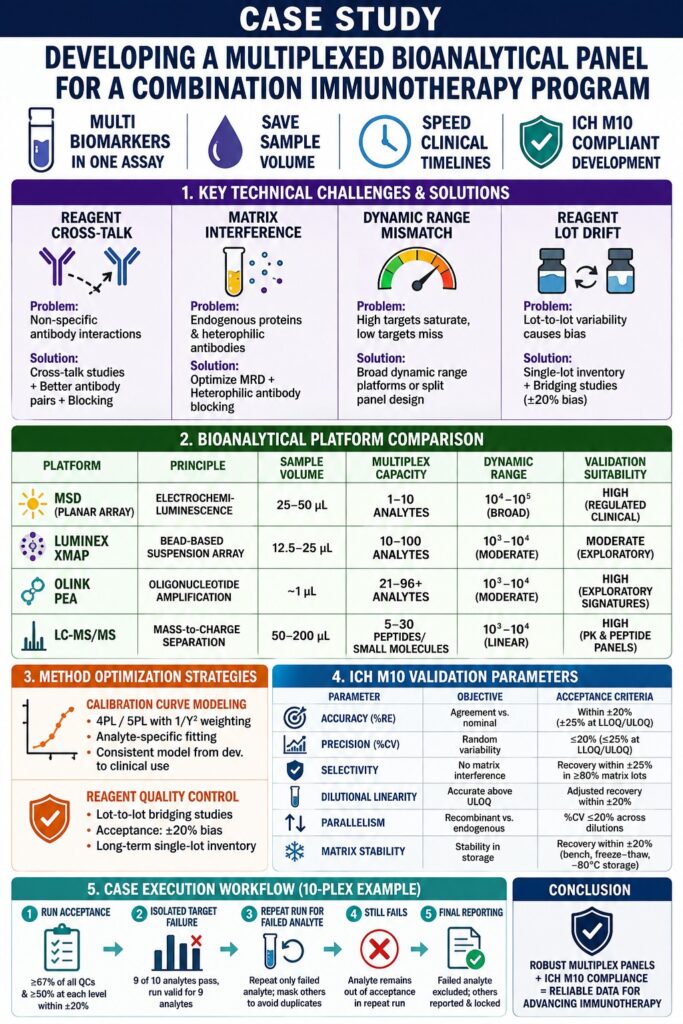
Technical Bottlenecks in Developing a Multiplexed Bioanalytical Panel
The development of a multiplexed bioanalytical panel is associated with several significant analytical challenges, including non-specific antibody cross-reactivity, substantial matrix interference from biological samples, and discrepancies in the dynamic concentration ranges of individual analytes. Successfully addressing these obstacles requires extensive cross-talk investigations, optimization of Minimum Required Dilution (MRD), and the application of calibration models tailored to the selected analytical platform.
Managing Reagent Cross-Reactivity and Specificity
Reagent cross-reactivity in multiplex assays arises when capture or detection antibodies bind unintentionally to non-target antigens or interact with other antibodies present within the same reaction mixture. To minimize these interactions, bioanalytical scientists systematically evaluate antibody pairs through cross-talk screening studies and replace reagents that demonstrate non-specific behavior.
When multiple primary antibodies coexist within a single assay environment, capture reagents designed for Biomarker A must not interact with detection reagents or recombinant proteins associated with Biomarker B. Cross-reactivity assessments typically involve challenging the complete multiplex detection cocktail with high-concentration single-analyte calibrators while also evaluating individual detection antibodies against the full multiplex capture matrix. Any reagent exhibiting heterologous interference or signal enhancement exceeding 10% is generally replaced or redesigned using alternative host-species backbones, recombinant single-chain variable fragments (scFvs), or specialized blocking reagents to improve specificity.
Resolving Matrix Interference and Optimizing Minimum Required Dilution
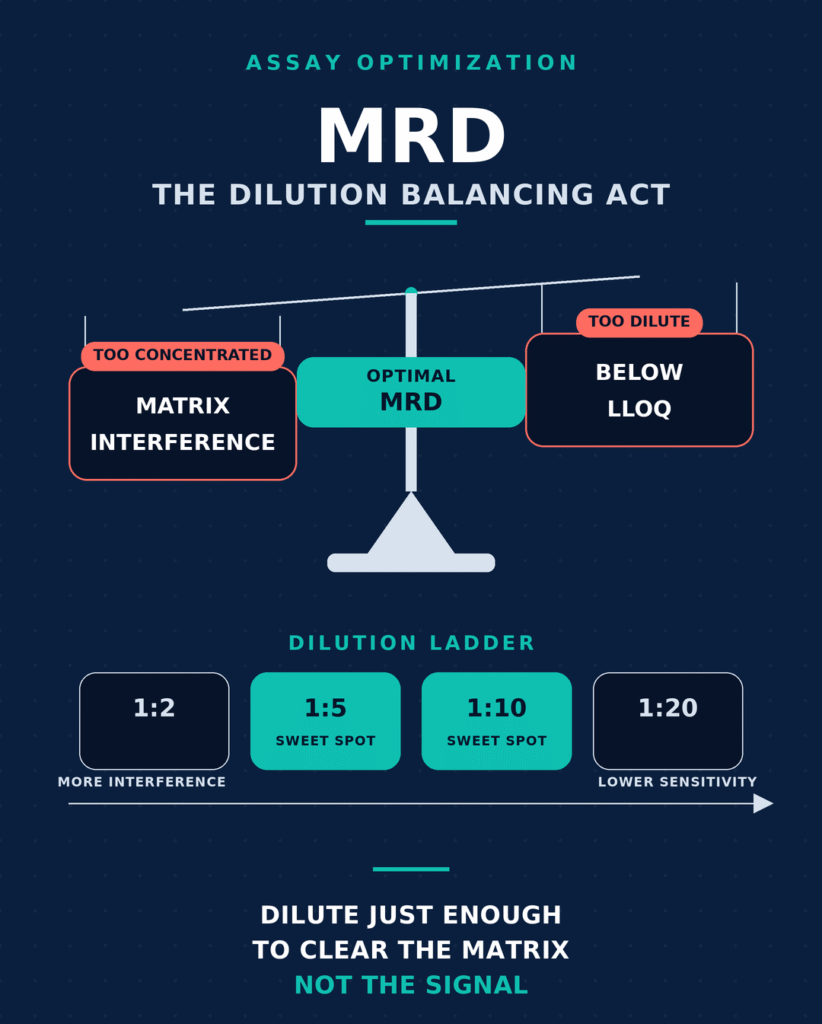
Matrix interference is controlled through the establishment of an optimized Minimum Required Dilution (MRD), which reduces the impact of endogenous serum proteins while preserving sufficient sensitivity for low-abundance analytes. Achieving an appropriate balance between matrix suppression and assay sensitivity is essential for obtaining consistent target recovery across diverse clinical samples.
Biological matrices such as human serum and plasma contain numerous endogenous components, including heterophilic antibodies, human anti-mouse antibodies (HAMA), rheumatoid factors, and dense protein networks that can disrupt target-antibody binding interactions. Determining the optimal MRD requires evaluating multiple dilution conditions—for example, 1:2, 1:5, 1:10, and 1:20—using both unspiked and target-spiked matrix lots from multiple donors. Although higher dilution factors can effectively reduce matrix-related interference, excessive dilution may cause low-abundance cytokines, including Interleukin-2 (IL-2), Interleukin-4 (IL-4), and Interleukin-5 (IL-5), to fall below the lower limit of quantification (LLOQ), compromising assay performance.
Learn how to prevent analytical interference and signal suppression in LC-MS/MS and ligand-binding assays by reviewing our strategies on Matrix Effects in LC-MS/MS Bioanalysis.
| Analytical Bottleneck | Bioanalytical Impact | Primary Root Cause | Analytical Mitigation Strategy |
|---|---|---|---|
| Reagent Cross-Talk | False-positive signals and distorted target quantification | Non-specific interactions between unmatched capture and detection antibodies | Conduct comprehensive cross-talk matrix studies, replace problematic clone pairs, and optimize blocking buffer compositions |
| Matrix Suppression | Reduced analyte recovery and increased variability across matrix lots | Endogenous proteins, heterophilic antibodies, and viscosity-related matrix differences | Optimize Minimum Required Dilution (MRD) and incorporate heterophilic antibody blocking reagents |
| Dynamic Range Mismatch | Signal saturation for highly abundant targets alongside poor detection of low-abundance analytes | Simultaneous presence of sub-pg/mL cytokines and μg/mL acute-phase proteins | Utilize platforms with broad dynamic ranges, such as ECL systems, or separate analytes into multiple panel configurations |
| Reagent Lot Drift | Longitudinal bias in clinical sample quantification | Structural or conjugation variability between reagent lots | Secure long-term single-lot inventories and establish validated bridging protocols |
Bioanalytical Platform Selection for Combination Immunotherapy Profiling
Selecting the most appropriate bioanalytical platform for combination immunotherapy profiling requires balancing assay sensitivity requirements, sample volume constraints, dynamic range expectations, and multiplexing capacity. Planar electrochemiluminescence systems (MSD), bead-based suspension arrays (Luminex), proximity extension assays (Olink), and mass spectrometry platforms (LC-MS/MS) each provide unique advantages depending on the objectives and stage of the clinical program.
The selection of a suitable analytical technology represents a critical component of multi-analyte assay development. Meso Scale Discovery (MSD) electrochemiluminescence technology employs carbon electrode surfaces that generate light following electrical stimulation, resulting in excellent signal-to-noise performance, wide dynamic ranges spanning 4–5 logs, and low-pg/mL sensitivity. The planar array format is particularly advantageous for regulated Phase I–III clinical studies requiring reliable quantification of core pro-inflammatory cytokine panels.
Luminex xMAP technology utilizes color-coded magnetic microspheres coated with analyte-specific capture antibodies, enabling highly multiplexed panel configurations capable of measuring up to 50–100 analytes simultaneously. This technology is commonly used in early-stage biomarker discovery and exploratory translational research programs, although careful monitoring is required to control bead settling and background signal variability.
Olink Proximity Extension Assay (PEA) combines dual-antibody recognition with DNA oligonucleotide hybridization and amplification through qPCR or next-generation sequencing (NGS) detection. This proximity-dependent mechanism significantly minimizes non-specific antibody interactions and supports high-level multiplexing from extremely small sample volumes (approximately 1 µL), making it particularly valuable for limited-volume clinical specimens.
Liquid Chromatography-Tandem Mass Spectrometry (LC-MS/MS) provides absolute structural specificity without dependence on antibody-based capture reagents. It is widely recognized as a gold-standard analytical platform for multiplexed quantification of small molecules and targeted peptide therapeutics, although sensitivity for native low-abundance cytokines may be lower than that achievable with ligand-binding assays.
Need dedicated analytical capabilities for modern bio-therapeutics? Explore our specialized Oligonucleotide Bioanalytical Services for tailored platform solutions.
| Bioanalytical Platform | Assay Principle | Sample Input Volume | Typical Multiplex Capacity | Dynamic Range | Clinical Validation Suitability |
|---|---|---|---|---|---|
| Meso Scale Discovery (MSD) | Electrochemiluminescence (Planar Array) | 25–50 µL | 1–10 analytes per well | 10^4–10^5 (Broad) | High; fully compliant with regulated clinical studies |
| Luminex xMAP | Fluorescent Bead Suspension Array | 12.5–25 µL | 10–100 analytes per well | 10^3–10^4 (Moderate) | Moderate; frequently used for exploratory clinical endpoints |
| Olink PEA | Oligonucleotide Hybridization and Amplification | Approximately 1 µL | 21–96+ analytes per run | 10^3–10^4 (Moderate) | High for exploratory biomarker signature profiling |
| LC-MS/MS | Mass-to-Charge Separation and Quantification | 50–200 µL | 5–30 small molecules or peptides | 10^3–10^4 (Linear) | High; established standard for PK and targeted peptide panels |
Method Optimization Strategies for Developing a Multiplexed Bioanalytical Panel
Method optimization for a multiplexed bioanalytical panel requires careful consideration of calibration curve modeling, buffer composition, and reagent lot bridging strategies to maintain long-term assay performance. Robust mathematical fitting approaches and controlled reagent management practices are essential for minimizing analytical drift during extended clinical programs.
Mathematical Modeling and Calibrator Curve Fitting
Mathematical modeling of multiplex calibration curves requires analyte-specific non-linear regression approaches, including 4-parameter logistic (4PL) and 5-parameter logistic (5PL) models with 1/Y^2 weighting. These models accommodate differences in binding kinetics among analytes while maintaining accurate quantification across broad concentration ranges. Establishing and maintaining a consistent curve-fitting approach throughout development, validation, and clinical testing is critical for preventing analytical bias.
Because cytokines and other biomarkers possess distinct binding characteristics, dissociation constants, and saturation profiles, the application of a single unweighted calibration model across all analytes can introduce significant inaccuracies at both low and high concentration levels. Weighting schemes such as 1/Y^2 or 1/X^2 compensate for heteroscedasticity and ensure that calibrators near the LLOQ contribute appropriately to curve generation. Once an analyte-specific model and weighting strategy have been selected during method development, those parameters must remain unchanged throughout validation and routine clinical sample analysis.
Critical Reagent Quality Control and Lot-to-Lot Bridging
Maintaining critical reagent quality requires structured lot-to-lot bridging studies that compare newly manufactured antibodies or pre-coated assay plates against previously validated lots before implementation in clinical testing. Acceptance criteria generally require concentration recoveries to remain within ±20% of nominal values during comparative evaluations.
Variability can arise between monoclonal antibody production batches, fluorophore or ruthenium conjugation processes, and pre-coated assay plate manufacturing. Without appropriate controls, these differences may produce artificial shifts in patient biomarker data over the course of multi-year clinical studies. To mitigate this risk, bioanalytical laboratories often establish long-term single-lot reagent inventories or perform formal reagent bridging studies. These investigations involve analyzing identical quality control samples and natural matrix specimens using both the currently validated reagent lot and the proposed replacement lot. Measured concentrations obtained with the new lot must demonstrate bias within ±20% of established nominal values before clinical deployment.
Ensure your long-term clinical trial sample integrity by examining our best practices on Stability Testing in Bioanalysis.
Regulatory Validation Framework under ICH M10 Guidelines
Validation of a multiplexed bioanalytical panel under ICH M10 requires demonstrating acceptable performance for accuracy, precision, selectivity, dilutional linearity, parallelism, and sample stability across the intended quantitative range. Applying a Context-of-Use (CoU) framework ensures that the extent of validation aligns with the role of each biomarker, whether it supports primary safety and dosing decisions or exploratory pharmacodynamic assessments.
Review the comprehensive regulatory framework for global compliance in our guide to ICH M10 Bioanalytical Method Validation Guidelines.
Accuracy, Precision, and Range Acceptance Standards
Accuracy and precision requirements generally mandate mean concentration recoveries within ±20% of nominal values (±25% at the LLOQ and ULOQ) and coefficients of variation (%CV) below 20% (≤25% at the LLOQ and ULOQ). Total error, representing the combination of systematic bias and random variability, should not exceed 30% for intermediate quality control samples and 40% at assay boundaries.
Validation studies require the analysis of Quality Control (QC) samples prepared at a minimum of five concentration levels across the assay range, including the Lower Limit of Quantification (LLOQ), Low QC (LQC), Medium QC (MQC), High QC (HQC), and Upper Limit of Quantification (ULOQ).
- Accuracy / Relative Error (%RE): Mean calculated concentrations must remain within ±20% of nominal values for LQC, MQC, and HQC samples and within ±25% at the LLOQ and ULOQ.
- Precision (%CV): Intra-run and inter-run variability must not exceed 20% for intermediate QC levels and must remain below 25% at the LLOQ and ULOQ.
- Total Error: The combined value of |%RE| + %CV should not exceed 30% for intermediate QC levels and 40% at the quantitative limits.
Parallelism, Matrix Selectivity, and Endogenous Target Assessment
Parallelism and matrix selectivity assessments confirm that recombinant calibrator standards accurately reflect the behavior of endogenous biomarkers in complex biological matrices. Demonstrating dilutional parallelism provides assurance that diluted clinical samples can be quantified accurately without introducing concentration-dependent bias.
Parallelism studies are conducted by performing serial dilutions of clinical samples containing elevated endogenous biomarker concentrations. Concentration-adjusted results across the dilution series should demonstrate a %CV within ±20%, indicating the absence of matrix-induced non-parallel behavior. Matrix selectivity is evaluated by spiking target analytes into at least six to ten individual non-hemolyzed and non-lipemic matrix lots and confirming that recoveries remain within ±25% of expected values despite donor-to-donor variability.
Navigating global submission requirements? Read our detailed breakdown of EMA vs FDA Bioanalytical Method Validation Differences to stay aligned across regulatory bodies.
| Regulatory Parameter | Regulatory Objective (ICH M10) | Standard Acceptance Criteria | Bioanalytical Implementation |
|---|---|---|---|
| Accuracy (%RE) | Demonstrate agreement between measured and nominal concentrations | Mean concentration within ±20% (±25% at LLOQ/ULOQ) | Evaluated using independent spiked matrix QC samples across ≥3 validation runs |
| Precision (%CV) | Measure random variability within and between analytical runs | Intra-run and inter-run %CV ≤20% (≤25% at LLOQ/ULOQ) | Requires ≥5 determinations per concentration level across multiple analytical runs |
| Selectivity | Confirm absence of interference from endogenous matrix constituents | Spiked analyte recovery within ±25% across ≥80% of matrix lots | Evaluated using ≥6–10 independent donor matrix lots, including disease-state samples |
| Dilutional Linearity | Verify accurate quantification of samples diluted above the ULOQ | Dilution-adjusted recovery within ±20% of expected values | Includes assessment of prozone (hook) effects at high concentrations |
| Parallelism | Confirm equivalent binding behavior of recombinant standards and endogenous analytes | Concentration %CV ≤20% across serial matrix dilutions | Evaluated using authentic clinical samples with elevated endogenous target levels |
| Matrix Stability | Establish analyte stability during collection, storage, and processing | Recovery within ±20% of baseline measurements | Includes benchtop, freeze-thaw, and long-term frozen storage evaluations at -80°C |
Case Execution: Clinical Sample Analysis and Data Management
The execution of clinical sample analysis in combination immunotherapy programs requires strict in-study acceptance criteria and controlled analyte masking procedures to maintain data quality across multi-center clinical investigations. Well-defined workflows for handling isolated analyte failures ensure that valid biomarker data are preserved while minimizing disruptions to study timelines.
In a Phase I/II combination immunotherapy study evaluating an anti-PD-1 monoclonal antibody alongside an immunomodulatory cytokine fusion protein, a 10-plex Meso Scale Discovery panel consisting of IFN-γ, IL-1β, IL-2, IL-4, IL-6, IL-8, IL-10, IL-12p70, IL-13, and TNF-α was implemented to characterize pharmacodynamic responses. Clinical sample batches were managed using a structured workflow for run acceptance and data handling:
- In-Study Run Acceptance Evaluation: An analytical run is considered acceptable when at least 67% of all quality control samples, and a minimum of 50% of QCs at each concentration level, generate results within ±20% of nominal target values.
- Isolated Target Failure Identification: When nine of ten analytes satisfy run acceptance requirements but a single analyte, such as IL-4, fails QC acceptance criteria, the run remains valid for the nine compliant analytes.
- Repeat Run Execution and Data Masking: A focused repeat analysis is authorized solely for the failed analyte. Analytical software templates are configured to automatically mask data from the previously accepted analytes during re-analysis, preventing duplicate reporting and preserving data integrity.
- Formal Target Exclusion: If the failed analyte continues to fall outside acceptance criteria during repeat testing, that analyte is formally excluded from final clinical reporting while all compliant analyte datasets are finalized and locked for submission.
Ensure continuous data integrity during late-stage clinical trials by implementing robust Bioanalytical CRO Services for Phase II & Phase III Studies.
Conclusion
The development of a multiplexed bioanalytical panel for combination immunotherapy clinical programs offers an efficient and highly sensitive approach for assessing complex pharmacokinetic and pharmacodynamic endpoints while maintaining compliance with regulatory expectations. By effectively addressing analytical challenges such as matrix interference, antibody cross-reactivity, dynamic range disparities, and reagent lot continuity under ICH M10 guidelines, bioanalytical laboratories can generate reliable and scientifically robust datasets that support the advancement of innovative multi-agent immuno-oncology therapies. Organizations seeking guidance on custom multiplex panel development, assay validation, and regulatory-compliant clinical implementation can engage with experienced scientific teams to design solutions tailored to the unique requirements of their immunotherapy programs – Contact us today.
Looking for expert support on complex assay design and global regulatory alignment? Partner with an experienced Bioanalytical CRO
to build a robust Bioanalytical Strategy for Drug Development.
Frequently Asked Questions
ICH M10 provides a globally harmonized framework for bioanalytical method validation by outlining expectations for parameters such as accuracy, precision, selectivity, sensitivity, and stability. While originally focused on pharmacokinetic assays, its principles are commonly applied to multiplex biomarker panels. Validation requirements are typically adapted using a Context-of-Use (CoU) strategy to ensure that assay rigor aligns with the intended clinical application of each biomarker.
Minimum Required Dilution (MRD) is established through systematic testing of multiple sample dilution levels to identify the optimal balance between matrix reduction and assay sensitivity. Bioanalytical scientists evaluate spiked and unspiked biological matrices at various dilution factors to determine the lowest dilution that minimizes interference while maintaining accurate analyte recovery. The selected MRD must also preserve the ability to detect low-abundance biomarkers within the assay’s validated range.
Preventing cross-reactivity requires extensive screening of capture and detection antibodies during assay development. Individual antibody pairs are evaluated against non-target analytes and assay components to identify unintended interactions that may generate false-positive signals. When problematic antibody combinations are detected, alternative reagents, optimized blocking strategies, or revised assay conditions are introduced to maintain target specificity and analytical reliability.
Regulatory expectations for multiplex bioanalytical assays generally require measured concentrations to remain within ±20% of nominal values across most quality control levels and within ±25% at the LLOQ and ULOQ. Precision is typically assessed through the coefficient of variation (%CV), which should remain below 20% for most concentrations and below 25% at assay boundaries. These criteria help ensure that assay performance remains consistent, reliable, and scientifically defensible throughout validation and clinical application.
Parallelism studies confirm that endogenous biomarkers present in biological samples behave similarly to the reference standards used to generate calibration curves. By evaluating serially diluted clinical samples, laboratories can determine whether concentration-adjusted results remain consistent across dilution levels. Successful parallelism demonstrates that matrix effects are adequately controlled and that the assay can accurately quantify native analytes within complex biological environments.
When a single analyte fails acceptance criteria during a multiplex run while other targets remain compliant, the passing analytes are generally retained and reported. The failed analyte may undergo a targeted repeat analysis without requiring re-evaluation of the entire panel. If repeat testing continues to demonstrate unacceptable performance, that specific analyte can be excluded from final reporting while preserving valid data generated for the remaining biomarkers.
Planar multiplex platforms utilize fixed capture antibody locations on a solid surface, allowing analytes to be identified based on their spatial position within the assay. In contrast, suspension-based systems employ uniquely coded microbeads carrying specific capture reagents that remain suspended throughout analysis. Planar platforms are often favored for regulated clinical studies due to their reproducibility and broad dynamic range, whereas suspension technologies provide greater multiplexing capacity and flexibility for exploratory biomarker research.
Long-term assay consistency is maintained through proactive reagent management and comprehensive lot-to-lot comparability assessments. Laboratories frequently secure large inventories of validated reagent lots to support extended clinical programs. When a new lot must be introduced, bridging studies are performed using quality control samples and representative matrices to confirm that analytical performance remains equivalent and that no systematic bias is introduced into the study data.
Ultra-sensitive technologies are particularly valuable when target biomarkers are present at extremely low concentrations or when only minimal sample volumes are available for analysis. These platforms employ advanced signal amplification or detection mechanisms that extend analytical sensitivity beyond the capabilities of conventional multiplex assays. As a result, they are commonly selected for studies involving low-abundance cytokines, early pharmacodynamic responses, and translational biomarker investigations where maximum sensitivity is essential.
Reference:
- U.S. Food and Drug Administration. (2022, November). M10 bioanalytical method validation and study sample analysis: Guidance for industry. U.S. Department of Health and Human Services. FDA Guidance Document
- Rajapaksha, R. D., & Farmer, J. T. (2026). Regulatory and scientific considerations in PK and biomarker assay validation: Lessons from bioanalytical practice. Bioanalysis, 18(3), 293–311. https://doi.org/10.1080/17576180.2026.2658614
- Fu, Q., Schoenhoff, F. S., Savage, W. J., Zhang, P., & Van Eyk, J. E. (2010). Multiplex assays for biomarker research and clinical application: Translational science coming of age. Proteomics Clinical Applications, 4(3), 271–284. https://doi.org/10.1002/prca.200900217
- Shengule, S., Alai, S., Bhandare, S., Patil, S., Gautam, M., Mangaonkar, B., Gupta, S., Shaligram, U., & Gairola, S. (2024). Validation and suitability assessment of multiplex Mesoscale Discovery immunogenicity assay for establishing serological signatures using vaccinated, non-vaccinated and breakthrough SARS-CoV-2 infected cases. Vaccines, 12(4), Article 433. https://doi.org/10.3390/vaccines12040433
- U.S. Food and Drug Administration. (2022, November). M10 bioanalytical method validation and study sample analysis: Guidance for industry. U.S. Department of Health and Human Services, Food and Drug Administration, Center for Drug Evaluation and Research, & Center for Biologics Evaluation and Research. https://www.fda.gov/media/162903/download
- Joubert, A., Joubert, A., van der Merwe, M., Norman, J., Castel, S., Denti, P., Sliwa, K., Maartens, G., Sinxadi, P., & Wiesner, L. (2022). Validation of a quantitative multiplex LC-MS/MS assay of carvedilol, enalaprilat, and perindoprilat in dried blood spots from heart failure patients and its cross validation with a plasma assay. Journal of Mass Spectrometry and Advances in the Clinical Lab, 27, 7–17. https://doi.org/10.1016/j.jmsacl.2022.12.003
Get In Touch With Us
About The Author


