

Introduction:
Dexamethasone Injection CMC requirements are a critical part of developing and submitting a generic injectable drug product through the U.S. FDA Abbreviated New Drug Application (ANDA) pathway. Because dexamethasone injection is a sterile parenteral dosage form, the CMC package must provide robust evidence that the proposed product can be consistently manufactured to meet predefined quality attributes throughout its shelf life.
FDA’s ANDA framework requires applicants to submit quality information in CTD format, describing the drug substance and drug product in detail while emphasizing complete, high-quality applications. For teams building a dexamethasone ANDA submission, CMC development goes far beyond assay compliance — it requires an integrated understanding of formulation composition, pharmaceutical development, manufacturing process controls, analytical methods, microbiological controls, packaging, and stability, along with the relationship between critical material/process attributes and finished-product quality.
This is particularly important for sterile injections, since deficiencies in aseptic processing, container closure integrity, particulate control, or microbiological controls can have direct consequences for product quality and patient safety.
Summary:
- Dexamethasone Injection CMC requirements cover the drug substance, formulation, manufacturing process, analytical controls, container closure system, microbiological quality, stability, and supporting documentation submitted in the ANDA.
- For an injectable generic, the CMC package must demonstrate consistent identity, strength, quality, purity, and sterility of the finished drug product across its entire shelf life.
- FDA expects applicants to organize quality information in the CTD/eCTD format, with the core pharmaceutical quality data in Module 3 and summarized in the Quality Overall Summary (QOS).
- Dexamethasone sodium phosphate injection is a water-soluble parenteral product, making control of pH, assay, impurities, sterility, particulate matter, endotoxins, fill volume, and container closure integrity especially critical.
- Formulation development should reference the RLD’s qualitative and quantitative composition, dosage strength, and inactive ingredients.
- Manufacturing controls must address solution preparation, filtration, aseptic processing or sterilization, filling, sealing, environmental monitoring, and process validation.
- A new FDA draft guidance on Container Closure Systems (August 2026) signals evolving expectations that applicants should monitor closely.
- ResolveMass Laboratories supports generic manufacturers with end-to-end CMC documentation, method validation, and regulatory strategy for sterile injectable ANDAs, including dexamethasone.
1: What Are the Key Dexamethasone Injection CMC Requirements?
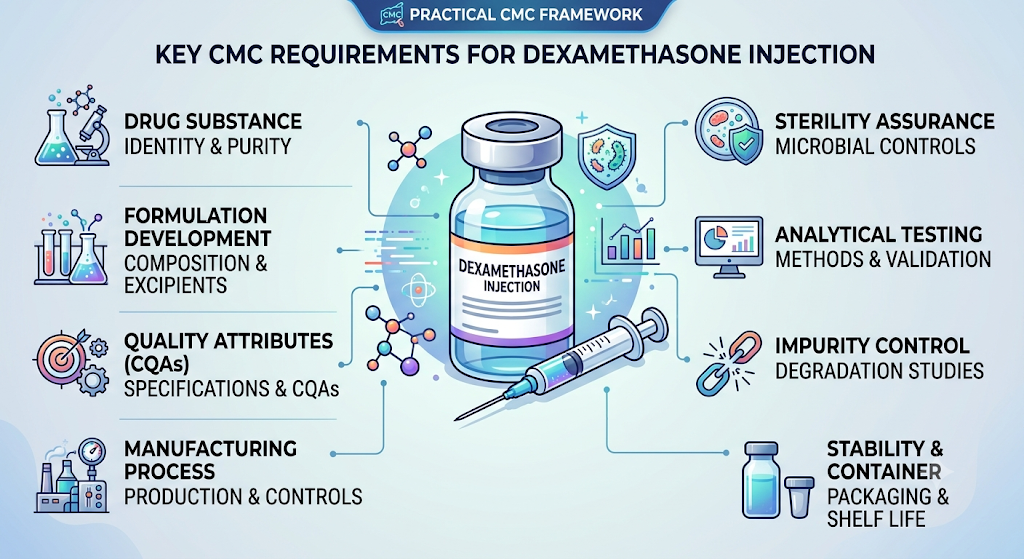
The key Dexamethasone Injection CMC requirements include drug substance characterization, formulation and pharmaceutical development, manufacturing-process information, specifications, analytical procedures, process validation, microbiological controls, container closure information, and stability data.
A practical CMC framework is shown below:
| CMC Area | Key Information for Dexamethasone Injection |
|---|---|
| Drug substance | Identity, assay, impurities, physicochemical properties, supplier/manufacturer |
| Formulation | API concentration, excipients, pH adjusters, preservative where applicable |
| Pharmaceutical development | Formulation rationale, compatibility, critical quality attributes |
| Manufacturing | Batch formula, process flow, critical process parameters |
| Sterile processing | Filtration/sterilization strategy, aseptic controls, environmental monitoring |
| Finished-product testing | Assay, impurities, pH, particulate matter, sterility, endotoxins, fill volume |
| Analytical methods | Method descriptions, validation/verification, and suitability |
| Packaging | Container closure description, materials, compatibility, and integrity |
| Stability | Long-term, accelerated, and applicable in-use studies |
| Regulatory documentation | CTD/eCTD Module 3, QOS, and supporting reports |
FDA’s ANDA guidance explains that the QOS should summarize the drug substance and drug product CMC information while remaining fully supported by the detailed data in Module 3.
1. Drug Substance CMC Requirements for Dexamethasone
The drug substance section must establish that the dexamethasone starting material used to manufacture the injection has appropriate identity, quality, purity, and consistency.
Depending on the API form and manufacturing arrangement, documentation may include:
- Nomenclature, chemical name, molecular formula, and molecular weight
- Structural information and manufacturer/manufacturing site details
- Manufacturing process description or reference to an appropriate Drug Master File (DMF)
- Starting materials, controls, specifications, and analytical procedures
- Impurity profile, residual solvents, and elemental impurities where applicable
- Water content or other relevant physicochemical properties
- Batch analysis and stability information
For dexamethasone sodium phosphate specifically, the salt form matters because its physical and chemical characteristics directly influence formulation performance and stability. An injectable formulation is sensitive to variations in API quality — differences in impurity levels, degradation products, or water content can affect finished-product stability. The API control strategy should therefore be linked to the finished-product control strategy rather than treated as an isolated section.
2. Formulation and Pharmaceutical Development
The formulation section should explain why each component is present and how the formulation consistently achieves the required quality attributes. This is a core focus area during dexamethasone injection development, where formulation scientists must justify every excipient against the Reference Listed Drug’s composition.
Dexamethasone sodium phosphate is water-soluble and has been formulated with excipients such as sodium citrate and water for injection, with some presentations also containing benzyl alcohol as a preservative. Approved labeling for reference products has historically identified a pH range around 7.0–8.5, though the actual reference product and proposed generic formulation must always be evaluated against current, applicable product information rather than an outdated label.
Important formulation considerations include:
- API concentration and strength
- Buffer selection, concentration, and pH adjustment
- Tonicity considerations
- Preservative selection for multidose presentations
- API-excipient compatibility and solution clarity
- Degradation pathways and adsorption/interaction with packaging materials
- Compatibility with the intended route of administration
FDA’s Inactive Ingredients Database, updated quarterly, is a useful industry resource for evaluating inactive ingredients in approved drug products. Ultimately, the formulation should be supported by real development studies rather than theoretical justification alone.
3. Critical Quality Attributes for Dexamethasone Injection
Critical quality attributes (CQAs) are measurable characteristics that must remain within defined limits to ensure product quality. For dexamethasone injection, potentially relevant CQAs include:
- Appearance and identification
- Assay and related substances/degradation products
- pH and particulate matter
- Sterility and bacterial endotoxins
- Extractable/fill volume and container closure integrity
- Preservative content (where applicable)
- Osmolality or other product-specific attributes, when scientifically justified
Specifications should be established based on the reference product, applicable compendial requirements, development data, stability information, and current regulatory expectations.
4. Manufacturing Process and Process Controls
The manufacturing section should clearly describe how the formulation moves from raw materials to the final sterile product. For a typical sterile solution injection, this may include:
- Receipt and testing of raw materials, dispensing, and formulation preparation
- Addition and dissolution of API and excipients, followed by pH adjustment
- Bulk solution testing or in-process controls, including bioburden control
- Sterilizing filtration or an applicable sterilization approach
- Aseptic filling, container closure, and visual inspection
- Packaging and labeling
Critical process parameters may include mixing time and speed, temperature, addition sequence, pH adjustment conditions, filtration parameters, filter integrity, hold time, filling volume and speed, and environmental conditions. A risk-based approach helps identify which parameters require enhanced monitoring or tighter control, and the process must be supported throughout by appropriate development and validation evidence.
5. Sterility and Microbiological CMC Requirements
Sterility is one of the most important aspects of Dexamethasone Injection CMC requirements because the product is administered parenterally. Rigorous sterility and endotoxin testing for dexamethasone injection underpins the entire microbiological control strategy.
The strategy should address:
- Raw-material microbiological quality and water system controls
- Bioburden control and sterilizing filtration, where applicable
- Aseptic processing controls, environmental monitoring, and personnel qualification
- Media fills/process simulations
- Sterility testing and bacterial endotoxin testing
- Container closure integrity and microbial contamination prevention
An important regulatory principle is that a sterility test alone does not establish sterility assurance — facility design, personnel practices, validated processes, environmental controls, sterilization or aseptic processing, and container closure integrity must all work together as a system.
6. Analytical Methods and Validation
Analytical testing provides the evidence that each batch meets its established specifications. Thorough analytical characterization of dexamethasone injection typically covers methods for:
- Identification, assay, and related substances
- pH, particulate matter, and bacterial endotoxins
- Sterility and preservative content (where applicable)
- Extractable volume and other product-specific quality attributes
Chromatographic methods are particularly important for assay and degradation-product monitoring. Method validation or verification should address specificity, accuracy, precision, linearity, range, detection limit, quantitation limit, and robustness, and must demonstrate that the methods can reliably distinguish dexamethasone from relevant degradation products and formulation components.
7. Impurity and Degradation-Product Control
Impurity control is essential for injectable products because final drug product quality depends on controlling both process-related and degradation-related impurities. The CMC strategy should consider API-related impurities, process-related impurities, degradation products, potential interaction products, residual solvents, and elemental impurities where applicable.
Forced-degradation studies are central to this effort. A well-designed forced degradation study for dexamethasone helps establish degradation pathways and confirms that analytical procedures are truly stability-indicating. This work supports:
- Identification of degradation pathways
- Selection of stability-indicating analytical methods
- Establishment of impurity specifications
- Packaging decisions and formulation optimization
- Shelf-life justification
8. Container Closure System Requirements
The container closure system must protect the dexamethasone injection from contamination, moisture, interaction, and other factors that could compromise quality. Depending on the presentation, the packaging system may include a glass vial or ampoule, rubber stopper, aluminum seal, plastic components, or syringe/delivery components.
Key considerations include material compatibility, container closure integrity, protection against environmental exposure, sterility maintenance, interaction with the drug product, and suitability across the proposed shelf life. Assessing extractables and leachables in dexamethasone injectables is a critical part of this evaluation, since rubber stoppers and elastomeric components can interact with the formulation over time.
Notably, FDA published a new draft guidance on Container Closure Systems for Human Drugs and Biological Products in August 2026. While the document is currently a draft and explicitly not for implementation, it signals evolving regulatory thinking that applicants should monitor when planning future CMC strategies.
9. Stability Requirements
Stability studies demonstrate that the proposed dexamethasone injection continues to meet established quality requirements throughout its proposed shelf life. A stability program should consider:
- Long-term and accelerated stability, plus intermediate conditions when applicable
- Multiple representative batches in the proposed commercial packaging
- Assay, degradation products, pH, appearance, and particulate matter
- Sterility-related attributes and container closure integrity
- Preservative content, where applicable
Stability-indicating analytical methods are essential, since they allow meaningful monitoring of chemical changes during storage. The resulting data must ultimately support the proposed expiration period and storage statement.
10. Manufacturing Site and Facility Information
The ANDA should clearly identify all facilities involved in manufacturing, packaging, and testing. FDA’s guidance on identification of manufacturing establishments explains that applications must provide accurate information on the locations of manufacturing, packaging, and control sites. For a sterile injectable, applicants should also be prepared to demonstrate that the facility, equipment, utilities, environmental controls, personnel practices, and quality systems are appropriate for sterile drug manufacturing.
11. CMC Documentation in the ANDA (CTD Structure)
CMC information should be logically organized within the CTD/eCTD structure:
| CTD Section | Typical Content |
|---|---|
| 2.3 | Quality Overall Summary |
| 3.2.S | Drug Substance |
| 3.2.P | Drug Product |
| 3.2.P.1 | Description and Composition |
| 3.2.P.2 | Pharmaceutical Development |
| 3.2.P.3 | Manufacture |
| 3.2.P.4 | Control of Excipients |
| 3.2.P.5 | Control of Drug Product |
| 3.2.P.6 | Reference Standards/Materials |
| 3.2.P.7 | Container Closure System |
| 3.2.P.8 | Stability |
The QOS should provide a clear overview of the CMC information, fully supported by corresponding data in Module 3. FDA also requires ANDAs to be submitted electronically in eCTD format.
2: Common CMC Deficiencies in Dexamethasone Injection ANDAs
CMC deficiencies typically arise when submitted information fails to connect formulation development, manufacturing controls, analytical methods, and product quality. Common risk areas include:
- Incomplete formulation justification or insufficient API characterization
- Inadequate impurity assessment or weak specification justification
- Insufficient analytical method validation or process validation information
- Incomplete aseptic-process controls, filter validation, or integrity controls
- Incomplete container closure integrity information
- Insufficient stability data
- Inconsistencies between Module 2 and Module 3, or between batch records and submitted manufacturing descriptions
- Poor linkage between CQAs and critical process parameters
FDA’s Good ANDA Submission Practices guidance specifically highlights these recurring deficiencies as common causes of delayed approval.
3: How a Risk-Based CMC Strategy Improves ANDA Readiness
A risk-based strategy makes the CMC package more scientifically coherent and easier for reviewers to follow, using a logical chain:
Material attributes → Process parameters → CQAs → Analytical controls → Stability → Final specifications
If a formulation attribute has the potential to affect degradation, the development program should clearly establish how that risk is evaluated, controlled, and monitored during manufacturing and stability testing. This prevents a fragmented submission in which individual sections contain data but fail to explain how the overall control strategy assures product quality. For complex generics, FDA also offers Pre-ANDA meetings to clarify expectations during development.
CMC responsibilities don’t end at approval, either. Sound lifecycle management strategies for dexamethasone injectables — covering post-approval changes, supplier qualification, and continued process verification — help maintain product quality and regulatory compliance long after the initial ANDA is granted.
4: Why CMC Expertise Matters for Dexamethasone Injection ANDA Development
Developing an injectable generic requires coordination between formulation scientists, analytical scientists, microbiologists, manufacturing professionals, quality teams, and regulatory specialists. An experienced CMC team connects reference-product assessment, formulation development, analytical method development, impurity profiling, forced degradation, stability studies, sterile manufacturing, process validation, container closure evaluation, and regulatory documentation into one coherent strategy. The goal isn’t simply generating a large volume of data — it’s generating relevant, scientifically justified data that collectively demonstrates consistent product quality.
5: CMC Readiness Checklist for Dexamethasone Injection ANDA
Before submission, applicants can use the following high-level checklist:
- API identity, quality, and impurity profile adequately established
- Formulation composition and excipient controls justified
- Pharmaceutical development studies documented and CQAs identified
- Manufacturing process and critical process parameters adequately described
- Sterilization/aseptic process strategy and process validation strategy established
- Analytical methods appropriately developed and validated
- Finished-product specifications justified and microbiological controls established
- Container closure system characterized, including integrity strategy
- Stability program completed or ongoing, with a scientifically supported shelf-life proposal
- Module 2 and Module 3 information reconciled, with accurate manufacturing site details
- QOS consistent with Module 3 and eCTD documentation checked for completeness
Conclusion:
Dexamethasone Injection CMC requirements encompass far more than assay and finished-product testing. A successful ANDA CMC package must demonstrate a scientifically justified, well-integrated relationship between the drug substance, formulation, manufacturing process, analytical methods, sterile-processing controls, container closure system, and stability program. Particular attention should be given to formulation composition, pH, impurity and degradation control, sterility assurance, bacterial endotoxins, particulate matter, analytical method performance, process validation, container closure integrity, and long-term stability.
FDA’s ANDA framework continues to evolve — including the August 2026 draft guidance on container closure systems — which is why applicants should maintain an up-to-date regulatory strategy rather than relying on legacy assumptions. A well-integrated CMC development program helps identify quality risks early, strengthens the scientific justification for specifications and processes, and reduces avoidable questions during regulatory review.
Frequently Asked Questions:
The most important consideration is establishing an integrated control strategy that consistently assures the identity, strength, quality, purity, and sterility of the injectable product. Every major CMC element should be supported by appropriate scientific data and aligned with the proposed manufacturing process and regulatory requirements.
Before submission, applicants should verify that the formulation, manufacturing process, analytical methods, specifications, sterile-processing controls, container closure system, stability data, and supporting documentation are adequately justified and internally consistent across the CTD/eCTD submission.
Analytical laboratories can support CMC programs through activities such as method development and validation, assay and impurity testing, degradation studies, stability testing, characterization, and other analytical investigations required to establish product quality.
Container closure integrity helps demonstrate that the packaging system can maintain the product’s sterility and protect it from external contamination throughout its intended shelf life. It is therefore an important component of the overall quality and sterility-assurance strategy for sterile injections.
Reference
- Fu L, Dong S, Xie R, Jia G, Zhao N, Xiang Q, Ji X, Zhao X, Chen X, Ma L, Cui Y. A multi-dimensional comparative study of 505 (b)(2) NDAs approved by FDA and Class 2 NDAs approved by NMPA from 2017 to 2023: Uncovering trends, characteristics, and regulation of modified new drugs. Regulatory Toxicology and Pharmacology. 2025 Nov 1;162:105864.https://www.sciencedirect.com/science/article/pii/S0273230025000947
- Manohari PJ, Seshadri VC, Munirathnam I, Ramesh AA, Kunchithapatham J, Maanvizhi S. Quality by Design Based Pharmaceutical Development Report of Cost-effective Dexamethasone Tablets, 20 mg for Regulatory Submission. Journal of Pharmaceutical Research International. 2025 May 19;37(5):89-117.https://www.researchgate.net/profile/Packiaraj-Jeyachandran-Manohari/publication/391870958_Quality_by_Design_Based_Pharmaceutical_Development_Report_of_Cost-effective_Dexamethasone_Tablets_20_mg_for_Regulatory_Submission/links/682b68578a76251f22e2d7b6/Quality-by-Design-Based-Pharmaceutical-Development-Report-of-Cost-effective-Dexamethasone-Tablets-20-mg-for-Regulatory-Submission.pdf
- Lourenço D, Miranda M, Sousa JJ, Vitorino C. Therapeutic-driven framework for bioequivalence assessment of complex topical generic drug products. International Journal of Pharmaceutics. 2024 Aug 15;661:124398.https://www.sciencedirect.com/science/article/pii/S037851732400632X
About the Author


