

Introduction
Dissolution Method Development for Generic Oral Solid Dosage Forms involves establishing a scientifically justified and discriminating in vitro testing procedure to assess drug release kinetics and demonstrate bioequivalence with the Reference Listed Drug (RLD). Dissolution testing functions as a critical surrogate marker for evaluating drug product quality and forecasting in vivo performance. For generic pharmaceutical manufacturers and Contract Development and Manufacturing Organizations (CDMOs), the development of a robust dissolution procedure is essential for supporting Abbreviated New Drug Application (ANDA) submissions, enabling Scale-Up and Post-Approval Changes (SUPAC), and obtaining biowaiver eligibility under the Biopharmaceutics Classification System (BCS).
An appropriately developed dissolution procedure must achieve an optimal balance between sensitivity and ruggedness. The method should be sufficiently sensitive to detect meaningful changes in formulation attributes, including active pharmaceutical ingredient (API) particle size distribution, excipient supplier variation, granule density, and tablet compression force, while remaining reproducible and robust enough for routine quality control testing across different manufacturing locations and analytical laboratories. Reaching this balance requires a systematic development strategy aligned with United States Pharmacopeia (USP) Chapter The Dissolution Procedure: Development and Validation, International Council for Harmonisation (ICH) recommendations, and regulatory expectations established by the U.S. Food and Drug Administration (FDA) and the European Medicines Agency (EMA).
Learn more about navigating contract development models: Peptide CDMO vs. CRO: Choosing the Right Partner
Share via:
Article Summary:
- Dissolution method development is essential for generic oral solid dosage forms to assess drug release, support bioequivalence, ANDA submissions, SUPAC, and BCS biowaivers.
- FDA, EMA, and USP expectations emphasize validated methods, appropriate dissolution apparatus, multiple physiological pH media, and adequate discriminatory power.
- BCS-based strategies can support biowaivers: BCS Class 1 requires ≥85% dissolution within 30 minutes, while BCS Class 3 requires ≥85% within 15 minutes in relevant media.
- Technical development involves optimizing dissolution media, sink conditions, surfactants, deaeration, USP Apparatus 1/2, agitation speed, and hydrodynamic factors such as floating, coning, and vessel adhesion.
- Analytical testing uses UV/Vis or HPLC/UHPLC, with filter compatibility and recovery studies performed to prevent inaccurate dissolution results.
- f₂ statistical analysis is commonly used to compare generic and reference dissolution profiles; an f₂ value of 50–100 generally indicates similarity, with bootstrap or multivariate approaches available for highly variable data.
- QbD and method validation ensure specificity, accuracy, precision, robustness, and reproducibility, while an experienced CDMO can help streamline development, validation, biowaiver support, and regulatory submissions.
Regulatory Framework Governing Generic Oral Solid Dosage Forms
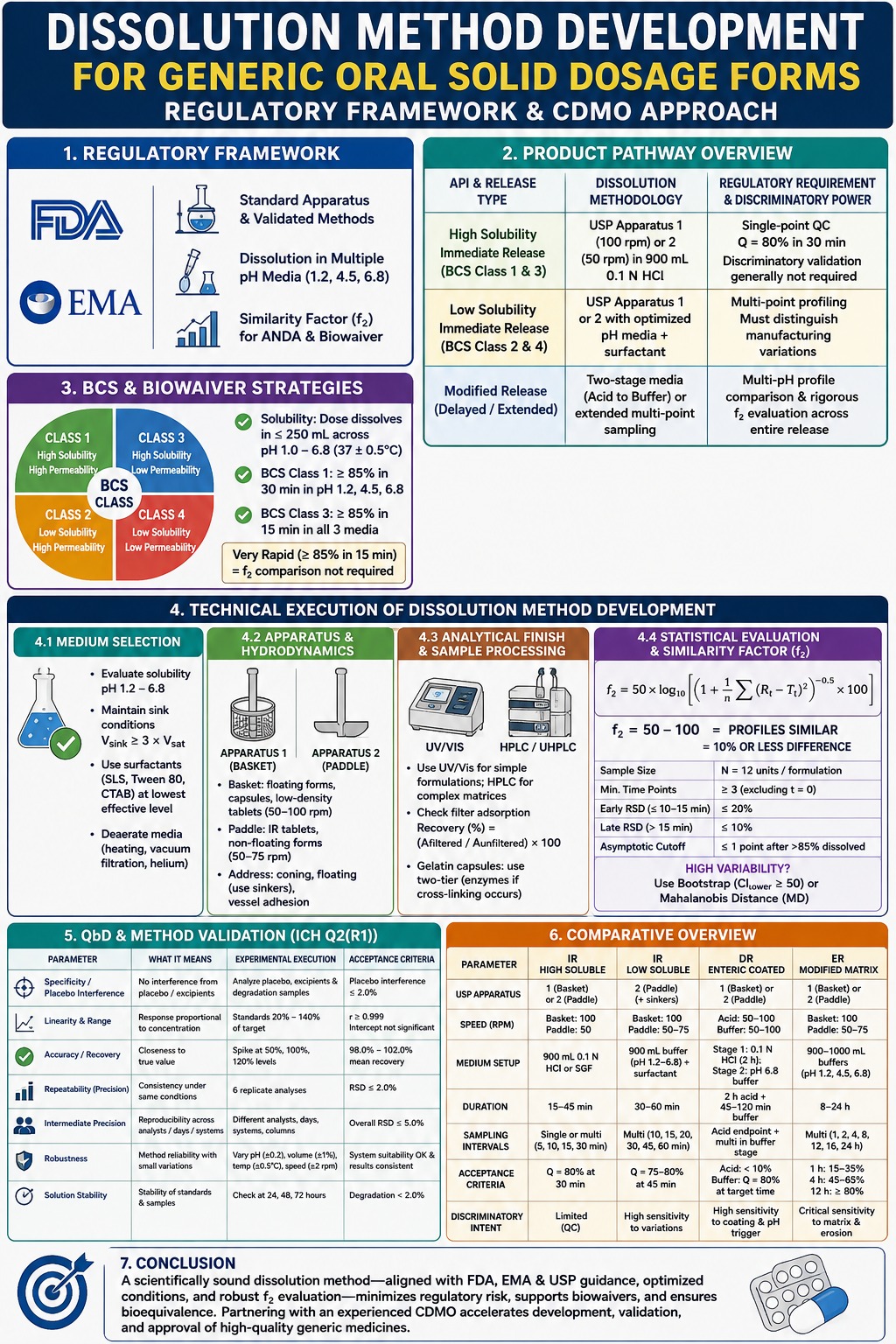
The regulatory framework for generic oral solid dosage forms requires demonstrating that the generic product exhibits comparable in vitro drug release characteristics to the Reference Listed Drug across physiologically relevant pH environments. Regulatory authorities require the use of standardized dissolution apparatus, validated analytical methodologies, and similarity factor (f₂) assessments to support ANDA submissions and biowaiver applications.
Looking to partner for your pharmaceutical pipeline? Outsource Peptide Manufacturing to a Trusted CDMO
FDA and EMA Guidance Standards for Immediate and Modified Release Products
FDA and EMA guidance documents recommend dissolution profiling in multiple media, including pH 1.2, 4.5, and 6.8, to establish batch consistency and demonstrate bioequivalence. Immediate-release products containing highly soluble drug substances may qualify for standardized dissolution testing approaches, whereas poorly soluble and modified-release formulations generally require customized discriminating dissolution procedures.
For immediate-release (IR) products containing highly soluble APIs, the FDA guidance Dissolution Testing and Acceptance Criteria for Immediate-Release Solid Oral Dosage Form Drug Products Containing High Solubility Drug Substances provides simplified testing recommendations. When an API demonstrates high solubility across the physiological pH range, a compendial dissolution method such as USP Apparatus 1 (basket) operated at 100 rpm or USP Apparatus 2 (paddle) operated at 50 rpm in 900 mL of 0.1 N Hydrochloric Acid (HCl) or Simulated Gastric Fluid (SGF) without enzymes may be employed without the need to establish discriminatory capability against manufacturing variations.
In contrast, products containing poorly soluble APIs (BCS Class 2 and BCS Class 4) or modified-release (MR) dosage forms, including delayed-release and extended-release products, require extensive dissolution method development. Regulatory agencies expect the procedure to possess adequate discriminatory power to identify out-of-specification batches and detect variations associated with Critical Quality Attributes (CQAs) and Critical Process Parameters (CPPs).
| Product Regulatory Pathway | API Solubility & Release Type | Standard Dissolution Methodology | Regulatory Requirements & Discriminatory Power |
|---|---|---|---|
| Standardized Compendial Release | High Solubility / Immediate Release (BCS Class 1 & 3) | USP Apparatus 1 (100 rpm) or USP Apparatus 2 (50 rpm) in 900 mL 0.1 N HCl | Single-point quality control acceptance criteria (Q = 80% in 30 minutes); discriminatory validation is generally not required. |
| Customized Discriminating Method | Low Solubility / Immediate Release (BCS Class 2 & 4) | USP Apparatus 1 or 2 with optimized pH media and surfactant incorporation | Multi-point dissolution profiling; method must distinguish manufacturing-related differences such as particle size and hardness variations. |
| Modified Release Profiling | Delayed Release (DR) or Extended Release (ER) | Two-stage media systems (Acid to Buffer) or extended multi-point sampling schedules | Comprehensive multi-pH profile comparison and rigorous f₂ similarity evaluation across the entire release period. |
Need full-spectrum analytical support for your filing? Explore One-Stop CDMO Analytical Services for ANDA Submissions
Biopharmaceutics Classification System (BCS) and Biowaiver Strategies
Biowaiver pathways allow generic drug manufacturers to replace in vivo bioequivalence studies with comparative in vitro dissolution testing for eligible BCS Class 1 and BCS Class 3 oral solid dosage forms. Eligibility requires demonstrating rapid or very rapid dissolution in physiologically relevant media while ensuring that excipients do not significantly influence drug absorption.
To obtain a BCS Class 1 or Class 3 biowaiver, the generic product must satisfy stringent criteria related to solubility, permeability, and dissolution behavior:
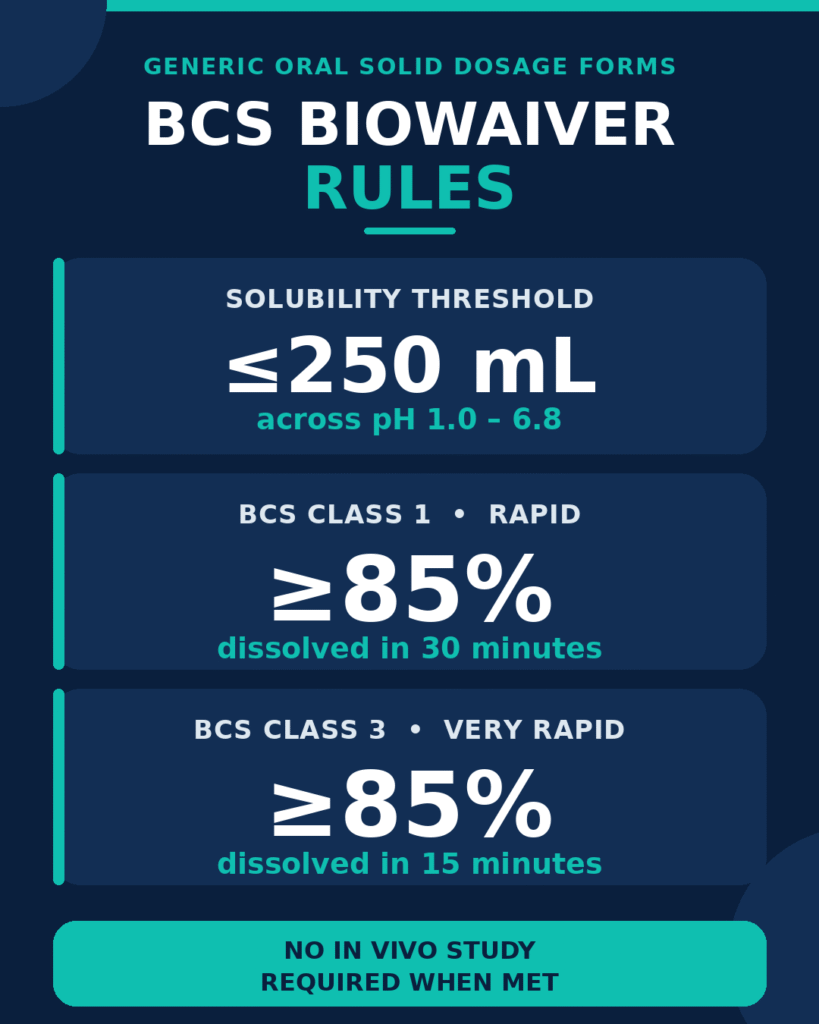
- Solubility Threshold: The highest marketed strength of the drug product must dissolve in 250 mL or less of aqueous media across the pH range of 1.0 to 6.8 at 37 ± 0.5°C.
- Rapid Dissolution: For BCS Class 1 products, at least 85% of the labeled API content must dissolve within 30 minutes in pH 1.2, pH 4.5 acetate buffer, and pH 6.8 phosphate buffer.
- Very Rapid Dissolution: For BCS Class 3 products, at least 85% of the labeled API content must dissolve within 15 minutes in all three physiological media using USP Apparatus 1 at 100 rpm or USP Apparatus 2 at 50 rpm.
When a generic formulation achieves the very rapid dissolution criterion (≥ 85% within 15 minutes), profile comparison using the f₂ similarity factor is generally unnecessary because the dissolution profiles are considered equivalent by default.
Evaluating regional CDMO choices? Compare US vs. Overseas Peptide CDMOs
Technical Execution of Dissolution Method Development for Generic Oral Solid Dosage Forms
The technical execution of Dissolution Method Development for Generic Oral Solid Dosage Forms requires systematic optimization of dissolution media, apparatus selection, filtration strategies, and analytical detection techniques in accordance with USP guidance. CDMO analytical scientists typically apply a structured development approach to establish a discriminating and reliable dissolution method.
Physicochemical Profiling and Medium Selection
Medium selection is based on evaluating API solubility and stability across physiologically relevant pH conditions while maintaining sink conditions throughout the dissolution test. For poorly soluble compounds, carefully selected surfactants are incorporated to enhance solubility without obscuring formulation-related differences.
The development process begins with determining equilibrium solubility across the physiological pH range of 1.2 to 6.8 while ensuring sink conditions are maintained throughout the study. Sink conditions are generally defined as a dissolution medium volume that is at least three to ten times greater than the saturation volume required to dissolve the entire dose:
Vsink ≥ 3 × Vsat
For poorly water-soluble APIs, surfactants are systematically evaluated to improve solubility while preserving discriminatory capability. Commonly used surfactants include Sodium Lauryl Sulfate (SLS), Polysorbate 80 (Tween 80), and Cetyltrimethylammonium Bromide (CTAB). The selected surfactant concentration should represent the lowest effective level capable of achieving sink conditions and supporting complete dissolution (>85%) within the desired timeframe. The use of organic solvents such as methanol, ethanol, and acetonitrile in dissolution media is generally discouraged by regulatory agencies and requires strong scientific justification.
Deaeration of dissolution media is equally important because dissolved gases may generate microbubbles on dosage forms or vessel surfaces during testing. These microbubbles can restrict solvent contact, alter dissolution behavior, and create artificial floating effects. Common compendial deaeration approaches include heating, vacuum filtration, and helium sparging prior to volume adjustment.
Explore end-to-end drug development solutions: Learn About Peptide Drug Development CDMO Services
Hydrodynamic Apparatus Selection and Operational Parameters
The choice between USP Apparatus 1 (basket) and USP Apparatus 2 (paddle) is determined by dosage form characteristics such as density, buoyancy, and hydrodynamic behavior. Operational parameters must be carefully optimized to maintain appropriate fluid dynamics while minimizing hydrodynamic artifacts.
Apparatus selection is guided by the physical properties of the dosage form:
- USP Apparatus 1 (Basket): Commonly selected for floating dosage forms such as capsules, low-density tablets, and multiparticulate systems. The basket assembly, typically utilizing a 40-mesh screen, keeps the dosage unit submerged and promotes consistent exposure to the dissolution medium. Agitation speeds generally range between 50 and 100 rpm.
- USP Apparatus 2 (Paddle): Frequently used for immediate-release tablets and non-floating dosage forms. Standard agitation speeds are typically 50 rpm for conventional tablets and 75 rpm for products that exhibit a tendency to adhere to vessel surfaces.
Potential hydrodynamic issues must be identified and addressed during method development:
- Coning: Insoluble excipients with high density may accumulate beneath the paddle shaft, forming a cone-shaped deposit that creates stagnant fluid zones and slows dissolution. This effect can often be reduced by increasing paddle speed or by using peak-bottom vessels when scientifically justified.
- Floating: Gelatin capsules and certain film-coated tablets may float during testing. Helical wire sinkers are commonly employed to maintain proper immersion and ensure consistent hydrodynamic conditions.
- Vessel Adhesion: Tablets adhering to vessel walls may require conversion to USP Apparatus 1 or the use of appropriate non-reactive sinkers.
Comparing specialized development models? Understand the Differences Between a Peptide CDMO vs. CMO
Analytical Finish and Sample Processing
Analytical finish selection focuses on the accurate quantification of dissolved API using UV/Vis spectrophotometry or chromatographic techniques such as HPLC and UHPLC. Sample preparation procedures must effectively minimize excipient interference and prevent API adsorption to filtration materials.
UV/Vis spectrophotometry offers rapid analysis and cost-effective operation for simple, highly soluble formulations. However, interference from excipients, colorants, or capsule shell components can result in unacceptable background absorbance exceeding 2% placebo interference. Under such circumstances, HPLC or UHPLC methods are preferred because they provide separation of the target analyte from formulation excipients and degradation products.
Filter compatibility studies are essential to evaluate potential API adsorption onto membrane filters. Significant adsorption may lead to artificially reduced dissolution results. Filter assessments typically involve comparing analyte recovery from filtered samples against centrifuged, unfiltered reference solutions using the following equation:
Recovery (%) = (Afiltered / Aunfiltered) × 100
When adsorption is concentration dependent and saturable, a predetermined discard volume—typically the first 2 to 5 mL of filtrate—is established to ensure representative sample collection.
For gelatin capsule formulations exposed to elevated temperature or humidity conditions, gelatin cross-linking may occur, resulting in the formation of a water-insoluble pellicle that restricts dissolution. Under these circumstances, a two-tier dissolution approach described by USP may be applied. Tier 1 utilizes standard dissolution media. If failure is attributed to cross-linking, Tier 2 incorporates enzymes, with pepsin used in acidic media (pH < 2.0) and pancreatin used in media at or above pH 6.8.
Statistical Evaluation of Dissolution Profiles and Similarity Factor (f₂)
Dissolution profile comparisons commonly rely on the similarity factor (f₂) to determine equivalence between generic formulations and the Reference Listed Drug. An f₂ value ranging from 50 to 100 is generally considered evidence of profile similarity and corresponds to an average difference of approximately 10% or less across matching sampling intervals.
Mathematical Definition and Application Criteria
The similarity factor (f₂) represents a logarithmic transformation of the squared differences between test and reference dissolution profiles. Proper application requires compliance with regulatory requirements concerning sample size, sampling intervals, and data variability.
The similarity factor is calculated using the following equation:
f₂ = 50 × log₁₀ [(1 + (1/n) Σ(Rt − Tt)²)^−0.5 × 100]
Where:
- n represents the number of valid sampling time points.
- Rt represents the mean percentage dissolved for the Reference Listed Drug at time point t.
- Tt represents the mean percentage dissolved for the generic Test formulation at time point t.
To ensure valid statistical interpretation, regulatory agencies require adherence to the following criteria:
| Parameter Requirement | Regulatory Standard / Criterion | Scientific Rationale |
|---|---|---|
| Sample Size | Minimum 12 individual dosage units per formulation (N = 12) | Provides adequate statistical power and minimizes sampling bias. |
| Time Point Selection | Identical sampling intervals for test and reference products | Ensures direct temporal comparison between dissolution profiles. |
| Minimum Time Points | At least 3 sampling points excluding t = 0 | Allows meaningful characterization of dissolution behavior. |
| Asymptotic Cutoff | No more than one sampling point after >85% dissolution is achieved | Prevents late-stage plateau values from masking early profile differences. |
| Early Point Variability | Relative Standard Deviation (RSD) ≤ 20% for time points ≤ 10 or 15 minutes | Controls variability during early disintegration and dissolution stages. |
| Late Point Variability | Relative Standard Deviation (RSD) ≤ 10% for time points >15 minutes | Preserves accuracy and reliability of f₂ calculations. |
Addressing High Data Variability: Bootstrap and Multivariate Approaches
When dissolution datasets exhibit variability exceeding acceptable Relative Standard Deviation limits, alternative statistical methodologies may be used to evaluate profile similarity. These approaches include bootstrap resampling techniques and multivariate statistical models such as Mahalanobis Distance analysis.
High variability may occur during early disintegration, in complex modified-release matrix systems, or in aged products. Under these conditions, conventional f₂ calculations may yield misleading results. Regulatory authorities, including the FDA and EMA, may accept alternative approaches when scientifically justified.
- Bootstrap Methodology: This approach generates a minimum of 5,000 resampled datasets through random replacement from the original dissolution data. A two-sided 90% confidence interval for f₂ is then calculated using percentile-based methods. Similarity is established when the lower confidence interval limit is equal to or greater than 50 (CIlower ≥ 50).
- Mahalanobis Distance (MD): For dissolution profiles exhibiting multivariate normal behavior and complex covariance structures, the Model-Independent Multivariate Statistical Distance approach quantifies the distance between mean test and reference vectors. A 90% confidence region is established and compared against a predefined similarity boundary.
Scaling your drug product to commercial volumes? Read About CDMO Scale-Up Services
Quality by Design (QbD) and Method Validation in CDMO Operations
Quality by Design (QbD) principles integrate risk-based assessment tools and Design of Experiments (DoE) methodologies into dissolution method development. CDMOs validate these methods in accordance with ICH Q2(R1) requirements to ensure accuracy, precision, robustness, and reproducibility across analytical laboratories.
QbD-based development begins with defining the Analytical Target Profile (ATP). Potential failure modes, including media pH variation, surfactant quality differences, hydrodynamic inconsistencies, and filter adsorption, are evaluated using Failure Mode and Effects Analysis (FMEA). Design of Experiments (DoE) studies are subsequently conducted to establish acceptable operating ranges and method robustness.
| ICH Q2(R1) Validation Parameter | Experimental Execution Strategy | Acceptance Criteria Thresholds |
|---|---|---|
| Specificity / Placebo Interference | Analyze placebo formulations, individual excipients, and degradation samples under test conditions. | Placebo interference ≤ 2.0% of nominal drug response. |
| Linearity and Range | Prepare calibration standards spanning 20% to 140% of target concentration. | Correlation coefficient (r) ≥ 0.999 with a non-significant intercept. |
| Accuracy / Recovery | Spike API into placebo matrices at 50%, 100%, and 120% concentration levels. | Mean recovery between 98.0% and 102.0%. |
| Repeatability (Precision) | Perform six replicate analyses under identical operating conditions. | Relative Standard Deviation (RSD) ≤ 2.0%. |
| Intermediate Precision | Assess reproducibility across analysts, days, dissolution systems, and chromatographic columns. | Overall Relative Standard Deviation (RSD) ≤ 5.0%. |
| Robustness | Deliberately vary media pH (±0.2), volume (±1%), temperature (±0.5°C), and agitation speed (±2 rpm). | System suitability remains acceptable and dissolution results remain consistent. |
| Solution Stability | Evaluate stability of standards and filtered samples over 24, 48, and 72 hours. | Analyte degradation less than 2.0% relative to freshly prepared solutions. |
Looking for specialized characterization insights? Read Our Case Study on Semaglutide Characterization
Comparative Overview of Dissolution Testing Parameters
Dissolution testing parameters differ considerably depending on dosage form architecture, API solubility characteristics, and release mechanisms. The following comparison summarizes major operational parameters and regulatory expectations across common oral solid dosage form categories.
| Parameter Category | Immediate Release (IR) Highly Soluble | Immediate Release (IR) Poorly Soluble | Delayed Release (DR) Enteric Coated | Extended Release (ER) Modified Matrix |
|---|---|---|---|---|
| Typical USP Apparatus | Apparatus 1 (Basket) or Apparatus 2 (Paddle) | Apparatus 2 (Paddle) with sinkers when required | Apparatus 1 (Basket) or Apparatus 2 (Paddle) | Apparatus 1 (Basket) or Apparatus 2 (Paddle) |
| Standard Agitation Speed | Baskets: 100 rpm; Paddles: 50 rpm | Baskets: 100 rpm; Paddles: 50–75 rpm | Acid Stage: 50–100 rpm; Buffer Stage: 50–100 rpm | Baskets: 100 rpm; Paddles: 50–75 rpm |
| Dissolution Medium Setup | 900 mL 0.1 N HCl or SGF without enzymes | 900 mL buffer (pH 1.2–6.8) with surfactants such as SLS or Tween | Stage 1: 0.1 N HCl (2 hours); Stage 2: pH 6.8 buffer | 900–1000 mL physiological buffers (pH 1.2, 4.5, and 6.8) |
| Testing Duration | 15–45 minutes | 30–60 minutes | 2 hours acid stage plus 45–120 minutes buffer stage | 8–24 hours |
| Sampling Intervals | Single-point or multi-point (5, 10, 15, 30 minutes) | Multi-point (10, 15, 20, 30, 45, 60 minutes) | Acid-stage endpoint plus multi-point buffer-stage sampling | Multi-point (1, 2, 4, 8, 12, 16, 24 hours) |
| Acceptance Criteria | Q = 80% at 30 minutes | Q = 75–80% at 45 minutes | Acid Stage: <10% release; Buffer Stage: Q = 80% at target time | Multi-point specifications such as 1 hour: 15–35%, 4 hours: 45–65%, and 12 hours: ≥80% |
| Discriminatory Intent | Limited; primarily quality control testing | High sensitivity to particle size and excipient variability | High sensitivity to enteric coating performance and pH-triggered release | Critical sensitivity to polymer viscosity and matrix erosion characteristics |
Selecting a partner in North America? Guide to Choosing a Peptide CDMO in the US
Conclusion
Successful Dissolution Method Development for Generic Oral Solid Dosage Forms requires the integration of regulatory expectations with advanced analytical science and robust statistical evaluation. By combining guidance from the FDA, EMA, and USP with scientifically sound approaches such as surfactant optimization, hydrodynamic control, automated sample handling, and advanced f₂ statistical evaluation techniques, generic drug developers can reduce regulatory uncertainty and strengthen demonstrations of bioequivalence. Collaboration with an experienced CDMO can further streamline dissolution method development, analytical validation, and biowaiver support activities, ultimately accelerating the availability of high-quality generic medicines in global markets.
For specialized support in analytical biopharmaceutics, dissolution method development, and regulatory testing protocols, connect with our analytical team through our Contact Us page.
Frequently Asked Questions (FAQs)
Sink conditions refer to a testing environment where the dissolution medium has sufficient capacity to dissolve the entire amount of drug released from the dosage form without becoming saturated. Maintaining these conditions ensures that drug release is not artificially limited by solubility constraints. As a result, the dissolution profile reflects the actual performance of the formulation rather than the limitations of the testing medium.
Calculation of the similarity factor (f₂) is generally unnecessary when both the generic product and the Reference Listed Drug achieve very rapid dissolution. If at least 85% of the labeled drug content dissolves within 15 minutes in all required physiological media, regulatory agencies typically consider the dissolution profiles comparable without additional mathematical comparison. This approach simplifies the evaluation process for qualifying products.
When dissolution results exhibit variability beyond acceptable regulatory limits, traditional f₂ calculations may no longer provide a dependable assessment of profile similarity. In such situations, alternative statistical techniques are employed to evaluate equivalence more accurately. Methods such as bootstrap confidence interval analysis or multivariate statistical approaches can provide a more robust assessment when dissolution data are highly variable.
Two-tiered dissolution testing is commonly used for gelatin-based dosage forms that may experience cross-linking during storage. In the initial stage, dissolution testing is performed using standard media. If poor dissolution is attributed to gelatin cross-linking, a second stage is conducted using enzyme-containing media, which helps break down the cross-linked gelatin layer and provides a more accurate assessment of drug release behavior.
Filter adsorption studies are performed to determine whether dissolved drug molecules are being retained by filtration membranes during sample preparation. Analysts compare drug recovery from filtered samples against unfiltered or centrifuged controls to identify potential losses. If adsorption is detected, alternative membrane materials may be selected, or a predefined filtrate discard volume may be used to saturate binding sites before collecting analytical samples.
Organic solvents such as methanol or acetonitrile are sometimes used to assist in preparing standard solutions for analytical testing. However, their concentration in the final solution should remain minimal to avoid affecting the analytical results. Regulatory expectations generally require that the solvent level be sufficiently low and scientifically justified, while also demonstrating that it does not interfere with analyte detection, quantification, or method performance.
USP Apparatus 1 (basket) is typically operated at 100 rpm, while USP Apparatus 2 (paddle) is commonly run at 50 rpm for conventional immediate-release products. Certain formulations, including those with unique release characteristics or a tendency to adhere to vessel surfaces, may require higher paddle speeds such as 75 rpm. Any deviation from commonly accepted operating conditions should be supported by scientific evidence generated during method development.
The presence of dissolved gases in the dissolution medium can negatively influence test performance by generating microbubbles on the dosage form surface or within the dissolution vessel. These bubbles may interfere with fluid contact, alter hydrodynamic conditions, and reduce apparent dissolution rates. Proper deaeration helps eliminate these effects and improves the consistency, accuracy, and reproducibility of dissolution testing results.
HPLC and UHPLC methods provide superior specificity when formulation components or degradation products interfere with direct UV measurement. These chromatographic techniques separate the active pharmaceutical ingredient from excipients, colorants, impurities, and degradation compounds before detection. As a result, they offer greater analytical accuracy, improved sensitivity, and enhanced reliability for complex pharmaceutical formulations.
Reference:
- U.S. Food and Drug Administration. (1997, August). Dissolution testing of immediate release solid oral dosage forms: Guidance for industry. U.S. Department of Health and Human Services. https://www.fda.gov/regulatory-information/search-fda-guidance-documents/dissolution-testing-immediate-release-solid-oral-dosage-forms
- U.S. Food and Drug Administration. (1997, August). SUPAC-MR: Modified release solid oral dosage forms—Scale-up and postapproval changes: Chemistry, manufacturing, and controls; in vitro dissolution testing; and in vivo bioequivalence documentation. U.S. Department of Health and Human Services. https://www.fda.gov/media/70936/download
- U.S. Food and Drug Administration. (2015, September). Dissolution testing and specification criteria for immediate-release solid oral dosage forms containing biopharmaceutics classification system class 1 and 3 drugs: Guidance for industry. U.S. Department of Health and Human Services. https://www.fda.gov/media/92988/download
- Shah, V. P., Tsong, Y., Sathe, P., & Liu, J. P. (1998). Scientific and regulatory standards for assessing product performance using the similarity factor, f₂. The AAPS Journal, 1(2), Article 3. https://doi.org/10.1208/ps010203
- U.S. Food and Drug Administration. (2018, August). Dissolution testing and acceptance criteria for immediate-release solid oral dosage form drug products containing high solubility drug substances: Guidance for industry. U.S. Department of Health and Human Services. https://www.fda.gov/regulatory-information/search-fda-guidance-documents/dissolution-testing-and-acceptance-criteria-immediate-release-solid-oral-dosage-form-drug-products
- European Medicines Agency. (n.d.). Clinical pharmacology and pharmacokinetics: Questions and answers. European Medicines Agency. https://www.ema.europa.eu/en/human-regulatory-overview/research-development/scientific-guidelines/clinical-pharmacology-pharmacokinetics-guidelines/clinical-pharmacology-pharmacokinetics-questions-answers
Get In Touch With Us
About The Author


