

Case Study: End-to-End Biosimilar Analytical Package for a Regulatory Submission — How a CRO Partnership Delivered a Complete ICH Q6B Dossier
 By Anusha Sinha
•
August 8, 2026
By Anusha Sinha
•
August 8, 2026
Introduction
Developing an End-to-End Biosimilar Analytical Package for a Regulatory Submission requires the generation of comprehensive physicochemical, structural, and functional comparability data between a proposed biosimilar candidate and its innovator reference product in accordance with ICH Q6B guidelines. This extensive analytical characterization package fulfills regulatory expectations by providing the “totality of evidence” needed to demonstrate that no clinically meaningful differences exist between the biosimilar and the reference biologic. By collaborating with an experienced Contract Research Organization (CRO), biopharmaceutical companies can effectively manage complex analytical challenges, minimize development risks, and compile a fully compliant Common Technical Document (CTD) Module 3 submission package.
Recombinant therapeutic proteins, especially monoclonal antibodies (mAbs) and Fc-fusion proteins, inherently exhibit structural heterogeneity arising from host-cell expression systems, enzymatic processing, and downstream manufacturing operations. Demonstrating that a biosimilar possesses the same amino acid sequence and comparable higher-order structure, post-translational modification (PTM) profile, and biological activity as the reference product requires the use of highly sensitive and orthogonal analytical methodologies. This case study illustrates how an integrated CRO partnership implemented a comprehensive analytical testing strategy that systematically addressed every requirement outlined in ICH Q6B, ultimately producing a regulatory-ready analytical package suitable for submission.
Learn how expert CRO solutions simplify complex characterization for biological molecules: Explore Biosimilar Characterization Services
Need a Complete Biosimilar Analytical Package for Your Regulatory Submission? From physicochemical characterization and biological activity testing to impurity profiling, comparability assessments, and ICH Q6B-compliant documentation, a well-structured analytical package is critical for successful biosimilar approval. ResolveMass provides end-to-end analytical support to help sponsors generate robust, submission-ready data and build comprehensive regulatory dossiers with confidence. Contact Us
Article Summary: Key Takeaways
- End-to-end analytical characterization is the foundation of biosimilar development, generating comprehensive physicochemical, structural, and functional comparability data aligned with ICH Q6B.
- A CRO partnership can evaluate 40+ critical quality attributes (CQAs) across multiple reference-product batches and biosimilar lots, creating a robust head-to-head similarity assessment.
- Structural characterization confirms amino acid sequence, molecular mass, terminal variants, and disulfide connectivity using LC-MS/MS, Orbitrap MS, enzymatic peptide mapping, and Edman degradation.
- Higher-order structure and biophysical comparability use orthogonal techniques such as CD, DSC, HDX-MS, SV-AUC, and SEC-MALS to assess protein folding, thermal stability, aggregation, and conformational similarity.
- PTM, glycan, charge-variant, and functional profiling evaluates N-glycans, deamidation, oxidation, charge heterogeneity, receptor binding, cellular potency, ADCC, and CDC to establish comparable biological activity.
- Forced degradation and impurity testing assess stability and degradation pathways using stress conditions, CE-SDS, SEC-MALS, qPCR, ELISA, and LC-MS/MS, supported by a three-tier risk-based statistical framework.
- The final analytical evidence is organized into CTD Module 3 (3.2.S and 3.2.P) with ALCOA+, GLP, and cGMP-compliant documentation, providing a submission-ready dossier that reduces regulatory uncertainty and supports efficient biosimilar approval.
Executing an End-to-End Biosimilar Analytical Package for a Regulatory Submission: Case Study Overview
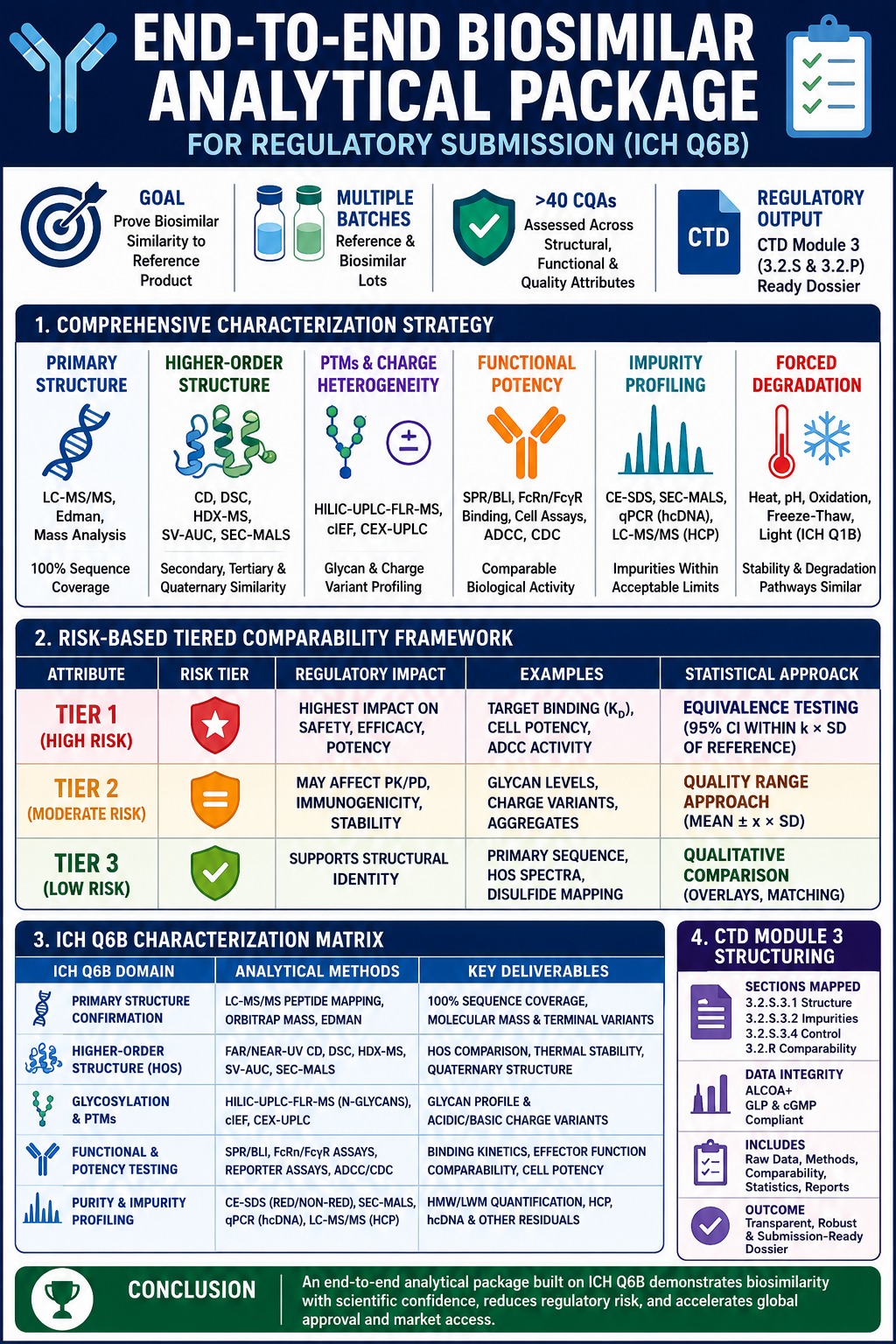
A CRO-driven End-to-End Biosimilar Analytical Package for a Regulatory Submission integrates multiple layers of head-to-head analytical characterization across several reference product batches and biosimilar manufacturing lots to support the development of a risk-based CTD Module 3 dossier. In this representative biosimilar program, a coordinated analytical framework successfully identified, measured, and benchmarked more than 40 critical quality attributes (CQAs) for a monoclonal antibody biosimilar intended for an oncology indication.
Discover how identifying and benchmarking CQAs establishes the foundation of your analytical program: Read about Critical Quality Attributes (CQAs) in Biosimilars
Regulatory agencies worldwide, including the U.S. Food and Drug Administration (FDA), European Medicines Agency (EMA), and Health Canada, follow a stepwise assessment approach in which analytical similarity serves as the foundation of biosimilar evaluation. When an analytical characterization package demonstrates a high degree of similarity supported by robust statistical comparability, regulatory authorities may reduce the extent of non-clinical and clinical data required. To establish this level of confidence, the analytical program assessed multiple commercial batches of the reference product manufactured over different years alongside pilot-scale and clinical-scale biosimilar lots.
The analytical strategy encompassed structural confirmation, biophysical characterization, glycan and charge variant analysis, biological activity testing, forced degradation evaluation, and impurity profiling. Through the application of advanced mass spectrometry platforms and automated biological assays, the CRO produced method qualification documentation, comprehensive analytical datasets, and statistical similarity assessments specifically formatted to support CTD Module 3 submissions, including Sections 3.2.S and 3.2.P.
Structural and Physicochemical Characterization Strategy Under ICH Q6B
Structural characterization performed under ICH Q6B is intended to verify the primary amino acid sequence, intact molecular mass, disulfide bond arrangement, and terminal residue modifications of the biosimilar relative to the reference product. Using a combination of multi-enzyme proteolytic digestion, high-resolution LC-MS/MS, and Orbitrap mass spectrometry, the CRO achieved complete sequence coverage and confirmed primary structure identity.
Primary sequence confirmation was initiated through enzymatic digestion using trypsin, Lys-C, Glu-C, and chymotrypsin, generating complementary peptide fragments that enabled comprehensive sequence analysis. These peptides were separated using ultra-performance liquid chromatography (UPLC) and subsequently analyzed by high-resolution tandem mass spectrometry (MS/MS) with mass accuracy maintained below 3 ppm. Fragmentation techniques including collision-induced dissociation (CID) and higher-energy collisional dissociation (HCD) produced spectra that verified the amino acid sequence without evidence of unassigned sequence variants or amino acid substitutions. In regions where MS/MS fragmentation produced uncertain sequence assignments, particularly near protein termini, gas-phase N-terminal Edman degradation was employed as an orthogonal analytical technique for additional confirmation.
Dive deeper into the regulatory frameworks that govern biological characterization: Read the ICH Q6B Guidelines for Biological Characterisation
Amino acid composition analysis was conducted following complete acid hydrolysis and derivatization, confirming consistency with theoretical molar ratios. Terminal sequence heterogeneity was extensively evaluated to characterize N-terminal pyroglutamic acid formation and C-terminal heavy-chain lysine processing. Disulfide bond architecture was established through comparative analysis of reducing and non-reducing peptide maps, confirming that all intra-chain and inter-chain disulfide linkages exhibited native connectivity without evidence of disulfide scrambling. Additional confirmation was obtained through intact mass, reduced mass, and deglycosylated mass measurements generated by Orbitrap mass spectrometry, which demonstrated excellent molecular weight agreement between biosimilar and reference product batches.
Higher-Order Structure (HOS) and Biophysical Comparability Analysis
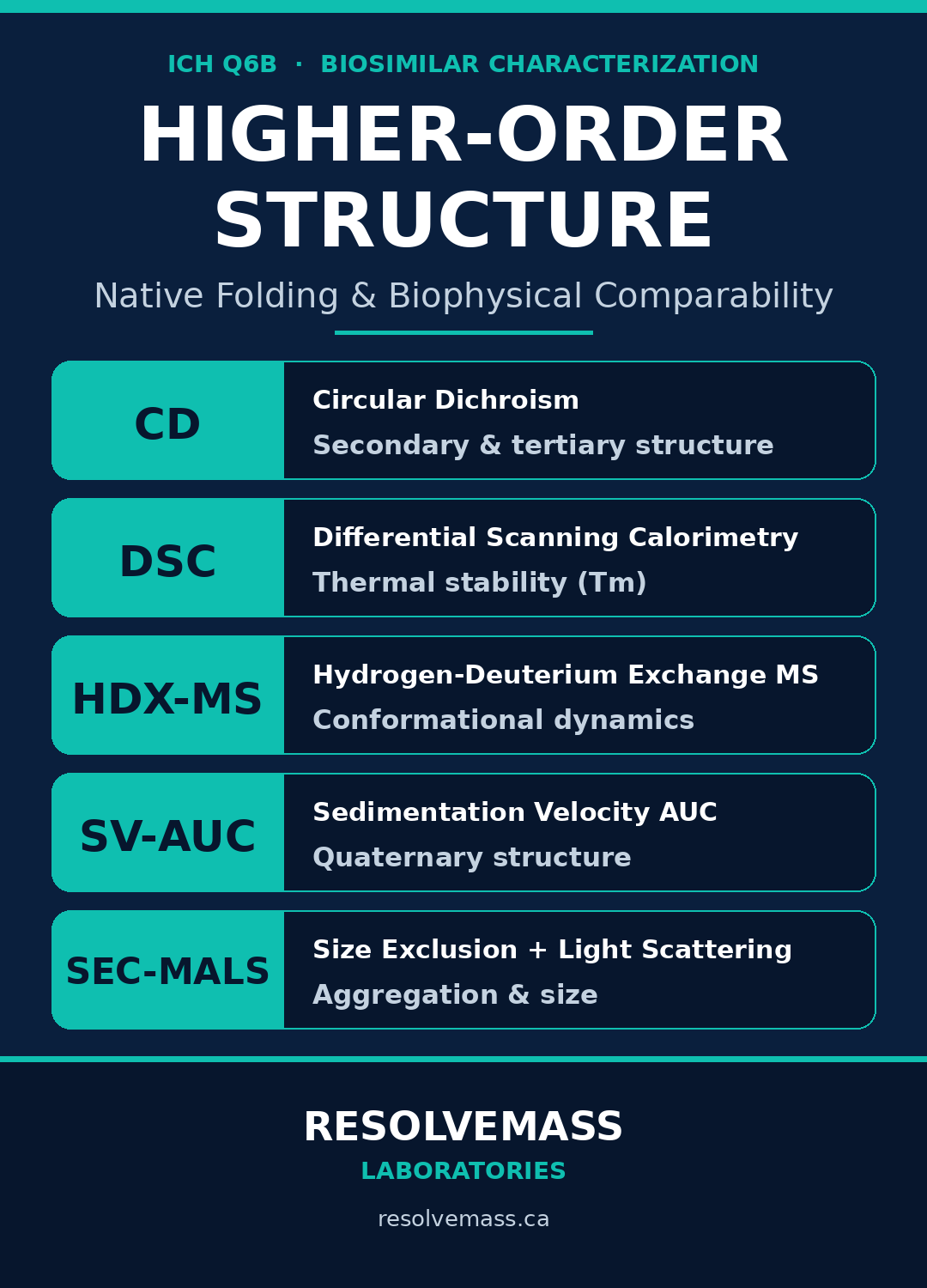
Higher-order structure (HOS) characterization evaluates the secondary, tertiary, and quaternary structural integrity of a biological product to verify native protein folding, conformational stability, and overall structural consistency. The analytical platform incorporated multiple orthogonal techniques—including Far-/Near-UV Circular Dichroism (CD), Differential Scanning Calorimetry (DSC), Hydrogen-Deuterium Exchange Mass Spectrometry (HDX-MS), and Sedimentation Velocity Analytical Ultracentrifugation (SV-AUC)—to identify even subtle conformational differences.
Because higher-order structural attributes directly influence biological function, pharmacological performance, and immunogenicity risk, it is essential to detect and characterize even minor folding variations. Secondary structural content was quantified using Far-UV CD spectroscopy (190–250 nm), where spectral deconvolution confirmed equivalent distributions of β-sheets, α-helices, and turn structures between the biosimilar and reference product. Tertiary structural environments surrounding aromatic amino acid residues, including tryptophan, tyrosine, and phenylalanine, were assessed using Near-UV CD spectroscopy (250–350 nm) together with intrinsic fluorescence measurements.
See how native mass spectrometry provides uncompromised insights into higher-order protein structures: Discover Native Mass Spectrometry for Biosimilars
Thermal stability profiles generated through DSC identified domain-specific unfolding transitions (Tm1, Tm2, and Tonset), demonstrating comparable thermal stability and structural rigidity across biosimilar and reference lots. To further investigate conformational dynamics at high resolution, HDX-MS monitored deuterium incorporation rates along the peptide backbone over defined time intervals, revealing highly similar solvent accessibility patterns throughout all functional domains. Quaternary structure and protein self-association behavior were examined using SV-AUC and Size Exclusion Chromatography coupled with Multi-Angle Light Scattering (SEC-MALS), confirming equivalent monomer content and comparable levels of soluble oligomeric species under physiologically relevant buffer conditions.
Understand how tracking soluble species and aggregates mitigates immunogenicity risks: Read About Aggregation Analysis in Biosimilars
Post-Translational Modification and Charge Heterogeneity Profiling
Post-translational modification (PTM) profiling is performed to identify and quantify enzymatic and chemical modifications—including N-glycosylation, deamidation, oxidation, and other molecular variants—that may arise during cell culture, purification, formulation, or storage. Using HILIC-UPLC-FLR-MS for fluorescently labeled N-glycan analysis alongside cIEF and CEX-UPLC for charge variant characterization, the study generated a detailed map of the complete molecular isoform profile of the therapeutic protein.
N-linked glycosylation critical quality attributes were examined because of their significant impact on serum half-life, Fc receptor interactions, and antibody-dependent cellular cytotoxicity (ADCC). N-glycans were enzymatically released using PNGase F, derivatized with fluorescent tags such as Procainamide or 2-AB, and separated using Hydrophilic Interaction Liquid Chromatography coupled with Mass Spectrometry (HILIC-UPLC-FLR-MS). Relative abundances of major glycan species, including neutral glycans (G0, G0F, G1F, and G2F), high-mannose structures (Man5 and Man6), afucosylated glycans, and sialylated variants, were quantified to ensure that both major and minor glycoforms remained within the distribution ranges established by the reference product.
Gain detailed insights into evaluating N-glycan structures and their impacts on clinical performance: Learn More About Glycosylation Analysis of Biosimilars
Charge heterogeneity characterization was performed using capillary Isoelectric Focusing (cIEF) and strong cation-exchange chromatography (CEX-UPLC). Acidic variants generated through mechanisms such as asparagine deamidation, glycation, and sialylation were separated alongside basic variants associated with C-terminal lysine retention, succinimide formation, and incomplete N-terminal pyroglutamate conversion. Each isolated charge variant peak was subsequently characterized through online LC-MS analysis, enabling precise structural assignment and facilitating a clear understanding of the relationship between molecular structure and biological function.
Explore mass spectrometry methodologies used to resolve and characterize acidic and basic charge variants: Read About Charge Variant Analysis in Biosimilars
Functional Potency Assays and Mechanism of Action Assessment
Functional potency assays are designed to evaluate the biological activity and receptor-binding characteristics of a biosimilar in order to demonstrate that its mechanism of action is comparable to that of the reference product. Surface Plasmon Resonance (SPR) and Bio-Layer Interferometry (BLI) were employed to quantify binding kinetics (KD, kon, koff) for target antigens and Fc receptors, including FcRn and FcγRIIIa. These studies were complemented by cell-based reporter assays as well as ADCC and CDC bioassays.
To satisfy regulatory expectations for biological similarity, all relevant functional pathways associated with the therapeutic mechanism of action were assessed through direct comparison with the reference product. Target-binding affinity was measured using SPR biosensor technology, generating equilibrium dissociation constants (KD) that demonstrated statistical comparability between biosimilar and originator materials. In addition, interactions with neonatal Fc receptors (FcRn), which regulate intracellular antibody recycling and systemic persistence, were evaluated under physiologically relevant pH conditions, including binding at pH 6.0 and release at pH 7.4.
Binding interactions with Fcγ receptors—including FcγRI, FcγRIIa, and FcγRIIIa V158/F158 polymorphic variants—as well as complement protein C1q were characterized to assess effector function capability. Cell-based potency assays utilizing engineered reporter cell lines measured downstream signaling responses and generated relative potency values expressed as percentages of reference standard activity. For therapeutic antibodies that rely on cytotoxic effector mechanisms, dedicated bioassays measuring Antibody-Dependent Cellular Cytotoxicity (ADCC) and Complement-Dependent Cytotoxicity (CDC) were performed. These studies confirmed that biosimilar response curves closely matched those of the reference product across the evaluated concentration ranges.
Forced Degradation, Impurity Profiling, and Tiered Risk Matrix
Forced degradation studies subject biotherapeutic products to controlled environmental stress conditions to identify degradation pathways, evaluate stability characteristics, and verify the stability-indicating capability of analytical methods. Product-related and process-related impurities were assessed using CE-SDS, SEC-MALS, qPCR, and LC-MS/MS and were evaluated within a structured three-tiered statistical risk assessment framework.
Stress studies were performed under both early-stage and late-stage development protocols, exposing biosimilar and reference product lots to thermal conditions (40°C and 50°C), mechanical agitation, repeated freeze-thaw cycles, photostability testing in accordance with ICH Q1B, acidic and basic pH challenges, and oxidative stress using H₂O₂. Comparative analysis of degradation pathways and degradation kinetics demonstrated that both the biosimilar and reference product followed highly similar degradation mechanisms. These findings confirmed that the analytical characterization methods were capable of monitoring stability-indicating quality attributes throughout product development and storage.
Learn how stress testing verifies stability-indicating methods for regulatory packages: Discover Forced Degradation Protocols for Biosimilars
Product-related impurities, including high-molecular-weight aggregates and low-molecular-weight degradation fragments, were quantified using both reducing and non-reducing CE-SDS in combination with SEC-MALS. Process-related impurities were evaluated using multiple orthogonal analytical approaches. Host Cell Proteins (HCP) were quantified using ELISA and further characterized through high-sensitivity LC-MS/MS analysis. Residual Host Cell DNA (hcDNA) levels were measured using quantitative PCR (qPCR), while process-derived residual contaminants such as Protein A leachates were quantified using highly sensitive sandwich immunoassay platforms.
Explore high-sensitivity LC-MS/MS methodologies for tracking process- and product-related impurities: Read About Impurity Profiling of Biosimilars
To establish analytical similarity in accordance with FDA and EMA biosimilar evaluation principles, the CRO implemented a risk-based statistical tiering framework. This structured approach categorized analytical attributes according to their potential impact on safety, efficacy, pharmacokinetics, immunogenicity, and overall product quality.
| Attribute Risk Tier | Regulatory Evaluation Criteria | Characterization Parameters Included | Statistical Comparability Method |
|---|---|---|---|
| Tier 1 (High Risk) | Attributes with the highest potential impact on clinical safety, efficacy, and potency | Fab target antigen binding (KD), cell-based biological potency, ADCC activity | Equivalence Testing (95% confidence interval within k × SD of the reference product) |
| Tier 2 (Moderate Risk) | Attributes that may influence PK/PD performance, immunogenicity, or structural stability | Sub-subunit glycan levels (fucose, mannose, sialic acid), charge variants, aggregate content | Quality Range Approach (Mean ± x × SD established from reference lots) |
| Tier 3 (Low Risk) | Characterization attributes primarily supporting structural identity confirmation | Primary sequence confirmation, HOS spectral overlays, disulfide linkage mapping | Qualitative visual comparison, raw data overlays, and side-by-side spectral matching |
Swipe horizontally to view the full table on smaller screens.
To further demonstrate the scope and depth of the analytical characterization package developed under ICH Q6B guidance, the following matrix summarizes the analytical methodologies employed throughout the biosimilar comparability program and the corresponding regulatory deliverables generated.
| ICH Q6B Characterization Domain | Deployed Analytical Methodologies | Primary Regulatory Deliverable |
|---|---|---|
| Primary Structure Confirmation | LC-MS/MS Peptide Mapping, Orbitrap Intact/Reduced Mass Analysis, Edman Degradation | 100% amino acid sequence coverage, molecular mass assignment, and terminal variant characterization |
| Higher-Order Structure (HOS) | Far/Near-UV CD, DSC, HDX-MS, SV-AUC, SEC-MALS | Secondary and tertiary structure comparison, thermal stability assessment, and quaternary structure evaluation |
| Glycosylation & PTMs | HILIC-UPLC-FLR-MS (PNGase F-released glycans), cIEF, CEX-UPLC | Glycan profile characterization and acidic/basic charge variant distribution analysis |
| Functional & Potency Testing | Target SPR/BLI, FcRn/FcγR Binding Assays, Reporter Gene Potency Assays, ADCC/CDC Assays | Binding kinetics (KD), effector function comparability, and cellular potency determination |
| Purity & Impurity Profiling | CE-SDS (Reducing/Non-Reducing), SEC-MALS, qPCR for hcDNA, LC-MS/MS for HCP | Quantification of high- and low-molecular-weight species, residual host cell proteins, and residual host cell DNA |
Swipe horizontally to view the full table on smaller screens.
Structuring CTD Module 3 for the End-to-End Biosimilar Analytical Package for a Regulatory Submission
Preparing an End-to-End Biosimilar Analytical Package for a Regulatory Submission for inclusion within CTD Module 3 (Sections 3.2.S and 3.2.P) requires analytical comparability data to be organized into a comprehensive, regulatory-compliant documentation package supported by ALCOA+ data integrity principles. Partnering with a CRO significantly streamlines this process by providing validated analytical methods, batch comparability assessments, and scientifically justified risk-based evaluations that are ready for submission to global health authorities.
Analytical outputs were systematically mapped to established CTD sections, including Section 3.2.S.3.1 (Elucidation of Structure and Other Characteristics), Section 3.2.S.3.2 (Impurities), Section 3.2.S.4 (Control of Drug Substance), and Section 3.2.R (Regional Information and Comparability Protocols). Supporting datasets—including raw mass spectrometry files, chromatographic profiles, receptor-binding kinetics, bioassay results, and statistical equivalence calculations—were generated and managed within rigorous GLP and cGMP quality systems.
By integrating primary analytical data, method qualification and validation reports, comparability assessments, and statistical tiering evaluations into a unified reporting framework, the CRO minimized data gaps that frequently lead to regulatory questions, information requests, or development delays. This highly organized submission package provided regulatory reviewers with a transparent and scientifically robust demonstration of biosimilar analytical similarity.
Conclusion: Value of an End-to-End Biosimilar Analytical Package for a Regulatory Submission
Delivering a comprehensive End-to-End Biosimilar Analytical Package for a Regulatory Submission provides the scientific evidence necessary to establish analytical biosimilarity and support successful regulatory approval across international markets. Through the use of CRO expertise and advanced orthogonal analytical technologies, biosimilar sponsors can reduce regulatory uncertainty, accelerate development timelines, and demonstrate product comparability with a high degree of statistical confidence.
As global regulatory agencies increasingly place greater emphasis on analytical characterization while reducing reliance on extensive clinical studies, detailed structural, physicochemical, and functional comparability assessments have become the cornerstone of biosimilar development. A thoroughly executed analytical package built upon ICH Q6B principles not only facilitates regulatory approval but also safeguards development investments and supports a smooth progression from candidate selection through commercial authorization.
ResolveMass Laboratories Inc. provides advanced mass spectrometry, biophysical characterization, and ICH Q6B analytical testing services for biosimilar developers worldwide. To discuss your regulatory submission requirements or obtain a customized comparability testing strategy, visit the ResolveMass Contact Page.
Frequently Asked Questions
How does ICH Q6B define characterization expectations for biosimilars?
ICH Q6B outlines the scientific framework for characterizing recombinant biotherapeutic products by evaluating their structural, physicochemical, biological, and purity-related attributes. For biosimilars, these guidelines help establish a systematic approach to demonstrating similarity with the reference product. The goal is to generate sufficient analytical evidence showing that any observed differences do not affect product quality, safety, or clinical performance.
Why is mass spectrometry critical for primary sequence confirmation?
Mass spectrometry is one of the most powerful tools for confirming the primary structure of a therapeutic protein because it provides highly accurate molecular mass measurements and detailed sequence information. Advanced LC-MS/MS platforms can verify amino acid sequences, detect sequence variants, identify terminal modifications, and characterize disulfide bond arrangements. This level of analytical detail is essential for demonstrating structural equivalence between a biosimilar and its reference product.
What orthogonal techniques assess higher-order structure comparability?
Higher-order structure comparability is typically evaluated using multiple orthogonal analytical methods that examine protein conformation from different perspectives. Techniques such as Far-/Near-UV Circular Dichroism (CD), Differential Scanning Calorimetry (DSC), Hydrogen-Deuterium Exchange Mass Spectrometry (HDX-MS), Sedimentation Velocity Analytical Ultracentrifugation (SV-AUC), and SEC-MALS collectively assess folding patterns, thermal stability, conformational dynamics, and aggregation behavior. Using several complementary methods increases confidence in structural similarity assessments.
How are glycosylation and charge variants profiled in biosimilarity programs?
Glycosylation profiling involves releasing N-glycans from the protein, labeling them with fluorescent tags, and analyzing them using HILIC-UPLC-FLR-MS to determine glycan composition and distribution. Charge heterogeneity is evaluated using techniques such as capillary Isoelectric Focusing (cIEF) and cation-exchange chromatography (CEX-UPLC), which separate acidic and basic variants. Mass spectrometry is often used afterward to identify the molecular changes responsible for each detected variant.
How is functional biological potency evaluated for regulatory submissions?
Functional potency is assessed through a combination of receptor-binding studies and cell-based biological assays that measure the therapeutic activity of the biosimilar. Technologies such as Surface Plasmon Resonance (SPR) and Bio-Layer Interferometry (BLI) are used to evaluate binding kinetics, while reporter gene assays measure downstream biological responses. For antibodies with effector functions, ADCC and CDC assays provide additional evidence that the biosimilar performs similarly to the reference product.
What role do forced degradation studies play in biosimilar submissions?
Forced degradation studies intentionally expose the biosimilar and reference product to various stress conditions, including elevated temperatures, oxidation, light exposure, and pH extremes. These studies help identify degradation pathways, evaluate product stability, and determine whether analytical methods can reliably detect degradation-related changes. Demonstrating comparable degradation behavior between products strengthens the overall analytical similarity assessment.
How is statistical tiering applied to biosimilar quality attributes?
Statistical tiering is used to classify critical quality attributes according to their potential impact on clinical performance and patient safety. High-risk attributes are generally evaluated using rigorous equivalence testing, while moderate-risk attributes are assessed through predefined quality ranges established from reference product data. Lower-risk attributes are often compared using qualitative assessments and analytical data overlays to confirm structural consistency.
What is the difference between batch release testing and extended characterization?
Batch release testing consists of routine quality control assays performed to confirm that each manufactured lot meets predefined specifications before distribution. Extended characterization, in contrast, involves a much deeper investigation of molecular structure, functional activity, impurities, and stability attributes using advanced orthogonal analytical techniques. This extensive characterization is particularly important during biosimilar development to establish analytical similarity with the reference product.
How does a CRO partnership accelerate biosimilar regulatory approval?
Working with a specialized CRO provides access to experienced scientists, advanced analytical platforms, and established regulatory workflows that support biosimilar development programs. CROs can efficiently execute complex characterization studies, generate submission-ready documentation, and ensure compliance with regulatory expectations and data integrity standards. Their expertise helps reduce development risks, address potential scientific concerns early, and streamline the path toward regulatory approval.
Reference:
- U.S. Food and Drug Administration. (2020). Development and licensure of vaccines to prevent COVID-19: Guidance for industry. U.S. Department of Health and Human Services. https://www.fda.gov/media/135612/download
- Bas, T. G. (2025). Innovative formulation strategies for biosimilars: Trends focused on buffer-free systems, safety, regulatory alignment, and intellectual property challenges. Pharmaceuticals, 18(6), 908. https://doi.org/10.3390/ph18060908
- Janani, S., Manikandan, K., & Kamaraj, R. (2018). Overview of biosimilars. Research Journal of Pharmacy and Technology, 11(11), 5152–5158. https://doi.org/10.5958/0974-360X.2018.00941.1
Need a Complete Biosimilar Analytical Package for Your Regulatory Submission?
From physicochemical characterization and biological activity testing to impurity profiling, comparability assessments, and ICH Q6B-compliant documentation, a well-structured analytical package is critical for successful biosimilar approval. ResolveMass provides end-to-end analytical support to help sponsors generate robust, submission-ready data and build comprehensive regulatory dossiers with confidence.
Contact UsAbout The Author
Anusha Sinha
Anusha Sinha, B.Pharm, is an experienced pharma professional with a strong background in Analytical Chemistry and Polymer Chemistry. With a passion for translating complex scientific data into clear, accessible content, she plays a vital role in communicating ResolveMass Laboratories Inc.’s advanced testing capabilities. In addition to her scientific expertise, Anusha leads Business Development initiatives, helping clients across pharmaceutical, biotechnology, and materials science sectors find tailored analytical solutions. Her combined experience in science and strategy positions her at the forefront of client engagement and technical communication.

