

Introduction
A thorough Extractables and Leachables Assessment of a peptide prefilled syringe generates the empirical chemical data necessary to support drug safety, therapeutic efficacy, and compatibility between the formulation and its packaging throughout the intended shelf life. This case study examines a 0.8 mL single-dose prefilled syringe (PFS) delivery system developed for a therapeutic peptide that is particularly susceptible to surface-induced aggregation, hydrophobic adsorption, and methionine oxidation.
Therapeutic peptides occupy a distinctive structural position between small molecule pharmaceuticals and large monoclonal antibodies and exhibit specific chemical liabilities, including oxidation of methionine or cysteine residues, hydrolytic cleavage, and non-covalent self-association. The evaluated prefilled syringe container closure system (CCS) consists of a Type I borosilicate glass barrel, a bromobutyl rubber plunger stopper incorporating a fluoropolymer barrier film, an elastomeric needle shield, residual tungsten species generated during barrel formation, and a polydimethylsiloxane (PDMS) silicone oil coating used to provide suitable gliding performance. A scientifically robust Extractables and Leachables Assessment supports compliance with United States Pharmacopeia (USP) chapters <1663> and <1664>, ISO 10993-18, and International Council for Harmonisation (ICH) Q3E standards, thereby supporting comprehensive quality control throughout the product lifecycle.
Learn more about the structural and stability differences that influence peptide development in our guide to peptides versus small molecule drugs.
Share via:
Quick Summary:
- Extractables & Leachables (E&L) assessment is essential for confirming peptide drug safety, stability, therapeutic efficacy, and compatibility with prefilled syringe (PFS) packaging.
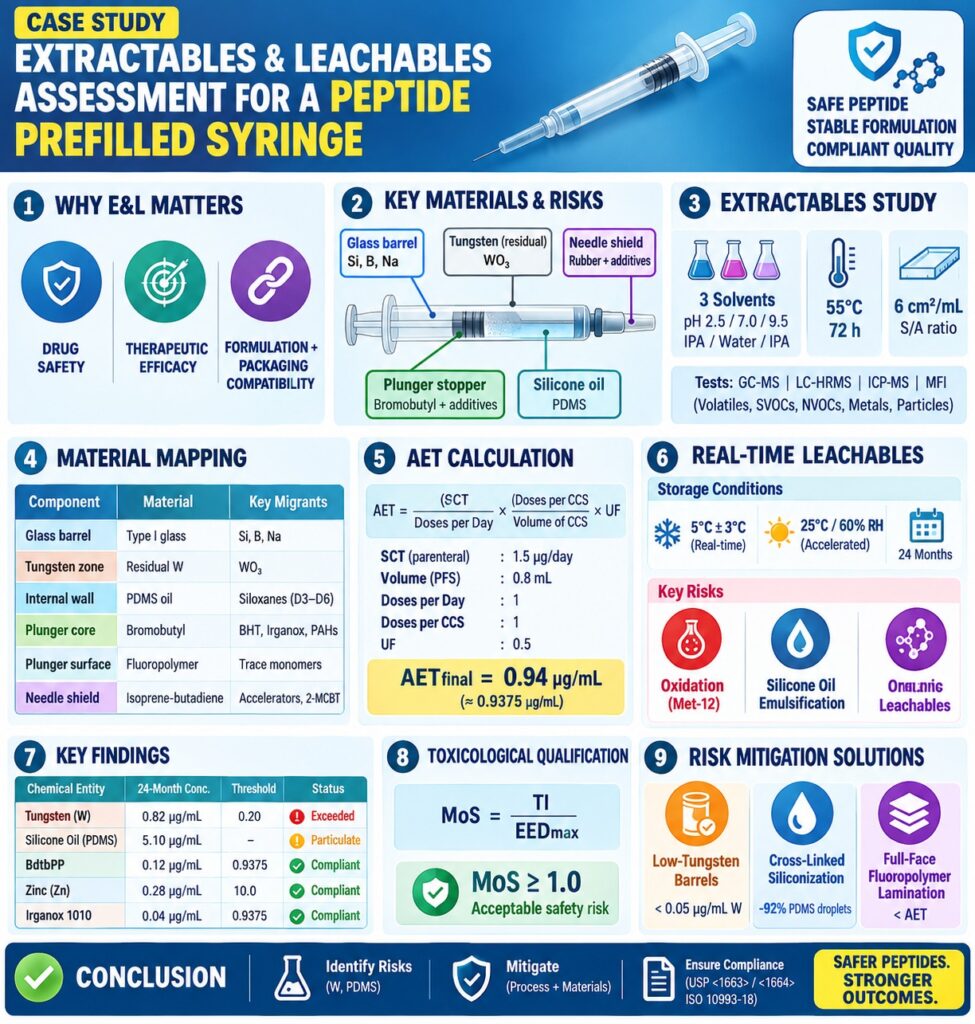
- The PFS system can introduce potential migrants from glass, residual tungsten, silicone oil, rubber stoppers, fluoropolymer coatings, and needle shields, making comprehensive material mapping important.
- Controlled extractables studies use aggressive solvents and elevated temperature with analytical techniques such as GC-MS, LC-HRMS, ICP-MS, and MFI to identify organic compounds, metals, and particles.
- For the 0.8 mL PFS, the calculated final Analytical Evaluation Threshold (AET) was ~0.94 µg/mL, meaning leachables at or above this level require structural identification and toxicological qualification.
- Real-time stability testing identified three key risks: tungsten-induced methionine oxidation, silicone-oil particle nucleation, and organic plunger leachables.
- Key findings included 0.82 µg/mL tungsten, associated with increased Met-12 oxidation, and 5.10 µg/mL silicone oil, associated with subvisible particle formation; several organic leachables remained below the AET.
- Risk mitigation included low-tungsten syringe barrels, cross-linked/baked-on siliconization, and full-face fluoropolymer plunger lamination, helping reduce peptide oxidation, particles, and elastomer-derived leachables while supporting USP <1663>/<1664>, ISO 10993-18, and ICH Q3E-aligned control.
Material Mapping and Extractables and Leachables Assessment Risk Profiling
Material mapping of a prefilled syringe delivery system involves identifying the chemical constituents associated with all primary and secondary contact materials to establish potential migration pathways before laboratory extraction studies are performed. This risk-profiling approach establishes the analytical scope needed to monitor volatile, semi-volatile, non-volatile, and inorganic impurities.
Within a prefilled syringe, the drug formulation remains in prolonged and direct contact with several materials of construction during the intended two-year shelf life. The principal contact surfaces consist of the internal glass barrel wall, elastomeric plunger stopper, and needle shield, while secondary materials may include ambient adhesives and external device packaging. Each material can contribute different chemical entities that may migrate into the peptide formulation during storage or under stressed conditions.
Explore custom peptide synthesis services for peptide development and synthesis requirements.
| Syringe Component | Material of Construction | Potential Migrants / Extractables Classes | Primary Mechanism of Interaction |
|---|---|---|---|
| Glass Barrel | Type I Borosilicate Glass | Silicon (Si), Boron (B), Sodium (Na), Delamination Flakes | Metal ion leaching, hydrolytic glass surface dissolution |
| Barrel Funnel Region | Residual Tungsten Pins | Soluble Polyoxotungstates, Tungsten Oxides (WO3) | Peroxotungstate formation leading to peptide oxidation |
| Internal Barrel Wall | Polydimethylsiloxane (PDMS) Oil | Free Silicone Oil Droplets, Low MW Cyclic Siloxanes (D3-D6) | Emulsification, particle nucleation, hydrophobic binding |
| Plunger Stopper Core | Bromobutyl Elastomer | BHT, Irganox 1010, Oligomers, Zinc Activators, Polycyclic Aromatic Hydrocarbons | Diffusion through matrix, additive leaching |
| Plunger Surface | Fluoropolymer Barrier (ETFE/FEP) | Trace Monomers, Fluorinated Oligomers | Physical barrier layer limiting elastomeric diffusion |
| Needle Shield | Isoprene-Butadiene Rubber | Curing Accelerators, 2-Mercaptobenzothiazole (2-MCBT), Nitrosamines | Solvent condensation and vapor-phase migration |
Controlled Extractables Study Execution for Peptide Prefilled Syringes
A controlled extractables study exposes individual packaging components to aggressive extraction solvents and elevated thermal conditions to establish a worst-case chemical profile. This intentionally intensified evaluation helps identify potential leachables and supports the selection of suitably sensitive analytical methods for subsequent real-time stability studies.
The extraction strategy examined both individual and assembled components using three model solvent systems: purified water adjusted to pH 2.5, pH 7.0, and pH 9.5; a 50:50 (v/v) isopropanol/water mixture intended to simulate surfactant-assisted solubilization; and pure isopropanol to provide comprehensive organic extraction. The components were extracted at 55°C for 72 hours using a surface area-to-volume ratio of 6 cm2/mL. These conditions were selected to facilitate broad chemical characterization while minimizing degradation of the underlying polymer structures.
| Analytical Instrument / Method | Target Compound Category | Representative Extractables Identified | Analytical Sensitivity / LOD |
|---|---|---|---|
| Headspace GC-MS (HS-GC-MS) | Volatile organic compounds (VOCs), residual solvents | Isopropanol, acetone, low molecular weight cyclic siloxanes (D3-D6) | 0.05 µg/mL |
| Direct Injection GC-MS (EI/CI) | Semi-volatile organic compounds (SVOCs), antioxidants | Butylated hydroxytoluene (BHT), Irganox 1010/1076 degradation products, stearic acid | 0.10 µg/mL |
| LC-HRMS (UPLC-QTOF / Orbitrap) | Non-volatile organic compounds (NVOCs), rubber additives | Bis(2,4-di-tert-butylphenyl)phosphate (BdtbPP), 2-mercaptobenzothiazole (2-MCBT) | 0.02 µg/mL |
| ICP-MS (Thermo iCAP RQ) | Elemental impurities, heavy metals | Tungsten (W), Silicon (Si), Barium (Ba), Zinc (Zn), Aluminum (Al) | 0.001 µg/mL (1 ppb) |
| Micro-Flow Imaging (MFI) / RMM | Subvisible particles, silicone droplets | Polydimethylsiloxane (PDMS) oil droplets, glass micro-particles, peptide aggregates | Particles ≥ 1 µm |
Derivation of the Analytical Evaluation Threshold (AET) for Peptide Formulations
The Analytical Evaluation Threshold (AET) represents the concentration at or above which an extractable or leachable should undergo structural identification and toxicological qualification. The threshold is derived using the Safety Concern Threshold (SCT) established by the Product Quality Research Institute (PQRI) and ICH Q3E guidelines.
For parenteral dosage forms, including prefilled subcutaneous injections, the specified SCT is 1.5 µg/day (1.5 µg/patient/day) for non-mutagenic leachables. The estimated AET (AETestimated), expressed in µg/mL, is calculated according to the drug product’s daily dose volume and container closure system configuration:
AETestimated = (SCT / Doses per Day) × (Doses per CCS / Volume of CCS)
Because response factors can vary during non-targeted mass spectrometry screening, unknown compounds may demonstrate different ionization efficiencies compared with internal standards. Therefore, an Uncertainty Factor (UF) is incorporated to establish the final reporting threshold (AETfinal):
AETfinal = AETestimated × UF
Applied Case Study Calculation
The evaluation parameters established for the 0.8 mL single-dose prefilled syringe are as follows:
- PFS Delivery Volume (Volume of CCS): 0.8 mL
- Dosing Schedule: 1 prefilled syringe per day (Doses per Day = 1, Doses per CCS = 1)
- Safety Concern Threshold (SCT): 1.5 µg/day
- Uncertainty Factor (UF): 0.5 (representing a conservative 50% analytical response factor variability)
AETestimated = (1.5 µg/day / 1 dose/day) × (1 dose / 0.8 mL) = 1.875 µg/mL
AETfinal = 1.875 µg/mL × 0.5 = 0.9375 µg/mL (approximately 0.94 ppm)
Accordingly, any leachable compound detected in the peptide drug formulation at or above 0.9375 µg/mL during real-time stability testing requires formal structural identification and toxicological qualification.
Real-Time Leachables Assessment and Biologics Compatibility Findings
Real-time leachables studies evaluate drug formulations maintained under recommended storage conditions to measure chemical migration and determine its potential effects on peptide critical quality attributes. The therapeutic peptide formulation was evaluated while stored in the final prefilled syringes under long-term ICH stability conditions, including 5°C ± 3°C for real-time storage and 25°C / 60% RH for accelerated storage, over a period of 24 months.
The evaluation indicated that chemical migration from the container closure system can influence peptide stability through three principal degradation pathways: metal-catalyzed chemical oxidation, surfactant-mediated silicone oil emulsification, and interaction with organic compounds.
See how peptide CDMO scale-up services can support the transition from development-scale work toward larger manufacturing requirements.
Tungsten-Induced Methionine Oxidation Mechanics
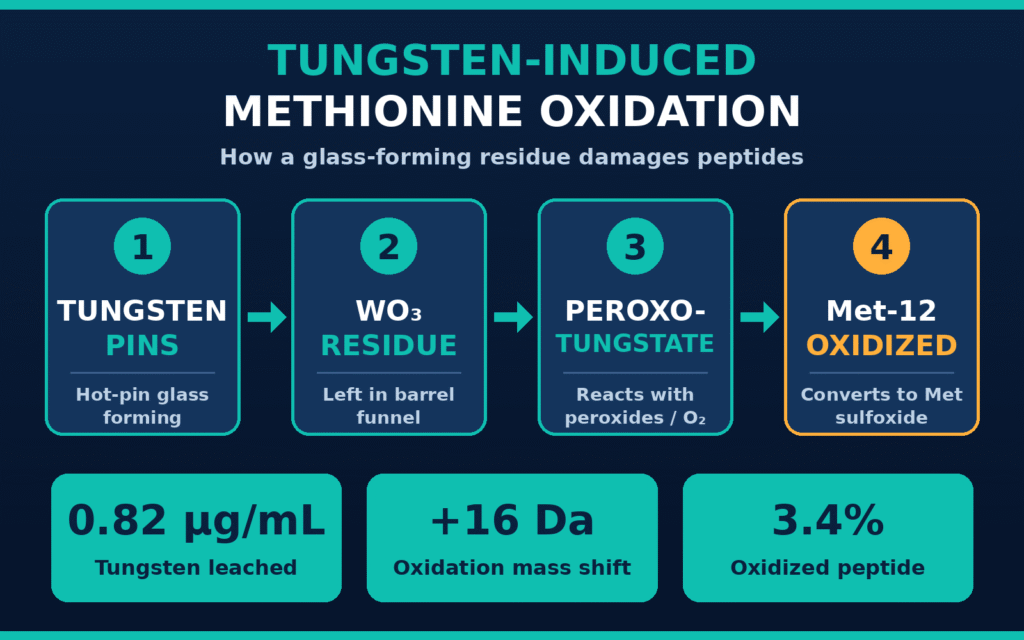
Inductively Coupled Plasma Mass Spectrometry (ICP-MS) analysis of the peptide formulation detected leachable tungsten concentrations reaching 0.82 µg/mL at 12 months under accelerated storage conditions. Residual tungsten oxides (WO3), introduced during hot-pin glass forming, can react with trace peroxides or dissolved oxygen to generate reactive peroxotungstate species. These peroxotungstates can directly oxidize the methionine residue (Met-12) within the peptide, converting it to methionine sulfoxide and increasing the oxidized variant peak (+16 Da) to 3.4% as measured by LC-MS reverse-phase peptide mapping.
Review GMP peptide API manufacturing services for considerations involved in developing and manufacturing peptide APIs under GMP-oriented requirements.
Silicone Oil Emulsification and Subvisible Particle Nucleation
Micro-Flow Imaging (MFI) demonstrated a time-dependent increase in subvisible particles ranging from 2 µm to 10 µm, with the particle concentration reaching a maximum of 14,200 particles/mL after 18 months. Morphological filters were used to distinguish spherical polydimethylsiloxane (PDMS) oil droplets from non-spherical proteinaceous material. Free silicone oil droplets functioned as hydrophobic nucleation sites, facilitating peptide adsorption and promoting secondary non-covalent aggregation during mechanical agitation.
Learn more about formulating a lyophilized peptide injectable and the development considerations associated with peptide injectable formulations.
Organic Plunger Leachables Profile
Liquid Chromatography High-Resolution Mass Spectrometry (LC-HRMS) and Gas Chromatography Mass Spectrometry (GC-MS) detected trace concentrations of bis(2,4-di-tert-butylphenyl)phosphate (BdtbPP) at 0.12 µg/mL and 2-mercaptobenzothiazole (2-MCBT) at 0.05 µg/mL. Both concentrations remained below the derived AET of 0.9375 µg/mL, indicating that the fluoropolymer plunger coating effectively limited the migration of organic additives.
Compare the operational differences between a peptide CDMO and CMO when planning peptide development and manufacturing activities.
| Chemical Entity | Source Component | Extractable Baseline (µg/mL) | 24-Month Leachable Conc. (µg/mL) | Regulatory Threshold (µg/mL) | CQA Impact & Status |
|---|---|---|---|---|---|
| Tungsten (W) | Glass barrel funnel residue | 4.50 | 0.82 | 0.20 (ICH Q3D Limit) | Exceeded limit; induced Met-12 oxidation |
| Silicone Oil (PDMS) | Internal barrel lubricant | 16.80 | 5.10 | N/A (Particulate Count) | Induced subvisible particulate nucleation |
| BdtbPP | Rubber stopper antioxidant | 2.10 | 0.12 | 0.9375 (AET) | Compliant; below AET limit |
| Zinc (Zn) | Plunger vulcanization activator | 11.30 | 0.28 | 10.0 (ICH Q3D) | Compliant; well below safety limit |
| Irganox 1010 Degradants | Plunger rubber core | 3.40 | 0.04 | 0.9375 (AET) | Compliant; restricted by fluoropolymer film |
Toxicological Qualification and Risk Mitigation Framework in Extractables and Leachables Assessment
Toxicological qualification assesses the clinical safety significance of identified leachables by comparing patient exposure with established health-based exposure limits and determining the corresponding Margin of Safety. When an Extractables and Leachables Assessment identifies chemical migration that may affect product quality or exceed applicable safety limits, targeted container closure engineering and appropriate process controls should be implemented.
Explore the considerations involved in Canadian vs. US peptide CDMOs for peptide development and manufacturing programs.
The toxicological Margin of Safety (MoS) is determined by comparing the Tolerable Intake (TI) or Permissible Daily Exposure (PDE) with the Maximum Estimated Daily Exposure (EEDmax):
MoS = Tolerable Intake (TI) / EEDmax
An MoS ≥ 1.0 indicates that the evaluated leachable is associated with an acceptable systemic safety risk for patients.
Applied Risk Mitigation Engineering Solutions
- Low-Tungsten Syringe Barrels: Transitioning to ceramic pin forming technology or implementing post-forming acid-wash cycles reduced residual tungsten concentrations to < 0.05 µg/mL. This eliminated methionine oxidation and maintained oxidized peptide variants below 0.5%.
- Cross-Linked Baked-On Siliconization: Replacing free silicone oil emulsion with thermal baked-on siliconization or immobilized fluoropolymer coatings reduced free PDMS droplet counts by 92%, thereby reducing particle nucleation while maintaining the required glide force specifications.
- Full-Face Fluoropolymer Plunger Lamination: Maintaining full-face ETFE/FEP fluoropolymer plunger lamination prevented elastomeric antioxidants and vulcanization residues from being extracted above the final AET.
Learn more about peptide CDMO services in Canada and their potential role across peptide development and manufacturing stages.
Conclusion
A rigorous Extractables and Leachables Assessment for peptide prefilled syringes connects complex material chemistry with biological safety considerations and regulatory compliance requirements. Identification of tungsten-induced oxidation and silicone oil droplet nucleation as important product risks enables focused mitigation approaches, including low-tungsten barrel processing and cross-linked siliconization, to support long-term drug stability. Integrating controlled extractables profiling under USP <1663> with real-time leachables monitoring under USP <1664> and ISO 10993-18 establishes a scientifically defensible framework for supporting global regulatory submissions and approvals.
Learn more about impurity control strategies under ICH Q3A and how impurity-management principles can support pharmaceutical development and quality control.
To consult with laboratory experts regarding the design of customized extractables and leachables studies, analytical method validation, or regulatory compliance strategies for prefilled syringes, visit the ResolveMass Laboratories Contact Page.
Frequently Asked Questions
Therapeutic peptides can be chemically and physically sensitive because of their amino acid composition and molecular structure. Certain leachables may promote methionine or cysteine oxidation, hydrolytic degradation, adsorption, aggregation, or other changes that can affect peptide stability and biological activity.
Potential sources include the Type I borosilicate glass barrel, bromobutyl elastomeric plunger stopper, fluoropolymer barrier film, needle shield, silicone oil coating, and residual tungsten from glass forming. Each material may release different organic, inorganic, elemental, or polymer-related substances under extraction or storage conditions.
For the evaluated 0.8 mL single-dose prefilled syringe, the estimated AET was calculated as 1.875 µg/mL using the specified SCT and dosing configuration. After applying the Uncertainty Factor of 0.5, the final AET was 0.9375 µg/mL, approximately 0.94 ppm.
Residual tungsten associated with the glass barrel forming process can contribute to the generation of reactive tungsten species under suitable chemical conditions. These species may promote oxidation of susceptible peptide residues, including methionine, potentially increasing oxidized peptide variants and affecting product quality.
Free polydimethylsiloxane (PDMS) silicone oil droplets can provide hydrophobic surfaces onto which peptide molecules may adsorb. These interfaces can facilitate molecular interactions and contribute to secondary non-covalent aggregation, particularly when the syringe experiences mechanical agitation during handling or use.
A fluoropolymer barrier such as ETFE/FEP can limit direct interaction between the drug formulation and the underlying elastomeric material. This barrier can reduce the migration of elastomer-derived additives, antioxidants, and vulcanization-related substances into the peptide formulation.
Potential strategies include using low-tungsten syringe barrels, applying post-forming acid-wash processes, adopting cross-linked baked-on siliconization, and maintaining full-face fluoropolymer plunger lamination. These approaches can reduce elemental and organic migration while also addressing silicone-related particulate formation and peptide stability concerns.
Reference:
- Qi, L., Liu, J., Ronk, M., Gallegos, A., Fujimori, K., Luo, Y., Li, K., Lee, H., & Nashed-Samuel, Y. (2021). A holistic approach of extractables and leachables assessment of rubber stoppered glass vial systems for biotechnology products. Journal of Pharmaceutical Sciences, 110(11), 3580–3593. https://doi.org/10.1016/j.xphs.2021.07.015
- Liu, W., Swift, R., Torraca, G., Nashed-Samuel, Y., Wen, Z.-Q., Jiang, Y., Vance, A., Mire-Sluis, A., Freund, E., Davis, J., & Narhi, L. (2010). Root cause analysis of tungsten-induced protein aggregation in pre-filled syringes. PDA Journal of Pharmaceutical Science and Technology, 64(1), 11–19. https://www.researchgate.net/publication/51059768_Root_Cause_Analysis_of_Tungsten-Induced_Protein_Aggregation_in_Pre-filled_Syringes_PDA_Journal_of_Pharmaceutical_Science_and_Technology
- Nashed-Samuel, Y. (n.d.). Yasser Nashed-Samuel. ResearchGate. https://www.researchgate.net/profile/Yasser-Nashed-Samuel
- Jenke, D. (2022). General principles for risk assessment of extractables and leachables. In Extractables and leachables: Characterization of drug products, packaging, manufacturing and delivery systems, and medical devices (pp. 333–358). John Wiley & Sons. https://doi.org/10.1002/9781119605096.ch10
- Fiedler, B. (2017). Pre-filled plastic syringe containing a VEGF antagonist (WO Patent No. WO2017085253A1). World Intellectual Property Organization. Patent document
- International Council for Harmonisation of Technical Requirements for Pharmaceuticals for Human Use. (2025). Q3E guideline for extractables and leachables (Draft version, endorsed August 1, 2025). U.S. Food and Drug Administration. FDA guidance PDF
Get In Touch With Us
About The Author


