

Introduction
Extractables and Leachables (E&L) Requirements for Single-Use Bioprocessing in cell therapy programs define the analytical frameworks and risk assessment standards necessary to ensure that living cellular products remain free from harmful chemical contaminants that may migrate from manufacturing equipment. Compliance with these requirements helps protect cellular viability, preserve phenotypic stability, and satisfy global regulatory expectations before commercial authorization.
Advanced Therapy Medicinal Products (ATMPs), including autologous and allogeneic cell therapies such as CAR-T, stem cell, and engineered T-cell products, represent a major transformation in modern biomanufacturing paradigms. Unlike recombinant monoclonal antibodies (mAbs) or therapeutic proteins, where the drug substance passes through extensive downstream clearance operations such as protein A affinity chromatography, ion exchange resins, and ultrafiltration/diafiltration, cell therapy products are the living cells themselves. As a result, cell therapy manufacturing processes generally do not include harsh or selective downstream purification operations that can remove trace chemical contaminants. Any chemical entity that leaches from single-use components, including bioprocess bags, fluid transfer tubing, sterile connectors, depth filters, microcarriers, or cryopreservation vials, may therefore remain in direct contact with the living drug substance throughout its manufacturing and storage lifecycle.
Process equipment-related leachables (PERLs) may adversely affect living cell cultures by changing cellular expansion kinetics, triggering premature apoptosis, disrupting mitochondrial membrane potential, or altering phenotype expression. In addition, migrated leachables that remain present in the final cryopreserved dosage form can create direct safety concerns for patients, including possible immunogenicity, systemic toxicity, or carcinogenicity. As single-use technology (SUT) increasingly becomes the preferred approach for cell therapy bioprocessing because of its operational flexibility and ability to reduce cross-contamination risks, biopharmaceutical developers must move beyond passive reliance on supplier-generated information and establish proactive, scientifically rigorous E&L qualification programs.
Explore our specialized E&L testing services for prefilled syringes and bioprocessing systems.
Article Summary:
- E&L control is critical in cell therapy because living cells are the drug substance and lack extensive downstream purification to remove chemical contaminants.
- Single-use components such as bags, tubing, filters, connectors, and cryopreservation containers can release leachables that may affect cell viability, phenotype, expansion, and patient safety.
- USP <1663>/<1664> and BPOG provide key frameworks for extractables testing and risk assessment, with USP requirements becoming enforceable on May 1, 2026.
- bDtBPP is a major cytotoxic leachable that can form from Irgafos 168 during gamma sterilization and cause mitochondrial disruption, reduced viability, and impaired T-cell expansion.
- AET establishes the analytical sensitivity limit for identifying and evaluating chemical compounds, using the 1.5 µg/day Safety Concern Threshold (SCT) along with dose, extraction volume, contact area, and uncertainty factors.
- Orthogonal analytical testing using HS-GC-MS, GC-MS, UHPLC-HRMS, and ICP-MS enables detection of volatile, semi-volatile, non-volatile, and elemental impurities at very low concentrations.
- A proactive lifecycle strategy—vendor qualification, risk tiering, targeted E&L testing, cytotoxicity studies, pre-use flushing, lot-release testing, and supplier change control—is essential to protect cell products and ensure regulatory readiness.
Regulatory Frameworks Governing Extractables and Leachables (E&L) Requirements for Single-Use Bioprocessing
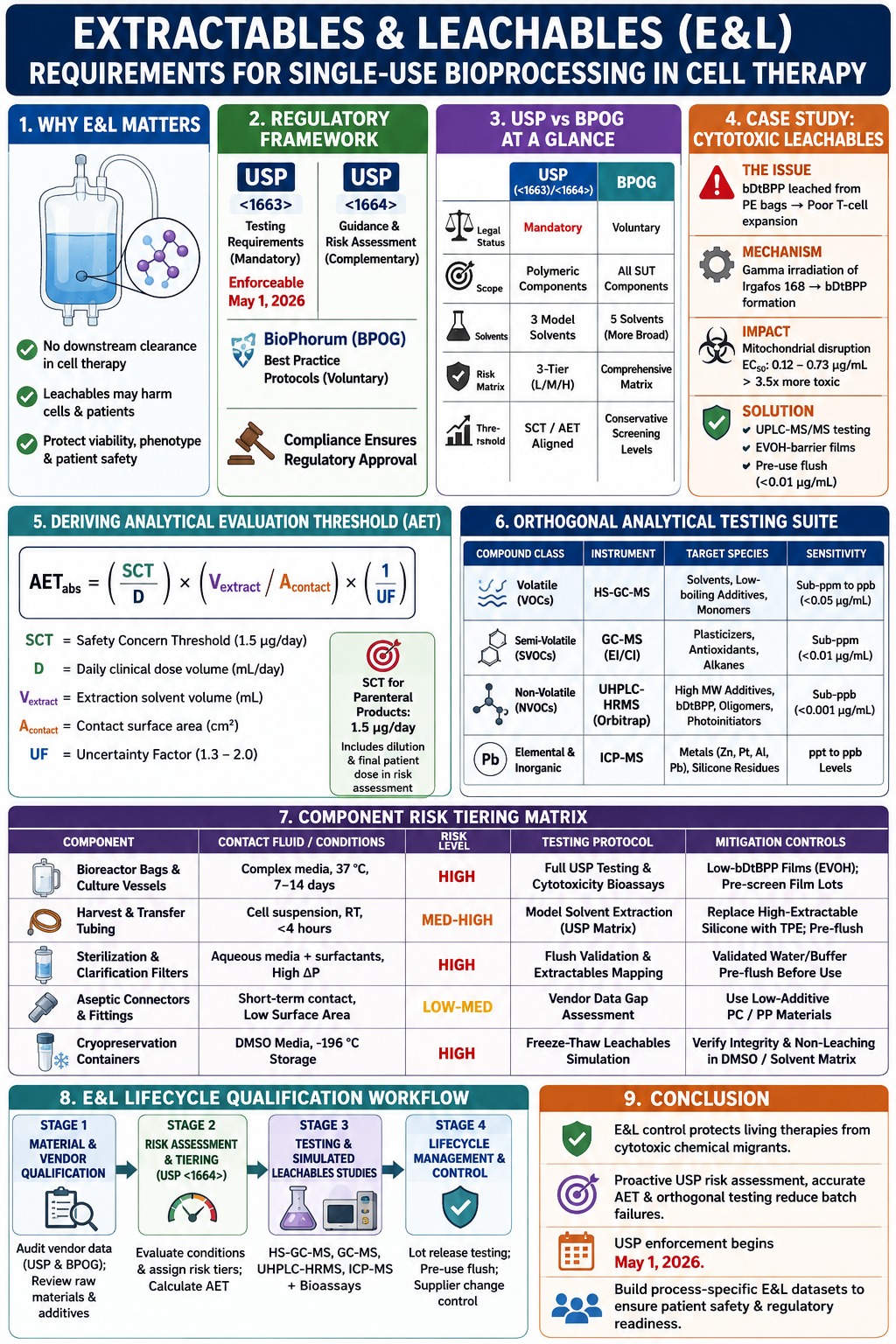
Achieving regulatory compliance with Extractables and Leachables (E&L) Requirements for Single-Use Bioprocessing requires consideration of relevant United States Pharmacopeia chapters, together with established BioPhorum Operations Group (BPOG) protocols. These standards transition toward mandatory compendial enforcement on May 1, 2026, establishing defined model solvent extraction matrices, risk-tiering approaches, and analytical evaluation thresholds for the qualification of polymeric biomanufacturing equipment.
Historically, biopharmaceutical manufacturers assessed single-use components through fragmented approaches derived from container closure system guidance, including USP , USP , and USP , as well as medical device biocompatibility protocols such as ISO 10993. However, process components are exposed to operating environments that can differ substantially from those associated with static primary packaging. Polymeric single-use systems can interact with continuously moving process fluids, changing pH conditions, organic solvents, surfactant-containing media, and elevated temperatures during upstream bioreaction and downstream formulation operations.
To address these process-specific risks, the United States Pharmacopeial Convention introduced two interconnected chapters:
- USP : A mandatory compendial standard defining extraction conditions, testing procedures, and documentation requirements for plastic components and assemblies used in the manufacture of biopharmaceutical drug substances and products.
- USP : A complementary characterization and guidance chapter describing risk assessment approaches, material interaction matrices, and risk-tiering strategies used to establish the appropriate scope of USP testing.
Learn more about selecting appropriate solvents for extractables studies in single-use systems.
Alongside these compendial frameworks, the BioPhorum Operations Group (BPOG) developed standardized extractables testing protocols that have gained broad acceptance throughout the bioprocessing industry. BPOG guidelines employ multi-solvent and multi-temperature extraction conditions intended to provide comprehensive chemical characterization of single-use components across a wide range of applications. Understanding the technical similarities, differences, and practical implementation requirements of these frameworks is important when developing cross-jurisdictional compliance strategies.
Discover best practices for outsourcing E&L testing to qualified partner laboratories.
| Parameter / Feature | USP / USP Standard | BioPhorum (BPOG) Protocol | Regulatory & Operational Impact |
|---|---|---|---|
| Legal & Regulatory Status | Mandatory compendial standard (Enforceable May 1, 2026). | Voluntary industry best-practice guideline. | Non-compliance with USP after May 2026 may jeopardize regulatory filing approval. |
| Target Scope | Polymeric components in process contact with drug substances/products. | Single-use components across upstream/downstream bioprocessing. | USP focus is legally binding for release of clinical and commercial SUT assemblies. |
| Extraction Solvents | Neutral pH buffer, acidic pH buffer, organic-containing solution (e.g., 50% Ethanol). | 50% Ethanol, Water for Injection (WFI), Low pH (pH 3), High pH (pH 10), 0.1 M HCl. | BPOG offers broader chemical mapping; USP streamlines compulsory model solvents. |
| Risk Categorization | 3-Tier Risk Assessment Matrix (Low, Medium, High Risk). | Comprehensive matrix based on fluid exposure and process location. | High-risk components, such as those with long contact times or surfactant-containing media, require full characterization. |
| Threshold Alignment | Aligned with Safety Concern Threshold (SCT) and AET derivation. | Employs conservative screening levels for standardized profiling. | Both require quantitative analytical evaluation against toxicological thresholds. |
Case Study: Mitigating Cytotoxic Leachables in Cell Therapy Expansion Media
The evaluation of cytotoxic leachables in cell therapy expansion media illustrates how trace chemical migrants can directly compromise living cell viability during ex vivo culture. In a commercial autologous T-cell therapy program, inconsistent cell expansion performance was ultimately associated with sub-parts-per-million levels of bis(2,4-di-tert-butylphenyl)phosphate (bDtBPP), a cytotoxic degradant generated during the gamma sterilization of polyethylene bioprocess bags.
Read our comprehensive investigation guide on the root causes of failed E&L studies.
Mechanism of Irgafos 168 Breakdown and bDtBPP Generation
Irgafos 168 breakdown can occur when gamma irradiation oxidizes the trisarylphosphite antioxidant incorporated into polyolefin films, producing intermediates that subsequently undergo hydrolysis and generate the cytotoxic compound bis(2,4-di-tert-butylphenyl)phosphate (bDtBPP). During early-phase clinical manufacturing, an autologous CAR-T cell program experienced substantial batch-to-batch variability during the ex vivo expansion stage. Several patient-specific manufacturing runs demonstrated abrupt cell growth arrest between days 4 and 6 of culture, together with reduced mitochondrial membrane potential and declining cell viability. After media formulation errors, viral vector toxicity, and operator variability were excluded as potential causes, the investigation focused on the single-use bioprocess containers used during cell culture expansion.
Polyolefin films, including polyethylene and polypropylene, used in bioprocess bags contain processing stabilizers that help prevent polymer cross-linking and thermal degradation during high-temperature film extrusion. Tris(2,4-di-tert-butylphenyl)phosphite, commercially known as Irgafos 168, is a commonly used secondary antioxidant that scavenges hydroperoxides. However, when single-use bioprocess containers undergo terminal gamma irradiation, typically 25–45 kGy, to achieve sterility, Irgafos 168 can undergo radiation-induced oxidation and degradation.
Gamma radiation converts tris(2,4-di-tert-butylphenyl)phosphite into tris(2,4-di-tert-butylphenyl)phosphate. Subsequent exposure to moisture or aqueous media can result in partial hydrolysis, producing bis(2,4-di-tert-butylphenyl)phosphate (bDtBPP). Because bDtBPP contains both lipophilic tert-butylphenyl groups and a hydrophilic phosphate moiety, the compound can readily migrate from the inner polyethylene contact layer into aqueous culture media containing serum or proteins.
Learn how selecting low-leachables packaging materials protects sensitive cell cultures from chemical degradation.
Biological Impact and Cytotoxicity Thresholds
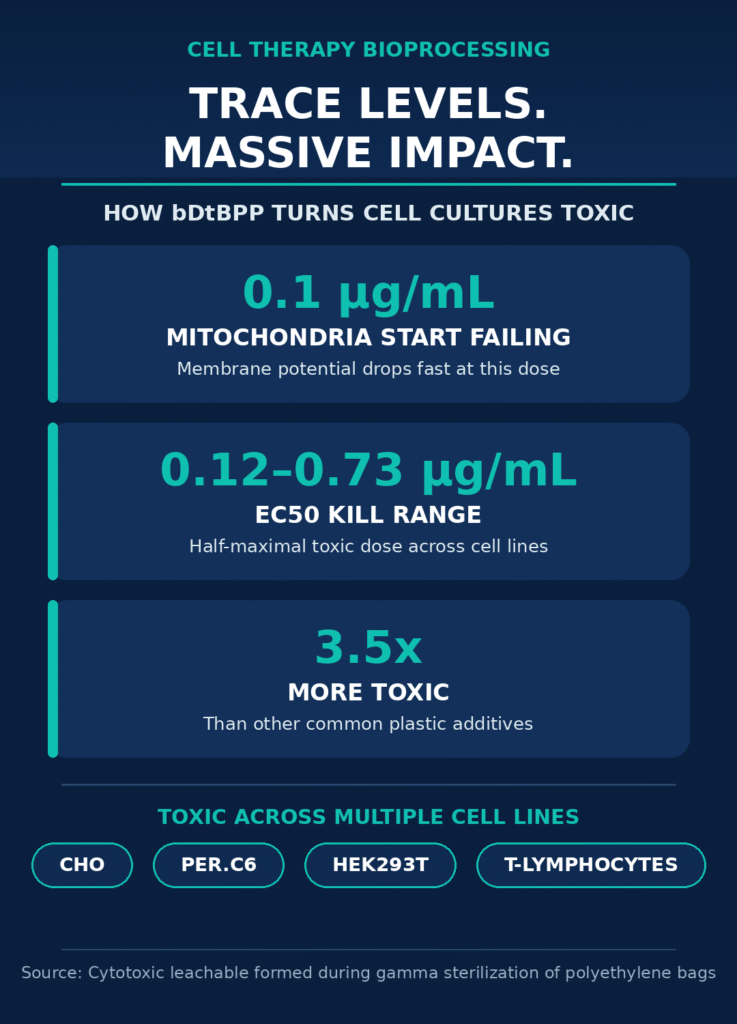
The biological effects of bDtBPP are associated with its capacity to interfere with cellular energetics by causing rapid depolarization of the mitochondrial membrane potential (ΔΨm). Toxicological screening has shown that bDtBPP can act as a potent cellular toxin across multiple cell lines, including Chinese Hamster Ovary (CHO) cells, PER.C6, human embryonic kidney (HEK293T) cells, and primary human T-lymphocytes.
The biological activity of bDtBPP can occur at trace concentrations substantially below conventional toxicological thresholds established for non-living biologic products:
- Effective Concentration (EC50): The half-maximal inhibitory concentration (EC50) for bDtBPP in mammalian expansion systems ranges from 0.12 μg/mL to 0.73 μg/mL (0.25–1.5 μM).
- Mitochondrial Disruption: Exposure to bDtBPP concentrations as low as 0.1 μg/mL can cause a rapid reduction in mitochondrial membrane potential (ΔΨm), thereby impairing cellular energy production.
- Potency Differential: Comparative investigations indicate that bDtBPP is more than 3.5 times more cytotoxic than other commonly encountered plastic additives, such as N-lauryldiethanolamine, and considerably more toxic than its parent molecule Irgafos 168, which demonstrates negligible direct cytotoxicity.
Evaluating toxicological risks for identified migrants? Explore our expert services for toxicological qualification of leachables.
Root Cause Remediation and Engineering Controls
Addressing bDtBPP leaching requires replacement of conventional polyethylene culture films with multi-layer EVOH-barrier films, implementation of lot-release UPLC-MS/MS testing, and validation of pre-inoculation flushing procedures. To prevent further expansion failures, the cell therapy program established three primary controls:
- Analytical Quantitation: Ultra-performance liquid chromatography coupled with tandem mass spectrometry (UPLC-MS/MS) was implemented to screen incoming bioprocess bag film lots for residual bDtBPP and oxidized Irgafos 168 intermediates.
- Film Architecture Transition: The program replaced conventional polyethylene bioprocess films containing high concentrations of Irgafos 168 with advanced multi-layer films. These alternative film structures incorporated ethylene vinyl alcohol (EVOH) fluid-contact barrier layers or reformulated antioxidant stabilization packages specifically optimized to minimize bDtBPP formation following gamma sterilization.
- Pre-use Extraction Flushing: An automated pre-use flush using balanced salt solution was introduced before cell inoculation. This procedure effectively reduced surface-bound residual leachables to below detectable limits (<0.01 μg/mL).
Deriving Analytical Evaluation Thresholds (AET) for Extractables and Leachables (E&L) Requirements for Single-Use Bioprocessing
Determining the Analytical Evaluation Threshold (AET) for Extractables and Leachables (E&L) Requirements for Single-Use Bioprocessing establishes the quantitative sensitivity limit above which unidentified chemical peaks must undergo structural identification and toxicological evaluation. This threshold connects the Safety Concern Threshold (SCT) of 1.5 μg/day with factors including clinical dosing volume, contact surface area, and analytical uncertainty.
Learn how to accurately calculate the Analytical Evaluation Threshold (AET) for your testing protocols.
Mathematical Derivation of the AET
In accordance with USP and ICH Q3E guidelines, analytical methods must provide adequate sensitivity for detecting volatile, semi-volatile, non-volatile, and elemental impurities present above the Safety Concern Threshold (SCT). For parenteral biopharmaceutical products, the recognized SCT is 1.5 μg/day, below which the potential risk of carcinogenic or toxic effects is considered negligible for lifetime exposure.
The absolute Analytical Evaluation Threshold (AETabs) in μg/mL can be calculated using the following formula:
AETabs = (SCT / D) × (Vextract / Acontact) × (1 / UF)
Where:
- SCT = Safety Concern Threshold (1.5 μg/day).
- D = Maximum daily clinical dose volume administered to the patient (mL/day or L/day).
- Vextract = Volume of extraction solvent used during laboratory testing (mL).
- Acontact = Total surface area of the single-use component in contact with process fluid (cm²).
- UF = Uncertainty Factor (typically 1.3 to 2.0), accounting for differences in analytical detector response factors across diverse chemical classes during mass spectrometry screening.
When determining the AET for an in-process cell therapy operation, the dilution factor associated with upstream media entering downstream processing fluids, together with the final patient administration volume, must be incorporated into the overall risk assessment model.
Comprehensive Orthogonal Analytical Testing Suite
Because no single analytical method can identify every chemical structure, characterization of single-use extractables profiles requires an orthogonal suite of high-resolution analytical technologies.
Read our comparison of GC-MS vs. LC-MS in E&L testing to select the right approach.
| Chemical Compound Class | Primary Analytical Instrument | Target Extraction Species | Typical Sensitivity Range |
|---|---|---|---|
| Volatile Organic Compounds (VOCs) | Headspace Gas Chromatography-Mass Spectrometry (HS-GC-MS). | Residual solvents, low-boiling antioxidants, monomers, degradation gases. | Sub-ppm to ppb levels (<0.05 μg/mL). |
| Semi-Volatile Organic Compounds (SVOCs) | Direct Injection GC-MS (Electron Ionization/Chemical Ionization). | Plasticizers (phthalates), secondary antioxidants, slip agents, alkanes. | Sub-ppm levels (<0.01 μg/mL). |
| Non-Volatile Organic Compounds (NVOCs) | Ultra-High Performance Liquid Chromatography coupled with High-Resolution Orbitrap Mass Spectrometry (UHPLC-HRMS). | High-molecular-weight additives, Irgafos degradation products (bDtBPP), oligomers, photoinitiators. | Sub-ppb levels (<0.001 μg/mL). |
| Elemental & Inorganic Impurities | Inductively Coupled Plasma-Mass Spectrometry (ICP-MS). | Heavy metal catalysts (zinc, platinum, aluminum, lead), silicone cross-linking residues. | Parts-per-trillion (ppt) to ppb levels. |
Discover the role of ICP-MS in E&L testing for elemental species profiling.
Implementation Protocol for Extractables and Leachables (E&L) Requirements for Single-Use Bioprocessing
Implementing Extractables and Leachables (E&L) Requirements for Single-Use Bioprocessing throughout a manufacturing facility requires a four-stage lifecycle qualification workflow incorporating vendor audit information, USP risk matrix tiering, orthogonal analytical screening, and pre-use flushing controls. Categorizing components according to fluid temperature, solvent aggressiveness, contact duration, and process location enables targeted risk management while supporting regulatory compliance readiness.
Learn about establishing effective leachables monitoring during stability studies.
Component Risk Tiering Matrix
Applying USP principles requires each single-use component to be evaluated across multiple interaction parameters:
- Fluid Character: Aqueous, organic, or surfactant-rich media, such as cell culture media containing Poloxamer 188 / Pluronic F-68, can accelerate the leaching of organic additives.
- Contact Duration & Temperature: Elevated-temperature culture conditions (37 °C) maintained for extended periods of 7–21 days can present a greater leaching potential than short-duration transfers conducted at room temperature.
- Proximity to Final Product: Upstream materials may experience less volumetric dilution than downstream filling assemblies; however, cell therapy processes do not provide conventional purification-based clearance of chemical contaminants.
| Single-Use Component | Contact Fluid / Operating Conditions | Risk Level | Compulsory Testing Protocol | Targeted Mitigation Controls |
|---|---|---|---|---|
| Bioreactor Bags & Culture Vessels | Complex media, 37 °C, 7–14 days contact time. | High | Full USP testing & cell cytotoxicity bioassays. | Select low-bDtBPP films (EVOH layers); pre-screen film lots. |
| Harvest & Transfer Tubing | Cell suspension, room temperature, <4 hours contact. | Medium to High | Model solvent extraction (USP matrix). | Replace high-extractable silicone tubing with TPE or pre-flush. |
| Sterilization & Clarification Filters | Aqueous media with surfactants, high differential pressure. | High | Flush validation & extractables mapping per BPOG/USP. | Implement validated water/buffer pre-flush volumes before processing. |
| Aseptic Connectors & Fittings | Short-term fluid contact, low surface area. | Low to Medium | Vendor data gap assessment & initial matrix evaluation. | Standardize on qualified, low-additive polycarbonate/polypropylene. |
| Cryopreservation Containers | DMSO-containing media, sub-zero storage (-196 °C). | High | Freeze-thaw leachables simulation with target solvent. | Verify container integrity and non-leaching in DMSO/solvent matrix. |
Lifecycle Qualification Protocol
A robust SUT qualification workflow consists of four sequential execution phases:
- Stage 1: Material & Vendor Qualification: Audit single-use component vendor extraction packages against USP and BPOG protocols while evaluating complete raw material formulations, polymer additive packages, and gamma radiation cross-linking parameters.
- Stage 2: Risk Assessment & Tiering Matrix (USP ): Evaluate process components according to contact duration, operating temperature, pH extremes, organic solvent content, and surfactant concentrations to assign defined risk tiers and establish calculated Analytical Evaluation Thresholds (AET).
- Stage 3: Targeted Testing & Simulated Leachables Studies: Perform orthogonal analytical screening using HS-GC-MS, GC-MS, UHPLC-HRMS, and ICP-MS with representative model solvents under worst-case operating conditions. Complement these analyses with functional biological toxicity assays using relevant target therapeutic cell lines.
- Stage 4: Lifecycle Management & Control Strategy: Establish routine raw material lot-release testing procedures, incorporate pre-use flushing requirements into master batch records, and maintain formal quality agreements with single-use suppliers requiring advance notification of resin or manufacturing process modifications.
Conclusion
Compliance with Extractables and Leachables (E&L) Requirements for Single-Use Bioprocessing is critical for protecting living advanced therapies from cytotoxic chemical migrants and maintaining regulatory compliance. By integrating proactive USP risk assessments, accurate AET derivation, and advanced orthogonal analytical screening, cell therapy developers can reduce batch failures while strengthening patient safety controls.
With the May 1, 2026 enforcement deadline for USP approaching, depending exclusively on generic vendor marketing claims creates significant regulatory and operational vulnerabilities. Cell therapy programs should therefore establish scientifically defensible, process-specific E&L datasets capable of demonstrating control over cytotoxic migrants such as bDtBPP and protecting living cellular products.
To evaluate analytical testing capabilities, request customized method validation, or arrange a comprehensive USP / regulatory gap assessment for bioprocessing lines, visit the ResolveMass Contact Page.
Frequently Asked Questions
USP and USP are scheduled to become enforceable on May 1, 2026, according to the framework described in this article. Manufacturers using single-use process-contact materials should establish documented risk assessments, appropriate extractables testing, and supporting analytical data before the applicable compliance date. Early implementation can also help identify potential material-related risks before regulatory submission.
Cell therapy products contain living cells that can be directly exposed to chemical substances released from single-use manufacturing components. Unlike many conventional biopharmaceutical processes, cell therapy manufacturing does not typically include extensive purification steps capable of removing trace leachables. Consequently, potentially harmful compounds may remain in the process environment and affect cellular viability, phenotype, or product quality.
Gamma irradiation can cause chemical changes within polymer formulations by generating reactive species and promoting degradation of certain additives. For example, the antioxidant Irgafos 168 may undergo oxidation and subsequent transformation during irradiation and aqueous exposure. These reactions can generate degradation products, including bis(2,4-di-tert-butylphenyl)phosphate (bDtBPP), which may subsequently migrate into process fluids.
Bis(2,4-di-tert-butylphenyl)phosphate (bDtBPP) is a chemical degradation product associated with the breakdown of the antioxidant Irgafos 168 in polymeric single-use materials. Its importance in cell therapy arises from its reported cytotoxic effects at low concentrations. Exposure can interfere with cellular growth and mitochondrial membrane potential, potentially compromising the performance and consistency of cell expansion processes.
The Analytical Evaluation Threshold (AET) defines the concentration at which detected extractables require further analytical identification and evaluation. Its calculation considers factors such as the Safety Concern Threshold (SCT), clinical dose volume, extraction volume, component contact surface area, and applicable uncertainty factors. The resulting value helps laboratories determine which analytical signals require detailed characterization.
A comprehensive extractables assessment relies on multiple complementary analytical techniques because chemical compounds differ considerably in volatility, polarity, molecular weight, and elemental composition. Headspace GC-MS is used for volatile compounds, while Direct Injection GC-MS supports semi-volatile compounds. UHPLC-HRMS evaluates non-volatile organic compounds, and ICP-MS is used to characterize elemental and inorganic impurities.
The extractables profile of silicone tubing can differ substantially from that of thermoplastic elastomer (TPE) tubing because the two materials contain different polymer chemistries and additive systems. Silicone materials may release siloxane-related compounds under certain process conditions, whereas TPE materials can present different organic extractables depending on their formulation. Material selection should therefore be based on process-specific E&L data rather than polymer type alone.
Vendor-supplied BPOG extractables information can provide useful preliminary characterization data, but it may not independently demonstrate compliance for every manufacturing application. Manufacturers should perform a documented, process-specific assessment to determine whether the vendor data adequately represents their contact conditions, extraction parameters, component configuration, and analytical requirements. Additional testing may be necessary when significant data gaps are identified.
Biomanufacturers can reduce leachable-related risks by selecting appropriately characterized low-extractable materials and applying risk-based component qualification. Validated pre-use flushing procedures can further reduce surface-associated chemical residues before process contact. Routine lot testing, supplier change notification agreements, and targeted biological compatibility studies can provide additional controls for protecting cell therapy products.
Reference:
- Hauk, A., Pahl, I., Austerjost, J., Hupfeld, J., Bernfeld, J., Lavrentieva, A., & Menzel, R. (2026). Advanced extractables and leachables assessment of microcarriers used for adherent cell cultures. Biotechnology Journal, 21(4), e70220. https://doi.org/10.1002/biot.70220
- Hammond, M., Nunn, H., Rogers, G., Lee, H., Marghitoiu, A.-L., Perez, L., Nashed-Samuel, Y., Anderson, C., Vandiver, M., & Kline, S. (2013). Identification of a leachable compound detrimental to cell growth in single-use bioprocess containers. PDA Journal of Pharmaceutical Science and Technology, 67(2), 123–134. https://doi.org/10.5731/pdajpst.2013.00905 (journal.pda.org)
- Ducker, C., Kolodziejski, M., Jacques, M., Roark, J., Blakinger, A., & Lehman, T. (2014, November 24). The risks of single-use bioprocess containers. American Pharmaceutical Review. Source article
- Hammond, M., Nunn, H., Rogers, G., Lee, H., Marghitoiu, A.-L., Perez, L., Nashed-Samuel, Y., Anderson, C., Vandiver, M., & Kline, S. (2013). Identification of a leachable compound detrimental to cell growth in single-use bioprocess containers. PDA Journal of Pharmaceutical Science and Technology, 67(2), 123–134. https://doi.org/10.5731/pdajpst.2013.00905 (PDA Journal)
Get In Touch With Us
About The Author


