

Introduction:
Extractables and Leachables Testing for Prefilled Syringes has become an essential requirement for pharmaceutical companies developing injectable biologics, biosimilars, vaccines, peptides, and small-molecule drug products. Prefilled syringes provide convenience, improved dosing accuracy, and reduced contamination risk, but they also introduce complex material interactions that may compromise product quality throughout shelf life.
Late-stage development is particularly challenging because any unexpected leachable identified during process validation, stability testing, or regulatory review can delay product approval by several months. Identifying the contamination source often requires advanced analytical capabilities, deep material knowledge, and a scientifically defensible investigation.
This case study illustrates how a structured Extractables and Leachables (E&L) investigation successfully resolved an unexpected failure observed during long-term stability testing of a prefilled syringe drug product. While the project described here is representative of common industry scenarios, it reflects the systematic scientific approach used by experienced analytical laboratories to support regulatory submissions.
Summary:
- Extractables and Leachables Testing for Prefilled Syringes identified the root cause of an unexpected leachable that appeared during late-stage stability testing of a monoclonal antibody program.
- Prefilled syringe (PFS) systems are especially prone to E&L issues because of the number of elastomeric closures, silicone lubricants, adhesives, and polymer components in direct, prolonged contact with the drug product.
- A structured investigation combining risk assessment, controlled extractables studies, orthogonal mass spectrometry, and toxicological evaluation traced the failure to tungsten residuals and a silicone/antioxidant-related degradation product.
- Corrective actions — supplier requalification, tightened component specifications, and a targeted re-test protocol — resolved the failure without a formulation redesign, keeping the filing timeline intact.
- Advanced LC-MS/MS, LC-HRMS, GC-MS/MS, GC-HRMS, and ICP-MS techniques were central to both identifying the unknown leachable and building a regulatory-defensible data package.
- Below, we walk through the full investigation step by step, the regulatory expectations that shape PFS E&L programs, and the practical lessons that apply to any sponsor developing a prefilled syringe combination product.
1: Why Extractables and Leachables Testing Matters for Prefilled Syringes
Extractables and leachables (E&L) testing for prefilled syringes matters because the syringe barrel, plunger, needle shield, and tip cap are all in prolonged, direct contact with the drug product, and any chemical migration from these components can compromise product safety, stability, or efficacy. Unlike vials or ampoules, a PFS is a combination product: glass or polymer barrel, elastomeric plunger stopper, tungsten-formed needle bore (in staked-needle designs), and a silicone lubricant layer that allows the stopper to glide smoothly during injection. Each of these materials is a potential source of leachables.
Regulatory bodies treat PFS-specific E&L risk seriously. FDA guidance on container closure systems, ICH Q3E, and USP <1663>/<1664> (extractables and leachables assessment) all call out prefilled syringes as a higher-scrutiny category because of tungsten, silicone, and adhesive exposure that simply doesn’t exist in a standard vial-stopper system. Our detailed breakdown of E&L testing for prefilled syringes covers this risk profile in more depth. For sponsors, E&L testing isn’t a checkbox — it’s a program-defining risk area that, if mismanaged, can derail a filing timeline in the final stretch of development.
2: Why Are Prefilled Syringes Highly Susceptible to E&L Issues?
Prefilled syringes are highly susceptible to E&L issues because they contain numerous polymeric and elastomeric components that can release organic or inorganic compounds into the drug product over time, and because injectable products deliver any resulting contaminants directly into the bloodstream. Typical contributing materials include:
- Silicone oil lubricants
- Elastomeric plunger stoppers
- Needle shields
- Adhesives and rubber formulations
- Polymer barrels and tip caps
- Label adhesives
- Manufacturing processing aids, antioxidants, plasticizers, and mold release agents
Because injectable drug products bypass the gastrointestinal barrier entirely, even trace-level leachables measured in parts-per-billion (ppb) may require full toxicological assessment. This is one reason extractables risk in plastic packaging and container closure selection are treated as CMC-critical decisions rather than late-stage formalities.
Common Sources of Leachables in Prefilled Syringe Systems
| Component | Potential Leachables | Potential Risk |
|---|---|---|
| Plunger stopper | Antioxidants, oligomers | Patient exposure |
| Needle shield | Vulcanization agents | Stability impact |
| Silicone lubricant | Silicone species | Protein aggregation |
| Adhesives | Organic additives | Unknown impurities |
| Polymer barrel | Plasticizers | Product contamination |
| Rubber components | Accelerators | Toxicological concern |
| Metal needle / tungsten pin | Elemental impurities | Regulatory non-compliance |
3: The Program: A Late-Stage Biologic in a Staked-Needle PFS
The case study centers on a monoclonal antibody program that had already completed Phase III clinical trials and was preparing its stability data package for a BLA submission, using a staked-needle, tungsten-pin-formed glass syringe with a fluoropolymer-coated plunger stopper — a common configuration for high-viscosity biologics requiring low extractable-force delivery, and one we discuss further in our overview of extractables and leachables in biologics.
During 12-month long-term and accelerated stability testing, an unknown impurity appeared and increased over storage time across multiple production lots, flagged during LC-MS non-targeted screening. Critically, the impurity was absent in the drug substance, was not observed in a comparator vial presentation of the same drug product, and exceeded the internal reporting threshold — strongly suggesting a packaging-related leachable rather than a manufacturing or formulation issue. With the filing timeline only weeks away and commercial-scale manufacturing already underway, the sponsor needed answers fast.
What the Initial Data Showed
| Observation | Detail |
|---|---|
| Trigger | Out-of-specification (OOS) leachable at 12-month stability timepoint |
| Analytical method | LC-MS/MS non-targeted screening + GC-MS headspace analysis |
| Flagged analytes | Elevated tungsten (ICP-MS), a siloxane/antioxidant-related degradation compound |
| Batch scope | Two of six commercial-scale lots affected; four lots within spec |
| Comparator | Vial presentation of the same drug product showed no impurity |
| Risk | Potential filing delay, protein aggregation concern near tungsten-exposed surfaces |
4: Root Cause Investigation: How the Failure Was Traced
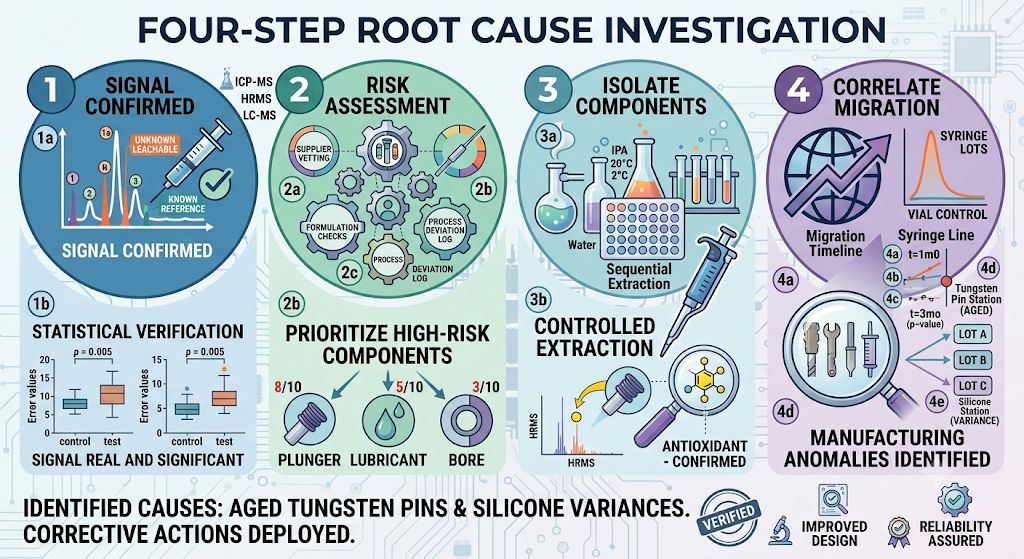
The root cause investigation for this PFS E&L failure followed four structured steps — confirmation, risk assessment, controlled extraction, and migration correlation — rather than jumping straight to a single assumed cause.
Step 1: Confirm the Analytical Signal
Before chasing a root cause, the finding had to be verified as real rather than an artifact of sample handling or instrument drift.
- ICP-MS was used to quantify tungsten across all six lots, confirming elevated levels specifically in the two flagged lots. Our team’s approach to ICP-MS in extractables and leachables testing follows this same orthogonal-confirmation model.
- LC-MS/MS with high-resolution mass spectrometry (LC-HRMS) characterized the unidentified siloxane/antioxidant-related peak against a reference library of known degradation products, supported by GC-HRMS for trace impurity confirmation.
- Blank and placebo controls were re-run in parallel to rule out reagent or extraction-solvent contamination.
Step 2: Comprehensive Risk Assessment
A structured risk assessment narrowed the potential contamination sources before further laboratory testing began. Every component supplier was evaluated against material specifications, formulation disclosures, certificates of analysis, supplier extractables reports, manufacturing process changes, and historical complaint records. Components were then ranked by direct product contact, contact duration, temperature exposure, surface area, and drug formulation compatibility — this ranking is the same framework we detail in our guide to root causes of failed E&L studies. The highest-risk materials identified were the plunger stopper, the silicone lubricant, and the tungsten-formed needle bore.
Step 3: Simulate Extractables from Individual Components
With the signal confirmed and risk ranked, controlled extractables studies isolated which syringe component was contributing each leachable. Extraction solvents included water, ethanol, IPA, and both acidic and basic solutions — the same solvent-selection principles covered in our article on solvents for extractables studies — tested under elevated temperature, extended solvent contact time, and multiple polarities to represent worst-case conditions, in line with USP <1663> principles.
- The glass barrel, tungsten-formed needle bore, plunger stopper, and silicone coating were tested independently.
- Tungsten extraction studies specifically targeted the needle-forming pin region, since tungsten pins are used to form the needle bore in staked-needle syringes and can leave residual tungsten oxide at the glass-metal interface.
- Silicone extraction studies quantified both free silicone oil and its degradation byproducts, while the plunger stopper extract was screened for antioxidant degradation products — a known contributor discussed in our review of E&L testing for container closure systems.
High-resolution mass spectrometry ultimately matched the unidentified compound to a degradation product of the antioxidant used in the elastomeric plunger formulation, confirmed through accurate mass determination, isotopic pattern analysis, fragmentation interpretation, database comparison, and reference standard confirmation.
Step 4: Migration Study and Process Correlation
A migration study demonstrated that leachable levels increased under real long-term storage conditions, with higher concentrations at elevated temperature, a progressive increase over shelf life, and a strong correlation with elastomer and silicone contact area — while the comparator vial presentation showed no migration at all. This confirmed the plunger stopper and silicone interface, rather than the formulation itself, as the source.
A parallel review of the syringe supplier’s manufacturing records showed the two affected lots were produced using tungsten-forming pins nearing the end of their qualified service life, and a silicone lubricant dispensing variance slightly above the upper process control limit — both converging on the same two production lots.
Root Cause Summary
| Contributing Factor | Root Cause Identified | Evidence |
|---|---|---|
| Tungsten leachable | Aging tungsten-forming pins at syringe supplier | Pin service-life records + ICP-MS correlation |
| Siloxane/antioxidant-related leachable | Silicone application above target specification; antioxidant degradation in plunger elastomer | Dispensing process data + extraction study + LC-HRMS identification |
| Migration behavior | Elevated temperature and elastomer/silicone contact area accelerated migration | Migration study across storage conditions |
| Lot-specific failure pattern | Both factors converged on the same two production lots | Batch genealogy cross-reference |
5: Toxicological Risk Assessment
Identifying a leachable is only part of the investigation — regulators also expect a scientifically justified safety evaluation, not simply an analytical detection. The toxicological assessment for this program evaluated daily patient exposure, maximum clinical dose, the Threshold of Toxicological Concern (TTC), published toxicology literature, and applicable regulatory guidance to establish a margin of safety. Our overview of extractables and leachables thresholds and extractables and leachables carcinogenicity testing outlines this framework in more detail.
Although the calculated patient risk remained low, the sponsor elected to eliminate the leachable before commercial launch to strengthen regulatory confidence — a decision consistent with the risk-based approach described in the ICH Q3E E&L risk assessment framework.
6: How ResolveMass Resolved the E&L Failure Without a Formulation Redesign
The failure was resolved by narrowing the corrective action to the syringe component supply chain rather than the drug formulation itself, since the investigation confirmed the leachables originated from manufacturing process variance and component chemistry, not an inherent incompatibility between the biologic and the container closure system. This distinction mattered enormously for timeline: a formulation change would have required new stability studies and likely a filing delay measured in months, while a component and process correction could be handled through a targeted CMC amendment.
The corrective and preventive action (CAPA) plan included:
- Tungsten pin requalification: The syringe supplier tightened the pin replacement interval and added in-process tungsten residual testing on incoming syringe lots.
- Silicone application tightening: The lubricant dispensing specification was narrowed, and a post-application silicone quantification step was added as a routine incoming inspection.
- Elastomer supplier collaboration: The plunger stopper supplier developed an updated formulation using an alternative antioxidant system with improved oxidative stability.
- Additional qualification testing: The revised component underwent material characterization, extractables profiling, leachables evaluation, functional testing, sterilization compatibility, and aging studies.
- Stability confirmation: Three engineering lots using the corrected components demonstrated no detectable leachable increase, stable product quality, comparable syringe functionality, and acceptable protein stability.
- Targeted re-testing protocol: Rather than re-running the full stability program, a bracketed leachables re-test was designed using the corrected-process lots at the same 12-month timepoint, supported by a scientific justification memo for the regulatory file — with method validation performed per our method validation for extractables and leachables testing approach.
- Regulatory documentation: A comprehensive package was prepared covering the risk assessment, analytical methods, validation reports, unknown identification data, toxicological assessment, supplier change documentation, and comparability studies, maintaining data integrity in extractables and leachables testing throughout.
7: Analytical Techniques Used in This E&L Investigation
A combination of orthogonal techniques was essential to this investigation because no single method can characterize the full range of extractables and leachables risk in a prefilled syringe system. The distinction between platforms — covered further in our comparison of GC-MS vs LC-MS in E&L testing — is what allowed the team to both screen broadly and confirm precisely.
| Technique | Purpose in This Case |
|---|---|
| LC-MS/MS and LC-HRMS | Non-targeted screening and identification of organic leachables, including the antioxidant degradation product |
| GC-MS/MS and GC-HRMS | Detection and confirmation of volatile and semi-volatile extractables from elastomeric and polymer components |
| ICP-MS | Quantification of tungsten and other elemental/metallic leachables |
| FTIR | Confirmation of silicone coating composition and polymer characterization |
| Headspace GC | Residual volatile compound screening |
| Controlled extraction studies (USP <1663> aligned) | Component-specific extractables profiling under accelerated, worst-case conditions |
| Toxicological risk assessment | Safety qualification of confirmed leachables against permitted daily exposure (PDE) thresholds |
Final Outcome
| Parameter | Before Investigation | After Resolution |
|---|---|---|
| Unknown impurity | Present, increasing over storage | Not detected |
| Stability concern | Yes | No |
| Supplier risk | High | Controlled |
| Regulatory readiness | Delayed | Submission-ready |
| Patient safety confidence | Moderate | High |
Following implementation of corrective actions, the sponsor completed its regulatory submission without additional E&L-related deficiencies, and the corrected package passed all stability and compatibility testing.
8: Regulatory Expectations for Prefilled Syringe E&L Studies
Regulatory agencies increasingly expect comprehensive E&L programs that include product-specific risk assessment, scientifically justified analytical thresholds, worst-case extraction studies, stability-based leachables evaluation, toxicological risk assessment, qualified analytical methods, complete traceability of packaging materials, and lifecycle management following supplier changes. These expectations are formalized under ICH Q3E guideline for extractables and leachables and the associated ICH Q3E E&L study requirements, and requirements can differ meaningfully depending on jurisdiction — see our comparison of E&L testing: USA vs Europe and our summary of E&L requirements for U.S. market authorization.
A robust E&L program supports submissions for NDA, ANDA, and BLA filings, biosimilars, combination products, and vaccines alike — our guide to E&L testing for NDA/ANDA submissions and our collection of FDA extractables and leachables case studies illustrate how these expectations play out across product types. These principles extend well beyond prefilled syringes, applying equally to E&L testing for autoinjectors, E&L testing for ophthalmic drug products, extractables and leachables in dexamethasone injectables, E&L in emerging biologics and advanced therapies, extractables and leachables in biologics and ATMPs, and even E&L testing for veterinary drug products. Sponsors should also stay ahead of evolving expectations, including nitrosamine-related leachables risk in packaging — see packaging leachables and nitrosamine E&L — and where the field is heading overall in our outlook on the future of extractables and leachables testing.
9: Key Lessons for Sponsors Running PFS Combination Products
Late-stage E&L failures are almost always preventable with earlier, more rigorous component-level extractables characterization, and this case reinforces several practical lessons for any sponsor developing a prefilled syringe combination product.
- Begin E&L studies early. Early characterization reduces costly late-stage surprises; our dedicated E&L testing services for prefilled syringes are designed to be engaged from Phase I onward.
- Understand every material, not just the qualified supplier data. Even approved materials may behave differently depending on formulation chemistry — supplier extractables reports should be independently verified using product-specific studies.
- Use orthogonal analytical techniques. Unknown identification often requires multiple complementary analytical technologies working together, not a single screening method.
- Evaluate toxicology alongside chemistry. Regulators expect scientific justification for patient safety, not simply analytical detection.
- Qualify syringe components at the supplier-process level, not just the material level. Tungsten and silicone risks are driven by manufacturing process parameters as much as by the base materials themselves.
- Design a bracketed re-testing strategy in advance. Having a scientifically justified, targeted re-test protocol ready to deploy is what keeps a filing timeline intact when an unexpected leachable appears.
10: Why Choose ResolveMass Laboratories for Extractables and Leachables Testing for Prefilled Syringes?
ResolveMass Laboratories provides scientifically rigorous E&L studies designed to meet FDA, Health Canada, EMA, and ICH expectations, whether a sponsor is outsourcing E&L testing to a laboratory in the United States or building a global submission strategy. Our capabilities include comprehensive risk assessments, extractables study design, leachables method development and validation, and unknown impurity identification using high-resolution mass spectrometry, backed by LC-MS/MS, LC-HRMS, GC-MS/MS, GC-HRMS, and ICP-MS analysis, along with toxicological risk assessment support, stability study support, and regulatory-ready technical reports — the same depth of support described in our overview of E&L testing in the United States and our auto-injector E&L testing services.
Whether supporting early formulation development or resolving complex late-stage contamination issues, our multidisciplinary scientists help sponsors generate defensible analytical data that accelerates regulatory success.
Conclusion:
Extractables and Leachables Testing for Prefilled Syringes is far more than a regulatory requirement—it is a critical component of ensuring patient safety, product quality, and successful commercialization. As demonstrated in this case study, even trace-level contaminants identified late in development can significantly impact regulatory timelines if not investigated systematically.
By combining comprehensive risk assessments, advanced analytical technologies, toxicological expertise, and collaborative problem-solving, sponsors can confidently identify contamination sources, implement effective corrective actions, and maintain submission readiness. Early investment in Extractables and Leachables Testing for Prefilled Syringes helps reduce development risks, avoid costly delays, and strengthen regulatory confidence throughout the product lifecycle.
Frequently Asked Questions:
The biggest challenges include detecting trace-level compounds, identifying unknown leachables, differentiating packaging-derived impurities from formulation degradants, and evaluating interactions between the drug product and multiple syringe components. Biologic formulations add further complexity because they are often more sensitive to packaging materials than small-molecule drugs.
Silicone oil is commonly used to ensure smooth plunger movement during injection. However, excess silicone can migrate into the drug product, potentially contributing to particulate formation, protein aggregation, or interactions with sensitive formulations. E&L studies evaluate whether silicone-related compounds remain within acceptable limits throughout the product’s shelf life.
Some leachables migrate very slowly and may not be detectable immediately after manufacturing. Long-term stability studies help determine whether the concentration of these compounds increases during storage under recommended conditions, ensuring the product remains safe and compliant until its expiration date.
Yes. Factors such as pH, solvent composition, protein concentration, surfactants, ionic strength, and storage temperature can significantly influence the migration of compounds from packaging materials. This is why E&L studies must be product-specific rather than relying solely on generic supplier data.
Manufacturers should evaluate material compatibility, chemical resistance, extractables profile, leachables risk, sterilization compatibility, mechanical performance, shelf-life requirements, and regulatory history. Selecting the right container closure system early can minimize the likelihood of late-stage development issues.
Risk assessments should be reviewed whenever there are significant changes to the drug product, manufacturing process, packaging materials, sterilization method, storage conditions, or component suppliers. Regular updates ensure that the E&L program remains aligned with current product and regulatory requirements.
Polymer syringes may contain a wider variety of additives, stabilizers, and processing aids compared to glass syringes, which can increase the range of potential extractables. However, both glass and polymer systems require comprehensive E&L evaluations because components such as elastomeric closures and silicone lubricants are common to both designs.
Reference
- Sharma N, Brahmankar Y, Babar D, Bhogle T, Mirase R, Rathod R, Shah R. Systematic approaches on extractable and leachable study designs in pharmaceuticals and medical devices: a review. Journal of Packaging Technology and Research. 2023 Oct;7(3):127-45.https://link.springer.com/article/10.1007/s41783-023-00157-8
- Darji P. Extractables and Leachables (E&L) Testing for Transdermal Patches and Topical Drug Delivery Systems.https://resolvemass.ca/extractables-and-leachables-el-testing-for-transdermal-patches/
- DeCollibus DP, Searcy J, Tivesten A, Akhtar N, Lindenberg C, Abarrou N, Pradhan S, Fiandaca M, Franklin J, Govindan G, Liu HY. Considerations for the terminal sterilization of oligonucleotide drug products. nucleic acid therapeutics. 2023 Jun 1;33(3):159-77.https://journals.sagepub.com/doi/abs/10.1089/nat.2022.0073
- Darji P. Designing Leachables Screening for Parenteral Drug Products.https://resolvemass.ca/leachable-screening-for-parenteral-formulations/
About the Author


