
Introduction
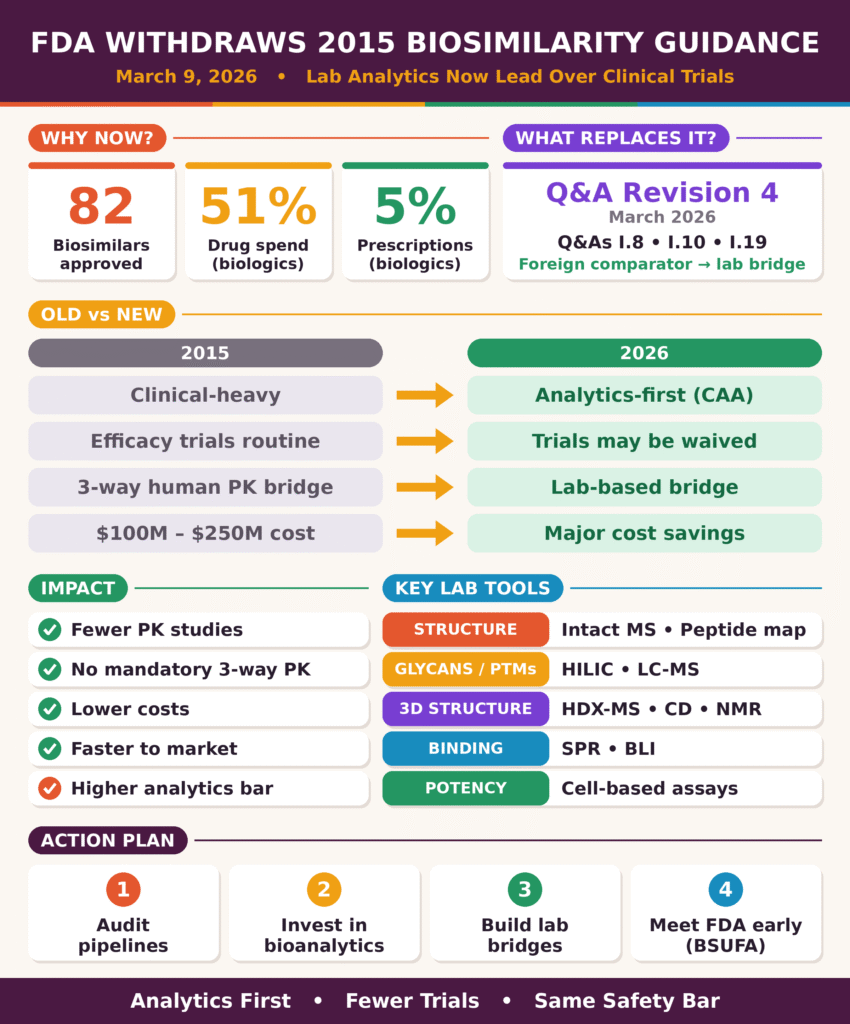
On March 9, 2026, the U.S. Food and Drug Administration (FDA) officially announced the withdrawal of its 2015 biosimilarity guidance, titled “Scientific Considerations in Demonstrating Biosimilarity to a Reference Product,” as part of its efforts to modernize regulatory pathways for biological products. This decision reflects more than a decade of regulatory experience gained through the approval of 82 biosimilars and signals a shift toward precision analytical science rather than routinely relying on redundant clinical trials. Biologic medicines account for 51% of total U.S. drug spending while representing only 5% of prescriptions. Historically, high development costs, largely associated with extensive comparative clinical trials, have created significant barriers to biosimilar market entry. By withdrawing the 2015 framework and releasing updated draft guidance, the FDA aims to reduce unnecessary regulatory and financial burdens without compromising established safety and efficacy standards.
This regulatory transition replaces a broad, clinically intensive guidance framework with targeted, science-based approaches that emphasize advanced bioanalytical characterization. Recognizing that Comparative Analytical Assessments (CAAs) can detect subtle molecular differences more sensitively than comparative clinical efficacy studies (CES), the FDA is changing how sponsors establish biosimilarity under Section 351(k) of the Public Health Service Act. For biopharmaceutical companies, contract research organizations, and specialized bioanalytical testing laboratories, this policy development represents a fundamental shift in development priorities. Greater emphasis is now placed on advanced analytical testing, detailed structural characterization, and comprehensive functional profiling to support regulatory submissions.
Explore how peptide mapping in biosimilars supports detailed molecular characterization and comparative analytical assessments.
Share via:
Get In Touch With Us
Quick Summary:
- The withdrawal: On March 9, 2026, the FDA withdrew its 2015 guidance, “Scientific Considerations in Demonstrating Biosimilarity to a Reference Product.” The goal is to modernize biosimilar development and reduce unnecessary clinical trials.
- Why it happened: Experience from 82 approved biosimilars since 2015 showed that Comparative Analytical Assessments (CAAs) detect molecular differences more sensitively than clinical efficacy studies. Clinical trials often added little new information.
- Market context: Biologics make up 51% of U.S. drug spending but only 5% of prescriptions. High development costs ($100M–$250M) have been a major barrier to biosimilar competition.
- What replaces it: The updated Q&A guidance (Revision 4, March 2026) breaks expectations into focused modules. Revised Q&As I.8, I.10 and I.19 let sponsors bridge a foreign comparator to the U.S. reference product with analytical data instead of mandatory three-way human PK studies.
- Impact on developers: Developers may run fewer clinical PK and efficacy studies, cut costs by potentially tens of millions of dollars, and reach the market faster. In exchange, the bar for analytical quality and statistical rigor is higher.
- Central role of lab testing: Biosimilarity now relies on high-resolution characterization of several areas:
- primary structure, using intact MS and peptide mapping
- glycans and PTMs, using HILIC and LC-MS
- higher-order structure, using HDX-MS, CD and NMR
- binding, using SPR and BLI
- potency, using cell-based assays
- Recommended actions: Sponsors should audit current pipelines for studies that could be cut, partner with capable analytical CROs, build robust analytical bridging matrices, and seek early FDA feedback through BSUFA meetings before changing clinical commitments.
Regulatory Catalyst: Why the FDA Withdraws Its 2015 Biosimilarity Guidance
The FDA withdrew its 2015 biosimilarity guidance following a decade of accumulated regulatory experience indicating that Comparative Analytical Assessments (CAAs) are substantially more sensitive than clinical trials for identifying structural and functional differences between biological medicines. Consequently, routinely requiring comparative clinical efficacy studies could create unnecessary financial and operational challenges for developers without consistently generating additional evidence of safety or efficacy beyond that established through comprehensive analytical evaluations.
When the original guidance was finalized in April 2015, the FDA had approved only one biosimilar, filgrastim-sndz. Because the agency had limited long-term comparative data at that stage, the regulatory framework followed a stepwise, hierarchical approach to establishing biosimilarity, with human clinical testing serving as a common component of the evaluation process. Over the following eleven years, experience gained from evaluating 82 approved biosimilars across diverse therapeutic categories, including monoclonal antibodies, fusion proteins, and cytokine modulators, strengthened the role of analytical characterization. This experience demonstrated that clinical trials often provided limited additional information about product differences that had not already been identified through detailed analytical testing.
Learn more about post-translational modifications (PTMs) in biosimilars and their importance in evaluating structural and functional differences.
Scientific Rationale: What Drove Policy Evolution When the FDA Withdraws Its 2015 Biosimilarity Guidance
The scientific justification for replacing the 2015 framework is rooted in advances in bioanalytical technologies, including high-resolution mass spectrometry and surface plasmon resonance. These techniques can identify and characterize molecular micro-heterogeneities that may be difficult to distinguish through clinical studies alone. Factors such as patient population variability, concomitant medications, differences in clinical dosing, and variations in disease states can obscure subtle differences between batches during efficacy evaluations. In contrast, advanced analytical instruments enable scientists to examine molecular structures and quantify specific variations under controlled laboratory conditions with high precision.
In addition, improved scientific understanding of biological mechanisms has reinforced the importance of structural integrity and functional target binding in determining clinical performance. By acknowledging “Generally Accepted Scientific Knowledge” (GASK), the FDA recognizes that additional comparative clinical trials may provide limited incremental information when analytical similarity and relevant biological functions have already been convincingly established. This scientific development contributed to the move away from the rigid 2015 framework toward more flexible, analytical-first regulatory expectations.
Discover how glycosylation analysis of biosimilars helps compare glycan profiles and characterize important molecular attributes.
| Regulatory Parameter | 2015 Legacy Framework | 2026 Modernized Framework |
|---|---|---|
| Primary Regulatory Pillar | Stepwise evaluation model with substantial reliance on clinical studies. | Analytical-first approach centered on Comparative Analytical Assessment (CAA). |
| Clinical Efficacy Studies (CES) | Routinely expected for many therapeutic biologics. | May be waived when sufficient comparative analytical and functional evidence establishes similarity. |
| Foreign Comparator Bridging | Three-way clinical pharmacokinetic (PK) bridging studies were commonly required under the earlier framework. | Analytical bridging may be used with appropriate scientific justification, without automatically requiring human three-way PK trials. |
| Development Cost Impact | Development programs could incur costs of $100M–$250M. | Potentially substantial cost reductions through streamlined clinical PK assessments and trial requirements. |
| Scientific Benchmark | A conservative framework established during the early stages of biosimilar development. | A science-driven approach informed by regulatory experience with approved biosimilars. |
What Replaces the 2015 Framework: New Q&A Guidance Revision 4
The withdrawn 2015 scientific considerations guidance is being superseded by updated FDA guidance, including “New and Revised Draft Q&As on Biosimilar Development and the BPCI Act (Revision 4),” issued in March 2026. This updated framework organizes regulatory expectations into more focused question-and-answer documents, helping sponsors avoid unnecessary testing while providing greater flexibility to justify development decisions using current scientific evidence.
Instead of addressing every scientific and regulatory consideration in a single, static document, the FDA has separated administrative, scientific, and bioanalytical requirements into more targeted guidance modules. Revision 4 serves as an important operational reference by clarifying expectations for comparative testing, analytical justification, and clinical data requirements under the Biologics Price Competition and Innovation Act (BPCI Act). This modular approach allows sponsors to evaluate individual development requirements more efficiently and determine which studies are scientifically necessary for their specific biosimilar programs.
Review the ICH Q6B guidelines for biological characterization to understand the broader principles governing the characterization and specifications of biological products.
Revisions to Q&As I.8, I.10, and I.19: Streamlining Foreign Comparator Data
The FDA revised Q&As I.8, I.10, and I.19 to provide greater flexibility in establishing comparability when developers use non-U.S.-licensed comparator products. Under the updated approach, sponsors may support scientific bridging among a proposed biosimilar, a U.S.-licensed reference product, and a foreign comparator through comprehensive analytical characterization rather than automatically relying on clinical pharmacokinetic (PK) bridging studies involving human subjects. The acceptability of this approach depends on the available evidence and the scientific justification provided by the sponsor.
Under the earlier Revision 3 framework, issued in September 2021, developers seeking to rely on safety and efficacy data generated using foreign-sourced reference products generally needed to conduct three-arm clinical PK/PD studies to establish a bridge between the foreign comparator and the U.S.-licensed reference product. Revision 4 provides a pathway for sponsors to establish this scientific connection through comprehensive side-by-side analytical testing, including primary structure mapping, glycan profiling, and receptor binding assays, supported by a thorough scientific rationale. This development reflects a broader international movement toward evidence-based regulatory approaches, although the specific requirements and acceptability of analytical bridging continue to depend on the applicable regulatory framework, product characteristics, and available data.
Explore biosimilar comparability studies to learn how structured analytical comparisons can support evidence-based biosimilarity assessments.
What Changes for Biosimilar Developers: Key Development Impacts
The withdrawal of the 2015 guidance and the introduction of updated recommendations may streamline biosimilar development by reducing unnecessary clinical testing, lowering development expenditures, and potentially shortening time-to-market timelines. When scientifically justified and accepted by regulators, reducing the reliance on certain clinical studies allows developers to direct more resources toward high-throughput bioanalytical characterization and minimizes unnecessary exposure of patients to clinical trials that offer limited additional information.
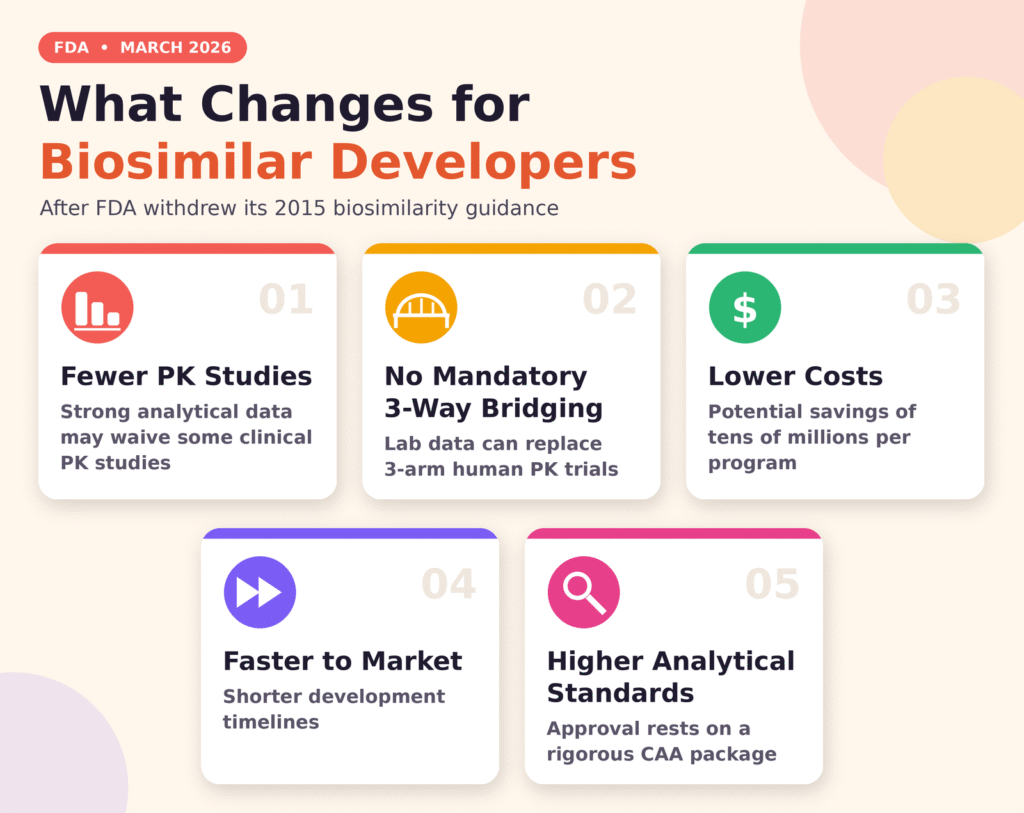
The principal operational and strategic implications for biopharmaceutical developers include the following:
- Reduction of Clinical PK Study Mandates: Sponsors may be able to streamline or waive certain clinical pharmacokinetic studies when comprehensive analytical evidence demonstrates a high degree of similarity. Decisions should be supported by sensitive, orthogonal assays and a scientifically justified assessment of any remaining uncertainty.
- Elimination of Mandatory Three-Way Clinical PK Bridging: Developers using non-U.S.-licensed comparator products may be able to avoid dedicated three-arm human PK studies when the updated regulatory framework permits an analytical bridging strategy. This approach can reduce the logistical challenges associated with clinical recruitment, study execution, and data analysis.
- Direct Cost Reductions: Streamlining clinical PK assessments and eliminating unnecessary clinical endpoints may reduce overall development expenditures. Depending on the product, development strategy, and studies that can be avoided, savings could be substantial, potentially reaching tens of millions of dollars across a development program.
- Compressed Time-to-Market Timelines: Reducing the need for certain multicenter comparative clinical trials may shorten the overall biosimilar development lifecycle. The actual reduction depends on the original development plan, regulatory feedback, analytical data requirements, and the extent to which clinical studies can be modified or omitted.
- Heightened Analytical Standards: Regulatory decisions increasingly depend on the quality, depth, precision, and statistical rigor of the Comparative Analytical Assessment (CAA) package. Sponsors must generate comprehensive evidence demonstrating structural, physicochemical, and functional similarity while adequately evaluating any observed differences.
Understand the role of critical quality attributes (CQAs) in biosimilars when prioritizing analytical testing and evaluating product similarity.
The Central Role of High-Resolution Analytical Testing and Laboratory Characterization
High-resolution analytical testing has become a central component of biosimilar evaluation under the FDA’s modernized regulatory approach. Comprehensive structural and functional characterization can provide critical evidence that supports biosimilarity and may reduce the need for certain late-stage clinical studies. To meet regulatory expectations, sponsors must employ advanced biophysical and bioanalytical platforms capable of characterizing primary protein structures, higher-order structures (HOS), and post-translational modifications (PTMs).
As reliance on clinical trials for detecting product differences decreases in scientifically justified circumstances, the importance of comprehensive analytical characterization increases. Sponsors must establish convincing analytical evidence and demonstrate that the selected methods are suitable for identifying differences that could affect product quality, safety, efficacy, or biological activity. Independent analytical laboratories, including ResolveMass Laboratories Inc., can support these objectives through high-precision mass spectrometry, biophysical characterization, and specialized bioanalytical assays designed to evaluate structural similarity and batch-to-batch consistency. Advanced mass spectrometry techniques, including intact mass analysis, peptide mapping, and hydrogen-deuterium exchange mass spectrometry (HDX-MS), help identify and characterize subtle molecular variations that could influence the performance of a biological product.
Learn how forced degradation of biosimilars helps investigate degradation pathways and assess molecular stability under controlled stress conditions.
| Analytical Characterization Domain | Primary Analytical Testing Platform | Regulatory Objective in Comparative Analytical Assessment (CAA) |
|---|---|---|
| Primary Protein Structure | Intact LC-MS/MS, MALDI-TOF, LC-MS Peptide Mapping | Confirms amino acid sequence identity and evaluates C-terminal and N-terminal variations. |
| Post-Translational Modifications (PTMs) | Hydrophilic Interaction Chromatography (HILIC-SPE), LC-MS | Characterizes N-linked and O-linked glycans and evaluates deamidation, oxidation, and glycation levels. |
| Higher-Order Structure (HOS) | HDX-MS, Circular Dichroism (CD), Nuclear Magnetic Resonance (NMR) | Evaluates tertiary and quaternary structural characteristics and assesses conformational similarity. |
| Fc Receptor & Target Binding | Surface Plasmon Resonance (SPR), Bio-Layer Interferometry (BLI) | Quantifies binding kinetics, including KDK_D, konk_{on}, and koffk_{off}, for FcγRIIIaFc\gamma RIIIa, FcRnFcRn, and C1qC1q. |
| Biological Activity & Potency | Cell-based reporter gene assays, proliferation assays | Compares mechanism of action (MoA)-related biological activity and potency with the reference product. |
Strategic Action Plan for Biopharmaceutical Companies
Biopharmaceutical companies should proactively adjust their development strategies to reflect the evolving regulatory landscape. Key priorities include strengthening analytical characterization packages, reviewing existing clinical trial commitments, and engaging with the FDA early through appropriate Biosimilar User Fee Act (BSUFA) scientific meetings. Investing in bioanalytical testing during the early stages of development enables sponsors to identify potential differences sooner, build a stronger evidence base for biosimilarity, and assess whether additional clinical studies are necessary.
Biopharmaceutical leaders should consider implementing the following strategic measures:
- Audit Current Biosimilar Pipelines: Review ongoing development programs to identify clinical efficacy studies, pharmacokinetic assessments, and foreign comparator bridging studies that may be suitable for modification or elimination under Revision 4. Each proposed change should be evaluated against the product’s characteristics, existing evidence, and applicable FDA requirements.
- Expand Bioanalytical Laboratory Investments: Collaborate with experienced contract research organizations (CROs) that have advanced mass spectrometry systems, biophysical characterization capabilities, and validated or appropriately qualified analytical methods. These partnerships can help sponsors develop comprehensive Comparative Analytical Assessments supported by reliable, reproducible data.
- Develop Scientifically Justified Analytical Bridges: When using non-U.S.-licensed reference products, construct systematic analytical comparison matrices covering multiple lots of the U.S.-licensed reference product, foreign comparator, and proposed biosimilar. Assess critical quality attributes, molecular structures, post-translational modifications, and relevant functional properties to establish a robust scientific justification for the proposed bridging strategy.
- Request BSUFA Early Action Meetings: Engage the FDA through appropriate scientific meeting pathways to obtain feedback on proposed analytical strategies, potential clinical study waivers, and overall development plans. Sponsors should seek alignment with the relevant FDA review division, including the Center for Drug Evaluation and Research (CDER) when applicable, before making major changes to clinical development commitments.
Discover ResolveMass biosimilar characterization services for analytical support across structural, physicochemical, and functional evaluation.
Conclusion
The regulatory transition associated with the FDA’s withdrawal of its 2015 biosimilarity guidance marks an important development in the move toward modern, analytics-driven biosimilar development. By replacing the earlier framework with more flexible, science-based approaches, including the updated Revision 4 Q&A guidance, the agency is creating opportunities for sponsors to establish biosimilarity through comprehensive analytical evidence while reducing unnecessary clinical testing where scientifically justified. This approach can help biopharmaceutical companies allocate resources more efficiently, strengthen structural and functional characterization, and minimize avoidable patient exposure to clinical trials without compromising established standards for safety, efficacy, and product quality. As bioanalytical evidence assumes an increasingly important role in regulatory submissions, collaboration with experienced analytical testing laboratories can help sponsors generate reliable data, address regulatory expectations, and support successful biosimilar development and market entry.
Explore the end-to-end biosimilar analytical package for regulatory submissions to learn how integrated analytical testing can support a comprehensive regulatory evidence package.
To learn more about optimizing analytical characterization strategies and meeting modern biosimilar testing requirements, contact the expert team at ResolveMass Laboratories Inc.: ResolveMass Laboratories Inc. Contact Page.
Frequently Asked Questions
The updated regulatory framework includes the “New and Revised Draft Q&As on Biosimilar Development and the BPCI Act (Revision 4),” issued in March 2026. These question-and-answer documents clarify regulatory expectations and provide updated recommendations for biosimilar development. Their modular structure also makes it easier to address specific scientific and regulatory issues as guidance evolves.
The updated approach allows sponsors to consider reducing or waiving certain clinical PK studies when comprehensive analytical evidence and other relevant data adequately establish similarity. This can lower development costs, shorten study timelines, and reduce unnecessary participation by human subjects. Any decision to omit a study must be scientifically justified and consistent with applicable FDA requirements.
The updated guidance provides greater flexibility for sponsors to establish a scientific bridge without automatically relying on three-way clinical PK studies. Developers may use comprehensive analytical comparisons involving the proposed biosimilar, the U.S.-licensed reference product, and the foreign comparator. The acceptability of this approach depends on the strength of the analytical evidence and the sponsor’s scientific justification.
Withdrawing the 2015 guidance does not, by itself, revoke the approval of biosimilars already authorized for marketing. Existing products remain subject to their applicable regulatory requirements, including ongoing quality monitoring and postmarketing obligations. Any regulatory action affecting an approved product would depend on the specific circumstances and relevant FDA decisions.
Comparative clinical efficacy studies may be unnecessary when robust analytical and functional evidence, together with other relevant data, adequately demonstrates biosimilarity. The decision depends on the product’s characteristics, its mechanism of action, and any remaining scientific uncertainty. Sponsors should provide a clear rationale for omitting such studies and follow applicable FDA recommendations.
Developers may reduce expenses by avoiding clinical studies that do not provide meaningful additional evidence of biosimilarity. Potential savings depend on the development program, the number and type of studies eliminated, and the resources required for analytical testing. Claims of specific savings, such as a 50% reduction or 20 million dollars per program, should be supported by reliable cost data rather than assumed to apply to every biosimilar.
The analytical methods selected depend on the product’s molecular characteristics and critical quality attributes. Common techniques include high-resolution LC-MS/MS for peptide mapping and intact mass analysis, HILIC-SPE for glycan profiling, surface plasmon resonance (SPR) for receptor-binding studies, and cell-based bioassays for biological potency. Combining complementary methods helps establish a comprehensive understanding of structural and functional similarity.
No, changes to FDA guidance do not independently amend the statutory definition of biosimilarity established under Section 351(k) of the Public Health Service Act. A proposed biosimilar must still be highly similar to its reference product, with no clinically meaningful differences in safety, purity, and potency. The updated framework concerns how sponsors can demonstrate that standard using appropriate scientific evidence.
Sponsors can develop a scientific justification by conducting comprehensive, side-by-side analytical assessments of multiple lots of the proposed biosimilar, the U.S.-licensed reference product, and the foreign comparator. These assessments may include primary structure analysis, glycosylation profiling, higher-order structure evaluation, receptor-binding studies, and functional assays. The resulting data must demonstrate an adequate analytical relationship among the products and satisfy applicable FDA requirements for using foreign comparator data.
Reference:
- U.S. Food and Drug Administration. (2026, March 9). FDA takes further steps to streamline biosimilar development and make medicines more affordable. https://www.fda.gov/news-events/press-announcements/fda-takes-further-steps-streamline-biosimilar-development-and-make-medicines-more-affordable
- Niazi, S. K. (2023). The FDA’s new guideline “Generally Accepted Scientific Knowledge” (GASK): An opportunity to expedite the approval of biosimilars. Pharmaceuticals, 16(11), Article 1517. https://doi.org/10.3390/ph16111517
- U.S. Food and Drug Administration. (2026, March). New and revised draft Q&As on biosimilar development and the BPCI Act (Revision 4): Draft guidance for industry. https://www.fda.gov/regulatory-information/search-fda-guidance-documents/new-and-revised-draft-qas-biosimilar-development-and-bpci-act-revision-4
- U.S. Food and Drug Administration. (2026, March). Questions and answers on biosimilar development and the BPCI Act: Guidance for industry. https://www.fda.gov/regulatory-information/search-fda-guidance-documents/questions-and-answers-biosimilar-development-and-bpci-act-guidance-industry
Get In Touch With Us
About The Author