
Introduction
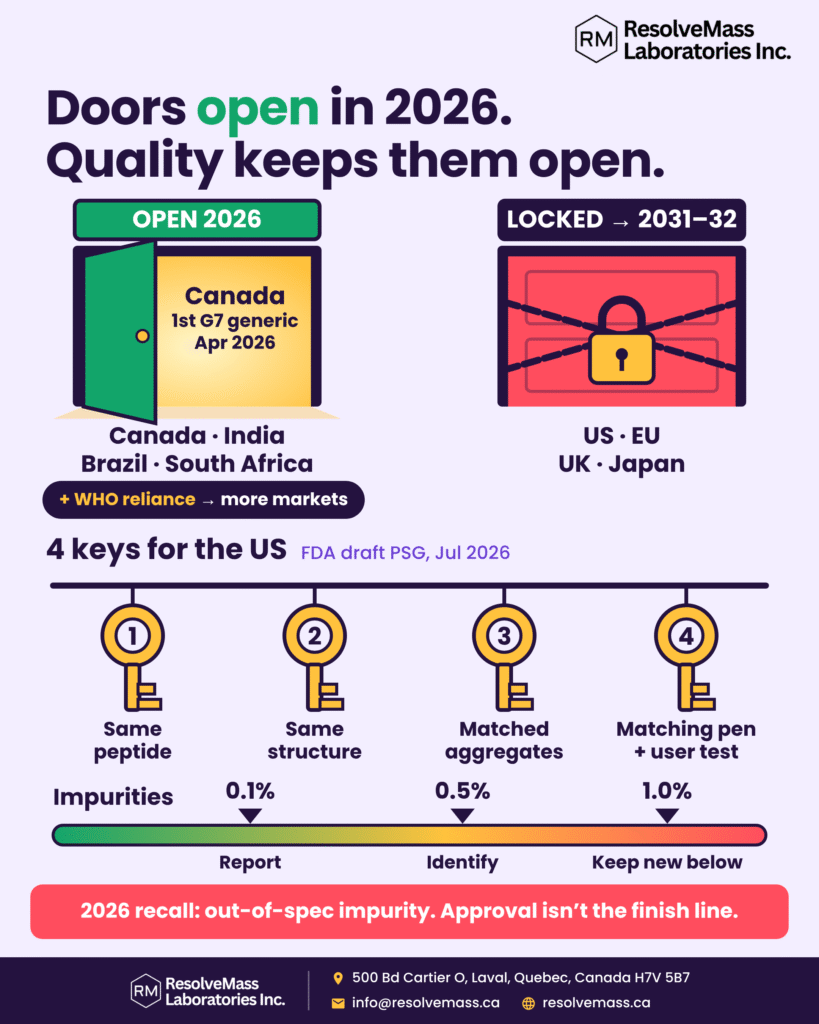
Generic Semaglutide Development in 2026 is characterized by a divided global regulatory landscape. Canada and several early-opening emerging markets began permitting commercial generic injections between March and September 2026, whereas the United States, European Union, United Kingdom, and Japan remain protected by primary patents and supplementary exclusivity provisions extending through 2031–2032. For generic sponsors and development teams, taking advantage of these staggered market-entry opportunities requires coordinating near-term regulatory submissions under Health Canada’s Abbreviated New Drug Submission (ANDS) framework and World Health Organization (WHO) reliance pathways with the more stringent physicochemical, impurity, and device-comparability requirements introduced in the U.S. Food and Drug Administration’s (FDA) revised draft Product-Specific Guidances (PSGs) issued in July 2026.
This regulatory divergence is closely associated with semaglutide’s structural characteristics and drug-device combination complexity. Semaglutide is a 31-amino-acid GLP-1 receptor agonist containing a non-natural α-aminoisobutyric acid (Aib) substitution at position 2 and a C18 stearic diacid-γ-Glu-(AEEA)2 lipidation attached to Lys20. These structural features place semaglutide at the intersection of synthetic peptide chemistry and complex parenteral characterization. Achieving regulatory acceptance across Canada, emerging markets, and the U.S. Abbreviated New Drug Application (ANDA) pathway requires effective control of process-related and degradation-related impurities, prevention of aggregation and fibrillation, verification of pen-injector equivalence, and appropriate adaptation of regulatory dossiers to developments documented through November 2026.
Explore pharmaceutical CDMO services across the United States and Canada to understand the available development and analytical support.
Share via:
Quick Summary:
- A split market: Generic semaglutide opened in Canada and several emerging markets in 2026. The US, EU, UK and Japan stay protected until about 2031–2032 through patent extensions and exclusivity.
- Canada went first: Novo Nordisk’s Canadian compound patent lapsed over an unpaid maintenance fee, and data protection ended in January 2026. Canada became the first G7 country to approve a generic, Dr. Reddy’s in April 2026, followed by Apotex and Sandoz. Pen-device patents may still apply.
- Health Canada’s route: Generics use the ANDS pathway, which leans on analytical and pharmaceutical-equivalence evidence rather than clinical trials. A 2026 out-of-specification impurity recall showed that quality control after approval matters as much as approval itself.
- Emerging markets: India, Brazil and South Africa saw rapid launches and steep price cuts. China and Mexico remain blocked by data protection, and WHO prequalification and reliance pathways can extend a single strong dossier across many countries.
- The FDA reset: In July 2026, the FDA issued 17 revised draft product-specific guidances, including Ozempic and Wegovy, and withdrew its 2021 synthetic-peptide guidance. The new drafts cover synthetic, semi-synthetic and recombinant semaglutide alike. They require multi-batch comparisons against aged reference product, plus checks of structure, aggregates and immune-response risk.
- Impurity rules: Sponsors must report impurities above 0.1%, identify those above 0.5%, and keep new impurities below 1.0%. Total impurities must not exceed the reference product’s, and that calls for orthogonal methods such as multi-enzyme peptide mapping with high-resolution LC-MS.
- The device counts too: As drug-device combination products, generics must match the reference pen’s dosing and user interface, pass extractables and leachables testing, and show comparable use in human-factors studies.
Global Patent Landscape and 2026 Market Entry Windows
Semaglutide’s core compound patent expired on March 20, 2026, in most jurisdictions without patent term extensions, including India, Brazil, China, and South Africa. Canada, however, became accessible earlier, on January 4, 2026, following the permanent lapse of its patent in 2019 and the subsequent expiration of data protection. Nevertheless, the expiration of the primary compound patent does not automatically authorize commercial marketing. Secondary patents covering pen-injector devices, bilateral data exclusivity provisions, and jurisdiction-specific patent litigation can continue to restrict market entry.
In Canada, Novo Nordisk’s primary compound patent (CA 2601784, “Acylated GLP-1 compounds”) permanently lapsed after the company failed to pay a CAD 250 maintenance fee, which would have increased to CAD 450 when including the late fee. The deadline for reversing this lapse expired on August 31, 2020, an outcome that Novo Nordisk subsequently characterized as a strategic decision. Since CA 2601784 is not listed in Canada’s Patent Register, generic applicants were able to avoid patent linkage under the Patented Medicines (Notice of Compliance) Regulations (PM(NOC)). Consequently, they bypassed the conventional 24-month statutory litigation stay. Following the termination of data protection on January 4, 2026, Canada became the first G7 country where generic versions of Ozempic and Wegovy could enter the market. However, industry trackers report that secondary patents associated with Canadian pen-injector devices may remain in force until at least 2033, making careful device freedom-to-operate engineering essential.
| Market | Core Patent Status | Generic Launch Status (as of September–November 2026) | Remaining Exclusivity or Regulatory Barriers |
|---|---|---|---|
| Canada | Permanently lapsed in 2019 (CA 2601784); data protection ended January 4, 2026 | Generic products have been available since mid-May 2026, with Ozempic and Wegovy equivalents approved | Pen-device patents are reported to extend until at least 2033 |
| India | Expired March 20, 2026 | Injectable products entered the market from March 21, 2026, with dozens of brands becoming available | Oral tablet formulation patent remains in force until 2031 |
| Brazil | Expired March 20, 2026, following the Superior Court of Justice’s unanimous rejection of an extension | First approval granted in May 2026, followed by approvals for more than six additional companies during July–August 2026 | Initial approvals were restricted to type 2 diabetes pens |
| South Africa | Expired in March 2026 | First generic launched in August 2026 at approximately 18.5% below Ozempic’s price; 13 additional applications remain pending | Further price reductions are anticipated as pending applications receive approval |
| Saudi Arabia | No local patent reported | First generic launched on September 16, 2026 | Other Gulf Cooperation Council countries require separate national approvals |
| China | Expired March 20, 2026, with the decision upheld by the Supreme People’s Court in December 2025 | No generic products approved yet | Data protection continues until approximately April 2027 under the China–Switzerland FTA; clinical studies are required |
| Mexico | Expired in March 2026 | No generic products approved yet | Court-granted 10-year data protection extends until approximately July 2029 and remains contested |
| United States | Extended until December 5, 2031 | No approved ANDAs according to Orange Book data available in October 2026 | Confidential settlements indicate possible market entry around 2032; extensive secondary patents remain applicable |
| EU and UK | Supplementary Protection Certificates (SPCs) extend until approximately March 2031 | No generic products marketed | EU 8+2(+1) exclusivity began in February 2018 and has also been enforced against compounded copies |
| Japan | Extended until approximately 2031 | No generic products marketed | Development of oral generics has already begun in anticipation of loss of exclusivity |
The commercial developments in these early-opening markets provide valuable information for companies preparing to enter the U.S. and European markets later. An April 2026 IQVIA analysis indicates that originator defense strategies, including Novo Nordisk’s introduction or planned introduction of secondary authorized brands in four of the eight first-wave markets and its increasing focus on oral GLP-1 therapies, will generate practical benchmarks for assessing price elasticity and substitution before the 2031–2032 loss-of-exclusivity (LOE) period. In the United States, Novo Nordisk has also entered into confidential settlements involving Ozempic patent litigation with Alvogen, Rio Biopharmaceuticals, Sun Pharma, Dr. Reddy’s, Mylan, Zydus, and Apotex.
Understanding how outsourcing arrangements support generic development can help sponsors prepare for these different market-entry timelines. Learn how CDMOs can accelerate generic drug development in the United States and Canada.
Health Canada ANDS Pathway and Lessons from 2026 Generic Approvals
Health Canada regulates generic injectable semaglutide as a subsequent-entry aqueous parenteral solution under Part C, Division 8 of the Food and Drug Regulations. Applicants can pursue approval through the Abbreviated New Drug Submission (ANDS) pathway, which allows them to request a waiver of in vivo bioequivalence studies when pharmaceutical equivalence, excipient sameness, and device comparability have been adequately demonstrated. This approach follows Health Canada’s policies on Pharmaceutical Quality of Aqueous Solutions and Submissions for Generic Parenteral Drugs. Unlike regulatory systems that require comprehensive clinical bridging studies, the Canadian pathway places considerable emphasis on pharmaceutical quality and analytical evidence.
Canada represents one of the most commercially valuable semaglutide markets worldwide. Drug Discovery & Development reported that Ozempic generated sales of CAD 2.9 billion in 2025. Additionally, Business Standard estimated the Canadian GLP-1 market at CAD 2.6 billion, with annual demand approaching 12 million semaglutide injection pens, in November 2026. These market conditions contributed to the rapid expansion of generic competition throughout 2026.
Important Health Canada authorization milestones include the following:
April 28, 2026: Health Canada issued a Notice of Compliance (NOC) to Dr. Reddy’s Laboratories Ltd. (Control Number 279513, filed January 5, 2024; DIN 02567806 and DIN 02567814) for Semaglutide Injection 1.34 mg/mL, available in 2 mg/pen and 4 mg/pen presentations. This authorization made Canada the first G7 country to approve a generic semaglutide product.
May 1, 2026: Apotex obtained Health Canada approval for a generic Ozempic-equivalent injection indicated for adults diagnosed with type 2 diabetes.
June 29, 2026: Health Canada authorized Apotex’s Sevmia, becoming the first generic semaglutide product approved for chronic weight management. The product references Wegovy and is indicated for patients aged 12 years and older. It also represented the third generic semaglutide product to receive overall regulatory clearance.
September 18, 2026: Sandoz received Health Canada authorization for Sandoz Semaglutide, an Ozempic-equivalent product indicated for type 2 diabetes. Health Canada had also reported that seven additional generic semaglutide submissions were under regulatory review as of May 2026.
Although Health Canada reports that generic medications in Canada are frequently priced 45% to 90% below their brand-name equivalents, maintaining commercial viability depends heavily on consistent post-approval quality management. On August 26–27, 2026, Health Canada announced a Type II retail-level recall (RA-82537) involving all lots of Dr. Reddy’s Semaglutide Injection (DIN 02567806 and DIN 02567814) because of an out-of-specification (OOS) impurity. A separate packaging and labelling issue was also reported in financial media, affecting Canadian supplies ahead of a planned November 2026 relaunch. This incident illustrates that receiving ANDS approval is only one part of successful commercialization. Maintaining product availability and regulatory compliance also requires robust shelf-life impurity monitoring, reliable manufacturing controls, and comprehensive device-packaging quality assurance.
Generic manufacturers entering the Canadian market must coordinate formulation development, analytical testing, manufacturing readiness, and regulatory documentation. Explore CDMO support for generic drug development in Canada.
Emerging Markets Registration Strategies and WHO Reliance Pathways
Generic sponsors seeking access to emerging markets generally combine direct national regulatory submissions in high-volume countries, including India through the Central Drugs Standard Control Organisation (CDSCO), Brazil through the Agência Nacional de Vigilância Sanitária (ANVISA), and South Africa through the South African Health Products Regulatory Authority (SAHPRA), with WHO Prequalification (PQ) and Stringent Regulatory Authority Collaborative Registration Procedures (SRA CRP). These mechanisms can facilitate market entry across approximately 50 participating countries. However, because national regulatory authorities may classify semaglutide differently depending on their respective statutory frameworks, manufacturers must develop submission strategies that reflect regional regulatory requirements.
Commercial activity across the first-wave emerging markets has expanded considerably since March 2026.
India (CDSCO): Dozens of generic injectable semaglutide brands entered the domestic market beginning March 21, 2026. These included CDSCO-approved products from MSN Laboratories and export-oriented portfolios from several major manufacturers. Dr. Reddy’s, which received approvals in 10 countries, is targeting 6–7 million pens across 10 markets during H2 FY27. Hetero/Gufic has submitted applications in more than 22 countries, Lupin/Galenicum is targeting 23 countries, and Biocon–Ajanta has established a presence across 26 countries. Domestic applicants must also consider CDSCO’s operational directives introduced in 2026. These include more intensive state-level inspections of GLP-1 supply chains and a January 2026 Sugam portal requirement under which pending applications are rejected following three reminders issued at 30-day intervals.
Brazil (ANVISA) and South Africa (SAHPRA): Brazil’s Superior Court of Justice unanimously rejected the patent extension, allowing ANVISA to approve the first generic diabetes pen in May 2026. At least six additional products received approval by August 2026. Dr. Reddy’s obtained Brazilian approval in November 2026, while Sun Pharma began commercialization through a local partner. Initial generic products were priced between R$452 and R$498 per pen, compared with approximately R$975–999 for Ozempic, within an estimated USD 245 million semaglutide market for diabetes treatment. In South Africa, where Business Standard estimates the GLP-1 market is approaching USD 182 million, the first generic product launched in August 2026 at a price approximately 18.5% below Ozempic. Another 13 applications remain pending, indicating the potential for further market competition.
China (NMPA) and Mexico (COFEPRIS): Despite the expiration of the primary semaglutide patent in March 2026, China’s market remains restricted until approximately April 2027 because of data protection provisions under the China–Switzerland Free Trade Agreement. Additionally, the National Medical Products Administration (NMPA) classifies synthetic semaglutide as a chemical drug and recombinant semaglutide as a biologic, while requiring full clinical studies for both categories. Mexico also remains inaccessible to generic competitors until approximately July 2029 because of court-granted data protection, although local generic manufacturers continue to challenge this restriction.
Manufacturers seeking to expand into Africa, Latin America, and Asia without repeating complete regulatory assessments in every jurisdiction can use WHO’s Additional Guidance on Submission Requirements for Semaglutide (GLP-1 receptor agonist) for subcutaneous injection, together with the WHO Active Pharmaceutical Ingredient Master File (APIMF) pathway.
WHO Prequalification functions as a primary scientific assessment mechanism for approximately 50 countries, including 15–20 African Union member states that have committed to African Medicines Agency (AMA) reliance procedures. Similarly, WHO SRA CRP allows participating national authorities to rely on previous regulatory assessments and approvals issued by recognized agencies such as Health Canada, the FDA, or EMA. Therefore, a scientifically comprehensive Health Canada ANDS dossier can provide a strong regulatory foundation for manufacturers planning multi-country commercialization throughout emerging markets.
Sponsors managing submissions across multiple regulatory jurisdictions may benefit from coordinated development and registration support. Review CDMO solutions for generic pharmaceutical projects in Canada.
Navigating the FDA ANDA Route for Generic Semaglutide Development
The U.S. FDA’s ANDA pathway for Generic Semaglutide Development underwent a substantial regulatory revision on July 28, 2026. On this date, the agency published 17 revised draft Product-Specific Guidances (PSGs), including updated draft guidance documents for Ozempic (NDA 209637) and Wegovy (NDA 215256). At the same time, the FDA withdrew its May 2021 guidance addressing synthetic peptide ANDAs referencing drugs of rDNA origin.
The public comment period associated with the Federal Register notice (Docket No. FDA-2007-D-0369, 91 FR 47834) ended on September 28, 2026. A replacement overarching guidance for peptide products was anticipated later in 2026. Consequently, development teams preparing dossiers for potential U.S. market entry during 2031–2032 must reassess and update their Chemistry, Manufacturing, and Controls (CMC) strategies to reflect the revised regulatory expectations.
One of the most important changes in the July 2026 draft PSGs is the replacement of the previous framework, which distinguished synthetic peptides from rDNA-derived active pharmaceutical ingredients (APIs). The revised PSG_209637 and PSG_215256 explicitly address generic semaglutide manufactured through recombinant, synthetic, or semi-synthetic processes.
Under this framework, the API supplier generally supports the regulatory submission through a U.S. Type II Drug Master File (DMF), which serves a role comparable to an Active Substance Master File (ASMF) or Certificate of Suitability (CEP) in Europe. Applicants using recombinant or semi-synthetic manufacturing processes must additionally demonstrate effective control of host-cell proteins (HCPs) and residual host-cell DNA through appropriate manufacturing controls and targeted comparative analytical studies.
Preparing an ANDA requires close coordination between product development, analytical characterization, manufacturing documentation, and regulatory planning. Understand the generic drug development process under the ANDA pathway.
FDA July 2026 Product-Specific Guidance Requirements for Ozempic and Wegovy
To establish active ingredient sameness, demonstrate appropriate impurity qualification, and support an in vivo bioequivalence waiver under 21 CFR 320.22(b)(1), generic applicants must address eight major technical requirements outlined in the July 2026 draft PSGs for Ozempic (PSG_209637) and Wegovy (PSG_215256).
| PSG Technical Pillar | July 2026 FDA Recommendation (PSG_209637 / PSG_215256) | Strategic Implication for ANDA Sponsors |
|---|---|---|
| Batch and Aging Design | Compare at least three batches of the proposed generic product, tested at or near release and at the end of the proposed shelf life, against at least three batches of the reference listed drug (RLD) aged before expiry under worst-case labelled storage conditions. | Requires early procurement of multiple RLD batches and coordinated real-time stability studies under worst-case storage conditions. |
| Active Ingredient Sameness | Demonstrate identical primary amino acid sequences and comparable physicochemical properties across synthetic, semi-synthetic, or recombinant manufacturing routes. Recombinant products must also demonstrate control of HCPs and residual DNA. | Eliminates reliance on the withdrawn 2021 guidance and makes pre-ANDA meetings advisable when assessing non-clinical risks associated with recombinant APIs. |
| Higher-Order Structure (HOS) | Assess secondary and tertiary structures, together with aggregates wherever applicable. | Requires orthogonal structural characterization to establish conformational comparability with the RLD. |
| Oligomers and Aggregates | Address and minimize aggregation differences identified during comparative analytical studies through appropriate manufacturing strategies. | Helps reduce immunogenicity concerns and supports the possibility of waiving in vitro innate immune testing. |
| Innate Immune Response | Evaluate innate immune risks by characterizing aggregates and non-API impurities, including particulates, microbial contaminants, residual solvents, elemental impurities, and leachables. | In vitro innate immune testing may be waived when aggregate profiles are comparable to the RLD and non-API impurities comply with applicable compendial and toxicological limits. |
| Biological Activity | Perform comparative enzymatic, ligand-binding, or cell-based assays when scientifically appropriate. | Such testing may be omitted only when justified by demonstrating that the formulated peptide lacks functional secondary or higher-order structure. |
| API-Related Impurity Thresholds | Report impurities above 0.1%; identify impurities above 0.5%; maintain common impurities at or below the RLD level or 1.0%, whichever is greater; reduce new impurities below 1.0%; and ensure that total impurities above 0.1% do not exceed the RLD total. | Exceeding these thresholds does not automatically prevent submission, but it can trigger additional scientific evaluation and require appropriate safety and efficacy justification. |
| Q1/Q2 Formulation and Device | Demonstrate Q1 qualitative sameness and Q2 quantitative sameness within ±5% to support a 21 CFR 320.22(b)(1) bioequivalence waiver. Differences in preservatives, buffers, or antioxidants may be permitted under 21 CFR 314.94(a)(9)(iii) when scientifically justified. | Ozempic’s multi-use disposable pen and Wegovy’s single-dose pen require comprehensive device-comparability assessments and comparative-use human factors evaluations. |
Although draft PSGs are not legally binding, departures from the FDA’s recommended testing approaches can result in increased scrutiny from the Office of Generic Drugs (OGD). Sponsors operating legacy development programs based on the withdrawn 2021 guidance should perform a detailed traceability gap assessment, establish analytical methods with sensitivity below the 0.1% reporting threshold, and consider controlled correspondence or formal pre-ANDA meetings to obtain alignment on assay waivers and justifications for non-Q1/Q2 excipient formulations.
Regulatory planning must also account for post-market pharmacovigilance and labelling requirements associated with evolving GLP-1 class safety considerations. These include the FDA’s November 9, 2026, Drug Safety Communication, which requires updates to the Warnings and Precautions sections across GLP-1 receptor agonist products concerning the potential risk of nonarteritic anterior ischemic optic neuropathy (NAION).
For sponsors navigating these evolving expectations, analytical documentation and regulatory readiness should be developed together rather than treated as separate activities. Review analytical requirements for ANDA generic drug submissions.
Analytical Characterization and Device Equivalence in Generic Semaglutide Development
Demonstrating therapeutic equivalence for injectable semaglutide without conducting comparative clinical efficacy trials requires comprehensive evidence of molecular-level analytical sameness, supported by mechanical and toxicological equivalence of the prefilled pen delivery system. These assessments are essential for establishing that the proposed generic product maintains the relevant quality, safety, and performance characteristics of the reference listed drug.
Peptide Mapping and Impurity Control in Generic Semaglutide Development
High-resolution, multi-enzyme peptide mapping combined with ultra-high-performance liquid chromatography–mass spectrometry (UPLC-HRMS) and forced degradation studies is essential for establishing complete sequence characterization, achieving 100% sequence coverage, and identifying trace impurities below the FDA’s 0.1% reporting threshold.
Solid-phase peptide synthesis (SPPS) can generate several process-related variants that require careful identification and quantification. These include amino acid deletions, truncated sequences such as [3-31] or Des(3-6), amino acid insertions, D-amino acid epimers (D-His1, D-Glu3, D-Iso-Asp9), and positional isomers involving the fatty-acid side chain. These impurity categories are different from the host-cell-related impurities that may occur during recombinant DNA (rDNA) manufacturing.
Semaglutide can also undergo multiple degradation pathways when present in aqueous formulations. These include Asn/Gln deamidation, oxidation of Trp25/His/Tyr residues producing +16 Da, +32 Da, and +48 Da mass shifts, aldehyde adduct formation, thermal cleavage resulting in 2,5-diketopiperazines, and hydrophobic aggregation or fibrillation. Understanding these degradation mechanisms is necessary for developing reliable stability-indicating analytical methods and establishing suitable product shelf-life specifications.
The potential biological consequences of differences in impurity profiles were highlighted in a 2026 peer-reviewed study (PMC13593678). The research used MHC-II-associated peptide proteomics (MAPPs) assays to examine follow-on and compounded semaglutide batches. Investigators identified distinct amino acid deletions and additions in follow-on drug substances and finished products. They also observed higher concentrations of high-molecular-weight proteins under light-stress conditions. These differences resulted in the presentation of potentially immunogenic peptides on dendritic cells obtained from healthy donors.
To minimize immunogenicity concerns and reduce the likelihood of post-approval out-of-specification (OOS) recalls, manufacturers should establish comprehensive analytical characterization strategies incorporating orthogonal techniques.
Dual-Enzyme Sequencing: Combining overnight Glu-C digestion in 50 mM sodium phosphate buffer at pH 7.8 and 37°C with calcium-stabilized chymotrypsin digestion for two hours at 37°C helps overcome steric hindrance near Aib2 and the lipidated Lys20 residue. This complementary digestion strategy enables verification of the complete N-terminal and C-terminal sequences, along with the lipidation site, while achieving mass errors below 7–10 ppm through UPLC-HRMS/MSE.
Trace Co-Eluting Impurity Resolution: UHPLC coupled with high-resolution accurate-mass data-dependent MS2 (HRAM ddMS2) can distinguish co-eluting isobaric oxidative and deamidated degradation products. The method can resolve these impurities at relative levels as low as 0.005%, providing an analytical sensitivity margin approximately 20 times below the FDA’s 0.1% reporting threshold.
Implementing these analytical workflows within a qualified GMP laboratory framework can reduce the risk of regulatory deficiencies during both Health Canada ANDS and FDA ANDA assessments. Based in Laval, Quebec, ResolveMass Laboratories Inc. operates under a Health Canada Drug Establishment Licence (3-002945-A), U.S. FDA registration (3042696771), and an ISO 9001:2015-certified Quality Management System. The organization supports global pharmaceutical sponsors through multi-enzyme semaglutide peptide mapping, ANDA sameness evaluations, nitrosamine quantification, extractables and leachables (E&L) testing, and GMP release testing.
Accurate peptide mapping and impurity identification are essential when demonstrating molecular-level comparability between generic and reference products. Explore specialized peptide analytical characterization services.
Pen Injector Comparability, Extractables and Leachables, and Human Factors
Since Ozempic and Wegovy are regulated as drug-device combination products, including under Part 3 combination-product provisions and 21 CFR 3.2(e) in the United States, generic manufacturers must demonstrate more than API quality equivalence. Their development programs must also establish mechanical dosing accuracy, container-closure compatibility, and patient usability to support the overall safety and performance of the proposed product.
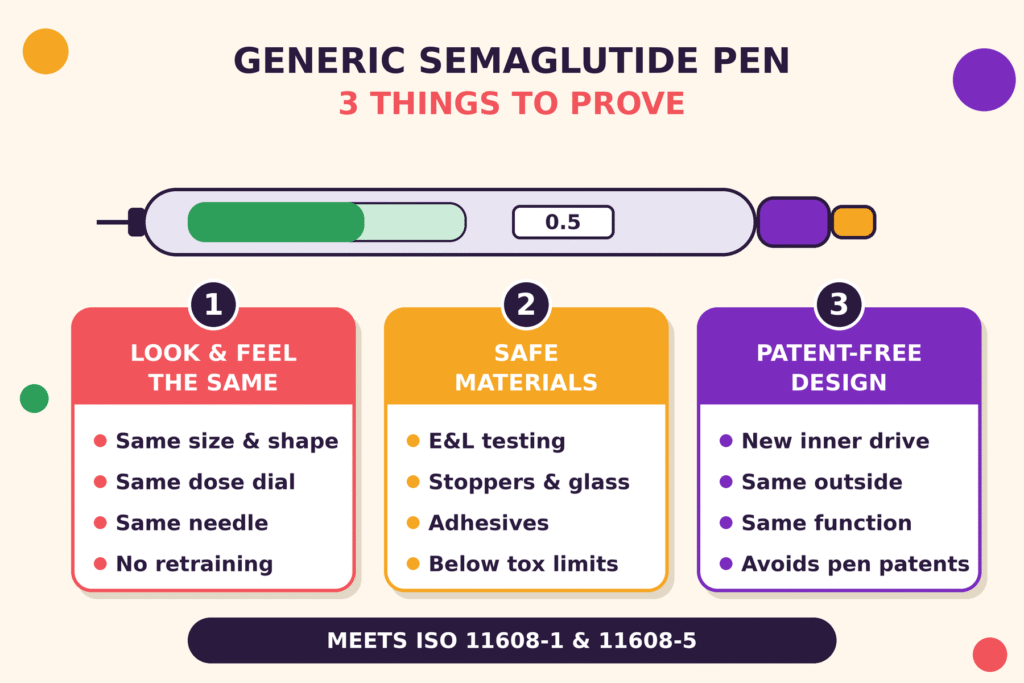
In the United States, Ozempic (NDA 209637) is supplied through a multi-use disposable pen injector with concentrations of 1.34 mg/mL, 0.68 mg/mL, and 2.68 mg/mL. In comparison, Wegovy (NDA 215256) uses a single-dose pen injector. These delivery systems require appropriate evaluation against relevant device standards, including ISO 11608-1 and ISO 11608-5.
Combination-product submissions generally require three interconnected device-development and qualification workstreams.
External Critical Design and User Interface Comparability: Generic pen devices should closely match the reference product in terms of overall dimensions, shape, dose-selector operation, dose-button functionality, and needle gauge and length. Comparative-use human factors assessments must demonstrate that the proposed device can deliver equivalent safety and clinical performance without requiring specialized patient retraining. Any differences in the user interface should be carefully assessed to determine whether they could affect dose selection, administration accuracy, or patient handling.
Extractables and Leachables (E&L) Qualification: Materials used in the delivery system, including elastomeric stoppers, glass cartridges, adhesives, and lubricants, must undergo appropriately designed extractables and leachables studies. These investigations should establish that potentially migrating compounds remain below acceptable toxicological thresholds throughout the product’s shelf life. The studies must also evaluate whether interactions between packaging materials and the peptide could contribute to oxidation, aggregation, or other forms of degradation.
Device Patent Design-Arounds: Device patent considerations are particularly important in Canada, where industry sources report that secondary pen-injector patents may remain in force until at least 2033 despite the permanent lapse of the primary compound patent. Engineering teams must therefore develop alternative internal drive mechanisms that avoid infringing protected device features while preserving the external operating principles and functionality necessary for comparable product performance.
Conclusion
Successful Generic Semaglutide Development requires a coordinated regulatory, analytical, and manufacturing strategy that captures the immediate commercial opportunities emerging in Canada and first-wave emerging markets during 2026 while addressing the increasingly demanding scientific expectations of the U.S. ANDA pathway. Sponsors pursuing Health Canada’s Division 8 ANDS route or planning expansion across Latin America, Africa, and Asia through ANVISA, CDSCO, SAHPRA, and WHO Prequalification reliance mechanisms must recognize that regulatory approval is only one component of long-term commercial success.
Early post-approval challenges, including the August 2026 Canadian OOS impurity recall, demonstrate why peptide stability, impurity monitoring, and device-packaging controls must remain central throughout product development and commercialization. A successful regulatory strategy should incorporate comprehensive analytical characterization, validated stability-indicating methods, and effective quality management systems to maintain consistent product quality throughout the proposed shelf life.
Aligning CMC dossiers with the FDA’s revised July 2026 draft PSG recommendations is equally important for companies preparing for future U.S. and European market entry. Critical development priorities include multi-lot RLD aging studies, impurity monitoring below the 0.1% reporting threshold, higher-order structure verification, and pen-injector comparability assessments conducted in accordance with applicable ISO 11608 standards. By integrating these requirements into their development programs, generic manufacturers can strengthen regulatory submissions, address complex global quality expectations, and prepare for the anticipated 2031–2032 loss-of-exclusivity opportunities in the United States and Europe.
For sponsors planning generic semaglutide development, coordinated peptide manufacturing, analytical characterization, and regulatory support can help address complex development requirements. Explore specialized peptide CDMO services.
To discuss GMP peptide characterization, ANDA sameness evaluations, extractables and leachables (E&L) studies, or impurity profiling for your semaglutide development program, contact the scientific team at ResolveMass Laboratories Inc. through the following page:
Frequently Asked Questions
By September 2026, Health Canada had authorized four generic semaglutide products from Dr. Reddy’s, Apotex, and Sandoz. These include generic Ozempic equivalents for type 2 diabetes and Apotex’s Sevmia, approved for chronic weight management in patients aged 12 years and older. Dr. Reddy’s received the first Canadian authorization on April 28, 2026, while seven additional generic applications were reportedly under review in May 2026.
Canada became accessible to generic manufacturers because Novo Nordisk’s primary compound patent had permanently lapsed in 2019 and was not listed in the Canadian Patent Register. Once data protection expired on January 4, 2026, generic applicants could proceed without the usual 24-month PM(NOC) litigation stay. In contrast, U.S. patent protection extends until December 5, 2031, and confidential settlements suggest that generic market entry may occur around 2032.
Yes, the FDA’s revised draft Product-Specific Guidances issued on July 28, 2026, cover semaglutide APIs manufactured through synthetic, semi-synthetic, and recombinant processes. The updated guidance documents, PSG_209637 for Ozempic and PSG_215256 for Wegovy, establish the applicable comparative requirements for these manufacturing approaches. Applicants using recombinant processes must additionally demonstrate adequate control of host-cell proteins (HCPs) and residual host-cell DNA.
The FDA’s July 2026 draft PSGs recommend reporting active ingredient-related impurities exceeding 0.1% and identifying those present above 0.5%. Common impurities should remain within the RLD level or 1.0%, whichever is greater, while newly identified impurities should be controlled below 1.0%. Additionally, the total concentration of impurities exceeding 0.1% should not be higher than the corresponding total impurity level in the RLD.
A generic semaglutide injection may qualify for an in vivo bioequivalence waiver by demonstrating pharmaceutical equivalence, active ingredient sameness, and appropriate formulation comparability. Under 21 CFR 320.22(b)(1), Q1 qualitative sameness and Q2 quantitative sameness within ±5% can support the waiver for eligible formulations. Any differences involving preservatives, buffers, or antioxidants must be scientifically justified in accordance with 21 CFR 314.94(a)(9)(iii).
Health Canada issued a Type II retail-level recall (RA-82537) on August 26–27, 2026, covering all lots of Dr. Reddy’s Semaglutide Injection under DIN 02567806 and DIN 02567814. The action followed the identification of an impurity that exceeded its specified acceptance limit. Financial reports also highlighted a separate packaging and labelling issue that affected Canadian product availability before the anticipated November 2026 relaunch.
The expiration of semaglutide’s primary compound patent does not immediately eliminate other regulatory restrictions in China and Mexico. China maintains data protection until approximately April 2027 under the China–Switzerland Free Trade Agreement and requires full clinical studies for synthetic and recombinant semaglutide applications. Mexico remains protected by a court-granted 10-year data exclusivity period extending until approximately July 2029, although generic manufacturers continue to challenge this restriction.
WHO Prequalification offers a structured regulatory assessment pathway for generic semaglutide, supported by specific submission guidance and the Active Pharmaceutical Ingredient Master File (APIMF) procedure. The Stringent Regulatory Authority Collaborative Registration Procedure (SRA CRP) also enables participating countries to use previous assessments conducted by recognized regulatory authorities. These reliance mechanisms can reduce duplicated reviews and support faster registration across approximately 50 participating countries, including African countries involved in African Medicines Agency reliance initiatives.
Generic semaglutide developers must establish molecular and structural comparability through peptide mapping, higher-order structure characterization, and oligomer and aggregate profiling. Comparative biological activity testing may also be necessary, depending on the scientific justification, with assessments involving at least three generic batches and three appropriately aged RLD batches. Pen-injector development additionally requires ISO 11608 performance testing, extractables and leachables (E&L) evaluation, and comparative-use human factors studies to demonstrate reliable dosing, device safety, and patient usability.
Reference:
- Health Canada. (2026, June 29). Canada approves first generic semaglutide for weight loss. https://www.canada.ca/en/health-canada/news/2026/06/canada-approves-first-generic-semaglutide-for-weight-loss.html
- Health Canada. (2026, May 1). Canada approves second generic semaglutide, the first G7 country to do so. https://www.canada.ca/en/health-canada/news/2026/05/canada-approves-second-generic-semaglutide-the-first-g7-country-to-do-so.html
- Health Canada. (2026, August 27). Semaglutide Injection: Out-of-Specification (Impurity) Recall RA-82537. https://recalls-rappels.canada.ca/en/alert-recall/semaglutide-injection-out-specification-impurity
- U.S. Food and Drug Administration. (2026, July 28). FDA Publishes Revised Draft Product-Specific Guidances for Certain Generic Peptide Products. https://www.fda.gov/drugs/drug-alerts-and-statements/fda-publishes-revised-draft-product-specific-guidances-certain-generic-peptide-products
- U.S. Food and Drug Administration. (2026, November 9). FDA Requires Safety Labeling Changes for Glucagon-Like Peptide-1 Receptor Agonists (GLP-1 RAs) Due to Potential Increased Risk of Rare But Serious Eye Condition. https://www.fda.gov/drugs/drug-safety-communications/fda-requires-safety-labeling-changes-glucagon-peptide-1-receptor-agonists-glp-1-ras-due-potential
- Health Canada. Notice: Guidance for Industry – Pharmaceutical Quality of Aqueous Solutions. https://www.canada.ca/en/health-canada/services/drugs-health-products/drug-products/applications-submissions/guidance-documents/chemical-entity-products-quality/notice-guidance-industry-pharmaceutical-quality-aqueous-solutions.html
- Health Canada Drug and Health Product Portal. (2026, April 28). Regulatory Decision Summary: Semaglutide Injection (Control Number 279513). https://dhpp.hpfb-dgpsa.ca/review-documents/resource/RDS1776954365092
- U.S. Food and Drug Administration. (2026, July). Draft Guidance on Semaglutide (NDA 209637, Ozempic). https://www.accessdata.fda.gov/drugsatfda_docs/psg/PSG_209637.pdf
Get In Touch With Us
About The Author