

Introduction
Demonstrating bioequivalence for a Generic Topical Semisolid ANDA requires a comprehensive assessment of qualitative (Q1), quantitative (Q2), and structural (Q3) sameness, together with comparable in vitro drug release and cutaneous permeation performance against the Reference Listed Drug (RLD). This comparative in vitro characterization approach enables applicants to pursue generic drug approval through biowaivers, thereby reducing reliance on costly and highly variable clinical endpoint trials.
The regulatory approach for Abbreviated New Drug Applications (ANDAs) involving complex topical semisolids—including creams, ointments, gels, and lotions—has increasingly emphasized detailed non-clinical characterization. FDA guidance developments addressing physicochemical and structural (Q3) characterization, In Vitro Release Testing (IVRT), and In Vitro Permeation Testing (IVPT) have established important pathways for demonstrating generic equivalence. Since semisolid products are heterogeneous, multi-phase systems, relatively small differences in excipient source, grade, phase addition sequence, processing temperature, or manufacturing shear can influence the microstructural organization of the formulation (Q3). Such structural differences can subsequently affect the thermodynamic activity of the active pharmaceutical ingredient (API), vehicle metamorphosis, and cutaneous absorption behavior. This case study explores the analytical, formulation, and regulatory strategies necessary to demonstrate formulation equivalence, dissolution sameness, and bioequivalence for complex generic topical semisolids.
Explore Comparative Testing Between Generic and RLD Services to establish equivalence and support your regulatory filings.
Share via:
Article Summary:
- Generic topical semisolid ANDAs require comprehensive demonstration of Q1, Q2, and Q3 sameness, along with comparable in vitro release and permeation performance to the Reference Listed Drug (RLD).
- Q1 sameness confirms identical qualitative composition, while Q2 sameness requires component concentrations to generally remain within ±5% of the RLD. Advanced deformulation using HPLC-CAD, GC-MS, NMR, and ICP-MS helps establish formulation similarity.
- Q3 sameness evaluates the formulation’s physical and microstructural properties, including rheology, globule/particle size, thermal behavior, polymorphic form, pH, density, and water activity. These properties can directly affect drug release and absorption.
- IVRT (In Vitro Release Testing) measures drug release through a synthetic membrane using diffusion cells. Key requirements include appropriate linearity, precision, membrane inertness, robustness, and discriminatory capability. FDA acceptance generally uses a 90% CI of 75.00%–133.33% for comparative release rates.
- IVPT (In Vitro Permeation Testing) evaluates drug permeation through human dermatomed skin and measures parameters such as maximum flux (Jmax) and total mass permeated (AMT). Bioequivalence is generally assessed using a 90% CI of 80.00%–125.00%.
- Common regulatory deficiencies include poor IVRT discriminatory power, uncontrolled skin-donor variability, and incomplete rheological characterization. Proper skin-barrier screening and comprehensive structural testing are therefore essential.
- A scientifically robust Q1/Q2/Q3 + IVRT + IVPT strategy can support an in vitro characterization-based biowaiver, potentially reducing the need for costly clinical endpoint studies while demonstrating therapeutic equivalence and supporting ANDA approval.
Achieving Q1 and Q2 Sameness in Generic Topical Semisolid ANDA Submissions
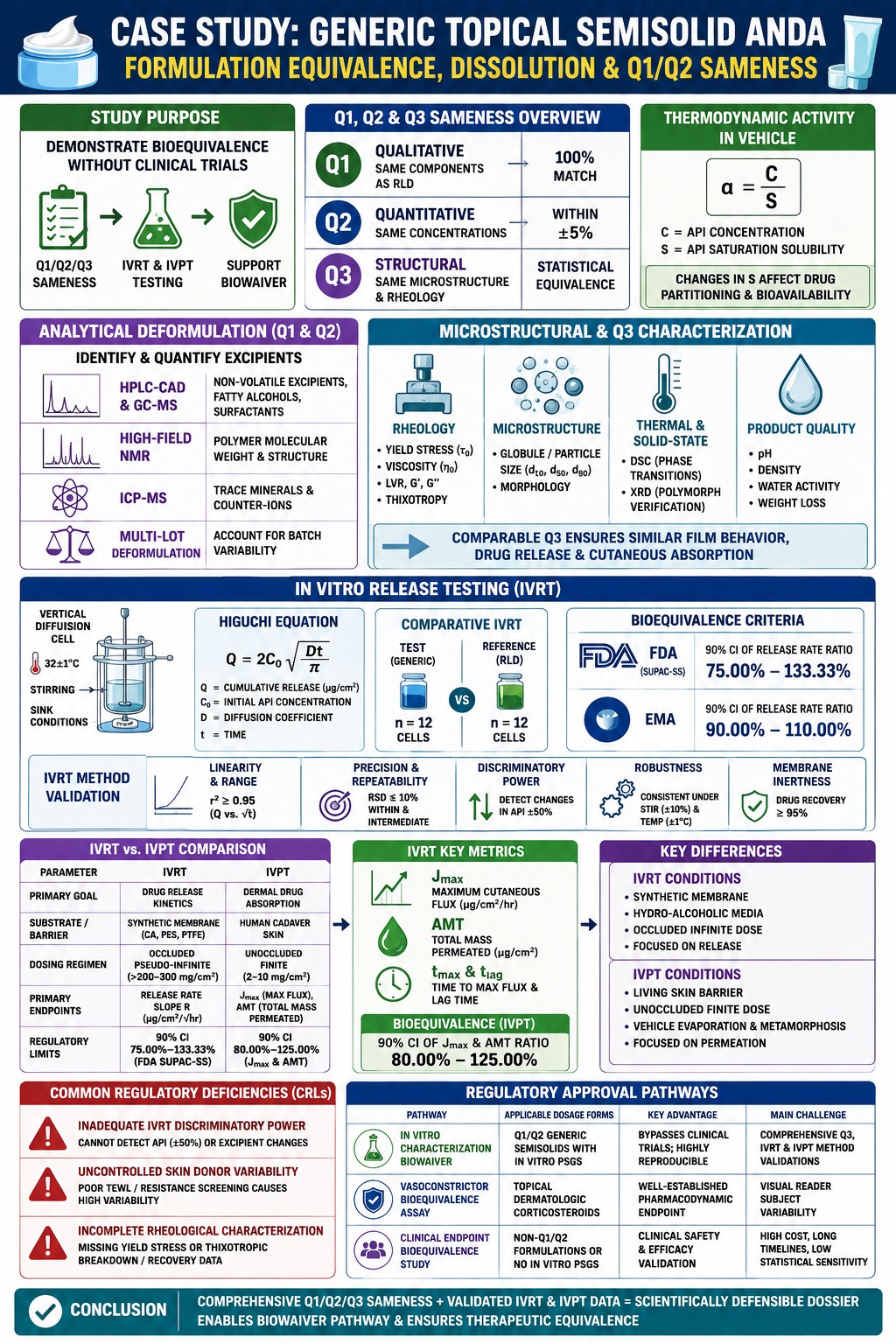
Establishing Q1 and Q2 sameness in a Generic Topical Semisolid ANDA requires comprehensive identification of each inactive ingredient and alignment of its concentration within a strict ±5% threshold relative to the Reference Listed Drug formulation. Advanced analytical deformulation techniques can separate and characterize excipient grades, polymer chain distributions, and surfactant ratios, helping confirm that the active pharmaceutical ingredient maintains comparable solubility and thermodynamic activity within the generic vehicle.
Deformulation (reverse engineering) of several RLD production lots is important for accounting for normal commercial batch-to-batch variability and for establishing appropriate target formulation constraints. Analytical characterization typically incorporates complementary, orthogonal separation techniques, including:
- High-Performance Liquid Chromatography with Charged Aerosol Detection (HPLC-CAD) and Gas Chromatography-Mass Spectrometry (GC-MS) can be used to isolate and quantify non-volatile excipients, fatty alcohols, and complex surfactants.
- High-Field Nuclear Magnetic Resonance (NMR) spectroscopy can characterize polymer molecular weight distributions and structural substitution patterns.
- Inductively Coupled Plasma Mass Spectrometry (ICP-MS) can quantify residual trace minerals and counter-ions.
Learn how advanced Impurity Profiling Services provide precise identification and quantification for your submissions.
For topical semisolids, simply reproducing the nominal composition is frequently not sufficient to establish equivalence. Excipients such as petrolatum bases, emulsifying waxes, carbomers, and polysorbates may consist of chemically complex mixtures rather than individual, well-defined entities. For example, replacing a cetostearyl alcohol supplier with another source that has a different cetyl-to-stearyl alcohol ratio, or using a carbomer with a different crosslinking density, can change the structure and properties of the vehicle matrix. These differences can influence the API thermodynamic activity (a), which is described by the following relationship:
a = C/S
where C represents the API concentration in the vehicle and S represents the API saturation solubility limit in that vehicle. Any change in S can modify the thermodynamic driving force responsible for drug partitioning from the vehicle into the stratum corneum. As a result, changes in vehicle composition or structure may influence in vivo bioavailability even when the nominal Q1 and Q2 characteristics meet the specified requirements.
Partner with experts through Generic Peptide & Oligonucleotide Projects for robust analytical and characterization support.
| Parameter Category | Regulatory Scope & Sameness Definition | Primary Analytical Instrumentation | Target Regulatory Threshold |
|---|---|---|---|
| Q1 (Qualitative Sameness) | Identical active and inactive components as the RLD vehicle. | High-Field NMR, FT-IR, HPLC-MS, GC-MS | 100% qualitative component match |
| Q2 (Quantitative Sameness) | Identical concentrations of active and inactive components. | HPLC-UV/CAD, GC-FID, Karl Fischer, Titration | Within ±5% of RLD target concentrations |
| Q3 (Structural Sameness) | Identical physical state, microstructure, and rheological profile. | Rheometers, XRD, DSC, Laser Diffraction Particle Sizers | Statistical equivalence across structural profiles |
Microstructural Characterization and Q3 Sameness for Complex Semisolids
Demonstrating Q3 microstructural sameness establishes that the generic topical formulation possesses comparable physical state, phase microstructure, and rheological flow characteristics to the Reference Listed Drug. Assessment of parameters such as yield stress, linear viscoelasticity, globule size distribution, and thermal phase behavior helps determine whether manufacturing-related differences could influence post-application film behavior and active drug release.
FDA guidance documents call for comprehensive physical characterization of complex semisolid vehicles. Important physical attributes evaluated as part of Q3 characterization include:
- Rheological Profiling: Evaluation of yield stress (τ₀), zero-shear viscosity (η₀), linear viscoelastic region (LVR), storage and loss moduli (G’ and G”), loss factor (tan δ = G”/G’), and thixotropic shear-thinning recovery kinetics.
- Microstructure & Phase State: Determination of emulsion globule or solid particle size distribution parameters (d₁₀, d₅₀, d₉₀ via laser diffraction), together with assessment of morphological structure.
- Thermal & Solid-State Characterization: Determination of phase transition temperatures and enthalpy changes using Differential Scanning Calorimetry (DSC), along with verification of the API polymorphic form using X-ray Powder Diffraction (XRD).
- General Product Quality Attributes: Measurement of pH, density/specific gravity, water activity (a₍w₎), and weight loss profiles associated with evaporation.
Read about Mass Spectrometry Approaches for Charge Variant Analysis to streamline your characterization strategy.
Rheological behavior has a direct influence on topical drug delivery. When a generic emulsion has a lower yield stress or undergoes structural breakdown more rapidly than the RLD, the applied dose may spread into a thinner surface layer. Differences in film thickness can modify the surface area-to-volume ratio and consequently influence the rate at which volatile solvents evaporate. Such changes can modify localized API concentration gradients, potentially promoting premature drug crystallization or changing flux across the cutaneous barrier. Therefore, demonstrating comparable Q3 characteristics helps establish that the generic formulation exhibits behavior equivalent to the reference product under physiological conditions.
Discover solutions for Biosimilar Characterization Using Mass Spectrometry to ensure comprehensive structural validation.
In Vitro Release Testing (IVRT) Method Development and Validation
In vitro release testing (IVRT) measures the rate at which an active drug is released from a topical vehicle through an inert synthetic membrane and into a receptor medium under steady-state sink conditions. Method validation according to USP guidelines requires evaluation of linear Higuchi release kinetics, precision, membrane inertness, robustness, and sufficient discriminatory capability to identify relatively small differences in formulation performance.
IVRT is commonly performed using Vertical Diffusion Cell (VDC / Franz cell) systems equipped with controlled temperature jackets maintained at 32±1°C and continuous magnetic stirring. The receptor solution must maintain sink conditions so that the final API concentration remains below 10–30% of its saturation limit throughout the study. Synthetic membranes, including polyethersulfone (PES), cellulose acetate (CA), and polytetrafluoroethylene (PTFE), are selected according to their suitability and inertness, with studies demonstrating greater than 95% API recovery and no rate-limiting transport resistance.
Cumulative drug release per unit area (Q) from a pseudo-infinite dose can be described using the Higuchi equation:
Q = 2 C₀ √(Dt/π)
where C₀ represents the initial API concentration in the formulation, D represents the API diffusion coefficient, and t represents time. The principal experimental parameter is the release rate (R), calculated as the slope obtained by plotting Q against the square root of time (√t). A linear regression coefficient of r² ≥ 0.95 is required across 5 to 6 sampling points.
Check out specialized Generic Peptide Semaglutide Projects for tailored analytical and bioequivalence support.
Comparative IVRT assessments evaluate 12 cells containing the proposed Generic product against 12 cells containing the Reference standard. Under FDA SUPAC-SS and current draft guidance criteria, bioequivalence is established when the 90% confidence interval for the ratio of median release rates between the Test and Reference products falls strictly within 75.00%–133.33%. European regulatory standards (EMA) apply a narrower acceptance interval of 90.00%–110.00%.
Accelerate your timelines with dedicated Liraglutide Generic Development Services.
| Validation Parameter | Objective & USP Acceptance Criteria | Experimental Execution Strategy |
|---|---|---|
| Linearity & Range | r² ≥ 0.95 for Q vs. √t over designated time points. | Evaluate 5–6 sampling intervals across a 4-to-6-hour study duration. |
| Precision & Repeatability | Within-run and intermediate RSD ≤ 10% across diffusion cells. | Control cell orifice dimensions, stirring speeds, and temperature (32±1°C). |
| Method Discriminatory Power | Differentiate release rates of altered formulations. | Compare test release rates against altered API concentrations (±50%). |
| Method Robustness | Release rate remains consistent under small operational shifts. | Evaluate deliberate perturbations in stir rate (±10%) and temperature (±1°C). |
| Membrane Inertness | Drug recovery from membrane immersion ≥95%. | Verify zero API adsorption and absence of matrix interference. |
Bridging Dissolution to Cutaneous Absorption: Comparative IVRT vs. IVPT Analysis
In Vitro Permeation Testing (IVPT) complements IVRT by determining the rate and extent of active drug permeation through human dermatomed skin into systemic or dermal sampling compartments. Whereas IVRT primarily evaluates formulation release from a non-biological system, IVPT provides information about skin partitioning, unoccluded vehicle metamorphosis, and stratum corneum permeation kinetics under finite-dose conditions.
IVPT studies use dermatomed human cadaver skin mounted on Franz diffusion cells under unoccluded finite dosing conditions (2–10 mg/cm²). Important pharmacokinetics-equivalent metrics derived from IVPT flux profiles include:
- Maximum Cutaneous Flux (J₍max₎): The peak permeation rate expressed per unit area per hour.
- Total Mass Permeated (AMT): The cumulative mass absorbed across the skin over the study period.
- Time to Maximum Flux (t₍max₎) and Lag Time (t₍lag₎): Parameters used to characterize absorption kinetics.
Statistical bioequivalence requires the 90% confidence intervals for the geometric mean ratios of J₍max₎ and AMT between the Test and Reference products to remain within the standard 80.00%–125.00% acceptance range.
Need LC-MS characterization to establish product comparability? Learn how to Prove Biosimilarity Using LC-MS.
Formulations that demonstrate comparable Q1, Q2, and Q3 characteristics and meet IVRT requirements may nevertheless exhibit different IVPT profiles. IVRT uses synthetic membranes, hydro-alcoholic receptor media, and occluded infinite dosing conditions that limit vehicle evaporation. In contrast, IVPT evaluates unoccluded metamorphosis on living skin tissue, where volatile solvent loss may produce transient API supersaturation, vehicle component co-permeation, and modification of stratum corneum lipids. The combined application of IVRT and IVPT analytical methodologies enables developers to distinguish formulation release behavior from the mechanisms governing permeation through the biological barrier.
Explore comprehensive Biosimilar Comparability Studies for complete regulatory compliance.
| Experimental Parameter | In Vitro Release Testing (IVRT) | In Vitro Permeation Testing (IVPT) |
|---|---|---|
| Primary Goal | Assesses drug release kinetics and vehicle quality. | Evaluates rate and extent of dermal drug absorption. |
| Substrate / Barrier | Synthetic porous membrane (e.g., CA, PES, PTFE). | Excised human dermatomed cadaver skin. |
| Dosing Regimen | Occluded pseudo-infinite dose (>200–300 mg/cm²). | Unoccluded finite dose (2–10 mg/cm²). |
| Primary Endpoints | Steady-state release rate slope R (µg/cm²/√hr). | Maximum Flux (J₍max₎), Total Mass Permeated (AMT). |
| Regulatory Limits | 90% CI within 75.00%–133.33% (FDA SUPAC-SS). | 90% CI within 80.00%–125.00% (J₍max₎ and AMT). |
Case Study Synthesis: Navigating Regulatory Deficiencies in Generic Topical Semisolid ANDA Filings
Successful submission of a Generic Topical Semisolid ANDA requires applicants to proactively identify and address common regulatory deficiencies involving inadequate IVRT discriminatory capability, excessive skin donor variability in IVPT, and rheological non-conformance. Combining qualitative deformulation, detailed structural profiling, and validated diffusion cell testing provides a scientifically defensible dossier to support a biowaiver-based regulatory strategy.
FDA complete response letters (CRLs) associated with topical generic applications may identify specific analytical and methodological deficiencies, including:
- Inadequate IVRT Discriminatory Power: Failure to demonstrate that the IVRT assay can identify meaningful changes in API concentration (±50%) or detect relevant excipient modifications.
- Uncontrolled Skin Donor Variance: Inadequate pre-screening of skin barrier integrity through Transepidermal Water Loss (TEWL) or electrical resistance testing, resulting in excessive intra- and inter-donor variability during IVPT studies.
- Incomplete Rheological Characterization: Failure to include thixotropic breakdown/recovery assessments or yield stress measurements, leaving post-application film dynamics insufficiently characterized.
The appropriate regulatory submission pathway is determined by factors such as dosage form complexity, corticosteroid classification, and the availability of applicable FDA Product-Specific Guidances (PSGs).
Seeking characterization services for complex synthetic peptides like Lanreotide? Discover specialized Lanreotide Generic Development Services.
| Regulatory Approval Pathway | Applicable Dosage Forms | Core Approval Advantages | Primary Development Challenges |
|---|---|---|---|
| In Vitro Characterization Biowaiver | Q1/Q2 generic semisolids with published in vitro PSGs. | Bypasses human clinical trials; highly reproducible. | Requires comprehensive Q3, IVRT, and IVPT method validations. |
| Vasoconstrictor Bioequivalence Assay | Topical dermatologic corticosteroids. | Well-established pharmacodynamic blanching endpoint. | Susceptible to visual reader subject variability. |
| Clinical Endpoint Bioequivalence Study | Non-Q1/Q2 formulations or products lacking in vitro PSGs. | Provides clinical safety and efficacy validation. | High financial cost, long timelines, low statistical sensitivity. |
Conclusion
The successful development and regulatory approval of a Generic Topical Semisolid ANDA require a rigorous, science-based demonstration of Q1, Q2, and Q3 equivalence, supported by robust IVRT and IVPT analytical data. By demonstrating physical, structural, and physiological sameness, drug sponsors can pursue characterization-based biowaivers that may facilitate market entry while maintaining therapeutic equivalence.
As regulatory authorities increasingly emphasize in vitro biowaivers for complex generic products, successful development depends on advanced deformulation, precise rheological control, and appropriately validated diffusion testing. Integrating comprehensive Q1/Q2/Q3 matching with validated IVRT release profiles and IVPT permeation kinetics creates a complete and scientifically defensible dossier for regulatory assessment.
Need comprehensive mass spectrometry or intact mass testing to support your drug development pipeline? Learn more about Intact Mass Analysis Services to get started.
To discuss specialized topical formulation deformulation, Q3 rheological characterization, or validated IVRT/IVPT study design, contact the analytical team via the ResolveMass Laboratories Contact Page.
Frequently Asked Questions (FAQs)
For comparative IVRT under FDA SUPAC-SS, the 90% confidence interval for the ratio of median release rates between the Test and Reference products is evaluated against the 75.00%–133.33% acceptance range. European regulatory expectations may apply a narrower 90.00%–110.00% interval. The applicable acceptance criterion should always be confirmed against the current regulatory guidance for the specific product.
IVRT evaluates how efficiently the drug is released from the formulation through an inert synthetic membrane and does not reproduce the biological barrier properties of human skin. IVPT provides additional information about drug partitioning and permeation through dermatomed human skin under finite-dose conditions. Therefore, IVPT can help identify differences in skin permeation that may not be apparent from IVRT results alone.
Synthetic membrane selection for IVRT involves demonstrating that the membrane is compatible with the formulation and does not significantly interact with the API. The selected membrane should provide adequate drug recovery, minimal or no drug adsorption, and no meaningful rate-limiting resistance to drug transport. Materials such as PES and CA can be evaluated based on these performance characteristics.
Rheological testing provides important information about how a topical semisolid flows, spreads, deforms, and recovers after applied stress. Parameters such as yield stress, zero-shear viscosity, viscoelastic moduli, and thixotropic recovery can reveal differences in formulation microstructure. Comparable rheological behavior supports the conclusion that the generic formulation may exhibit similar spreading and post-application film characteristics to the RLD.
The discriminatory capability of an IVRT method is demonstrated by deliberately introducing meaningful formulation changes and determining whether the method can distinguish their effects on drug release. These changes may include variations in API concentration or modifications to selected excipient levels. A suitable method should generate measurable and scientifically interpretable differences when the formulation is intentionally altered.
Maintaining sink conditions prevents the receptor phase from becoming saturated with the released API during the experiment. The receptor concentration is generally maintained well below its saturation solubility so that drug release continues without significant resistance from accumulation in the receiving phase. This supports reliable measurement of the formulation’s release kinetics and helps minimize the possibility of back-diffusion.
An in vitro biowaiver may be considered when the product satisfies the applicable regulatory requirements for formulation sameness and in vitro performance. Depending on the specific product and FDA Product-Specific Guidance, this can involve demonstrating Q1 and Q2 sameness, appropriate Q3 characterization, and comparable IVRT and/or IVPT results. The precise evidence required depends on the dosage form and the regulatory pathway established for the particular product.
Vehicle metamorphosis describes the physical and chemical changes that occur in a topical formulation after it is applied to the skin. Evaporation of volatile components can modify API solubility, vehicle composition, and thermodynamic activity, potentially changing the driving force for drug partitioning into the stratum corneum. These changes can consequently influence the rate and extent of cutaneous permeation observed during IVPT.
Before an IVPT experiment begins, excised human dermatomed skin should be evaluated to confirm that its barrier function is suitable for the study. Transepidermal Water Loss (TEWL) and electrical resistance or impedance measurements can be used to identify specimens with compromised barrier integrity. Excluding damaged skin samples helps reduce donor-related variability and improves the reliability and interpretability of permeation results.
Reference:
- U.S. Food and Drug Administration. (2022). Product-specific guidances for generic drug development: Draft guidance. https://www.fda.gov/media/162471/download
- Srinivas, C., et al. (2023). Utility of in vitro release testing (IVRT) to assess “sameness” of clotrimazole creams for use as a biowaiver. International Journal of Pharmaceutics, 644, 123280. https://www.researchgate.net/publication/375180437_Utility_of_in_vitro_release_testing_IVRT_to_assess_’sameness’_of_1_clotrimazole_creams_for_use_as_a_biowaiver
- Akhgari, A., Shakib, M., & Siahi-Shadbad, M. R. (2020). Assessment of sameness and/or differences between marketed creams containing miconazole nitrate using a discriminatory in vitro release testing (IVRT) method. Journal of Pharmaceutical Sciences, 109(5), 1698–1705. ResearchGate
- Akhgari, A., Shakib, M., & Siahi-Shadbad, M. R. (2020). Assessment of sameness and/or differences between marketed creams containing miconazole nitrate using a discriminatory in vitro release testing (IVRT) method. Journal of Pharmaceutical Sciences, 109(5), 1698–1705. ResearchGate figure/table
- Szoleczky, R., Budai-Szűcs, M., Csányi, E., Berkó, S., Tonka-Nagy, P., Csóka, I., & Kovács, A. (2022). Analytical quality by design (AQbD) approach to the development of in vitro release test for topical hydrogel. Pharmaceutics, 14(4), 707. https://doi.org/10.3390/pharmaceutics14040707
Get In Touch With Us
About The Author


