


Introduction:
Host Cell Protein Analysis for Biosimilars sits at the intersection of process development and regulatory strategy, since residual host-cell proteins are among the impurities regulators scrutinize most closely when reviewing a biosimilar’s comparability package. Every biosimilar is manufactured through its own cell line, culture process, and purification scheme, which means its HCP population will never be a perfect match to the reference product’s — the question regulators ask isn’t whether the profiles are identical, but whether any differences are understood, controlled, and shown not to affect safety or efficacy.
Two analytical techniques anchor most HCP testing programs: ELISA, which delivers fast and highly sensitive total-HCP quantification for routine release and clearance monitoring, and LC-MS/MS, which identifies and characterizes the individual proteins that make up that residual population. Neither method alone tells the complete story. This article walks through how each technique works, where they complement one another, what factors influence HCP results, and how a well-structured HCP analytical strategy fits into the broader biosimilar development lifecycle — from cell-line selection through commercial lot release.
Summary:
- Host Cell Protein Analysis for Biosimilars is an important component of process-related impurity characterization and comparative analytical assessment for biosimilar development.
- HCPs are proteins originating from the host cells (CHO, E. coli, yeast, insect cells, etc.) used to manufacture a therapeutic protein, and they are classified as process-related impurities.
- HCP ELISA provides sensitive measurement of total residual immunoreactive HCP and remains the primary method for routine lot-release and clearance monitoring.
- LC-MS/MS complements ELISA by identifying and characterizing individual HCP species, including high-risk proteins that a given antibody panel may under-represent.
- Combining ELISA and LC-MS/MS provides broader, orthogonal analytical evidence than either technique alone and is increasingly expected for biosimilar comparability packages.
- HCP testing supports process development, purification optimization, comparability studies, process-change evaluation, and CMC documentation across the biosimilar lifecycle.
- ResolveMass Laboratories can support biosimilar developers with HCP ELISA testing, LC-MS/MS characterization, method development, comparative profiling, and technical/regulatory reporting.
1: What Is Host Cell Protein Analysis for Biosimilars?
Host Cell Protein Analysis for Biosimilars measures residual proteins originating from the cells used to manufacture a therapeutic protein. HCPs are considered process-related impurities and may remain in the final drug substance or drug product following downstream purification.
Host cells such as CHO cells, E. coli, yeast, insect cells, and other expression systems generate thousands of endogenous proteins during production. Some are removed effectively during downstream processing, while others persist because of their abundance, physicochemical properties, or interactions with the therapeutic protein itself. How the expression system is selected and developed in the first place has a direct bearing on the resulting HCP population — see our overview of cell line development for biosimilars for how upstream choices shape downstream impurity risk.
For biosimilars specifically, HCP analysis is particularly important because the proposed biosimilar may use a different cell line, expression system, culture process, purification process, or manufacturing site than the reference product. Regulators don’t expect an identical HCP profile — they expect a scientifically justified assessment showing any differences don’t compromise safety.
HCP analysis helps answer several practical development questions:
- Are residual HCPs effectively controlled?
- Is the purification process providing adequate HCP clearance?
- Does the proposed biosimilar have a comparable HCP profile to the reference product?
- Are specific HCPs enriched following a manufacturing change?
- Does the analytical method provide sufficient coverage and sensitivity?
- Are there process-specific HCPs that require further investigation?
ICH Q6B identifies host-cell proteins as cell-substrate-derived process-related impurities and recommends sensitive analytical approaches for their detection.
2: Why Is HCP Analysis Important in Biosimilar Development?
HCP analysis is important because residual host-cell proteins can be difficult to remove completely and may potentially affect product quality, stability, and safety. For biosimilars, analytical similarity is a fundamental part of demonstrating the proposed product is highly similar to the reference product, and HCP data feed directly into that similarity assessment — see our broader comparability exercise in biosimilar development framework for how HCP data fits alongside other comparability endpoints.
HCP analysis can support:
- Cell-line and upstream process development
- Downstream purification development
- Process characterization and scale-up
- Process validation
- Comparability studies
- Manufacturing-change assessments
- Biosimilar analytical similarity studies
- CMC documentation and regulatory submissions
The objective should not be limited to obtaining one HCP concentration. Developers should consider both the overall level of HCP and, where scientifically justified, the identity and distribution of individual HCP species. If a program’s analytical strategy hasn’t accounted for this distinction, it is worth reviewing our guide on why biosimilars fail regulatory approval, since incomplete impurity characterization is a recurring theme in review deficiencies.
3: HCP ELISA vs. LC-MS/MS: What Is the Difference?
HCP ELISA primarily provides an aggregate measurement of immunoreactive residual HCP, whereas LC-MS/MS provides information about individual HCP proteins based on their characteristic peptides and mass-spectrometric signals.
| Parameter | HCP ELISA | LC-MS/MS |
|---|---|---|
| Primary purpose | Total HCP quantification | HCP identification and characterization |
| Principle | Antibody-based immunoassay | LC separation and tandem mass spectrometry |
| Main output | HCP concentration | Individual HCP identification and relative/quantitative information |
| Individual HCP identification | Limited | Strong capability |
| Antibody coverage | Important consideration | Not applicable in the same way |
| Process-specific HCP investigation | Limited | Highly useful |
| Routine monitoring | Commonly used | Often complementary |
| Comparability studies | Useful | Valuable for detailed characterization |
| Orthogonal information | Immunochemical | Mass-spectrometric |
These techniques should generally be viewed as complementary rather than competing approaches, each answering a different question about the same residual HCP population.
4: How Does HCP ELISA Work?
HCP ELISA uses antibodies generated against host-cell proteins to capture and detect residual HCPs in a biological drug sample, and the choice between a generic platform kit and a process-specific reagent shapes how representative that measurement is.
There are two broad categories of HCP ELISA:
| ELISA Type | Description | Typical Use Case |
|---|---|---|
| Platform/Generic ELISA | Commercial kit raised against a generic null-cell-line HCP pool (e.g., generic CHO HCP) | Early-phase development, rapid screening, when process-specific reagents aren’t yet available |
| Process-Specific ELISA | Custom antibody raised against HCPs from the sponsor’s own null cell line and process | Late-stage development and commercial lot release; preferred for pivotal comparability studies |
A typical HCP ELISA workflow involves:
- Preparation of an appropriate HCP reference standard
- Addition of the test sample to the assay
- Capture of HCPs using specific antibodies
- Detection of captured HCPs using an immunochemical detection system
- Comparison against a calibration curve
- Calculation of residual HCP concentration
- Evaluation against predefined process or product requirements
One of the most important considerations is antibody coverage. HCP ELISA does not necessarily detect every HCP equally — some proteins generate a strong response, while others have weak or limited immunoreactivity depending on their abundance, structure, and representation in the immunogen used to raise the antibodies.
Key HCP ELISA method parameters typically evaluated include specificity, accuracy, precision, sensitivity, limit of detection, limit of quantification, range, dilutional linearity, spike recovery, matrix effects, sample dilution, reference-standard suitability, antibody coverage, and robustness. For biosimilars, these factors are especially important when the proposed product is manufactured using a different host-cell system or manufacturing process than the reference product.
5: How Does LC-MS/MS Detect Host Cell Proteins?
LC-MS/MS detects HCPs by converting proteins into peptides through enzymatic digestion, separating the peptides using liquid chromatography, and detecting them using tandem mass spectrometry.
A simplified workflow looks like this: protein sample → enzymatic digestion → LC separation → MS/MS acquisition → database searching → HCP identification → relative or quantitative assessment.
Unlike an aggregate ELISA result, LC-MS/MS can help identify:
- Specific residual HCPs
- Process-specific HCPs
- HCPs that increase after a manufacturing change
- HCPs associated with particular purification fractions
- HCPs that persist through downstream processing
- Differences in HCP profiles between manufacturing processes
- Differences between proposed biosimilar and reference-product samples
USP General Chapter <1132.1> discusses residual HCP measurement using LC-MS and recognizes the ability of LC-MS approaches to provide information about the identity and amount of individual HCPs.
6: Why Combine HCP ELISA and LC-MS/MS for Biosimilars?
Combining HCP ELISA and LC-MS/MS provides complementary information — ELISA delivers sensitive overall quantification, while LC-MS/MS delivers molecular-level identity and distribution data for the residual HCP population.
HCP ELISA provides:
- Sensitive overall HCP measurement
- Routine process monitoring
- Purification-clearance assessment
- Batch-to-batch trending
- Quantification of residual immunoreactive HCP
LC-MS/MS provides:
- Individual HCP identification
- Molecular characterization
- Process-specific HCP investigation
- Detailed HCP profiling
- Orthogonal assessment of HCP clearance
- Additional information for comparative analytical studies
This combined approach helps developers understand whether an observed difference between lots or processes is simply a change in total HCP concentration, or whether it reflects a meaningful change in the composition of the residual HCP population — including individual HCPs with known risk implications for product stability or immunogenicity.
7: HCP Analysis for Comparative Analytical Assessment
HCP analysis contributes directly to the comparative analytical assessment that underpins a biosimilar filing. FDA’s guidance on therapeutic protein biosimilars emphasizes comparative analytical assessment as a core development component, and differences in manufacturing processes and expression systems can influence process-related impurities, including host-cell-derived proteins.
Comparative HCP studies may include:
| Comparative Element | Example Assessment |
|---|---|
| Total HCP | HCP ELISA concentration |
| HCP profile | LC-MS/MS profiling |
| HCP clearance | Analysis of process intermediates and final material |
| Individual HCPs | Targeted or broader MS assessment |
| Manufacturing consistency | Multiple lots |
| Reference comparison | Side-by-side analysis |
| Process changes | Pre-change vs. post-change profiles |
There is no single HCP concentration that automatically establishes biosimilarity. Interpretation should consider the product, manufacturing process, analytical method, reference product, and the overall quality-risk assessment. HCP data typically sit alongside other analytical similarity endpoints — functional bioassay results, PK/PD comparisons, and formulation/stability data — as part of a complete comparability package.
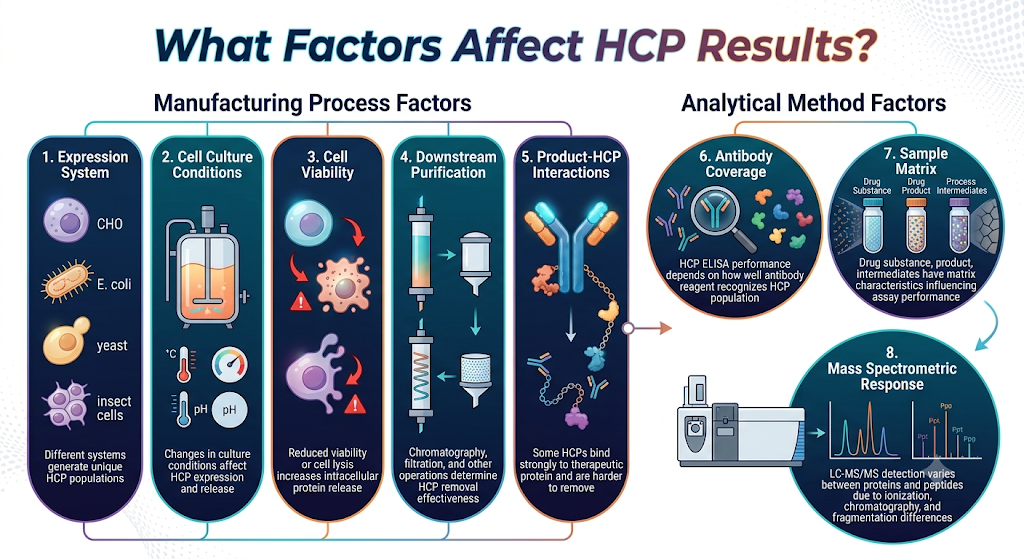
8: What Factors Affect HCP Results?
HCP results can be influenced by both the manufacturing process and the analytical method itself.
- Expression system — different systems (CHO, E. coli, yeast, insect cells) generate different HCP populations
- Cell culture conditions — changes in culture conditions can affect host-cell protein expression and release
- Cell viability — reduced viability or cell lysis increases release of intracellular proteins
- Downstream purification — chromatography, filtration, and other operations determine how effectively HCPs are removed
- Product-HCP interactions — some HCPs bind strongly to the therapeutic protein and are consequently harder to remove
- Antibody coverage — HCP ELISA performance depends heavily on how well the antibody reagent recognizes the actual HCP population
- Sample matrix — drug substance, drug product, and process intermediates each have matrix characteristics that can influence assay performance
- Mass spectrometric response — LC-MS/MS detection varies between proteins and peptides because ionization, chromatographic behavior, and fragmentation characteristics differ
9: When Should Biosimilar Developers Use LC-MS/MS HCP Analysis?
LC-MS/MS HCP analysis is particularly useful when total HCP measurement alone doesn’t provide enough information about the identity or composition of residual host-cell proteins.
- Biosimilar comparability — comparing HCP profiles between proposed biosimilar and reference-product samples
- Process development — investigating HCP clearance through downstream purification steps
- Manufacturing changes — evaluating whether an upstream or downstream process change alters the residual HCP population
- Root-cause investigation — identifying which HCP species may be contributing to an unexpected increase in total HCP levels
- Process-specific HCP identification — characterizing individual HCPs not adequately captured by a total-HCP immunoassay
- Orthogonal characterization — strengthening the overall analytical characterization strategy alongside ELISA data
10: HCP Analysis Challenges for Biosimilars
The major challenge in Host Cell Protein Analysis for Biosimilars is the sheer complexity of the HCP population itself.
- Large numbers of potential HCP species
- Very wide differences in protein abundance
- Variable antibody recognition across that population
- Low-abundance HCP detection
- Product-HCP interactions that complicate removal
- Complex sample matrices
- Different expression systems and purification processes across programs
- Potential process-specific HCPs unique to a given manufacturing line
- Difficulty interpreting small differences between products
Consequently, HCP testing should be designed around the specific product and manufacturing process rather than relying on a generic, one-size-fits-all testing strategy.
11: Regulatory Considerations for HCP Testing
HCP testing should be incorporated into the overall CMC and quality strategy for biological products, not treated as a standalone assay.
ICH Q6B identifies host-cell proteins as process-related impurities and describes the use of sensitive assays for their detection. ICH Q11 also addresses impurities derived from cell substrates — including host-cell proteins and host-cell DNA — within biotechnology manufacturing more broadly.
For biosimilars, the analytical strategy should logically connect: manufacturing process → HCP risk → analytical method → HCP clearance → comparative data → overall quality assessment. Because HCPs are one of several process-related impurity classes reviewers scrutinize, sponsors often coordinate HCP testing alongside related impurity work such as extractables and leachables testing for biosimilar drug development, so the full impurity picture — not just HCPs in isolation — supports the filing.
The selected methods and acceptance criteria should be scientifically justified for the specific product and intended regulatory purpose; there is no universal HCP limit that applies across all products.
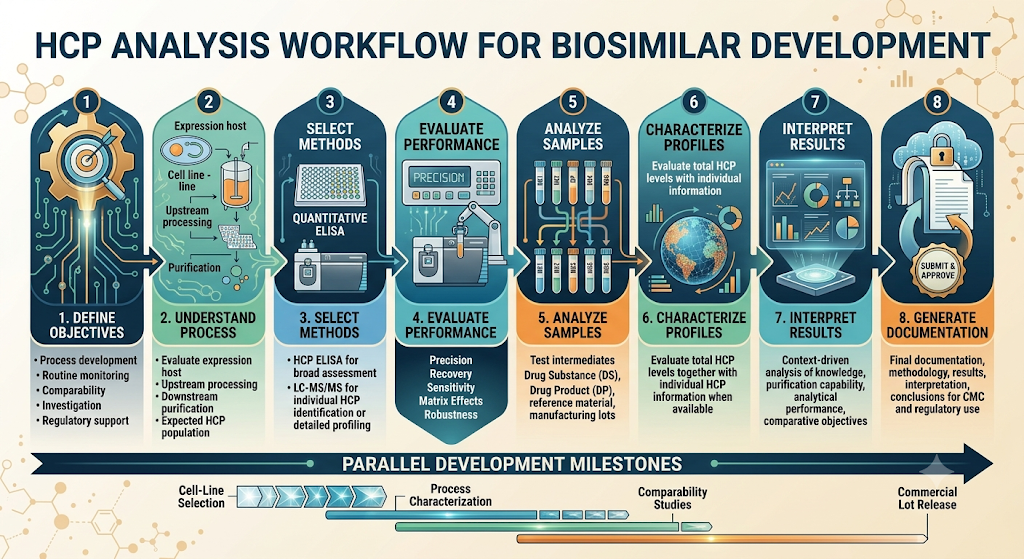
12: HCP Analysis Workflow for Biosimilar Development
A practical HCP analytical workflow typically follows eight stages:
- Define the analytical objective — process development, routine monitoring, comparability, investigation, or regulatory support
- Understand the manufacturing process — evaluate the expression host, upstream processing, downstream purification, and expected HCP population
- Select analytical methods — HCP ELISA for broad quantitative assessment, LC-MS/MS when individual HCP identification or detailed profiling is required
- Evaluate method performance — assess precision, recovery, sensitivity, matrix effects, dilutional behavior, and robustness
- Analyze representative samples — test appropriate process intermediates, drug substance, drug product, reference material, and manufacturing lots
- Characterize HCP profiles — evaluate total HCP levels together with individual HCP information when available
- Interpret the results — assess HCP data in context of process knowledge, purification capability, analytical performance, and comparative objectives
- Generate technical documentation — document methodology, results, interpretation, and conclusions in a format suitable for CMC and regulatory use
This workflow generally runs in parallel with the broader development milestones described in our biosimilar development guide, from cell-line selection through commercial lot release.
Why Choose an Orthogonal HCP Strategy?
A single analytical method cannot answer every HCP-related question. ELISA and LC-MS/MS provide different types of information and are therefore complementary rather than interchangeable.
HCP ELISA primarily answers: “How much immunoreactive HCP is present?”
LC-MS/MS helps answer: “Which HCPs are present, and what does the residual HCP population actually look like?”
Using both techniques together provides a more comprehensive understanding of HCP clearance and residual HCP composition than either method could deliver alone — which is why regulators increasingly expect orthogonal HCP evidence in biosimilar comparability packages.
13: How ResolveMass Supports HCP Analysis for Biosimilars
ResolveMass Laboratories Inc. supports biosimilar and biopharmaceutical developers with analytical strategies for residual HCP characterization and comparative assessment, tailored to the expression system, therapeutic protein, manufacturing process, and regulatory objectives involved.
Our analytical services include HCP ELISA testing, LC-MS/MS-based HCP characterization, HCP method development and optimization, comparative HCP profiling, HCP clearance studies, individual HCP identification, orthogonal analytical characterization, data interpretation, and technical/regulatory-oriented reporting. As a Canadian biosimilar CDMO partner, we can integrate HCP testing into a broader analytical package alongside process development, formulation, and stability work under one coordinated program.
Conclusion:
Host Cell Protein Analysis for Biosimilars is an important component of biopharmaceutical analytical characterization and impurity control. HCP ELISA provides sensitive measurement of total immunoreactive HCP, while LC-MS/MS provides complementary information about individual HCP species and residual HCP composition. For biosimilar developers, ELISA and LC-MS/MS should not be viewed as competing technologies — together they form an orthogonal analytical strategy connecting HCP quantification with molecular characterization, purification-process understanding, comparability assessment, and CMC development.
A scientifically designed Host Cell Protein Analysis for Biosimilars program should account for the expression system, manufacturing process, analytical method performance, reference product, sample matrix, and regulatory objectives.
Frequently Asked Questions:
HCP analysis can be performed on different materials throughout the biopharmaceutical manufacturing process. Samples may include harvest material, process intermediates, purification fractions, drug substance, and drug product. Testing multiple stages can help evaluate HCP clearance during downstream processing. Final-product testing can help assess residual HCP levels. The sample strategy should be defined according to the study objective and manufacturing process.
Antibody coverage describes how effectively an HCP ELISA antibody reagent recognizes the range of proteins produced by the manufacturing host. Different HCPs may be recognized with different efficiencies. Poor coverage can result in underestimation of certain HCP species. Therefore, characterization of the antibody reagent is an important part of assay development. LC-MS/MS can provide complementary information about HCPs that may have limited immunoreactivity.
HCP ELISA can provide highly sensitive detection of residual host cell proteins. However, actual sensitivity depends on the assay design, antibody reagent, calibration standard, matrix, and method performance. Parameters such as limit of detection and limit of quantification should be established or characterized as appropriate. Dilutional behavior and recovery can also affect reliable measurement. Sensitivity should therefore be evaluated for the intended sample and application.
HCP characterization is an important part of controlling process-related impurities in biological products. The specific extent and type of HCP testing depend on the product, expression system, manufacturing process, and regulatory strategy. HCP data can support process characterization and comparative analytical assessment. Appropriate analytical methods should be scientifically justified for their intended purpose. Regulatory expectations should be considered when designing the overall HCP strategy.
A lower total HCP concentration does not automatically establish that one biosimilar is analytically superior. HCP results should be evaluated in the context of the manufacturing process and analytical method. The identity and characteristics of individual residual HCPs may also be relevant. Method performance and antibody coverage should be considered when interpreting ELISA results. Overall product quality should be assessed using an integrated analytical strategy.
Downstream purification plays a major role in removing residual host cell proteins from biopharmaceutical products. Chromatography, filtration, and other purification operations can progressively reduce HCP levels. Some HCPs may be more difficult to remove because of their physicochemical properties or interactions with the therapeutic protein. HCP analysis across purification stages can help evaluate clearance efficiency. LC-MS/MS can provide additional insight into which HCPs persist through purification.
Reference
- Ito T, Lutz H, Tan L, Wang B, Tan J, Patel M, Chen L, Tsunakawa Y, Park B, Banerjee S. Host cell proteins in monoclonal antibody processing: Control, detection, and removal. Biotechnology progress. 2024 Jul;40(4):e3448.https://aiche.onlinelibrary.wiley.com/doi/abs/10.1002/btpr.3448
- Pilely K, Johansen MR, Lund RR, Kofoed T, Jørgensen TK, Skriver L, Mørtz E. Monitoring process-related impurities in biologics–host cell protein analysis: Pilely K. et al. Analytical and Bioanalytical Chemistry. 2022 Jan;414(2):747-58.https://link.springer.com/article/10.1007/s00216-021-03648-2
- Guo J, Kufer R, Li D, Wohlrab S, Greenwood-Goodwin M, Yang F. Technical advancement and practical considerations of LC-MS/MS-based methods for host cell protein identification and quantitation to support process development. InMAbs 2023 Dec 31 (Vol. 15, No. 1, p. 2213365). Taylor & Francis.https://www.tandfonline.com/doi/abs/10.1080/19420862.2023.2213365
- Tank P, Vora S, D’Souza F, Kamble SS, Rameshkumar N. Advanced mass spectrometry techniques for monitoring biopharmaceutical host cell proteins. Trends in Biotechnology. 2025 Aug 22.https://www.cell.com/trends/biotechnology/fulltext/S0167-7799(25)00311-7
- Alhuthali S, Pauzi SM, Kontoravdi C. Host cell protein impurities in therapeutic proteins: overview of advances in detection, nonconventional removal technologies and immunogenicity assessment. Journal of Biological Engineering. 2026 May 19.https://link.springer.com/article/10.1186/s13036-026-00685-2
About the Author


