

Introduction
An ICH Q3D Elemental Impurity Assessment provides a systematic, science-based safety framework for identifying, quantifying, and controlling toxic elemental contaminants in finished drug products. Integrating this risk-based assessment with a fully validated Inductively Coupled Plasma Mass Spectrometry (ICP-MS) analytical method ensures that elemental concentrations remain consistently below the established Permitted Daily Exposure (PDE) limits throughout a drug product’s commercial lifecycle.
The implementation of the International Council for Harmonisation (ICH) Q3D guideline, together with the United States Pharmacopeia (USP) General Chapters <232> Elemental Impurities—Limits and <233> Elemental Impurities—Procedures, has transformed regulatory compliance across global pharmaceutical markets. Legacy compendial procedures, particularly the non-specific USP <231> heavy metals sulfide precipitation test, had significant analytical limitations. These included poor recovery of volatile elements, subjective manual colorimetric interpretation, and the inability to quantify individual elements specifically.
Modern regulatory compliance requires trace element determination at parts-per-billion (ppb) or parts-per-trillion (ppt) levels using advanced plasma spectrochemistry. Applying Quality Risk Management (QRM) principles in accordance with ICH Q9 enables pharmaceutical manufacturers to systematically evaluate potential contamination sources, including active pharmaceutical ingredients (APIs), mineral and synthetic excipients, manufacturing utilities, processing equipment wear, and container-closure leaching. This assessment supports the development of evidence-based control strategies suitable for Common Technical Document (CTD) regulatory submissions.
Strengthen your testing strategy with analytical development services for pharmaceutical products.
Share via:
Quick Summary:
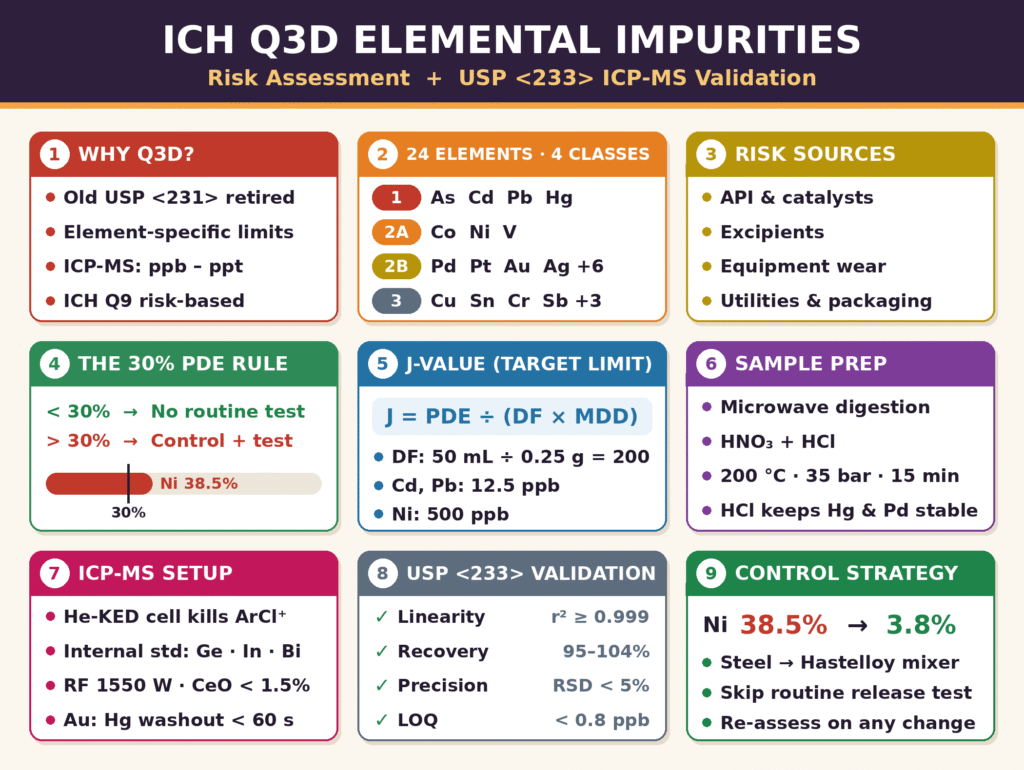
- Purpose: An ICH Q3D assessment, paired with a validated ICP-MS method under USP <232>/<233>, keeps toxic elemental impurities below their Permitted Daily Exposure (PDE) limits. It replaces the old, non-specific USP <231> heavy-metals test.
- Element classes: Q3D sorts 24 elements into four classes by toxicity and likelihood of occurrence. Class 1 (As, Cd, Pb, Hg) must always be assessed. Classes 2A, 2B and 3 depend on the route of administration and how the product is made. The R2 revision added limits for skin-applied (cutaneous) products and updated the PDEs for Au, Ag and Ni.
- Risk assessment: Possible sources (APIs, excipients, equipment, utilities, packaging) are mapped, and their contribution is compared to a 30% PDE threshold. In the case study, a 2.0 g/day oral tablet, only Nickel (38.5% of PDE) went above that threshold.
- J-value calculation: J = PDE ÷ (dilution factor × maximum daily dose) turns each PDE into a target concentration in the test solution. With a dilution factor of 200 mL/g, the targets came to 12.5 ppb for Cd and Pb and 500 ppb for Ni.
- Sample prep and instrument setup: Samples were digested by microwave in HNO₃ + HCl at 200 °C and 35 bar. The HCl keeps Hg and the platinum-group elements in solution. A helium collision cell (He-KED) removes argon-based interferences, internal standards (Ge, In, Bi) correct for signal drift, and adding gold cut Hg carryover time to under 60 seconds.
- Validation results: All USP <233> criteria were met:
- Linearity: r² ≥ 0.999
- Recovery: 95–104%
- Precision: RSD under 5%
- LOQ: below 0.8 ppb
- Control strategy: Swapping the unpassivated steel mixer for a Hastelloy vessel lowered Nickel from 38.5% to 3.8% of PDE. Routine release testing can then be replaced by supplier controls and change control. The assessment should be repeated whenever suppliers, the synthesis route, equipment or packaging change.
Executing the ICH Q3D Elemental Impurity Assessment Strategy
Conducting an ICH Q3D Elemental Impurity Assessment involves identifying and mapping potential sources of elemental contamination throughout the drug product manufacturing process. The assessment then compares empirical or theoretical elemental concentrations against the established 30% control threshold. This systematic evaluation determines whether routine testing of raw materials or finished dosage forms is necessary to ensure patient safety.
The ICH Q3D guideline classifies 24 elemental impurities into four toxicity classes according to their Permitted Daily Exposure (PDE) values and likelihood of occurrence in pharmaceutical formulations:
- Class 1 elements (As, Cd, Pb, Hg): These elements exhibit significant human toxicity and are widely distributed environmental contaminants. Consequently, they must be included in every elemental impurity risk assessment, regardless of the route of administration.
- Class 2A elements (Co, Ni, V): These elements exhibit route-dependent toxicity and have a relatively high probability of entering pharmaceutical products through manufacturing processes, particularly from stainless steel and alloy processing equipment.
- Class 2B elements (Au, Pd, Pt, Ir, Os, Rh, Ru, Ag, Se, Tl): These elements have route-dependent toxicity but generally occur at low natural abundance. Their assessment is particularly important when they are intentionally introduced during manufacturing, such as through the use of synthetic catalysts.
- Class 3 elements (Sb, Ba, Li, Mo, Cu, Sn, Cr): These elements generally present lower toxicity concerns following oral administration but require stricter evaluation and monitoring in parenteral and inhalation dosage forms.
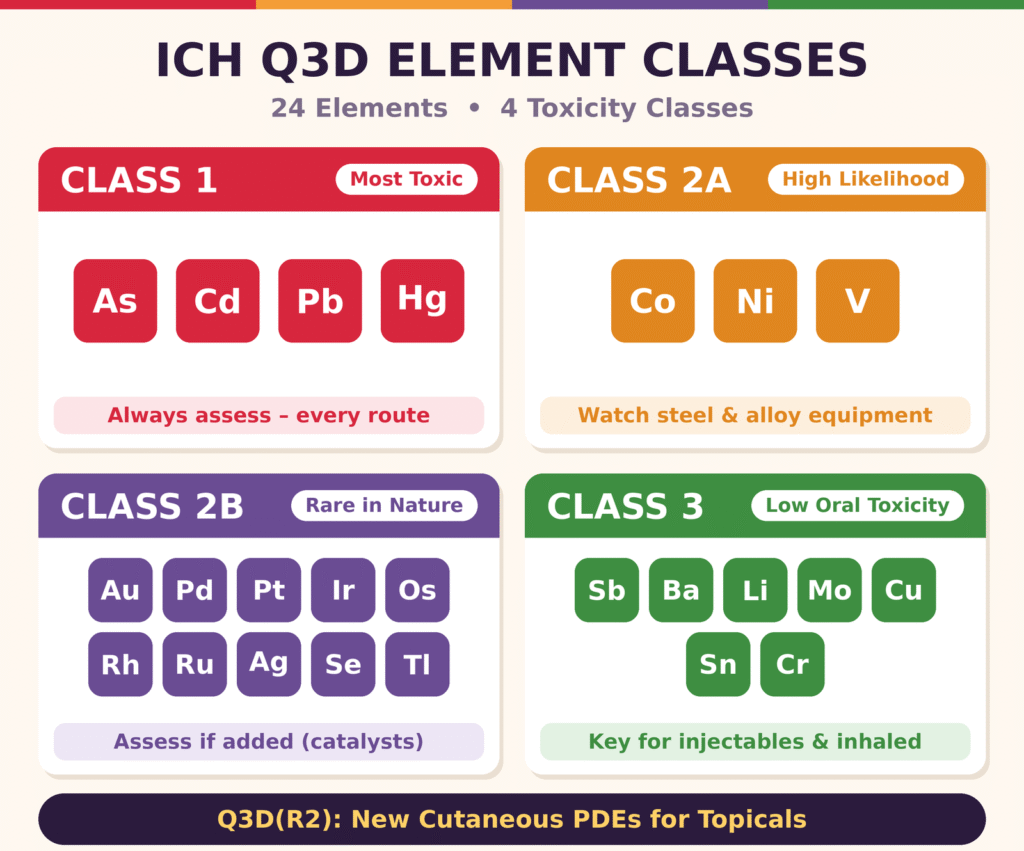
Under the ICH Q3D(R2) revision, updated safety requirements introduced dedicated Cutaneous and Transcutaneous Concentration Limits (CTCL) and cutaneous PDEs for topical dosage forms. The revision also established updated PDEs for Gold, Silver, and Nickel.
In this case study, an oral film-coated tablet formulation with a maximum daily dose of 2.0 g/day underwent a comprehensive elemental impurity risk assessment. The investigation identified potential contamination sources associated with raw material origins, fluid transport lines, mill blades, and primary foil packaging.
| Element | ICH Class | Oral PDE (µg/day) | Measured Concentration (µg/g) | Daily Exposure (µg/day) | Percentage of PDE (%) | Control Strategy Action |
|---|---|---|---|---|---|---|
| Arsenic (As) | Class 1 | 15.0 | 0.85 | 1.70 | 11.3% | Below 30% threshold; routine release testing not required. |
| Cadmium (Cd) | Class 1 | 5.0 | 0.12 | 0.24 | 4.8% | Below 30% threshold; routine release testing not required. |
| Lead (Pb) | Class 1 | 5.0 | 0.40 | 0.80 | 16.0% | Below 30% threshold; routine release testing not required. |
| Mercury (Hg) | Class 1 | 30.0 | 0.05 | 0.10 | 0.3% | Below 30% threshold; routine release testing not required. |
| Cobalt (Co) | Class 2A | 50.0 | 1.10 | 2.20 | 4.4% | Below 30% threshold; control equipment wear. |
| Nickel (Ni) | Class 2A | 200.0 | 38.50 | 77.00 | 38.5% | Exceeds 30% control threshold; requires quantitative ICP-MS validation and engineering controls for equipment. |
| Vanadium (V) | Class 2A | 100.0 | 2.40 | 4.80 | 4.8% | Below 30% threshold; routine release testing not required. |
| Palladium (Pd) | Class 2B | 100.0 | 0.02 | 0.04 | 0.04% | Intentionally added synthetic catalyst; downstream purge validated to achieve less than 30% of PDE. |
Review regulatory support for generic drugs to understand the documentation needed for market authorization.
Target Limit Determination and Calculation of J-Values
The J-value represents the maximum allowable concentration of a target elemental impurity in a prepared sample solution. It translates the regulatory Permitted Daily Exposure (PDE) limits into appropriate analytical working concentrations. Calculating J-values aligns the instrument’s linear dynamic range with regulatory safety thresholds and establishes suitable standard calibration curves and spike concentrations.
The mathematical formula used to calculate the target solution concentration, J, is:
J = PDE / (Total Dilution Factor × Maximum Daily Dose)
Here, the PDE is expressed in µg/day, the Maximum Daily Dose (MDD) is expressed in g/day, and the Total Dilution Factor represents the volume of the final prepared solution relative to the sample mass, expressed in mL/g.
In this case study, a 0.25 g sample of ground tablet drug product was digested and diluted to a final volume of 50 mL. The resulting total dilution factor was calculated as follows:
Dilution Factor = Final Volume / Sample Mass
Dilution Factor = 50 mL / 0.25 g = 200 mL/g
Using the maximum daily dose of 2.0 g/day, the target solution limit, J, for each analyte was calculated using the following expression:
J (µg/L or ppb) = [PDE (µg/day) / (200 mL/g × 2.0 g/day)] × 1000
The factor of 1000 accounts for the conversion between milliliters and liters.
| Element | Oral PDE (µg/day) | Dilution Factor (mL/g) | Maximum Daily Dose (g/day) | Solution Target Limit, J (µg/L or ppb) | Working Calibration Range (0.5J–1.5J) |
|---|---|---|---|---|---|
| Cadmium (Cd) | 5.0 | 200 | 2.0 | 12.5 | 6.25–18.75 ppb |
| Lead (Pb) | 5.0 | 200 | 2.0 | 12.5 | 6.25–18.75 ppb |
| Arsenic (As) | 15.0 | 200 | 2.0 | 37.5 | 18.75–56.25 ppb |
| Mercury (Hg) | 30.0 | 200 | 2.0 | 75.0 | 37.50–112.50 ppb |
| Cobalt (Co) | 50.0 | 200 | 2.0 | 125.0 | 62.50–187.50 ppb |
| Vanadium (V) | 100.0 | 200 | 2.0 | 250.0 | 125.00–375.00 ppb |
| Nickel (Ni) | 200.0 | 200 | 2.0 | 500.0 | 250.00–750.00 ppb |
Discover how pharmaceutical CDMO services can support analytical development and manufacturing requirements.
Sample Preparation and Digestion Protocols
Closed-vessel microwave-assisted acid digestion is a standard sample preparation technique for complex pharmaceutical dosage forms. It facilitates the decomposition of organic matrices while retaining volatile toxic elements quantitatively under appropriate digestion conditions. Selecting the appropriate sample preparation chemistry helps prevent nebulizer blockage, minimize carbon-related ionization enhancements, and dissolve refractory elemental species.
USP <233> describes analytical preparation approaches selected according to the properties of the sample matrix.
| Preparation Protocol | Matrix Applicability | Chemical Digestion Reagents | Volatile Element Retention (Hg, As, Se) | Key Analytical Considerations |
|---|---|---|---|---|
| Closed-Vessel Microwave Digestion | Solid dosage forms, insoluble APIs, and mineral excipients such as TiO2 and talc. | Concentrated HNO3 (69%), HCl (37%), and H2O2 (30%). | Greater than 95% retention of Hg, As, and Se under suitable conditions using pressurized fluoropolymer seals. | Broad applicability; helps eliminate carbon-based polyatomic interferences by thoroughly oxidizing organic matrices. |
| Direct Aqueous Solubilization | Water-soluble APIs, oral liquids, and small-volume injectables. | 1.0%–2.0% v/v HNO3 in ultrapure Type I water (18.2 MΩ·cm). | Approximately 100% retention without elevated-temperature digestion, where analytes remain stable. | Rapid sample preparation; total dissolved solids (TDS) should remain below 0.2% w/v to prevent deposition in cone orifices. |
| Direct Organic Dissolution | Non-polar APIs, lipophilic matrices, and oil-based formulations. | Specialized organic solvents, including DMSO, NMP, and 2-butoxyethanol. | Retention varies; volatilization controls may be necessary. | May require the introduction of oxygen (O2) gas into the plasma to prevent carbon soot accumulation on interface cones. |
For the oral tablet drug product examined in this case study, 0.25 g of finely ground composite powder was weighed into PTFE microwave digestion vessels. A mixture of 5.0 mL of concentrated, trace-metal-grade Nitric Acid (HNO3, 69%) and 1.0 mL of Hydrochloric Acid (HCl, 37%) was added.
The inclusion of Hydrochloric Acid is important for stabilizing Mercury (Hg) as the soluble chlorocomplex [HgCl4]2− and maintaining Platinum Group Elements, including Pd, Pt, and Rh, in a stable solution. The vessels were digested at 200°C for 15 minutes under a pressure of 35 bar. After cooling, the digested samples were diluted to a final volume of 50 mL using Type I ultrapure water.
Explore analytical characterization services for specialized pharmaceutical testing needs.
ICP-MS Method Validation Framework Under USP <233>
Validating an ICP-MS analytical procedure under USP <233> requires experimental evidence demonstrating that the method satisfies established performance criteria for specificity, linearity, accuracy, repeatability, and intermediate precision. Meeting these quantitative requirements confirms that matrix effects and spectral interferences are adequately controlled across the method’s operational range.
Specificity and Collision Cell Interference Mitigation
Specificity in ICP-MS analysis requires the unambiguous identification and quantification of target analyte isotopes in the presence of complex drug product matrix components and plasma-generated polyatomic interferences. Polyatomic ions can have the same mass-to-charge ratio (m/z) as target elemental ions, potentially causing inaccurate measurements.
Examples include argon chloride (40Ar35Cl+), which interferes with Arsenic (75As+); argon dimer (40Ar40Ar+), which interferes with Selenium (80Se+); and argon oxide (40Ar16O+), which interferes with Iron (56Fe+).
To reduce these polyatomic interferences, the ICP-MS instrument was operated in Collision Cell Mode using pure Helium (He) gas in combination with Kinetic Energy Discrimination (KED). Polyatomic interfering species generally have larger collision cross-sections than monatomic target analyte ions. As ions travel through the octopole collision cell, polyatomic interferences undergo more frequent collisions with Helium atoms and lose kinetic energy more rapidly.
A bias-voltage barrier at the cell exit discriminates against lower-energy interfering ions, allowing the target analyte ions, including 75As+, 60Ni+, and 111Cd+, to proceed to the mass analyzer. Online addition of internal standards, including 72Ge, 115In, and 209Bi, at a concentration of 10 ppb helped compensate for signal drift and physical differences in sample matrix viscosity.
Linearity, Accuracy, and Precision Performance
Linearity was assessed by analyzing calibration standards at five concentration levels spanning 0.1J to 2.0J, equivalent to 10%–200% of the target limit. The resulting linear regression coefficients (r2) exceeded 0.999 for all monitored elements, demonstrating a strong linear relationship between analyte concentration and instrument response.
Accuracy was evaluated using spike recovery studies. Unspiked sample matrices were fortified with target analytes at 0.5J, 1.0J, and 1.5J, with triplicate preparations at each level. USP <233> specifies that mean recoveries should fall within 70%–150% of the theoretical values.
Precision was established by assessing repeatability across six independent sample preparations spiked at 1.0J, using an acceptance criterion of %RSD ≤ 20%. Intermediate precision was evaluated across 12 total preparations analyzed over two days by different analysts using separate instruments. The acceptance criterion for combined intermediate precision was %RSD ≤ 25%.
| Validation Parameter | USP <233> Acceptance Criteria | Method Validation Protocol | Empirical Case Study Results | Regulatory Compliance Status |
|---|---|---|---|---|
| Specificity | Unambiguous quantification without signal interference. | Reagent blank, matrix blank, and Helium KED cell optimization. | Signal interference below 1.0% of J; internal standard recovery within 85%–115% [cite: 3, 14]. | Compliant. |
| Linearity | Linear response with correlation coefficient r2 ≥ 0.990 | Five-point standard curve: 0.1J, 0.5J, 1.0J, 1.5J, and 2.0J. | r2 ≥ 0.9994 across all target isotopes. | Compliant. |
| Accuracy (Recovery) | Mean spike recovery between 70% and 150% | Triplicate matrix spikes at 0.5J, 1.0J, and 1.5J [cite: 4]. | Class 1 (As, Cd, Pb, Hg): 95.4%–103.8%; Class 2A (Ni, Co, V): 97.1%–102.1%. | Compliant. |
| Repeatability | %RSD ≤ 20% for six independent preparations at 1.0J | Analyst 1, Instrument 1, Day 1 (N = 6). | As: 2.4%; Cd: 2.1%; Pb: 1.6%; Hg: 3.8%; Ni: 1.9%. | Compliant. |
| Intermediate Precision | Combined %RSD ≤ 25% across 12 preparations. | Analyst 1 (Day 1, Instrument 1) and Analyst 2 (Day 2, Instrument 2), N = 12. | Combined %RSD across all analytes: 3.4%–4.9%. | Compliant. |
| Limit of Quantitation | Quantitation limit ≤ 0.5J, with signal-to-noise ratio S/N ≥ 10 | Verification using low-level matrix spikes. | LOQ established between 0.02J and 0.08J, corresponding to less than 0.8 ppb. | Compliant. |
Compare CDMO and CRO models to determine which development and testing structure best fits your project.
Analytical Interferences and Instrumental Parameter Optimization
Optimizing ICP-MS operating parameters helps suppress oxide formation, reduce physical sample transport interferences, and maintain signal stability during high-throughput routine batch analysis. Fine-tuning plasma power, nebulizer gas flow rates, and collision cell settings helps maintain analytical sensitivity across different pharmaceutical sample matrices.
Daily instrument performance was verified using a multielement tuning solution containing Lithium (Li), Yttrium (Y), Cerium (Ce), Cobalt (Co), and Thallium (Tl). Oxide formation levels, measured using the ratio 156CeO+/140Ce+, were maintained below 1.5%. Doubly charged species, monitored using the ratio 70Ce2+/140Ce+, were kept below 3.0%.
The key instrumental parameters optimized for the USP <233> validation protocol included the following:
- Radio-Frequency (RF) Power: Set to 1550 W to support the effective atomization and ionization of refractory elements.
- Carrier Argon Gas Flow: Maintained at 1.05 L/min to balance sample aerosol transport with plasma residence time.
- Helium Collision Gas Flow: Controlled at 4.3 mL/min in KED mode to reduce polyatomic interferences, including 40Ar35Cl+ and 40Ar40Ar+.
- Spray Chamber Temperature: Maintained at 2.0°C to reduce solvent vapor loading and minimize solvent-derived oxide interferences.
- Gold Matrix Stabilization: Gold (Au) was added at 200 ppb to all diluents and rinse solutions. Gold helps stabilize Mercury (Hg) by reducing its adsorption and memory effects in sample introduction and rinse lines. This approach reduced washout times between injections from approximately 15 minutes to less than 60 seconds.
Learn about generic drug analytical characterization and the role of reliable analytical data in development.
Data Synthesis and Establishment of the Finished Product Control Strategy
Combining empirical batch release data with the formal elemental impurity risk assessment provides the scientific and regulatory foundation for establishing a long-term elemental impurity control strategy in CTD Module 3 (3.2.P.5.6). Demonstrating that elemental concentrations consistently remain below the 30% PDE control threshold can support a scientifically justified decision to eliminate routine finished product release testing, where permitted by applicable regulatory requirements and supported by the overall control strategy.
Analysis of three commercial-scale drug product validation batches using the validated ICP-MS method showed that Class 1 elements (As, Cd, Pb, Hg) consistently remained below the Limit of Quantitation (LOQ < 0.10J). These results corresponded to exposures below 5% of the applicable Permitted Daily Exposures.
Although the initial pilot batches showed elevated Nickel concentrations of 38.5 µg/g, representing 38.5% of the PDE, the contamination was attributed to shear friction during powder blending in an unpassivated stainless steel mixer. To address this issue, an engineering control was introduced by replacing the steel blender with a passivated Hastelloy vessel. Subsequent testing confirmed that Nickel concentrations decreased to 3.8 µg/g, equivalent to 3.8% of the PDE and comfortably below the 30% control threshold.
Based on these findings, the final regulatory control strategy established that routine finished product batch release testing could be omitted in favor of raw material supplier testing and formal change control procedures, provided the risk assessment and supporting evidence continued to justify this approach. Reassessment of the ICH Q3D Elemental Impurity Assessment would be initiated when significant changes occurred in raw material suppliers, synthesis routes, processing equipment, or primary container-closure systems.
See how integrated CDMO services can support development planning and quality oversight.
Conclusion
A comprehensive ICH Q3D Elemental Impurity Assessment, combined with a fully validated USP <233> ICP-MS procedure, provides a science-based quality framework for global pharmaceutical authorization. Accurate calculation of J-values, standardized microwave-assisted digestion, and effective control of polyatomic interferences support reliable trace element analysis and regulatory compliance while improving analytical efficiency.
Applying Quality Risk Management principles enables pharmaceutical manufacturers to establish scientifically justified elemental impurity control strategies that may replace unnecessary routine release testing with robust supplier controls, appropriate analytical verification, and engineered manufacturing safeguards. These measures help maintain drug product quality and patient safety throughout the commercial lifecycle.
Build a stronger analytical quality strategy with pharmaceutical testing and development support from ResolveMass.
For technical support with elemental impurity assessments, ICP-MS method validation, or regulatory compliance testing, visit the ResolveMass Laboratories Contact Page.
Frequently Asked Questions
The J-value is calculated by dividing the elemental impurity’s PDE by the product of the total dilution factor and the maximum daily dose. It establishes the target concentration in the prepared analytical solution, typically expressed in µg/L or ppb. The resulting value helps determine suitable calibration standards, working ranges, and spike concentrations for ICP-MS method validation.
ICH Q3D identifies four Class 1 elements that must be assessed for every relevant drug product: Arsenic (As), Cadmium (Cd), Lead (Pb), and Mercury (Hg). Class 2A elements, including Cobalt (Co), Nickel (Ni), and Vanadium (V), also require evaluation because they may enter formulations through raw materials, catalysts, or manufacturing equipment. The assessment should consider all credible sources of contamination and the applicable route of administration.
ICP-MS method validation evaluates specificity, accuracy, precision, and the ability to quantify elemental impurities reliably in the sample matrix. Commonly applied USP criteria include mean spike recoveries of 70%–150% and repeatability with a relative standard deviation (%RSD) not exceeding 20% across six preparations. Intermediate precision is generally assessed across 12 preparations, with a combined %RSD not exceeding 25%, where these criteria are specified in the applicable procedure.
Closed-vessel microwave digestion uses controlled heating and pressure to break down complex pharmaceutical matrices efficiently. The sealed vessel reduces the loss of volatile elements, such as Mercury (Hg) and Arsenic (As), while minimizing contamination from the surrounding environment. This approach can improve analyte recovery and produce a suitable solution for sensitive ICP-MS measurements when the digestion conditions are appropriately optimized.
The ICH Q3D(R2) revision introduced additional considerations for elemental impurity control in cutaneous and transcutaneous drug products, including dedicated cutaneous PDEs and Cutaneous and Transcutaneous Concentration Limits (CTCL). It also updated certain elemental impurity limits, including those for Gold, Silver, and Nickel, for specified routes of administration. Manufacturers should consult the applicable guideline tables to confirm the current limits for their product and route of administration.
The Summation Option allows manufacturers to estimate the total elemental impurity content of a drug product by combining the contributions from individual components, such as the API, excipients, and water. Each component’s measured or justified impurity concentration is adjusted according to its proportion in the formulation. This approach may be suitable when the necessary component-level data are reliable and the applicable ICH Q3D conditions are met, including the relevant maximum daily intake provisions.
Helium Collision Cell technology reduces spectral interference by introducing Helium gas into the ion path before mass analysis. Polyatomic ions undergo collisions with Helium atoms and generally lose more kinetic energy than smaller target ions under suitable operating conditions. Kinetic Energy Discrimination (KED) then removes many of these lower-energy interfering ions, improving the accuracy of elemental measurements.
Repeatability evaluates the consistency of analytical results when the same method is performed under closely controlled conditions, typically using the same instrument, analyst, and testing period. Intermediate precision assesses variability when relevant conditions change, such as the analyst, instrument, or day of analysis. Together, these evaluations demonstrate whether an ICP-MS method can deliver consistent results within a laboratory under routine operating conditions.
For drug products with a maximum daily intake exceeding 10 grams, the standard default concentration limits may not be directly applicable. The permitted elemental impurity concentration should instead be determined using the applicable PDE and the actual maximum daily intake, following the relevant ICH Q3D provisions. This calculation ensures that the total daily exposure remains within the established safety limit for the relevant element and route of administration.
Reference:
- United States Pharmacopeia. (2016). General chapter ⟨232⟩: Elemental impurities—Limits. In USP 39–NF 34. https://www.usp.org/sites/default/files/usp/document/our-work/chemical-medicines/key-issues/c232-usp-39.pdf
- International Council for Harmonisation of Technical Requirements for Pharmaceuticals for Human Use. (2019). ICH guideline Q3D (R1) on elemental impurities: Step 5. European Medicines Agency. https://www.ema.europa.eu/en/documents/scientific-guideline/international-conference-harmonisation-technical-requirements-registration-pharmaceuticals-human-use-ich-q3d-elemental-impurities-step-5-revision-1_en.pdf
- United States Pharmacopeia. (n.d.). Elemental impurities updates. https://www.usp.org/impurities/elemental-impurities-updates
- United States Pharmacopeia. (2023). General chapter ⟨232⟩: Elemental impurities—Limits. USP–NF. https://doi.org/10.31003/USPNF_M5192_03_01
- International Council for Harmonisation of Technical Requirements for Pharmaceuticals for Human Use. (2020, September 28). ICH Q3D(R2): Guideline for elemental impurities—Cutaneous permitted daily exposures (PDEs), Step 2 document. https://database.ich.org/sites/default/files/ICH_Q3D%28R2%29Step2_Cutaneous_PDEs_2020_0928.pdf
Get In Touch With Us
About The Author