
Introduction
The implementation of ICH Q7 for Peptide APIs establishes the essential regulatory framework and Good Manufacturing Practice (GMP) requirements governing quality systems, risk management, and sequential process controls throughout the chemical synthesis of peptide drug substances. Compliance with these international guidelines helps ensure that synthetic therapeutic peptides consistently meet the structural identity, purity, and safety requirements necessary for human clinical trials and commercial distribution. Initially developed for conventional small-molecule active pharmaceutical ingredients (APIs), the ICH Q7 framework has been adopted by major global regulatory authorities, including the U.S. Food and Drug Administration (FDA), European Medicines Agency (EMA), and Health Canada, to address the specialized chemistry, complex impurity profiles, and distinctive unit operations involved in peptide manufacturing.
Synthetic peptides occupy a unique position between traditional small-molecule drugs and biological products. Regulatory classification depends on the peptide, its intended use, molecular characteristics, and the applicable jurisdiction. Certain synthetic peptides are regulated through chemical drug-substance pathways rather than biological licensing pathways. Unlike conventional small-molecule synthesis, which generally consists of a limited number of individual chemical reactions, peptide synthesis involves repetitive and sequential chain elongation cycles. Every additional coupling step introduces cumulative risks associated with incomplete reactions, racemization, deletion sequence formation, and structural degradation. Consequently, implementing ICH Q7 for Peptide APIs requires translating broad regulatory principles into clearly defined, unit-operation-specific quality controls throughout the manufacturing process, from raw material qualification and solid-phase synthesis to cleavage, chromatographic purification, counter-ion exchange, and final lyophilization.
Explore the regulatory requirements for GLP-1 peptide characterization to understand the analytical evidence needed to support peptide quality and regulatory submissions.
Share via:
Quick Summary:
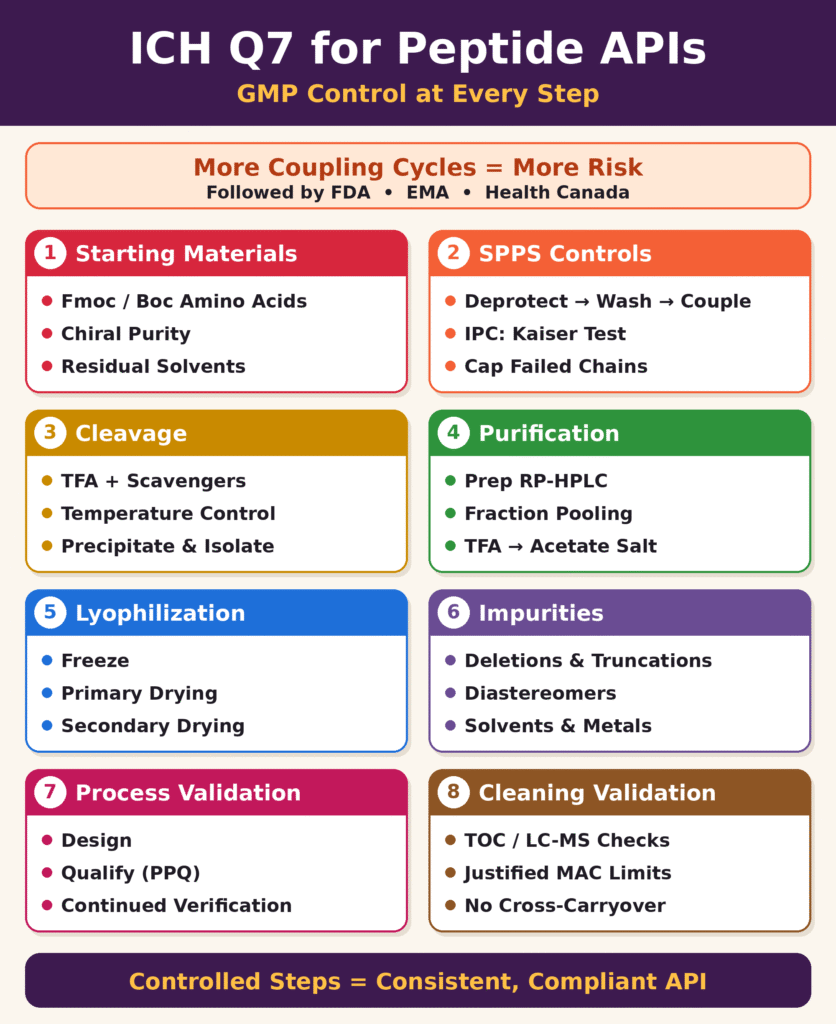
- Framework: ICH Q7 is the GMP framework for peptide APIs, applied by the FDA, EMA and Health Canada. Peptides need specific controls because every repeated coupling cycle adds risk of incomplete reactions, racemization, deletions and degradation.
- Starting materials: Protected amino acids (Fmoc/Boc) are typical regulatory starting materials, and they mark where full GMP begins. Each lot needs qualification, including chiral purity (D-enantiomers form diastereomers that are hard to remove), residual solvents (ICH Q3C), and controls on resins, reagents and solvents.
- SPPS controls: Solid-phase synthesis needs defined limits for deprotection, washing, coupling and stoichiometry. In-process checks such as the Kaiser test confirm each cycle, and capping stops failed chains from growing into hard-to-separate impurities.
- Cleavage: TFA with sequence-appropriate scavengers (TIS, EDT, water, thioanisole) releases the peptide and removes protecting groups. Temperature and reaction time must stay within validated limits to prevent alkylation and oxidation. The crude peptide is then precipitated, typically with cold MTBE or ether.
- Purification and salt exchange: Preparative RP-HPLC removes related impurities. Only fractions that meet predefined criteria are pooled. TFA counter-ions are often exchanged to acetate or HCl, with product-specific limits.
- Lyophilization and impurities: Freeze-drying (freezing, primary drying, secondary drying) produces a stable, moisture-controlled powder that is handled in risk-based controlled environments. Deletions, diastereomers, truncations, solvents (Q3C) and metals (Q3D) are controlled using validated, stability-indicating methods (ICH Q2(R2)).
- Validation: Lifecycle process validation (design, qualification, continued verification) links critical process parameters to critical quality attributes. Cleaning validation with TOC or LC-MS and justified MAC limits prevents cross-contamination in multi-product facilities, together ensuring consistent, compliant peptide APIs.
Defining Regulatory Starting Materials Under ICH Q7 for Peptide APIs
Under ICH Q7 for Peptide APIs, regulatory starting materials (RSMs) may include appropriately justified protected amino acid derivatives and other materials that contribute to the molecular structure of the final peptide active substance. The regulatory classification of functionalized solid-phase resins and structural linkers depends on their function, the manufacturing route, and the justified starting point of API manufacture. The selection and qualification of these materials require comprehensive risk assessments, impurity fate-and-purge studies, and appropriate incoming material specifications to prevent early-stage chemical impurities from persisting into the final API.
Selecting regulatory starting materials is a crucial chemistry, manufacturing, and controls (CMC) milestone because it establishes the regulatory boundary at which full GMP compliance begins. Regulators assess proposed RSMs by considering their chemical characteristics, manufacturing history, impurity profile, and the number and nature of chemical transformation steps performed under GMP controls after their incorporation into the manufacturing process. In solid-phase peptide synthesis (SPPS), fluorenylmethyloxycarbonyl (Fmoc)- or tert-butyloxycarbonyl (Boc)-protected amino acids serve as fundamental building blocks. An impurity introduced through a single lot of protected amino acid can generate deletion sequences or diastereomeric variants throughout an entire commercial batch. Therefore, every lot must undergo documented qualification and appropriate analytical testing before approval for manufacturing use.
| Material Category | Representative Examples | Potential Regulatory Classification | Critical Quality Attributes (CQAs) and Controls |
|---|---|---|---|
| Protected Amino Acids | Fmoc-Ala-OH, Boc-D-Trp-OH, Fmoc-Cys(Trt)-OH | Potential regulatory starting materials | Enantiomeric purity, chemical purity, residual solvents, water content, and elemental impurities. Acceptance limits must be justified for the specific material and process. |
| Solid Support Resins | Chlorotrityl chloride (CTC) resin, Wang resin, Rink Amide resin | Process material; classification depends on the manufacturing route and starting-material justification | Substitution loading (mmol/g), particle-size distribution, swelling characteristics, functional-group availability, and relevant residual contaminants. |
| Coupling Reagents | HATU, DIC, HBTU, Oxyma Pure | Chemical reagents and process auxiliaries | Assay, moisture content, relevant degradation products, and reactive contaminants. |
| Solvents and Auxiliaries | N,N-Dimethylformamide (DMF), NMP, DCM, piperidine | Process solvents and auxiliaries | Solvent purity, water content, relevant degradation impurities, and residual-solvent controls appropriate to the intended use. |
The control strategy for protected amino acids requires verification of enantiomeric purity through an appropriate method, such as chiral chromatography. Trace D-enantiomer contaminants in natural L-amino acid stocks can produce diastereomeric peptide impurities with molecular weights identical to those of the target sequence and similar chemical properties. These similarities make separation during downstream preparative chromatography particularly challenging.
Review chiral analysis of therapeutic peptide APIs to learn how stereochemical impurities can be evaluated using appropriate analytical techniques.
Headspace gas chromatography (HS-GC), where appropriate, is used to assess residual solvents in raw materials in accordance with applicable specifications and relevant guidance, including ICH Q3C. Class 1 and Class 2 solvents require controls appropriate to their toxicological classification and intended use. Additionally, preloaded resins containing the C-terminal amino acid require suitable supplier qualification, documented material traceability, and enhanced oversight based on the potential impact of the resin on the final peptide API.
Good Manufacturing Practice Controls in SPPS Under ICH Q7 for Peptide APIs
Good Manufacturing Practice (GMP) controls in solid-phase peptide synthesis (SPPS) under ICH Q7 for Peptide APIs require clearly established operating limits for coupling reactions, deprotection cycles, stoichiometric ratios, and in-process controls (IPCs). Maintaining control over these critical process parameters (CPPs) helps prevent the progressive accumulation of deletion sequences and truncated fragments during successive amino acid additions.
Solid-phase peptide synthesis proceeds through repeated chemical reaction cycles performed on an insoluble polymeric support. In accordance with applicable ICH Q7 equipment, computerized-system, and documentation requirements, automated peptide synthesizers should operate under appropriate qualification and control procedures. Computerized systems used in GMP manufacturing must be managed according to their intended use and applicable requirements for data integrity, audit trails, access controls, and accurate liquid delivery.
Learn more about GLP-1 peptide sequencing workflows and the analytical approaches used to verify peptide sequence integrity.
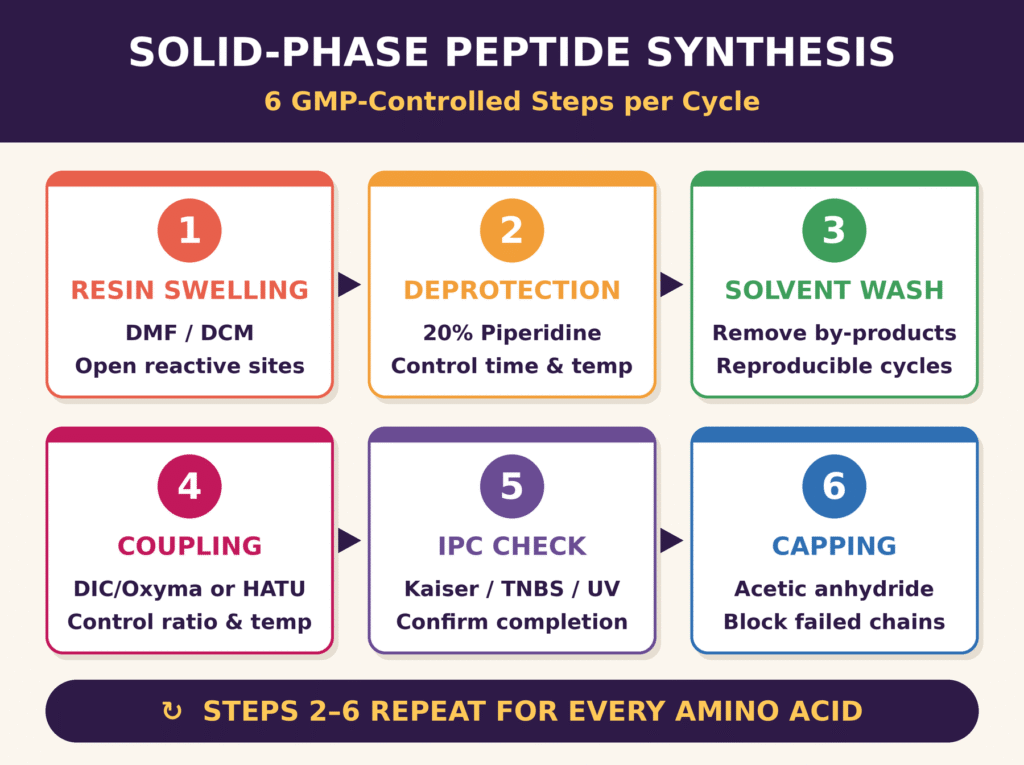
Sequential Manufacturing Steps in Solid-Phase Peptide Synthesis
- Resin Conditioning and Swelling: Polymeric resins are solvated in appropriate solvents, such as DMF or DCM, to improve pore accessibility and maximize the availability of functional sites.
- Deprotection Cycle: The N-terminal protecting group is selectively removed using basic reagents, typically 20% piperidine in DMF for Fmoc chemistry. Reaction duration, solution temperature, and flow rates must remain within established operating limits. Excessive exposure or elevated temperatures can initiate base-catalyzed side reactions, including aspartimide formation in sequences containing Asp-Gly or Asp-Ala motifs, as well as other sequence-dependent degradation reactions.
- Solvent Wash Phase: Intermediate washing steps remove residual deprotection reagents and reaction by-products. Effective washing minimizes unintended reactions and helps maintain reproducibility during subsequent coupling cycles.
- Coupling Reaction Cycle: Activated amino acid derivatives are introduced in appropriate stoichiometric proportions alongside coupling reagents and additives, such as DIC/Oxyma or HATU. Reaction temperature, mixing efficiency, and reaction duration are controlled to promote adequate coupling conversion while minimizing side reactions.
- In-Process Control (IPC) Verification: Qualitative or quantitative tests, including the Kaiser test for primary amines and TNBS assays, or inline UV monitoring of deprotection streams, are used as appropriate to verify reaction progress and coupling completion before synthesis proceeds to the next cycle.
- Capping of Unreacted Intermediates: When steric hindrance or incomplete reaction contributes to coupling failure, capping procedures using reagents such as acetic anhydride selectively acetylate unreacted free amine groups. This prevents those chains from continuing through subsequent coupling cycles and can facilitate the separation of truncated peptide impurities during downstream purification.
Cleavage and Deprotection Under ICH Q7 for Peptide APIs
Cleavage and global deprotection under ICH Q7 for Peptide APIs require appropriate control over reaction temperature, cleavage-cocktail composition, and scavenger ratios. These controls enable the assembled peptide to be detached from the resin while simultaneously removing amino acid side-chain protecting groups. Applying validated process limits and appropriate scavenger systems helps minimize re-alkylation, oxidation, and undesirable chemical modifications during protecting-group removal.
After chain assembly is complete, the fully protected peptide-resin conjugate undergoes global cleavage. In Fmoc-based chemistry, cleavage is commonly achieved using strong acid mixtures containing trifluoroacetic acid (TFA) and suitable nucleophilic scavengers.
Cleavage Reaction
General representation of peptide cleavage:
Peptide–Resin–(Side-Chain Protecting Groups)
→ TFA / Scavenger Mixture →
Crude Peptide + Resin + Trapped Reactive Species
The exact reaction products depend on the resin linker, protecting groups, peptide sequence, and cleavage conditions.
Scavenger selection, including triisopropylsilane (TIS), ethanedithiol (EDT), phenol, water, and thioanisole, depends on the peptide sequence and the protecting groups used. These scavengers help capture reactive carbocations generated during cleavage of tert-butyl, trityl, and Pbf protecting groups. If these reactive species are not effectively captured, they can react with susceptible side chains, producing alkylated tryptophan, cysteine, or tyrosine impurities.
Critical Process Controls During Cleavage
- Temperature Control: Cleavage reactions may be exothermic, so reaction temperature must be monitored and maintained within validated limits. A temperature range of 15°C to 25°C may be suitable for certain processes, but the operating range must be justified for the specific peptide and cleavage chemistry. Excessive temperatures can accelerate acid-mediated degradation and unwanted chemical modifications.
- Reaction Duration: Exposure to acid cocktails must be validated to achieve adequate protecting-group removal while minimizing acid hydrolysis, oxidation, and side-chain degradation.
- Precipitation and Isolation: After resin filtration, the dissolved crude peptide may be precipitated using cold organic antisolvents, such as methyl tert-butyl ether (MTBE) or diethyl ether, where compatible with the process. Centrifugation or filtration is then used to isolate the crude peptide. The isolated material is evaluated for crude purity, molecular identity by mass spectrometry, and relevant residual reagents or scavengers.
Chromatographic Purification and Salt Exchange Under ICH Q7 for Peptide APIs
Chromatographic purification and salt exchange under ICH Q7 for Peptide APIs involve preparative reverse-phase high-performance liquid chromatography (RP-HPLC) and controlled counter-ion exchange. These processes convert crude reaction products into purified drug substances with an appropriate counter-ion profile. Performing these unit operations under GMP requires predefined fraction-pooling criteria, controlled processing conditions, documented acceptance criteria, and suitable analytical testing.
Crude synthetic peptides may contain structurally related impurities, including single-amino-acid deletion sequences, truncated fragments, diastereomers, and oxidized residues. Preparative RP-HPLC uses hydrophobic silica stationary phases, such as C18 or C4, and gradient elution with suitable mobile phases to achieve separation of these impurities.
For a broader view of the analytical techniques used to assess peptide identity, purity, and physicochemical properties, review the peptide physicochemical characterization services.
Preparative Purification Workflow
- Crude Dissolution and Load Preparation: Crude peptide powder is dissolved in a suitable aqueous-organic mobile phase. The solution is clarified or filtered using a membrane compatible with the peptide and solvent system to protect column integrity. A 0.22 µm membrane may be appropriate for certain preparations, depending on the process requirements.
- Primary Purification Run: Gradient elution using water and acetonitrile, with appropriate acid modifiers, separates the target peptide from closely related sequence impurities and degradation products.
- Fraction Testing and Pooling: Column effluent is collected in individual fractions, which are evaluated using suitable analytical methods, such as analytical HPLC. Only fractions meeting predefined written acceptance criteria are combined to form the purified bulk composite. Illustrative criteria may include a specified peptide purity and limits for individual unknown impurities. Actual acceptance limits must be justified according to the product specification, development data, and applicable regulatory requirements. Fractions that fail the criteria are managed through validated recycling, reprocessing, or rejection procedures, as appropriate.
- Counter-Ion Exchange: Cleavage with TFA can result in a peptide containing trifluoroacetate counter-ions. Because the counter-ion profile can affect product quality, safety, and stability, the process may require conversion to the intended counter-ion, such as acetate or hydrochloride, in accordance with the product specification and applicable regulatory requirements.
Counter-Ion Conversion Reaction
Peptide · xTFA
→ Anion Exchange / RP-HPLC Buffers →
Peptide · yAcOH + Released TFA-Containing Species
Here, x and y represent the amounts of the respective counter-ions associated with the peptide. The equation is a simplified process representation; the actual counter-ion composition depends on peptide charge, solution conditions, and the exchange procedure. AcOH denotes acetic acid, while TFA denotes trifluoroacetic acid.
Ammonium acetate is one example of a buffer that may be used during counter-ion exchange, depending on the selected purification strategy.
Counter-ion conversion may be performed through secondary RP-HPLC displacement steps or dedicated anion-exchange chromatography. Quality control testing measures residual trifluoroacetate content and verifies that the target counter-ion content meets established acceptance criteria. Numerical limits, such as residual trifluoroacetate below 0.5% or 0.1% and acetate content between 4.0% and 12.0% w/w, should be treated as product-specific examples rather than universal regulatory requirements.
Lyophilization and Environmental Control Under ICH Q7 for Peptide APIs
Lyophilization and final isolation under ICH Q7 for Peptide APIs convert purified liquid peptide solutions into stable, moisture-controlled API powders through validated freeze-drying cycles conducted under appropriate environmental conditions. Environmental controls, including temperature, humidity, and contamination prevention, help protect hygroscopic peptide products against moisture uptake, degradation, and contamination.
Three Phases of the Lyophilization Cycle
- Freezing Phase: The purified bulk solution is cooled under controlled conditions to form a frozen matrix. The freezing conditions are selected according to the formulation’s thermal characteristics, including the collapse temperature (Tc) or glass transition temperature of the maximally freeze-concentrated phase (Tg′), where applicable.
- Primary Drying (Sublimation): Chamber pressure is reduced under vacuum while shelf temperature and product temperature are carefully regulated. Ice is removed through sublimation without exceeding the product’s critical temperature limits, which could result in cake collapse or melt-back.
- Secondary Drying (Desorption): The chamber temperature is increased under controlled vacuum to remove residual bound water through desorption. Final moisture content is reduced to the established product specification and may be measured using Karl Fischer titration. A limit such as ≤ 5.0% w/w may be appropriate for certain products but is not a universal requirement for all peptide APIs.
Because lyophilized peptides may be hygroscopic, bulk handling, weighing, packaging, and container-closure sealing must be performed under appropriately controlled environmental conditions. Cleanroom classification and environmental monitoring requirements must be established through a risk-based assessment of the operation and applicable GMP requirements. ISO 8, ISO 7, or ISO 5 environments may be appropriate for particular activities, but these classifications are not automatically mandated for every synthesis, purification, or API handling operation.
Primary packaging may consist of suitable pharmaceutical-grade glass containers, such as Type I glass vials, or other qualified containers compatible with the peptide API. Closures and packaging systems must provide appropriate protection against moisture and other environmental factors. Storage conditions, container-closure suitability, and the use of nitrogen flushing should be justified by stability data and the product’s specific requirements.
Learn about GLP-1 peptide stability and analytical methods to understand how analytical testing supports the assessment of peptide stability and degradation.
Impurity Characterization Thresholds Under ICH Q7 for Peptide APIs
Impurity characterization for synthetic peptide APIs under ICH Q7 for Peptide APIs requires the identification, quantification, and control of process-related and degradation impurities according to applicable regulatory guidance and product-specific specifications. Analytical methods used for batch release should be stability-indicating and capable of resolving relevant sequence variants, stereoisomers, and residual chemical reagents.
The U.S. FDA guidance concerning abbreviated new drug applications (ANDAs) for certain highly purified synthetic peptide drug products and applicable EMA guidance establish expectations for impurity characterization and control. However, impurity reporting, identification, and qualification thresholds depend on the relevant regulatory framework, maximum daily dose, route of administration, impurity type, and applicable guidance. A single set of numerical thresholds should not be applied universally to every synthetic peptide API.
| Impurity Category | Primary Synthesis Cause or Origin | Suitable Analytical Methods | Regulatory Control Considerations |
|---|---|---|---|
| Deletion Sequences | Incomplete amino acid coupling during SPPS cycles | High-resolution LC-MS and analytical RP-HPLC | Characterization and acceptance criteria should be based on applicable guidance, impurity risk, and product-specific specifications. |
| Diastereomeric Variants | Racemization during activation, coupling, or other synthesis operations | Chiral LC, UHPLC-MS, and appropriate comparative analysis | Quantification and control limits should reflect the impurity’s potential impact on quality, safety, and efficacy. |
| Truncated Sequences | Incomplete chain elongation, including sequences terminated by capping | RP-HPLC and electrospray mass spectrometry | Identification, separation, and control should be supported by validated analytical methods and justified specifications. |
| Residual Solvents | Residual DMF, NMP, DCM, acetonitrile, MTBE, and other processing solvents | Headspace GC-FID or GC-MS, as appropriate | Limits should follow the applicable ICH Q3C classification and relevant product-specific requirements. |
| Elemental Impurities | Trace metals originating from raw materials, reagents, catalysts, or process equipment | ICP-MS or another suitably validated elemental analysis method | Risk assessment and control should follow applicable ICH Q3D requirements and permitted daily exposure considerations. |
Analytical method validation in accordance with ICH Q2(R2), where applicable, requires demonstrating that methods are suitable for their intended purpose. Stability-indicating methods should distinguish the principal peptide from relevant degradation products and impurities. Forced degradation studies involving acidic conditions, basic conditions, oxidation, thermal stress, and photolysis can help establish whether degradation products are adequately separated from the principal active peak. Examples of peptide degradation products include oxidized methionine and deamidated glutamine residues.
See how multi-attribute monitoring (MAM) for peptide characterization can support the assessment of multiple product quality attributes within an integrated analytical workflow.
Process and Cleaning Validation Under ICH Q7 for Peptide APIs
Process validation and quality system integration for synthetic peptides under ICH Q7 for Peptide APIs require a lifecycle-based approach that connects critical process parameters (CPPs) with critical quality attributes (CQAs), while incorporating validated cleaning procedures to prevent cross-contamination. Demonstrating reproducibility across process performance qualification (PPQ) batches provides evidence that the manufacturing process and associated quality systems can consistently produce API batches that meet established specifications.
Three Stages of Process Validation
- Stage 1 — Process Design: The manufacturing process is developed using scientific knowledge, process characterization, and risk assessments. Quality by Design (QbD) principles described in ICH Q8 and quality risk management principles described in ICH Q9 may support the identification and control of critical process variables.
- Stage 2 — Process Qualification: Process performance qualification batches are manufactured to demonstrate that the facility, equipment, utilities, and manufacturing process can consistently produce material meeting the required quality attributes. The number of qualification batches should be justified using scientific and risk-based considerations rather than assuming that three consecutive commercial-scale batches are universally mandatory.
- Stage 3 — Continued Process Verification: Batch yields, operating parameters, analytical results, and other relevant performance indicators are monitored during routine manufacturing. Ongoing trend analysis helps identify process variation and maintain a state of control.
Cleaning Validation and Cross-Contamination Prevention
Cleaning validation presents specific challenges in multi-product peptide manufacturing facilities. Polymeric resins, protected amino acids, and hydrophobic peptides can adhere to stainless-steel reactors, tubing, and purification equipment. Cleaning procedures must therefore employ suitable, validated analytical methods, such as total organic carbon (TOC) analysis or high-sensitivity LC-MS, where appropriate, to confirm that residual carryover remains within justified acceptance limits.
Maximum allowable carryover (MAC) limits should be calculated or otherwise scientifically justified using relevant product and process information. Cleaning validation must also address the sampling strategy, recovery of residues from equipment surfaces, analytical method sensitivity, and the potential for residues to accumulate in difficult-to-clean locations. Equipment cleaning protocols should prevent residual resin beads, peptide fragments, and other process materials from contaminating subsequent manufacturing batches.
Review the full characterization data package for a GLP-1 receptor agonist ANDA for an example of how characterization results can support a peptide regulatory submission.
Conclusion
Comprehensive implementation of ICH Q7 for Peptide APIs across applicable manufacturing unit operations provides the technical framework and quality-system controls necessary for producing consistent peptide drug substances. Establishing appropriate controls over starting materials, solid-phase synthesis, cleavage parameters, chromatographic purification, counter-ion exchange, lyophilization, and cleaning helps manufacturers maintain batch-to-batch consistency and meet applicable regulatory requirements.
As global regulatory expectations for synthetic peptides continue to evolve, robust quality systems, scientifically justified specifications, validated analytical methods, and lifecycle process controls remain essential for maintaining product quality and supporting successful market access.
Planning a peptide characterization program? Review the peptide characterization CRO deliverables checklist to help identify the analytical outputs and documentation needed for your development or regulatory objectives.
To discuss specialized custom peptide synthesis, analytical testing, or regulatory compliance support, visit the ResolveMass Contact Us page.
Frequently Asked Questions (FAQs)
A regulatory starting material (RSM) is a defined substance introduced into the manufacturing process that contributes to the structure of the final peptide API. Depending on the manufacturing route and regulatory justification, it may include protected amino acid derivatives or suitable peptide intermediates. Its selection requires a documented rationale, appropriate quality specifications, supplier qualification, and risk-based evaluation of potential impurities.
Trifluoroacetic acid (TFA) is commonly used during peptide cleavage and deprotection, which can leave the isolated peptide in its trifluoroacetate salt form. Excess residual TFA may affect product purity, stability, formulation properties, and suitability for its intended use. When necessary, counter-ion exchange converts the peptide into a suitable salt, such as acetate or hydrochloride, with residual TFA controlled according to established specifications.
Impurity reporting, identification, and qualification requirements depend on the applicable regulatory guidance, the impurity type, and the intended use of the peptide API. A concentration of 0.10% may serve as an identification or reporting threshold in certain contexts, while 0.50% may be relevant to qualification requirements. These values are not universal limits, so manufacturers must establish appropriate impurity specifications using applicable guidance, product-specific assessments, and safety data.
Solid-phase peptide synthesis (SPPS) builds the peptide chain on an insoluble polymeric resin, requiring controls over resin loading, swelling, coupling efficiency, deprotection, and washing. Liquid-phase peptide synthesis (LPPS) performs reactions in solution and generally involves additional intermediate isolation and purification operations. Both approaches must follow applicable ICH Q7 principles, with control strategies tailored to their respective manufacturing processes and impurity risks.
The appropriate environmental classification for peptide manufacturing depends on the operation, contamination risks, facility design, and applicable regulatory requirements. ISO 8 environments may be used for certain synthesis operations, while ISO 7 areas may be appropriate for specific downstream processing activities. Operations involving final API powder handling and packaging require suitable contamination controls, which may include ISO 5 localized protection when justified by the process and product requirements.
Cleaning validation demonstrates that established cleaning procedures consistently remove peptide residues, process chemicals, and other contaminants to acceptable levels. Manufacturers typically use swab or rinse sampling followed by suitable analytical methods, such as Total Organic Carbon (TOC) analysis or high-sensitivity LC-MS. Acceptance criteria should be scientifically justified using toxicological assessments, equipment considerations, and potential cross-contamination risks, including those associated with residual resin particles.
Supplier qualification for protected amino acids generally includes a Quality Agreement, relevant Certificates of Analysis (CoAs), approved material specifications, and documentation supporting identity, purity, chiral purity, and residual solvent controls. Depending on the material’s criticality, additional records may include supplier audit reports, manufacturing process information, and change notification procedures. These documents help establish that the supplier can consistently provide materials meeting the manufacturer’s quality requirements.
ICH Q7 emphasizes appropriate in-process monitoring and control to ensure that manufacturing operations remain consistent with established procedures and quality requirements. During peptide chain elongation, techniques such as the Kaiser test, other colorimetric assays, and inline UV monitoring can help assess coupling completion or deprotection performance. Defined acceptance criteria and documented results help determine whether the process can proceed to the next synthesis cycle or requires corrective action.
No, a Certificate of Analysis (CoA) documents the analytical results for a particular material batch against specified acceptance criteria, but it does not independently establish a supplier’s overall GMP compliance. A site audit evaluates broader aspects of the quality management system, including manufacturing controls, documentation, deviation handling, and change management. Supplier qualification should therefore consider CoAs alongside risk-based audits and other relevant evidence of the supplier’s quality capabilities.
Reference:
- Health Canada. (2019, April 8). Active pharmaceutical ingredients – Good manufacturing practices – Questions and answers. Government of Canada. https://www.canada.ca/en/health-canada/services/drugs-health-products/compliance-enforcement/information-health-product/drugs/active-pharmaceutical-ingredients-questions-answers.html
- European Medicines Agency. (2025). Guideline on the development and manufacture of synthetic peptides. https://www.ema.europa.eu/en/documents/scientific-guideline/guideline-development-manufacture-synthetic-peptides_en.pdf
- U.S. Food and Drug Administration. (2016). Quality considerations for peptide drug products: Guidance for industry. https://www.fda.gov/media/96718/download
- U.S. Food and Drug Administration. (2023). Guidance for industry. U.S. Department of Health and Human Services.
- Jiao, T. (2024, September 25). Teriparatide injection first generic approval: Quality-related review considerations. Office of Pharmaceutical Quality Assessment I, Office of Pharmaceutical Quality, Center for Drug Evaluation and Research, U.S. Food and Drug Administration. https://www.fda.gov/media/184411/download
Get In Touch With Us
About The Author