

Introduction:
Injectable steroid manufacturing scale-up is one of the most technically demanding transitions in sterile parenteral drug development, because a process that performs well at 5–10 L in the lab can behave very differently at 200–2,000 L commercial scale. Corticosteroid and anabolic steroid injectables — including suspensions like triamcinolone acetonide, methylprednisolone acetate, and testosterone esters — are formulated as sterile suspensions or oily solutions where particle size, crystal form, and viscosity directly determine bioavailability and injection-site safety. Scaling these products up isn’t simply a matter of running bigger batches; it requires re-verifying sterility assurance, particle-size distribution, dissolution behavior, and impurity profiles at every intermediate scale, a challenge our team has worked through extensively in dexamethasone injection development programs. For CDMOs and sponsors managing generic injectable steroid programs, understanding where scale-up typically breaks down — and building the analytical bridge to catch it early — is what separates a smooth technology transfer from a costly deviation investigation.
Summary:
- Injectable steroid manufacturing scale-up moves a formulation from lab-scale batches to commercial volumes while preserving sterility, potency, and particle-size consistency
- The biggest failure points are solubility/particle-size drift, sterility assurance at larger fill volumes, and container-closure/E&L behavior that changes with batch size
- Analytical bridging (comparability testing between clinical and commercial lots) is the single most important control strategy for a successful scale-up
- Regulatory submissions (ANDA/ANDS) require documented equivalence of the scaled process, not just the final product specification
- Partnering with a CDMO/CRO that runs orthogonal analytical characterization in parallel with process development significantly reduces scale-up failure risk
1: Why Is Scale-Up So Difficult for Injectable Steroid Suspensions?
Scale-up is difficult because injectable steroid suspensions are physically metastable systems — small changes in mixing shear, cooling rate, or micronization equipment at larger scale can shift particle size, crystal habit, or agglomeration behavior even when the formulation itself is unchanged.
Most injectable corticosteroids and androgens are poorly water-soluble APIs suspended or dissolved in oil vehicles (sesame oil, cottonseed oil, benzyl benzoate) or aqueous vehicles with suspending agents. Their in vivo release rate — and therefore their therapeutic profile — depends on:
- Particle size distribution (PSD) of the micronized API
- Crystal polymorphic form, which can convert under different cooling or milling conditions
- Viscosity and suspending-agent performance, which changes with mixing geometry
- Uniformity of dose across the batch, particularly for suspensions prone to settling
At lab scale, small-batch homogenizers and micronizers produce a PSD that may not replicate at pilot or commercial scale, where different mill types, tip speeds, and residence times are used.
2: What Are the Main Technical Failure Points in Scale-Up?
The three most common failure points are particle-size/polymorph drift during micronization, sterility assurance breakdown during larger-volume aseptic filling, and container-closure interactions that only appear at commercial fill speeds.
| Failure Point | What Changes at Scale | Typical Consequence |
|---|---|---|
| Micronization/milling | Different equipment, longer processing time, higher shear | PSD shift, polymorphic conversion, dissolution failure |
| Aseptic filling | Longer fill runs, more line interventions, higher fill-speed | Increased microbial contamination risk, media fill failures |
| Terminal sterilization (where applicable) | Larger autoclave loads, heat penetration variability | Incomplete sterility assurance, degradation of heat-sensitive steroids |
| Suspension homogeneity | Larger mixing vessels, different impeller geometry | Settling, dose non-uniformity across fill |
| Container-closure system | Higher-speed stoppering, different vial/stopper lots | Extractables/leachables shifts, particulate contamination |
| Stability | Longer hold times before fill, different bulk storage conditions | Impurity growth, oxidative degradation |
3: How Does Particle Size Control Change Between Lab and Commercial Scale?
Particle size control shifts from a formulation variable at lab scale to a process-engineering variable at commercial scale, because the milling equipment itself — not just the milling parameters — usually changes between stages.
A wet-milling or jet-milling process validated at 2 L rarely transfers directly to a 500 L commercial batch. Teams typically need to:
- Re-characterize PSD (D10/D50/D90) at each scale using laser diffraction, alongside microscopy for morphology confirmation
- Confirm polymorphic form by XRPD and DSC at every scale-up stage, since steroid APIs are prone to polymorphic conversion under shear and thermal stress
- Run in vitro release testing (USP apparatus 4 or equivalent) to verify that PSD changes haven’t altered the release profile
- Bridge dissolution/release data statistically against the clinical or reference-listed drug (RLD) batch used in bioequivalence studies
Without this bridging data, regulators will not accept that the scaled batch is equivalent to the batch used in pivotal studies.
4: What Sterility Assurance Challenges Emerge at Larger Scale?
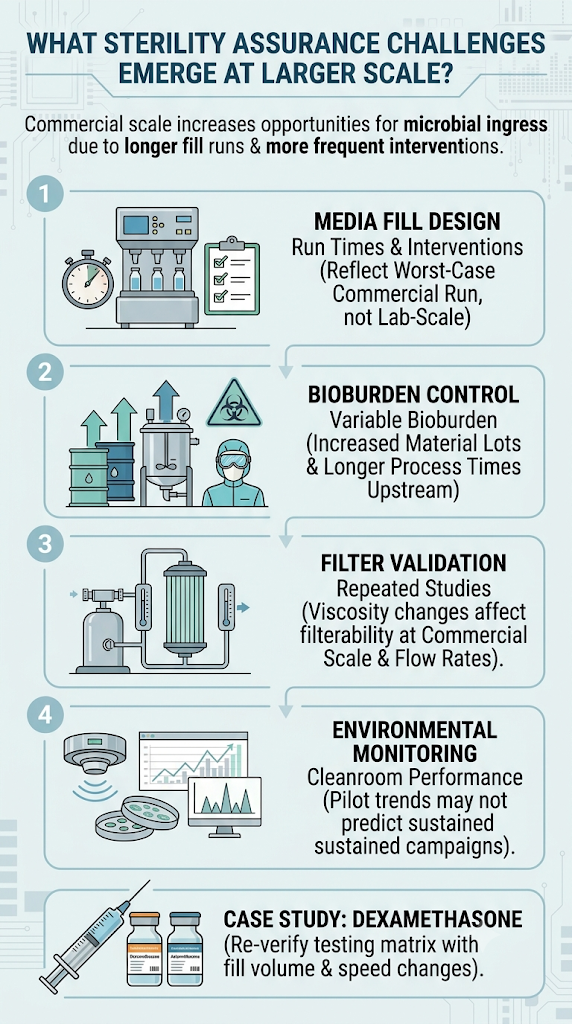
Sterility assurance challenges emerge because longer aseptic fill runs and more frequent line interventions at commercial scale statistically increase the opportunity for microbial ingress, even when the process itself hasn’t changed.
Key considerations for injectable steroid scale-up include:
- Media fill design must reflect worst-case commercial run length and intervention frequency, not lab-scale run times
- Bioburden control upstream of sterile filtration becomes more variable with larger raw material lots and longer processing times
- Filter validation (bacterial retention studies) must be repeated for the actual commercial filter train and flow rate, since viscosity of oil-based vehicles affects filterability
- Environmental monitoring trends from pilot-scale runs are not always predictive of commercial cleanroom performance under sustained fill campaigns
Our own sterility and endotoxin testing for dexamethasone injection work illustrates how this testing matrix needs to be re-verified as fill volumes and line speeds change, not treated as a one-time qualification exercise.
5: How Do Extractables and Leachables (E&L) Risk Change at Commercial Scale?
E&L risk changes at commercial scale primarily because higher-speed stoppering and different container-closure component lots introduce mechanical and material variability that isn’t present in small hand-filled lab batches.
Injectable steroid vehicles — particularly oil-based ones — are aggressive extraction media for rubber stoppers and elastomeric components. A container-closure system that passed E&L screening at lab scale may show different leachables behavior once:
- Fill speeds increase and stopper compression forces change
- Different stopper or vial suppliers/lots are qualified for commercial volume
- Vehicle contact time with the closure changes due to different shelf storage orientation
Selecting and qualifying the right container-closure systems for injectable steroids early, and repeating a structured E&L risk assessment at commercial scale aligned with ICH Q3E principles as they continue to develop, helps catch these shifts before they surface as an OOS result late in stability testing.
6: What Does a Practical Scale-Up Bridging Strategy Look Like?
A practical bridging strategy runs analytical comparability testing in parallel at each scale — lab, pilot, and commercial — rather than waiting until the commercial batch is complete to test equivalence.
A typical framework includes:
- Stage-gate comparability testing: PSD, polymorph form, assay, related substances, and dissolution compared at each scale before proceeding to the next
- Design of Experiments (DoE) on critical process parameters (mixing speed, milling time, fill-line speed) to define a validated operating range before full commercial runs
- Parallel stability programs initiated at pilot and commercial scale so degradation trends can be compared, not assumed
- Cross-functional risk assessment combining process engineering, analytical, and regulatory input before locking the commercial process
7: What Do Regulators Expect for Scale-Up of Generic Injectable Steroids?
Regulators expect documented, data-driven equivalence between the scaled commercial process and the batches used to establish bioequivalence and stability, submitted as part of the CTD Module 3 quality section for ANDA/ANDS filings.
This typically means:
- Comparative PSD and dissolution data between pivotal clinical/BE batches and commercial-scale batches
- Process validation data covering at least three commercial-scale batches
- Updated impurity and degradation profiles reflecting the commercial process
- A justified control strategy for any process parameter shown to affect critical quality attributes during scale-up studies
Our experience supporting a dexamethasone ANDA submission reflects exactly this expectation — reviewers want to see the scaled process demonstrably tied back to the batches used in bioequivalence and stability studies, not just a final specification table.
Conclusion:
Injectable steroid manufacturing scale-up succeeds when particle size, sterility assurance, and container-closure performance are treated as process-engineering variables that must be re-verified at every stage — not assumptions carried forward from lab-scale development. The technical failure points are predictable: micronization drift, aseptic fill variability, and E&L shifts at higher fill speeds. What separates a successful scale-up from a costly deviation is building analytical bridging data into the process from pilot scale onward, rather than discovering equivalence gaps at commercial validation. For sponsors managing generic or branded injectable steroid programs, working with a CRO/CDMO partner experienced in orthogonal characterization and stage-gate comparability testing significantly de-risks the path from clinical to commercial supply.
Frequently Asked Questions:
Unexpected impurities can first be detected through stability-indicating chromatographic analysis. Further characterization may involve LC-MS, HRMS, NMR, or other complementary techniques depending on the impurity and analytical objective. The resulting data can help connect an impurity to a potential process or formulation source.
The biggest challenge is maintaining consistent product quality when process conditions change with equipment and batch size. Mixing, heat transfer, filtration, filling, hold times, and impurity formation can all behave differently at commercial scale. These differences need to be characterized rather than assumed to be equivalent.
Process characterization identifies how critical process parameters affect critical quality attributes. It provides evidence for defining appropriate operating ranges and control strategies. This knowledge can then support engineering studies, validation, and continued process monitoring.
Reference
- Tomarelli E, Cerra B, Mutti FG, Gioiello A. Merging continuous flow technology, photochemistry and biocatalysis to streamline steroid synthesis. Advanced Synthesis & Catalysis. 2023 Dec 5;365(23):4024-48.https://advanced.onlinelibrary.wiley.com/doi/abs/10.1002/adsc.202300305
- Lee JW, Park JH, Yu GW, You JW, Han MJ, Kang MJ, Ho MJ. Sustained-release intra-articular drug delivery: PLGA systems in clinical context and evolving strategies. Pharmaceutics. 2025 Oct 20;17(10):1350.https://www.mdpi.com/1999-4923/17/10/1350
- Khabale MB, Abale ML, Kasande S. “Key Success Factors of Value Chain Management of Injectable Formulations”: An Expert Opinion Survey. Anveshak International Journal of Management (AIJM). 2025 Jul 1;14(2):227.https://openurl.ebsco.com/contentitem/gcd:187271579?sid=ebsco:plink:crawler-gcd&id=ebsco:gcd:187271579&crl=c&jrnl=23500794
- Poonia N, Madan J, Pandita D, Levin M. How to Develop Robust Scale-up Strategies for Complex Injectable Dosage Forms.https://www.researchgate.net/profile/Faraat-Ali/publication/400751349_Drug_complexes_development_and_scale-up_strategies_of_injectable_dosage_forms/links/6992ef4212f837212a1b0d53/Drug-complexes-development-and-scale-up-strategies-of-injectable-dosage-forms.pdf
About the Author


