

Introduction:
Intact Mass Analysis and Middle-Up Characterization of Biosimilar mAbs are mass spectrometry-based approaches for evaluating the molecular identity and structural consistency of therapeutic monoclonal antibodies (mAbs). They measure the whole molecule and its enzyme-generated subunits, then compare the results to the reference product. Biosimilar development demands this level of analysis because mAbs are heterogeneous biological molecules. Their quality can be influenced by sequence, post-translational modifications, glycosylation, processing, aggregation, and manufacturing conditions.
The objective is not simply to show that the proposed product has the expected nominal molecular weight. It is to establish whether the product is highly similar to the reference product, and whether observed differences are scientifically understood and relevant to product quality. The FDA’s final guidance on therapeutic protein biosimilars emphasizes comparative analytical studies as a core component of demonstrating biosimilarity. ICH Q5E provides a quality-focused framework for evaluating the comparability of biotechnology-derived products.
At ResolveMass Laboratories Inc., a Canadian analytical CRO/CDMO specializing in biosimilar characterization and mass spectrometry, we approach mAb characterization as a multi-level analytical investigation. It begins with intact mass, continues with middle-up analysis, and then moves to orthogonal methods where the data calls for them. This is also how a well-designed comparability exercise in biosimilar development is built: broad and fast first, deeper only where needed.
Summary:
- Intact Mass Analysis and Middle-Up Characterization of Biosimilar mAbs provide complementary information about monoclonal antibody identity, molecular mass, structural integrity, and product-related variants.
- Intact mass analysis evaluates the whole antibody (about 148 kDa), confirming the expected mass and detecting major mass shifts from modifications or processing differences.
- Middle-up characterization analyzes controlled antibody subunits (roughly 25–100 kDa). It gives greater structural resolution than intact analysis without the complexity of full peptide mapping.
- Together, the two approaches support biosimilar analytical similarity assessments, comparability studies, characterization of critical quality attributes (CQAs), and investigation of unexpected variants.
- Advanced mass spectrometry can investigate glycoforms, C-terminal variants, oxidation, deamidation-associated changes, clipping, and other product-related species.
- A mass spectrum is never proof of biosimilarity on its own. Intact and middle-up data should be interpreted alongside orthogonal techniques.
1: What Is Intact Mass Analysis of a Biosimilar mAb?
Intact mass analysis measures the molecular mass of the complete antibody. It gives a rapid assessment of molecular identity, major structural variants, and overall molecular integrity. The antibody is typically analyzed by high-resolution LC-MS after suitable sample preparation, and the charge-state envelope is deconvoluted into a zero-charge mass profile. Depending on the objective, the antibody can be run in its non-reduced, deglycosylated (PNGase F), or reduced form.
The resulting spectrum can provide information about:
- Expected molecular mass
- Heavy- and light-chain composition
- Major glycoforms (G0F, G1F, G2F), which differ by 162 Da per galactose
- C-terminal lysine variants
- Oxidation-related mass shifts
- Clipping or truncation
- Other detectable post-translational modifications and unexpected species
Intact analysis is especially valuable as an identity and high-level comparability assessment, because it evaluates the molecule without digesting it into peptides. It generally cannot localize a modification to a specific residue, which is where middle-up and peptide-level approaches come in.
Why Is Intact Mass Analysis Important for Biosimilar mAbs?
Intact mass analysis gives a rapid molecular-level comparison between a proposed biosimilar and its reference product while preserving the overall antibody architecture. For a biosimilar program, it helps answer:
- Does the observed mass correspond to the expected antibody?
- Are major mass populations consistent between biosimilar and reference material?
- Are unexpected molecular species present?
- Are major glycoform distributions broadly consistent?
- Are processing-related variants detectable?
- Does a mass difference require additional investigation?
A difference in observed mass should not automatically be read as a product-quality failure. Biological molecules are naturally heterogeneous, so differences must be evaluated in context. That is why intact data is most valuable when integrated with orthogonal characterization.
2: What Is Middle-Up Characterization of Biosimilar mAbs?
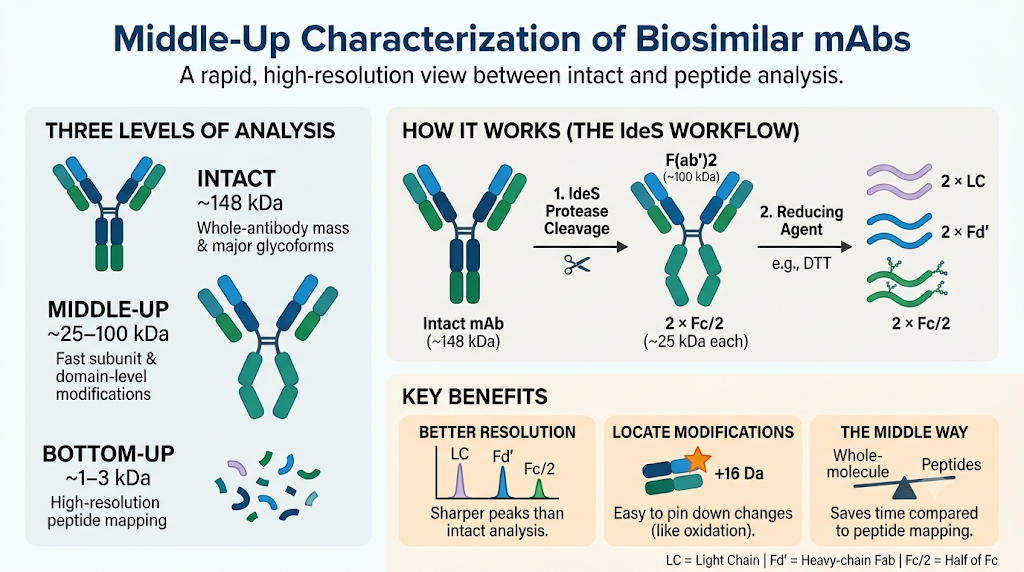
Middle-up characterization analyzes large antibody fragments generated by controlled enzymatic or chemical cleavage. It provides greater structural resolution than intact analysis while retaining substantial molecular information. It sits between intact (whole-molecule) and bottom-up (peptide-level) analysis, hence the name “middle.”
The most common route uses IdeS, an IgG-specific protease that cleaves below the hinge region. This produces:
- One F(ab’)2 fragment (~100 kDa)
- Two Fc/2 fragments (~25 kDa each)
Adding a reducing agent splits F(ab’)2 further, giving light chain (LC), Fd’ (the heavy-chain Fab portion), and Fc/2 subunits of about 25 kDa each. Smaller species yield sharper peaks, so modifications that shift mass by only a few Da become easier to resolve. Just as importantly, you learn where a modification sits. A +16 Da shift on Fc/2 points to the Fc region, while the same shift on Fd’ points to the Fab.
Intact vs. Middle-Up vs. Bottom-Up
| Characterization level | Primary analytical question | Typical information |
|---|---|---|
| Intact mass | What is the mass of the complete antibody? | Molecular mass, major glycoforms, major variants |
| Middle-up | What is the mass and composition of major subunits? | Domain-level variants, modifications, structural differences |
| Bottom-up peptide mapping | Where is a modification located? | Sequence confirmation, site-specific PTMs, peptide-level impurities |
3: Intact Mass Analysis and Middle-Up Characterization of Biosimilar mAbs: Complementary Approaches
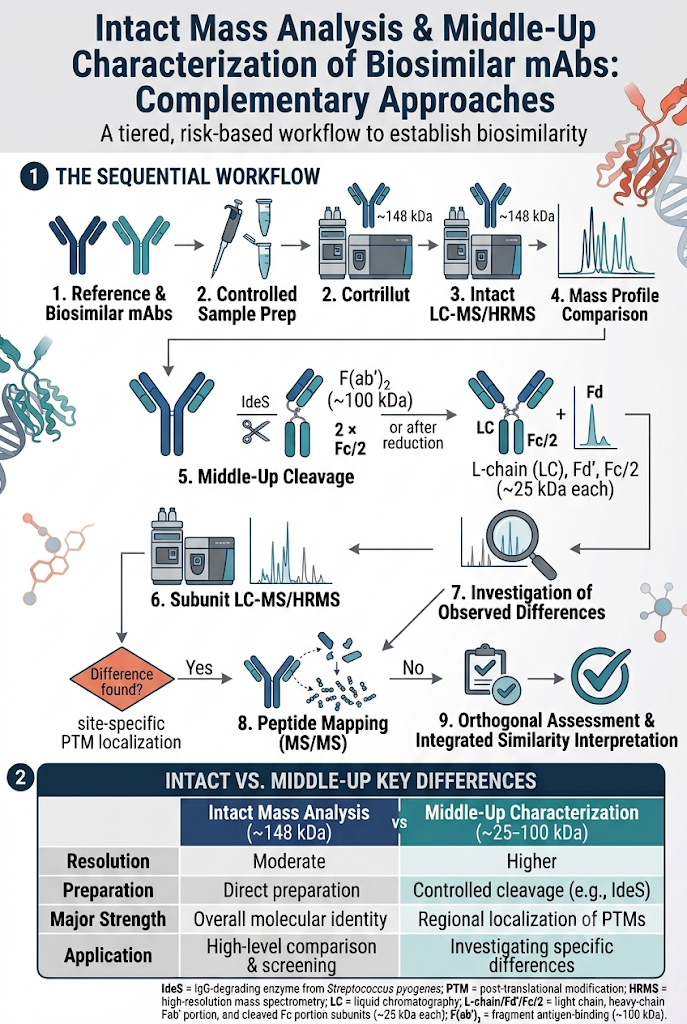
Intact mass and middle-up characterization are complementary rather than competing. Intact analysis establishes the overall molecular picture, middle-up investigates differences within defined subunits, and peptide mapping provides site-specific information when a difference needs to be localized.
A practical workflow follows this sequence:
Reference mAb + biosimilar mAb → controlled sample preparation → intact LC-MS/HRMS → mass profile comparison → middle-up cleavage → subunit LC-MS/HRMS → investigation of observed differences → peptide mapping or targeted work where required → orthogonal assessment → integrated similarity interpretation
This supports a risk-based approach rather than reliance on a single measurement.
Intact vs. Middle-Up: Key Differences
| Feature | Intact Mass Analysis | Middle-Up Characterization |
|---|---|---|
| Molecular level | Complete antibody (~148 kDa) | Large subunits (~25–100 kDa) |
| Structural resolution | Moderate | Higher |
| Sample preparation | Relatively direct | Requires controlled cleavage (e.g., IdeS ± reduction) |
| Major strength | Overall molecular identity | Localization to antibody regions or subunits |
| Glycoform assessment | Useful | More resolved in selected contexts |
| PTM investigation | Detects mass shifts | Helps narrow location |
| Follow-up analysis | May require middle-up or peptide mapping | May require peptide mapping |
| Biosimilar application | High-level comparison, lot screening | Difference investigation and deeper comparison |
4: Which Quality Attributes Can Be Investigated?
Mass spectrometry can investigate several molecular attributes relevant to biosimilar mAb quality, though techniques differ in sensitivity and structural resolution. ICH describes quality attributes as molecular or product characteristics selected for their ability to indicate product quality, collectively contributing to the assessment of identity, purity, potency, and stability.
| Attribute | Approximate mass signature | Best level of analysis |
|---|---|---|
| Fc N-glycoforms (G0F, G1F, G2F, Man5) | Steps of 162 Da (hexose) | Intact, middle-up (Fc/2) |
| C-terminal lysine variants | +128 Da per retained Lys | Intact, middle-up |
| N-terminal pyroglutamate | −17 Da (from Gln) | Middle-up (LC, Fd’) |
| Oxidation (Met/Trp) | +16 Da per site | Middle-up |
| Glycation | +162 Da | Intact, middle-up |
| Deamidation | ~+1 Da (hard to resolve intact) | Middle-up, then peptide mapping |
| Fragments, truncations | Mass losses matching cleavage sites | Reduced intact, middle-up |
| Disulfide-related heterogeneity | Differences between non-reduced and reduced forms | Intact (non-reduced vs reduced) |
Small shifts such as deamidation show why middle-up exists. They are flagged at the subunit level and confirmed by peptide mapping.
5: How Does HRMS Improve Biosimilar mAb Characterization?
High-resolution mass spectrometry (HRMS) improves characterization by providing accurate-mass measurements that distinguish closely related species and help investigate unexpected mass differences. In complex mAbs, multiple species can overlap in conventional spectra. HRMS, combined with chromatographic separation and appropriate deconvolution, improves interpretation.
HRMS supports:
- Accurate molecular-mass determination
- Detection of low-level mass differences
- Assignment of molecular species
- Comparative profiling and investigation of unexpected peaks
- Confirmation of proposed modifications
- Characterization of antibody fragments
- Data-driven selection of follow-up experiments
Accurate mass is not the same as complete structural identification. When a difference is detected, MS/MS, peptide mapping, enzymatic treatment, or orthogonal analysis may be needed to determine its origin.
6: What Is the Role of Sample Preparation?
Sample preparation is critical because antibody heterogeneity, buffer components, salts, excipients, and incomplete processing can all affect mass-spectrometric data quality. A well-controlled workflow considers:
- Buffer exchange and desalting
- Protein concentration
- Denaturation, reduction, and alkylation conditions where applicable
- Enzymatic cleavage and digestion conditions
- Control of sample handling to minimize artificial modifications
- Appropriate reference and test-product controls
Biosimilar and reference product should be handled under comparable, controlled conditions wherever scientifically justified, because preparation artifacts can create or obscure differences. Formulation matters here too. Excipients and degradation behavior shape both the mass data and the product’s stability profile, which is why characterization is closely linked to biosimilar formulation development and stability. Container and process-contact materials can introduce their own artifacts and impurities, so extractables and leachables testing for biosimilar drug development is part of a complete quality picture.
How Can Middle-Up Analysis Help Investigate Differences?
Middle-up analysis can narrow an observed intact-mass difference to a specific antibody region or subunit, which makes it easier to design targeted follow-up experiments. Suppose intact analysis shows a consistent mass difference between biosimilar and reference product. The question becomes: where does the difference originate?
Middle-up divides the antibody into larger structural components and shows whether the difference is associated with a particular subunit. If necessary, peptide-level analysis then provides further localization. The characterization hierarchy is:
Intact mass → regional/subunit information → peptide/site-specific information
This reduces unnecessary experimentation while increasing confidence in the interpretation.
7: Comparative Analytical Assessment for Biosimilar mAbs
Comparative analytical assessment compares the proposed biosimilar with a suitable reference product across relevant structural and functional attributes to identify and evaluate differences. A strong program does not ask only whether the masses are identical. It asks:
- What attributes are comparable, and what differences are observed?
- Are the differences within expected biological or analytical variability?
- Are they product-related or method-related?
- Could a difference affect biological function?
- What orthogonal evidence supports the conclusion?
The FDA’s September 2025 final guidance specifically addresses the design and evaluation of comparative analytical studies for proposed therapeutic protein biosimilars. A defensible package typically includes:
- Multiple reference product lots (to define natural variability) compared with several biosimilar lots
- Identical acquisition and deconvolution parameters across all samples
- Predefined acceptance criteria and a range-based or statistical comparison approach
- Documented scientific rationale for any observed differences
Where a glycoform difference is found, follow-up often includes functional testing, since glycosylation can influence Fc-mediated activity. That is the role of biosimilar functional bioassay development, which links structural findings to biological meaning. Analytical evidence also sits alongside clinical pharmacology, so understanding the role of PK/PD studies in biosimilar development helps teams plan how analytical and clinical data fit together.
8: Intact Mass and Middle-Up Workflow
ResolveMass structures intact and middle-up characterization around the specific analytical questions that arise during biosimilar development. A representative workflow:
- Sample and reference assessment: Review of materials, formulation, sample availability, and expected structure against the characterization objectives.
- Method development: Optimization of chromatography, ionization, acquisition parameters, and sample preparation for the antibody and the question at hand.
- Intact mass analysis: Native, deglycosylated, and reduced forms analyzed across all biosimilar and reference lots to establish the overall mass profile.
- Middle-up characterization: IdeS cleavage with and without reduction, followed by comparative LC-MS/HRMS of LC, Fd’, and Fc/2 subunits.
- Difference investigation: Assessment using accurate mass, chromatographic behavior, fragmentation data, and comparison with expected modifications.
- Orthogonal characterization: Integration with peptide mapping, chromatography, spectroscopy, or other methods where appropriate.
- Comparative interpretation: Results interpreted within the overall similarity assessment rather than as isolated pass/fail measurements.
Common Pitfalls in mAb Intact and Middle-Up Analysis
- Over-interpreting relative abundance: Ionization efficiency can differ between species, so quantitation should be treated as relative and verified orthogonally.
- Incomplete IdeS digestion: Residual intact or single-cut species distort the profile, so digestion efficiency should be monitored.
- Sample-preparation artifacts: Artificial oxidation or deamidation can be introduced during handling.
- Inconsistent deconvolution: Different algorithm settings between lots can create apparent differences that do not exist.
- Too few reference lots: The reference product’s own variability must be characterized before similarity can be judged.
Why Choose ResolveMass for Biosimilar mAb Characterization?
ResolveMass combines mass spectrometry expertise, analytical method development, and pharmaceutical characterization experience to support complex biologic programs. For biosimilar mAbs, the challenge extends beyond acquiring a spectrum. The value lies in selecting the right analytical level, interpreting complex molecular data, and deciding which findings need deeper investigation.
We support projects involving:
- Intact mass and middle-up characterization
- LC-MS and HRMS analysis
- Peptide mapping and PTM characterization
- Unknown impurity investigation
- Comparative analytical assessment
- Method development and optimization
- Degradation and stability investigations
- Orthogonal analytical characterization
Results intended for regulated development programs require traceable documentation, controlled workflows, appropriate system suitability, and scientifically justified interpretation. For sponsors who want analytical work and development support under one roof, our biosimilar CDMO in Canada capabilities extend beyond characterization.
Key Takeaways
- Intact Mass Analysis and Middle-Up Characterization of Biosimilar mAbs provide complementary levels of molecular characterization.
- Intact analysis evaluates the complete antibody and identifies major mass populations and variants.
- Middle-up characterization adds structural resolution by evaluating defined subunits.
- HRMS improves accurate-mass measurement and the investigation of unexpected species.
- Mass differences should be investigated scientifically, not automatically treated as meaningful product differences.
- Peptide mapping and orthogonal methods provide site-specific and functional information.
- Interpretation should consider the complete quality-attribute profile and the intended regulatory context.
Conclusion:
Intact Mass Analysis and Middle-Up Characterization of Biosimilar mAbs provide complementary mass spectrometry strategies for establishing molecular identity, investigating structural variants, and supporting comparative analytical characterization. Intact analysis offers a rapid view of the complete antibody, while middle-up adds resolution into major subunits. When differences appear, peptide mapping, MS/MS, or orthogonal techniques determine their origin and significance.
For biosimilar developers, the strongest strategy is not simply obtaining a molecular mass. It is a structured workflow that connects accurate measurement → difference detection → structural investigation → orthogonal confirmation → scientifically justified interpretation.
Frequently Asked Questions:
Intact mass analysis measures the complete monoclonal antibody, providing information about its overall molecular mass, major glycoforms, and detectable mass-shifting variants. Middle-up analysis uses controlled cleavage, often with enzymes such as IdeS, to generate larger antibody fragments, allowing differences to be examined at the subunit or domain level. Intact analysis therefore provides a whole-molecule view, while middle-up analysis offers greater structural resolution without going all the way to peptide-level characterization.
IdeS is used because it cleaves IgG antibodies at a defined location below the hinge region, generating well-defined antibody fragments that are easier to analyze by LC-MS or HRMS. This can simplify complex intact-mAb spectra and help evaluate Fab- and Fc-related molecular characteristics separately. IdeS-based middle-up workflows can therefore help investigate differences that are difficult to localize from intact mass data alone.
Yes, intact mass analysis can detect glycosylation-related mass differences and provide information about major glycoform populations, but it generally cannot establish the precise glycosylation site or fully resolve all glycan structures. For more detailed glycan characterization, middle-up analysis, glycopeptide mapping, released-glycan analysis, or other orthogonal methods may be required. This layered approach is particularly useful when comparing biosimilar and reference mAbs because glycosylation can influence important quality and functional attributes.
No, intact or middle-up analysis alone is generally not sufficient to establish biosimilarity for a regulatory submission.
These techniques should be integrated with peptide mapping, glycan analysis, aggregation, charge-variant, higher-order structure, and functional assays.
A comprehensive comparative analytical assessment evaluates multiple relevant quality attributes.
The final analytical strategy should be scientifically justified and aligned with the applicable regulatory pathway.
For FDA-regulated therapeutic protein biosimilar development, the FDA’s 2025 final guidance recommends including at least 10 reference product lots when feasible.
Reference lots should ideally represent different manufacturing periods and expiration dates to capture product variability.
The proposed biosimilar should also be represented by multiple lots, with the number justified by the study design.
Lot selection and sample numbers should ultimately reflect product-specific variability and regulatory requirements.
Reference
- Ayoub D, Jabs W, Resemann A, Evers W, Evans C, Main L, Baessmann C, Wagner-Rousset E, Suckau D, Beck A. Correct primary structure assessment and extensive glyco-profiling of cetuximab by a combination of intact, middle-up, middle-down and bottom-up ESI and MALDI mass spectrometry techniques. InMAbs 2013 Sep 1 (Vol. 5, No. 5, pp. 699-710). Taylor & Francis.https://www.tandfonline.com/doi/abs/10.4161/mabs.25423
- Fekete S, Guillarme D, Sandra P, Sandra K. Chromatographic, electrophoretic, and mass spectrometric methods for the analytical characterization of protein biopharmaceuticals. Analytical chemistry. 2016 Jan 5;88(1):480-507.https://pubs.acs.org/doi/full/10.1021/acs.analchem.5b04561
- Beck A, Debaene F, Diemer H, Wagner‐Rousset E, Colas O, Dorsselaer AV, Cianférani S. Cutting‐edge mass spectrometry characterization of originator, biosimilar and biobetter antibodies. Journal of Mass Spectrometry. 2015 Feb;50(2):285-97.https://analyticalsciencejournals.onlinelibrary.wiley.com/doi/abs/10.1002/jms.3554
- Rathore D, Faustino A, Schiel J, Pang E, Boyne M, Rogstad S. The role of mass spectrometry in the characterization of biologic protein products. Expert review of proteomics. 2018 May 4;15(5):431-49.https://www.tandfonline.com/doi/abs/10.1080/14789450.2018.1469982
- D’Atri V, Fekete S, Beck A, Lauber M, Guillarme D. Hydrophilic interaction chromatography hyphenated with mass spectrometry: a powerful analytical tool for the comparison of originator and biosimilar therapeutic monoclonal antibodies at the middle-up level of analysis. Analytical chemistry. 2017 Feb 7;89(3):2086-92.https://pubs.acs.org/ancham/article/89/3/2086/847701
About the Author


