

Introduction
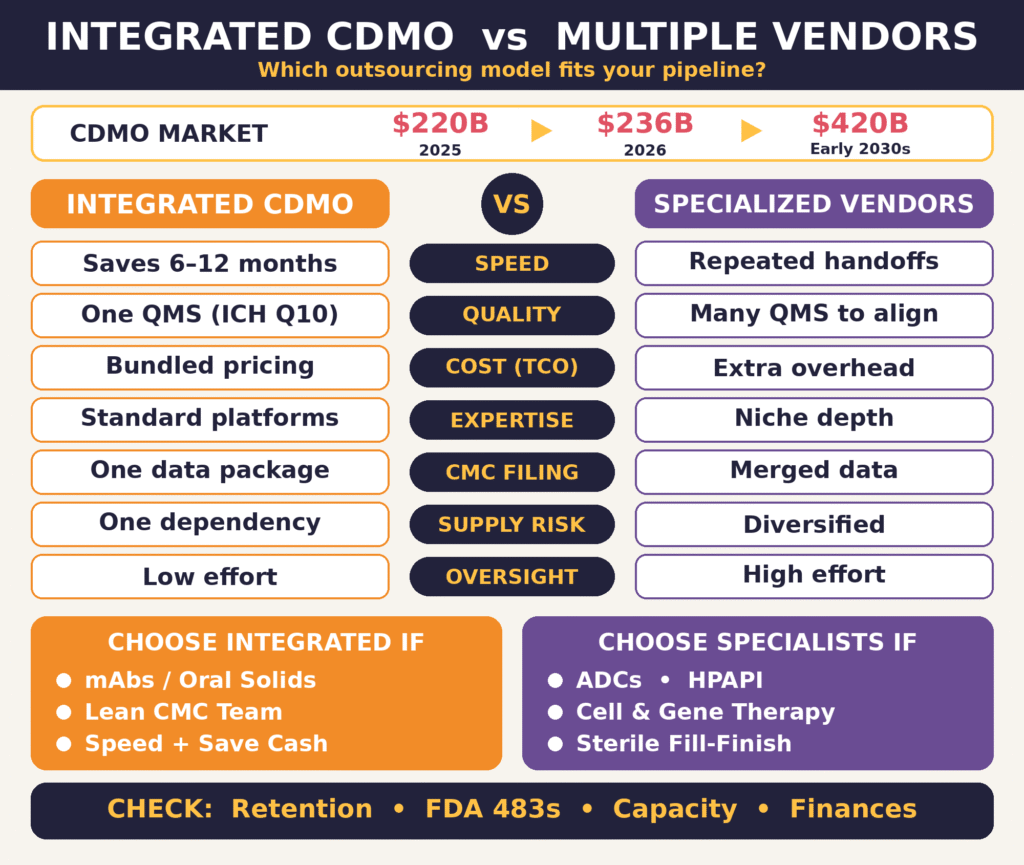
Selecting between an integrated contract development and manufacturing organization (CDMO) and multiple specialized vendors depends on whether a drug development program prioritizes accelerated timelines and centralized governance or specialized technical expertise and distributed operational risk. In the discussion of Integrated CDMO vs Multiple Vendors, biopharmaceutical executives must assess the potential 6-to-12-month reduction in development timelines offered by end-to-end partners against the niche technical capabilities available through specialized boutique facilities. The global biopharmaceutical CDMO market, valued at approximately 220 billion in 2025 and projected to grow to 236 billion in 2026, is expected to reach 420 billion by the early 2030s. This expansion highlights an industry-wide shift toward strategic outsourcing, driven by increasingly complex development pipelines, substantial capital requirements for internal infrastructure, and the growing need to accelerate time-to-market.
As drug development pipelines move beyond conventional small molecules toward complex biologics, antibody-drug conjugates (ADCs), cell and gene therapies, and viral vectors, sourcing strategies increasingly influence commercial viability and regulatory success. Biopharmaceutical leaders making Chemistry, Manufacturing, and Controls (CMC) decisions must determine whether consolidating drug substance manufacturing, drug product development, analytical development, and clinical packaging under a single partner offers greater advantages than distributing these activities among specialized providers. Making an informed strategic decision requires a thorough assessment of technology transfer requirements, Quality Management System (QMS) alignment, regulatory submission risks, Total Cost of Ownership (TCO), and long-term supply chain resilience.
For a closer look at how an integrated analytical approach can support generic drug development, explore one-stop CDMO analytical services for ANDA development.
Share via:
Quick Summary:
- The choice comes down to priorities. An integrated CDMO suits programs that value speed and one point of control. Multiple specialized vendors suit programs that need niche technical expertise and want risk spread across several partners. The CDMO market is projected to grow from about $220B in 2025 to $420B by the early 2030s.
- Integrated CDMOs speed up development. Keeping technology transfer inside one organization can save 6–12 months before first-in-human trials. A multi-vendor setup adds repeated method transfers, separate contracts and quality agreements, and waits for manufacturing slots at each vendor.
- One quality system makes compliance easier. A single QMS aligned with ICH Q8/Q9/Q10 keeps the control strategy consistent. With several vendors, separate quality systems and siloed data make it harder to find root causes and to assemble a consistent CMC (Module 3) package, which raises the risk of regulatory information requests.
- Integrated models can cost less overall. Bundled pricing, less internal coordination, fewer audits and faster timelines all lower total cost of ownership. That helps emerging biotechs stretch their cash. Unit prices from specialist vendors may look cheaper but carry hidden overhead.
- Complex modalities still need specialists. ADCs, cell and gene therapies, HPAPIs and sterile fill-finish under EU Annex 1 often require dedicated containment, custom equipment and specialized analytics that generalist CDMOs may not have.
- The decision depends on the molecule and the team. Well-established modalities like mAbs and oral solids, along with lean CMC teams, fit an integrated partner. Novel modalities and larger companies with experienced technical staff are better placed to manage a multi-vendor network.
- Due diligence matters for either model. Before choosing, check each partner’s customer retention, FDA 483s and warning letters, CAPA performance, capacity use and financial stability.
Technology Transfer and Timeline Compression: Integrated CDMO vs Multiple Vendors
Integrated CDMOs can accelerate clinical development by eliminating technology transfers between separate organizations, potentially recovering 6 to 12 months of development time between process development and Good Manufacturing Practice (GMP) manufacturing. In comparison, multi-vendor outsourcing models often involve repeated technology transfers, separate analytical method re-qualifications, and sequential Quality Technical Agreement (QTA) negotiations, all of which can extend project schedules and increase lead times.
Handoff Elimination and Schedule Acceleration in Integrated CDMO vs Multiple Vendors
Removing contractual handoffs between vendors can shorten the critical path to first-in-human clinical trials by bringing process development and GMP execution together within a single operational infrastructure. Under International Council for Harmonisation (ICH) Q10 principles, technology transfer involves moving product and process knowledge between development and manufacturing sites to support product realization. When sponsors engage multiple specialized vendors, such as one provider for active pharmaceutical ingredient (API) synthesis, another for drug product formulation, a third for sterile fill-finish, and an independent laboratory for release testing, knowledge must pass across organizational and contractual boundaries. Every transition between organizations may require:
- Independent analytical method transfers and re-qualification protocols across different laboratory environments.
- Reconciliation of distinct quality systems, deviation classifications, and investigation procedures.
- Additional project scheduling efforts due to manufacturing slot reservation periods and varying facility lead times.
- Repeated legal contract amendments, Master Services Agreements (MSAs), and QTA negotiations and approvals.
In contrast, an integrated CDMO manages technology transfers internally across its departments. Process knowledge developed during the early analytical and formulation stages can be transferred to adjacent GMP suites through shared digital platforms, coordinated quality oversight, and standardized processing equipment. Because the activities remain within the same organization, formal site-to-site transfers and certain secondary method re-validation activities may be reduced. This continuous workflow also minimizes the risk of losing “tribal knowledge,” which occurs when essential process information is not adequately captured in written documentation or communicated between separate vendors.
| Operational Parameter | Integrated CDMO Model | Multiple Specialized Vendors Model |
|---|---|---|
| Tech Transfer Lead Time | Compressed; internal knowledge transfer within a unified infrastructure. | Extended; inter-organizational transfers can add 6–12 months. |
| Contractual Governance | Single MSA and QTA framework covering the product lifecycle. | Multiple MSAs and QTAs, creating a greater legal and administrative burden. |
| Analytical Harmonization | Centralized testing and coordinated analytical method transfer. | Segmented testing that may require cross-validation between separate laboratories. |
| Facility Slot Reservation Risk | Coordinated scheduling between development and GMP production. | Greater exposure to independent vendor queues, scheduling conflicts, and backlogs. |
| Domain Technical Depth | Broad platform capabilities across established therapeutic modalities. | Deeper specialized expertise and access to customized equipment. |
Explore peptide CDMO scale-up services to understand how coordinated development and manufacturing activities can support a smoother transition from early-stage synthesis to larger-scale production.
Quality Systems, Regulatory Continuity, and ICH Compliance
Operating under a single Pharmaceutical Quality System (PQS) aligned with ICH Q10 can reduce regulatory oversight challenges by maintaining consistent process knowledge and coordinated risk management throughout the drug lifecycle. Engaging multiple specialized vendors can increase regulatory scrutiny when Quality Risk Management (QRM) practices are fragmented, batch release criteria differ, and investigation data remain isolated across separate organizations.
Quality Oversight and Control Strategy: Integrated CDMO vs Multiple Vendors
Integrated single-partner models can maintain a continuous control strategy and knowledge transfer process, from initial formulation screening through commercial validation. Achieving consistent quality throughout drug development depends on the coordinated implementation of three foundational guidelines: ICH Q8 (Pharmaceutical Development), ICH Q9 (Quality Risk Management), and ICH Q10 (Pharmaceutical Quality Systems). These frameworks emphasize incorporating quality into the manufacturing process by establishing the Quality Target Product Profile (QTPP), Critical Quality Attributes (CQAs), Critical Process Parameters (CPPs), and an appropriate overarching Control Strategy.
Within an integrated CDMO environment, the Control Strategy can be maintained throughout the product lifecycle with fewer organizational interruptions. Process characterization data generated during early formulation Design of Experiments (DOE) can directly inform the design space and in-process controls used during commercial scale-up. Approaches such as Real-Time Release Testing (RTRT) and continuous process verification may also be easier to coordinate when analytical data flow directly into a unified quality oversight system.
When multiple vendors manage separate stages of development, maintaining a consistent Control Strategy becomes more challenging. Each specialized provider operates under its own QMS, deviation classification system, and Corrective and Preventive Action (CAPA) procedures. An adjustment to the manufacturing process at the drug substance facility may change downstream physical properties during drug product manufacturing. However, identifying the root cause of the resulting variation can become more difficult because of inter-company confidentiality restrictions and competing commercial priorities.
Furthermore, when preparing Module 3 (CMC) documentation for regulatory submissions, including Investigational New Drugs (INDs) and Biologics License Applications (BLAs), sponsors working with multiple vendors must consolidate information from different documentation systems and data structures. This fragmentation can increase the likelihood of receiving Information Requests (IRs) or complete response letters from regulatory authorities when documentation, process descriptions, or risk assessments are inconsistent. A coordinated quality framework is therefore important for maintaining traceability, supporting regulatory review, and demonstrating consistent product and process understanding.
Learn how to organize essential regulatory information with this guide to CMC documentation at a CDMO for ANDA submissions.
Financial Economics: Total Cost of Ownership and Burn-Rate Dynamics
Integrated CDMOs can optimize Total Cost of Ownership (TCO) by reducing duplicated administrative activities, lowering internal program management expenses, and offering bundled pricing across multiple development stages. Although specialized vendors may provide competitive individual service rates for specific unit operations, the combined expense of managing several contracts and absorbing schedule delays can increase overall capital consumption.
Assessing the financial implications of biopharmaceutical outsourcing requires looking beyond initial quotations and considering both direct operating expenses and indirect capital costs. Important financial factors include:
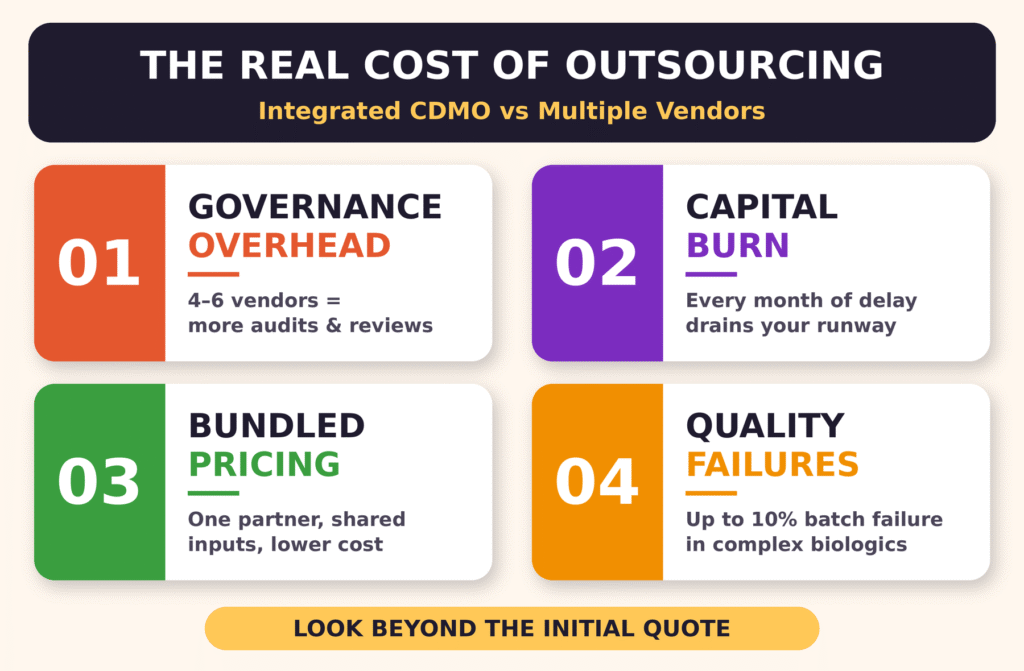
- Internal Governance Overhead: Coordinating four to six specialized vendors can require substantial internal resources across procurement, quality assurance, regulatory affairs, and supply chain management. The administrative costs associated with auditing multiple facilities, reviewing separate batch records, and resolving scope changes between vendors can increase indirect operating expenses and internal resource consumption.
- Capital Burn and Runway Management: For emerging biopharmaceutical companies raising capital while advancing clinical programs, the timing of cash flows can be just as important as total expenditure. Each month of delay caused by vendor handoffs generates ongoing internal operating expenses without necessarily advancing pipeline value. Shortening the timeline to first-in-human clinical trials by six months can substantially reduce pre-revenue capital consumption and help preserve financial runway.
- Bundled Pricing and Resource Standardization: Integrated CDMOs can use their operational scale to offer bundled pricing for process development, analytical characterization, and GMP manufacturing. Standardizing raw material inputs, platform cell lines, and commercially available consumable assemblies can help reduce procurement expenses and limit the need for repeated baseline method development activities.
- Cost of Quality Failures: Manufacturing batch failures, which may reach rates of 10% in some complex biologics manufacturing contexts, can result in substantial financial losses. Integrated quality oversight can reduce process misalignment during scale-up, helping sponsors avoid lost manufacturing campaign fees, wasted raw materials, and additional costs associated with investigations and corrective actions.
For a related perspective on outsourcing economics and geographical considerations, read United States vs. overseas peptide CDMOs.
Specialized Modalities and the Niche Vendor Imperative
Multiple specialized vendors may be better suited to novel or highly complex modalities, including antibody-drug conjugates (ADCs), cell and gene therapies, and high-potency active pharmaceutical ingredients (HPAPIs), when these products require niche technical expertise and customized infrastructure. In such advanced areas, the technical risks associated with process failure at a generalist facility may outweigh the additional coordination required to manage several specialized partners.
Selecting Sourcing Architecture for Complex Modalities: Integrated CDMO vs Multiple Vendors
Choosing a sourcing strategy for complex therapeutic modalities requires balancing the operational simplicity of a single-partner arrangement against the technical demands of specialized manufacturing capabilities. Integrated CDMOs often develop standardized platforms for conventional small molecules, monoclonal antibodies (mAbs), and relatively straightforward recombinant proteins. However, highly complex constructs and manufacturing processes may fall outside the capabilities of general-purpose platforms.
Several specialized therapeutic categories illustrate why multi-vendor sourcing strategies can remain necessary:
- Antibody-Drug Conjugates (ADCs): ADC development involves small molecule synthesis for the cytotoxic payload, mAb expression, bioconjugation chemistry, and specialized containment facilities for high-potency materials. Few CDMO facilities maintain leading capabilities across all three major technical areas. Consequently, sponsors may need to work with dedicated conjugation specialists and HPAPI providers to achieve the required technical performance and containment standards.
- Sterile Fill-Finish under EU Annex 1 Compliance: The revised EU GMP Annex 1 guidelines establish stringent expectations for Quality Risk Management, continuous environmental monitoring, and advanced barrier technologies, including Restricted Access Barrier Systems (RABS) and automated isolators. Specialized fill-finish providers operating validated, dedicated aseptic production lines may offer advantages in sterility assurance and contamination control compared with generalist facilities, depending on the specific process and site capabilities.
- Cell and Gene Therapies: Advanced therapy medicinal products (ATMPs) require specialized analytical technologies, such as droplet digital PCR (ddPCR) and next-generation sequencing (NGS), alongside regulatory experience in live-cell processing. Vendors focused on viral vector manufacturing may offer specialized production platforms capable of improving expression yields, reducing empty-to-full capsid ratios, and supporting regulatory compliance through established inspection histories.
| Modality / Process Area | Key Technical Challenges | Primary Vendor Selection Criteria |
|---|---|---|
| Antibody-Drug Conjugates (ADCs) | Cytotoxic payload safety, bioconjugation yield, and complex linker chemistry. | Established conjugation platforms and verified high-containment suites. |
| Viral Vectors (AAV, Lentivirus) | Low packaging efficiency, host cell protein removal, and scale-up instability. | High-yield cell lines and advanced characterization methods. |
| High-Potency APIs (HPAPI) | Strict occupational exposure limits (OEL < 10 ng/m³) and cross-contamination risks. | Dedicated high-containment facilities and appropriate engineering controls. |
| Aseptic Fill-Finish | EU Annex 1 compliance, particulate control, and container-closure integrity. | Advanced isolator technology and high-precision filling systems. |
For programs evaluating manufacturing partners in another major market, see peptide CDMO services in the United States.
Strategic Sourcing Comparison Matrix: Integrated CDMO vs Multiple Vendors
Choosing between an integrated CDMO and a network of specialized vendors requires assessing important operational factors in relation to internal oversight capabilities, risk tolerance, and pipeline objectives. Comparing these dimensions helps sponsors identify the sourcing model that best supports their development priorities while accounting for technical complexity, regulatory expectations, and operational dependencies.
| Strategic Evaluation Criteria | Integrated CDMO Strategy | Multiple Specialized Vendors Strategy |
|---|---|---|
| Speed to Clinical Trial (IND) | Optimal: Can eliminate transfers between separate organizations and potentially save 6–12 months. | Slower: Sequential technology transfers and independent facility lead times can introduce delays. |
| Technical Depth for Novel Modalities | Moderate: Well suited to established platforms but may lack specialized expertise in emerging fields. | Superior: Provides access to specialized experts, customized equipment, and bespoke analytical or manufacturing methods. |
| Quality Risk Management (ICH Q9) | Streamlined: A single QMS can support continuous data integration and coordinated risk assessment. | Complex: Requires reconciliation of different QMS environments, investigation procedures, and quality standards. |
| Supply Chain Resilience | Centralized: Greater dependence on one partner can increase exposure to operational or financial disruptions at that organization. | Diversified: Distributes operational dependencies across multiple independent facilities, although coordination risks remain. |
| Internal Sponsor Management Burden | Low: A single primary contact, consolidated governance, and fewer separate legal agreements can simplify oversight. | High: Requires dedicated vendor management, multi-site quality assurance audits, and additional legal coordination. |
| Regulatory Submission Complexity | Low: A unified quality framework can simplify preparation of the CMC data package. | High: Combining documentation from multiple vendors increases the risk of inconsistencies and incomplete information. |
Product complexity also influences the analytical and formulation capabilities a partner must provide. For generic drug programs, review bioequivalence study design for complex generic drug products to understand the considerations involved in selecting an appropriate development strategy.
Decision Framework for Biopharmaceutical Pipeline Execution
Selecting the most appropriate outsourcing structure requires a systematic evaluation of molecule maturity, internal technical capabilities, available capital, and critical development milestones. Biopharmaceutical executives can use the following strategic framework to determine which partner structure is most appropriate for their programs:
- Assess Molecule Complexity and Platform Fit: When a candidate uses a well-characterized modality, such as standard IgG mAbs or oral solid dosage forms, an integrated CDMO may provide established expression platforms and scalable processes that support faster development and more efficient capital utilization. However, when a molecule involves novel biology or challenging chemistry, engaging specialized vendors may help mitigate the risk of critical process failures by providing access to the required expertise and infrastructure.
- Evaluate Internal Technical Bandwidth: Emerging biotechnology companies with lean CMC and quality assurance teams may benefit from an integrated CDMO that functions as an outsourced operational infrastructure. By consolidating multiple development activities under one partner, these companies can reduce the internal resources required for coordination and oversight. In comparison, mid-sized and large biopharmaceutical companies with dedicated technical leaders and established quality teams may be better positioned to coordinate specialized multi-vendor networks.
- Execute Comprehensive Due Diligence: Sourcing teams should conduct detailed assessments of potential partners using relevant operational and quality metrics. Important areas of evaluation include:
- Examine five-year customer retention rates to assess client satisfaction, service consistency, and project continuity.
- Review regulatory compliance records, including FDA Form 483 observations, warning letters, and CAPA closure performance.
- Evaluate site capacity utilization rates to determine whether facilities have sufficient resources and are not excessively stretched across concurrent projects.
- Verify long-term financial stability and ownership structure to reduce the risk of unexpected disruptions resulting from financial distress or partner insolvency.
For teams developing peptide therapeutics, custom peptide synthesis services provide another relevant area to evaluate when comparing specialist capabilities with integrated development and manufacturing support.
Conclusion
Determining the most suitable strategy in the Integrated CDMO vs Multiple Vendors debate requires balancing development speed, regulatory continuity, internal management capacity, and therapeutic modality complexity. Integrated CDMOs offer significant advantages in accelerating clinical development, simplifying governance, and reducing administrative overhead through a unified Pharmaceutical Quality System. This single-partner model can be particularly beneficial for established biopharmaceutical modalities when reducing time-to-market and preserving capital are major priorities.
However, working with multiple specialized vendors remains important for novel or highly complex modalities that require dedicated infrastructure, advanced bioconjugation chemistry, or specialized analytical capabilities. Biopharmaceutical leaders should conduct thorough due diligence, examining operational performance, quality systems, technical expertise, and Total Cost of Ownership before deciding which sourcing model best aligns with their development strategy and pipeline objectives.
For additional guidance on planning generic drug regulatory submissions, explore stability batches required for an ANDA submission.
To discover how advanced analytical characterization, process validation, and technology transfer strategies can improve your drug development lifecycle, connect with the technical experts at the ResolveMass Laboratories Contact Page.
Frequently Asked Questions (FAQs)
Working with multiple specialized vendors can introduce scheduling conflicts, communication gaps, inconsistent quality procedures, and additional administrative responsibilities. Differences between Quality Management Systems (QMS) may complicate investigations and data reconciliation across facilities. Without effective coordination, these challenges can delay manufacturing activities and create inconsistencies in regulatory documentation.
ICH Q8, Q9, and Q10 provide important guidance on Pharmaceutical Development, Quality Risk Management (QRM), and Pharmaceutical Quality Systems (PQS), respectively. When evaluating a CDMO, sponsors should assess its ability to establish and maintain Critical Quality Attributes (CQAs), Critical Process Parameters (CPPs), and appropriate control strategies. Consistent implementation of these principles supports product quality and lifecycle management.
An integrated CDMO may reduce overall expenditure by consolidating services, limiting duplicated administrative work, and minimizing delays between development stages. However, the most economical option depends on the project’s technical requirements, pricing structure, and resource needs. For complex modalities, specialized vendors may offer better value by reducing the risk of process failures and costly manufacturing losses.
Technology transfers between separate facilities require the receiving site to understand the process, assess equipment compatibility, and establish suitable analytical and manufacturing procedures. Additional activities may include method transfer, qualification, Quality Technical Agreement negotiations, and production scheduling. Differences in equipment, documentation, or process understanding can create troubleshooting requirements that extend development timelines.
Specialized vendors are often preferable when a drug development program involves technically demanding products, including antibody-drug conjugates (ADCs), cell and gene therapies, or high-potency active pharmaceutical ingredients (HPAPIs). These applications may require dedicated containment systems, specialized analytical methods, or advanced manufacturing infrastructure. Selecting a provider with relevant experience can help address modality-specific challenges and support consistent product quality.
An integrated CDMO can simplify preparation of Module 3 Chemistry, Manufacturing, and Controls (CMC) documentation by maintaining development and manufacturing records within a coordinated quality framework. When several vendors participate, sponsors must collect and reconcile information from different systems and documentation practices. Effective data governance and document review are essential to minimize inconsistencies and respond efficiently to regulatory questions.
Biopharmaceutical companies can reduce supply chain vulnerabilities through comprehensive vendor qualification, careful assessment of raw material availability, and contingency planning for manufacturing disruptions. Maintaining appropriate safety stocks, identifying alternative suppliers for critical materials, and establishing reliable supplier relationships can improve continuity. Partner selection should also consider financial stability, geographic exposure, and the availability of backup manufacturing capacity.
CDMO due diligence should examine five-year customer retention trends, regulatory inspection records, CAPA closure performance, and on-time in-full (OTIF) delivery rates. Sponsors should also assess facility capacity utilization, manufacturing reliability, financial stability, and the provider’s experience with comparable products. Together, these indicators help evaluate operational performance, quality maturity, and the ability to support long-term development needs.
Integrated CDMO arrangements can reduce failures associated with communication gaps, inconsistent documentation, and process transfer challenges between development and manufacturing. Specialized vendors, however, may offer stronger protection against technically complex failures through dedicated equipment, focused expertise, and established procedures for specific modalities. The actual risk depends on the provider’s quality systems, process capabilities, and experience rather than the sourcing model alone.
Reference:
- U.S. Food and Drug Administration. (2012). Q8, Q9, & Q10 questions and answers—Appendix: Q&As from training sessions (Q8, Q9, & Q10 points to consider). https://www.fda.gov/regulatory-information/search-fda-guidance-documents/q8-q9-q10-questions-and-answers-appendix-qas-training-sessions-q8-q9-q10-points-consider
- International Council for Harmonisation of Technical Requirements for Pharmaceuticals for Human Use. (2011). Q8, Q9, & Q10 questions and answers (R4): Points to consider. https://database.ich.org/sites/default/files/Q8_Q9_Q10_Q%26As_R4_Points_to_Consider_0.pdf
- European Medicines Agency. (2010). ICH guideline Q8, Q9 and Q10—Questions and answers (Volume 4). https://www.ema.europa.eu/en/documents/scientific-guideline/ich-guideline-q8-q9-and-q10-questions-and-answers-volume-4_en.pdf
Get In Touch With Us
About The Author


