
Introduction
Integrating Ion Chromatography and TOC in Extractables Studies is essential for addressing the significant analytical blind spots associated with conventional Mass Spectrometry (MS) screening protocols used in container-closure and medical device evaluations. Although hyphenated chromatographic techniques, including Gas Chromatography-Mass Spectrometry (GC-MS) and Liquid Chromatography-Mass Spectrometry (LC-MS), serve as fundamental analytical tools for controlled extraction studies under USP and ISO 10993-18, their capabilities are inherently restricted by ionization requirements, volatility ranges, and chromatographic retention windows. As a result, poorly ionizing or poorly retained organic species, low-molecular-weight polar organic acids, and inorganic ionic contaminants can remain undetected, potentially affecting the completeness and reliability of the extractables profile.
Combining orthogonal analytical methodologies, particularly Ion Chromatography (IC) and Total Organic Carbon (TOC) analysis, establishes a comprehensive mass balance approach. This integrated strategy quantifies unaccounted carbon mass while detecting low-molecular-weight inorganic and polar compounds that conventional MS-based techniques may overlook. Specialized testing programs conducted at ResolveMass Laboratories Inc. employ these complementary analytical platforms to achieve more comprehensive extractable identification, meet stringent regulatory expectations, and support scientifically defensible toxicological risk assessments.
Explore comprehensive extractables and leachables testing approaches to strengthen your analytical strategy.
Share via:
Quick Summary:
- The problem: GC-MS and LC-MS are the core tools of extractables studies, but they have blind spots. GC-MS is limited by volatility and thermal stability, and LC-MS by ionization efficiency, ion suppression and retention. Some extractables can go undetected as a result.
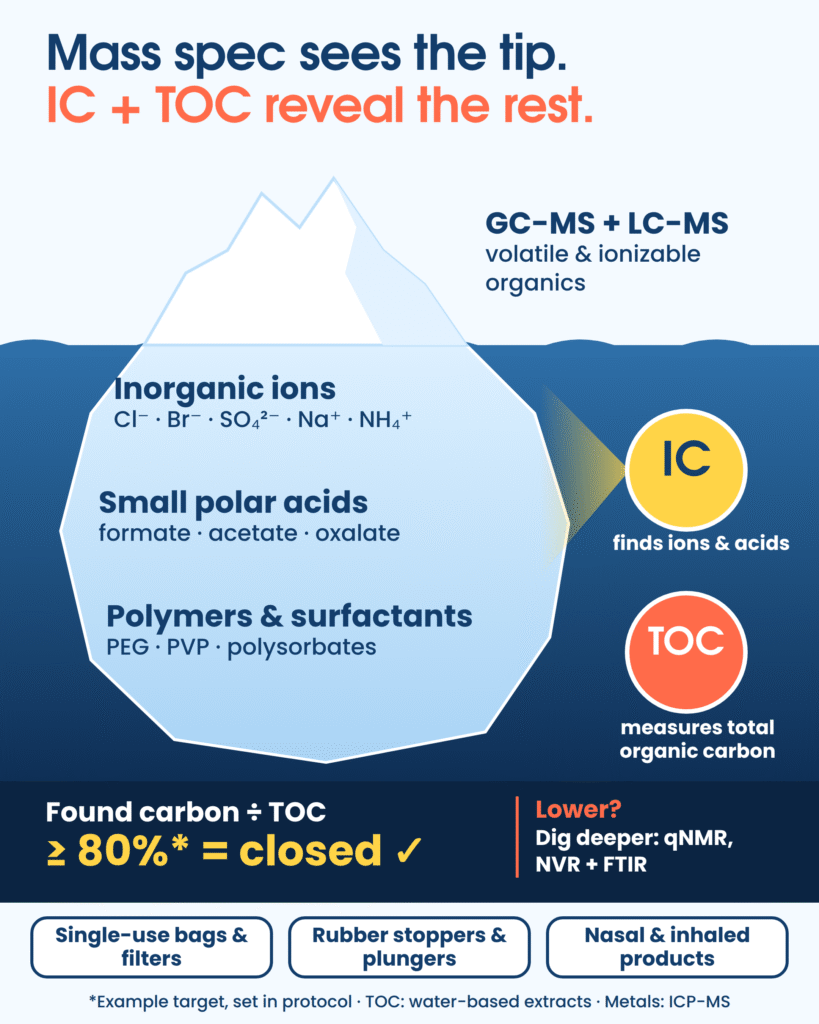
- What MS misses: Three groups often escape MS screening: inorganic ions (chloride, bromide, sulfate, sodium, ammonium), small polar organic acids (formate, acetate, oxalate), and polydisperse polymers and surfactants such as PEG, PVP and polysorbates. MS response also varies by compound, so estimating unknowns from one internal standard can be off by more than tenfold and lead to wrong conclusions against the AET.
- Ion Chromatography (IC): IC uses ion-exchange columns with suppressed conductivity detection to measure anions, cations and short-chain organic acids, typically down to the low ppb range. This matters for halobutyl and sulfur-cured elastomers and for gamma-irradiated single-use systems.
- Total Organic Carbon (TOC): TOC oxidizes organic matter to CO₂ and measures it without needing compound-specific response factors, so it gives an overall carbon figure for aqueous extracts. It has limits: volatiles can be lost during NPOC sparging, some materials oxidize incompletely, and extracts containing organic solvents can’t be tested.
- Mass balance reconciliation: The carbon in all identified compounds (from GC-MS, LC-MS and IC organic acids) is added up and divided by the measured TOC. A recovery at or above a target set in the protocol, for example 80%, suggests that characterization is essentially complete. Neither USP <1663> nor ISO 10993-18 sets a universal number.
- When recovery is low: A gap indicates an “organic carbon iceberg” of unidentified material. That calls for further work such as qNMR, or non-volatile residue (NVR) analysis with FTIR of the residue.
- Where it matters most: Single-use bioprocess bags and filters, elastomeric stoppers and plungers (with metals measured by ICP-MS), and nasal and inhaled products, which have very low thresholds. Adding IC and TOC gives regulators such as the FDA, EMA and Health Canada stronger evidence that no significant extractables were missed before the toxicological risk assessment.
The Blind Spots of Mass Spectrometry Screening in E&L Programs
Mass spectrometry screening using GC-MS and LC-MS has inherent limitations in detecting inorganic salts, low-molecular-weight polar organic acids, and compounds that ionize poorly or produce diffuse, hard-to-interpret signals. For GC-MS, the main limiting factors are volatility and thermal stability, because electron ionization (EI) ionizes nearly any compound that reaches the ion source. For LC-MS, the main limiting factors are ionization efficiency, ion suppression, and chromatographic retention. Such analytical gaps can compromise the completeness of extractables profiling unless additional orthogonal, non-MS analytical techniques are incorporated.
Controlled extraction studies designed in line with USP <1663> (Assessment of Extractables Associated with Pharmaceutical Packaging/Delivery Systems) generally depend on GC-MS for identifying volatile and semi-volatile organic compounds (VOCs/SVOCs) and LC-MS for analyzing non-volatile organic compounds (NVOCs). However, depending exclusively on MS-based screening can leave important chemical categories insufficiently characterized.
Learn more about GC-MS and LC-MS differences in E&L testing and their complementary analytical applications.
Inorganic Anions and Cations
Conventional GC-MS and LC-MS configurations are not designed to directly identify simple inorganic ions. These include anions such as fluoride (F-), chloride (Cl-), bromide (Br-), nitrate (NO3-), sulfate (SO4 2-), and phosphate (PO4 3-). They also include alkali metal cations such as sodium (Na+) and potassium (K+), alkaline earth metal cations such as magnesium (Mg2+) and calcium (Ca2+), and ammonium (NH4+). These ions lack the volatility required for gas chromatography, and only some can be analyzed by GC-MS after specialized derivatization. In LC-MS, they are poorly retained on reversed-phase columns. Their low mass-to-charge (m/z) values often fall below typical scan ranges or within high-background regions. Under standard electrospray ionization (ESI) and atmospheric pressure chemical ionization (APCI) conditions, they tend to appear as salt clusters and adducts rather than as clean, quantifiable signals.
Discover how ICP-MS supports elemental impurity analysis in E&L studies.
Low-Molecular-Weight Polar Organic Acids
Highly polar, low-molecular-weight carboxylic acids, including formic acid, acetic acid, glycolic acid, and oxalic acid, often elute close to the solvent front when analyzed using conventional reversed-phase LC (RP-HPLC) columns. Their early elution can cause signal interference and reduce analytical sensitivity. Additionally, their relatively low molecular mass (m/z less than 100) frequently places their signals within regions of elevated background noise in quadrupole and time-of-flight (TOF) mass spectrometers.
Non-Ionizing Macromolecules and Surfactants
Polymeric additives and oligomers, non-ionic surfactants such as polysorbates and poloxamers, polysorbate degradants, and hydrophilizing agents such as polyvinylpyrrolidone (PVP) and polyethylene glycol (PEG) are difficult to characterize by LC-MS. This is true even though many of them, particularly PEG and polysorbates, ionize readily in ESI as ammonium, sodium, or proton adducts. The difficulty arises because these materials are polydisperse. Their signal is divided across many oligomers, adduct types, and charge states, which lowers the response of each individual ion and complicates identification and quantification. Higher-molecular-weight fractions may fall outside the instrument’s mass range or elute poorly. Reference standards that match the actual oligomer distribution are rarely available. When these compounds co-elute with matrix components, ion suppression may further reduce detection and quantification capability.
Quantitative Response Factor Variation
Mass spectrometers generate analytical peak areas according to the ionization efficiency of individual compounds. Because different chemical substances exhibit different ionization responses, applying a single internal standard response factor to estimate the concentrations of unidentified compounds during non-targeted screening can produce substantial quantitative inaccuracies. In some cases, these errors may exceed an order of magnitude, potentially resulting in incorrect conclusions about whether an extractable concentration exceeds the Analytical Evaluation Threshold (AET).
Understand how AET determination influences extractables and leachables assessments.
Comparison of Analytical Techniques
| Analytical Technique | Target Analyte Classes | Detection Mechanism | Major Limitations | Role in Mass Balance |
|---|---|---|---|---|
| GC-MS | Volatile and semi-volatile organics (VOCs/SVOCs), antioxidants, siloxanes. | Gas chromatography coupled to Electron Ionization (EI) or Chemical Ionization (CI). | Cannot directly analyze non-volatile, thermally labile, or highly polar compounds without derivatization. | Quantifies semi-volatile organic carbon mass for TOC reconciliation; highly volatile compounds may be lost during NPOC sparging, so their contribution should be interpreted with caution. |
| LC-MS | Non-volatile organics (NVOCs), polar/semi-polar additives, UV stabilizers. | Reversed-phase liquid chromatography coupled to HRAM MS. | Does not adequately detect inorganic ions; poorly suited to polydisperse polymers and surfactants; susceptible to matrix ion suppression and solvent-front co-elution. | Quantifies ionizable non-volatile organic carbon mass. |
| Ion Chromatography (IC) | Inorganic anions, cations, and low-molecular-weight organic acids. | Ion-exchange separation with suppressed conductivity detection. | Primarily applicable to charged or ionizable species in polar or aqueous matrices. | Accounts for ionic species and organic acid contributions. |
| Total Organic Carbon (TOC) | Organic carbon-bearing migrants. | High-temperature catalytic combustion or UV-persulfate oxidation to CO2. | Non-specific technique that does not provide molecular structures or compound identities. | Provides an empirical measurement of total organic carbon. |
| ICP-MS | Elemental impurities, heavy metals, and trace metals (Pb, As, Cd, Hg, and other elements). | Inductively coupled plasma ionization with mass spectrometry detection. | Does not provide structural information about organic ligands or anion speciation. | Provides elemental mass accountability. |
Leveraging Ion Chromatography and TOC in Extractables Studies for Inorganic and Polar Species
Incorporating Ion Chromatography and TOC in Extractables Studies significantly expands analytical coverage by enabling the detection and quantification of non-chromatophoric inorganic ions, counterions, and low-molecular-weight organic acids that may escape conventional mass spectrometry screening. This complementary analytical approach combines broad-spectrum carbon measurement with accurate ionic speciation across different extraction media.
The integrated analytical workflow follows a series of systematic stages to establish comprehensive chemical coverage:
1. Controlled Extraction Generation
Materials undergo controlled extraction using polar (aqueous), semi-polar, and non-polar solvents under exaggerated or exhaustive temperature and exposure-duration conditions, in line with USP <1663> and ISO 10993-18 recommendations.
Explore the selection of solvents for extractables studies to support appropriate extraction conditions.
2. Parallel Analytical Screening
- Volatile and semi-volatile organic compounds are evaluated using GC-MS.
- Non-volatile ionizable organic compounds are screened using high-resolution LC-MS/MS.
- Inorganic anions, cations, and low-molecular-weight carboxylic acids are separated and quantified through Suppressed Conductivity Ion Chromatography.
3. Total Carbon Quantification
Aqueous extracts (water or aqueous buffers without organic co-solvent) are analyzed using a Total Organic Carbon (TOC) analyzer to establish the absolute empirical concentration of organic carbon present in each extract. Extracts prepared in organic or water-miscible organic solvents, such as ethanol/water or isopropanol/water mixtures, are not suitable for TOC analysis because the carbon contributed by the solvent overwhelms the carbon contributed by extractables.
4. Carbon Mass Conversion and Reconciliation
The carbon mass contributions calculated from the compounds identified through GC-MS, LC-MS, and IC are combined and compared with the experimentally determined TOC baseline.
5. Secondary Scouting (If Reconciliation Is Less Than 85%)
When a substantial carbon mass deficit remains after the initial analytical assessment, for example a recovery below a protocol-defined criterion such as 80%, additional non-targeted techniques are introduced. These may include quantitative Nuclear Magnetic Resonance (qNMR), or Non-Volatile Residue (NVR) gravimetric analysis combined with FTIR analysis of the residue. Together, these quantify and characterize polymeric material that conventional chromatographic techniques have not adequately detected.
Ion Chromatography for Anionic and Cationic Extractable Profiling
Ion chromatography provides quantitative analysis of trace inorganic species, including halides, sulfates, nitrates, and alkali metals, as well as organic carboxylates. It achieves this through ion-exchange stationary phases combined with suppressed conductivity detection. Pharmaceutical packaging materials, elastomeric closures, glass vials, single-use bioprocessing bags, and resin additives can release inorganic contaminants into aqueous contact media during extraction.
Inorganic anions, particularly chloride and bromide from halogenated (chlorobutyl and bromobutyl) elastomers, sulfate from sulfur-based cure systems, and residues from polymerization catalysts, may influence drug product pH, promote active pharmaceutical ingredient (API) degradation, or contribute to protein aggregation. Ion Chromatography separates these anions using quaternary ammonium anion-exchange columns with hydroxide or carbonate eluents. Electrolytic suppressors minimize background conductivity from the eluent, allowing detection limits in the low microgram-per-liter (ppb) range. Sub-ppb levels are achievable using large-volume injection or preconcentration.
Additionally, short-chain organic acids such as formate and acetate, along with other low-molecular-weight carboxylic acids, may form during gamma irradiation or thermal oxidative degradation of polyolefins and other polymers used in bioprocess bags and cell-culture filters. These compounds generally exhibit weak UV absorbance and inconsistent MS ionization behavior, making conventional analytical detection challenging. Ion Chromatography provides effective separation of these organic acids and enables reliable quantification. This is important for comparing their levels against the Analytical Evaluation Threshold (AET) and for the toxicological risk assessment.
Counterions, including ammonium (NH4+), sodium (Na+), potassium (K+), magnesium (Mg2+), and calcium (Ca2+), can also be accurately separated using weak-acid cation-exchange columns functionalized with carboxylic acid groups, some of which also contain phosphonic acid groups. These columns are typically operated with methanesulfonic acid (MSA) eluents, which allow monovalent and divalent cations to be separated and quantified in a single run.
Total Organic Carbon (TOC) as an Orthogonal Non-Specific Screen
Total Organic Carbon (TOC) analysis determines the overall quantity of organic carbon present in aqueous extracts. It provides a quantitative measurement that does not depend on the chromophoric properties or ionization efficiency of individual analytes. It is not entirely independent of analyte properties, however. In the commonly used non-purgeable organic carbon (NPOC) mode, the sample is acidified and sparged to remove inorganic carbon, which can also remove volatile organic compounds. Some compounds may also be incompletely oxidized, depending on the oxidation technique. Even so, TOC serves as an important complementary screening technique when evaluating compounds that may not respond adequately to conventional chromatographic detection methods.
TOC instruments generally operate through high-temperature catalytic combustion (typically about 680 degrees C to 950 degrees C or higher, depending on the instrument) or UV-persulfate oxidation. During these processes, organic molecules present in the extract are oxidized into carbon dioxide (CO2). The resulting CO2 is measured using a non-dispersive infrared (NDIR) detector or, in some UV-persulfate instruments, a membrane-based conductometric detector.
Because the detector response is proportional to the quantity of carbon converted to CO2, TOC analysis does not require compound-specific response factors, provided that oxidation is complete. This allows the technique to capture a broad range of organic migrants present in aqueous extractions. These may include non-chromatophoric aliphatic polymers and oligomers, degradation products originating from synthetic rubbers and adhesives, residual manufacturing detergents, and soluble cellulosic materials. Recovery can be incomplete for compounds that resist oxidation or are present as droplets or particles, such as silicone oil emulsions, particularly with UV-persulfate oxidation. Oxidation efficiency for such materials should therefore be verified.
Closing the Mass Balance: TOC Reconciliation Mechanics
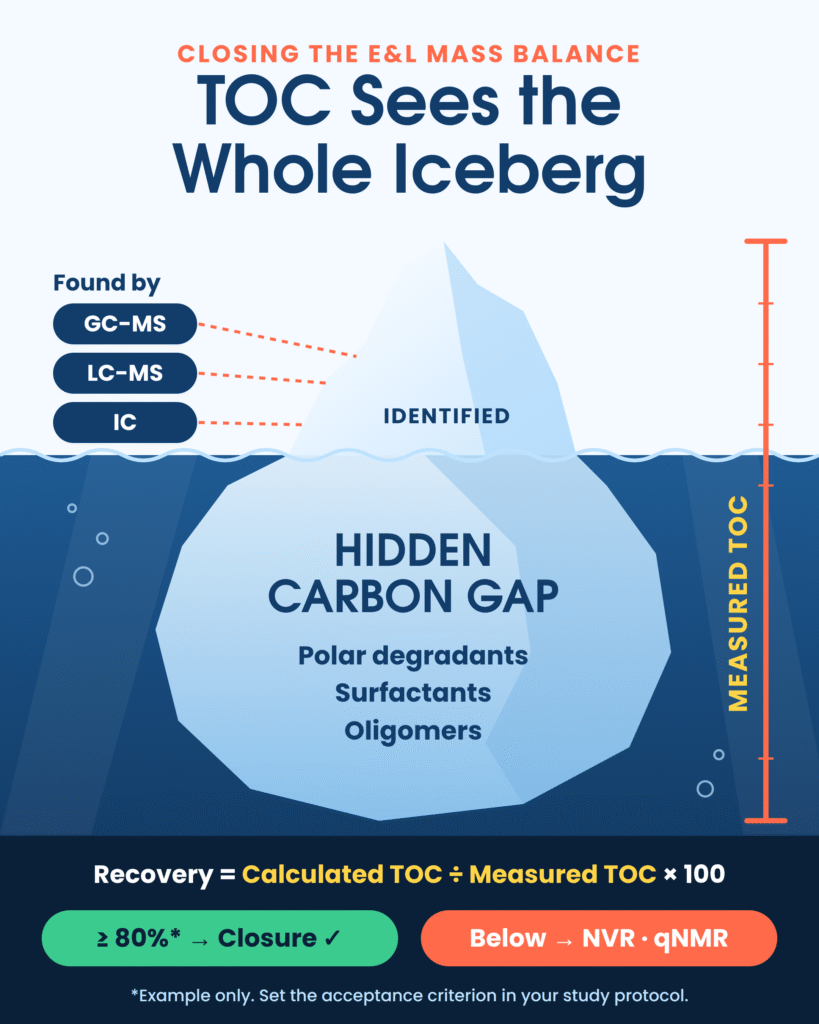
TOC reconciliation is an essential approach for evaluating the completeness of extractables characterization. It involves comparing the calculated carbon mass of all identified organic compounds with the experimentally measured organic carbon concentration in the extract solution. A high carbon recovery percentage indicates that the analytical workflow has accounted for most of the organic material present, reducing the likelihood that potentially hazardous organic migrants remain undetected during toxicological evaluation.
One of the primary challenges in extractables profiling is demonstrating that the analytical workflow has not overlooked potentially hazardous organic migrants because of differences in analytical selectivity. TOC reconciliation addresses this challenge by establishing an empirical carbon mass balance between identified compounds and the total organic carbon measured in the extraction medium.
The Mathematical Framework for Carbon Reconciliation
When a controlled extraction study is conducted using an aqueous solvent, the individual organic extractables identified and quantified through GC-MS, LC-MS, and IC must be converted into their corresponding organic carbon concentrations. From the IC results, only organic acids are included, because inorganic ions such as chloride and sulfate contain no organic carbon.
TOC calculated = SUM (i = 1 to N) [Ci x (nC,i x 12.011 / MWi)]
Where:
- Ci represents the measured mass concentration of an individual identified organic compound i (micrograms/mL or mg/L).
- nC,i represents the stoichiometric number of carbon atoms present in the chemical formula of compound i.
- 12.011 represents the atomic weight of carbon (g/mol).
- MWi represents the molecular weight of the identified compound i (g/mol).
- N represents the total number of organic compounds identified and quantified across all chromatographic analytical techniques.
Interpreting Mass Balance Percent Recovery
The extent of analytical completeness is assessed by calculating the percentage recovery (R TOC) of the calculated carbon mass relative to the experimentally measured carbon mass (TOC measured).
The percentage recovery is calculated using the following equation:
R TOC = (TOC calculated / TOC measured) x 100%
Neither USP <1663> nor ISO 10993-18 specifies a universal acceptance criterion for TOC reconciliation, so the criterion should be predefined in the study protocol. A high recovery, for example 80% or greater, generally indicates that analytical closure has been achieved. Values somewhat above 100% can also occur because of quantitation uncertainty in the screening methods. Such a result indicates that the combined chromatographic screening methods, including GC-MS, LC-MS, and IC, have accounted for the majority of organic extractables present in the test sample. This reconciliation provides regulatory authorities with greater confidence that unidentified organic toxicants are unlikely to represent a substantial uncharacterized portion of the extractables profile.
In contrast, when R TOC falls below the predefined acceptance criterion, the results suggest that the analytical profile may be incomplete, indicating the presence of what can be described as an “organic carbon iceberg.” In this situation, a considerable difference exists between the experimentally measured organic carbon concentration and the carbon mass accounted for through conventional analytical screening.
This discrepancy may indicate the presence of organic compounds that have not been adequately separated, detected, or quantified. Potential contributors include highly polar degradation products, non-volatile surfactants, and dissolved oligomers that chromatograph poorly. Such substances may exhibit poor chromatographic recovery, diffuse or weak ionization, or insufficient analytical response under standard MS conditions.
When TOC recovery falls below established acceptance or validation thresholds, additional analytical investigations become necessary. These may involve Non-Volatile Residue (NVR) gravimetric analysis, quantitative Nuclear Magnetic Resonance (qNMR), or specialized Ion Chromatography methods. These supplementary techniques help investigate unidentified organic material and account for the carbon mass that remains uncharacterized after the initial screening process.
Review method validation considerations for leachables testing to support reliable analytical results.
Strategic Implementation of Ion Chromatography and TOC in Extractables Studies for USP and ISO 10993-18 Workflows
Integrating Ion Chromatography and TOC in Extractables Studies supports alignment with USP and ISO 10993-18 expectations by providing additional evidence of characterization completeness before toxicological risk assessments are performed. This combined analytical methodology strengthens extractables evaluation and helps ensure that regulatory submissions contain comprehensive and appropriately reconciled safety profiles for container-closure systems, medical devices, and biomanufacturing equipment.
Regulatory authorities, including the FDA, EMA, and Health Canada, expect manufacturers to demonstrate that container-closure systems (CCS), drug delivery devices, and biomanufacturing single-use systems (SUS) do not release harmful substances into pharmaceutical products. Such evaluations require reliable identification and characterization of potential leachables originating from product-contact materials.
Depending exclusively on conventional LC-MS and GC-MS analytical data may leave important gaps in the overall characterization process. In particular, unresolved mass balance discrepancies can raise concerns about whether all relevant extractables have been identified and appropriately evaluated. Incorporating IC and TOC provides additional analytical evidence to address these limitations and improve the scientific reliability of regulatory submissions.
Understand the importance of toxicological qualification of leachables when assessing patient safety.
Risk-Based Analytical Application Across Matrix Types
Biopharmaceutical Single-Use Systems (SUS): Polymeric film bags and tubing used in biopharmaceutical manufacturing commonly contain antioxidants and thermal stabilizers, while sterile filter membranes such as polyethersulfone (PES) frequently contain hydrophilic wetting agents such as PVP. Gamma sterilization of these polymeric materials can generate low-molecular-weight organic radiolysis products. Ion Chromatography and TOC analysis help monitor filter flush efficiency and identify the accumulation of organic acids and other carbon-containing compounds that may otherwise remain undetected through conventional LC-MS screening.
Elastomeric Plungers and Container Closures: These components are manufactured using rubber formulations that may contain sulfur or peroxide curatives, zinc oxide activators, and inorganic fillers. During extraction with aqueous solvents, such materials can release ionic extractables, including zinc, sulfate, chloride or bromide (from halobutyl rubbers), and ammonium. Ion Chromatography enables direct quantification of the anions and ammonium, while zinc and other metals are measured by ICP-MS or ICP-OES. Sulfide, if relevant, requires a dedicated IC method with amperometric detection rather than suppressed conductivity.
Combination Devices and Orally Inhaled and Nasal Drug Products (OINDP): These products, particularly OINDP, typically require very low Analytical Evaluation Thresholds (AET). This is because the drug is delivered directly to sensitive respiratory tissue and because the established safety thresholds for these products are low, for example the PQRI safety concern threshold of 0.15 µg/day. For aqueous formulations such as nasal sprays and nebulizer solutions, integrating TOC analysis into the extractables workflow can reveal a carbon gap that points to non-volatile organic migrants not fully characterized by mass spectrometry screening. TOC does not identify these compounds, but it signals when further investigation is needed. For non-aqueous products such as pressurized metered-dose inhalers, TOC has limited applicability. This additional analytical assessment reduces the likelihood of overlooking relevant compounds before toxicological risk assessments are conducted and helps prevent critical omissions in product safety documentation.
Addressing complex mass balance challenges requires advanced analytical instrumentation, appropriately developed methodologies, and rigorous method validation. ResolveMass Laboratories Inc. develops controlled extraction studies that combine high-temperature TOC oxidation and suppressed conductivity Ion Chromatography with high-resolution accurate-mass (HRAM) LC-MS/MS platforms. This integrated testing approach supports comprehensive extractables characterization and generates scientifically robust analytical data packages that can facilitate regulatory review and approval processes.
Explore GMP-compliant extractables and leachables studies for pharmaceutical product-contact materials.
Conclusion: Achieving Comprehensive E&L Qualification
Implementing Ion Chromatography and TOC in Extractables Studies provides an important analytical solution for addressing the detection limitations associated with conventional mass spectrometry screening during pharmaceutical packaging and medical device evaluations. Although mass spectrometry remains a fundamental component of Extractables and Leachables (E&L) characterization, it cannot independently provide complete analytical coverage because of its limitations in detecting inorganic ions, low-molecular-weight polar organic acids, and poorly ionizing or polydisperse polymeric additives.
Combining high-resolution GC-MS and LC-MS platforms with Ion Chromatography for ionic speciation and Total Organic Carbon analysis for absolute carbon mass balance creates a more comprehensive analytical framework. This integrated strategy helps analytical scientists identify compounds that may otherwise remain outside the detection capabilities of conventional MS-based methods.
Furthermore, performing systematic TOC reconciliation provides an empirical assessment of extractables characterization completeness by comparing the carbon mass accounted for through individual analytical techniques against the total organic carbon measured experimentally. This process helps identify unexplained carbon deficits and determine whether additional analytical investigations are necessary to characterize potentially overlooked organic migrants.
Ultimately, partnering with specialized analytical testing facilities such as ResolveMass Laboratories Inc. enables manufacturers to implement comprehensive E&L testing strategies for container-closure systems, medical devices, and biomanufacturing components. By combining complementary analytical techniques with rigorous testing methodologies, manufacturers can strengthen product safety evaluations, improve extractables characterization, and support compliance with stringent global regulatory and quality requirements.
Contact Information
To understand how advanced E&L analytical strategies can support the qualification of your pharmaceutical packaging, biomanufacturing components, or medical devices, contact our experienced analytical team to discuss your testing requirements.
ResolveMass Laboratories Inc. – Contact Us
Frequently Asked Questions (FAQs)
Ion Chromatography separates analytes according to their ionic charge using specialized ion-exchange stationary phases rather than hydrophobic interactions. When combined with suppressed conductivity detection, it reduces background eluent conductivity and improves analytical sensitivity. This allows accurate measurement of inorganic ions and small organic acids, such as chloride, sulfate, formate, and acetate, even at trace part-per-billion (ppb) concentrations.
TOC reconciliation is a mass balance approach used to evaluate whether the organic compounds identified during extractables testing account for the total organic carbon present in an extract. It involves converting the concentrations of identified organic compounds from GC-MS, LC-MS, and IC into their corresponding carbon contributions. The calculated carbon concentration is then compared with the experimentally measured TOC value to determine the percentage of carbon recovery.
A TOC mass balance recovery (RTOC) below approximately 80–85% may indicate that the extractables profile is incomplete and that some organic carbon remains unaccounted for. Such discrepancies require additional investigation to identify potentially overlooked compounds. Analytical approaches such as Non-Volatile Residue (NVR) testing, quantitative Nuclear Magnetic Resonance (qNMR), and specialized chromatographic scouting can help characterize the unidentified material.
Inorganic extractables, including chloride, fluoride, and sulfate, can interfere with drug formulation properties by changing pH, promoting precipitation, or contributing to active pharmaceutical ingredient (API) degradation. Certain ionic contaminants may also accelerate chemical instability or affect sensitive biological products, including monoclonal antibodies. Depending on their concentration and toxicological characteristics, these substances may introduce patient safety concerns, making accurate identification and quantification essential.
TOC is a non-specific analytical technique that measures the overall organic carbon concentration in a sample without identifying individual compounds or determining their sources. Consequently, it cannot independently distinguish packaging-related extractables from cleaning agent residues or solvent impurities. To establish the identity and potential origin of these substances, TOC results must be evaluated alongside compound-specific analytical data obtained through GC-MS, LC-MS, and IC.
Suppressed conductivity detection is particularly suitable for E&L testing because many inorganic ions, including fluoride, chloride, sulfate, and ammonium, do not possess chromophores and therefore cannot be reliably detected using conventional UV methods. The suppressor reduces the electrical conductivity contributed by the eluent while improving the relative conductivity response of the analytes. This enhances detection sensitivity and supports the quantification of ionic extractables at very low concentrations, including ppb levels.
Matrix suppression occurs when co-eluting substances, such as surfactants and other non-target compounds, interfere with analyte ionization during LC-MS electrospray ionization (ESI). This interference can decrease analytical signals and result in underestimated extractable concentrations. Ion Chromatography uses conductivity-based detection rather than ESI, avoiding this particular ion suppression mechanism, while TOC measures total organic carbon through oxidation, providing an independent quantitative assessment of the organic material present.
IC and TOC are particularly important when evaluating polymeric Single-Use Systems (SUS), including storage bags, tubing, and sterilizing filters exposed to gamma irradiation or aggressive aqueous buffers. Gamma sterilization can generate polar organic degradation products, including organic acids, while polymer formulations may release hydrophilizing agents such as PVP and PEG. Since some of these substances exhibit poor chromatographic retention or limited ionization efficiency in conventional LC-MS, incorporating IC and TOC improves the overall completeness of extractables characterization.
Regulatory authorities, including the FDA and EMA, expect extractables studies to provide scientifically justified evidence of comprehensive chemical characterization and appropriate toxicological evaluation. Reports relying exclusively on targeted or semi-quantitative MS screening may leave important analytical gaps, particularly when unidentified organic material has not been adequately investigated. Incorporating complementary techniques such as TOC and NVR, where appropriate, helps demonstrate analytical completeness, address mass balance discrepancies, and strengthen the scientific justification of patient safety assessments.
Reference:
- Jenke, D., Couch, T. R., Robinson, S. J., Volz, T. J., & Colton, R. H. (2014). The use of TOC reconciliation as a means of establishing the degree to which chromatographic screening of plastic material extracts for organic extractables is complete. PDA Journal of Pharmaceutical Science and Technology, 68(3), 256–270. https://doi.org/10.5731/pdajpst.2014.00977
- Vas, G., Fleck, L., Comstock, K., & Cole, J. (2020). Extractable and leachable testing for pharmaceutical packaging, finished pharmaceutical products, and medical devices: An analytical perspective. Current Trends in Mass Spectrometry, 18(3), 5–14. https://www.spectroscopyonline.com/view/extractable-and-leachable-testing-for-pharmaceutical-packaging-finished-pharmaceutical-products-1
- U.S. Food and Drug Administration. (2024, September 20). Chemical analysis for biocompatibility assessment of medical devices: Draft guidance for industry and Food and Drug Administration staff. U.S. Department of Health and Human Services. https://www.fda.gov/media/181952/download
- Menzel, R., Hauk, A., Pahl, I., Maier, T. V., & Gebeyew, K. (2022, March 31). Extractables of PES membrane filters: Identification, lessons learned and rinsing recommendation [Conference presentation]. Uventia 2nd Annual Extractables & Leachables for Pharma Summit. https://doi.org/10.13140/RG.2.2.34255.76969
- Yu, X., Zdravkovic, S., Wood, D., Li, C., Cheng, Y., & Ding, X. (2009). A new approach to threshold evaluation and quantitation of unknown extractables and leachables using HPLC/CAD. Drug Delivery Technology, 9(3), 50–55. https://www.drug-dev.com/
- Menzel, R., Pahl, I., Loewe, T., & Hauk, A. (2018). Comparative extractables study of autoclavable polyethersulfone filter cartridges for sterile filtration. PDA Journal of Pharmaceutical Science and Technology, 72(3), 298–316. https://doi.org/10.5731/pdajpst.2017.008367
Get In Touch With Us
About The Author